Tipping in Hawaii: How Much to Tip and When

Tipping in Hawaii works the way it does across the United States, with a few island twists that catch visitors off guard. The standard rates are familiar, 18 to 20 percent at restaurants, a few dollars for hotel staff, 15 to 20 percent for taxis, but Hawaii adds its own wrinkles: a state service-charge law, automatic gratuities for larger groups, and tip prompts at every counter. This guide gives you the exact amounts for every situation, explains the law, and shows you how to tip with confidence from the moment you land.
This is the single complete guide to tipping in Hawaii. It covers restaurant, bar, hotel, taxi, tour, and spa tipping, Hawaii’s service charge law, automatic gratuities, tip jars, and practical money tips. If you have been searching for anything about tipping in Hawaii, the answers are all here on this one page.
The Short Answer: Tip Like the Mainland, With Aloha
Hawaii follows standard American tipping customs. Workers in the service industry depend on tips here even more than on the mainland, because Hawaii’s cost of living is among the highest in the nation while wages have not kept pace. A generous, correct tip is both good manners and genuine kokua, care for the people who make your vacation work. The baseline to memorize: 20 percent at sit-down restaurants, a few dollars a day for housekeeping, a dollar or two per bag for bellhops, and 15 to 20 percent for taxis. Everything else is detail, and this guide has all of it.
Restaurants: 18 to 20 Percent
At full-service restaurants, tip 18 to 20 percent of the pre-tax bill, with 20 percent the comfortable standard for good service. Hawaii’s restaurant prices run higher than the mainland, so the tip math adds up fast; on a $150 dinner for two, 20 percent is $30. Tip on the pre-tax amount, not the total with Hawaii’s general excise tax added. For exceptional service, going above 20 percent is appreciated and remembered. For poor service, dropping to 15 percent sends the message without stiffing the server, whose base pay assumes tips.
At buffets, including the breakfast buffet at your hotel, tip 10 percent or a few dollars per person, since you are serving yourself but someone is clearing plates and refilling coffee. At fast-casual spots where you order at the counter and food is brought to your table, a few dollars in the tip jar or 10 percent is a nice gesture. Food trucks: tipping is not expected, but rounding up or adding a dollar is common and welcome. Delivery to your hotel room follows restaurant rates, 15 to 20 percent, and check whether a delivery fee is already on the bill; a fee is not a tip.
Bars: A Dollar or Two Per Drink
At bars, the rule is simple: $1 to $2 per drink, or 15 to 20 percent if you are running a tab. Beer and wine get a dollar; cocktails, which take real work from the bartender, get two dollars or 20 percent. If you are ordering a round for the table, tip on the whole round. Bartenders in Waikiki and the resort areas remember generous tippers, and on a busy night that memory translates into faster service. As with restaurants, tip on the pre-tax amount.
Hotels: Housekeeping, Bellhops, and Valet
Hotel tipping has three parts. Housekeeping: $3 to $5 per day, left daily in an envelope or with a note marked for housekeeping, because the staff rotates and a lump sum at checkout may not reach the people who cleaned your room. Bellhops: $1 to $2 per bag when they bring your luggage up, more if they give you a helpful orientation. Valet: $2 to $5 when your car is returned, at the higher end at luxury resorts or in bad weather. Tip the valet on return, not on drop-off, since a different person usually brings the car back.

Concierges who score you a hard reservation or fix a real problem deserve $5 to $20 depending on the effort. The front desk does not expect tips for normal check-in. And if your resort charges a daily resort fee, remember that the fee goes to the hotel, not the staff; it does not replace tipping the people who serve you.
Taxis and Rideshares: 15 to 20 Percent
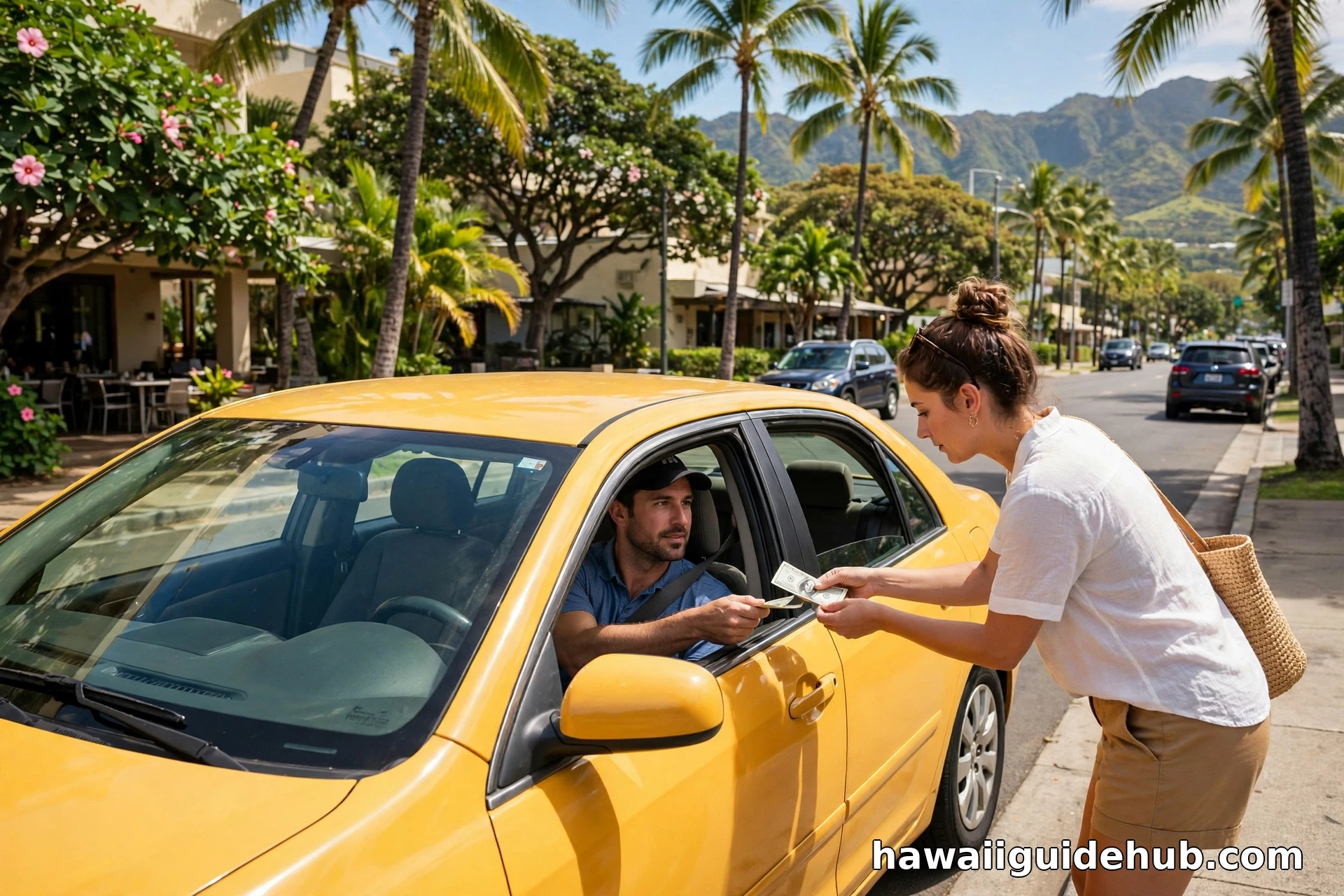
Taxi drivers get 15 to 20 percent of the fare, with a $2 minimum even on short rides. Add a dollar or two per bag if the driver handles your luggage. For rideshares like Uber and Lyft, the same 15 to 20 percent applies, added in the app after the ride. Airport shuttle drivers who help with bags get $1 to $2 per bag, or a few dollars per person. If a driver gives you a genuinely useful island orientation on the way from the airport, tipping toward 20 percent is the local way of saying mahalo.
Tours and Activities: Tip Your Guides
Guides and crews run on tips. For boat tours, snorkeling trips, and whale watching, $10 to $20 per person is standard for the crew, more for a full-day charter. Land tour guides, Road to Hana drivers, volcano tours, get $10 to $20 per person for a full day, $5 to $10 for a half day. Surf instructors: $10 to $20 per lesson. Luaus: tipping is not expected since service is built into the ticket price, but a few dollars for exceptional table service is a kind gesture. If a tour already includes a service charge, check the fine print before adding more.
Spas and Salons: 15 to 20 Percent
Resort spas are a Hawaii highlight, and the tipping standard is 15 to 20 percent of the treatment price. Many resort spas add the service charge automatically; check your bill before adding more. If the charge is labeled a service charge rather than a gratuity, Hawaii law requires the spa to tell you how it is distributed, which brings us to the law every visitor should know.
Hawaii’s Service Charge Law: What You Must Know
Here is where Hawaii differs from the mainland. Under Hawaii law, section 481B-14, any service charge a business adds to your bill must either go to the employees as tip income or be clearly disclosed to you as something else. A restaurant cannot quietly pocket a service charge while letting you believe it is the staff’s tip. The Hawaii Supreme Court reinforced the disclosure requirement in a 2025 ruling, so businesses are now extra careful, and you should be extra watchful.
What this means for you: when you see a service charge on the bill, ask or read the fine print. If it says the charge is distributed to employees, that is your tip and you do not need to add more unless you want to. If it says the charge is not a gratuity, or goes to the house, then tip your server separately. Also know that automatic gratuities for large parties, typically parties of six or more, are still legal in Hawaii; a bill to ban them failed in the legislature, so check every group dinner bill for an auto-gratuity before adding your own.
Tip Jars and Counter Service: Optional
You will see tip prompts everywhere in Hawaii: coffee shops, shave ice stands, food trucks, even self-checkout screens. Take a breath. Tipping at a counter where you order, pay, and carry your own food is entirely optional. Nobody expects it, and nobody judges you for pressing zero. If the service was genuinely friendly or your order was complicated, a dollar is a nice touch. Save your real tipping budget for the sit-down meals, hotel staff, and guides who actually depend on it.
Tipping on a Budget: Small Bills and Daily Math
A week in Hawaii involves dozens of small tips, so preparation matters. Break large bills at the hotel front desk or a bank early in the trip and keep a stash of ones and fives in your day pack. ATM fees add up if you are constantly withdrawing. Budget roughly $20 to $30 per day for tips for two travelers having a normal mix of meals and activities; fine dining days run higher. Put the housekeeping tip out each morning rather than saving it for checkout. And when in doubt, round up: generosity is the norm here, and a little extra aloha in the tip is never wrong.
What Visitors Get Wrong
A few mistakes come up again and again. The biggest is double-tipping on a service charge: adding 20 percent on top of an 18 percent auto-gratuity you did not notice. Always scan the bill first. The second is stiffing housekeeping because the room was not serviced daily; many Hawaii hotels now clean every few days by default, so tip on the days service happens. The third is tipping on the tax. Hawaii’s general excise tax is over 4.5 percent, and tipping on the tax-included total quietly overpays every meal. Calculate the tip on the subtotal. And the fourth is forgetting cash entirely: card tips work at restaurants, but housekeeping, bellhops, valets, and shuttle drivers all need bills.
Tipping for Luaus and Special Dinners
Luaus deserve a special note because they confuse everyone. The ticket price, often well over $100 per person, includes dinner, show, and service, so no tip is expected. But the servers working your table through a three-hour evening of refills and courses appreciate recognition; $5 to $10 per couple, handed directly or left at the table, is a gracious move. For special-occasion dinners, anniversaries, proposals, the sunset table you booked months ahead, consider 20 to 25 percent. Our guide to late-night eats in Hawaii covers where to keep the evening going afterward. The staff who make those nights seamless work incredibly hard, and Hawaii’s celebration dinners are exactly where generosity feels right.
Video: A Local on Hawaii Tipping Culture
A Hawaii local’s honest take on tipping culture in the islands, from counter-service tip prompts to restaurant etiquette.
Frequently Asked Questions
Do I tip at food trucks in Hawaii?
It is not expected, but it is common and welcome. Rounding up or adding a dollar is the norm. If the truck has a tip jar and the food was great, a couple of dollars is generous.
Is a service charge the same as a tip?
Not necessarily. Under Hawaii law, a service charge must go to employees or be disclosed as something else. Read the bill: if the charge is distributed to staff, it is your tip. If not, tip separately.
Should I tip housekeeping every day or at checkout?
Every day. Staff rotates, so a daily $3 to $5 tip left in a marked envelope reaches the person who actually cleaned your room. A lump sum at checkout often does not.
What if the service was bad?
Drop to 15 percent at a restaurant rather than leaving nothing; the message lands without punishing someone who may be having a bad day through no fault of their own. If something was truly wrong, speak to a manager, which helps more than a missing tip.
Do I tip in US dollars?
Yes. Hawaii uses the US dollar, and tips are in dollars. International visitors should get small bills early in the trip, since breaking large bills for tips gets tedious.
Do I tip the hotel concierge?
For routine questions, no. But if the concierge secures a hard-to-get reservation, fixes a travel problem, or arranges something special, $5 to $20 reflects the effort.
Is tipping expected on tours I booked online?
Yes. The booking price pays the company; the tip pays your guide and crew. Bring cash for the standard $10 to $20 per person, since boats and trailheads rarely take cards for tips.
Do I tip at a luau?
It is not expected, since service is built into the ticket price. A few dollars for exceptional table service is a kind gesture but never required.
Tipping in Hawaii is straightforward once you know the numbers: 20 percent at restaurants, a few dollars for hotel staff, 15 to 20 for taxis and guides, and a careful eye on every service charge. Keep small bills handy, tip housekeeping daily, and remember that behind every tip is someone working hard in one of the most expensive states in the country. A little generosity goes a long way in the islands.