How Hawaii’s Valleys Formed: Water, Time & Amphitheater Valleys

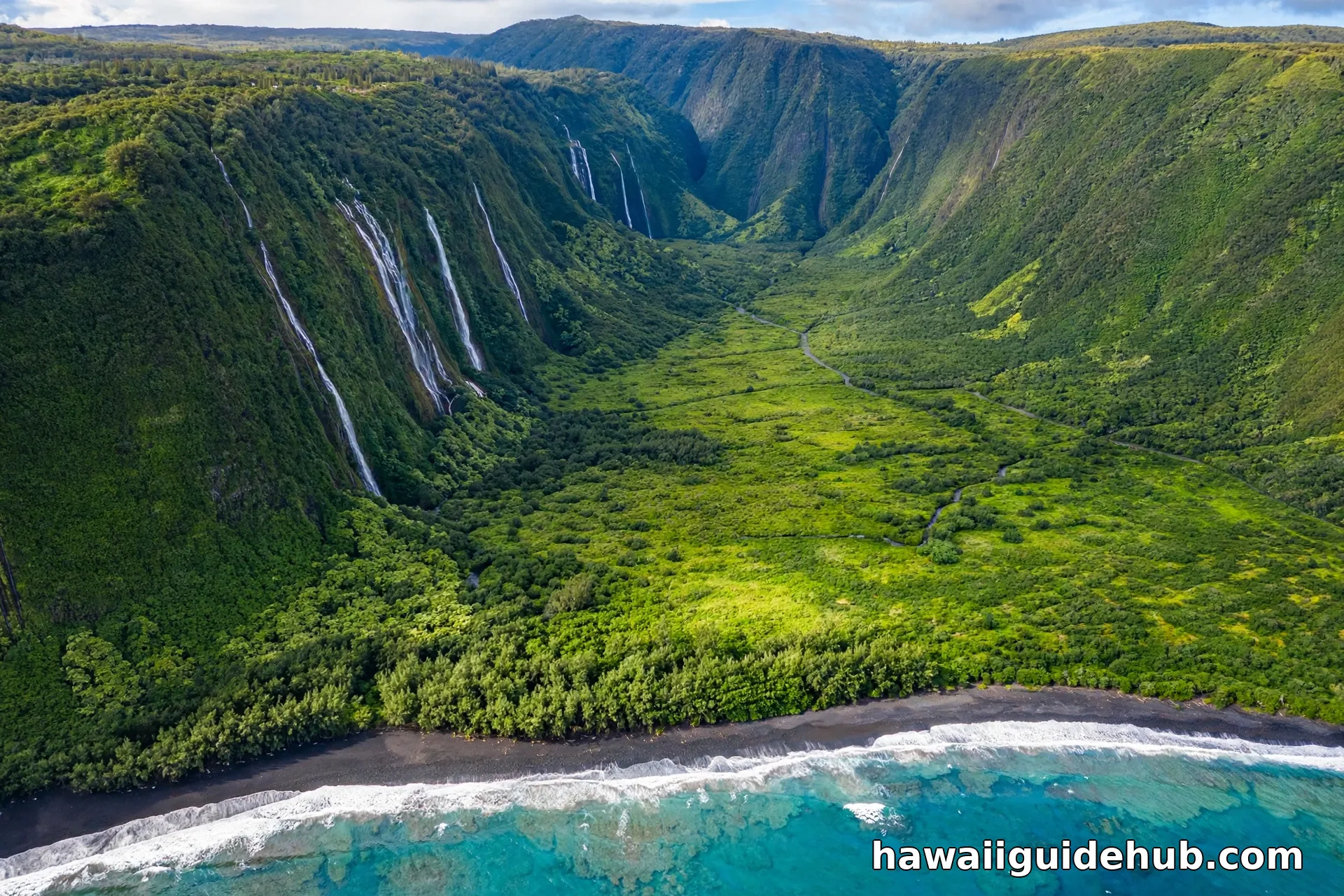
Hawaii’s valleys look carved by giants: mile-wide amphitheaters with 2,000-foot walls, waterfalls threading every fold, black-sand beaches at their mouths. They were carved by something smaller and more patient: water, working from inside the rock outward. The story involves underground dams of solidified magma, collapsing walls, and streams that steal each other’s water. This guide explains how Hawaii’s valleys formed and where to see the finest examples.
This is the single complete guide to how Hawaii’s valleys formed. It covers the groundwater-and-erosion formation process, the Waipio and Waimanu story, amphitheater headwalls, Iao Valley, Oahu’s valleys, a valley anatomy decoder, the best valleys to visit, and FAQs. Everything about Hawaii’s valley formation lives on this one page.
The Hidden Engine: Water Trapped Inside the Mountain
The surprising hero of valley formation is groundwater, and the surprising villain is the dike. When magma forces up through cracks and cools underground, it forms dikes: dense, nearly impermeable walls of rock. Per the USGS Volcano Watch on the Big Island’s great valleys, these dike complexes act as underground dams, trapping rainwater that seeps into the porous lava and impounding it high inside the mountain. In Kohala, the dike complex guides enormous volumes of groundwater toward the Waipio/Waimanu and Honokane/Pololu drainages. All that water has to escape somewhere, and where it emerges, it undermines the valley walls, which collapse in landslides, widening the valley far faster than stream erosion alone could.
This is why the biggest valleys sit where the dikes point the water: the process is plumbing as much as erosion. Valleys starved of groundwater stay shallow; valleys fed by dike reservoirs become amphitheaters. The whole Waipio/Waimanu system developed over roughly the last 100,000 to 200,000 years, per Bishop Museum geology materials: a blink in geological time, which tells you how aggressive the process is.
Valley Anatomy Decoder
Every great Hawaiian valley has the same parts, arranged the same way. Learn the anatomy once and you can read any valley:
| Part | What it is | Classic example |
| Amphitheater headwall | Curved 2,000-ft wall where groundwater sapping collapses the rock | Back of Waipio Valley |
| Hanging tributaries | Side streams pouring off walls they cannot cut as fast | Hiilawe Falls, 1,450 ft |
| Valley floor flats | Alluvium terraces; taro land for centuries | Waimanu, Kalalau floors |
| Sea-cliff mouth | Where the ocean truncated the valley’s seaward end | Pololu, Waipio black-sand beaches |
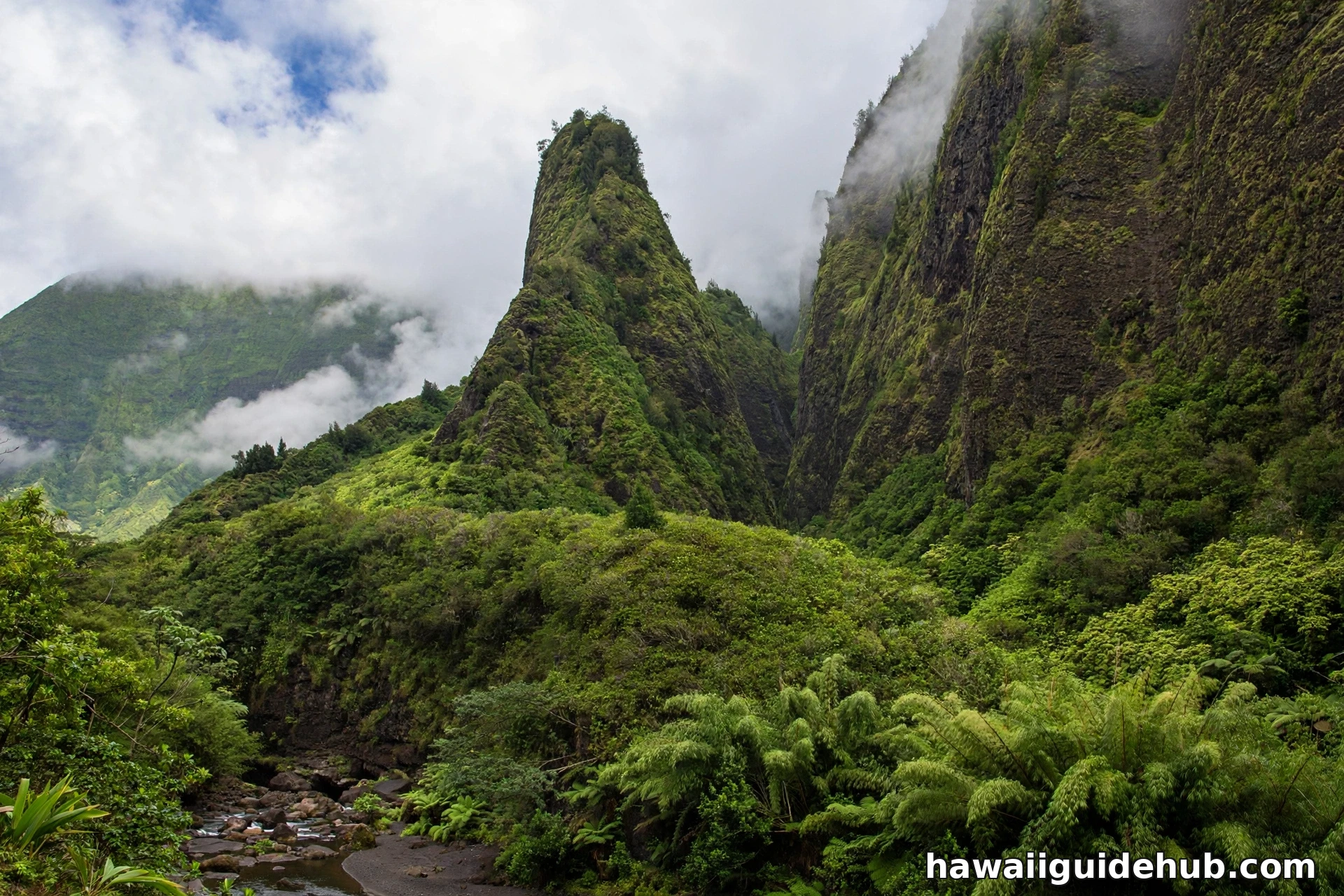
| Dike-ridge spines | Erosion-resistant intrusions standing as sharp ridges | Iao Needle, 1,200 ft |
Waipio and Waimanu: The Type Specimens
On the Big Island’s Kohala coast, Waipio and Waimanu are the textbook amphitheater valleys: mile-wide, 2,000-foot walls curving in a great arc, Hiilawe Falls pouring off the back wall, black sand at the mouth. Their development ran in stages, reconstructed by geologist Harold Stearns: streams cutting canyons along fault scarps, tapping the dike-confined groundwater, capturing neighboring streams, and finally being partly drowned as the island subsided. Waipio’s floor still holds taro farms and a small community, reachable by the famously steep Waipio Valley Road, one of America’s steepest, or on foot. The valley is sacred and inhabited: visit with respect, stay on public paths, and never trespass on taro land.
Iao Valley: The Needle and the Battle
West Maui’s Iao Valley is the most accessible great valley: a state park, paved paths, and the Iao Needle, a 1,200-foot vegetated lava remnant rising from the valley floor, an erosion-resistant spine left standing as the softer rock washed away. The valley head at Puu Kukui receives about 386 inches of rain a year, among the wettest spots in the state, and all of it drains through Iao Stream. History soaks the place: in 1790 the Battle of Kepaniwai, “the damming of the waters,” was fought here as Kamehameha unified the islands, and the valley was an alii burial ground. Designated a National Natural Landmark in 1972, it pairs geology and culture in a single short walk.
Oahu’s Valleys: Manoa, Waimea, and the Koolau Wall
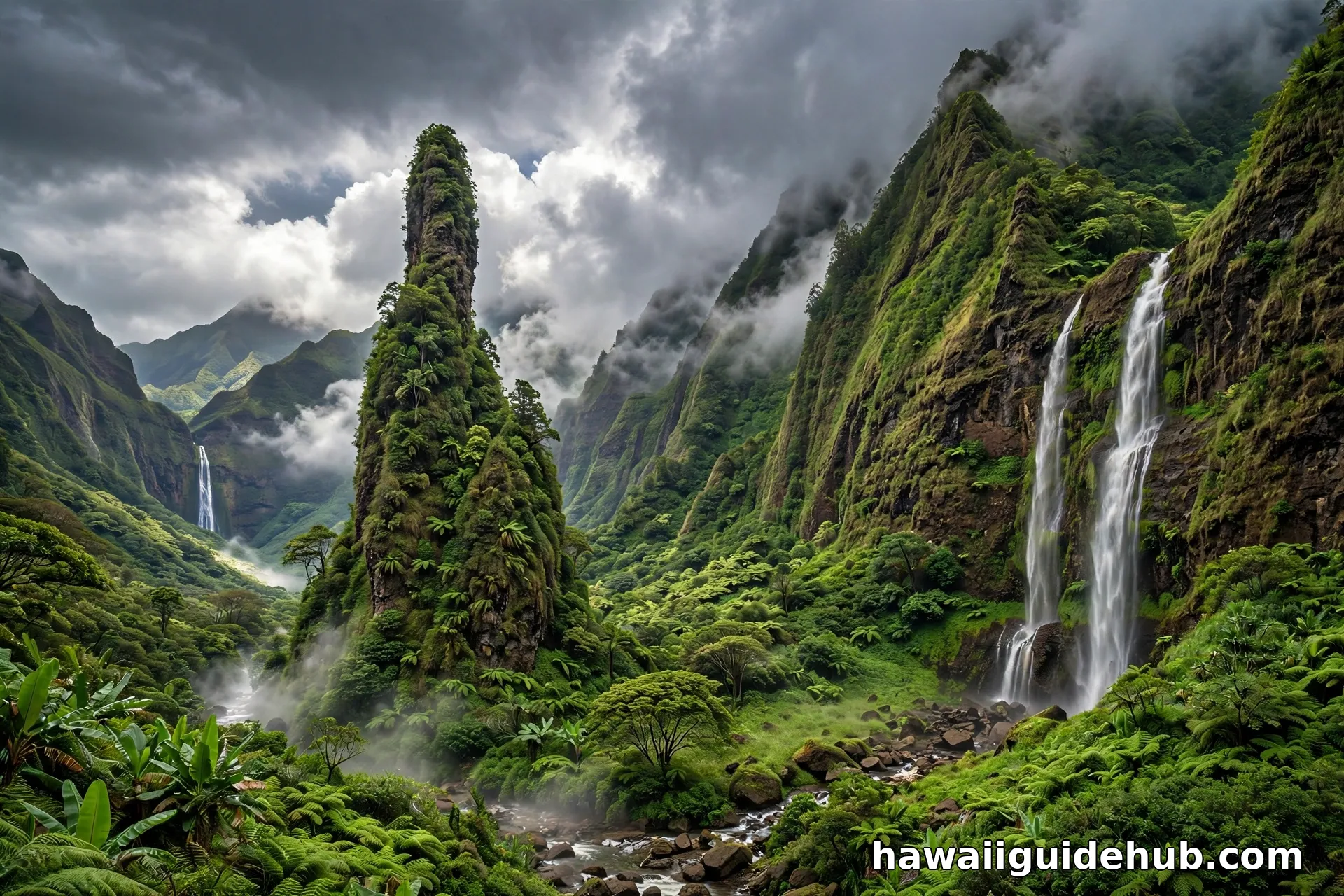
Oahu’s valleys are carved into two eroded volcanoes. Manoa Valley, behind Honolulu, is the island’s archetypal windward valley: daily rain, the 150-foot Manoa Falls at its head, and the rain that makes the valley also makes its rainbows. See our Manoa Falls guide for the hike. Waimea Valley on the north shore was carved from the Waianae volcano’s flank and doubles as a cultural landscape: botanical gardens, archaeological sites, and a swimmable waterfall. The Koolau’s windward wall is one continuous series of amphitheater valleys, each with its waterfall, visible from every windward highway pullout. Drive the Pali Highway on a rainy day and you can watch a dozen of them running at once: the island’s valley factory in full production.
Kauai: Where Valleys Become Canyons
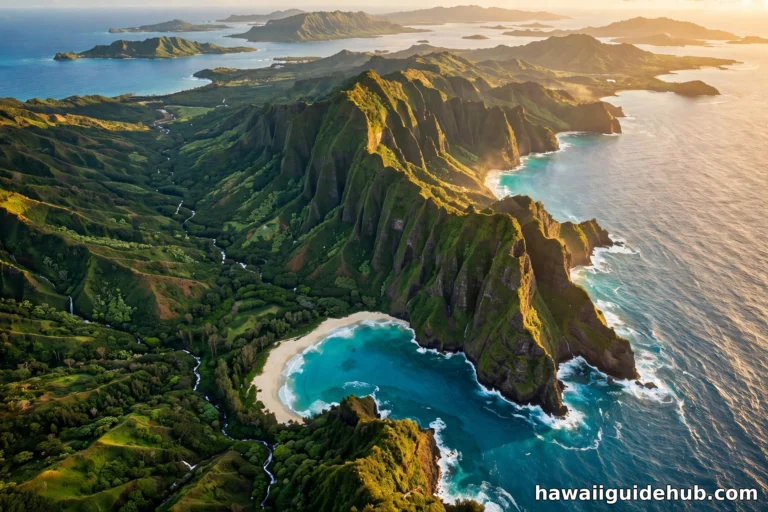
On Kauai, five million years of the same process turned valleys into the island’s defining features: Waimea Canyon is a valley system that grew into a canyon, and the Na Pali valleys, Kalalau, Honopu, Milolii, are amphitheater valleys whose seaward ends were truncated by the ocean into the great sea cliffs. Kauai shows the end state of valley evolution: given enough time, valleys widen, merge, and their walls become the cliffs. For the island’s full picture, see our Kauai guide.
Hiilawe Falls: The Tallest Ribbon
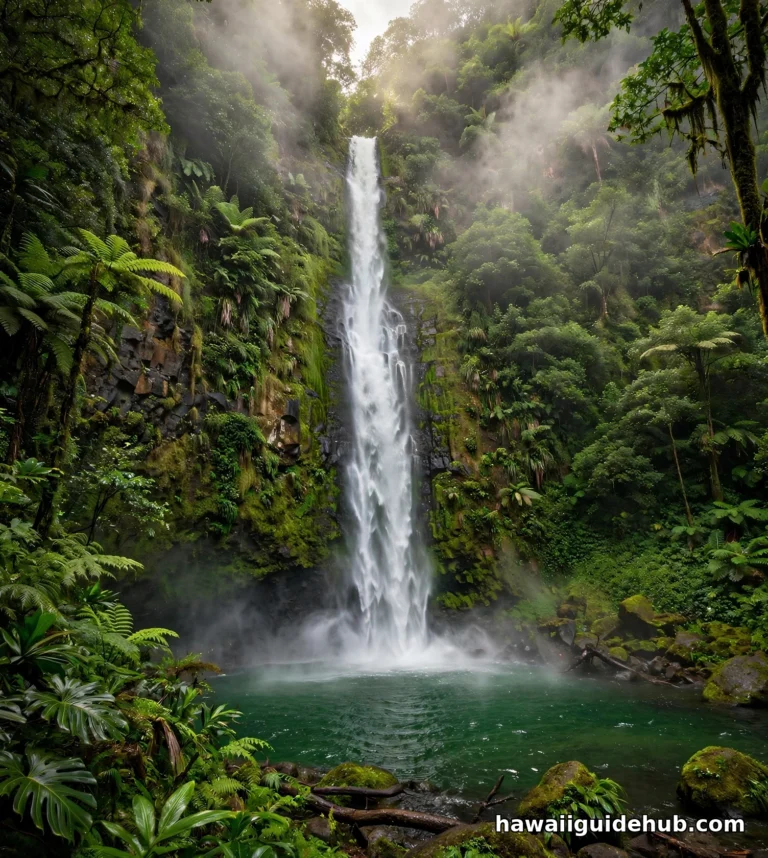
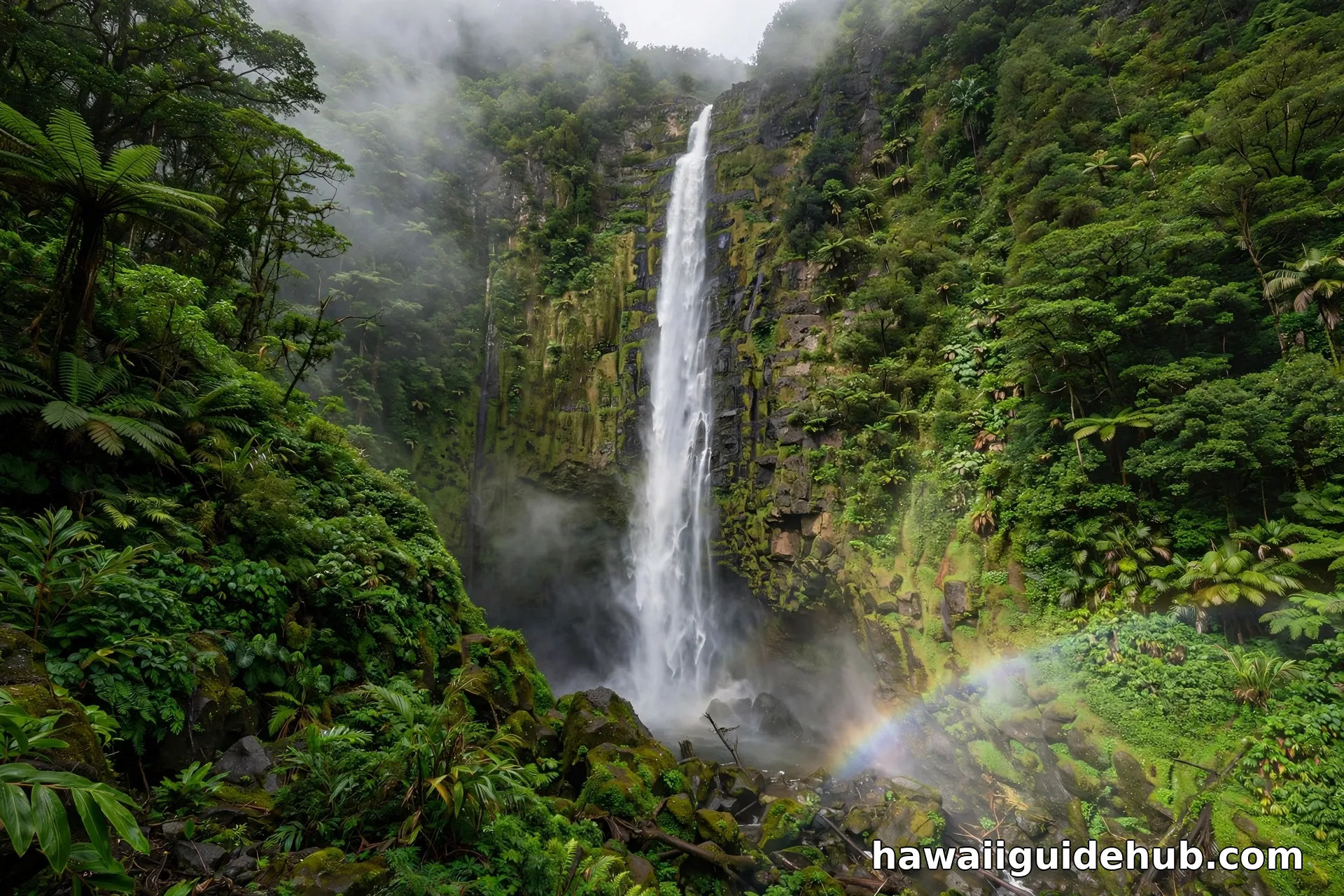
No valley story is complete without its waterfall. Hiilawe Falls, pouring 1,450 feet off Waipio’s back wall, is among the tallest waterfalls in Hawaii and the classic hanging-valley fall: a stream that could not cut as fast as the valley deepened, left pouring off the rim. After heavy rain it runs as a single great ribbon visible from the overlook; in dry spells it thins to threads. The falls are on private land and best admired from the Waipio overlook, which is part of their mystique: Hawaii’s tallest valley waterfall, forever just out of reach, doing exactly what hanging valleys do.
The Best Valleys to Visit
Waipio Valley overlook for the classic view without the descent; the road down is restricted and the hike is brutal. Iao Valley State Park for the easiest great-valley experience: paved, short, profound. Waimea Valley on Oahu for culture plus a waterfall swim. Manoa Falls trail for a rainforest valley walk behind the city. Kalalau via the Na Pali boat tour or the trail for the wildest. Go after rain for the waterfalls, but never enter valleys during flash-flood warnings: the same water that carved them can kill in them. And bring the valley anatomy decoder with you: once you can spot the headwall, the hanging falls, and the old taro flats, every valley in Hawaii starts telling you its own formation story.
Stream Piracy: How Valleys Steal Each Other’s Water
Valleys do not just erode; they compete. When one stream cuts headward faster than its neighbor, usually because it tapped a richer groundwater source, it can breach the divide and capture the neighbor’s headwaters: stream piracy. Stearns’ reconstruction of Waipio shows exactly this: Waipio Stream captured the ancestral Kawainui stream, suddenly doubling its water and its erosive power, which accelerated the valley’s growth. Piracy explains why some valleys are disproportionately huge for their current streams: they are running on stolen water. The drainage map of Kohala is a crime scene of such thefts, with underfit streams, too small for their valleys, marking the victims.
The Drowned Valleys: What Subsidence Hid
Stage four of the Waipio story is submergence: the island sank more than 1,200 feet, drowning the sea cliffs and the lower canyons, and alluvium filled the valley floors. This is why Waipio’s floor is flat farmland rather than a V-shaped gorge: you are walking on sediment that buried the drowned valley. Offshore, the drowned continuations of these valleys extend underwater, mapped by sonar as submarine canyons. Hawaii’s valleys do not end at the beach; they continue beneath the waves, carved when sea levels were lower and the island stood higher.
Valleys as Breadbaskets: The Ahupuaa Connection
The geology made the valleys farmable, and Hawaiians organized around them. The flat alluvial floors, the reliable streams, and the sheltered microclimates made valleys the agricultural heart of the islands: taro terraces (loi) lined Waipio, Waimanu, Kalalau, and Iao, fed by irrigation systems (auwai) that diverted stream water with elegant engineering. The ahupuaa land division typically centered on a valley, running from the mountain forest, which supplied timber and birds, through the farmed flats, to the fishing grounds at the valley mouth. Valley formation created the template; Hawaiian civilization filled it in.
Mars on Hawaii: Why Scientists Study These Valleys
Hawaii’s amphitheater-headed valleys are studied as analogs for valleys on Mars. Researchers comparing Kauai’s valleys to Martian valley networks have debated whether the Martian features were carved by surface runoff or by groundwater sapping, the same process debate that Hawaiian geologists worked through. The Hawaiian valleys, where the answer is known from fieldwork, calibrate the interpretation of the Martian ones. When you stand in Waipio, you are standing in a landscape that helps scientists read another planet: the plumbing of a Hawaiian volcano as a Rosetta Stone for Mars.
Watch: The Geology of Waimea Valley
Hawaii Valley Formation FAQs
How did Waipio Valley form?
Stream erosion plus groundwater sapping: dike complexes inside Kohala trapped huge volumes of groundwater and routed it to the Waipio drainage, where emerging water collapsed the valley walls into a mile-wide amphitheater over the last 100,000 to 200,000 years, per USGS and Bishop Museum research.
What is an amphitheater-headed valley?
A valley with a curved, cliff-walled head, shaped like an amphitheater, formed when groundwater seeping from the walls undermines and collapses the rock. Hawaii’s great valleys, Waipio, Waimanu, Kalalau, are textbook examples, and similar features have been studied as analogs for valleys on Mars.
What is the Iao Needle?
A 1,200-foot vegetated lava remnant in Maui’s Iao Valley: a spine of erosion-resistant rock left standing as the surrounding valley eroded away. It is a sacred site associated with the Hawaiian god Kanaloa and the centerpiece of Iao Valley State Monument.
Can you go down into Waipio Valley?
Access is restricted and the road is one of the steepest in America; the valley floor is inhabited and partly private taro land. Most visitors take in the overlook view. If you descend, go with respect: stay on public routes, do not enter taro fields, and keep noise down in the residential areas.
Why are Hawaiian valleys so green?
The same water that carved them feeds them: windward valleys catch enormous rainfall, the amphitheater walls trap mist, and springs seep at rock-layer boundaries. The result is rainforest stacked floor to rim, some of the lushest terrain in the Pacific.
Are the valleys dangerous?
Flash floods are the real hazard: valley streams can rise from trickle to torrent in minutes during mountain rain. Never cross or camp in valley streams during rain, heed all warnings, and check the forecast for the mountains, not just the coast.
Carved From the Inside Out
Hawaii’s valleys are the island’s plumbing made visible: rain trapped inside the mountain by walls of ancient magma, escaping where it can, collapsing walls and carving amphitheaters on its way to the sea. It took a hundred thousand years to carve Waipio and five million to turn Kauai’s valleys into canyons, and the process never stopped. Walk Iao Valley’s paved loop, stand at the Waipio overlook at golden hour, or hike to Manoa Falls after rain, and you are watching geology that is still, right now, carving. Somewhere inside Kohala, groundwater is pressing against a dike, a wall is weakening grain by grain, and the next collapse is quietly being scheduled. The valleys are not finished. They are just between collapses, and the water always wins in the end. Bring rain gear, bring respect for the people who still farm these floors, and bring time: valleys always reward the patient and unhurried visitor.