Time Difference Between California and Hawaii (2 or 3 Hours?)

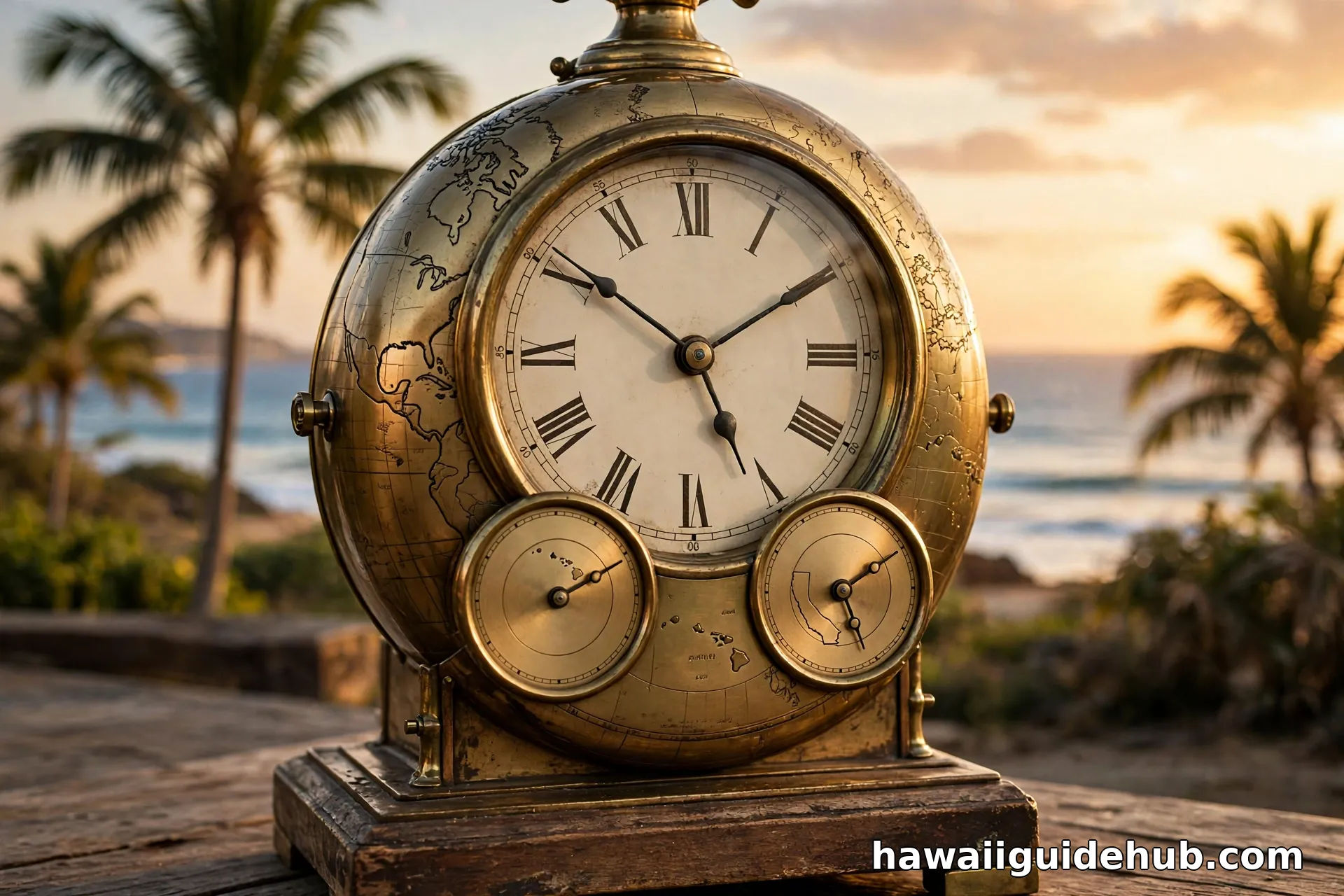
How many hours behind California is Hawaii? The answer is 2 or 3, and the reason trips up nearly everyone: Hawaii does not observe daylight saving time, while California does. From the second Sunday in March to the first Sunday in November, when California is on daylight time, Hawaii is 3 hours behind. The rest of the year, when California falls back to standard time, Hawaii is 2 hours behind. That is the whole puzzle, and this guide unpacks every practical consequence: calling home, flight math, meeting scheduling, and jet lag.
The Short Answer
Hawaii runs on Hawaii Standard Time (HST), UTC-10, all year: no spring forward, no fall back. California runs on Pacific Time, which is UTC-8 in winter (PST) and UTC-7 in summer (PDT). Subtract: in winter, Hawaii is 2 hours behind California; in summer, 3 hours behind. So when it is noon in Los Angeles in July, it is 9 AM in Honolulu. When it is noon in Los Angeles in January, it is 10 AM in Honolulu. Hawaii is always behind: never ahead, never the same.
The Two-Season Cheat Sheet
| Period | California is on | Hawaii is… | Noon in LA = ? in Honolulu |
| 2nd Sun Mar to 1st Sun Nov | Daylight Time (PDT, UTC-7) | 3 hours behind | 9:00 AM |
| 1st Sun Nov to 2nd Sun Mar | Standard Time (PST, UTC-8) | 2 hours behind | 10:00 AM |
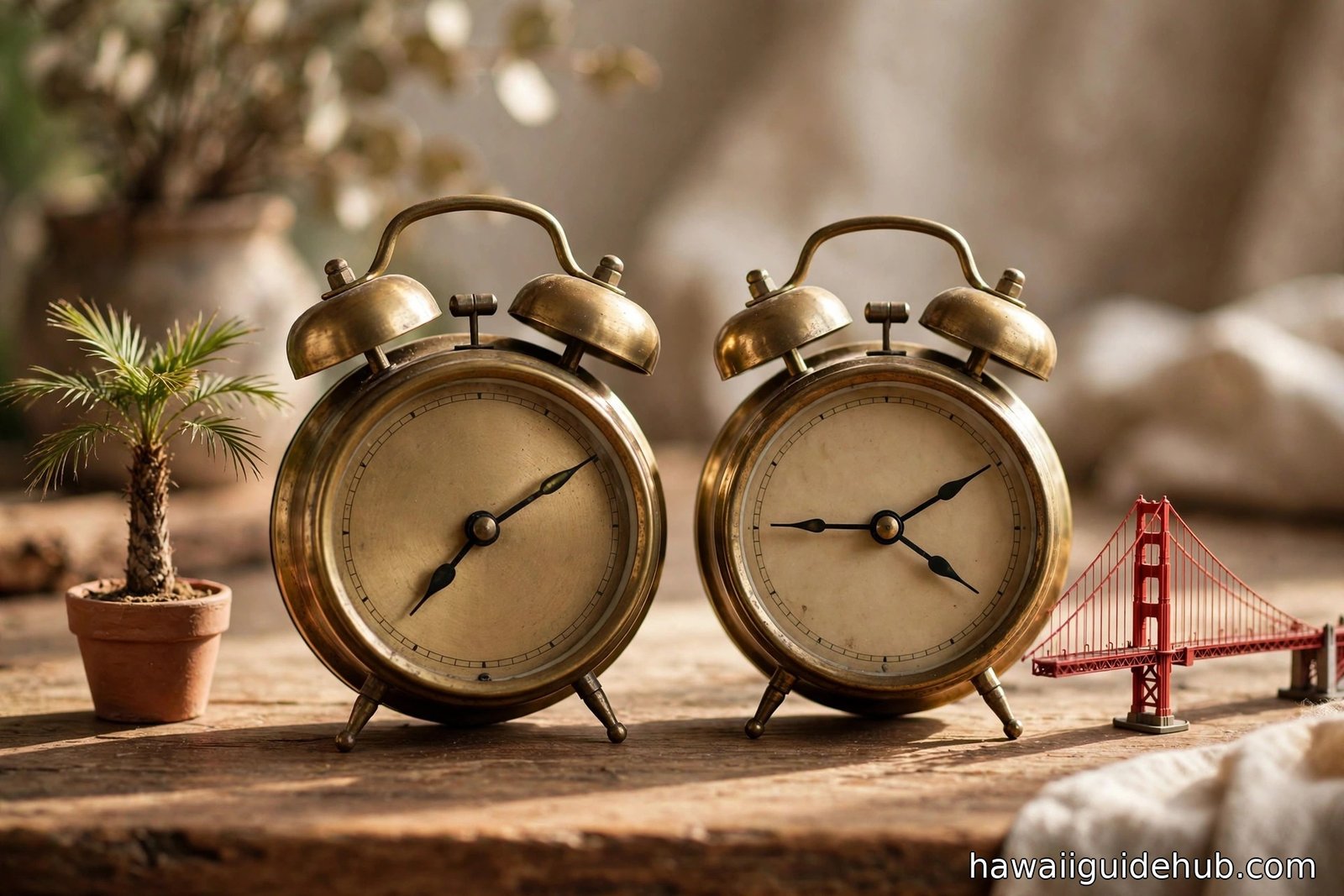
Memorize it as: summer 3, winter 2. The switch happens on California’s clock change weekends, not Hawaii’s (Hawaii has none). If you are traveling around those weekends, double-check: a flight booked across the change can shift your effective arrival math by an hour.
Why Hawaii Skips Daylight Saving
Daylight saving exists to shift daylight into summer evenings, which matters at high latitudes with big seasonal swings. Hawaii sits at about 20 degrees north: day length barely varies (roughly 11 to 13 hours year-round), and sunrise stays near 6-7 AM regardless. Shifting clocks would just move sunrise to an awkward hour for no benefit. Arizona (except the Navajo Nation) makes the same calculation. The result: Hawaii’s clocks are the steadiest in America, and it is always California that moves.
Calling and Texting Across the Gap
The practical rule: Hawaii wakes up earlier relative to California than you think. At 9 AM in Honolulu in summer, it is already noon in LA: your California friends are mid-morning while you are having coffee. In the evening it reverses: 8 PM in LA is 5 PM in Honolulu, so calling California at your dinnertime catches them at theirs. The danger zone is early morning California time: 7 AM in LA is 4 AM in Honolulu in summer. Set your phone to show both time zones for the trip: it prevents the 5 AM accidental call home.

Flight Math: Why Arrival Times Look Wrong
A Los Angeles to Honolulu flight takes about 5.5 hours. Leave LAX at 10 AM in July and you land at about 12:30 PM Honolulu time: you “gain” 3 hours, so the clock barely moves. The return is the cruel one: leave Honolulu at 1 PM, fly 5 hours, land at 9 PM California time: the day evaporates. In winter the effect softens by an hour. When booking connections, remember the gap changes with the season: a winter itinerary planned on summer math can misalign a tight connection by an hour. For flight times from the West Coast, see the Los Angeles to Hawaii flight time guide.
Jet Lag: The Easiest Westbound Trip in America
California to Hawaii is the gentlest jet lag in U.S. travel: only 2-3 hours, and westbound, which the body handles far better than eastbound. Most travelers feel nothing worse than waking up early: which in Hawaii means sunrise over the ocean, the best possible side effect. Practical tips: get sunlight in the morning (resets your clock fastest), stay up until a normal local bedtime on arrival day, and hydrate on the flight. The return east is slightly tougher: expect one groggy morning back in California. Compared to the 5-6 hour jumps from the East Coast, Californians have almost nothing to complain about.
For Remote Workers and Meetings
Hawaii’s time zone is a remote-work superpower with a California team: your 7 AM to 3 PM Honolulu day overlaps California’s 10 AM to 6 PM (summer). You get deep-work mornings while California sleeps, then full overlap afternoons. The catch: evening social life in California happens at your afternoon, and late California meetings eat your evening. Set calendar tools to display HST explicitly: “3 PM HST” prevents the perennial confusion where a California colleague books 3 PM their time and you join at noon.
Common Mistakes Travelers Make
Mistake 1: assuming it is always 3 hours. Winter visitors who subtract 3 arrive an hour early to everything. Mistake 2: forgetting the direction: Hawaii is behind, so a 9 AM Honolulu activity is noon-or-1 PM California time, not 6 AM. Mistake 3: scheduling calls by “your 3 PM” without specifying whose. Mistake 4: ignoring the March/November weekends: if your trip straddles a clock change, the gap shifts mid-trip. Mistake 5: trusting a hotel alarm set by the previous guest: always verify your phone auto-updated to HST on landing.
TV, Sports, and Live Events: The Viewing Shift
Hawaii’s time zone reshapes the sports calendar: a 1 PM Eastern NFL kickoff airs at 7 AM in Honolulu, which is why sports bars open at dawn on Sundays. Monday Night Football at 5:15 PM Pacific is 2:15 PM in Hawaii: an afternoon game. Prime-time TV at 8 PM Eastern reaches Hawaii at 2 PM, so network “prime time” is an afternoon affair and locals watch on delay or stream. The upside: pay-per-view fights and West Coast evening events land at civilized Hawaii afternoon hours. If you are visiting from California, your team’s schedule shifts 2-3 hours earlier: set reminders in HST.
Hawaii vs. the Rest of the U.S.: The Full Picture
For context beyond California: Hawaii is 4 hours behind Mountain in winter and 5 in summer; 5 behind Central in winter and 6 in summer; 5 behind Eastern in winter (EST, UTC-5) and 6 in summer (EDT, UTC-4). The pattern is uniform: every mainland zone shifts with DST while Hawaii stays put, so the gap to any mainland city is always one hour wider in summer than in winter. Arizona is the odd one out: like Hawaii, most of Arizona skips DST, so the Hawaii-Arizona gap stays a constant 3 hours year-round.
A Brief History of Hawaii’s Time
Hawaii standardized its time in the territorial era, settling on UTC-10, which closely matches solar time for the islands’ longitude. The state has never observed daylight saving: bills to adopt it surface periodically and die just as regularly, opposed by everyone from farmers to parents who do not want children waiting for school buses in the dark. The stability is a point of local pride: while the mainland argues twice a year about changing clocks, Hawaii simply does not participate.
Video: Is Hawaii Always 3 Hours Behind California?
The 2-vs-3-hour question, explained visually.
Frequently Asked Questions About the California-Hawaii Time Difference
How many hours behind California is Hawaii?
2 hours in winter (November to March, when California is on standard time) and 3 hours in summer (March to November, when California is on daylight time).
Is Hawaii ever ahead of California?
Never. Hawaii is always behind California by 2 or 3 hours, depending on the season.
Does Hawaii observe daylight saving time?
No. Hawaii stays on Hawaii Standard Time (UTC-10) year-round. Only California’s clocks change, which is why the gap shifts.
What time is it in Hawaii when it is 3 PM in California?
12 PM (noon) in summer, 1 PM in winter. Subtract 3 in summer, 2 in winter.
When do the clocks change?
California springs forward on the second Sunday in March and falls back on the first Sunday in November. Hawaii does nothing on either date.
Does the time difference affect all Hawaiian islands equally?
Yes. All Hawaiian islands share Hawaii Standard Time: there is no inter-island time difference.
The Arrival-Day Playbook
Land in Honolulu from California and your body thinks it is mid-afternoon while the local clock says late morning: use it. Drop bags, get lunch, and spend the afternoon in the sun: daylight is the fastest clock-resetter there is. Resist the nap: if you must, cap it at 20 minutes before 3 PM local. Eat dinner at a normal local hour even if you are not hungry, then get to bed at a reasonable local time: you will likely wake naturally around sunrise, which is the entire point of the first day. By day two, most Californians are fully adjusted: the 2-3 hour shift is the smallest jet lag in American travel.
What “HST” Means on Your Bookings
Tour confirmations, hotel check-in times, and inter-island flight itineraries all quote Hawaii Standard Time: which is simply local Hawaii time, year-round. The confusion comes when a mainland-based booking platform displays times in your home time zone: always toggle to local time or read the fine print. A snorkel tour “departing 7 AM HST” is 10 AM California summer time: miss that and you miss the boat. When in doubt, confirm with the operator in HST: they live it.
Cruises and Inter-Island Hops
Inter-island flights involve no time change at all: Honolulu, Kahului, Kona, and Līhuʻe all share HST. Cruises that sail from California to Hawaii cross the gap gradually, with the ship’s clock typically adjusting in overnight increments: check the daily program for which day the clocks change. On the return, the ship “loses” the hours the same way. It is the gentlest possible introduction to the time difference: you adjust an hour a night while someone else cooks.
Is Hawaii 3 hours behind Los Angeles right now?
It depends on the date: 3 hours behind from the second Sunday in March to the first Sunday in November (daylight time), 2 hours behind the rest of the year (standard time).
What is the time difference between San Francisco and Honolulu?
The same as Los Angeles: San Francisco is also on Pacific Time, so Honolulu is 2 hours behind in winter and 3 in summer.
Does the Time Difference Affect When to Visit?
Barely, but there is a subtle angle. Winter visitors from California get the smaller 2-hour gap, which makes the first day even easier: but winter is also peak season with higher prices. Summer visitors face the 3-hour gap and lower shoulder-season fares in late spring and fall. The time difference itself should never drive your dates: a single hour is nothing next to the price swings. For the money side of timing, see the cheapest time of year to visit Hawaii. And if you have not chosen an island yet, the best island for first-time visitors will point you right.
The Business Traveler’s Edge
Frequent California-Hawaii business travelers exploit the gap deliberately. Flying west on a Monday morning, you land “earlier” than you left by the clock: a 8 AM LAX departure lands around 10:30 AM Honolulu time, giving a nearly full workday on arrival. Schedule return flights for late afternoon: you land in California in the evening with the workday preserved. The one trap: booking a morning meeting in Honolulu on arrival day. Your body left California at dawn: give yourself the afternoon buffer, and you will look like the genius who never gets jet lag.
Summer 3, winter 2: that is the whole formula. Set both time zones on your phone before you fly, subtract accordingly for every call and booking, and enjoy the rare pleasure of a westbound trip where the clock barely moves on the way there and a glorious Hawaiian sunrise over the Pacific greets you early every single morning of your trip.