Hawaii’s Anchialine Pools: Hidden Worlds in the Lava

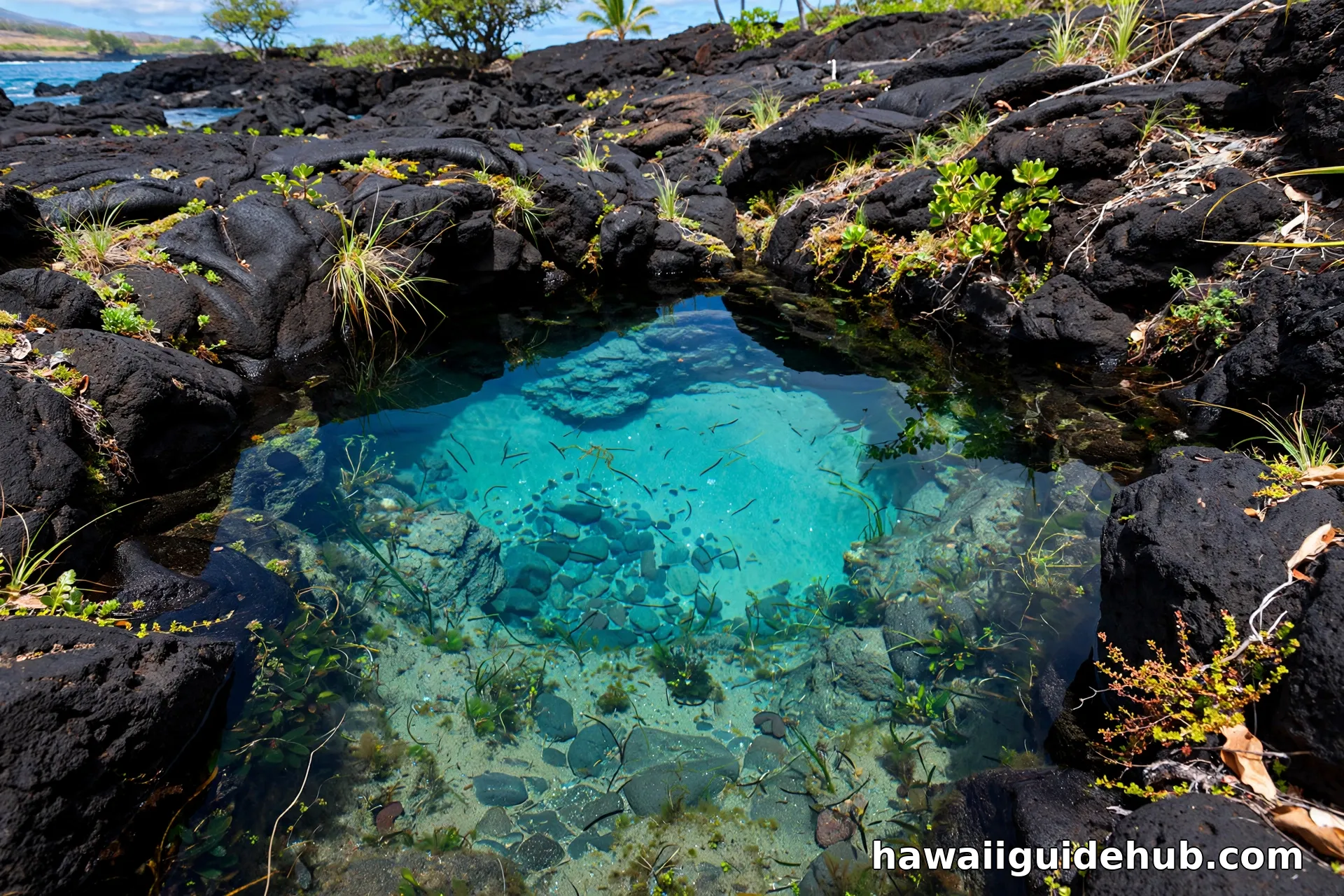
In the young lava fields of the Kona and Kohala coasts lie pools with no stream feeding them and no outlet to the sea, yet their water rises and falls with the tide. These are anchialine pools: windows into an underground estuary, where fresh groundwater floats on seawater seeping through the lava. They host tiny red shrimp found nowhere else, they were tended by Hawaiians for centuries, and they are among the most threatened Pair a pool visit with the best things to do on the Big Island, where most of the notable pools are found. ecosystems in the state. This guide explains what they are, who lives in them, and where to see them.
This is the single complete guide to Hawaii’s anchialine pools. It covers how the pools work, the opae ula shrimp, the pool communities, the cultural history, the threats, where to see pools responsibly, and FAQs. Everything about Hawaii’s anchialine pools lives on this one page.
What Makes a Pool Anchialine
“Anchialine” comes from the Greek for “near the sea,” and the definition is precise: a landlocked body of water with a subterranean connection to the ocean, showing tidal fluctuation but no surface connection. Rain and groundwater feed fresh water into lava depressions near the shore; seawater seeps in through underground cracks. Because fresh water is less dense, it forms a lens floating on the warmer seawater below, and as the ocean tide rises and falls, the pool’s level and salinity shift with it. About 700 such ponds are known in Hawaii, per University of Hawaii researchers, most in the youngest lava of the Big Island and Maui. Each is an ecosystem in flux, twice a day.
Anchialine Pool vs Tide Pool
| Feature | Anchialine pool | Tide pool |
| Ocean connection | Underground only; no surface link | Direct; waves wash in |
| Water | Brackish, layered fresh over salt | Full seawater |
| Tides | Level rises/falls with tide, delayed | Drains and refills visibly |
| Signature animal | Opae ula shrimp | Urchins, opihi, reef fish |
| Where | Young lava fields, inland of shore | Rocky shoreline |
| Biggest threat | Development, introduced fish | Trampling, collecting |
Opae Ula: The Shrimp That Owns the Pools
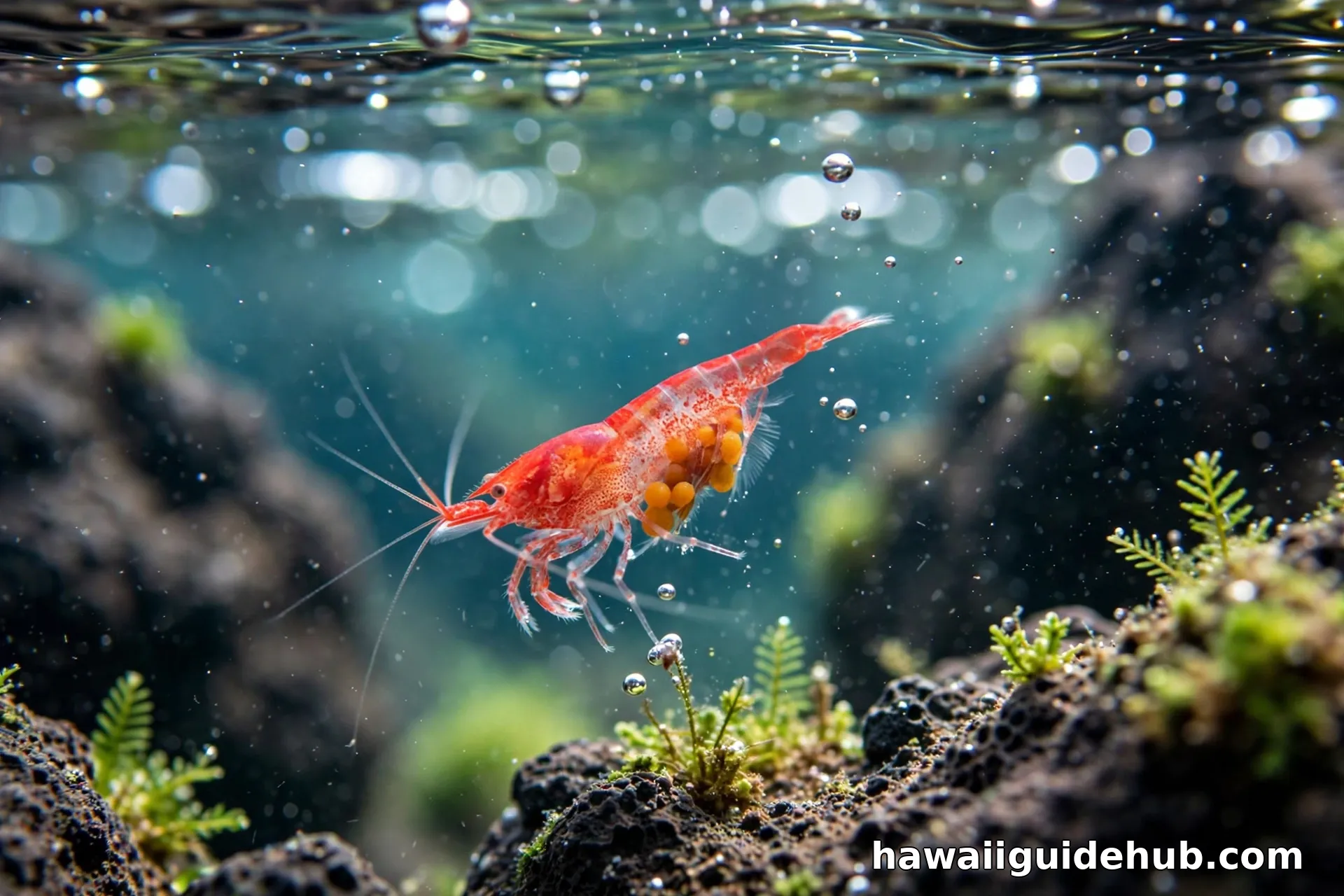
The undisputed ruler of the inland pools is the opae ula (Halocaridina rubra): a shrimp one to two centimeters long, red as a ember, found only in Hawaii. It grazes algae and bacterial films, tolerates wild swings of salinity and temperature, and can live an astonishing 20 years: a two-centimeter animal with the lifespan of a dog. Eight genetically distinct lineages have been identified across the islands, each pool complex its own evolutionary experiment. Where introduced fish are absent, the shrimp swarm in millions, turning the water rust-red; where mosquitofish or tilapia have been dumped, the shrimp vanish. The opae ula is the pool’s canary: its presence means the ecosystem works, its absence means something broke it.
The Pool Community
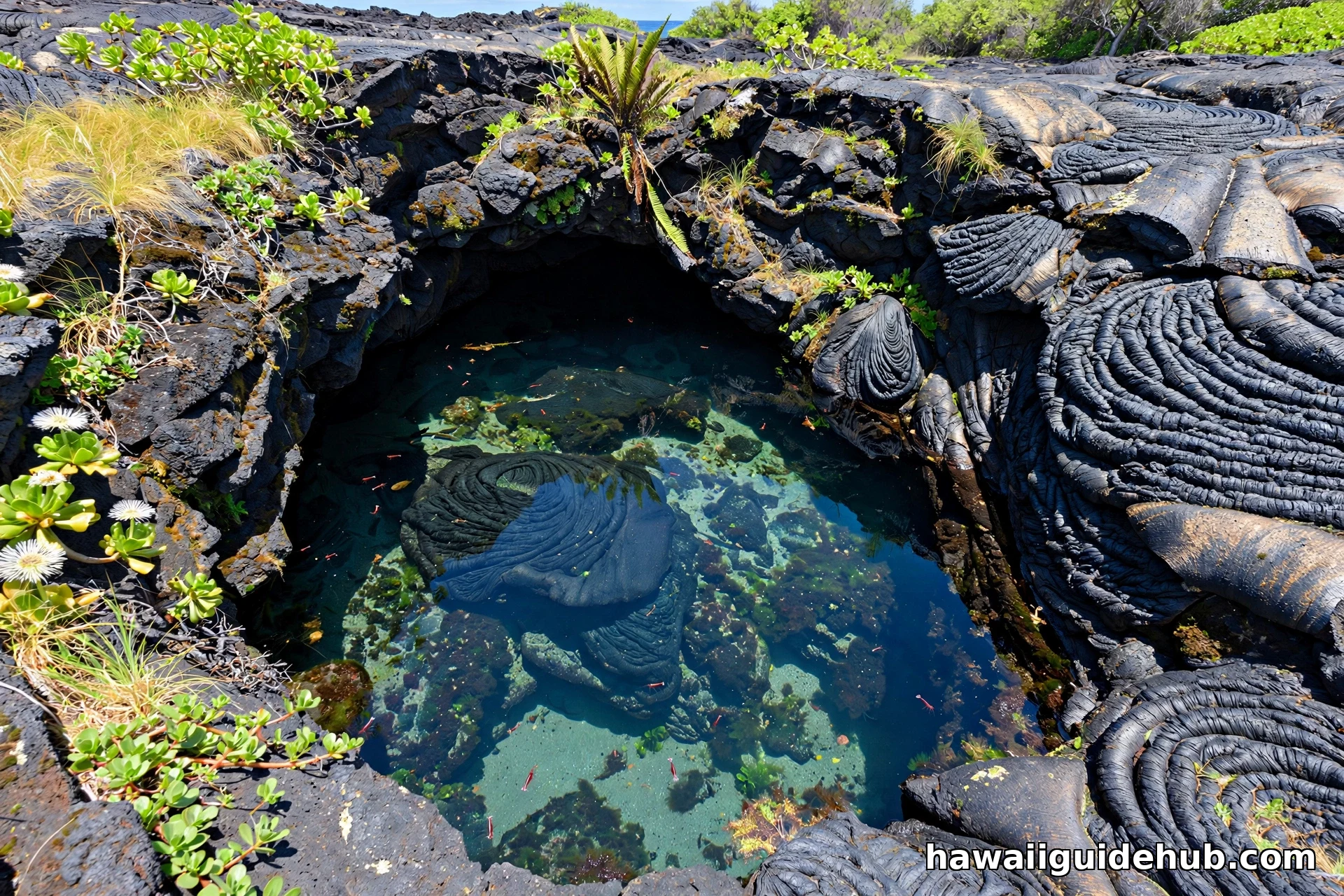
The shrimp are the stars, but the supporting cast is rich. Closer to the ocean, the pools host the opae huna and Metabetaeus lohena shrimp, small crabs, mullet, gobies, and eels that venture in from the sea. Damselflies hunt over the surface; native sedges, makaloa, and akulikuli fringe the edges; seaweeds and blue-green algae carpet the bottom. Each pool’s community reflects its salinity and distance from the sea: a gradient from nearly fresh inland pools dominated by opae ula to nearly marine pools full of reef visitors. Walk a shoreline with many pools and you are walking a transect through an underground estuary, each pond a different mixture.
Wai Opae: The Cultural History
Hawaiians knew these pools as wai opae: fresh water, and shrimp. The pools were family water sources in the dry leeward lava fields, habitat for the opae ula used as chum for opelu and akule fishing, and watering points for plantings of niu and hala. Leaves were cleared and sediment dredged: the pools were tended, not just used. The modern history is less kind: pools were filled for an airport runway and resort development, stocked with mosquitofish against dengue with no regard for the shrimp, and turned into decorative water features stocked with ornamental fish. The cultural lesson cuts both ways: the pools thrived under stewardship and withered under neglect, and the choice is the same today.
Threats: Fill, Fish, and Fertilizer
Development is the existential threat: pools are filled for construction, polluted by runoff, or isolated by groundwater pumping that lowers the water table. Introduced fish are the ecological threat: a single bucket of tilapia or mosquitofish can empty a pool of shrimp that took millennia to evolve. Nutrient pollution from cesspools and fertilizer feeds algal blooms that smother the bottom. And the aquarium trade harvests opae ula for the “ecosphere” market: sealed glass balls marketed as self-sustaining, each one a few shrimp removed from a wild pool. The state has moved to protect the pools, but enforcement is thin and the threats are many: this is an ecosystem that needs its visitors to be allies.
Where to See Anchialine Pools
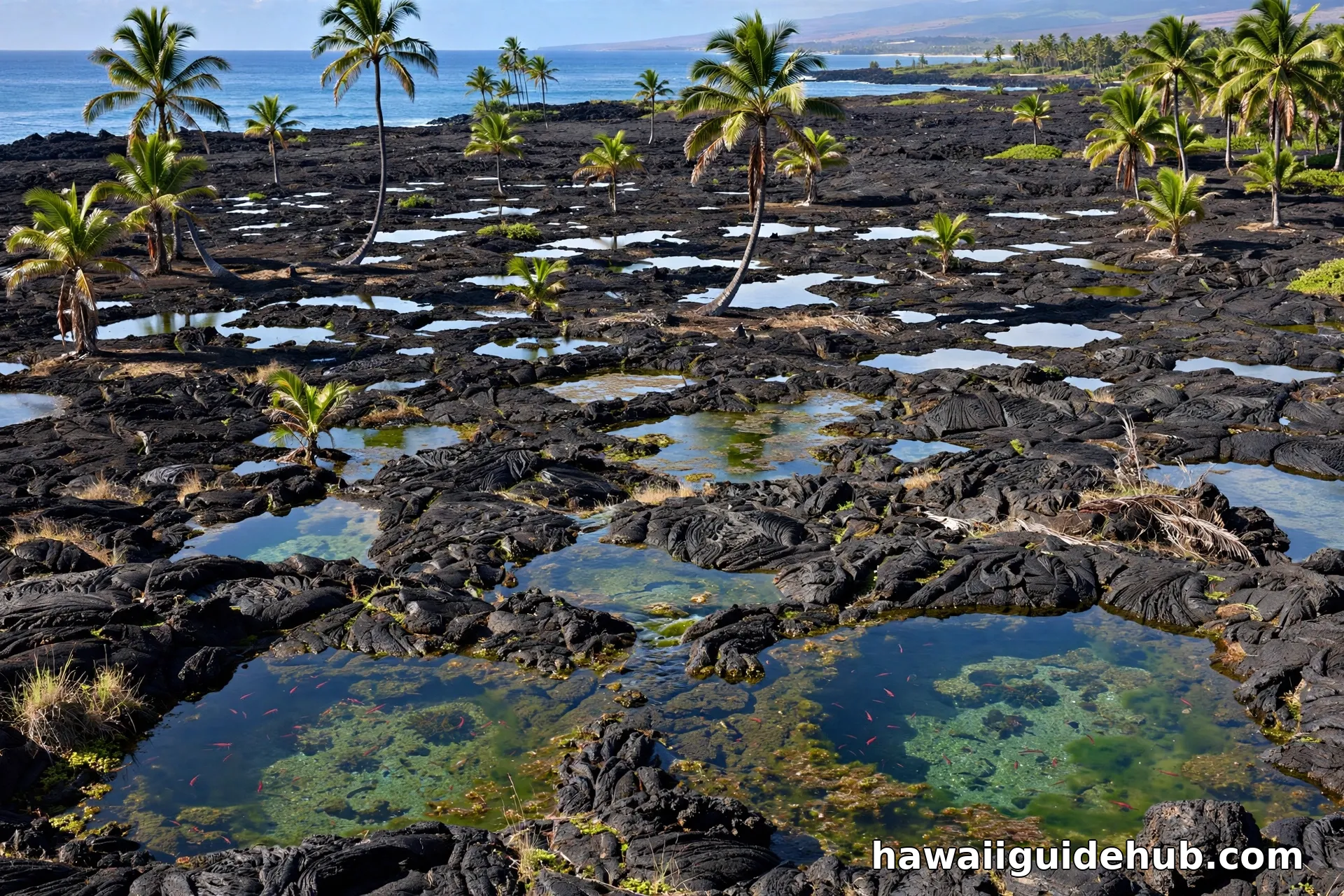
The best accessible pools are on the Big Island’s Kona and Kohala coasts. Kaloko-Honokohau National Historical Park protects a superb pool system with an easy trail: opae ula visible in the shallows, cultural sites alongside. The Waikoloa resort area’s coastal trails pass numerous pools: look for the rust-red shimmer of shrimp. On Maui, the Ahihi-Kinau Natural Area Reserve and the Waianapanapa cave pools hold opae ula, the latter wrapped in the legend of the princess Popoalaea, whose blood the red shrimp are said to recall. Rules everywhere: do not swim in the pools unless expressly permitted (sunscreen and trampling destroy them), never release anything, and never take shrimp. Observe from the edge: the pools are small, and your footprint is large.
The Eight Lineages: Evolution in Every Pool
The opae ula’s genetics tell a story of isolation within isolation. Researchers have identified eight genetically distinct lineages across the islands: shrimp in neighboring pool complexes, separated by mere miles of lava, that have diverged into their own evolutionary trajectories. Color varies too: Big Island and Maui shrimp run red, Oahu’s run pink to clear with orange or yellow tints, some banded. The pools are islands within islands, each one a separate experiment running for thousands of years. Lose a pool complex to development, and you do not just lose shrimp: you lose a lineage, an irreplaceable branch of the evolutionary tree.
The Ecosphere Problem
You may have seen them in gift shops: sealed glass spheres marketed as self-sustaining ecosystems, each containing a few opae ula. The shrimp inside can survive for years, which is presented as a marvel; in truth it is a slow starvation, the animals enduring rather than living. Worse, the trade drives wild harvest: collectors take shrimp from pools already stressed by development and introduced fish. The ecosphere’s marketing inverts the real wonder: the marvel is not a shrimp surviving in a glass ball, but millions of them thriving in a lava pool connected to the ocean through rock. Buy the photograph, not the sphere.
Groundwater: The Invisible River
The pools are fed by an invisible river: groundwater percolating downslope from the uplands through the porous lava. Rain that falls on the Kohala mountains travels underground for years before emerging in a coastal pool. This means the pools’ health depends on land use miles inland: pumping, pollution, and deforestation uphill all reach the pools eventually. The traditional Hawaiian understanding captured this: the wai opae were known to rise and fall with rains far mauka, and the pools were managed as part of the ahupuaa’s water system. Modern hydrology confirms it: protect the pool, and you must protect the watershed behind it.
Restoration: Removing the Fish
The most effective pool restoration is also the simplest: remove the introduced fish. Projects at several Big Island pool complexes have netted out tilapia and mosquitofish, and the opae ula rebound with astonishing speed: within months, the water reddens with shrimp again. Barriers prevent reintroduction; signage explains why the fishing is prohibited; community monitoring keeps watch. It is conservation with a visible payoff: the before-and-after is a pool empty of life versus a pool boiling with shrimp. The lesson generalizes: in these small, closed systems, removing the single wrong species can restore the whole ecosystem.
A Pool Walk: The Practical Guide
Walk the coastal trails of the Kona and Kohala coasts in the morning, when the light slants into the pools and the shrimp are active. Bring polarized sunglasses: they cut the surface glare and reveal the shrimp clouds below. Move slowly and keep your shadow off the water: the shrimp spook easily. Photograph with a polarizing filter for the same reason. Stay on the rock and trails: the pool edges are fragile, and the surrounding vegetation includes natives worth not trampling. And count the pools: the Waikoloa trails pass dozens, each slightly different in color, salinity, and life. It is a gallery walk where every painting is an ecosystem.
The Waianapanapa Legend
On Maui’s Hana coast, the anchialine pools of the Waianapanapa caves carry a legend. The princess Popoalaea fled her cruel husband and hid in the cave; when he found her by the reflection of her feather kahili in the water, he killed her there. At certain times of year, the story says, tiny red shrimp appear in the pool, turning the water red: a reminder of the slain princess’s blood. Whether or not you credit the legend, it does what legends do: it marks the pools as significant, storied places, not just puddles in the lava. The shrimp were sacred before biologists named them.
Why the Pools Matter to the Ocean
The pools are not isolated curiosities: they are the visible part of the subterranean estuary that fringes the young lava coasts. The same underground mixing that feeds the pools discharges offshore as submarine springs, nourishing nearshore productivity. The opae ula and their relatives are endemic components of a coastal aquifer ecosystem that science is only beginning to map. Protecting the pools protects the unseen: the groundwater, the springs, the reef’s hidden plumbing. The little red shrimp is the ambassador for an entire underground ocean.
Watch: Opae Ula in the Anchialine Pools
Hawaii Anchialine Pools FAQs
What is an anchialine pool?
A landlocked brackish pool with an underground connection to the ocean: no surface link, but the water level rises and falls with the tide. About 700 are known in Hawaii, mostly in young Big Island and Maui lava.
What is opae ula?
Halocaridina rubra, a tiny red shrimp endemic to Hawaii’s anchialine pools. One to two centimeters long, it can live 20 years and swarms in the millions where introduced fish are absent.
Can you swim in anchialine pools?
Generally no: swimming stirs sediment, introduces sunscreen, and crushes the fragile bottom community. Observe from the edge. A few sites permit entry where signed: follow the posted rules exactly.
Why do the pools rise and fall with the tide?
Seawater seeps through underground cracks in the lava, connecting the pool to the ocean. As the tide rises offshore, pressure pushes water up into the pool: a tide with no waves, arriving through rock.
Are anchialine pools endangered?
As an ecosystem, yes: among Hawaii’s most threatened. Development fills them, introduced fish empty them, and pollution degrades them. Many of the finest remaining systems are protected in parks and reserves.
Windows Into the Underground
Anchialine pools are Hawaii’s hidden waters: no stream, no waves, just a brackish mirror in the lava that breathes with the tide and glows red with shrimp found nowhere else. They were water sources and fishing aids for Hawaiians, laboratories for biologists, and legends for storytellers. They ask only to be left alone: observed, not swum; protected, not filled. Walk the Kona coast trails, crouch at the pool’s edge, and watch the opae ula graze. You are looking into an underground ocean, one shrimp at a time. For more Big Island nature, see our volcanoes guide and Kauai guide.