Jurassic Park in Hawaii: Kualoa Ranch and the Real Isla Nublar

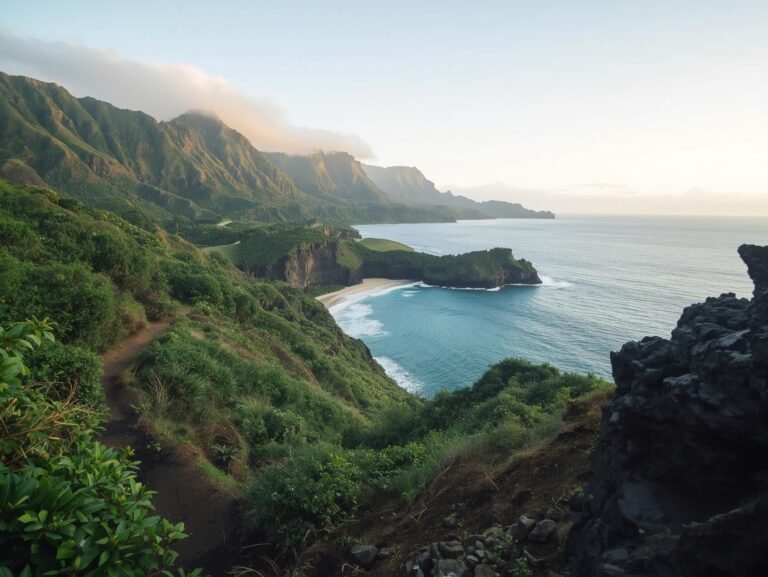
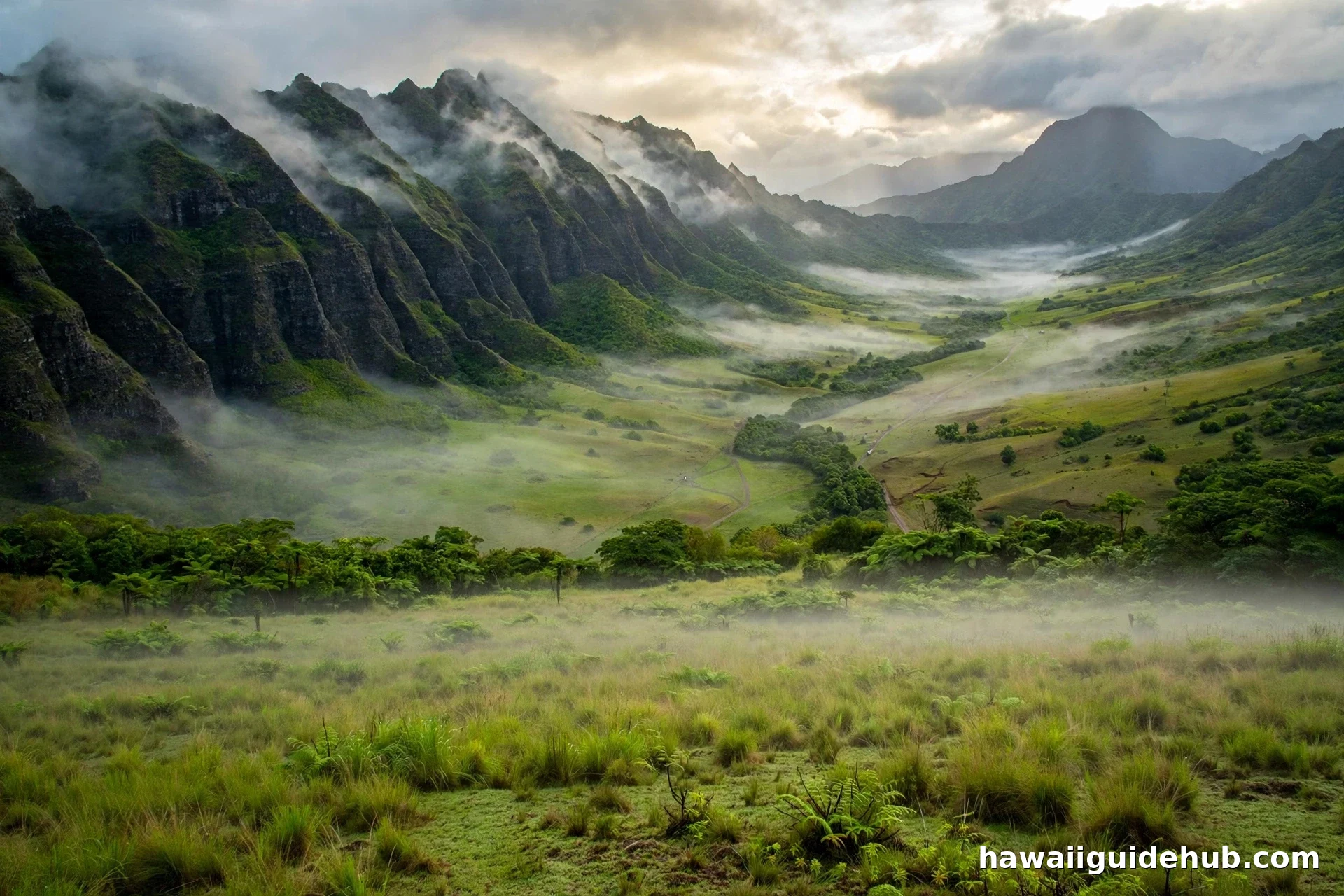
There is a moment on the drive up Kamehameha Highway when the Koʻolau mountains suddenly fill the windshield, all jagged green teeth against the sky, and your brain does a strange little flip. You have seen this exact view before. Not in a travel brochure, but on a movie screen, with a herd of dinosaurs thundering across the grass below. That is Kualoa Ranch, and for anyone who grew up on Jurassic Park, standing in Kaʻaʻawa Valley feels less like sightseeing and more like walking into a memory.
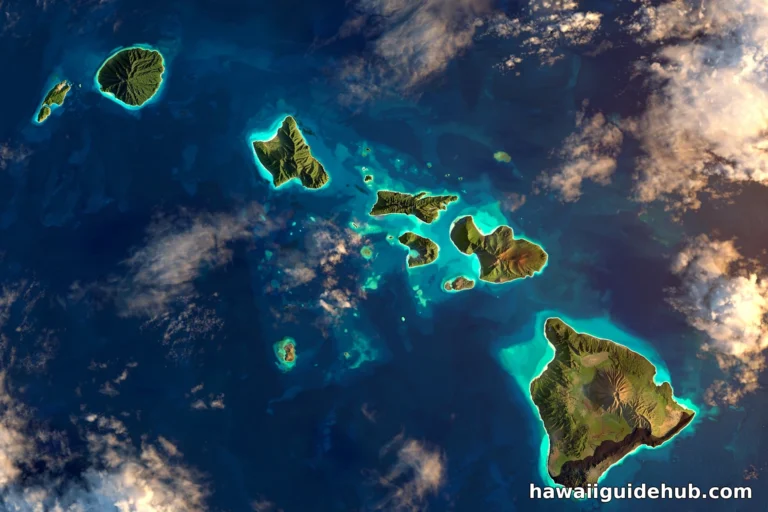
This is the complete guide to where Jurassic Park was actually filmed in Hawaii, with the focus where it belongs: on Oahu, where the most visitable and most famous locations sit. The fictional Isla Nublar was stitched together from real Hawaiian places, and almost all of the ones you can stand in today are on a single 4,000-acre ranch on Oahu’s windward coast.
Why Steven Spielberg Chose Hawaii
When Universal set out to film Michael Crichton’s novel in the early 1990s, the story was set on a fictional island off Costa Rica, and Costa Rica itself was briefly considered as a filming location. Spielberg ultimately chose Hawaii instead, largely for practical reasons. Hawaii had the roads, the crews, the infrastructure and the accessibility that a production of that size needed, plus the exact look the story demanded: lush, empty-feeling tropical valleys that could plausibly hide dinosaurs.
Filming began on August 24, 1992, on Kauai, which doubled for most of Isla Nublar’s forests. The shoot was supposed to stay there for three weeks of daytime exteriors. Then nature intervened in a way no producer could have scripted. On September 11, 1992, Hurricane Iniki slammed directly into Kauai as a Category 4 storm, one of the most powerful hurricanes ever to hit the islands. Sets were destroyed, including one built for a lengthy raptor sequence. Some of the storm footage in the finished film is reportedly real footage shot during the hurricane itself.
The production had to adapt fast, and that is how one of the film’s most famous scenes ended up on a different island entirely. The Gallimimus stampede, with the herd pouring over a fallen log as the characters watch in awe, was moved to Kualoa Ranch on Oahu. A hurricane redrew the movie’s geography, and Oahu gained its most iconic film location.
Kualoa Ranch: Hollywood’s Hawaii Backlot
Kualoa Ranch sits on Oahu’s windward coast, roughly 35 to 45 minutes from Waikiki, and it has been owned by the same family since 1850. It began as a working cattle ranch, and cattle still graze there today, but its second career as a filming location has made it famous worldwide. More than 200 movies and television shows have shot on the property, earning it the nickname Hollywood’s Hawaii Backlot.
The ranch covers about 4,000 acres of valleys and ridgelines, and its three main valleys each played a role in the Jurassic franchise. Kaʻaʻawa Valley, often called Jurassic Valley, is the big one, the sweeping green bowl framed by the jagged Koʻolau cliffs that reads instantly as dinosaur country. Hakipuʻu Valley and Kualoa Valley filled in other jungle and pasture scenes. The diversity is the point: within a few miles the ranch offers rainforest, open pasture, ridgeline and coastline, so a film crew could shoot a whole lost world without moving the trucks far.
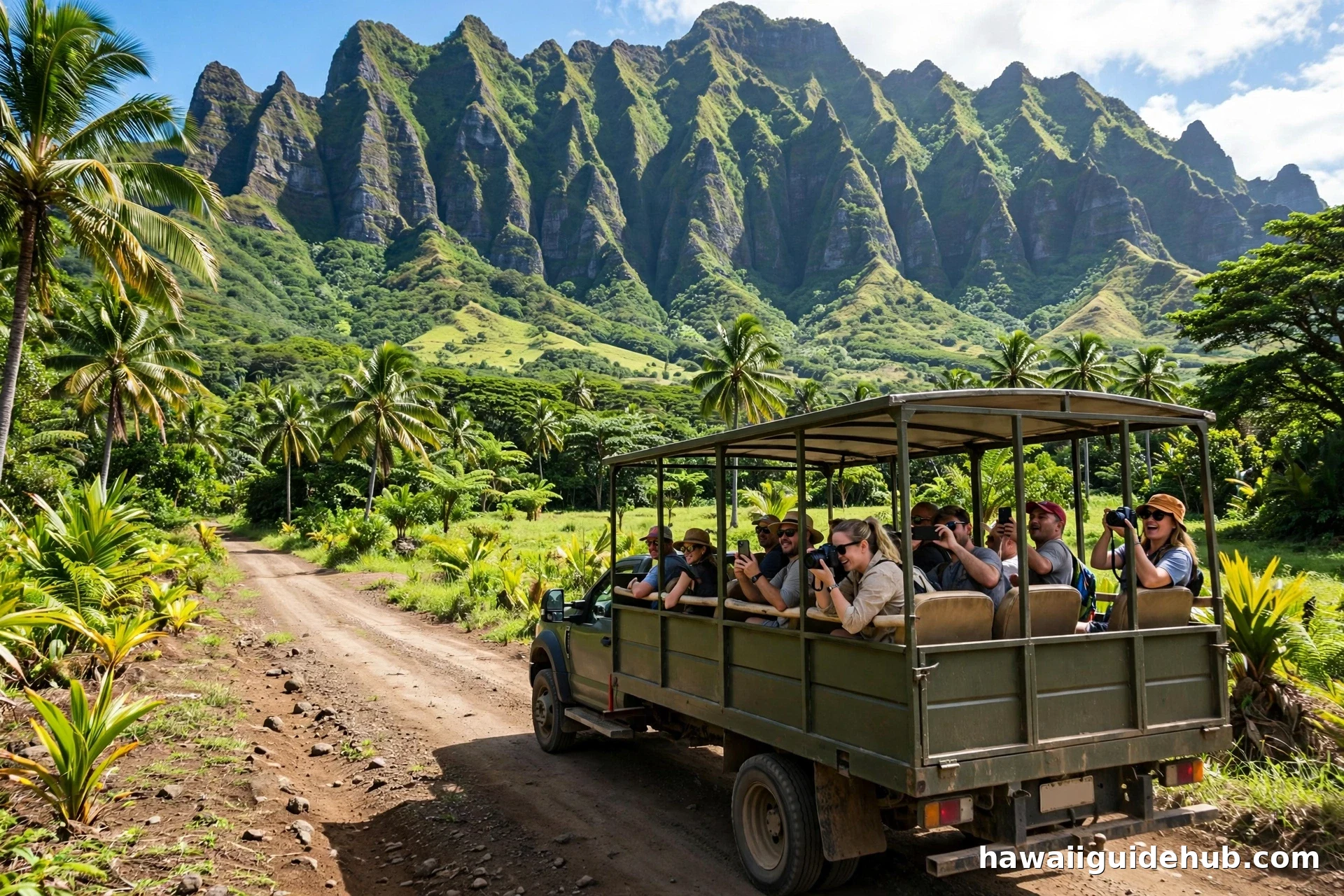
One thing to know before you plan: you cannot wander the ranch on your own. All valley access is through guided tours. Walk-ins can visit the cafe and gift shop at the ranch center, but the valleys themselves require a ticket. This is private land, and the family keeps it that way.
The Gallimimus Field: The Most Famous Shot
The single most recognizable Jurassic Park location in Hawaii is a grassy field in Kaʻaʻawa Valley. This is where the Gallimimus herd stampedes across the screen, pouring over and around a fallen tree log while Dr. Grant and the kids watch from behind it. The log became such a landmark that the ranch’s tours still stop at it, and visitors line up for photos in the exact spot.
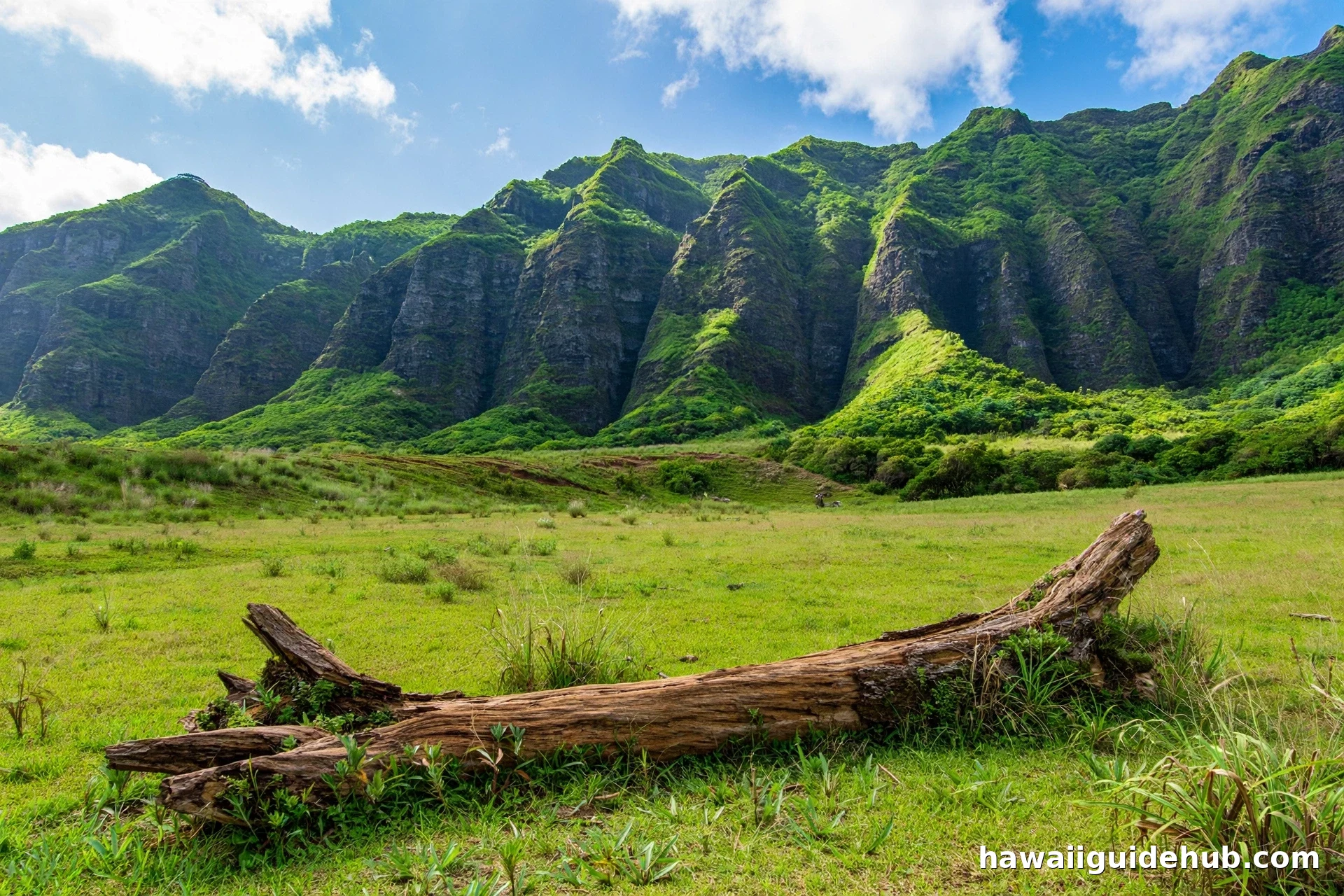
What makes the scene work on film is the backdrop, and what makes it work in person is that the backdrop is real. The steep, fluted ridges of the Koʻolau range rise directly behind the field, and on a clear morning the whole valley looks prehistoric without any computer help. Guides on the Jurassic Adventure Tour will point out the camera angles and tell the Hurricane Iniki story, which somehow makes the place feel even more cinematic.
Jurassic World and the Sequels at Kualoa
Kualoa Ranch did not retire after 1993. When Jurassic World filmed on Oahu in 2014, the ranch hosted some of its biggest set pieces. The Indominus Rex paddock, with its towering 60-foot walls, was built in the valley. The concrete bunker structures and dinosaur cages used in Jurassic World: Fallen Kingdom also stood on ranch land. If you take the dedicated Jurassic Adventure Tour, these are the stops where the guide’s commentary gets the most detailed, because the sets were substantial physical builds, not just empty fields.
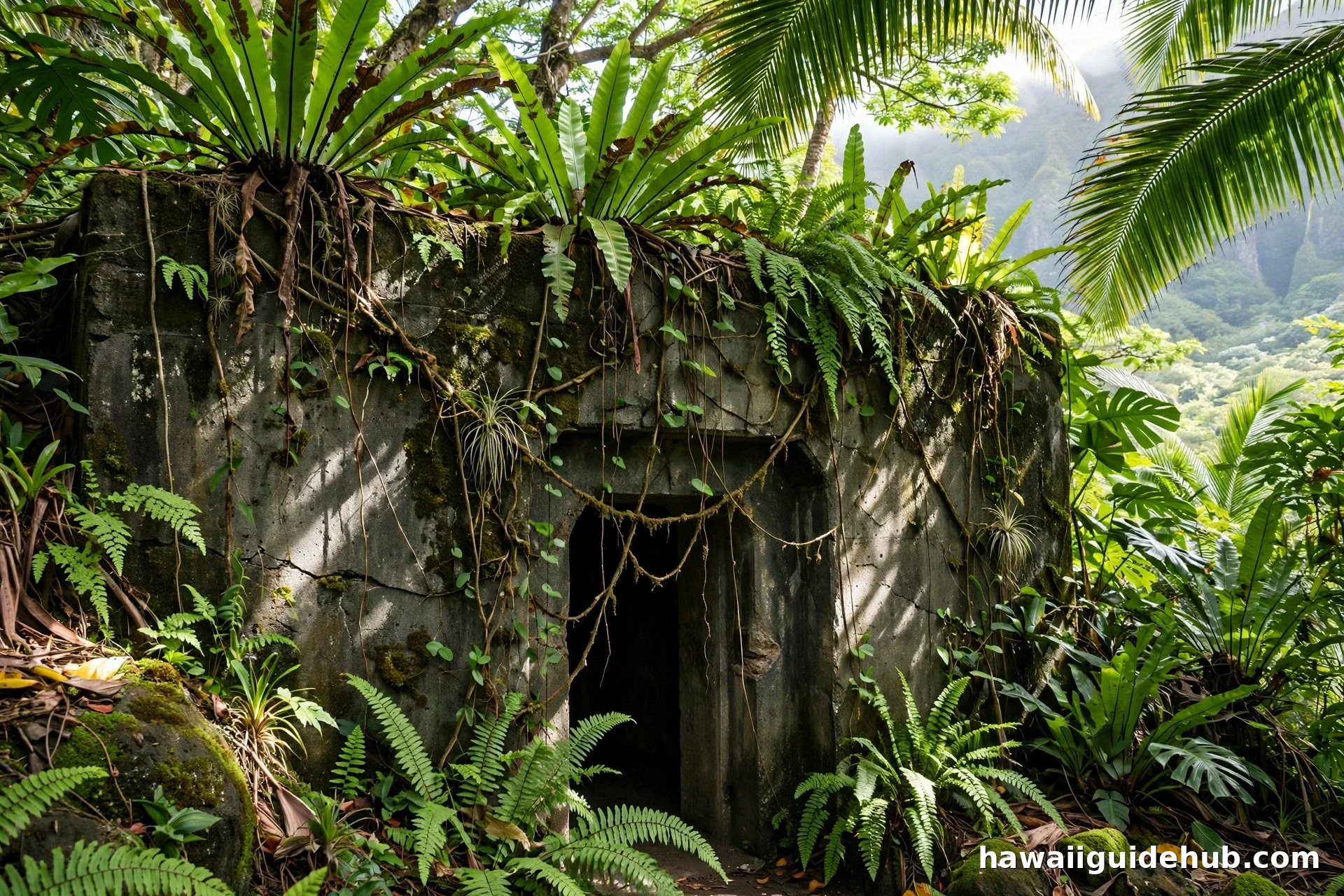
The ranch also appears in The Lost World: Jurassic Park and Jurassic Park III, both of which used Oahu locations for their island sequences. Across the whole franchise, Kaʻaʻawa Valley has played Isla Nublar and Isla Sorna at different times, which is a fun detail to carry onto the tour: the same valley has been two different fictional islands.
The Other Movies Shot Here
Jurassic Park may be the headliner, but the ranch’s filmography is the reason the general Movie Sites Tour exists. Kong: Skull Island filmed its boneyard scenes here. Jumanji: Welcome to the Jungle, 50 First Dates, Godzilla (1998), Pearl Harbor and Mighty Joe Young all shot on the property. Television is represented too: Lost filmed extensively in the valleys, and Hawaii Five-0 used multiple locations around the ranch.
This matters for your visit because the tours blend all of it together. Even on the Jurassic-focused tour, the guide will point out the Godzilla footprints, the Kong boneyard and the Lost bunker as you pass. If you are traveling with someone who does not share your dinosaur obsession, the broader Hollywood history keeps the ride interesting for them.
The Kauai and Maui Locations
The original film’s primary shoot was on Kauai, and several famous spots from the movie sit on the Garden Isle. Manawaiopuna Falls, a 400-foot waterfall in Hanapepe Valley, is the waterfall from the helicopter arrival scene. It sits on private land with no road access, so the only practical way to see it is from the air on a Kauai helicopter tour. The National Tropical Botanical Garden’s Allerton Garden, near Poʻipū, stood in for the jungle around the Dilophosaurus paddock, and it is open to the public on guided tours.
The Jurassic Park gates themselves were built on Waikoko Forest Management Road on Kauai, and the Tyrannosaurus paddock was nearby. The visitor center exterior was a large facade constructed at the Valley House Plantation Estate in Kealia. Most of these were temporary builds, long since struck, so Kauai’s Jurassic sightseeing is more about the landscapes than standing sets. On Maui, Keopuka Rock provided the opening helicopter shoreline shot.
None of this diminishes Oahu’s claim. Kauai has the landscapes, but Kualoa Ranch has the landscapes plus the standing sets, the tours and the access. For a traveler choosing where to spend a day, Oahu is the practical answer, especially for first-time visitors building their itinerary around the island’s highlights.
Which Kualoa Ranch Tour Should You Book
The ranch runs several tours that touch the Jurassic sites, and they differ more than the names suggest. The Jurassic Adventure Tour is the dedicated fan experience: 2.5 hours in an open-air vehicle through Kualoa, Hakipuʻu and Kaʻaʻawa valleys, with the Gallimimus field, the Indominus Rex paddock, the dinosaur cages and the bunkers, plus in-depth narration about how the valley became Isla Nublar. It runs around $150 per adult and is the right pick if Jurassic Park is the reason you are coming.
The Hollywood Movie Sites Tour is shorter, about 90 minutes, and broader: 200-plus film locations across the ranch’s whole history. It still stops at the famous fallen log, but it shares time with Kong, Jumanji, Lost and the rest. At around $60 per adult, it is the better value if your group has mixed interests.
For something more active, the UTV Raptor Tour puts you behind the wheel of your own off-road vehicle for 2 to 3 hours of bumpy trails deep into Jurassic Valley, from about $155 per person. The zipline course runs seven tandem lines over Kaʻaʻawa Valley, some up to a quarter mile long, over about 3 hours for ages 10 and up, around $185 per person. It is one of the standout outdoor adventures in Hawaii for thrill seekers. Prices change, so verify current rates at kualoa.com before booking.
Jurassic Park vs. Jurassic World on the Ground
Visitors sometimes ask whether the tour favors the original film or the newer ones, and the honest answer is that the valley does not distinguish. The Gallimimus field from 1993 and the Indominus paddock from 2015 sit in the same landscape, a short drive apart, and the guide moves between them the way the franchise itself moves between eras. What is striking is how little the valley has changed across the decades of filming. The ridges, the light, the scale of the place are constants; only the sets come and go.
That continuity is part of why the location keeps getting reused. A production designer can dress the same valley as Isla Nublar in one decade and Isla Sorna in the next, and audiences accept both, because the land itself carries the prehistoric feeling. When you stand in the field, you are standing in the one place the franchise has never been able to improve on.
Getting There and Practical Tips
Kualoa Ranch sits at 49-560 Kamehameha Highway in Kaneohe, on the windward side. Driving from Waikiki takes 35 to 45 minutes depending on traffic, and the coastal highway drive is scenic enough to be part of the day. Our Oahu island guide covers the full windward coast route. There is no public transit that makes sense for a tour schedule, so plan on a rental car or a tour package with pickup.
Book in advance, especially for the Jurassic Adventure Tour, which sells out on busy days. Check in 45 minutes before your departure time. Bring sunscreen, a hat and a camera; the open-air vehicles mean full sun exposure. Tours run rain or shine, and honestly the valley looks its most prehistoric with mist on the ridges, so a little weather is not a bad thing. Wear shoes you can walk in, since the photo stops involve short walks on uneven ground.
If you want to make a full day of the windward coast, the ranch pairs naturally with nearby stops. Kualoa Regional Park, just down the road, has the famous view of Mokoliʻi Island, the little island with the distinctive shape offshore. The town of Kaneohe has lunch options, and the drive back toward Honolulu passes several scenic lookouts.
See the Jurassic Tour on Video
Before you book, it helps to see what the Jurassic Adventure Tour actually looks like from a visitor’s perspective.
The Story Behind the Scenery
Part of what makes Kualoa Ranch special has nothing to do with movies. The ranch has been in the same family since 1850, and the land itself is storied in Hawaiian history. The valley was once a place of refuge and an important agricultural area, and guides weave that history into the tours alongside the film stories. The working cattle operation continues, so the dinosaur fields share space with grazing animals, which is a slightly surreal and very Hawaiian combination.
That layering is worth paying attention to on the tour. The guides tend to be locals with genuine knowledge of both the Hollywood history and the Hawaiian history, and the best moments of the ride are often the ones where those two stories intersect: a 170-year-old ranch that happens to look like the dawn of time.
Jurassic Park filmed across Hawaii, from Kauai’s waterfalls to Maui’s sea cliffs, but its most visitable soul lives in one valley on Oahu. Stand in the Gallimimus field with the Koʻolau ridges rising behind the fallen log, and the movie stops being something you watched. It becomes somewhere you have been.