Yellow Tang in Hawaii: Lauʻīpala, the Reef’s Golden Gardener

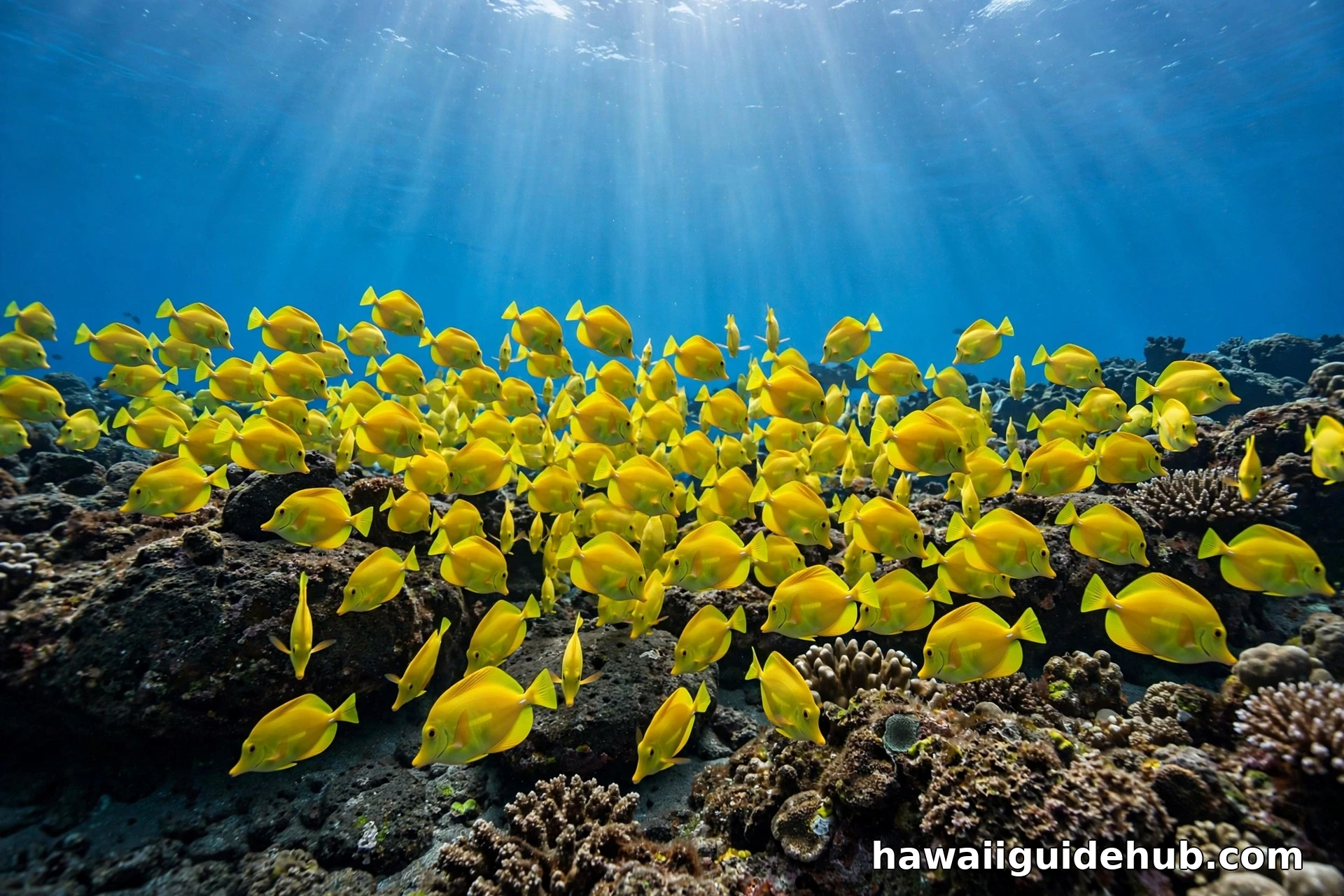
No reef fish says Hawaii like the yellow tang. A flash of pure, impossible yellow against dark lava rock, grazing in golden schools so dense that West Hawaii’s Kona coast earned the nickname “the Gold Coast.” In Hawaiian the fish is lauʻīpala, “yellowed ti leaf,” and it is both an ecological linchpin, the reef’s most tireless algae mower, and the center of the longest-running fisheries fight in state history.
This is the single complete guide to the yellow tang in Hawaii. It covers what the fish is and how it lives, its remarkable night color change and 40-year lifespan, its role as reef gardener and turtle cleaner, its moonlit spawning, the full story of the aquarium trade battle with an honest accounting of what is decided and what is not, and where snorkelers can see the great golden schools. If you have been searching for anything about yellow tang in Hawaii, the answers are all here on this one page.
Lauʻīpala: The Fish That Named a Coastline
The yellow tang, Zebrasoma flavescens, is a surgeonfish native to the central and western Pacific, found from the Ryukyu Islands to Hawaii, with Hawaii holding some of its densest populations. Adults reach about 8 inches, with a leaf-like oval body that is almost always a solid, brilliant yellow, marked only by the white scalpel spine on each side of the tail base. Historically, the species formed enormous aggregations along shallow West Hawaii reefs, schools so vast they were visible from shore, and that golden shimmer is what gave the Kona coast its “Gold Coast” nickname.
Juveniles shelter in dense finger coral (Porites compressa), hiding from predators among the branches. Adults roam lagoon and seaward reefs from just below the surge zone down to about 150 feet, with observations as deep as 250 feet. They are diurnal grazers by day and solitary sleepers by night, tucking into coral crevices alone.
Anatomy of a Grazer
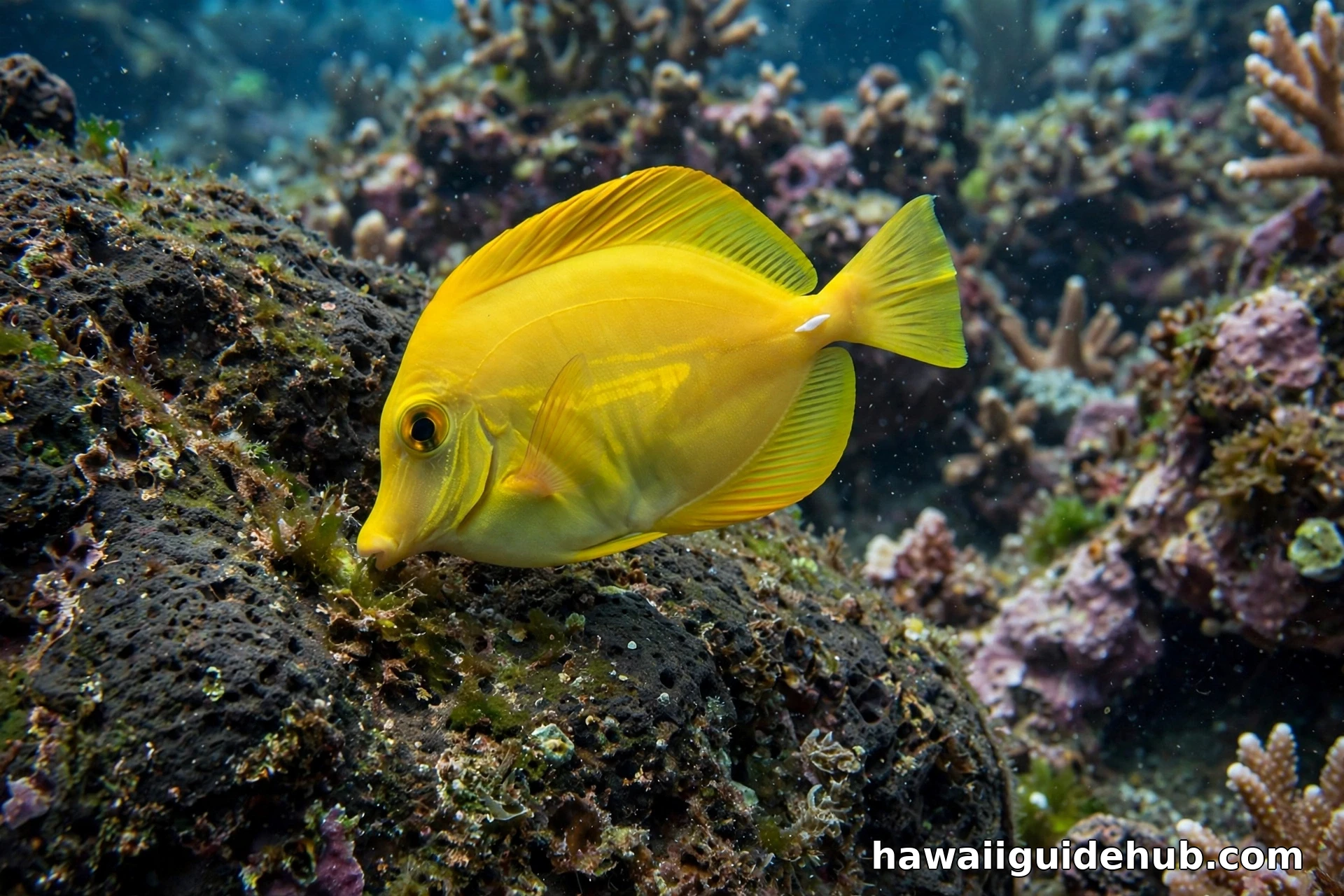
Everything about the yellow tang is built for scraping algae off rock. Its small, protruding snout carries spatulate teeth set close together, 12 upper and 14 lower in juveniles, 18 upper and 22 lower in adults, perfect for cropping filamentous turf algae. Like all surgeonfish, it carries a scalpel: a sharp white spine on each side of the caudal peduncle that flicks out for defense against predators. Males grow faster and larger than females, a dimorphism documented by Claisse and colleagues in 2009.
Then there is the night transformation. By day the fish is brilliant yellow; after dark the color fades to a muted, dusky yellow with a prominent brownish patch in the middle and a horizontal white band. The change happens rapidly and reverses just as fast at dawn. Researchers interpret it as camouflage for a sleeping fish: a bright yellow disc would be a beacon to nocturnal predators, while the mottled night pattern breaks up its outline in the dark reef.
And the lifespan startles everyone who learns it. Yellow tang can live more than 40 years in the wild, at least 41 documented, an extraordinary age for an 8-inch reef fish. They reach their full size within the first 3 to 6 years and then simply keep going, grazing the same reefs for decades. Sexual maturity comes early, at very small sizes around 65 millimeters, per Schemmel’s 2021 research, which helps populations rebound when given the chance.
Life on the Reef: Grazing, Cleaning, Spawning
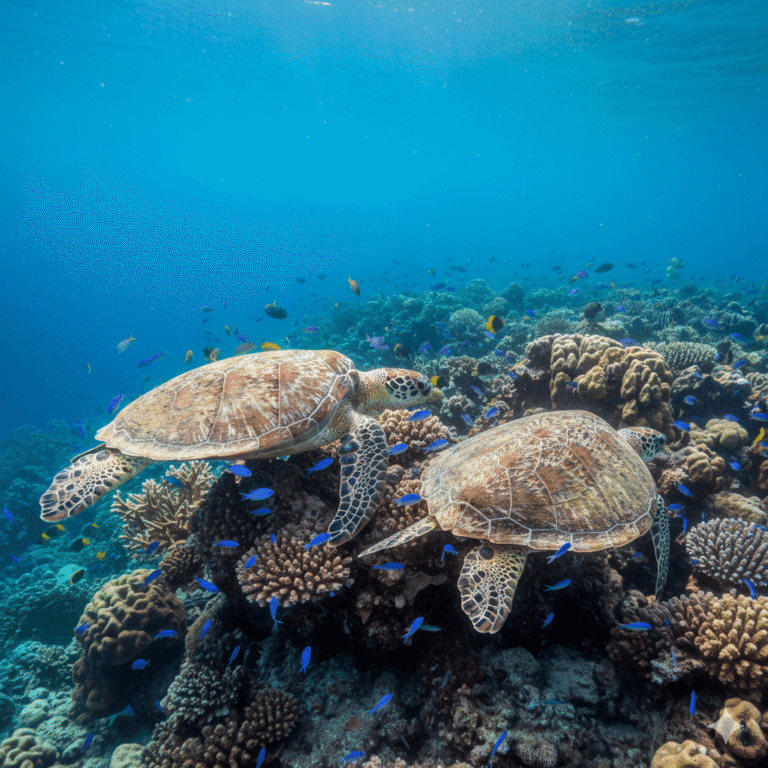
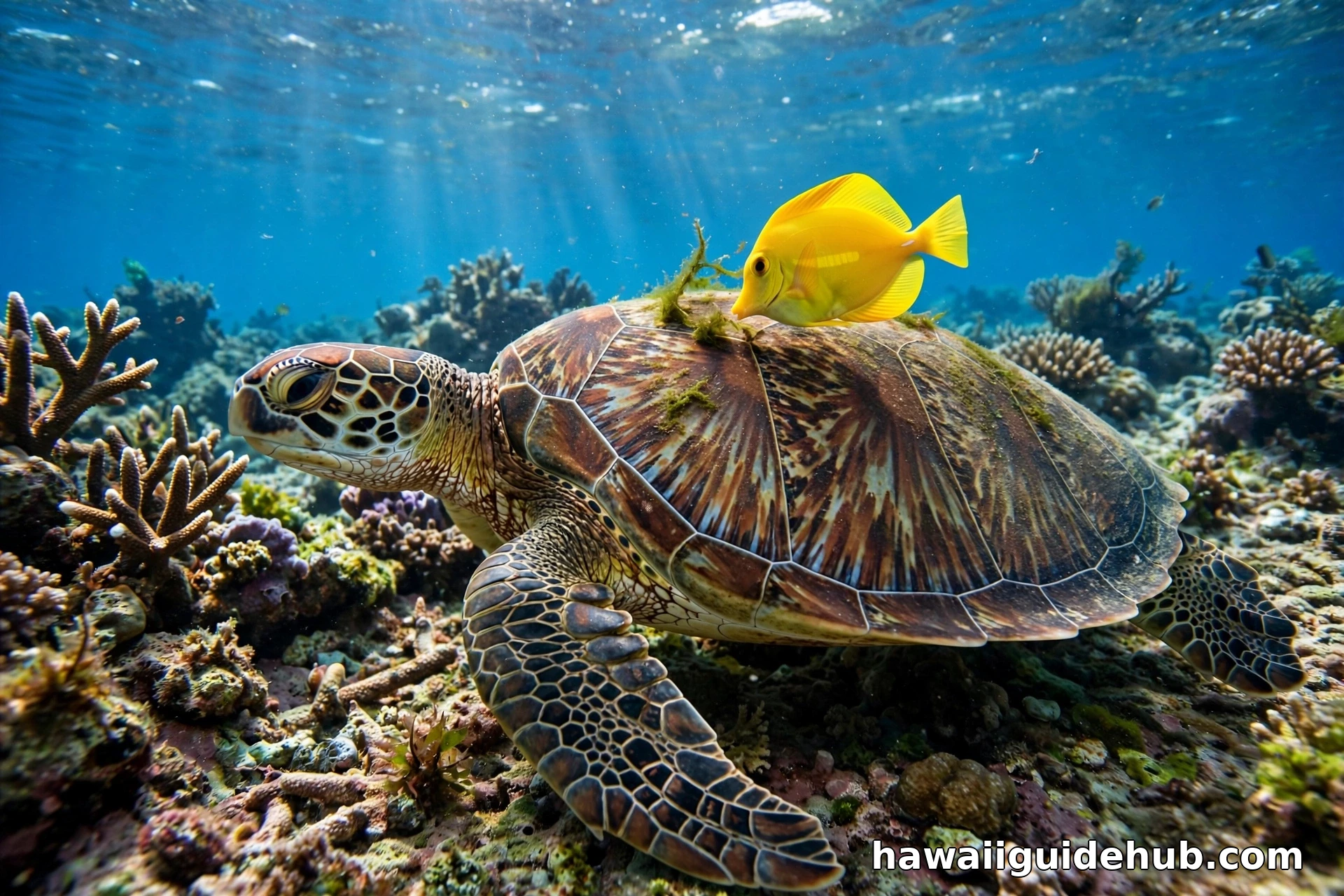
The yellow tang’s ecological job is algae control. By grazing turf algae off rocks and coral all day, tangs prevent fast-growing algae from smothering slow-growing corals, one of the most important services on a reef. They will even graze algae from the shells of green sea turtles, providing a cleaning service to one of Hawaii’s most beloved animals. Divers at cleaning stations sometimes watch tangs queue up alongside other species for the attentions of cleaner wrasses.
Reproduction is a moonlit affair. Yellow tang are broadcast spawners, reproducing year-round with a peak from March to September, most commonly on full-moon nights. Males shimmer and change color during courtship; pairs or groups rise together and release eggs and sperm into the water column. A single female can produce up to 40,000 eggs in a season. The planktonic larvae drift on ocean currents for weeks and can travel 100 miles or more before settling on a distant reef, which is how far-flung island populations stay connected.
The Aquarium Question: What’s Decided and What’s Not
No reef fish in Hawaii has been fought over like the yellow tang. It was historically the most collected aquarium fish in the state, with up to 70 percent of harvested yellow tangs sourced from Hawaii before the restrictions. In 2017, the Hawaii Supreme Court’s Umberger ruling required environmental review under HEPA for aquarium permits, effectively halting the commercial fishery. What followed was years of litigation, environmental impact statements, and dueling science. Here is an honest accounting of where things stand.
| Question | Status | Source / date |
| Is commercial aquarium fishing currently happening in West Hawaii? | No. The fishery is closed pending BLNR permit issuance. | Per DLNR data review, July 2024 |
| Did the court allow permits to resume? | Partially. A Jan 2023 ruling lifted the injunction for West Hawaii only, after HEPA review was satisfied. | Per governor’s office/DLNR release, Jan 2023 |
| Has DLNR issued any permits since? | No. DLNR stressed the ruling “does not itself authorize any aquarium fishing.” | Per DLNR statement, Jan 2023; no permits as of late 2025 |
| What about the rest of Hawaii? | The injunction on permits remains in effect statewide outside West Hawaii. | Per DLNR, Jan 2023 |
| What would a reopened fishery look like? | Proposed: 8 species white list; yellow tang TAC 200,000/year (28,571 per fisher). | Per RFEIS preferred alternative, 2021 |
| Do locals agree on reopening? | No. Fishers cite livelihoods; residents and scientists cite reef recovery since 2017. | Per Hawaii News Now, 2025; BLNR testimony, Oct 2025 |
The nuance matters. Opponents point to visible reef recovery since 2017, with residents testifying that yellow tang numbers at places like Puako visibly increased once collection stopped. Industry supporters note the proposed quotas are a fraction of historical take and that the environmental review found no significant impact. Both claims are on the record; the decision now sits with the Board of Land and Natural Resources. For the snorkeler, the practical upshot is simple: Hawaii’s reefs currently hold more yellow tang than they have in decades, and the golden schools are back.
The 100-Mile Drift: A Larva’s Journey
Every yellow tang begins as a speck in the plankton. After the full-moon spawning rise, fertilized eggs drift on the currents, hatching into transparent larvae that will spend weeks in the open ocean before settling onto a reef. Those larvae can travel 100 miles or more, which means the yellow tang grazing at Kealakekua Bay may have been spawned off a completely different island. This long larval drift is the species’ great resilience mechanism: even a heavily fished reef can be reseeded by currents carrying young from protected areas, and it is a key reason scientists argued West Hawaii’s fishery could be managed sustainably with proper replenishment areas.
The drift is also a gauntlet. The vast majority of larvae never make it, eaten by plankton feeders or swept into water with no reef to settle on. The survivors arrive as tiny, transparent juveniles that must find finger coral shelter immediately. It is a life history built on enormous fecundity compensating for enormous loss, 40,000 eggs per female per season buying a few dozen adults, and it explains why protecting the breeding adults, the big grazers that produce the most eggs, matters more than any other single measure.
Yellow Tang in Home Aquariums: The Ethical Picture
The yellow tang is one of the most popular marine aquarium fish in the world, which is precisely why the Hawaii fishery fight matters globally. With wild Hawaiian collection halted, the trade has shifted to captive-bred yellow tangs, which are now commercially available from aquaculture facilities. Captive-bred fish avoid reef impact entirely and tend to be hardier in tanks, though they remain a serious commitment: a 40-year lifespan, a need for large tanks with constant algae to graze, and susceptibility to marine ich.
If you keep or are considering a yellow tang, the ethical checklist is short. Choose captive-bred over wild-caught, and ask the seller to prove it. Provide the grazing the fish evolved for, not just pellets. And understand the animal: this is a creature that in the wild ranges over reefs for four decades, and a small bare tank is a poor substitute. The best yellow tang most people will ever see is the wild one, flashing gold across a Kona reef flat.
Where to See Yellow Tang in Hawaii
Kealakekua Bay on the Big Island is the classic spot: large schools of lauʻīpala graze the reef slopes there, and the bay’s protected status keeps the aggregations spectacular. Hanauma Bay on Oahu offers easy snorkeling with yellow tang among 100-plus fish species, though you will share the water with plenty of fellow snorkelers. The Kona coast’s reef flats at places like Kahaluu Beach Park hold reliable numbers in shallow water perfect for beginners. Go in the morning when the fish are actively grazing and the light makes the yellow incandescent, and remember the reef etiquette that keeps these schools thriving: do not touch coral, do not chase fish, and use reef-safe sunscreen.
A final tip for tang watching: move slowly and stay low. Yellow tang are wary of fast movement but will resume grazing within minutes if you float quietly, and a patient snorkeler is often rewarded with the school reforming around them. Early morning brings the most active feeding, while midday finds many fish resting in the reef’s shade. Polarized sunglasses help spot the golden flashes from shore before you even enter the water, and on West Hawaii’s calm summer mornings the schools sometimes feed in water barely waist-deep.
For more on the animals that share these reefs, the guide to ocean wildlife behavior and the responsible wildlife watching guide cover the etiquette, while Hawaii’s ocean traditions put the reef’s cultural depth in context.
Watch: Yellow Tang, Hawaii’s Best Kept Secret (Documentary)
Frequently Asked Questions
What is the Hawaiian name for yellow tang?
Lauʻīpala, meaning “yellowed ti leaf.”
How long do yellow tang live?
More than 40 years in the wild, per otolith aging studies, remarkable for an 8-inch fish.
Why do yellow tang change color at night?
The bright yellow fades to a mottled dusky pattern with a brown patch, likely camouflage for a sleeping fish vulnerable to nocturnal predators.
Are yellow tang endangered?
No. The IUCN lists them as Least Concern with stable populations, though Hawaii’s aquarium fishery remains closed pending permit decisions.
Do yellow tang really clean sea turtles?
Yes. Yellow tang graze filamentous algae directly off the shells of green sea turtles, a documented cleaning behavior that benefits the turtle and feeds the fish. Watch for it at turtle cleaning stations on Kona reefs.
What does lauʻīpala mean?
“Yellowed ti leaf” in Hawaiian, a reference to the fish’s bright yellow, leaf-shaped body.
Where is the best place to see yellow tang schools in Hawaii?
Kealakekua Bay on the Big Island for big aggregations; Hanauma Bay on Oahu for easy snorkeling; Kona coast reef flats for shallow-water viewing.
The yellow tang is Hawaii’s golden constant: an 8-inch fish with a 40-year life, a scalpel on its tail, a night disguise, and a starring role in the state’s biggest fisheries debate. Watch a school move across a West Hawaii reef flat like a single thinking sheet of gold, and you will understand both why collectors wanted them and why Hawaii fought to keep them on the reef, grazing in the open for anyone with a mask to see.