Hawaii’s Shield Volcanoes Explained

Hawaiʻi’s islands are the tops of the largest mountains on Earth, and they all got that way because of one kind of volcano. Nearly every major island in the Hawaiian chain is a shield volcano, built layer by layer from thin, runny lava that spreads out instead of piling into a steep cone. The result hides staggering size: Mauna Kea rises higher from its base than Mount Everest does from sea level, and Mauna Loa holds more rock than any other volcano on the planet.
This is the complete guide to Hawaiʻi’s shield volcanoes: what makes them different, how the hotspot built the island chain, the four stages of a volcano’s life, the five volcanoes of the Big Island plus the one growing offshore, the hazards to respect, and where to see them safely. Every fact is checked against the U.S. Geological Survey and the National Park Service.
Hawaii’s Shield Volcanoes at a Glance
| Shield volcanoes in 60 seconds | The answer | Why it matters |
|---|---|---|
| What it is | A broad, gently sloping volcano built by fluid basaltic lava flows | The shape tells you the lava was runny, not explosive |
| Where in Hawaii | Every main island; the Big Island alone has five, plus one growing offshore | You are standing on one anywhere in the state |
| Largest by volume | Mauna Loa, the largest volcano on Earth by volume | Bigger than any volcano anywhere |
| Tallest from base | Mauna Kea, about 33,500 feet from ocean floor to summit | Taller than Everest measured this way |
| Most active | Kīlauea, among the most active volcanoes in the world | The one most likely erupting on your trip |
| How they formed | The Pacific Plate drifting over a fixed hotspot in Earth’s mantle | The hotspot stays put; the islands march on |
| Growth stages | Preshield, shield, postshield, and rejuvenated (per the USGS) | Every Hawaiian island is at a different stage |
| Best place to see them | Hawaiʻi Volcanoes National Park on the Big Island | Two active volcanoes in one park |
| Current status | Check the USGS Hawaiian Volcano Observatory for today’s alert levels | Eruptions start and stop; check before you go |
What Exactly Is a Shield Volcano
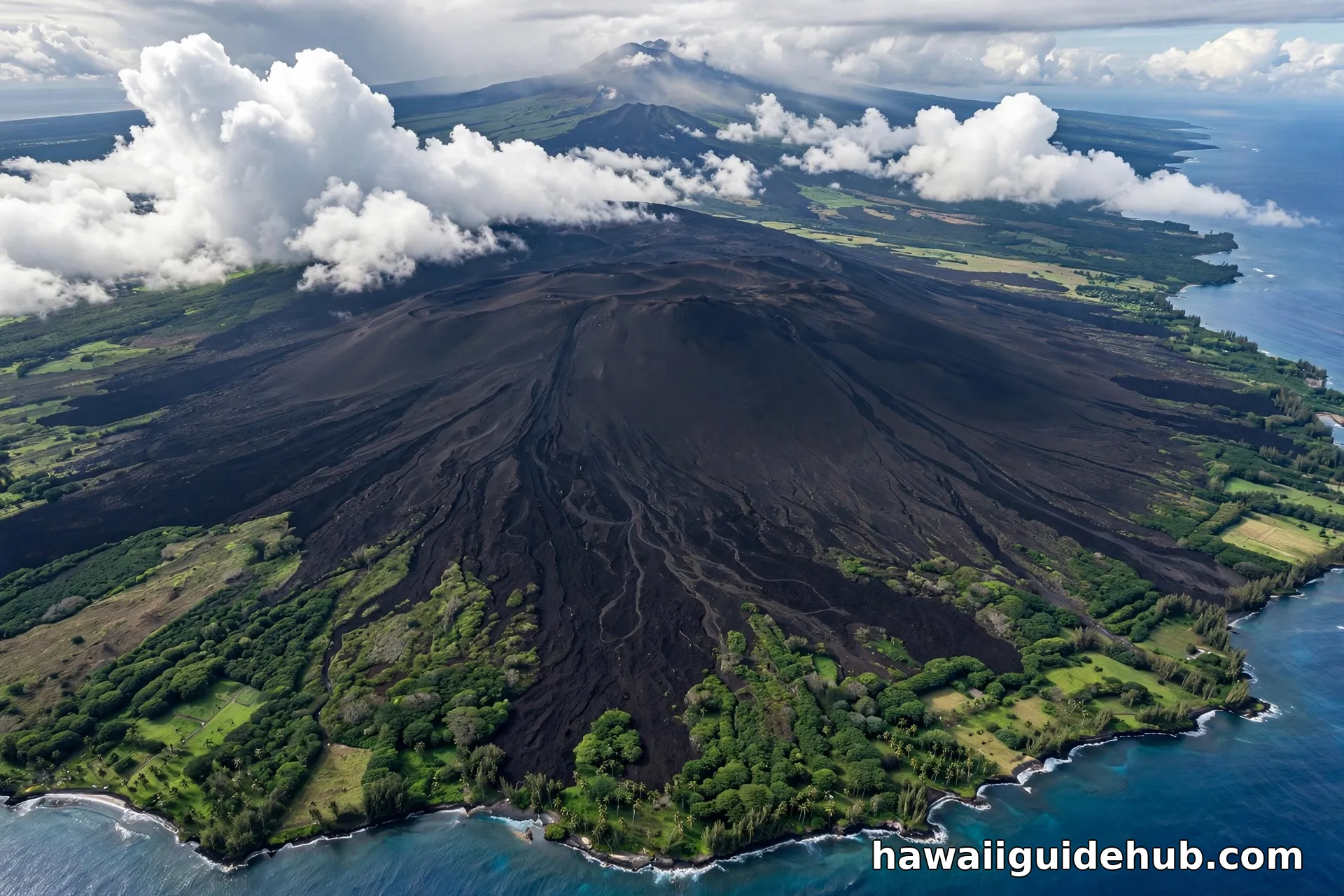
A shield volcano earns its name from its shape: a very wide, low dome, like a warrior’s shield lying flat, with slopes so gentle you might not realize you are on one. Drive up Mauna Loa and the road climbs so gradually the scale only hits you when you look back at the ocean far below.
The shape comes from the lava itself. Hawaiian volcanoes erupt basalt, a type of lava that is unusually hot and runny. Instead of blasting skyward, this fluid lava pours out and races downhill, sometimes traveling for miles before it cools. Eruption after eruption spreads new layers outward, and over hundreds of thousands of years those layers stack into an enormous mountain with a shallow profile. By contrast, steep cone-shaped volcanoes like Japan’s Mount Fuji are built by thick, sticky lava and explosive eruptions that pile material up close to the vent.
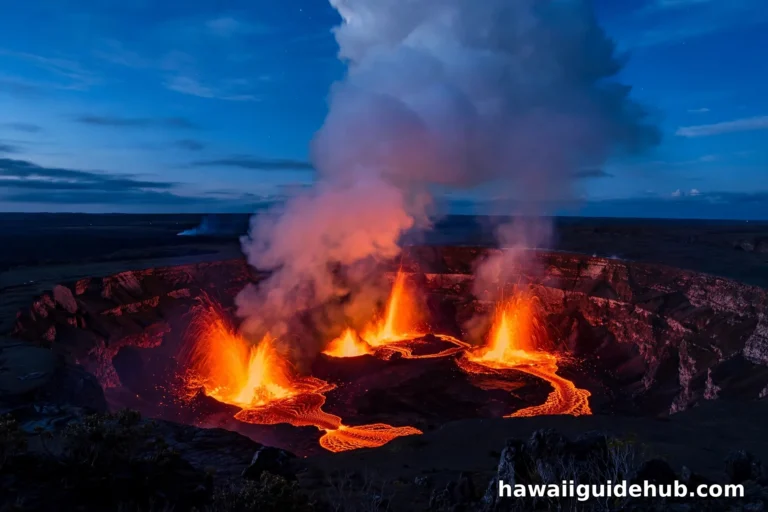
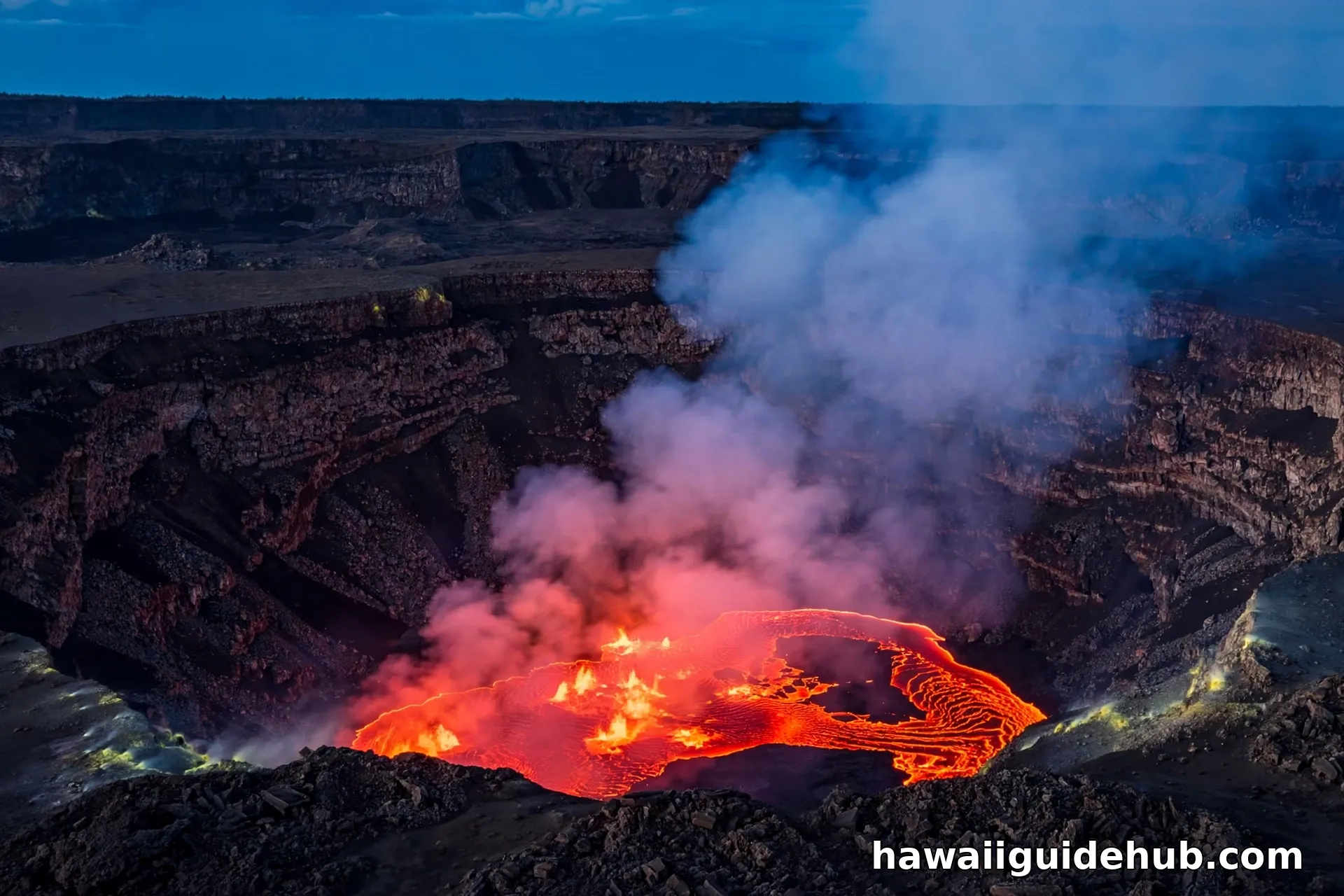
Hawaiian eruptions are mostly effusive, meaning lava flows out relatively calmly rather than exploding, which is why visitors can sometimes watch lava fountains from designated viewpoints. Calm does not mean harmless: the 2018 eruption of Kīlauea’s lower East Rift Zone destroyed hundreds of homes in Leilani Estates. The hazard here is fast-moving but channelized lava flows, volcanic gas, and ground cracking, rather than towering ash columns.
How the Hotspot Built the Hawaiian Islands
The Hawaiian Islands exist because of a hotspot, a plume of unusually hot rock rising from deep inside Earth’s mantle. The hotspot barely moves, but the Pacific Plate above it drifts northwest at roughly 10 centimeters (about 4 inches) per year. As the plate slides over the plume, magma punches through and a new volcano is born; then the plate carries it from its heat source, it quiets down, and a younger volcano starts growing behind it.
This conveyor belt has been running for tens of millions of years, leaving a trail of more than 80 volcanoes stretching about 3,600 miles from the Big Island to the Aleutian Islands. The age pattern across the main islands tells the same story in miniature: Kauaʻi finished its main growth about 5 million years ago, Oʻahu’s volcanoes are 2 to 3 million years old, Maui’s Haleakalā is younger still, and the Big Island, sitting directly over the hotspot today, is less than a million years old and still growing. Every island is a snapshot of the same volcano at a different point in its life.
The Four Stages of a Hawaiian Volcano’s Life
Hawaiian volcanoes typically evolve through four stages as their activity waxes and wanes, each reflecting the volcano’s distance from the hotspot. The whole cycle can take several million years.
Stage 1: Preshield (the underwater beginning)
Every Hawaiian volcano starts on the deep ocean floor. In this earliest stage, eruptions are small and produce chemically distinct alkalic lavas that cool instantly into bulbous pillow lava. The only Hawaiian volcano in this stage right now is Kamaʻehuakanaloa, the seamount formerly known as Lōʻihi, still about 3,189 feet below sea level off the Big Island’s south coast. Scientists estimate it could take as much as 200,000 years to reach the surface.
Stage 2: Shield (the main growth spurt)
This is the glory period. With the volcano closest to the hotspot’s center, eruption rates peak and roughly 95 percent of its total volume is emplaced in about 500,000 years, according to the USGS. Runny tholeiitic basalt pours out through the summit and long rift zones, building the classic shield profile. Both Kīlauea and Mauna Loa are in this stage now. Magma rises from the mantle through a near-vertical conduit, collects in a shallow summit reservoir, then erupts at the summit or travels sideways into the rift zones to feed flank eruptions.
Stage 3: Postshield (the quieter cap)
As the plate carries the volcano from the hotspot, heat fades and eruptions slow. The lava becomes more alkalic, and smaller eruptions build scattered cinder cones and short, thick, pasty flows that steepen the upper slopes. Mauna Kea and Hualālai, roughly 70 kilometers from the hotspot, are in this stage, as is Maui’s Haleakalā. The postshield stage winds down to zero over 250,000 years or less.
Stage 4: Rejuvenated (the surprise comeback)
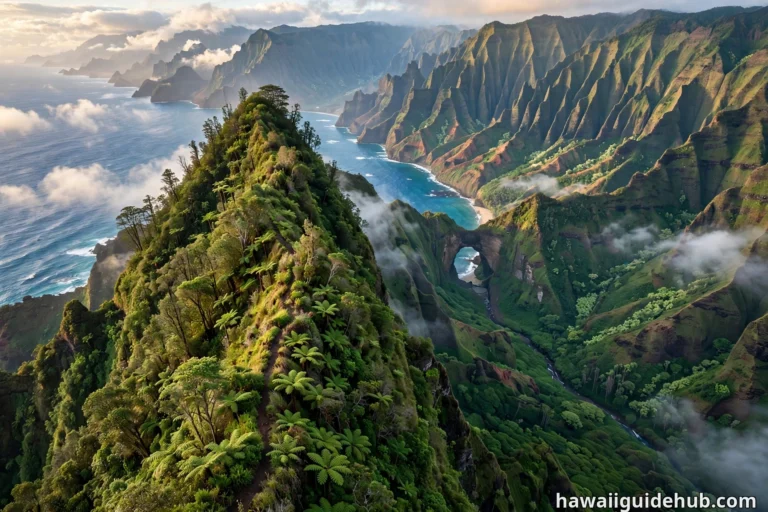
After the postshield stage, a volcano usually goes quiet for a very long time while erosion carves its flanks and the island slowly subsides. Then, in some cases, it wakes up. These rejuvenated eruptions have distinct low-silica chemistry and can punch through coral reefs that grew during the quiet period. On Oʻahu, Diamond Head, Koko Head, and Hanauma Bay all formed in rejuvenated eruptions of the Koʻolau volcano within the past 500,000 years. Scientists are still working out what triggers the comeback, but it produced some of Hawaiʻi’s most recognizable scenery.
The Five Shield Volcanoes of Hawaiʻi Island
The Big Island is five overlapping shield volcanoes, merged so completely that the boundaries are invisible from the ground. Their ages run oldest to youngest from northwest to southeast, and the USGS Hawaiian Volcano Observatory monitors all but the extinct Kohala.
| The Big Island’s five volcanoes, oldest to youngest | Where it stands today | The number to remember |
|---|---|---|
| Kohala | Extinct; last erupted about 120,000 years ago | Summit near 5,480 feet |
| Mauna Kea | Dormant; last erupted more than 4,000 years ago | Summit 13,796 feet |
| Hualālai | Active; last erupted in 1800 to 1801 | Summit 8,271 feet |
| Mauna Loa | Active; largest volcano on Earth by volume | Summit about 13,680 feet |
| Kīlauea | Active; among the world’s most active | Summit about 4,009 feet |
Kohala: the elder, now extinct
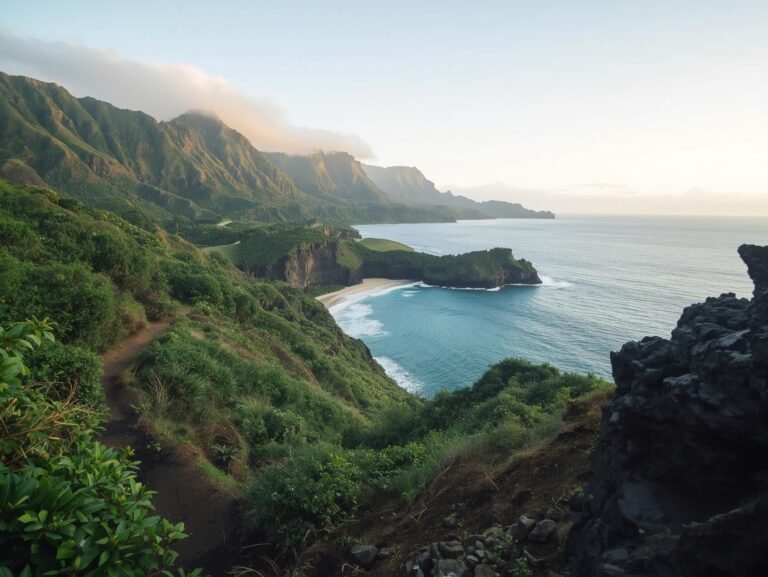
Kohala forms the northern tip of the Big Island, a deeply eroded mountain whose dramatic sea cliffs and valleys, including Waipiʻo Valley, were carved by millions of years of rain and giant landslides. It is the only one of the five considered extinct, having drifted too far from the hotspot to erupt again.
Mauna Kea: the tallest mountain on Earth from base to summit
Mauna Kea rises 13,796 feet above sea level, but that is less than half its story. It extends about 19,700 feet below the ocean surface to the deep sea floor, for a total height of nearly 33,500 feet, taller from base to summit than Mount Everest’s 29,029 feet. Its summit hosts world-famous observatories because the air above 13,000 feet is dry and remarkably steady. Mauna Kea is dormant, not extinct: it last erupted more than 4,000 years ago and could theoretically erupt again.
Hualālai: the active volcano next to Kailua-Kona
Hualālai sits directly behind Kailua-Kona on the island’s west side, which surprises visitors who see it as just a scenic backdrop. It is active and last erupted in 1800 to 1801, sending flows to the coast that are still visible near the Kona airport. In its postshield stage, any future eruption would likely build cinder cones and thick, slow flows near its summit and rift zones.
Mauna Loa: the largest volcano on Earth
Mauna Loa stands not quite as tall as Mauna Kea, at roughly 13,675 to 13,680 feet, but it is far larger in volume, an estimated 80,000 cubic kilometers, and it covers half the island. It has erupted about three dozen times since its first well-documented eruption in 1843, most recently in late 2022. Its summit caldera is about 2 by 3 miles across and 600 feet deep, and the USGS notes the summit swells between eruptions.
Kīlauea: one of the most active volcanoes in the world
Kīlauea is the youngest and busiest of the five. Its summit sits at about 4,009 feet inside Hawaiʻi Volcanoes National Park, and it has erupted with remarkable frequency for decades. Its 2018 lower East Rift Zone eruption was one of the most destructive in modern Hawaiian history, destroying hundreds of homes in Leilani Estates and reshaping the coastline. Its magma rises from at least 30 to 35 kilometers deep, directly beneath the caldera, and typically erupts at the summit or along the East and Southwest Rift Zones.
Pāhoehoe and ʻAʻā: The Two Faces of Hawaiian Lava
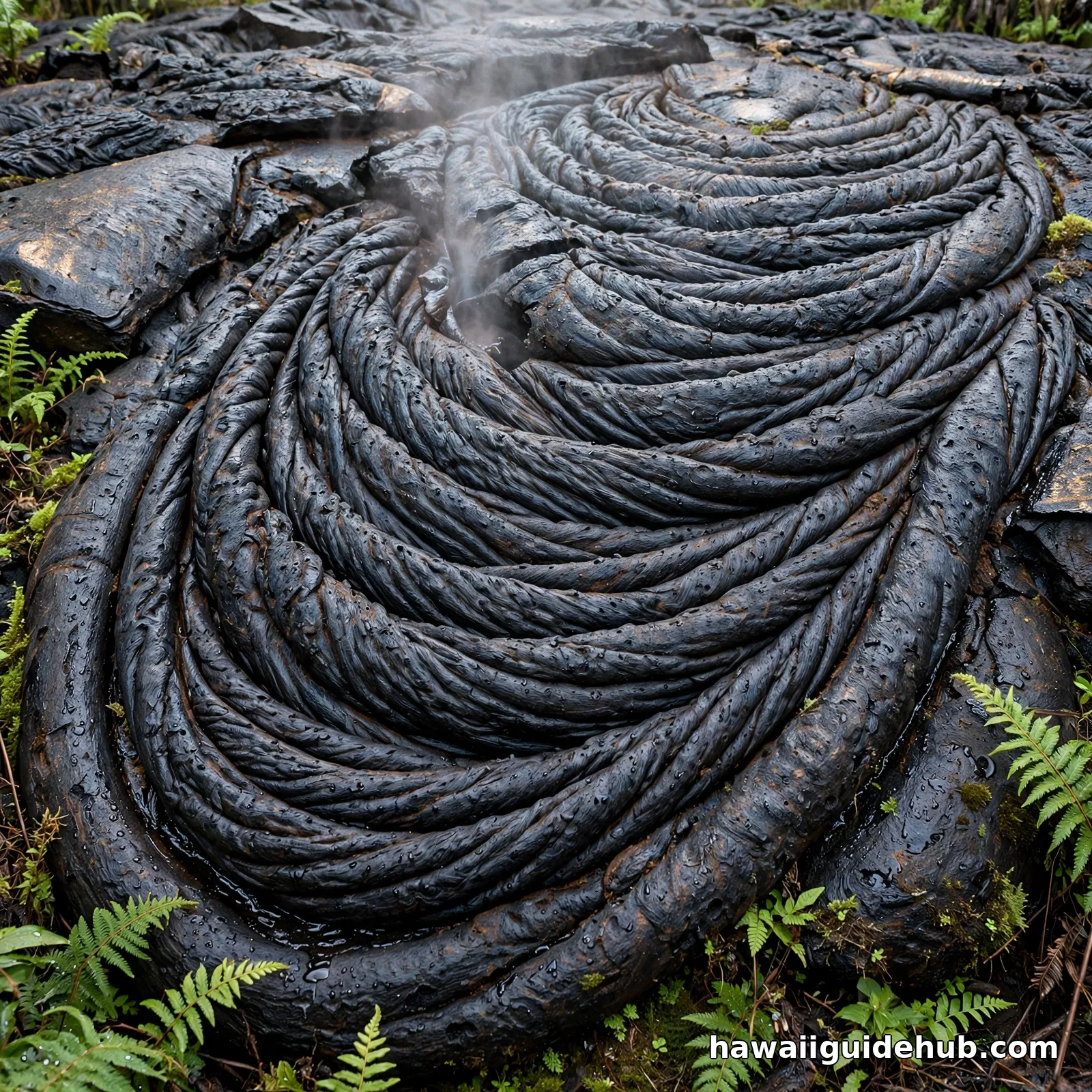
Once lava breaks the surface, it takes one of two famous forms, and every Big Island visitor will see both. Pāhoehoe (pah-hoy-hoy) is smooth, billowy, and ropy, like thick batter that wrinkled as it cooled, and it forms when lava flows slowly. ʻAʻā (ah-ah) is jagged, clinkery, and brutally sharp, forming when the flow is faster and tears its own cooling crust apart. The same eruption can produce both, and one flow can transform from pāhoehoe to ʻaʻā as it picks up speed downhill.
Beyond the Big Island: Haleakalā and the Next Island
Shield volcanoes built every island, not just the Big Island. Haleakalā, which forms most of Maui, is a massive postshield-stage shield that last erupted sometime between 1480 and 1600; its summit rises 10,023 feet, and its vast summit depression is one of Hawaiʻi’s most visited volcanic landscapes.
About 19 miles off the Big Island’s south coast, the submarine volcano Kamaʻehuakanaloa rises to 3,189 feet below the surface. Called Lōʻihi from 1955 until the Hawaiʻi Board on Geographic Names renamed it in July 2021, it sits over the hotspot in its preshield stage. A 1996 earthquake swarm of more than 4,000 events collapsed part of its summit into a pit now called Pele’s Pit. Given enough time, on the order of 200,000 years, it could become the next Hawaiian island.
Hazards: What Shield Volcanoes Can Do
Hawaiian eruptions are effusive rather than explosive, but they carry serious hazards. Lava flows destroy everything in their path and can race downhill at surprising speed; Mauna Loa’s 1950 flow reached the ocean in under three hours. New land where lava enters the sea is extremely unstable and can collapse without warning, and the steam plume it generates contains acid and glass particles. Volcanic gas is the subtler danger: sulfur dioxide forms vog, volcanic smog that irritates eyes and airways, so people with respiratory conditions should check air quality advisories before visiting active areas.
Seeing Hawaii’s Volcanoes Safely
Hawaiʻi Volcanoes National Park is the best place to experience shield volcanoes up close: the summit calderas of Kīlauea and Mauna Loa, steaming vents, cinder cones, the Nāhuku lava tube, and miles of trails across old lava fields. Before you go, check alert levels and closures on the USGS Hawaiian Volcano Observatory and NPS websites, since eruptions, gas, and road access change frequently. Stay on marked paths, never cross closure barriers, keep distance from crater rims and ocean entries, carry extra water, and wear sturdy closed shoes.
Volcano Words Worth Knowing
A few terms make viewpoint signs clearer. A caldera is a large depression formed when a volcano’s summit collapses into its emptied magma chamber; both Kīlauea and Mauna Loa have one. A rift zone is a crack system down the volcano’s flanks where magma travels sideways from the summit; Kīlauea’s East Rift Zone hosted the 2018 eruption. Vog is volcanic smog formed from sulfur dioxide. A cinder cone is a small steep hill of cinders from fountaining lava, common in the postshield stage. Pele is the Hawaiian goddess of volcanoes and fire, deeply woven into the cultural meaning of these landscapes.
Frequently Asked Questions
What is the difference between a shield volcano and a regular volcano?
Shield volcano is one of several volcano types. Shields have broad, gentle slopes built by runny lava flows, while stratovolcanoes like Mount Fuji are steep cones built by thick lava and explosive eruptions. That is why Hawaiian eruptions are mostly flowing lava rather than ash explosions.
Is Mauna Kea a shield volcano?
Yes. Mauna Kea is a postshield-stage shield volcano. It last erupted more than 4,000 years ago, so it is classified as dormant, and it is the tallest mountain on Earth measured from its base on the ocean floor to its summit.
How many active volcanoes does Hawaii have?
The USGS Hawaiian Volcano Observatory monitors six: Kīlauea, Mauna Loa, Hualālai, Haleakalā, Mauna Kea, and the submarine Kamaʻehuakanaloa. Kīlauea and Mauna Loa are the most frequently active; Hualālai and Haleakalā are active but quieter; Mauna Kea is dormant; Kamaʻehuakanaloa is growing underwater.
Will there be a new Hawaiian island?
Eventually. Kamaʻehuakanaloa is growing on the ocean floor about 19 miles south of the Big Island, and the USGS estimates it could take as much as 200,000 years to break the surface. On human timescales the island chain you see today is the one that matters.
Is it safe to visit Hawaii Volcanoes National Park?
Yes, when you follow the park’s rules. The NPS closes areas that are unsafe due to eruptions, gas, or unstable ground, and designated viewpoints keep visitors at safe distances. Check conditions and alert levels before your visit, stay out of closed areas, and take vog seriously if you have respiratory issues.
Hawaiʻi’s shield volcanoes are the reason these islands exist, and understanding them changes how you see every landscape here. The black sand beach you swim at is pulverized shield-stage lava. The cinder cone on the horizon is a postshield afterthought. The steep green cliffs of an older island are a shield volcano after millions of years of rain. Once you know the life story of these mountains, the whole archipelago reads like one biography, written in lava, with the newest chapter still being drafted beneath the waves.