The Hawaiian Monk Seal

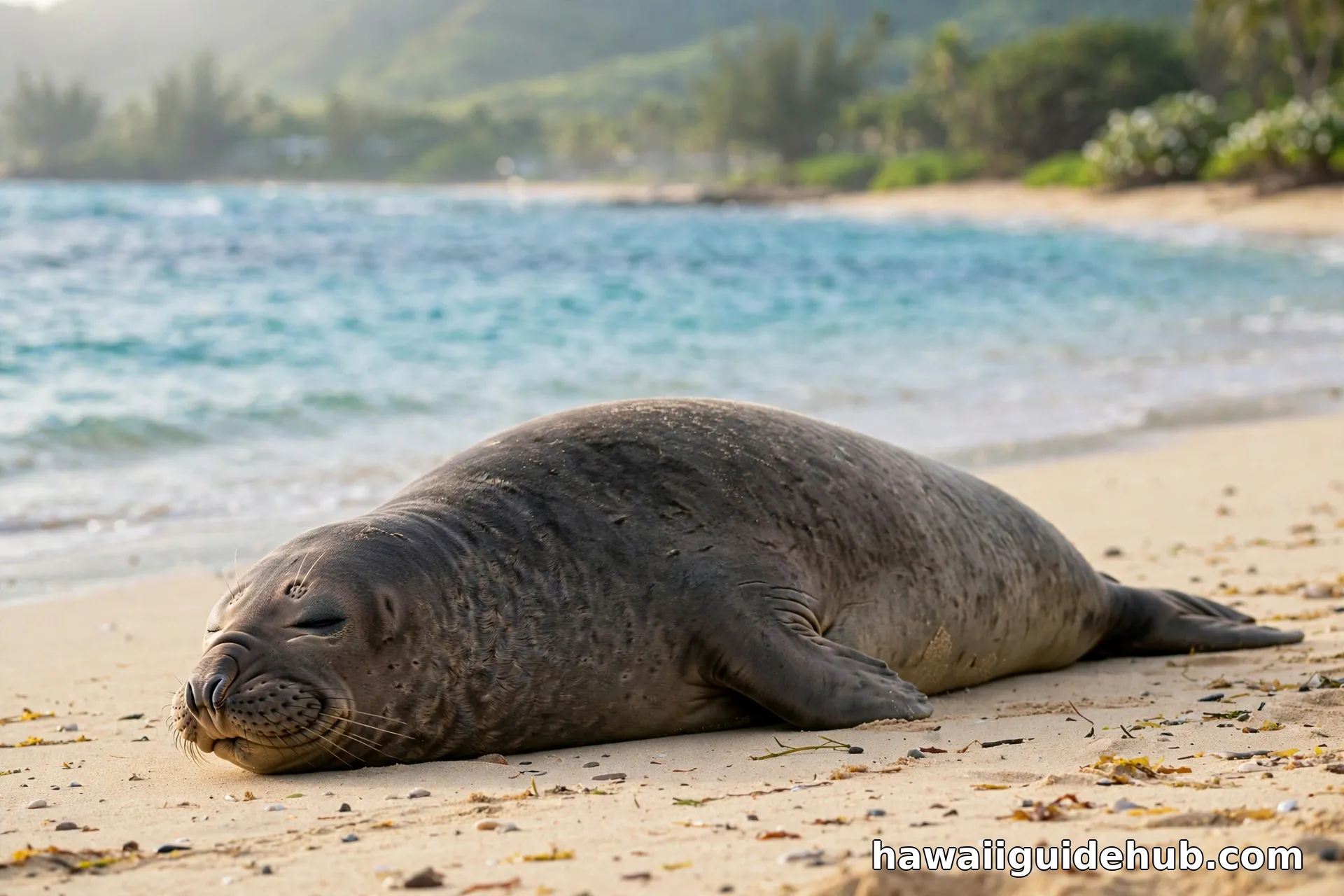
On a quiet morning at a beach on Oahu, Kauai, or Maui, you might walk over a rise of sand and find a big, dark, sleeping animal stretched out by the waterline. It looks like a dog that has given up and decided to nap in the sun. It is not a dog. It is a Hawaiian monk seal, one of the rarest marine mammals on earth, and there are fewer of them left than there are seats in a small-town football stadium.
Hawaiian Monk Seal at a Glance
| THE ANIMAL | |
| Scientific name | Neomonachus schauinslandi |
| Hawaiian name | ʻĪlioholoikauaua (dog that runs in rough water) |
| Native status | Endemic to Hawaii; the only seal native to the islands |
| Adult size | 400 to 600 pounds and about 7 feet long |
| Population | About 1,600 total (2025); most live in the Northwestern Hawaiian Islands |
| Main islands population | Roughly 300 to 400 seals |
| Where seen | Beaches and reefs across all the main Hawaiian Islands |
| THE LAW | |
| Legal status | Endangered under the Endangered Species Act; protected under the Marine Mammal Protection Act |
| Viewing distance | At least 150 feet; farther from mothers with pups |
| Report sightings | NOAA Marine Wildlife Hotline: (888) 256-9840 |
What a Hawaiian Monk Seal Is
The Hawaiian monk seal is a true seal, a member of the family that includes harbor seals and gray seals, and it lives nowhere else on the planet. Biologists call it Neomonachus schauinslandi, and it is the only seal species native to Hawaii. Its closest living relative is the Mediterranean monk seal, an animal that survives in small, scattered groups around the Mediterranean Sea and the Atlantic coast of Africa. The Caribbean monk seal, the third member of the group, is extinct, hunted out of existence by the 1950s.
Monk seals get their common name from their appearance. Adult seals have smooth, dark heads with sparse hair, and loose folds of skin around their necks that reminded early observers of the hooded robes worn by monks. They are also unusually solitary for seals. Where elephant seals and sea lions crowd onto beaches in noisy colonies, Hawaiian monk seals mostly haul out alone or in small, loose groups. A beachgoer who finds one resting on the sand has found an animal that is far more independent than most of its seal cousins.
The Hawaiian name, ʻīlioholoikauaua, translates roughly as “dog that runs in rough water,” a description that fits the way monk seals paddle through surf. The name is written with the ʻokina, the glottal stop that is a full letter in the Hawaiian language.
How Many Hawaiian Monk Seals Are Left
About 1,600 Hawaiian monk seals remain in the wild, according to NOAA Fisheries’ most recent estimates, making it one of the most endangered seal species in the world.
Most of the population, roughly 1,100 to 1,400 animals, lives in the remote Northwestern Hawaiian Islands, inside the Papahānaumokuākea Marine National Monument. These uninhabited atolls and reefs, stretching from Nihoa to Kure, are the species’ historical stronghold. Field teams from NOAA visit these islands every year to count seals, tag pups, and monitor the population, because this is where the majority of births happen and where the long-term future of the species will be decided.
The rest, roughly 300 to 400 seals, live in the main Hawaiian Islands, where most people encounter them. This main-island group has been growing in recent years, which is one of the few bright spots in the species’ story. More pups are being born on Kauai, Oahu, Maui, Molokai, and the Big Island than in the past, and citizen reports from beachgoers have become an important part of tracking them: NOAA relies on public sighting reports to monitor seals along more than 750 miles of inhabited shoreline.
The Hawaiian monk seal has been listed as endangered under the Endangered Species Act since 1976, and it is fully protected under the Marine Mammal Protection Act. Those two laws make it a federal crime to harass, harm, or kill a monk seal, with serious fines and possible prison time for violations.
Where You Might See a Monk Seal
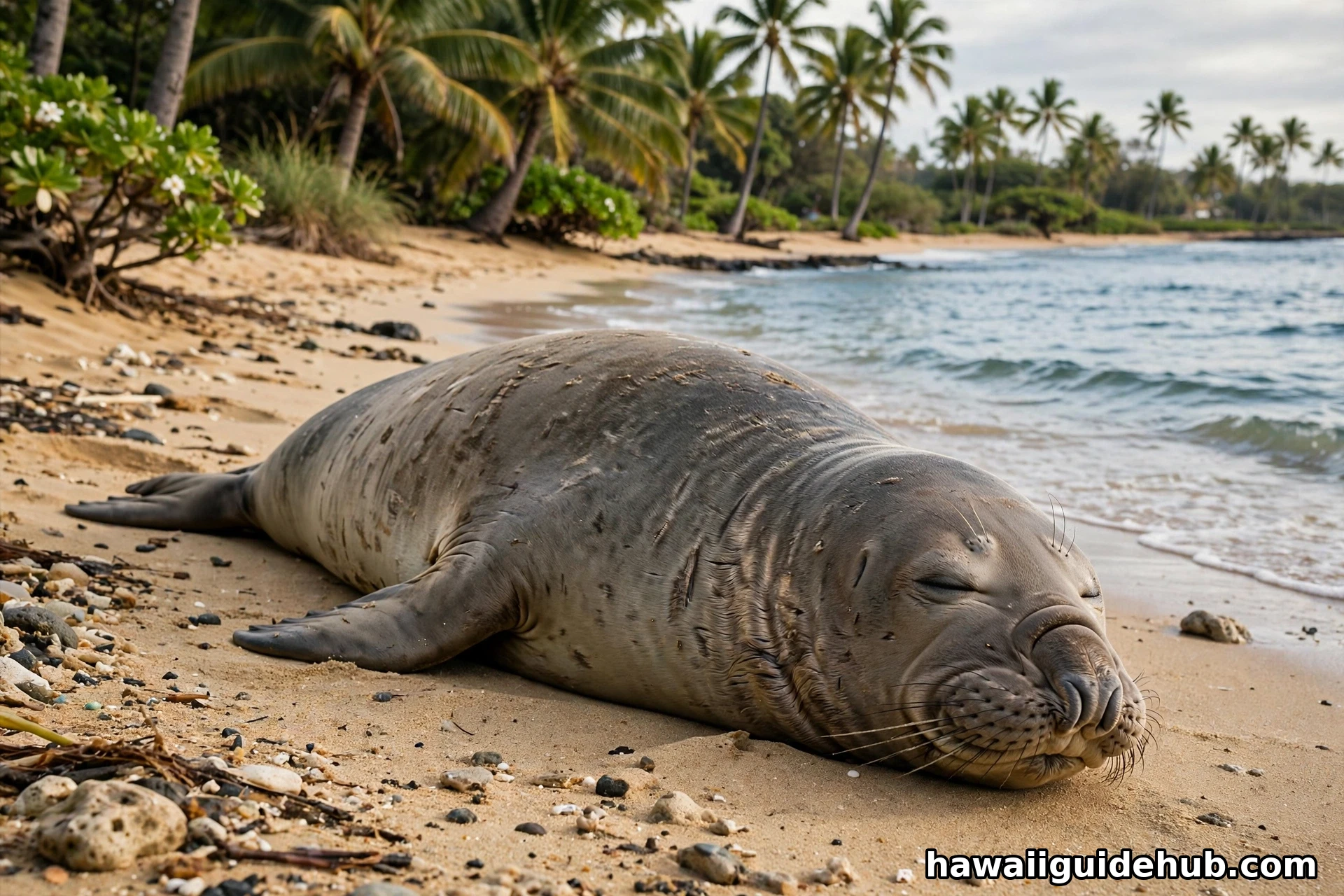
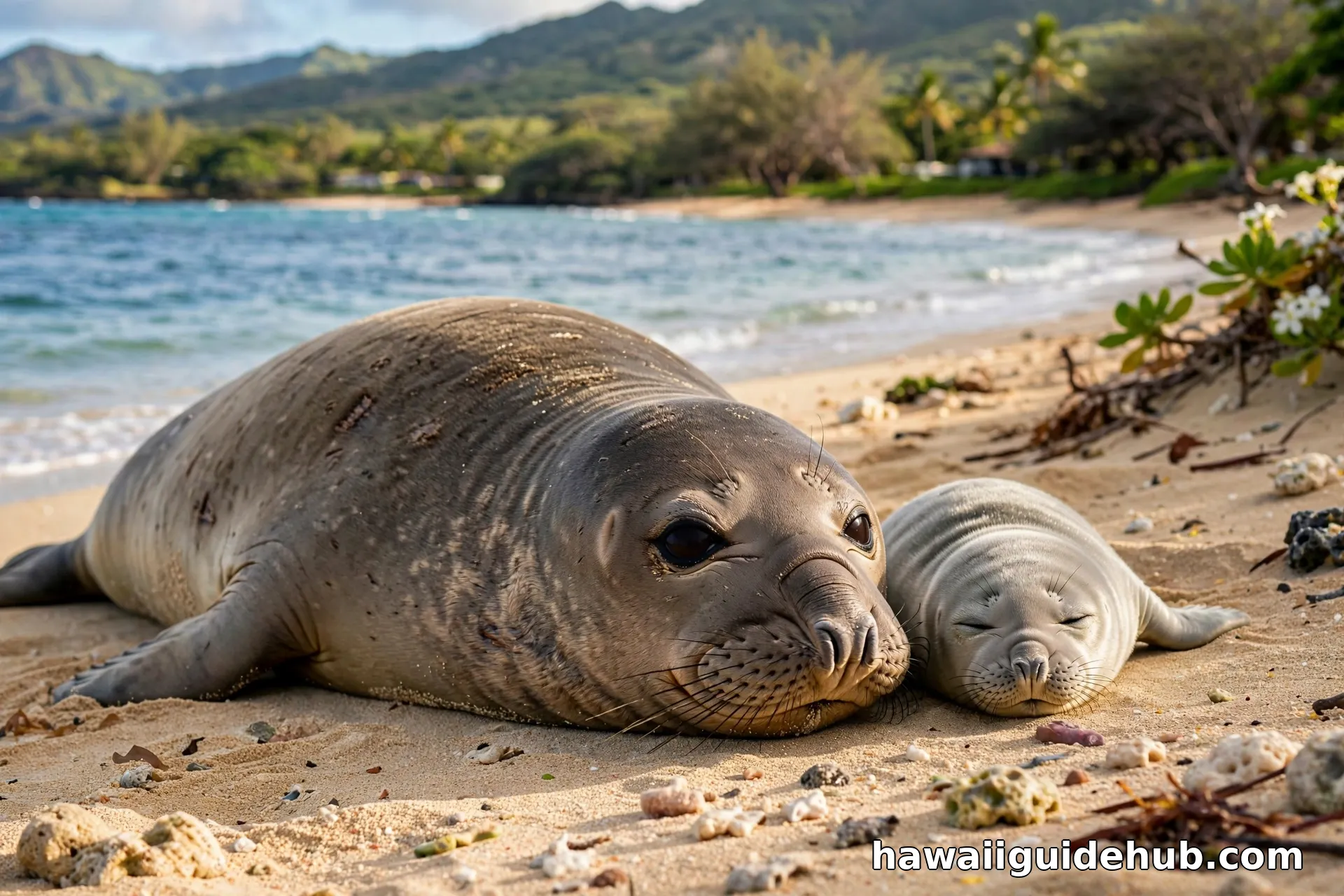
Monk seals spend most of their time in the ocean, hunting along reefs and in deeper water, but they regularly come ashore to rest, molt, and give birth. When a monk seal hauls out on a beach, it is usually resting after a night of foraging, and it may sleep on the sand for hours at a time. Unlike sea lions, which often look alert and social on land, a resting monk seal can look almost lifeless: flat on its side, motionless, breathing slowly. A seal that looks dead is very often just deeply asleep.
Seals haul out on beaches across all the main Hawaiian Islands. Kauai, Oahu, Maui, Molokai, Lanai, and the Big Island all have regular seal visitors, and sightings have become more common as the main-island population has grown. The seals tend to favor quiet, sandy stretches, but they also appear on busy beaches near towns and resorts. Any sandy shoreline in Hawaii is potential seal habitat, and a hauled-out seal can show up anywhere the ocean meets the sand.
Molting is another reason seals come ashore. Once a year, adult monk seals shed their entire outer layer of skin and fur in a process called a catastrophic molt, spending days to weeks on the beach while the old skin peels away in sheets. A molting seal looks alarming: patchy, raw-looking, and shedding in strips. It is a normal and healthy process. A molting seal needs rest and distance, not rescue, and the best response is to leave it completely alone.
What Monk Seals Eat and How They Live
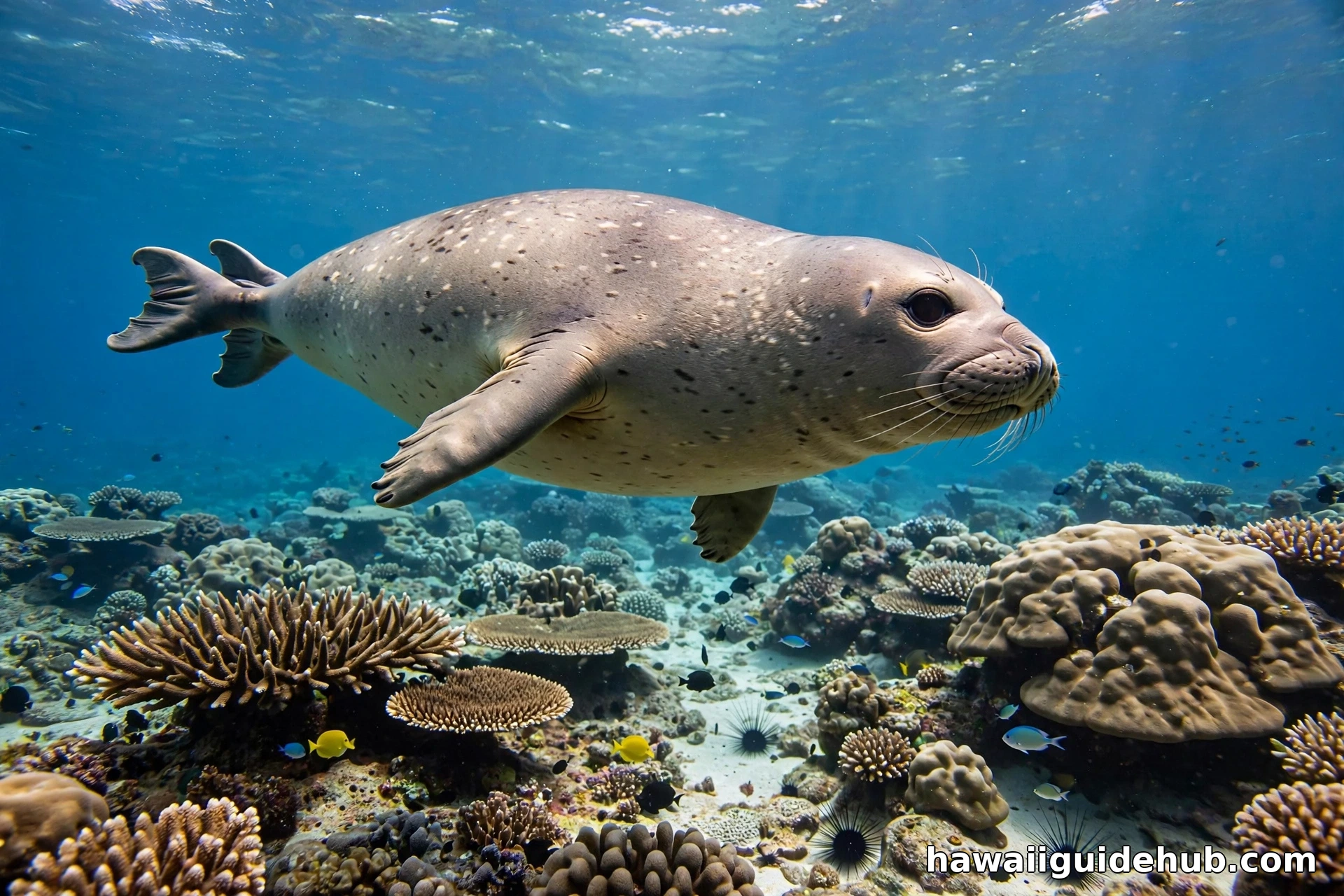
Hawaiian monk seals are generalist hunters that feed on a wide variety of reef and bottom-dwelling prey. Their diet includes reef fish, octopus, lobsters, eels, and other creatures found along coral reefs and sandy bottoms. They do much of their hunting at night or in deep water, sometimes diving hundreds of feet to find food, and then return to shallow reefs and beaches to rest during the day.
Adult monk seals reach 400 to 600 pounds and about 7 feet in length, with females often slightly larger than males. Despite their size, they are graceful and agile in the water, using their front flippers to maneuver precisely around reefs. On land they are clumsy and vulnerable, which is one reason a hauled-out seal must never be approached: a startled seal has few options, and a bite from a frightened 500-pound animal is a serious injury.
Breeding happens year round. A newborn pup weighs 25 to 35 pounds, roughly the size of a medium dog. The mother nurses it on extremely rich milk for five to seven weeks, during which the pup can grow to 200 pounds by weaning time. After weaning, the mother leaves, and the young seal must learn to hunt on its own. Females do not breed until they are about four or five years old, so the loss of a young female is a serious blow to the population’s future.
Why the Species Is Endangered
The Hawaiian monk seal’s troubles began in the 1800s, when whalers, sealers, and shipwrecked sailors hunted the animals in the Northwestern Hawaiian Islands for food and oil. Entire colonies were wiped out. By the time legal protections arrived in the 20th century, the population had been reduced to a fraction of its original size, and the species has been climbing back slowly ever since.
Modern threats are different but still serious. One of the leading killers of monk seals in the main Hawaiian Islands is toxoplasmosis, a parasite carried in cat feces that washes from land into the ocean. This is why wildlife agencies urge cat owners to keep cats indoors and to never abandon cats near the coast. Fishing gear is another major threat: seals become entangled in nets, lines, and hooks. NOAA runs a dedicated response program that disentangles and treats injured animals, but prevention matters more than rescue, and careful, responsible fishing practices save seal lives.
Other threats include loss of beach habitat to erosion and development, disturbance by people and dogs, shark predation on pups, and the species’ own low genetic diversity, a legacy of the 19th-century hunting that left the population genetically impoverished and less able to adapt to disease and change.
The Rescue and Recovery Effort
Bringing the monk seal back is a team effort led by NOAA Fisheries, the Hawaiʻi Department of Land and Natural Resources, the Marine Mammal Center, Hawaiʻi Marine Animal Response, and community volunteers. The Marine Mammal Center operates Ke Kai Ola, a dedicated monk seal hospital on the Big Island, where sick and injured seals are treated and released back to the wild.
Field teams also use temporary satellite tags to track seals after release, studying where they travel and how they use the ocean. Volunteer networks across the islands respond to seal sightings, set up protective perimeters around hauled-out seals and mother-pup pairs, and educate beachgoers about proper viewing distance. Without these volunteers, protecting seals on hundreds of miles of public beach would be impossible.
The long-term goal is to recover the population enough to remove the Hawaiian monk seal from the endangered species list. Every rehabilitated seal, protected pup, and sighting report moves the species closer.
The Viewing Rules: What to Do When You See a Seal
Seeing a Hawaiian monk seal is a privilege, and the rules for behaving around one are simple and nonnegotiable. NOAA’s viewing guidance says to stay at least 150 feet away from a resting seal, on land or in the water. That is about half a football field. If the seal is a mother with a pup, give even more space: at least 150 feet at minimum, and respect any perimeter set up by volunteers, which is often wider. Distance is measured from the animal, not from any rope or sign.
Never touch, feed, or try to get a seal’s attention. Do not pour water on a seal, do not chase it back into the ocean, and do not let your dog anywhere near it. Use a zoom lens or binoculars for photographs instead of walking closer. If you are snorkeling or swimming and a seal approaches you in the water, stay calm, do not reach out, and give it room to pass.
If a seal appears injured, entangled, or in trouble, do not attempt a rescue yourself. Call the statewide NOAA Marine Wildlife Hotline at (888) 256-9840. Trained responders will assess the situation. The same hotline is the right number for reporting any seal sighting, because every report helps scientists track the population. Reporting a sighting is one of the most useful things an ordinary beachgoer can do for the species.
It is worth remembering that harassing a monk seal is a federal offense. People have been prosecuted and fined for deliberately disturbing seals, and enforcement officers take these cases seriously. The laws exist because the species cannot afford to lose a single animal to human carelessness. For more on how to view Hawaii’s marine wildlife responsibly, see our guide to responsible marine wildlife viewing in Hawaii.
Monk Seals in Hawaiian Culture
The Hawaiian name ʻīlioholoikauaua shows that Native Hawaiians knew this animal well, and the seal appears in Hawaiian tradition and place names. Like the honu, the green sea turtle, the monk seal is a respected native animal of the islands, and many Hawaiians see its recovery as part of restoring the islands’ natural heritage. Learning the seal’s Hawaiian name, and using it, is a way to acknowledge that this animal belongs to Hawaii in a way no introduced species ever will. Our guide to Hawaiian green sea turtle conservation and etiquette covers another beloved native species with its own viewing rules.
Video: Species in the Spotlight
NOAA Fisheries’ spotlight on the Hawaiian monk seal: the animal, its threats, and the recovery effort.
Frequently Asked Questions
Are Hawaiian monk seals dangerous?
Monk seals are wild animals, not pets, and a frightened or startled seal can bite. Adults weigh 400 to 600 pounds and have powerful jaws. They are not aggressive toward people who keep their distance, and almost every dangerous encounter involves a person getting too close. The 150-foot viewing rule keeps both you and the seal safe.
How far away should I stay from a monk seal?
NOAA recommends staying at least 150 feet away, measured from the animal. For a mother with a pup, stay even farther back and respect any volunteer perimeter, which is often 150 to 300 feet. Use binoculars or a camera zoom for a close look.
What should I do if I see a monk seal on the beach?
Enjoy the sighting quietly from a distance. Keep dogs leashed and far away, do not touch or feed the seal, and call the NOAA Marine Wildlife Hotline at (888) 256-9840 to report it. Your report helps scientists monitor the population. If the seal appears injured or entangled, the same hotline connects you with trained responders.
Can I swim with a Hawaiian monk seal?
No. Approaching or interacting with a monk seal in the water violates federal law and puts you at risk of a bite. If a seal swims near you while you are snorkeling, stay calm, keep your distance, and do not reach toward it. Admire it, then let it go on its way.
Where is the best place to see a monk seal in Hawaii?
There is no guaranteed spot, because seals haul out wherever they choose. Sandy beaches on Kauai, Oahu, Maui, Molokai, and the Big Island all see regular visitors. Early mornings are a good time to look, since seals often haul out after nighttime foraging. Check beaches at low tide and scan the sand with binoculars.
Why are Hawaiian monk seals endangered?
They were hunted to near extinction in the 1800s for food and oil, and they never fully recovered. Today the biggest threats are toxoplasmosis from cat feces washing into the ocean, entanglement in fishing gear, habitat loss, and disturbance by people and dogs. The population is slowly growing in the main Hawaiian Islands thanks to conservation work.
The Hawaiian monk seal is a reminder that rarity can be beautiful. This animal, found nowhere else on earth, is worth 150 feet of your beach and a phone call to a hotline. Give it space, report your sighting, and you become part of the recovery story. For a broader look at the islands’ remarkable ocean life, see our guide to Hawaii’s iconic marine species for snorkelers and divers.