Spinner Dolphins of Hawaii

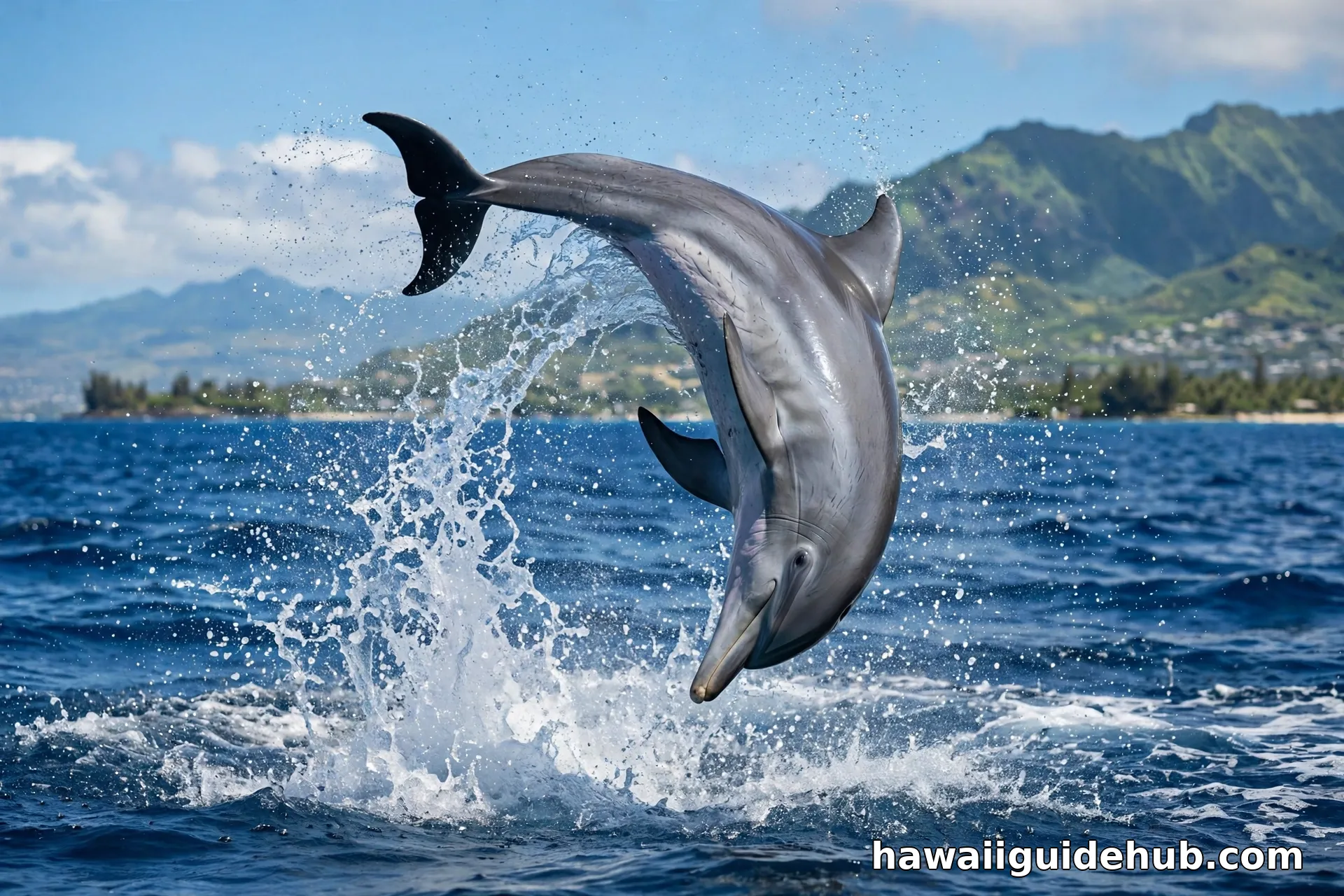
There is a moment, just after sunrise in a calm Hawaiian bay, when the water starts to move. A dark back breaks the surface, then another, and suddenly a dolphin launches itself into the air and spins, once, twice, three times, before landing with a splash. This is the Hawaiian spinner dolphin, the most acrobatic dolphin in the world, and one of the most commonly seen wild dolphins in Hawaii’s nearshore waters.
This is the single complete guide to spinner dolphins in Hawaii. It covers how to recognize them, where they go and why, the famous spinning behavior, the federal 50-yard rule that changed dolphin viewing forever, how to watch them responsibly, and the threats they face. Everything about spinner dolphins in Hawaii, in one place.
Spinner Dolphins in Hawaii at a Glance
| The animal | Stenella longirostris (Gray’s spinner dolphin in Hawaii); Hawaiian name naiʻa; 4.6 to 6.8 feet long, at least 181 pounds, about 20 years lifespan |
| The show | Leaping and spinning up to 7 times in the air; feeds offshore at night, rests in shallow bays by day |
| The law | Protected under the Marine Mammal Protection Act; the 50-yard rule makes it illegal to swim with, approach, or stay within 50 yards (federal rule, effective October 2021) |
| How to watch | From shore or a boat at 50+ yards, mornings in calm bays; seen in nearshore waters of all main Hawaiian Islands |
How to Recognize a Spinner Dolphin
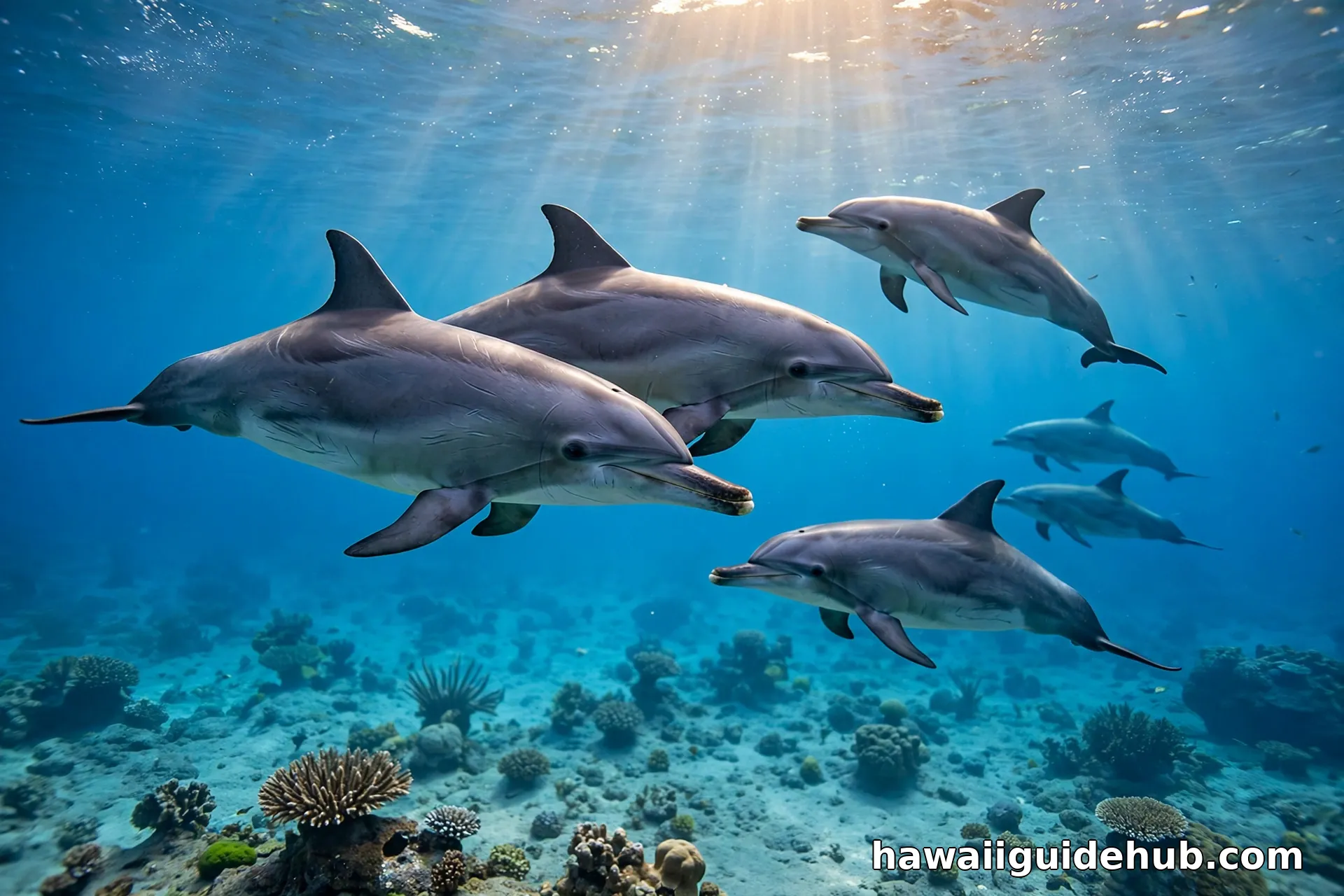
Spinner dolphins are relatively small and slender as dolphins go. Hawaiian animals belong to the Gray’s spinner dolphin subspecies: adult females run 4.6 to 6.7 feet long, adult males 5.2 to 6.8 feet, and they reach weights of at least 181 pounds. They have thin, back-curved flippers and dorsal fins that range from slightly curved to upright and triangular. Each dolphin’s dorsal fin is unique, with its own shape, nicks, and notches, and researchers photograph fins to identify individual animals and track them over the years.
Their color pattern comes in three parts: a dark gray cape across the back, a light gray band along the side, and a white belly. The long, slender beak is what earned them the species name longirostris, Latin for “long beak.” In the water, the surest identification is the behavior itself. No other dolphin in Hawaii routinely launches out of the sea and corkscrews through the air the way spinners do.
Bottlenose dolphins, which also live around Hawaii, are larger, stockier, and far less aerial. If you see a small, slender dolphin spinning like a thrown football, you are watching a spinner. Hawaiians call dolphins naiʻa, and the spinner’s acrobatics have made it the most familiar naiʻa in island waters, the one visitors picture when they imagine dolphins in Hawaii. Our deeper look at dolphin behavior around Oahu covers the rest, feeding, and social signals you might observe.
Why They Spin
A spinner dolphin can rotate up to seven times in a single leap before falling back into the water. Scientists believe the spinning serves mainly as acoustic signaling, a way to communicate with other dolphins, because the splashes and the sounds they make carry far underwater. The spinning may also help shake off remoras and other parasites that cling to the skin.
Spinning is social. Pods often spin in bursts, and the behavior peaks at certain times of day, especially around the transitions between resting and activity. A pod that has just finished its daytime rest will often erupt in leaps, spins, tail slaps, and fast swimming, as if the whole group is waking up together. Watching this wake-up sequence from a respectful distance is one of the great wildlife spectacles in Hawaii.
A Day in the Life: Night Hunters, Daytime Sleepers
Spinner dolphins live on an opposite schedule from most beachgoers. At night, they head offshore to feed on small fish, shrimp, and squid found 650 to 1,000 feet below the surface. Their prey rises toward the surface at night in a daily vertical migration, and the dolphins follow it, hunting in the dark with echolocation. A night of foraging is energetically expensive, which is why what happens during the day matters so much.
By day, the dolphins return to specific nearshore bays to rest, socialize, and nurse their young. They choose clear, calm, relatively shallow water with sandy bottoms, where they can watch for predators visually. Resting dolphins move slowly back and forth as a single tight unit, barely touching, and they stop using echolocation, relying on vision instead. They rest like this for about four to five hours a day. Because they must surface to breathe even while sleeping, they are only half asleep, and they look, to a casual observer, like they are simply swimming lazily or playing.
This daytime rest is the critical part of their biology. Without consistent, undisturbed rest, dolphins have less energy for the night’s foraging, and over time their body condition, disease resistance, reproduction, and ability to raise calves all suffer. The entire modern framework of spinner dolphin protection in Hawaii exists to defend these few hours of daytime sleep.
Not all Hawaiian spinner dolphins follow this exact routine. Researchers recognize both island-associated stocks, which rest in the nearshore bays described here, and a pelagic stock that ranges in deeper offshore waters. But the nearshore groups are the ones people encounter, and they are the ones the 50-yard rule was written to protect. When the rest period ends, the dolphins often swim in a zig-zag pattern, surging toward open water and doubling back, a coordinated movement scientists believe serves as a social cue for the whole pod to begin the night’s foraging run.
The 50-Yard Rule: What the Law Says
Since October 28, 2021, it has been illegal under federal law to swim with, approach, or remain within 50 yards of a Hawaiian spinner dolphin. The rule, issued by NOAA Fisheries under the Marine Mammal Protection Act, applies to every person, vessel, and object, including boats, kayaks, paddleboards, and drones, within 2 nautical miles of shore around the main Hawaiian Islands and in the designated waters bounded by Lanai, Maui, and Kahoolawe.
The rule also bans approach by interception, which means you cannot place yourself, your boat, or your paddleboard in the dolphins’ path so that they swim within 50 yards of you. Dropping swimmers ahead of a pod, a practice once called leapfrogging, is prohibited. There are narrow exceptions, such as when a dolphin approaches you on its own and you make no effort to engage and immediately move away, but the default is simple: stay 50 yards back.
Enforcement is real. NOAA’s Office of Law Enforcement has run hundreds of focused patrols since the rule took effect and has issued well over a hundred enforcement actions, with penalties ranging from $100 to $4,500. Most violations have involved commercial and recreational activity on Hawaii Island and Oahu. The 50-yard line is a minimum, not a permission slip: behavior beyond 50 yards can still count as illegal harassment if it disrupts the animals.
How to Watch Spinner Dolphins Responsibly
The best way to see spinner dolphins is also the legal way: from shore or from a boat, at 50 yards or more, using binoculars or a camera zoom. Many of their resting bays are visible from land, and morning is the prime window, when pods are settled into their daytime rest or just beginning their wake-up sequence. Watch briefly, then move on. The dolphins’ schedule matters more than your photo.
If you take a boat trip, choose the experience first and ask how the operator handles dolphin encounters. A responsible captain keeps distance, never chases or circles a pod, and does not promise in-water encounters with wild spinners in covered waters. Be skeptical of any itinerary that guarantees swimming with wild dolphins: in the regulated waters around the main islands, that activity is now illegal.
Kayakers and paddleboarders need the same discipline. If dolphins appear while you are on the water, do not paddle toward them, do not try to intercept their path, and move steadily away if you find yourself inside 50 yards. For a full rundown of viewing etiquette across species, see our guide to responsible marine wildlife viewing in Hawaii.
Where to See Spinner Dolphins in Hawaii
Spinner dolphins use bays and nearshore waters around all the main Hawaiian Islands, and they tend to return to the same resting areas day after day. On Oahu, the leeward coast around Waianae is famous for morning dolphin activity. On the Big Island, the Kona and Kohala coasts regularly host pods. Maui, Lanai, and Kauai all have their own resting bays. Because the dolphins follow the same daily rhythm everywhere, early morning in a calm, sandy-bottomed bay is the formula wherever you are.
Shore viewing is underrated. A pair of binoculars, a high vantage point, and patience will often produce better, longer, and completely legal dolphin watching than any boat. You will see the spins, the tail slaps, and the slow resting formations, all without entering the water or the 50-yard zone.
Reproduction and Family Life
Spinner dolphins are slow reproducers, like all marine mammals. They live about 20 years, with some individuals reaching at least 25. They can mate year round, with multiple males mating with one female. Gestation lasts about 11 months, and females generally calve once every three years, nursing each calf for one to two years. They reach sexual maturity at around seven years of age.
Calves stay close to their mothers within the pod, and the daytime resting bays double as nurseries where young dolphins are sheltered while mothers recover from the night’s foraging. Disturbing a resting pod does not just tire the adults; it disrupts the nursing and sheltering of the next generation. This is a major reason the 50-yard rule protects entire bays rather than individual animals.

Threats Beyond Disturbance
Viewing pressure is the most visible threat, but it is not the only one. Marine debris injures and kills dolphins through ingestion and entanglement, and researchers have found plastic in the lantern fish that make up much of the spinner dolphin’s diet, a pathway for pollutants to move up the food chain. Our guide to how plastic pollution affects marine life explains this chain in detail.
Human-made ocean noise interferes with the echolocation and communication the dolphins depend on for night feeding. Disease is a quieter threat: scientists have detected toxoplasmosis and cetacean morbillivirus in spinner dolphins, and while reported deaths are low, many deaths at sea go undetected. Climate-driven changes in ocean productivity could also shift the deep-water prey the dolphins depend on, though researchers are still working out how those changes will play out.
Video: Spinner Dolphins at Manele Bay
Spinner dolphins at Manele Bay, Lanai, filmed during a Pacific Whale Foundation trip. Listen for the dolphins’ clicks and whistles, and the singing humpback whales in the background.
Frequently Asked Questions
Can you swim with spinner dolphins in Hawaii?
No. Since October 2021, federal law prohibits swimming with, approaching, or remaining within 50 yards of Hawaiian spinner dolphins within 2 nautical miles of shore around the main islands. Violations carry fines from $100 to $4,500. Watch them from shore or a boat instead.
Why do spinner dolphins spin?
Scientists believe spinning is mainly a form of acoustic communication, with the splashes carrying messages to other dolphins. It may also help remove parasites like remoras from the skin. Spinners can rotate up to seven times in a single leap.
Where is the best place to see spinner dolphins?
Calm, sandy-bottomed bays on any main island, early in the morning. Oahu’s leeward Waianae coast and the Kona and Kohala coasts of the Big Island are well known for regular sightings. Shore viewing with binoculars is often the best option.
How big do spinner dolphins get?
Hawaiian spinner dolphins reach 4.6 to 6.8 feet long and weigh at least 181 pounds. They live about 20 years, with some individuals living 25 years or more.
Are spinner dolphins endangered?
They are not listed as endangered, but they are protected under the Marine Mammal Protection Act, and Hawaiian spinner dolphins have extra federal protections because of chronic disturbance of their daytime resting habitat. Harassing them is illegal.
What should I do if dolphins swim up to me?
Make no effort to engage or pursue them, and take immediate steps to move away. If you are on a vessel that is underway, continue normal navigation without trying to interact. Inadvertent close encounters are excused only when you do not pursue the animals.
The spinner dolphin asks very little of us: a quiet bay to sleep in during the day, and 50 yards of ocean between our excitement and their rest. Give them that, and Hawaii keeps one of the most joyful wildlife sights on earth. Watch from the shore with binoculars, pick a boat operator who respects the rule, and let the dolphins spin on their own terms. For more on the islands’ remarkable ocean residents, see our guide to Hawaii’s iconic marine species for snorkelers and divers.