Types of Lava in Hawaii: Pahoehoe, Aa, Pillow Lava and Where to See Them

Hawaii Was Built by Lava, One Flow at a Time
Every beach, cliff, and valley in the Hawaiian Islands began as molten rock. The Big Island is still growing today. A tectonic plate drifts slowly northwest over a hot spot in the Earth’s mantle, and magma keeps punching through the crust. What cools and hardens becomes new land. Scientists who study volcanoes around the world use Hawaiian words for the main types of lava flows: pāhoehoe and ʻaʻā. These two names describe nearly every flow you will see in Hawaii, plus a third type that forms underwater. Learn to tell them apart and the islands start to read like a story written in stone.
Why Hawaiian Lava Looks the Way It Does
Hawaiian volcanoes are shield volcanoes. Instead of erupting in one violent blast, they ooze. The magma here is basaltic, which means it is hot, runny, and low in the silica that makes other volcanoes explode. It pours out of summit vents and rift zones and spreads across the land in glowing rivers. Because the lava is so fluid, Hawaiian flows can travel for miles before they freeze. That fluidity is the whole reason the two classic lava types exist. The difference between them is not the rock itself. Chemically, pāhoehoe and ʻaʻā are nearly identical. The difference is how fast and violently the lava was moving when it cooled.
Pāhoehoe: The Smooth, Ropy Lava
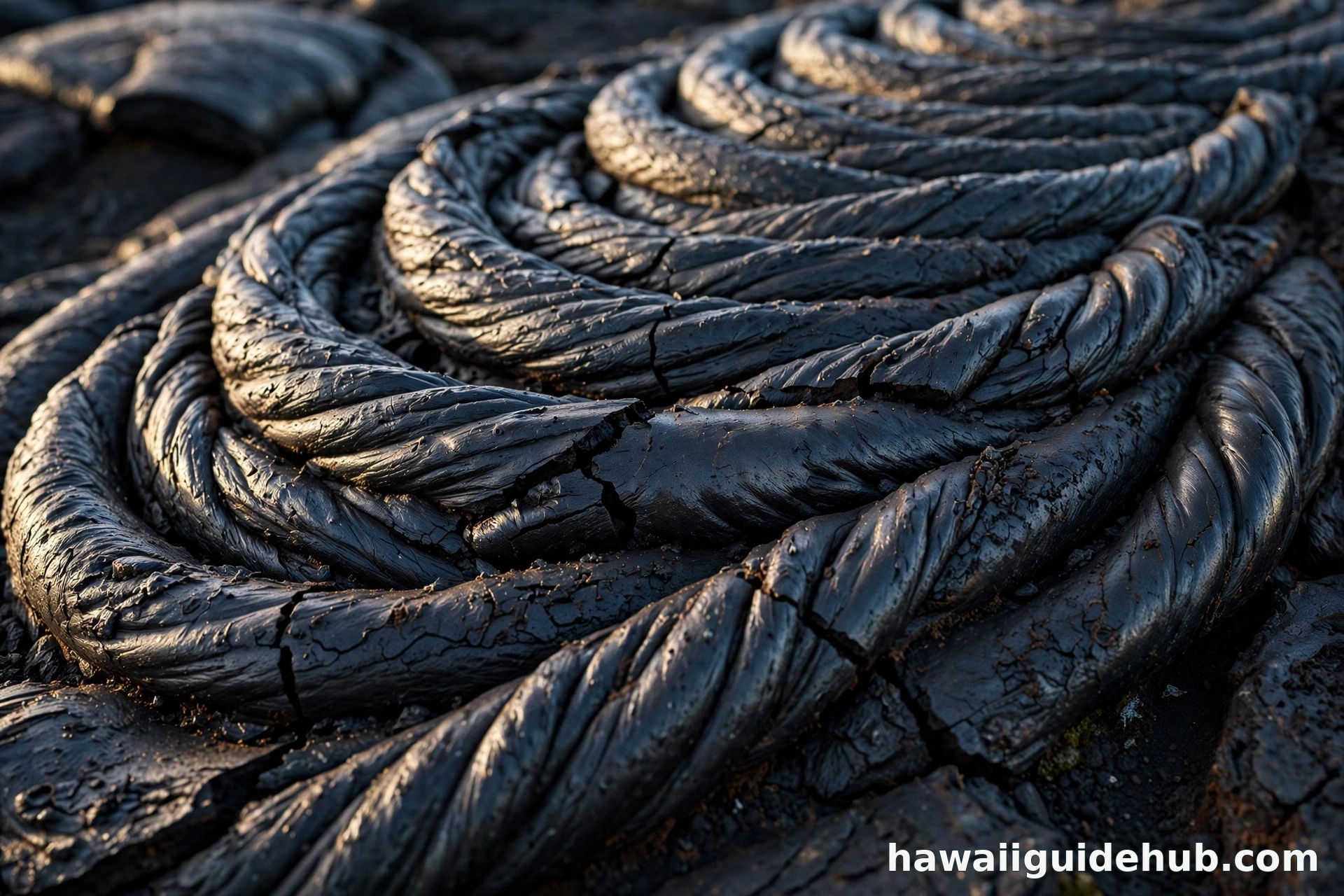
Pāhoehoe (say pah-hoy-hoy) is the gentle one. In Hawaiian the word suggests something smooth and unbroken. It forms when lava erupts at a low rate and flows calmly, so the surface skins over while the inside stays molten. That thin skin wrinkles as the liquid beneath keeps pushing forward. The result looks like coils of rope, braided hair, or frozen waves. Some flows spread into broad, smooth lobes that scientists call toes. Others puff up into rounded mounds called tumuli as lava piles in underneath and lifts the crust.
Not all pāhoehoe looks the same. During the 1969 to 1971 Mauna Ulu eruption on Kīlauea, USGS scientists documented three distinct varieties. One was a fragile, cavernous type full of gas bubbles and small tubes. Another was smooth and dense, fed by fountains over 100 meters tall. The third was hummocky and covered in overlapping toes, formed after lava traveled for kilometers through underground tubes. That last kind underlies most of Kīlauea’s present surface. When you walk the park today, the lumpy ground beneath your feet is mostly this tube-fed pāhoehoe.
ʻAʻā: The Rough, Jagged Lava
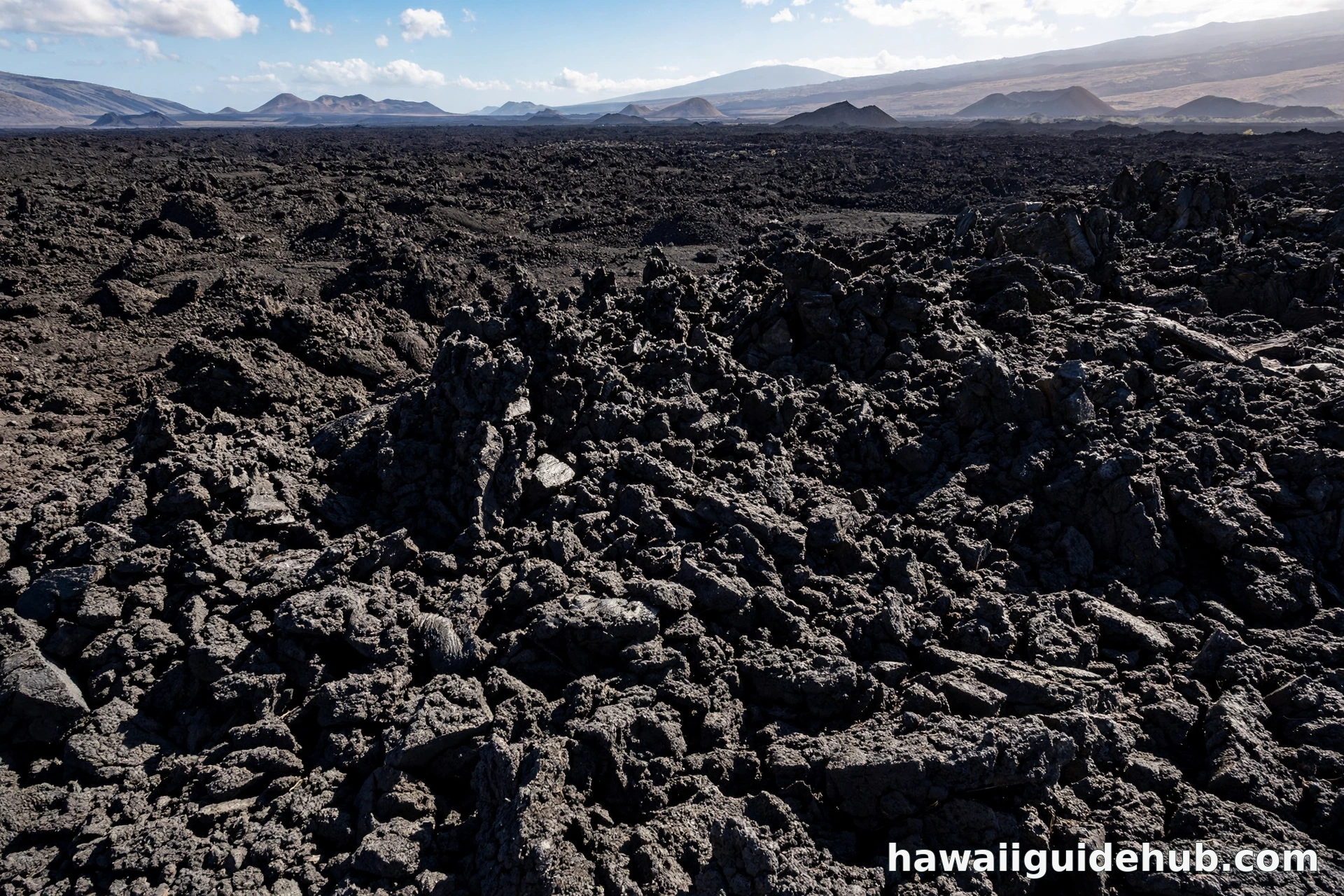
ʻAʻā (say ah-ah) is the troublemaker. It forms when lava erupts faster and thicker, or when a calm flow speeds up and starts churning. The surface crust cannot stretch fast enough, so it tears. The torn pieces tumble forward, pile on top of each other, and freeze into a field of sharp, clinkery rubble. Walking across ʻaʻā in sandals is a mistake you make exactly once. Locals joke that the name is the sound you make when you step on it barefoot. Where pāhoehoe invites you to look closer, ʻaʻā warns you to watch your step.
How the Same Lava Can Become Either Type
Here is the part most visitors find surprising. A single eruption can produce both types. It starts with speed and texture. A slow, steady pour makes pāhoehoe. If that same flow picks up speed down a steeper slope, or if the eruption rate jumps, the crust starts shredding and the flow transforms into ʻaʻā as it moves downhill. Geologists track this change by looking at shear, the force the moving lava applies to its own surface. Gentle shear keeps the skin intact. Strong shear tears it apart. Once lava has turned to ʻaʻā, it never smooths back into pāhoehoe. The transformation only runs one way.
Pillow Lava: When Lava Meets the Ocean
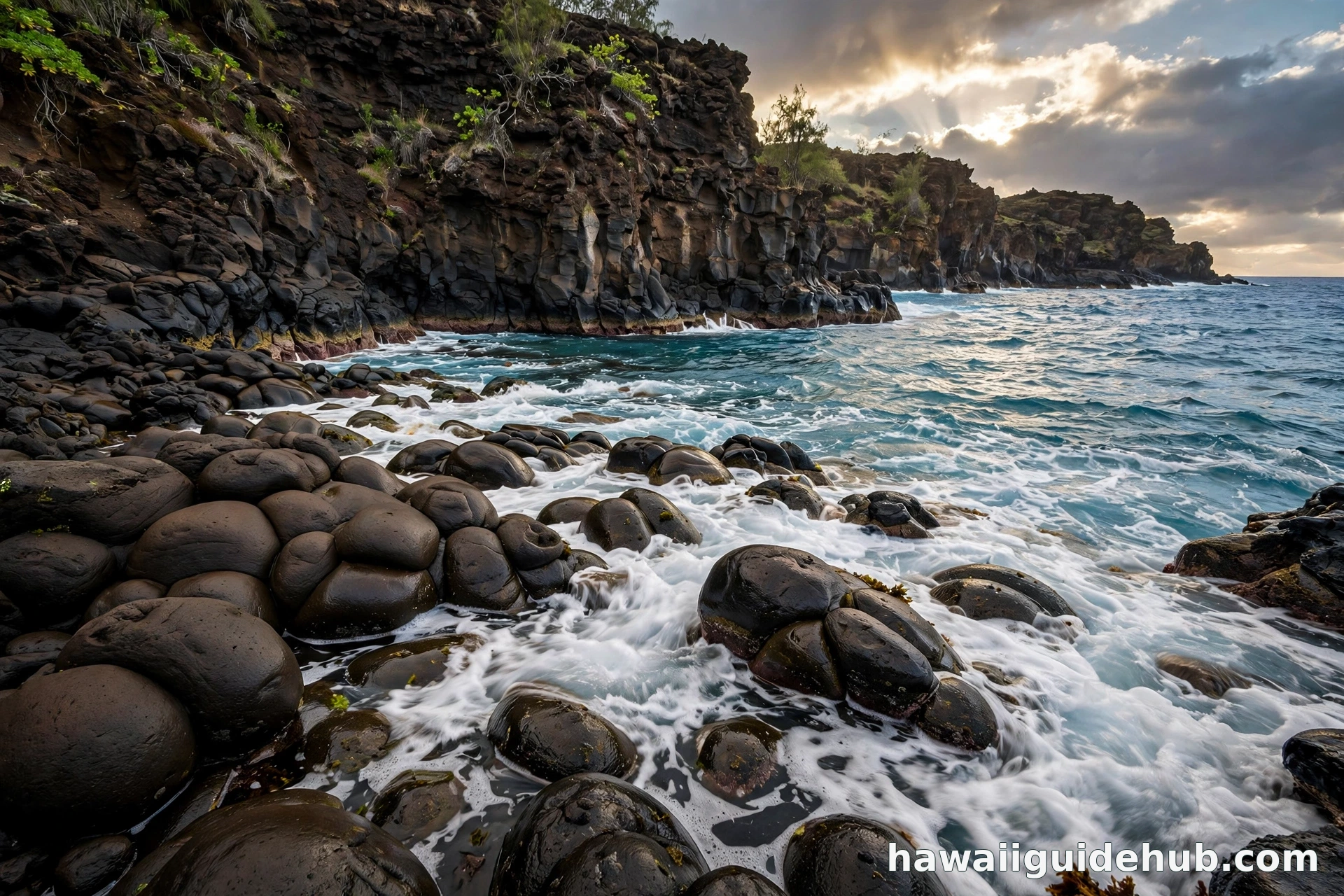
There is a third type you cannot watch form on land. When lava erupts underwater, the cold seawater chills it instantly. Instead of spreading, the lava squeezes out in rounded, bulbous blobs that stack like sacks of flour. These are pillow lavas. Most of the Hawaiian Islands were built this way, long before they broke the surface. The process is still happening right now. Southeast of Kīlauea, the Lōʻihi seamount is a young volcano growing on the ocean floor, stacking pillow lava layer by layer. It may become a new island in tens of thousands of years. You can see ancient pillow basalts exposed in sea cliffs around the Big Island, where uplift and erosion have raised old underwater flows into the air.
Lava Tubes: Rivers Under a Rocky Roof
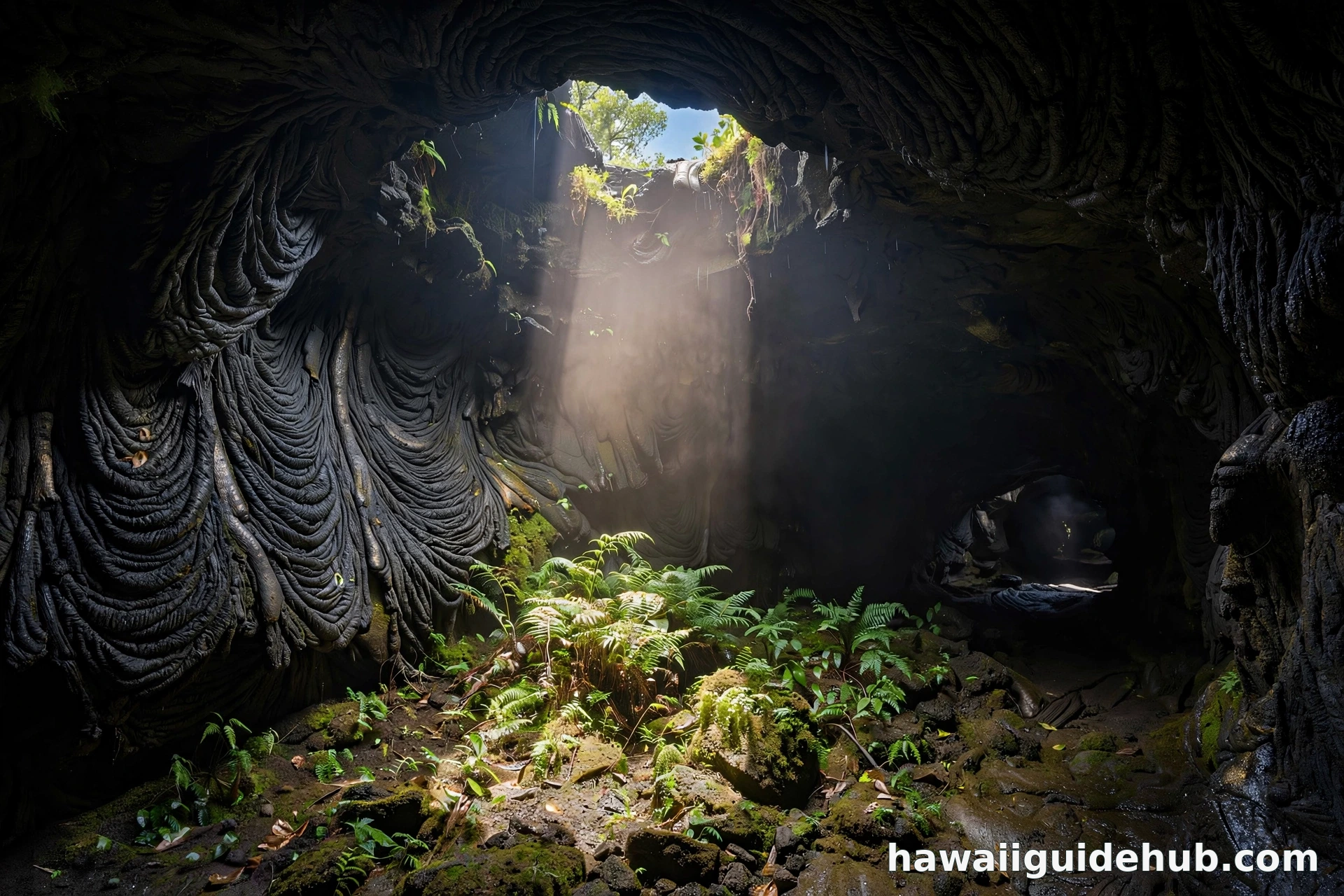
Some pāhoehoe flows do something remarkable. The surface hardens into a roof while molten lava keeps flowing underneath through a tunnel. When the eruption ends and the tunnel drains, a hollow cave remains. These are lava tubes, and walking through one feels like stepping inside the flow itself. The most famous is the Thurston Lava Tube, known in Hawaiian as Nāhuku, inside Hawaiʻi Volcanoes National Park. Its walls still show the ropy swirls of the flow that carved it, and ferns grow where skylights in the ceiling let daylight pour in. Lava tubes can run for miles. They are one reason Hawaiian flows travel so far: the insulated tunnel keeps lava hot and liquid long after the surface has cooled.
Lava Trees and Other Strange Formations
Pāhoehoe can preserve moments in surprising detail. At Lava Tree State Monument in Puna, a slow flow wrapped around living ʻōhiʻa trees. The trunks burned away, but the chilled lava kept the shape of each tree, leaving hollow columns standing in a forest of stone. Elsewhere you can find spatter cones, small mounds built where fountains of lava piled up around a vent, and littoral cones where lava met the sea and threw up glassy fragments. Even black sand beaches are part of the story. Waves grind basalt into sand, and where the lava was rich in green olivine crystals, the beach glitters green.
Pele’s Hair and Pele’s Tears
Some of Hawaii’s most delicate volcanic formations are born in lava fountains. When wind catches tiny droplets of molten lava and stretches them out, they cool into golden threads of volcanic glass called Pele’s hair, named for the volcano goddess. The threads are finer than human hair and can drift for miles, draping over plants and fences downwind of an eruption. When droplets cool before they stretch, they freeze into small glassy beads called Pele’s tears. You can sometimes spot both glittering on the ground near recent flows. Admire them where they lie. Like all natural features in the park, they are protected, and the old Hawaiian saying reminds visitors to take only photographs and leave only footprints.
The Two Volcanoes You Can Visit
Two of the world’s most studied volcanoes sit inside Hawaiʻi Volcanoes National Park. Mauna Loa is the largest active volcano on the planet. It rises 4,170 meters above the sea, and its base sits nearly 9,000 meters below the waves, which makes it taller from base to summit than Mount Everest. Its broad dome makes up about half of the Big Island. Eruptions usually begin at the summit caldera, called Mokuʻāweoweo, then migrate down rift zones on the flanks. Kīlauea, its smaller neighbor, is one of the most active volcanoes on Earth and has given scientists most of what they know about pāhoehoe and ʻaʻā. Three other Big Island volcanoes, Mauna Kea, Hualālai, and Kohala, are older and quiet, but their slopes are built from the same two lava types.
Where to See Each Lava Type in Hawaii
Hawaiʻi Volcanoes National Park is the best outdoor classroom for lava on Earth. Drive Chain of Craters Road and you cross flow after flow, young and old, smooth and jagged. Hike the Devastation Trail and the Kīlauea Iki Trail to walk across solidified lava lakes and crater floors. Tour Nāhuku to go inside a lava tube. The Sulphur Banks trail shows what volcanic gases do to rock. For lava tree molds, head to Lava Tree State Monument near Pāhoa. Pillow basalts show in coastal cliffs, and when an eruption sends lava to the ocean, the entry zone is unforgettable. Check park alerts before you go, because access changes with volcanic activity. If you are planning a wider trip, start with our guide to the things to do in Hawaii Volcanoes National Park and the best things to do on the Big Island.
Lava Safety: Respect the Rock
Lava country demands respect. ʻAʻā is brutally sharp, so wear sturdy closed shoes and long pants on any lava hike. Fresh flows can stay dangerously hot under a thin crust for weeks, and what looks solid may not be. Never cross barriers or enter closed areas. At ocean entries, new land benches can collapse without warning and drop you into boiling water, so watch only from marked viewpoints. Carry plenty of water, because lava fields reflect heat and offer no shade. Check the national park website and USGS volcano alerts before every visit. Conditions change fast when Kīlauea is restless. For first-time visitors, a ranger program or guided walk is the smartest way to learn the landscape. Hawaii rewards the curious, and the islands offer endless outdoor adventures in Hawaii beyond the lava fields too.
See the Lava Types on Video
Types of Lava in Hawaii: FAQs
What are the two main types of lava in Hawaii?
Pāhoehoe and ʻaʻā. Pāhoehoe is smooth, ropy, and forms from slow, fluid flows. ʻAʻā is rough, jagged, and forms from faster, thicker flows. Both are basaltic lava from Hawaii’s shield volcanoes, and volcanologists around the world use these Hawaiian names.
What is the difference between pāhoehoe and ʻaʻā?
The difference is flow behavior, not chemistry. Pāhoehoe forms when lava moves slowly enough for the surface to cool into a smooth skin that wrinkles into ropes. ʻAʻā forms when the flow moves faster or thickens, tearing its own crust into sharp rubble. The same lava can change from one to the other.
What is pillow lava?
Pillow lava forms when lava erupts underwater. The cold water chills the lava instantly into rounded, bulbous pillows. Most of the Hawaiian Islands were built from pillow lavas before they rose above the sea, and the Lōʻihi seamount is forming the same way today.
Where can I see lava tubes in Hawaii?
The Thurston Lava Tube, called Nāhuku, in Hawaiʻi Volcanoes National Park is the easiest to visit. It is a short walk from the Kīlauea Iki Overlook parking area and is lit for visitors. Older, wilder tubes exist elsewhere on the island but should only be entered with a guide.
Is it safe to walk on lava rock?
On old, cold flows, yes, with sturdy shoes and care. Pāhoehoe is generally fine to walk on. ʻAʻā is treacherous and sharp. Never walk on fresh flows, cross closed areas, or approach ocean entries beyond marked viewpoints. Always check park and USGS alerts first.
What is the difference between lava and magma?
They are the same material at different addresses. Magma is molten rock still underground. Once it erupts onto the surface, scientists call it lava. When lava cools and hardens, it becomes igneous rock, and in Hawaii that rock is basalt.
Can you see active lava in Hawaii right now?
It depends on Kīlauea’s mood. The volcano erupts in episodes, sometimes with fountains at the summit, sometimes quiet for months. Check the USGS Hawaiian Volcano Observatory updates and the national park website before your trip. Even without an active eruption, the park’s frozen flows are spectacular.
The Ground Beneath Your Feet
Once you know the vocabulary, Hawaii’s volcanic landscape starts talking to you. Ropy coils mean a calm flow froze in place. A field of black rubble means the lava was in a hurry. Rounded boulders at the shore mean the sea helped shape them. Every island is a chapter, and the Big Island is still being written. Stand on a flow that cooled before you were born, and you are standing on some of the youngest land on the planet.