
On This Page
Oʻahu History at a Glance
Oʻahu is the island where Hawaiian history concentrates most densely. It holds the ancient royal center of Waikīkī, the battlefield where Kamehameha the Great unified the islands, the only royal palace on American soil, the harbor attacked on December 7, 1941, and the modern capital of the state of Hawaiʻi. No other Hawaiian island carries so many turning points in one place.
Human history on Oʻahu stretches back roughly a thousand years, beginning with Polynesian voyagers who arrived by double-hulled canoe from the Marquesas and later Tahiti. Over centuries, their descendants built an intricate society of chiefdoms, temple systems, agriculture, and ocean navigation. European contact arrived in 1778 when Captain James Cook reached the islands, though Cook himself never set foot on Oʻahu. The decades that followed redrew the island’s political map entirely.
In 1795, the Battle of Nuʻuanu ended Oʻahu’s independence as a separate kingdom and brought it under the control of Kamehameha I, the conqueror from Hawaiʻi Island who went on to unify the archipelago. Honolulu grew from a small harbor town into the capital of the Hawaiian Kingdom, a position it has held through the Republic of Hawaiʻi, the territorial period, and statehood. The 1893 overthrow of Queen Liliʻuokalani, the 1898 annexation by the United States, the attack on Pearl Harbor, and the admission of Hawaiʻi as the 50th state in 1959 all played out on Oʻahu’s shores.
Today, about one million people live on Oʻahu, roughly two thirds of the state’s population, and most visitors to Hawaiʻi pass through Honolulu. The island’s history is not locked in museums. It is visible in street names, temple sites, plantation towns, military installations, and the neighborhoods where ancient and modern Hawaiʻi overlap. This guide walks through that history in chronological order, so you can understand what happened here, in the order it happened.
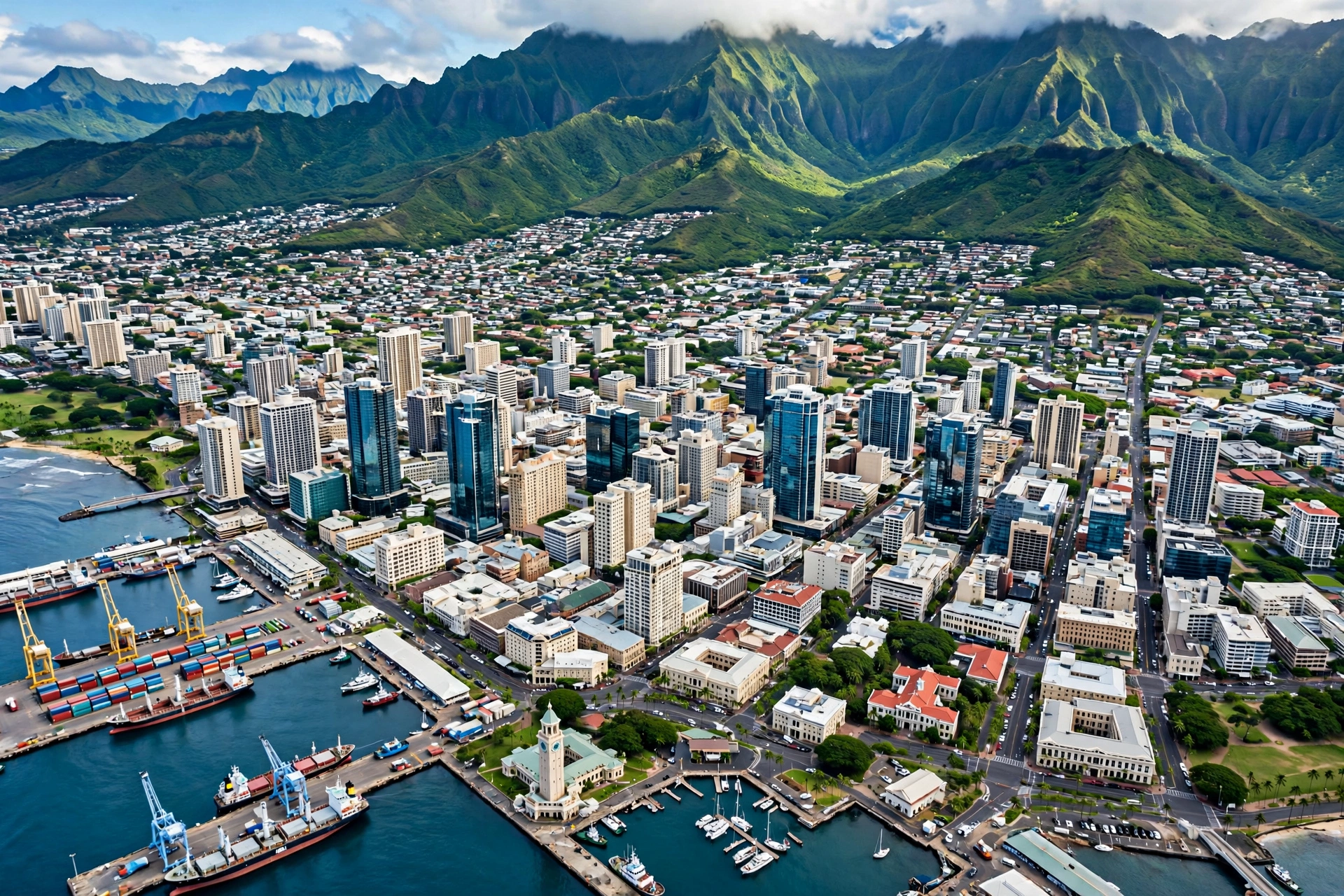
Ancient Hawaiʻi and the Chiefdoms
Long before written records, Oʻahu was settled by Polynesian navigators who crossed thousands of miles of open ocean using stars, swells, winds, and bird flight paths as their instruments. Archaeological evidence places the first settlements in the Hawaiian Islands around the 9th to 11th centuries, with later waves of voyagers arriving from the Society Islands. These settlers brought taro, sweet potato, pigs, dogs, chickens, and the cultural institutions that would shape Hawaiian society: the kapu system of sacred laws, the aliʻi class of chiefs, and the heiau, the stone temples where ritual life centered.
Oʻahu developed into its own political world. The island was divided into moku, or districts, and further into ahupuaʻa, the wedge-shaped land divisions that ran from the mountains to the sea. Each ahupuaʻa was designed to be self-sufficient, with upland forests for timber and birds, mid-elevation fields for taro and sweet potato, and coastal areas for fishing. The system was an early form of watershed management, and traces of it still shape how land on Oʻahu is used and described.
Waikīkī as a Royal Center
Centuries before hotels lined its shore, Waikīkī was one of the most important places in the Hawaiian Islands. The name means “spouting fresh water,” a reference to the springs and streams that fed the area’s extensive wetlands and fishponds. The broad coastal plain was a center of aliʻi residence, with high chiefs maintaining homes along the beach and in the fertile lands behind it. The area’s abundant fresh water supported intensive taro cultivation, and its offshore reefs provided rich fishing grounds.
Several heiau stood in and around Waikīkī, and the district was a place of ceremony as well as residence. When Kamehameha I later made his presence felt on Oʻahu, he maintained residences in Waikīkī, continuing a tradition of chiefly occupation that stretched back generations. The transformation of Waikīkī into a tourist district in the 20th century happened on top of this older history, which is still remembered in place names and in the work of Native Hawaiian cultural practitioners.
Society and Daily Life
Ancient Oʻahu society was organized around rank and ritual. The aliʻi nui, the high chiefs, traced their lineage to the gods and held authority over land and people. Below them were the kahuna, the priests and experts in fields from navigation to medicine, the makaʻāinana, the common people who farmed and fished, and the kauā, those outside the social order. The kapu system regulated daily life in fine detail, governing what people could eat, where they could go, and how men and women interacted.
Religion was inseparable from governance. The four major gods, Kū, Kāne, Lono, and Kanaloa, were honored at heiau of different types, from the small agricultural shrines to the luakini, the large temples where human sacrifice was performed in times of war. Oʻahu held many significant heiau, including sites in the uplands of the Koʻolau and Waiʻanae ranges. Some of these stone platforms survive today, though many were dismantled in the 19th century as land use changed.
Warfare between chiefdoms was a constant feature of political life. Oʻahu’s chiefs fought among themselves and against rivals from Maui and Hawaiʻi Island. Control of the island shifted repeatedly in the centuries before European contact, and the island’s rugged interior valleys provided both refuge and strategic advantage. This tradition of inter-island conflict set the stage for the most consequential battle in Hawaiian history.
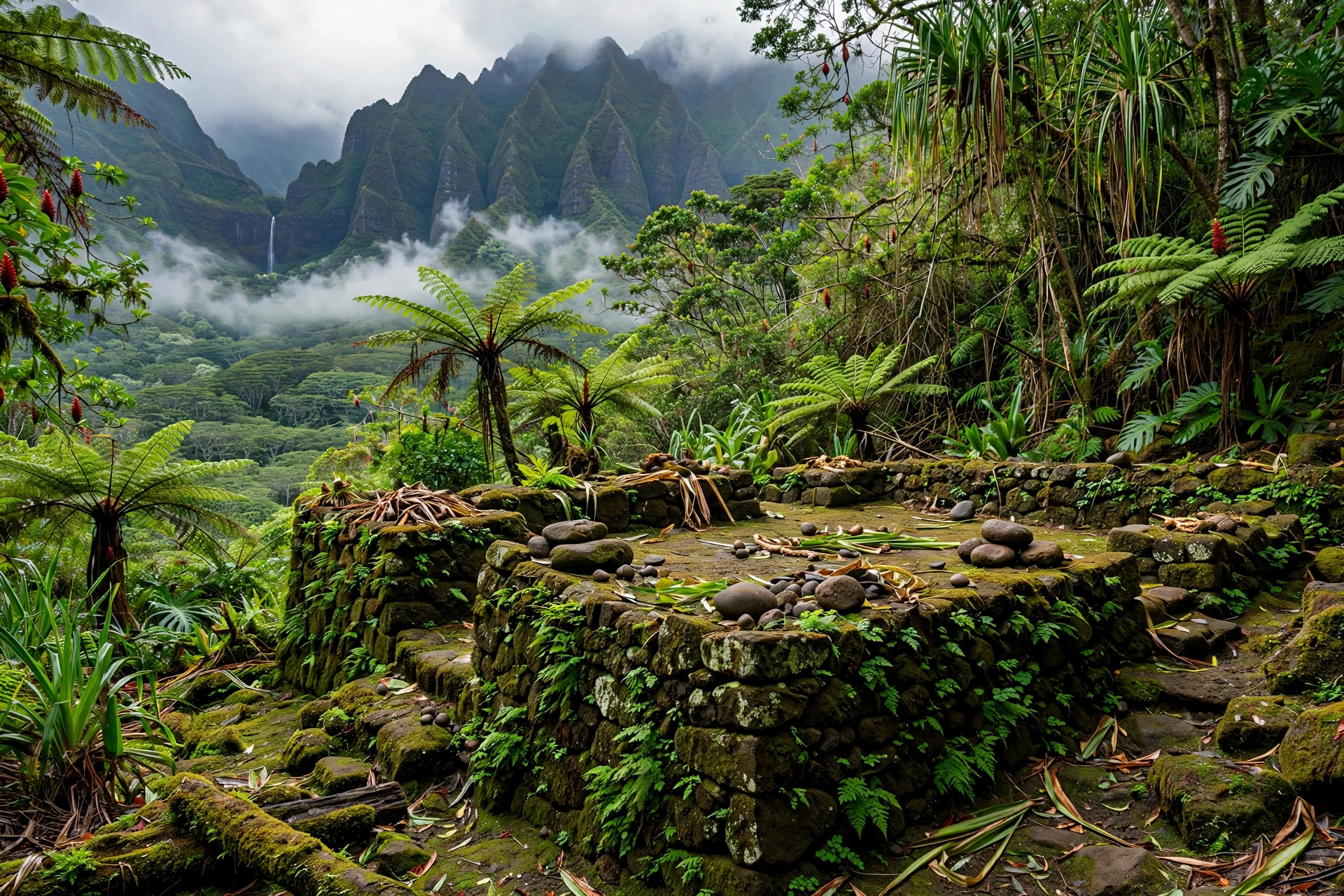
Unification and Kamehameha
The arrival of Europeans changed the balance of power in the islands permanently. Captain James Cook’s expedition reached Kauaʻi in 1778, introducing iron, firearms, and diseases to which Hawaiians had no immunity. Cook was killed at Kealakekua Bay on Hawaiʻi Island in 1779, but the trade he opened continued. Foreign ships called regularly for provisions, and Hawaiian chiefs quickly grasped the military value of Western weapons.
Kamehameha, a chief of the Kona district on Hawaiʻi Island, proved the most adept at combining traditional authority with new technology. He gathered European and American advisers, including the Englishmen John Young and Isaac Davis, acquired muskets and cannon, and built a Western-style armed force. Between 1790 and 1795, he conquered Maui, Molokaʻi, and Lānaʻi, then turned his attention to Oʻahu.
The Battle of Nuʻuanu
In the spring of 1795, Kamehameha assembled a fleet of war canoes and Western-style vessels and crossed the channels to Oʻahu. His forces landed on the island’s southern and western shores and pushed the Oʻahu army, led by the chief Kalanikūpule, back through the valleys toward the Nuʻuanu Pali, the steep cliff at the head of Nuʻuanu Valley. The battle that followed was one of the bloodiest in Hawaiian history.
Kamehameha’s troops, armed with muskets and cannon alongside traditional weapons, drove Kalanikūpule’s warriors up the valley to the 1,000-foot precipice. Hundreds of Oʻahu warriors were forced over the cliff to their deaths in the valley below. Kalanikūpule himself was captured and sacrificed. The victory gave Kamehameha control of Oʻahu, and with it, the most populous and agriculturally rich island in the chain.
The Battle of Nuʻuanu is remembered as the decisive event in the unification of the Hawaiian Islands. Kauaʻi and Niʻihau remained independent under their own chief, Kaumualiʻi, for another fifteen years, but in 1810 Kaumualiʻi agreed to become a tributary ruler, completing the unification without further bloodshed. Kamehameha established his court on Oʻahu at times, and the island became the political center of the new kingdom.
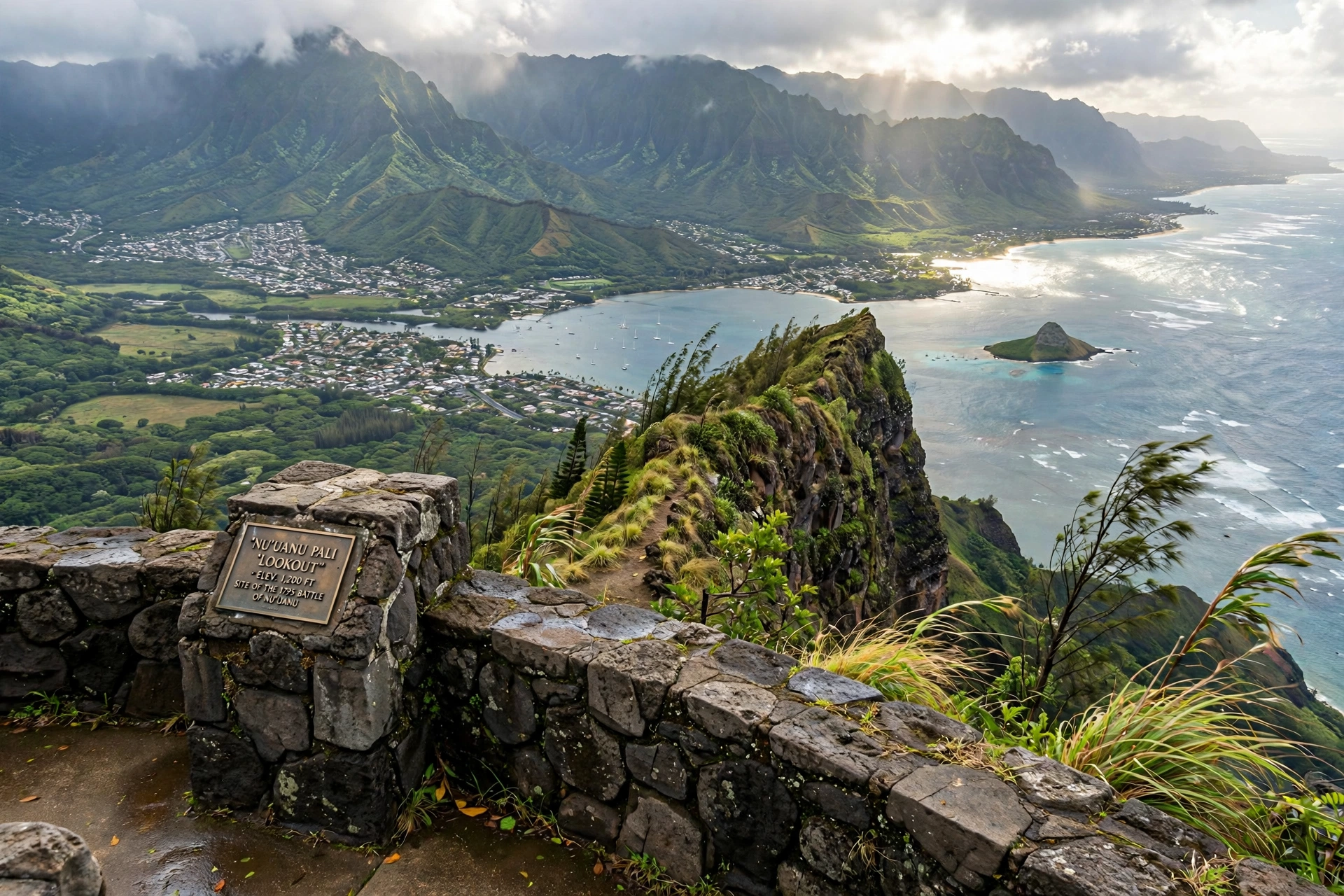
Today, the Nuʻuanu Pali Lookout is one of Oʻahu’s most visited historic sites. The view from the cliff stretches across the windward coast, and the trade winds that funnel through the gap are famously fierce. Interpretive signs at the lookout describe the battle, and the site remains a place of cultural significance for Native Hawaiians.
The Kingdom Era
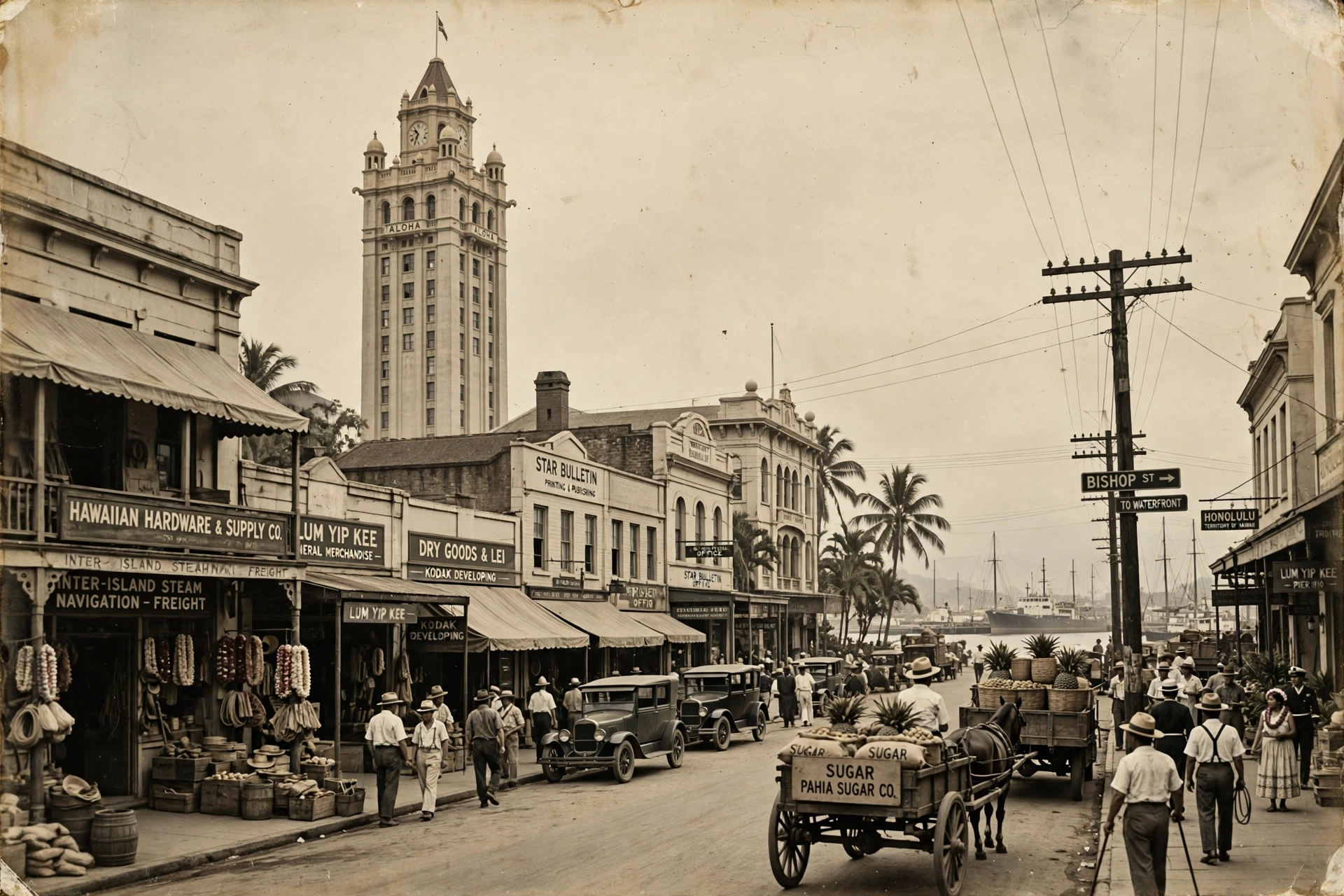
The Hawaiian Kingdom, founded by Kamehameha I, lasted from 1795 until 1893. For most of that century, Oʻahu was its heart. Honolulu, whose name means “sheltered bay,” grew from a small settlement around a natural harbor into a Pacific port city, a royal capital, and a cosmopolitan town where Hawaiian, American, European, and Asian influences mixed.
Honolulu Becomes the Capital
Kamehameha I moved his court to Honolulu in the early 1800s, recognizing the harbor’s value for trade. His son Liholiho, Kamehameha II, formally made Honolulu the capital. The town grew rapidly as sandalwood traders, whalers, and missionaries arrived. By the 1820s, Honolulu had churches, schools, printing presses, and a growing foreign merchant community. The American Protestant missionaries who arrived in 1820 had an outsized influence, introducing literacy, Western education, and eventually the written Hawaiian language.
The kingdom’s government modernized along Western lines while retaining Hawaiian sovereignty. Kamehameha III promulgated Hawaiʻi’s first constitution in 1840, establishing a constitutional monarchy. Honolulu’s streets filled with government buildings, and the town became the diplomatic center of the Pacific, with consulates from the United States, Britain, France, and other nations.
ʻIolani Palace and the Monarchy’s Height
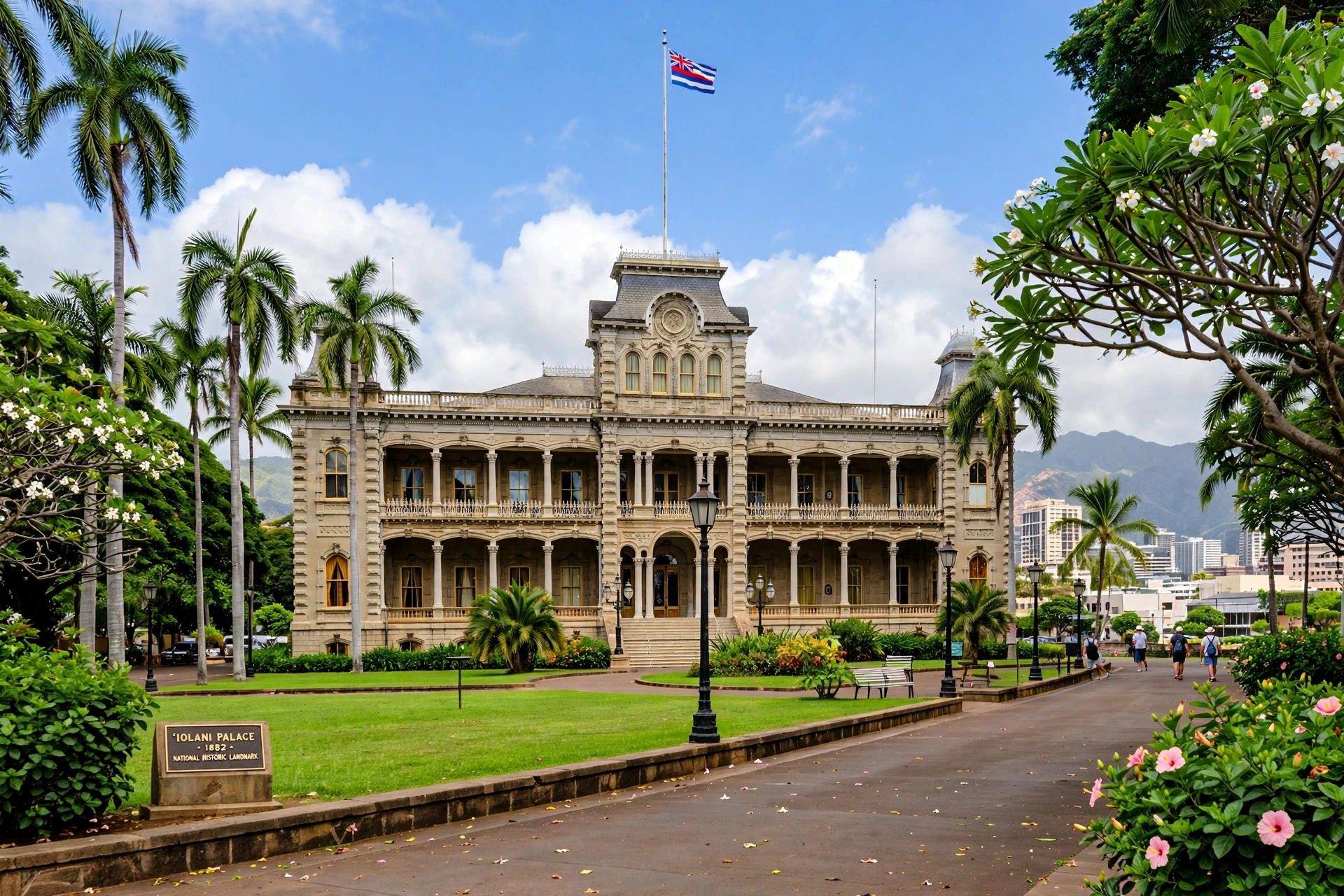
The most visible symbol of the kingdom stands in downtown Honolulu. ʻIolani Palace, completed in 1882 under King Kalākaua, was the official residence of the Hawaiian monarchs and the only royal palace on American soil. The palace was remarkably modern for its time, with electric lighting installed before the White House had it, indoor plumbing, and a telephone system. It served as the seat of government and the social center of the kingdom.
Kalākaua, known as the Merrie Monarch for his patronage of Hawaiian music, dance, and culture, presided over a renaissance of Native Hawaiian arts. His sister and successor, Queen Liliʻuokalani, was a gifted composer whose song “Aloha ʻOe” became world famous. The palace hosted state dinners, balls, and ceremonies, and its throne room witnessed the formal business of the kingdom.
Sugar, Immigration, and Economic Change
The kingdom’s economy was transformed by sugar. The Reciprocity Treaty of 1875 gave Hawaiian sugar duty-free access to the American market, triggering a plantation boom. Sugar planters, many of them descendants of missionaries, accumulated enormous wealth and political power. The plantations required labor on a massive scale, and the kingdom sponsored waves of immigration: Chinese workers beginning in the 1850s, followed by Portuguese, Japanese, Koreans, Filipinos, and others.
Oʻahu’s landscape changed accordingly. Plantation towns like Waipahu, ʻEwa, and Kahuku grew around the mills, and the island’s population became one of the most ethnically diverse in the world. Honolulu’s Chinatown, established in the 19th century, remains a historic district. The demographic mix created by plantation immigration defines modern Hawaiʻi’s multicultural character.
The concentration of economic power in the hands of the sugar planters, most of them American citizens or of American descent, created growing tension with the monarchy. That tension came to a head in the final years of the kingdom.
Overthrow and Annexation
The end of the Hawaiian Kingdom is one of the most debated episodes in American history, and it happened in downtown Honolulu. In January 1893, a group of American and European businessmen and sugar planters, organized as the Committee of Safety, overthrew Queen Liliʻuokalani with the support of United States Marines landed from the USS Boston. The Queen, seeking to avoid bloodshed, yielded her authority under protest, stating that she did so to avoid the loss of life and trusting that the United States government would right the wrong.
The conspirators established a Provisional Government and sought annexation to the United States. President Grover Cleveland, after receiving the report of his commissioner James Blount, concluded that the overthrow had been improper and refused to annex Hawaiʻi. His successor, President William McKinley, favored annexation, and in 1898, during the Spanish-American War, Congress passed the Newlands Resolution annexing the islands. The ceremony of annexation took place at ʻIolani Palace on August 12, 1898, an event that Native Hawaiians remember with mourning; the Hawaiian flag was lowered and the American flag raised as the royal anthem played.
The Republic of Hawaiʻi, which governed between the overthrow and annexation, was led by Sanford Dole, a member of the missionary-descended planter class. After annexation, Hawaiʻi became a United States territory in 1900. Queen Liliʻuokalani lived the rest of her life in Honolulu, much of it under effective house arrest at Washington Place, her private residence. She died in 1917.
The overthrow remains a live issue in Hawaiʻi. In 1993, the United States Congress passed the Apology Resolution, in which the United States acknowledged its role in the overthrow and apologized to Native Hawaiians. The sovereignty movement, which seeks various forms of redress including independence, remains active. Visitors to Oʻahu will encounter this history at ʻIolani Palace, where the story of the monarchy’s end is told in the rooms where it happened.
Pearl Harbor and World War II
Oʻahu’s strategic position in the mid-Pacific made it one of the most important military outposts in the world during the 20th century. The United States developed Pearl Harbor into a major naval base beginning in the early 1900s, dredging the harbor and building the shipyard, dry docks, and fuel storage that turned it into the headquarters of the U.S. Pacific Fleet. Army installations including Schofield Barracks, Fort Shafter, and Wheeler Field spread across the island.
December 7, 1941
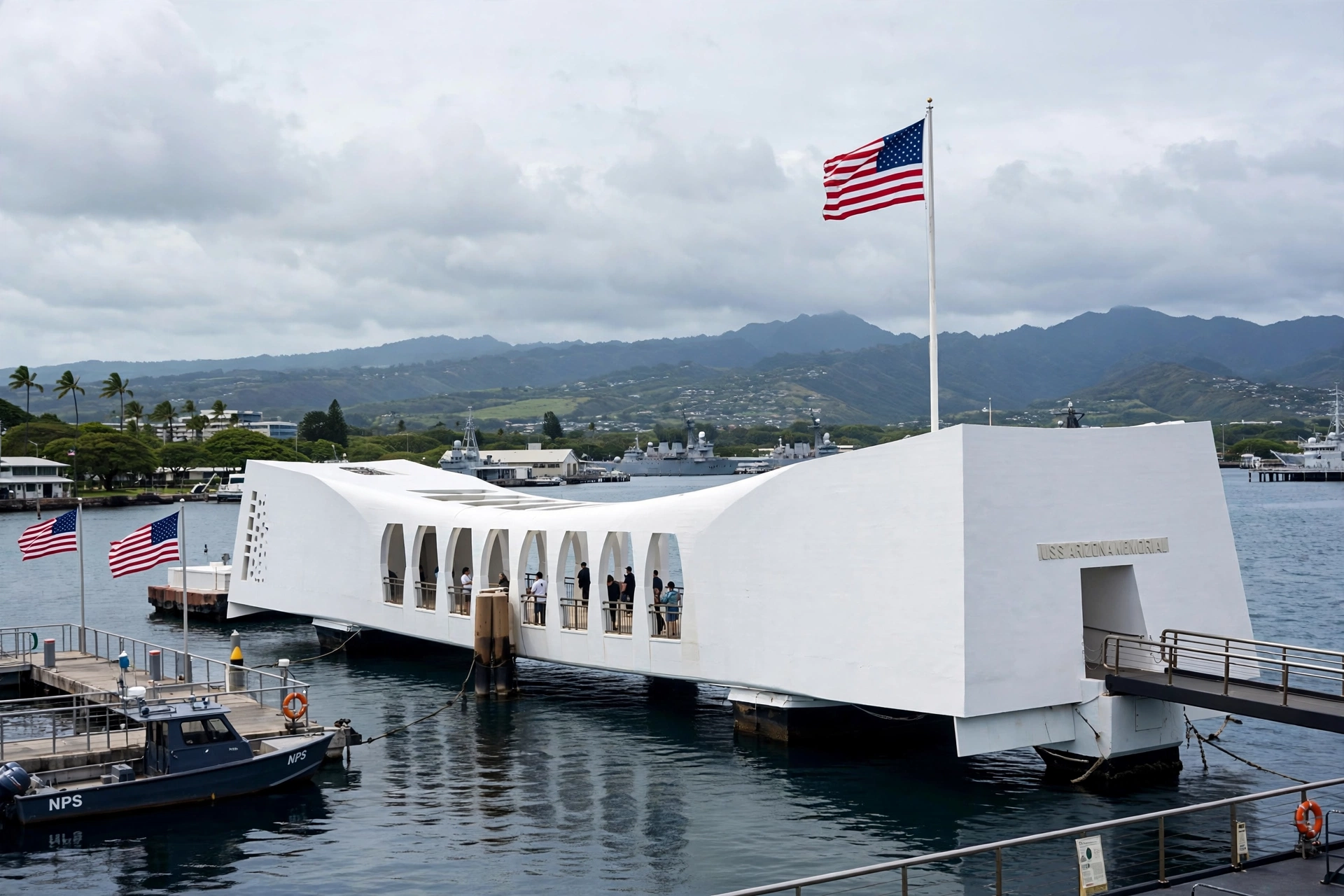
On the morning of Sunday, December 7, 1941, Japanese carrier-based aircraft launched a surprise attack on Pearl Harbor and other Oʻahu military installations. The attack began shortly before 8:00 a.m. and lasted less than two hours. It sank or damaged 19 American ships, including eight battleships, destroyed more than 300 aircraft, and killed 2,403 Americans, including 68 civilians. The battleship USS Arizona exploded and sank with 1,177 of her crew, the greatest single loss of the attack.
The attack brought the United States into World War II. President Franklin D. Roosevelt’s address to Congress the next day, calling December 7 “a date which will live in infamy,” led to the declaration of war against Japan. On Oʻahu, martial law was declared and remained in effect for nearly three years, with military authorities exercising broad control over civilian life.
Pearl Harbor became the forward base for the Pacific war. Damaged ships were repaired in its dry docks, and the harbor served as the staging point for the island-hopping campaigns that carried American forces across the Pacific. The war’s end was also tied to the harbor: the Japanese surrender was signed aboard the USS Missouri in Tokyo Bay in September 1945, and the Missouri is now moored at Pearl Harbor as a museum ship, bookending the war with the Arizona.
The War’s Legacy on Oʻahu
World War II left a permanent mark on Oʻahu. The military remains one of the island’s largest economic forces, with Joint Base Pearl Harbor-Hickam, Schofield Barracks, Marine Corps Base Hawaiʻi at Kāneʻohe, and other installations employing tens of thousands. The Pearl Harbor National Memorial, administered by the National Park Service, is among the most visited historic sites in the United States, drawing visitors from around the world to the USS Arizona Memorial, the Battleship Missouri, the USS Bowfin submarine museum, and the Pearl Harbor Aviation Museum.
The war also accelerated social change. The massive influx of military personnel and defense workers, the experience of martial law, and the postwar GI Bill contributed to the political transformation that eventually brought statehood. The 442nd Regimental Combat Team, composed largely of Japanese American soldiers from Hawaiʻi, became the most decorated unit in American military history for its size and length of service, and its veterans became leaders in postwar Hawaiʻi politics.
Statehood and Modern Oʻahu
After the war, Hawaiʻi’s drive for statehood intensified. The territory had sought admission since 1919, but Southern congressmen blocked it for decades, partly from racial prejudice against the islands’ nonwhite majority. The sacrifices of Hawaiʻi’s soldiers in World War II, the territory’s strategic importance, and the political organization of its labor unions and veterans gradually shifted opinion. On August 21, 1959, Hawaiʻi became the 50th state, with Honolulu as its capital.
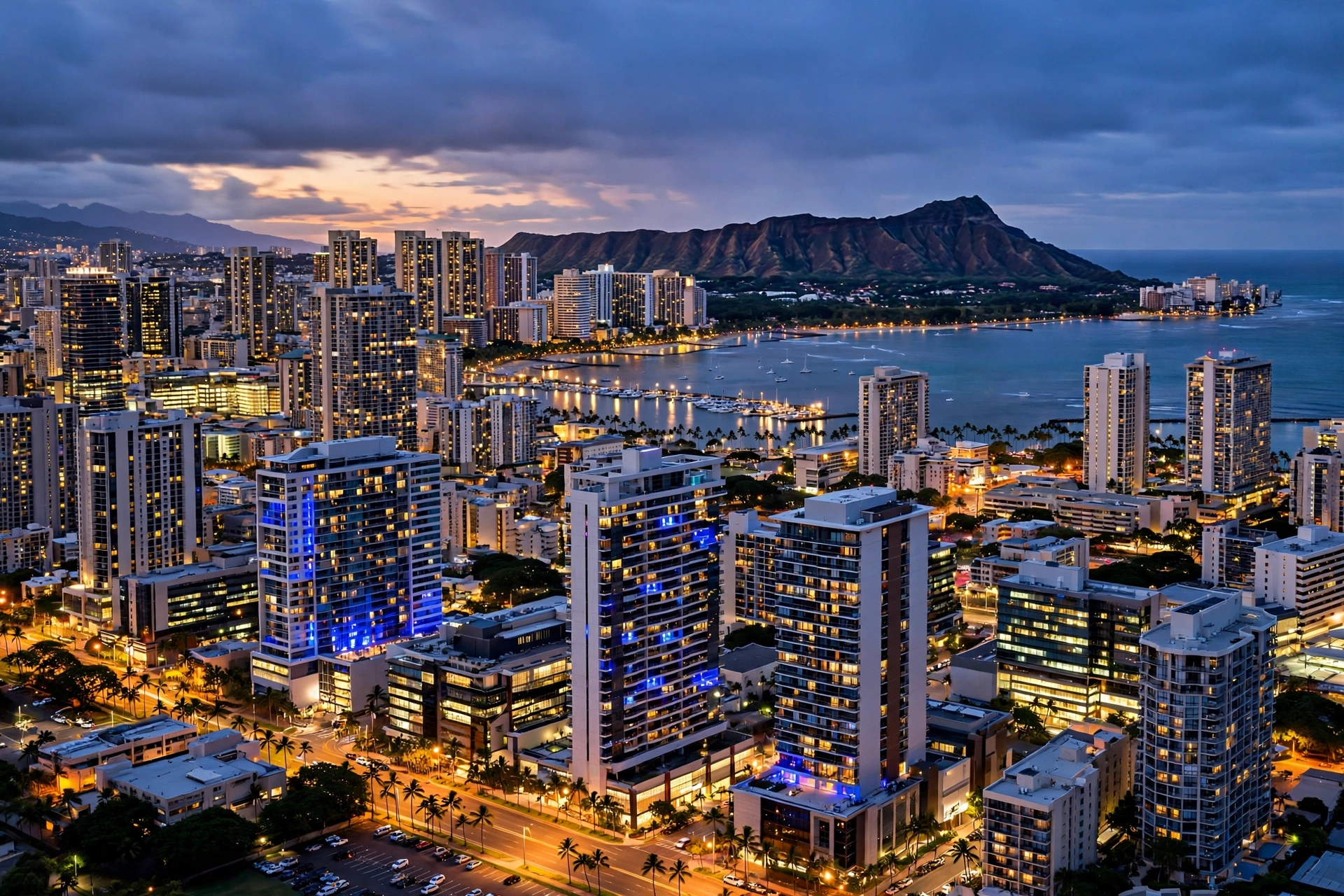
Statehood coincided with the jet age, and the two together transformed Oʻahu. Pan American’s first commercial jet service to Honolulu in 1959 cut travel time from the mainland dramatically, and visitor numbers climbed from hundreds of thousands to millions within a decade. Waikīkī, which had a handful of grand hotels like the Royal Hawaiian and the Moana, filled with high-rise hotels along Kalākaua Avenue. Tourism became the island’s dominant industry, eventually employing a large share of the workforce.
Honolulu grew into a Pacific metropolis. The downtown skyline rose, the suburbs spread across the central plateau and into the valleys, and the H-1, H-2, and H-3 freeways reshaped how people moved. The University of Hawaiʻi at Mānoa expanded into a major research institution. Honolulu became a center of Pacific finance, government, and military command, hosting the headquarters of U.S. Indo-Pacific Command at Camp H.M. Smith.
Modern Oʻahu balances its roles as a global tourist destination, a military hub, a state capital, and the homeland of Native Hawaiians. The Hawaiian cultural renaissance that began in the 1970s, marked by the revival of voyaging with the Hōkūleʻa canoe, the rebirth of hula and Hawaiian language education, and the growth of the sovereignty movement, continues to shape the island’s identity. Development pressures, housing costs, and the protection of agricultural land and open space are the central issues of contemporary island politics.
Historic Sites to Visit
Oʻahu’s history is best understood on foot, at the places where it happened. These are the essential historic sites, organized by era.
ʻIolani Palace
The palace in downtown Honolulu offers guided tours through the throne room, the state dining room, and the private quarters of the monarchs. The basement galleries house the royal regalia, including the crown jewels. Reservations are recommended, and the palace is closed on Sundays. Allow at least two hours. The palace grounds also include the coronation pavilion and the sacred mound associated with the site’s earlier history.
Pearl Harbor National Memorial
The memorial complex at Pearl Harbor includes the USS Arizona Memorial, reached by Navy boat; the Battleship Missouri, where the surrender was signed; the USS Bowfin Submarine Museum and Park; and the Pearl Harbor Aviation Museum on Ford Island. The Arizona Memorial program is free but requires advance reservations, which often fill weeks ahead. Plan a full day. For orientation and driving directions, see our Where Is Pearl Harbor on a Map guide.
Bishop Museum
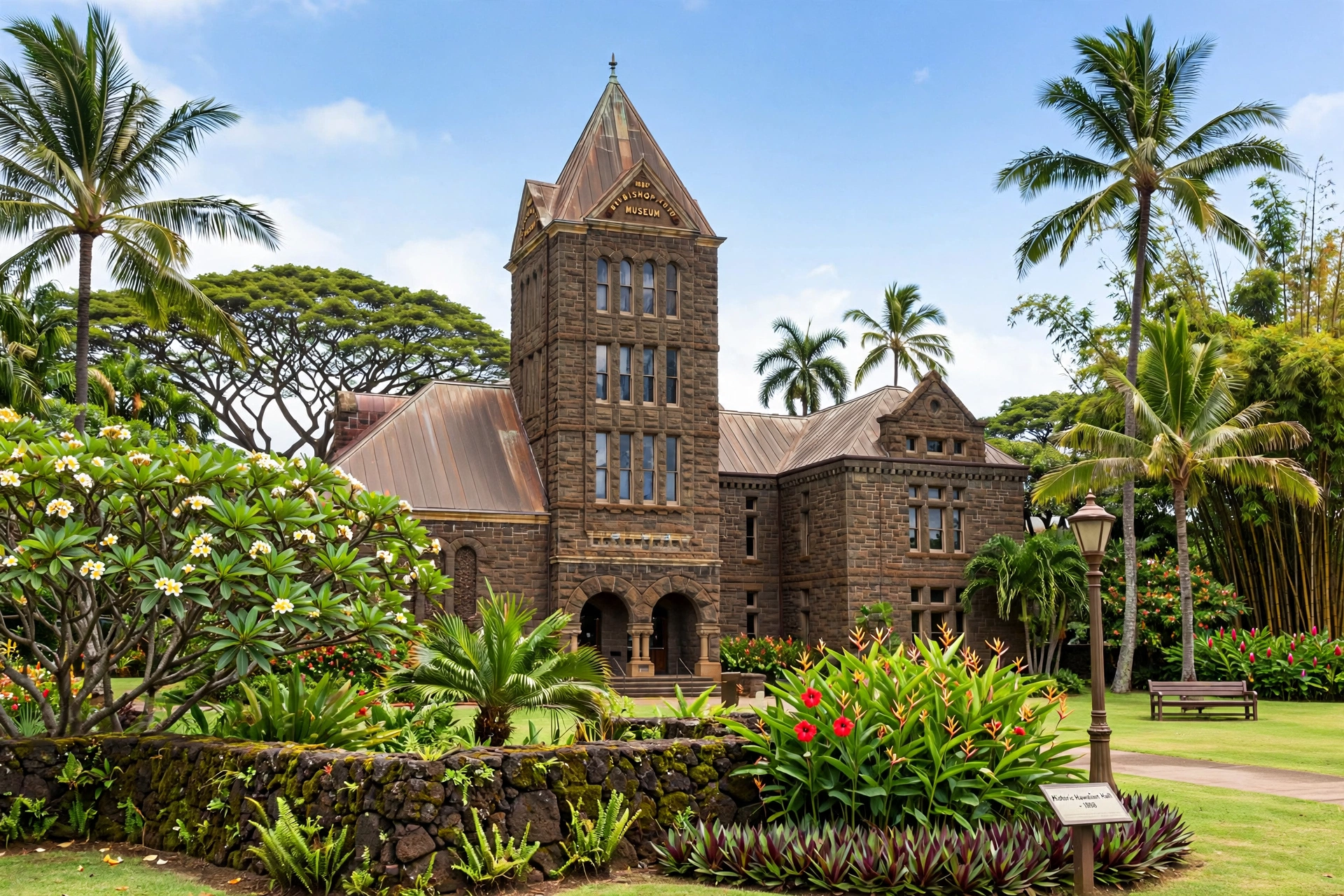
Founded in 1889 by Charles Reed Bishop in memory of his wife, Princess Bernice Pauahi Bishop, the Bishop Museum in Kalihi is the premier institution of Hawaiian and Pacific natural and cultural history. Its Hawaiian Hall houses the world’s finest collection of Hawaiian artifacts, including royal cloaks of ʻahu ʻula featherwork, and the planetarium and science exhibits cover the islands’ geology and oceanography. The museum is the essential stop for understanding ancient Hawaiʻi.
Nuʻuanu Pali Lookout
The cliff where the Battle of Nuʻuanu ended in 1795 offers sweeping views of the windward coast. Interpretive panels describe the battle and the natural history of the Koʻolau range. The lookout is a short drive from downtown via the Pali Highway, and it pairs naturally with a visit to the upland valleys. Hold onto your hat; the winds are genuinely powerful.
Washington Place and the Mission Houses
Washington Place, the residence where Queen Liliʻuokalani lived under arrest after the overthrow, now serves as the governor’s residence and offers limited tours. Nearby, the Hawaiian Mission Houses in downtown Honolulu preserve the 1820s homes of the first American missionaries, with exhibits on literacy, printing, and the missionary influence on the kingdom.
Honolulu’s Chinatown and Plantation-Era Sites
Downtown Honolulu’s Chinatown, with its 19th-century commercial buildings, markets, and temples, reflects the immigration era. The Hawaiʻi Plantation Village in Waipahu, an outdoor museum of restored plantation workers’ homes, shows how the island’s diverse communities lived during the sugar era. The Dole Plantation at Wahiawā, while commercial, sits in the midst of the former plantation landscape of central Oʻahu.
National Memorial Cemetery of the Pacific
The Punchbowl, the extinct volcanic crater above Honolulu, holds the National Memorial Cemetery of the Pacific, where more than 50,000 American service members are buried. The Courts of the Missing honor those lost in the Pacific theater. The site offers both solemn remembrance and panoramic views of the city.
Frequently Asked Questions
What is the oldest historic site on Oʻahu?
The island’s oldest surviving historic sites are its ancient heiau, the stone temple platforms built centuries before European contact. Notable examples include the Puʻu o Mahuka Heiau above Waimea Bay, the largest heiau on Oʻahu, and the Kaneʻaki Heiau in Mākaha Valley, which has been restored. These sites date to the era of the chiefdoms and predate all of the island’s colonial-era landmarks.
Where exactly was the Battle of Nuʻuanu fought?
The battle ranged across the southern and central parts of Oʻahu in 1795, but its climax came at the Nuʻuanu Pali, the cliff at the head of Nuʻuanu Valley. Kamehameha’s forces drove the Oʻahu army up the valley to the 1,000-foot precipice, where hundreds perished. The Nuʻuanu Pali Lookout, accessible via the Pali Highway, marks the site and offers views over the battlefield’s final ground.
Can you tour ʻIolani Palace?
Yes. ʻIolani Palace offers guided and self-guided audio tours of the state rooms and the basement galleries, which hold the royal regalia. The palace is in downtown Honolulu and is closed on Sundays. Reservations are strongly recommended, as tours often sell out. Photography policies vary by tour type, so check the palace’s official site before visiting.
What happened to Queen Liliʻuokalani after the overthrow?
After yielding under protest in 1893, the Queen was arrested in 1895 following an attempted royalist uprising and imprisoned for eight months in ʻIolani Palace. She then lived at Washington Place, her private Honolulu residence, until her death in 1917. She remained a revered figure among Native Hawaiians and spent her later years working on behalf of her people, including establishing a trust for orphaned children.
How long should I plan for Pearl Harbor?
Plan a full day. The USS Arizona Memorial program alone takes about 75 minutes including the boat ride, and the Battleship Missouri, the Bowfin submarine museum, and the aviation museum each take one to two hours. The Arizona Memorial is free but requires advance reservations. Arrive early, as the complex opens at 7:00 a.m. and the first programs fill quickly.
Was Honolulu always the capital of Hawaiʻi?
No. Before Kamehameha I moved his court there in the early 1800s, power centers shifted among the islands. Lahaina on Maui served as the capital of the kingdom from 1820 to 1845 under Kamehameha III before the capital returned permanently to Honolulu. Waikīkī and other Oʻahu sites were royal residences long before Honolulu became the administrative capital.
What is the significance of the Apology Resolution?
In 1993, on the 100th anniversary of the overthrow, the United States Congress passed a joint resolution acknowledging the role of the United States in the 1893 overthrow of the Hawaiian Kingdom and apologizing to Native Hawaiians. The resolution is a cornerstone document for the Hawaiian sovereignty movement and is frequently cited in discussions of redress and self-determination.
Are there historic sites related to ancient Hawaiʻi that I can visit respectfully?
Yes. Sites like the Puʻu o Mahuka Heiau and the Kaneʻaki Heiau can be visited, but they are sacred places. Stay on marked paths, do not move or stack stones, do not leave offerings unless participating in an authorized cultural practice, and keep noise low. Many heiau are on private land or in fragile condition; visit only those that are open to the public and follow all posted guidance.
Related Guides
- Oʻahu Map: Complete Reference Map and Area Guide
- Oʻahu Towns
- Where Is Pearl Harbor on a Map
- Oʻahu Hikes: Complete Trail Guide
- Oʻahu Beaches: Complete Guide
- Waikīkī Walking Map: Complete Reference
- Hawaii Map: Complete Island Guide
Reading Oʻahu Through Its History
Oʻahu’s history does not arrange itself into a single story. It is a layering of worlds: the Polynesian chiefdoms and their temple platforms, the kingdom that unified the islands and built a palace with electric lights, the republic and territory that remade the economy around sugar and the military, and the state that became a global crossroads of tourism and Pacific power. Each layer is still visible, often within a few blocks of the others in downtown Honolulu.
For the visitor, the value of this history is practical as well as intellectual. Knowing why Waikīkī was a royal center changes how you see the beach. Knowing what happened at the Nuʻuanu Pali changes how you stand at the lookout. Knowing the story of ʻIolani Palace changes a walk through downtown into something more than sightseeing. Oʻahu rewards the traveler who reads the island before walking it, and the island’s past is generous to those who take the time.