
Where Is Pearl Harbor on the Map
Finding Pearl Harbor on a map of Oʻahu is straightforward once you know what to look for: a large sheltered harbor on the island’s south shore, just west of Honolulu, with the city skyline visible to the east and the Waiʻanae Range rising to the west. This guide pins its exact location, explains the harbor’s layout with Ford Island at its center, walks through each memorial site, and covers everything you need to know before visiting. Whether you are planning a trip or simply want to understand where this historic site sits on the Hawaiian Islands, the maps, directions, and practical details below give you a complete picture.
In This Guide
Where Pearl Harbor Is Located
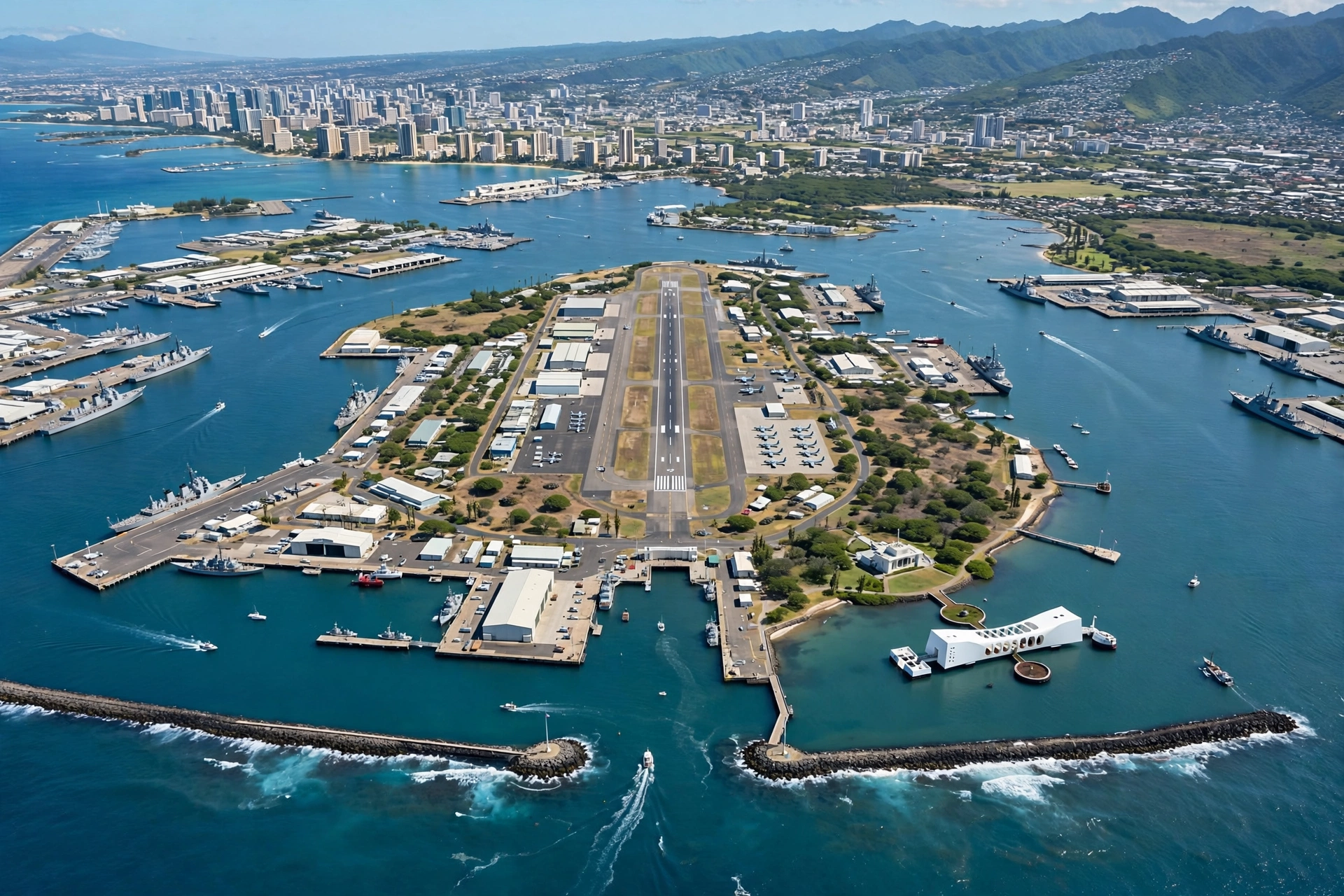
Pearl Harbor sits on the south shore of Oʻahu, roughly 10 miles west of downtown Honolulu and about 12 miles northwest of Waikīkī. On any map of the Hawaiian Islands, find Oʻahu first, then look to its southern coastline. Pearl Harbor occupies a deep natural indentation between Honolulu’s urban sprawl to the east and the Waiʻanae coast to the west. It is part of the Joint Base Pearl Harbor-Hickam military installation, one of the largest naval bases in the Pacific.
Geographically, the harbor opens to the south, facing the open Pacific Ocean through a single narrow entrance channel. The waters inside are calm and protected, which is precisely what made the site valuable as a naval anchorage. On a road map, the harbor is flanked by Interstate H-1 (also signed as the Queen Liliʻuokalani Freeway) to the north and Kamehameha Highway (Route 99) to the west. The city of ʻAiea borders the harbor’s northern edge, while the neighborhood of Halawa lies to the east, home to Aloha Stadium.
To orient yourself regionally: Honolulu International Airport (Daniel K. Inouye International Airport) is only about 4 miles east of Pearl Harbor, making the memorial one of the most accessible major attractions from the airport. Waikīkī, where most visitors stay, lies about 12 miles southeast. The drive takes roughly 25 to 35 minutes depending on traffic. From the North Shore towns of Haleʻiwa or Waimea Bay, Pearl Harbor is roughly 25 miles south, about a 45-minute drive via the H-2 and H-1 freeways.
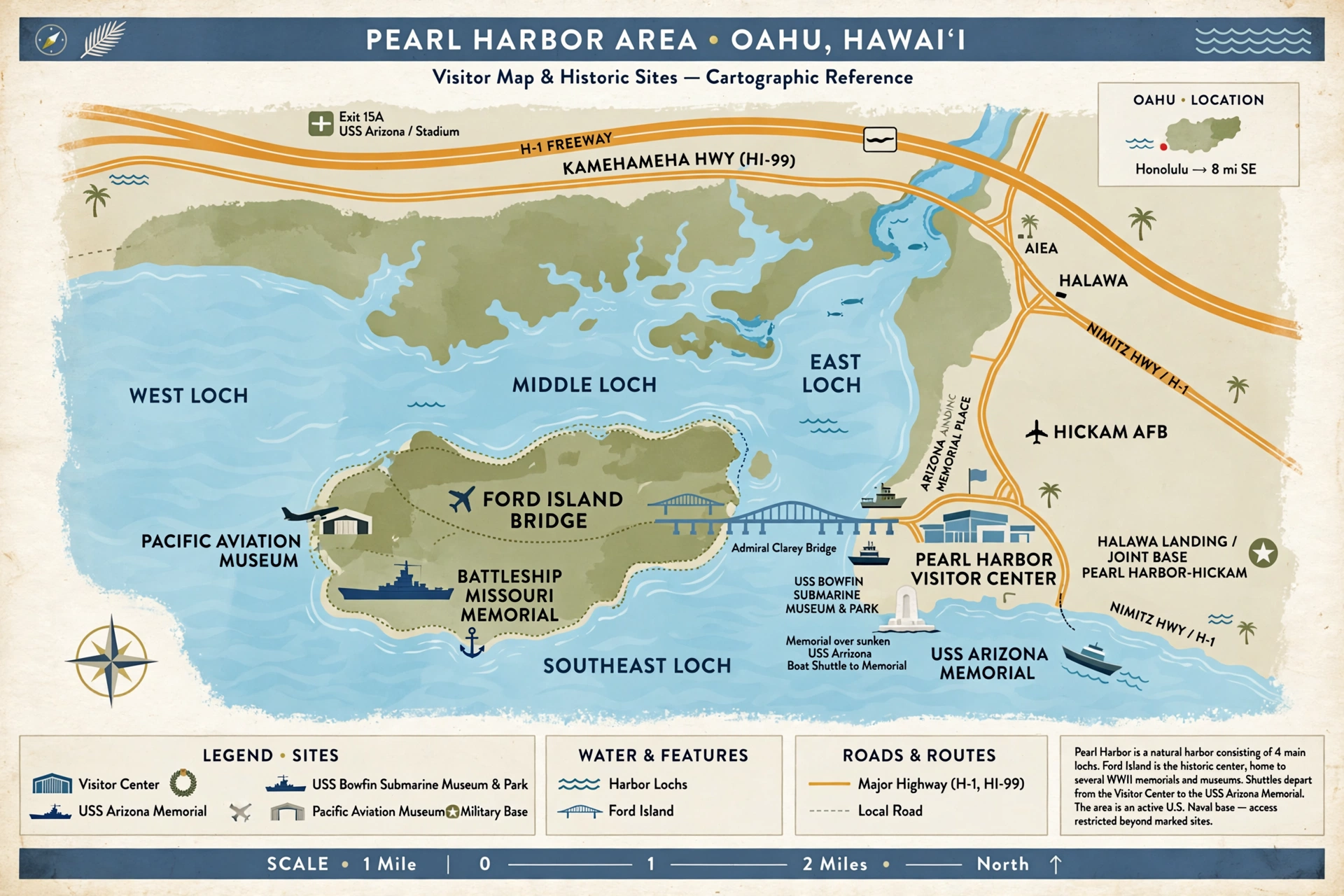
The harbor itself is not a single body of water but a complex of lochs. On detailed nautical charts you will see three main branches: East Loch, Middle Loch, and West Loch, all radiating from the harbor entrance like fingers. Ford Island sits near the center of this complex, between East Loch and Middle Loch. This geography matters for visitors because the memorial sites are spread across both shores: the USS Arizona Memorial, the visitor center, the submarine museum, and the aviation museum occupy different points around the harbor, and reaching some of them requires a shuttle bus across the Ford Island Bridge.
One point that confuses first-time visitors is the difference between the harbor and the memorial. Pearl Harbor is the active naval base and natural harbor. Pearl Harbor National Memorial is the National Park Service unit that preserves and interprets the sites of the December 7, 1941 attack. The memorial’s visitor center sits on the harbor’s eastern shore near ʻAiea, and the sites it manages include the USS Arizona Memorial in the harbor itself, plus partner sites on Ford Island and nearby. When people say they are “going to Pearl Harbor,” they almost always mean the national memorial and its partner attractions.
For trip planning, the memorial’s physical address is 1 Arizona Memorial Place, Honolulu, HI 96818. Plug this into any navigation app and it will route you to the visitor center parking area off Kamehameha Highway. The site is well signed from both the H-1 and H-201 freeways, with brown National Park Service highway signs guiding you the last few miles.
Pearl Harbor Area Layout
Understanding the harbor’s layout before you arrive makes the visit much smoother, because the attractions are not clustered in one walkable spot. They are distributed around the harbor’s shoreline and on Ford Island, and moving between them involves a mix of walking, shuttle buses, and boats.
The Pearl Harbor National Memorial Visitor Center anchors the visit. It sits on the eastern shore of the harbor in the Halawa area, with its own parking lot, two museums (the Road to War and Attack galleries), a bookstore, and the theater where the documentary film plays before the USS Arizona Memorial boat program. Everything begins here: this is where you check in, clear the bag policy, and board the Navy-operated boat to the Arizona Memorial.
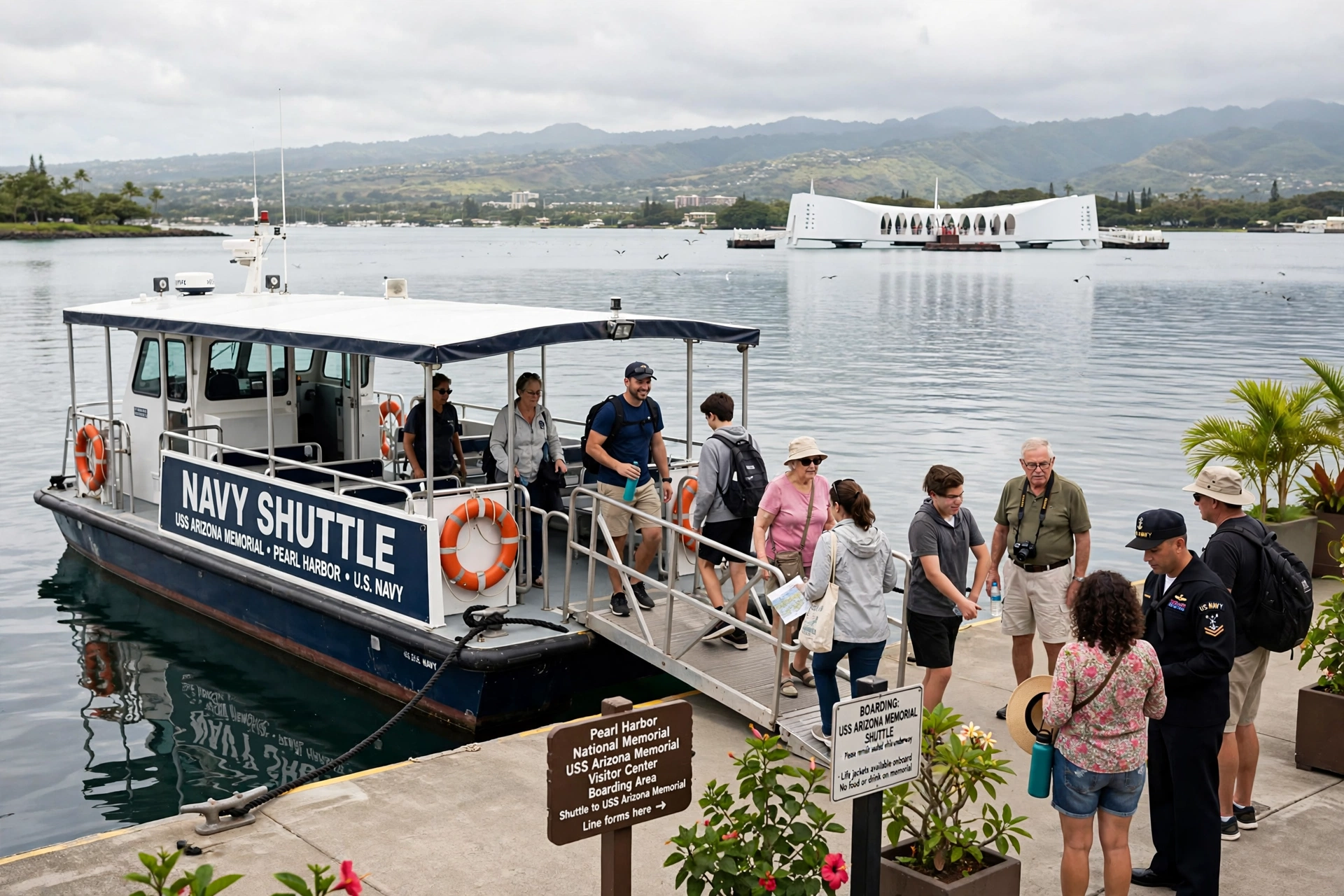
The USS Arizona Memorial itself floats in the harbor above the sunken battleship, roughly a quarter mile offshore from the visitor center. It is not on land; you reach it only by the official Navy shuttle boat, which departs from the visitor center dock. The memorial straddles the wreck without touching it, and from its open-air deck you can look down into the water at the rusting hull of the Arizona below.
Ford Island lies across the harbor to the west of the visitor center, connected to the mainland by the Admiral Clarey Bridge (Ford Island Bridge). This island holds two of the partner attractions: the Battleship Missouri Memorial, moored on the island’s southeastern shore, and the Pearl Harbor Aviation Museum, housed in historic hangars on the island’s airfield. Visitors cannot drive their own cars onto Ford Island; a free shuttle bus runs continuously from the visitor center parking area to the island’s attractions throughout the day.
Back on the mainland side, within walking distance of the visitor center, you will find the USS Bowfin Submarine Museum and Park, located just across the street from the memorial entrance. This privately operated museum includes the World War II submarine USS Bowfin, moored dockside, plus a museum building and outdoor exhibits. Because it is adjacent to the visitor center, most visitors pair it with their Arizona Memorial program on the same morning or afternoon.
The practical takeaway for mapping your day: budget a full day if you want to see all four major sites. A typical efficient route is the USS Arizona Memorial program and visitor center museums in the morning, the Bowfin at midday, then the Ford Island shuttle to the Battleship Missouri and Aviation Museum in the afternoon. The shuttle ride to Ford Island takes about 10 minutes each way, and each island attraction deserves at least 90 minutes.
Pearl Harbor National Memorial Sites
USS Arizona Memorial
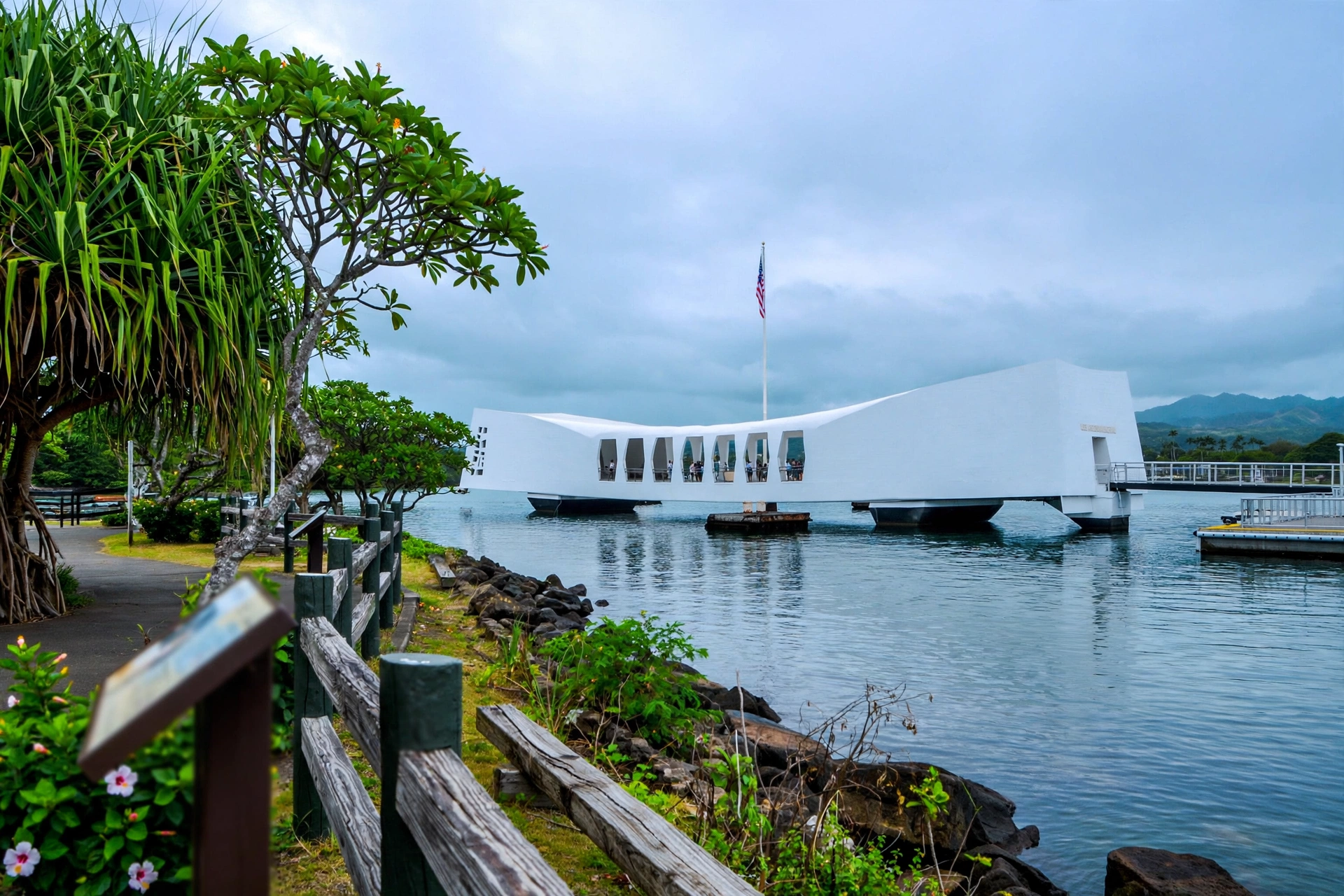
The USS Arizona Memorial is the centerpiece of the national memorial and the site’s most visited attraction. The white, open-air structure spans the sunken hull of the battleship USS Arizona, which was destroyed during the attack on December 7, 1941, with the loss of 1,177 crew members. More than 900 of those sailors and Marines remain entombed in the wreck, making the memorial both a historic site and an active gravesite.
The memorial was designed by Honolulu architect Alfred Preis and dedicated in 1962. Its distinctive shape, sagging in the middle and rising at both ends, is widely interpreted as representing initial defeat and ultimate victory. Inside, the shrine room at the far end carries a marble wall inscribed with the names of every crew member lost aboard the Arizona. Oil still seeps from the wreck below, rising to the surface in small droplets that visitors often call the “tears of the Arizona.”
Visits to the memorial follow a structured 45-minute program run by the National Park Service and the U.S. Navy: a 23-minute documentary film in the visitor center theater, followed by the boat ride out to the memorial, time to explore the structure, and the return trip. The program itself is free, though advance reservations through recreation.gov are strongly recommended because same-day tickets are limited.
Battleship Missouri Memorial
The USS Missouri, moored on Ford Island’s southeastern shore, is where World War II ended. On September 2, 1945, the formal Japanese surrender was signed aboard the Missouri in Tokyo Bay, and the ship now rests permanently at Pearl Harbor as a bookend to the war that began at this very harbor. The juxtaposition is deliberate and powerful: the Arizona marks where the war began for the United States, and the Missouri marks where it ended.
The Missouri is an Iowa-class battleship, 887 feet long, and visitors can explore multiple deck levels, including the surrender deck with its bronze plaque marking the exact signing spot, the massive 16-inch gun turrets, crew quarters, and the bridge. Guided tours and self-guided exploration are both available. This is a separately ticketed attraction operated by a nonprofit organization, not the National Park Service, and admission fees apply.
USS Bowfin Submarine Museum and Park
The USS Bowfin, nicknamed the “Pearl Harbor Avenger,” is a Balao-class submarine launched exactly one year after the attack, on December 7, 1942. She completed nine war patrols in the Pacific during World War II. Visitors can walk through the submarine’s narrow interior, from the torpedo rooms to the engine room, experiencing the cramped conditions submariners endured.
The surrounding park includes the Pacific Fleet Submarine Museum building with artifacts, a restored Japanese Kaiten manned torpedo, a Poseidon missile, and outdoor memorials honoring the 52 U.S. submarines lost in World War II. Like the Missouri, this is a separately ticketed attraction within easy walking distance of the national memorial visitor center.
Pearl Harbor Aviation Museum
Housed in two historic World War II-era hangars on Ford Island, the Pearl Harbor Aviation Museum displays more than 40 aircraft spanning from the 1940s to the modern era. Hangar 37 and Hangar 79 both still bear visible bullet holes and battle damage from the December 7 attack, preserved as part of the exhibits. Highlights include a Japanese Zero fighter, a B-25 Mitchell bomber, and a Stearman biplane in which two American pilots famously took off during the attack.
The museum also operates a flight simulator experience and maintains the historic Ford Island Control Tower, which visitors can tour for panoramic views of the harbor and the memorial sites. Admission is separately ticketed, and the museum is reached via the Ford Island shuttle from the visitor center.
Visiting: Tickets, Reservations, and What to Expect
Planning ahead is essential because the USS Arizona Memorial program has limited daily capacity and frequently sells out, especially during holidays and the winter high season. Here is how the ticketing works.
The USS Arizona Memorial boat program is free, but tickets are distributed through recreation.gov. A large block of tickets is released 8 weeks in advance at 3:00 p.m. HST, and a smaller block is released the day before at 3:00 p.m. HST. A small $1 service fee per ticket applies to online reservations. Same-day standby tickets are sometimes available at the visitor center, but relying on standby during busy periods is risky.
The partner attractions (Battleship Missouri, USS Bowfin, Pearl Harbor Aviation Museum) are separately ticketed and operated by independent nonprofit organizations. You can buy individual admission for each or purchase a combination passport that covers multiple sites at a discount. These tickets are available online in advance or at each attraction’s entrance.
Several practical rules shape the visit. The National Park Service enforces a strict no-bag policy inside the memorial complex: purses, backpacks, camera bags, and diaper bags are not permitted. Clear exceptions exist for medical items. A bag storage facility near the entrance holds bags for a small fee. Small cameras and phones are allowed, but large camera equipment and tripods are restricted on the memorial itself.
Expect airport-style security screening at the visitor center entrance. Arrive at least one hour before your scheduled Arizona Memorial program time to allow for parking, screening, and check-in. The full program takes about 45 minutes, but plan 2 to 3 hours for the visitor center museums, film, and memorial combined.
Visitors should also know that the memorial program can be suspended due to high winds or rough harbor conditions, since the Navy boat cannot safely dock at the memorial in choppy water. When this happens, the visitor center museums remain open and ticket holders may be rescheduled. Mornings generally offer the calmest conditions.
Dress for the weather: the site is largely outdoors, shade is limited, and Oʻahu’s south shore is typically sunny and warm. Bring reef-safe sunscreen, a hat, water, and comfortable walking shoes. Food options at the visitor center are limited to a small snack area, so plan meals around your visit.
Getting There: Directions and Transportation
Pearl Harbor is one of the easiest major attractions to reach on Oʻahu, thanks to its central location near Honolulu and the airport.
Driving
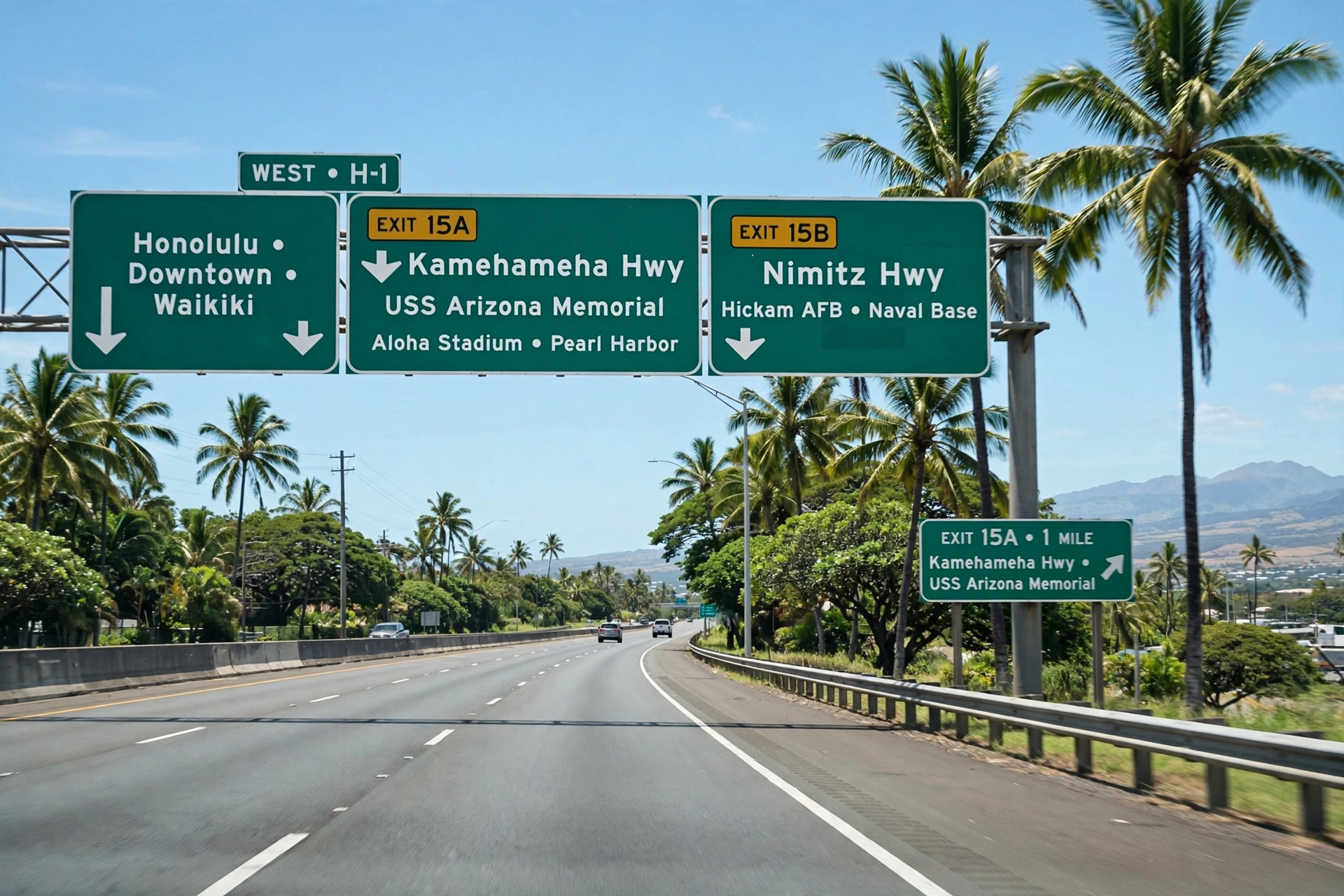
From Waikīkī (about 12 miles, 25 to 35 minutes): take Ala Wai Boulevard or Kalākaua Avenue to the H-1 Freeway westbound. Continue on H-1 West past the airport, then take Exit 15A for the Arizona Memorial and Stadium. Follow the brown National Park Service signs onto Kamehameha Highway to the visitor center entrance.
From Honolulu International Airport (about 4 miles, 10 to 15 minutes): exit the airport onto Nimitz Highway westbound, which becomes Kamehameha Highway. Follow signs for the Arizona Memorial. This is the simplest arrival of all, and many visitors stop at Pearl Harbor on their arrival or departure day.
From Ko Olina (about 22 miles, 30 to 40 minutes): take the H-1 Freeway eastbound toward Honolulu and use Exit 15A for the memorial.
From the North Shore (about 25 miles, 40 to 50 minutes): take the H-2 Freeway south to the H-1 interchange, then continue east on H-1 and exit at 15A.
Parking at the visitor center is free but the lot fills early, especially on weekends and holidays. Arriving before 9:00 a.m. gives you the best chance of a close spot. Overflow parking is available nearby during peak periods.
Public Transit
Oʻahu’s public bus system, TheBus, serves Pearl Harbor directly. Route 20 runs from Waikīkī and the airport area to the Arizona Memorial, and Route 42 connects from the Ala Moana area. The ride from Waikīkī takes roughly 45 to 60 minutes. A single adult fare is a few dollars, and day passes are available. Check the current schedule before relying on the bus, as frequency varies by time of day.
Tours and Shuttles
Many Waikīkī hotels are served by tour operators offering round-trip transportation packages to Pearl Harbor. These typically include hotel pickup, narration, and sometimes bundled admission to the partner attractions. If you prefer not to drive or navigate the bus, this is a convenient option, though independent visits give you more control over timing.
History Overview: December 7, 1941
On the morning of Sunday, December 7, 1941, the Imperial Japanese Navy launched a surprise attack on the U.S. Pacific Fleet anchored at Pearl Harbor. Beginning shortly before 8:00 a.m. local time, waves of torpedo bombers, dive bombers, and fighters struck the battleships moored along Ford Island’s “Battleship Row,” the airfields at Hickam, Wheeler, and Ford Island, and other military installations around Oʻahu.
The attack lasted less than two hours but was devastating. All eight U.S. battleships present were damaged, with four sunk. The USS Arizona suffered a catastrophic magazine explosion after a bomb penetrated her forward decks, sinking in minutes with 1,177 crew members aboard. The USS Oklahoma capsized, trapping hundreds inside. In total, 2,403 Americans were killed and more than 1,100 were wounded. Nearly 200 aircraft were destroyed or damaged.
The following day, President Franklin D. Roosevelt addressed Congress, calling December 7 “a date which will live in infamy,” and the United States formally entered World War II. The attack unified American public opinion behind the war effort and set in motion the Pacific campaign that would end with Japan’s surrender aboard the USS Missouri in Tokyo Bay on September 2, 1945.
Today the site is preserved as a place of remembrance and education. The National Park Service interprets not only the attack itself but also the broader story of the war in the Pacific, the road that led to conflict, and the reconciliation that followed. Visitors of all backgrounds, including many from Japan, come to reflect on the costs of war and the value of peace. The memorial’s tone is solemn rather than celebratory, and respectful behavior is expected throughout the grounds.
For those who want to go deeper, the visitor center’s two museums, the Road to War and Attack galleries, present detailed exhibits on the events leading up to December 7 and the attack itself, using artifacts, photographs, and firsthand accounts.
Nearby Attractions
Pearl Harbor’s central location puts several other Oʻahu attractions within easy reach, making it simple to combine the memorial with the rest of your day.
Aloha Stadium Swap Meet, in the Halawa district just east of the memorial, hosts one of Hawaiʻi’s largest open-air markets on Wednesdays, Saturdays, and Sundays, with hundreds of vendors selling local crafts, clothing, and souvenirs. It is an easy stop before or after your memorial visit.
Downtown Honolulu and the Hawaiʻi State Capitol are about 10 minutes east by car. Nearby, ʻIolani Palace, the only royal palace on U.S. soil, and the King Kamehameha Statue offer a window into the Kingdom of Hawaiʻi era.
Bishop Museum, Hawaiʻi’s premier museum of natural and cultural history, is roughly 15 minutes east in the Kalihi district. Its Hawaiian Hall and planetarium make it a strong pairing with the memorial for a history-focused day.
Waikīkī Beach and its shops, restaurants, and sunset views are about 25 to 35 minutes southeast, making the beach a natural afternoon destination after a morning at Pearl Harbor.
Frequently Asked Questions
Where exactly is Pearl Harbor on a map?
Pearl Harbor is on the south shore of Oʻahu, about 10 miles west of downtown Honolulu and 12 miles northwest of Waikīkī. It is a large natural harbor opening to the Pacific Ocean, with Ford Island near its center. The Pearl Harbor National Memorial Visitor Center is located at 1 Arizona Memorial Place, Honolulu, HI 96818, on the harbor’s eastern shore.
Is Pearl Harbor the same as the USS Arizona Memorial?
Not exactly. Pearl Harbor is the naval base and natural harbor. The USS Arizona Memorial is one site within Pearl Harbor National Memorial, the National Park Service unit that preserves the attack sites. The memorial also includes the visitor center, while partner organizations operate the Battleship Missouri, USS Bowfin, and Pearl Harbor Aviation Museum nearby.
How far is Pearl Harbor from Waikīkī?
Pearl Harbor is about 12 miles northwest of Waikīkī. The drive takes roughly 25 to 35 minutes via the H-1 Freeway westbound, depending on traffic. TheBus Route 20 also runs directly from Waikīkī to the memorial in about 45 to 60 minutes.
Do I need tickets to visit the USS Arizona Memorial?
The USS Arizona Memorial boat program is free, but advance reservations through recreation.gov are strongly recommended. Tickets are released 8 weeks ahead and again the day before at 3:00 p.m. HST, with a $1 service fee per ticket. Limited same-day standby tickets may be available at the visitor center.
Can I bring a bag to Pearl Harbor?
No. The National Park Service prohibits purses, backpacks, camera bags, and similar items inside the memorial complex. A bag storage facility near the entrance holds bags for a small fee. Small cameras and phones are permitted, and medical bags are excepted.
How long should I plan to spend at Pearl Harbor?
Plan 2 to 3 hours for the USS Arizona Memorial program and visitor center museums alone. If you want to see all four major sites (Arizona, Missouri, Bowfin, Aviation Museum), budget a full day of 6 to 8 hours.
Can I visit Ford Island on my own?
Ford Island is an active military installation, so private vehicles are not permitted. Visitors reach the Battleship Missouri and Pearl Harbor Aviation Museum via the free shuttle bus that runs continuously from the visitor center parking area.
Is Pearl Harbor free to visit?
The USS Arizona Memorial program and the National Park Service visitor center museums are free. The Battleship Missouri Memorial, USS Bowfin Submarine Museum, and Pearl Harbor Aviation Museum are separately ticketed attractions operated by nonprofit partners, with combination passes available.
What is the best time of day to visit Pearl Harbor?
Morning is best. The memorial opens at 7:00 a.m., parking is easier, crowds are thinner, and harbor conditions are typically calmest for the boat ride to the Arizona Memorial. Afternoon visits are still worthwhile but expect larger crowds and warmer temperatures.
Can children visit Pearl Harbor?
Yes, Pearl Harbor welcomes visitors of all ages, and the site is stroller-accessible. The subject matter is solemn, so parents may want to prepare younger children for the memorial’s tone. The documentary film and exhibits discuss wartime events frankly but appropriately.
Related Guides
- Hawaii Map: Complete Reference Map & Area Guide: the statewide map hub for orienting yourself across the islands
- Oʻahu Hikes: The Complete Guide: trails across the island, including ridges with harbor views
- Hawaii Beaches: the best beaches on every island
- Hawaii Snorkeling: The Complete Guide: top snorkel spots around Oʻahu and beyond
- Maui Map: Complete Reference Map & Area Guide: island-by-island map reference for trip planning
Reading Pearl Harbor on the Map and in Person
A map shows you where Pearl Harbor sits: a sheltered harbor on Oʻahu’s south shore, Ford Island at its heart, the memorial sites ringing its edges. But the map only begins the story. Standing at the visitor center shoreline, looking across the calm water to the white memorial spanning the Arizona’s wreck, with the Missouri’s gray silhouette on Ford Island beyond, the geography takes on its full meaning. This compact corner of Oʻahu holds the beginning and the end of America’s Second World War within a single view, and understanding its layout before you go lets you experience that perspective the moment you arrive.