The Hawaiian Language Revival: How ʻŌlelo Hawaiʻi Came Back to Life

Fifty years ago, the Hawaiian language was dying. Fewer than fifty fluent speakers under the age of eighteen remained in the entire state, most of them children of Niʻihau, a small privately owned island where Hawaiian had never stopped being spoken. In classrooms, government, and daily life, ʻōlelo Hawaiʻi had been pushed aside for nearly a century. Today the story is different. Hawaiian is an official language of the state, children learn math and science entirely in Hawaiian from preschool through college, and the University of Hawaiʻi awards doctoral degrees in the language. This is the complete guide to the Hawaiian language revival: how the language was nearly lost, the people who refused to let it go, and how it lives today.
This page is the canonical home for everything about the Hawaiian language revival. It covers the history of the decline, the key milestones, the immersion school movement, the role of the University of Hawaiʻi, and how visitors can respectfully encounter the language. If you have been searching for anything about the revival of ʻōlelo Hawaiʻi, the answers are all here on this one page.
Hawaiian Language Revival at a Glance
| THE LANGUAGE | |
| The language | ʻŌlelo Hawaiʻi (Hawaiian), a Polynesian language |
| The status | Official language of Hawaiʻi alongside English since 1978 |
| The alphabet | 13 letters: 5 vowels, 7 consonants, and the ʻokina |
| THE FALL | |
| The ban | 1896 law ended Hawaiian as a school language |
| The low point | Fewer than 50 fluent speakers under 18 by the 1980s |
| THE COMEBACK | |
| The turning point | ʻAha Pūnana Leo immersion preschools, founded 1983 |
| Today | Immersion schools statewide and university degrees through the PhD level |
| Where you will hear it | Street signs, schools, radio, hula and music, everyday conversation |
What ʻŌlelo Hawaiʻi Is
ʻŌlelo Hawaiʻi is the indigenous language of the Hawaiian Islands and a member of the Polynesian language family, closely related to Tahitian, Māori, and Samoan. Before European contact it was purely spoken. The written form most people see today was developed in the early nineteenth century, when American Protestant missionaries assigned letters to Hawaiian sounds. That alphabet is remarkably small: just thirteen letters. Five vowels (a, e, i, o, u), seven consonants (h, k, l, m, n, p, w), and the ʻokina, the glottal stop that is a full consonant in Hawaiian. A macron called the kahakō marks long vowels. Together the ʻokina and kahakō change meaning completely. The classic example is lānai, which means a porch or veranda, versus Lānaʻi, the island. Leave out the marks and you cannot be sure which word you are reading, which is why careful writers always include them.
The small alphabet is deceptive. Hawaiian builds rich meaning from short roots, and its sounds are musical and open, with every syllable ending in a vowel. Words you already know carry real weight. Aloha means far more than hello. Mahalo is thank you, and mahalo nui loa is thank you very much. Keiki means child, kūpuna means elders or ancestors, and ʻāina means land, a word tied to identity itself.
The Kingdom Years: A Language at Full Strength
It is easy to forget how strong Hawaiian once was. During the Kingdom of Hawaiʻi in the 1800s, the islands had one of the highest literacy rates in the world. Hawaiian-language newspapers, called nūpepa, flourished, and by some counts more than a hundred were published in the nineteenth century. Hawaiians and immigrants alike read them, and government business, laws, and the state anthem were in Hawaiian.
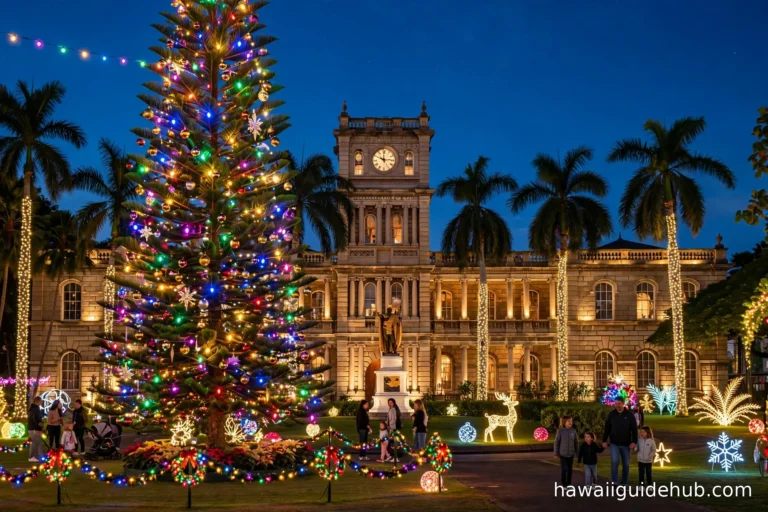
That strength is part of why the decline hit so hard. The overthrow of the Hawaiian Kingdom in 1893 was a political rupture, and language policy became one of the tools of the new order. To understand the kingdom era in more depth, see our guide to Hawaiʻi’s history before statehood. The palaces and public buildings of that period still stand, and a visit to ʻIolani Palace puts you face to face with the world in which Hawaiian was the language of power.
How the Language Was Nearly Lost
In 1896, three years after the overthrow, the Republic of Hawaiʻi enacted a law that effectively banned school instruction in ʻōlelo Hawaiʻi. English became the required language of education, and Hawaiian-medium schools were shut down. The effect was not instant, but it was relentless. Children who spoke Hawaiian at home were punished for using it at school. A generation learned that their language had no place in the classroom, and the next generation heard it less at home. Parents who wanted their children to succeed in an English-speaking economy stopped passing the language on.
By the middle of the twentieth century, Hawaiian had retreated to the margins. It survived among older speakers in rural communities, in church hymns, and in the songs of working musicians, but it was no longer the language children acquired naturally in most families. Each decade the pool of fluent speakers grew smaller and older. The language was not technically dead, but linguists use a blunt term for where it stood. It was moribund, no longer being transmitted to children, which is the condition from which languages do not usually recover.
The Low Point
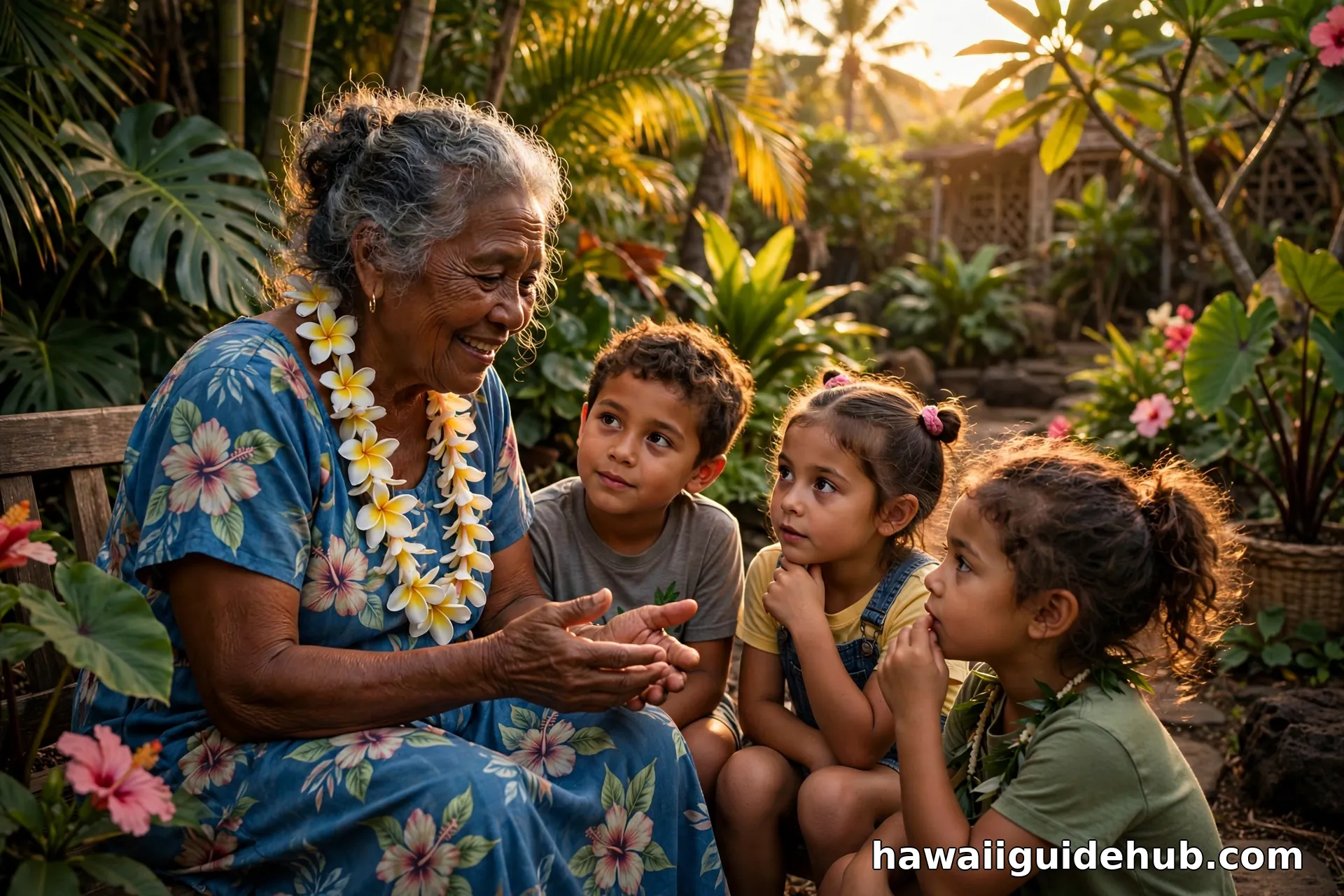
By the 1980s the numbers were stark. Fewer than fifty fluent speakers under the age of eighteen remained in the state. The living native-speaker population had dwindled to well under a thousand, most of them elderly and scattered across remote rural areas. The one continuous native-speaking community was on Niʻihau, a small privately owned island whose few hundred residents still used Hawaiian as their first language.
This is the moment the revival story starts from, and it matters because it shows how close the language came to disappearing. When a language stops being spoken to children, it has one generation left. The people who launched the revival in the 1970s and 1980s understood this clearly. They were not trying to preserve Hawaiian as a museum piece. They were trying to put it back into the mouths of children.
The Sparks of Revival
The revival did not begin with a single law or institution. It began with people, and with a cultural awakening that swept Hawaiʻi in the 1970s. This was the era of the Hawaiian Renaissance: a renewed pride in hula, voyaging, music, and identity that asked a pointed question. How could Hawaiians not speak the language of their grandparents? One of the most influential early figures was Larry Kimura, a Hawaiian language professor whose radio program Ka Leo Hawaiʻi began airing in the early 1970s and brought the voices of elderly native speakers into homes across the islands. For many younger Hawaiians it was the first time they had heard the language spoken naturally and at length.
Institutional milestones followed the cultural spark. In 1977, the nonprofit ʻAhahui ʻŌlelo Hawaiʻi helped standardize modern Hawaiian orthography, giving the written language consistent rules for the ʻokina and kahakō. Then came the landmark political victory. At the Hawaiʻi Constitutional Convention of 1978, delegates approved Article XV, Section 4 of the state constitution, which declares that English and Hawaiian shall be the official languages of Hawaiʻi. Hawaiian had legal standing again for the first time in eighty years.
But official status on paper did not put the language back into classrooms. The 1896 ban on Hawaiian-medium instruction was still on the books, and schools were still English-only. The revivalists decided that the answer was not to add Hawaiian as a subject in English schools. It was to build entirely new schools where Hawaiian was the language of everything, starting with the youngest children. That decision shaped everything that followed.
Pūnana Leo and the Immersion Movement
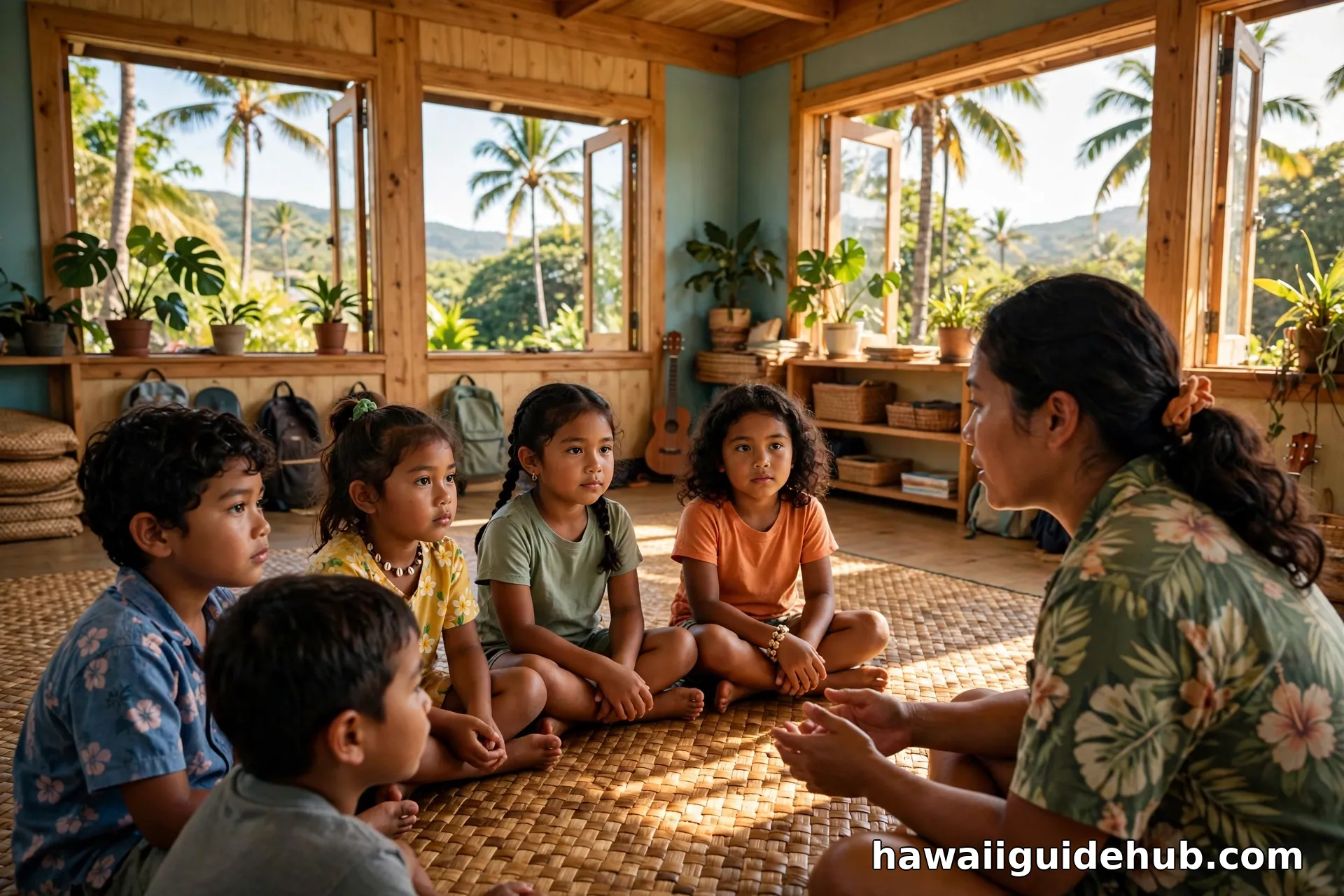
In 1983, a group of Hawaiian language educators and parents, including Kauanoe Kamanā and Pila Wilson of the University of Hawaiʻi at Hilo, formed the nonprofit ʻAha Pūnana Leo, the language nest. They modeled their program on the Māori kōhanga reo of New Zealand, which had shown that total immersion preschools could create new young speakers of an endangered language. The first Pūnana Leo preschool opened in 1984 on Kauaʻi. There was no state funding, no curriculum, and no precedent in Hawaiʻi. The families built it all themselves, creating lessons year by year as their children grew.
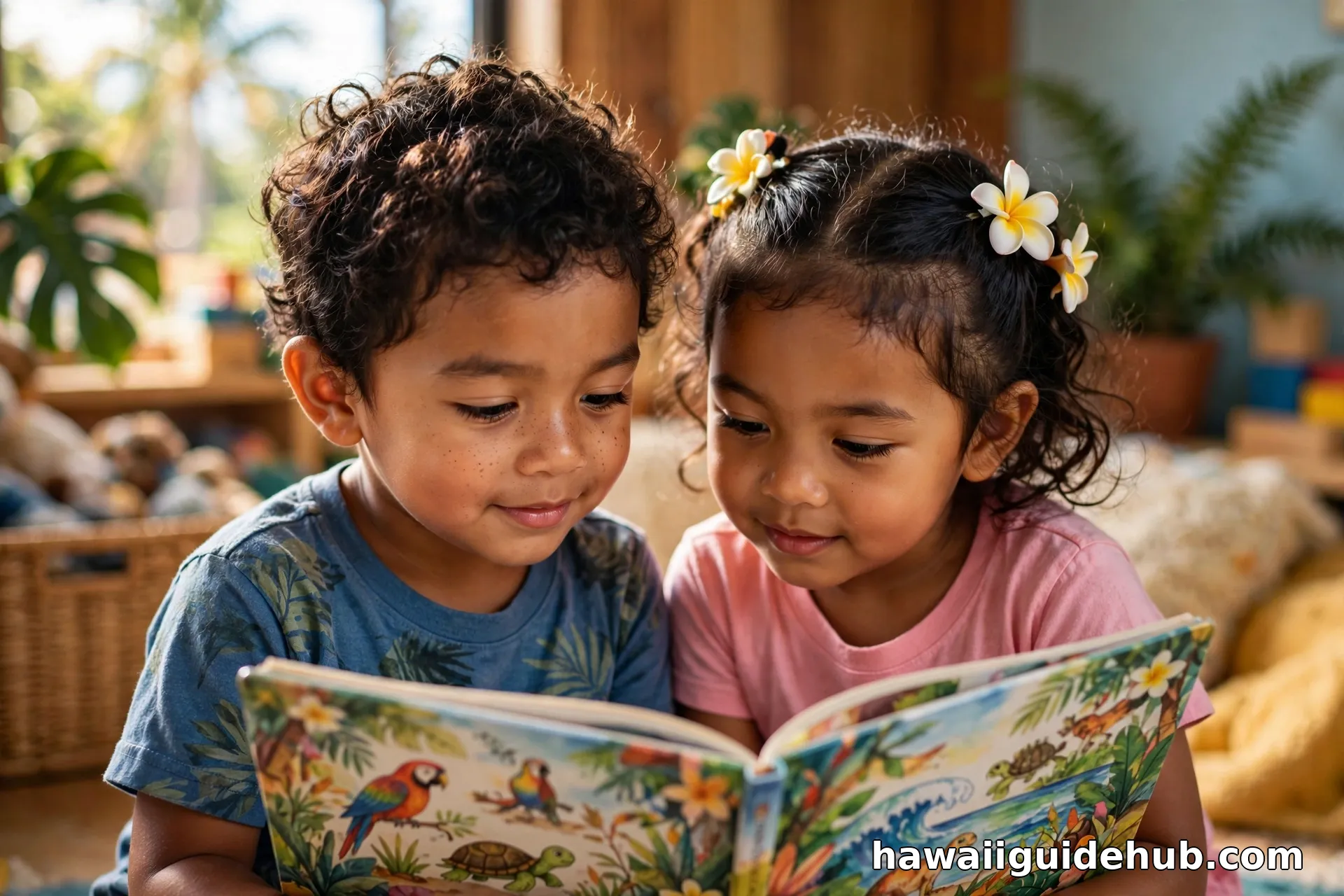
The movement then took on the law itself. Parents and activists lobbied the Board of Education, and in 1986 the state lifted the ninety-year ban on teaching through ʻōlelo Hawaiʻi in public and private schools. The following year the Board of Education approved the Papahana Kaiapuni ʻŌlelo Hawaiʻi, the Hawaiian Language Immersion Program, and the first immersion kindergarten and first grade classes opened to receive Pūnana Leo graduates. A grade was added each year as the children advanced. The public-school immersion track became known as Kula Kaiapuni, and today the network of Pūnana Leo preschools and Kula Kaiapuni schools includes more than twenty immersion schools across the islands serving around two thousand students.
The federal government added its weight in 1990 with the Native American Languages Act, which established it as United States policy to preserve and promote Native American languages, including Hawaiian. In 1999 the first full class of K-12 immersion students graduated, the first generation in nearly a century to complete their entire schooling in Hawaiian. Children who entered preschool speaking only English were graduating fluent in Hawaiian.
Hawaiian at the University
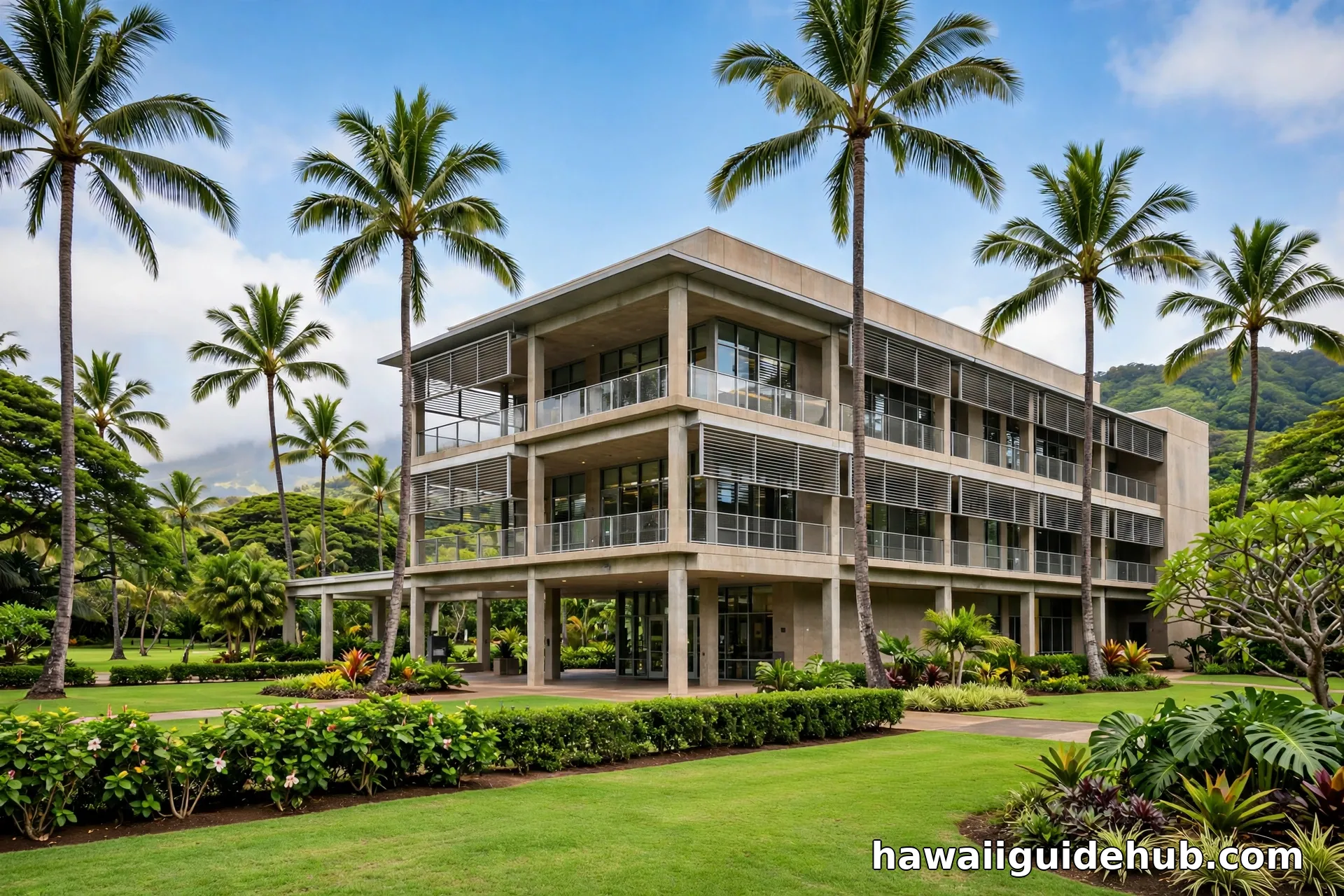
Higher education gave the revival its academic backbone. The University of Hawaiʻi at Mānoa established its Department of Hawaiian and Indo-Pacific Languages and Literatures in 1985, offering a bachelor’s degree in Hawaiian. But the bolder step came at UH Hilo. In 1997 the university established Ka Haka ʻUla O Keʻelikōlani, the College of Hawaiian Language, the first college in the world dedicated to education conducted through an indigenous language. In 2006 the first doctoral dissertation written entirely in ʻōlelo Hawaiʻi was completed at UH Mānoa, and in 2007 UH Hilo launched a doctoral program in Hawaiian language. The college’s permanent home, the Haleʻōlelo building, opened on the Hilo campus in 2014.
The university programs did more than grant degrees. They created the teachers, curriculum writers, and scholars the immersion schools needed, and they proved that Hawaiian could function as a complete modern language of scholarship. New vocabulary was coined systematically for everything from computer science to medicine. Today a student can enter a Pūnana Leo preschool at age four and, without ever leaving Hawaiian-medium education, earn a PhD in the language.
Where the Language Lives Today
Walk through Hawaiʻi today and the revival is visible everywhere. Street signs across the state carry Hawaiian names with proper ʻokina and kahakō. The month of February is officially ʻŌlelo Hawaiʻi Month, a statewide celebration of the language. Hawaiian appears in radio, newspapers, books, films, and music. Hula and mele, song, remain living vessels of the language, and an evening of traditional Hawaiian cultural performances is one of the most powerful ways a visitor can hear ʻōlelo Hawaiʻi used as it was meant to be used: in story and ceremony.
The language is also back in daily life in ways the revivalists dreamed about. Immersion graduates are now raising their own children in Hawaiian, creating the first new generation of native speakers in a century. Place names that were mangled into English spellings are being restored. The work is not finished, and speakers will tell you the language still needs more domains, more media, and more families. But the direction has reversed. Hawaiian went from a language with one generation left to a language with a future.
Visiting with respect: you do not need to speak Hawaiian to visit Hawaiʻi, but small efforts are noticed and appreciated. Learn to pronounce the place names you say every day, use aloha and mahalo sincerely rather than as jokes, and never mock the sounds of the language. If you want to go deeper, a book of Hawaiian phrases, or learning the Hawaiian names of the flowers of Hawaiʻi you photograph, connects you to the islands in a way English alone cannot.
Frequently Asked Questions
Is Hawaiian an official language of Hawaiʻi?
Yes. Article XV, Section 4 of the Hawaiʻi State Constitution, added by the 1978 Constitutional Convention, declares that English and Hawaiian shall be the official languages of Hawaiʻi, giving the language standing in government, education, and public life.
Why was the Hawaiian language banned?
In 1896 the Republic of Hawaiʻi, the government formed after the overthrow of the Hawaiian Kingdom, enacted a law that effectively ended school instruction in ʻōlelo Hawaiʻi and made English the required language of education. Hawaiian-medium schools were closed, children were punished for speaking Hawaiian at school, and over the following decades families stopped passing the language to their children.
What is Pūnana Leo?
Pūnana Leo means language nest. The ʻAha Pūnana Leo is the nonprofit founded in 1983 that runs Hawaiian language immersion preschools, where young children learn entirely through Hawaiian. It was modeled on the Māori language nests of New Zealand, and its graduates feed into the public-school Kula Kaiapuni immersion program, creating an unbroken Hawaiian-medium path from preschool through college.
How many people speak Hawaiian today?
Estimates vary, but roughly twenty-four thousand people in Hawaiʻi report speaking Hawaiian, with a smaller core of fully fluent speakers. The more important number is the pipeline: more than twenty immersion schools serve around two thousand students, and immersion graduates are now raising children in Hawaiian, rebuilding the native-speaker base year by year.
Can you learn Hawaiian as a visitor?
You can start. Community classes, university extension courses, books, apps, and online resources all teach Hawaiian to beginners. The ʻAha Pūnana Leo and University of Hawaiʻi programs are the most authoritative sources for learning materials. Even learning to say the names of the places you visit correctly is a meaningful first step.
What is the difference between Hawaiian and Pidgin?
They are completely different languages. ʻŌlelo Hawaiʻi is the indigenous Polynesian language of the islands. Hawaiʻi Pidgin, more precisely called Hawaiʻi Creole English, developed later on the sugar plantations from the mixing of Hawaiian, English, Portuguese, Japanese, Chinese, and other immigrant languages. Pidgin is an English-based creole with its own grammar. Calling Pidgin broken Hawaiian is a common misconception, and Hawaiians consider the distinction important.
The Hawaiian language revival is one of the great language comebacks of the modern world. A language that had fewer than fifty young speakers and one generation left was rebuilt by parents who started preschools with no funding, teachers who wrote their own textbooks year by year, radio hosts who put native voices back on the air, and lawmakers who restored the language to the constitution. It now lives in classrooms, song lyrics, street signs, and family kitchens. ʻŌlelo Hawaiʻi is alive, it is growing, and its future is being spoken into existence one keiki at a time.