Hawaiian Fishing Traditions: Ancient Methods & Ocean Wisdom

Hawaiians were among the Pacific’s greatest fishermen: throw nets, surround nets, deep-sea lines, octopus lures, and the remarkable loko i’a fishponds that farmed the sea. Fishing was science, spirituality, and sustenance woven together, governed by kapu that conserved the resource. This is the complete guide to Hawaiian fishing traditions: the methods, the fishponds, and the ocean wisdom.
This is the single complete guide to Hawaiian fishing traditions. It covers the throw net, surround netting, deep-sea fishing, the loko i’a fishponds, the makaha gates, fishing kapu and conservation, the fisherman’s gods, modern throw-net fishing, restoration efforts, and FAQs. Everything about Hawaiian fishing lives on this one page.
The Ocean as Farm and Temple
For Hawaiians, the ocean was both pantry and church: fishing fed the people and honored the gods. The fisherman (lawai’a) was a respected specialist, trained in currents, seasons, fish behavior, and ritual. Knowledge passed down in families: where the fish ran, when they spawned, how the moon affected the bite. This was marine science before the term existed: observation refined over a thousand years.
The Old Toolkit
| Method | How it worked | Target |
| Throw net (‘upena) | Weighted circular net cast by hand | Reef fish; mullet |
| Surround net (hukilau) | Community net encircling schools | Large schools; celebrations |
| Deep-sea line | Long lines from canoes | Ahi; bottom fish |
| Octopus lure | Cowrie-shell lure on line | He’e (octopus) |
| Loko i’a | Walled fishponds with gates | Mullet; milkfish |
Reading the Water: The Fisherman’s Knowledge
Before a net was ever cast, the lawai’a read the ocean like a scholar reads a manuscript: the color of the water told depth and bottom type; a ripple pattern revealed a school below; seabirds wheeling and diving marked bait fish driven up by predators; the moon phase predicted the bite, because many reef fish feed hardest around the new and full moons. Fishermen memorized ko’a, the offshore fishing grounds, by triangulating landmarks on shore: two mountain peaks aligned, a church steeple over a certain rock, each combination marking a productive spot. These coordinates were family treasures, inherited and guarded. The knowledge also ran deep into the sea itself: fishermen knew which species lived at which depths, what they ate, when they spawned, and how they migrated between islands. Modern fisheries biologists, arriving centuries later with sonar and surveys, found themselves confirming what the old fishermen already knew: the Hawaiians had mapped the ocean’s ecology without writing a word down. It was science carried in memory, tested every day, corrected every season.
The Throw Net: ‘Upena
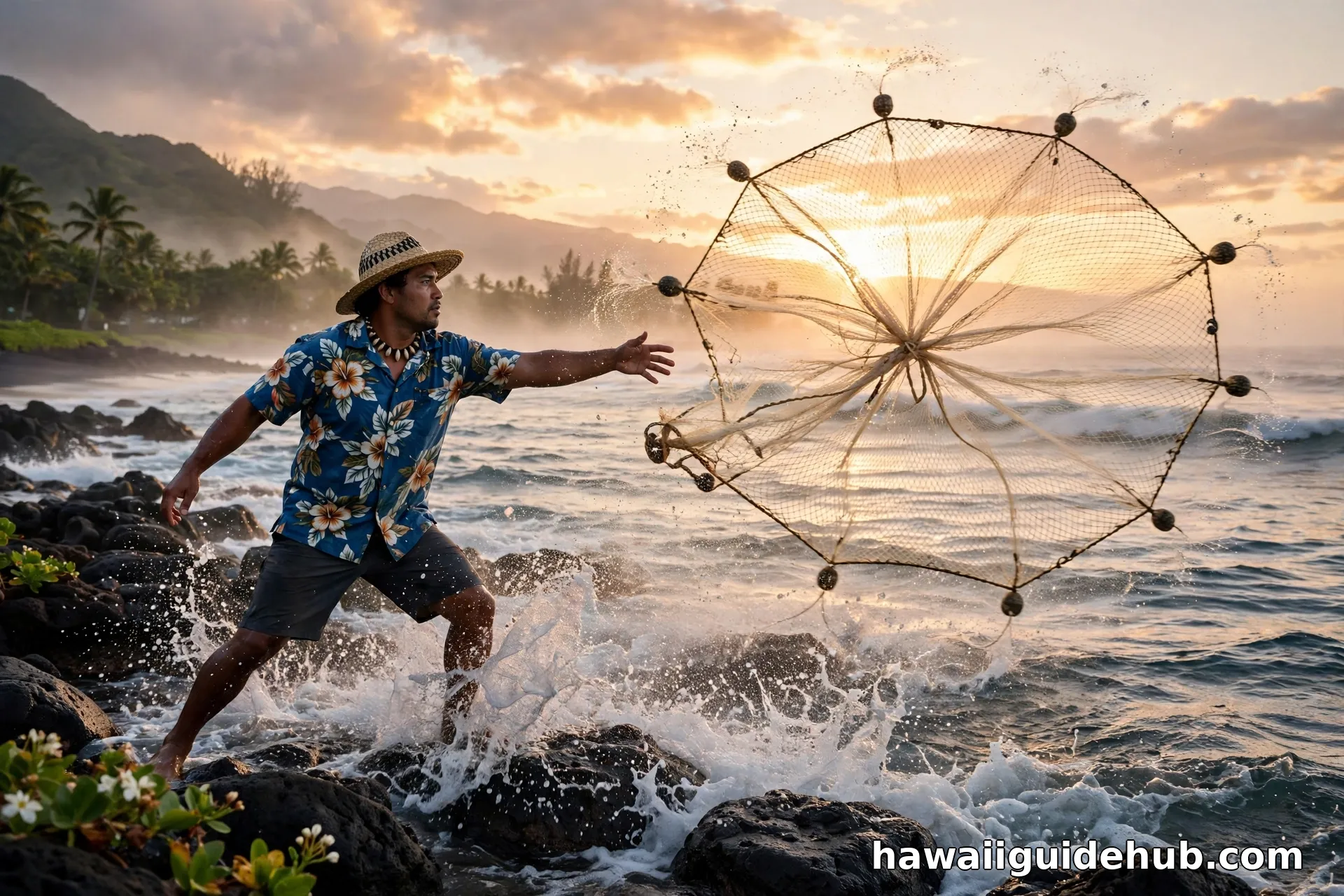
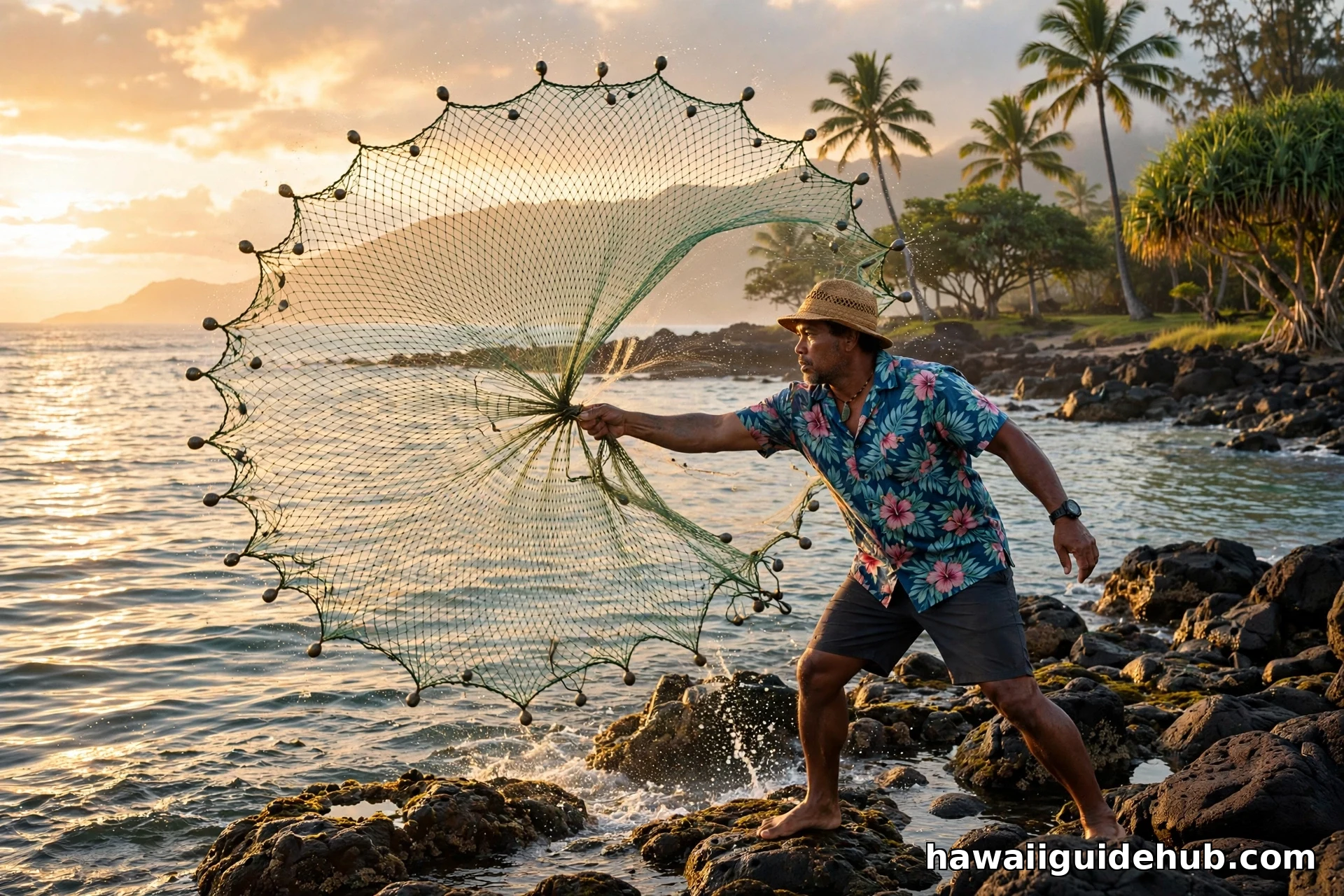
The throw net is Hawaii’s iconic fishing method: a circular weighted net, cast with a spinning motion that spreads it perfectly over the water. Masters read the water: shadows, ripples, bird activity, then cast in one fluid motion. Learning takes years: the net must open fully, sink fast, and trap the school. Modern throw-netters keep the tradition alive on beaches island-wide: watch for them at dawn, and watch respectfully.
Deep-Sea Fishing: The Canoe Fishermen
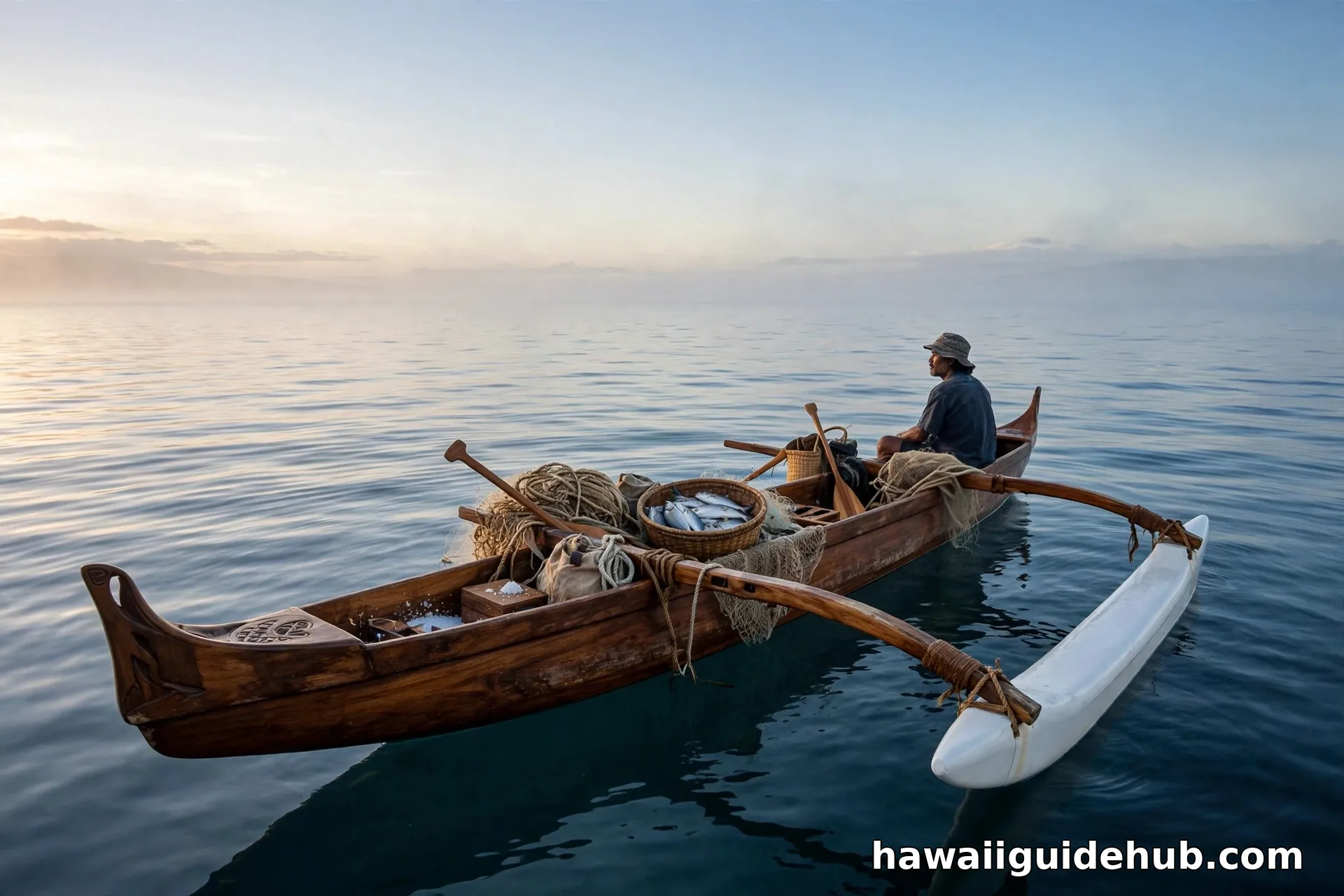
Offshore fishing was the lawai’a at his boldest: paddling miles out in a canoe to work the deep grounds where ahi, aku, and bottom fish lived. The gear was handmade and deadly effective: lines of twisted olona fiber, stronger than hemp; hooks of bone, shell, and wood, barbed and weighted; sinkers of stone ground to precise shapes. Fishermen chummed with mashed bait to draw schools to the surface, then worked them with lures. The octopus lure deserves special mention: a cowrie shell mounted on a shank with a bone barb, shaped to mimic a female octopus, the shell’s gloss flashing like life. Lowered on a line, it fooled he’e into striking: a triumph of observation and craftsmanship. Deep-sea trips were planned like military operations: weather read from clouds and wind, currents factored, the canoe loaded with water gourds and food, offerings made to Ku’ula for safe return. The risks were real: sudden squalls, sharks, the vastness itself. But the rewards fed villages, and the best offshore fishermen were celebrities in their communities.
Hukilau: The Community Net
Hukilau was fishing as festival: the community surrounded a school with a huge net, everyone pulling together, the catch shared among all. The events were social and spiritual: chants, prayers, and celebration. The famous “Hukilau Song” memorializes the tradition. Modern hukilau demonstrations keep it alive: the net, the teamwork, the sharing. Fishing was never solitary: it was the village feeding itself.
Building a Fishpond: Stone by Stone
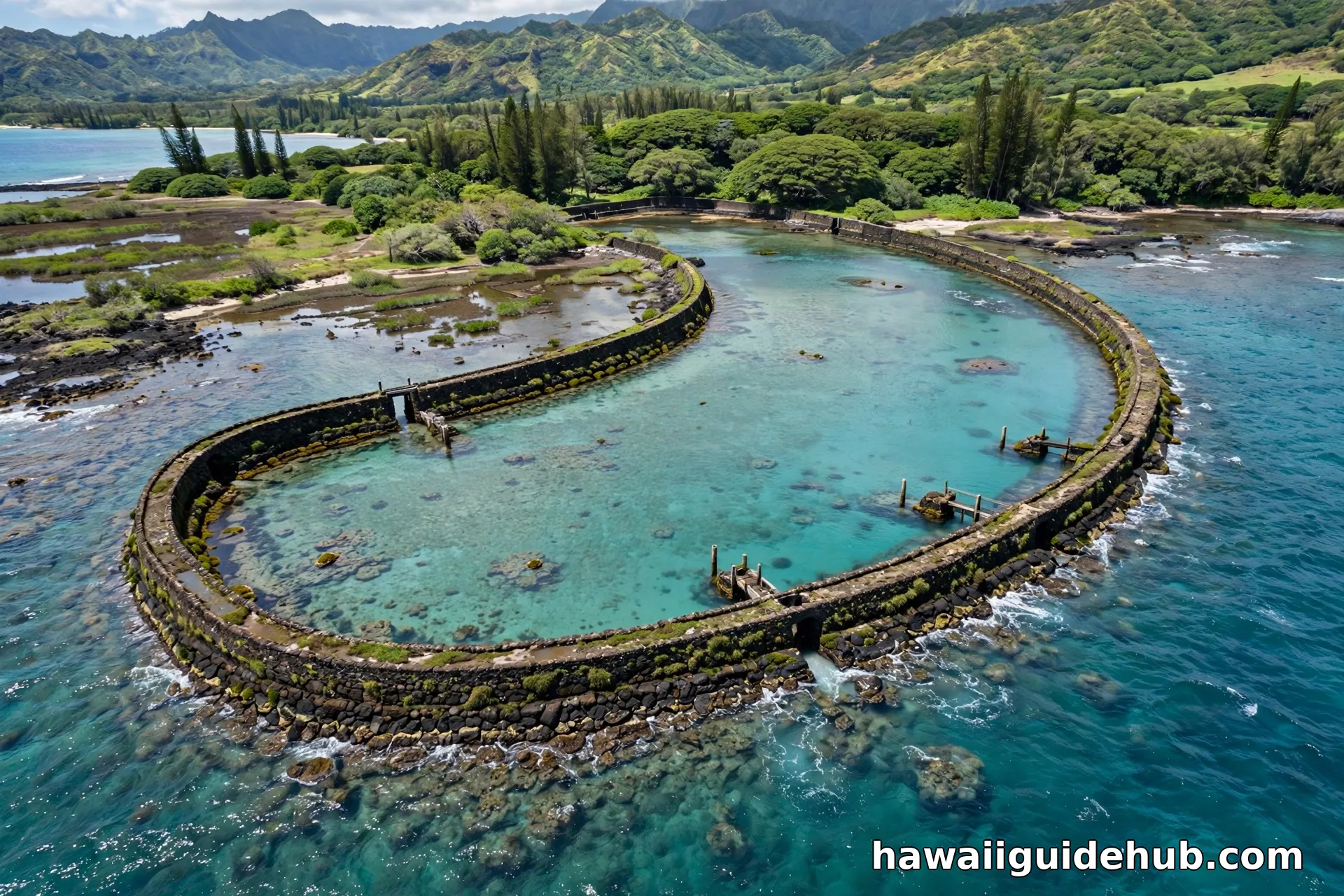
Building a loko i’a was one of the great engineering feats of old Hawaii: thousands of stones, fitted without mortar into walls that have stood for centuries against surf and storm. The work was organized by the ali’i, who commanded the labor of hundreds: stones passed hand to hand in human chains stretching from the shore, each placed by experienced wall-builders who knew how to lock basalt into a self-supporting mass. The kuapa walls rose above the high-tide line, wide enough to walk on, strong enough to break waves. The makaha gates were the genius detail: wooden frames set into gaps in the wall, filled with vertical slats spaced so small fish could pass but grown ones could not. The gates also let the tide flush the pond, keeping water oxygenated and healthy: the Hawaiians solved, centuries ago, the water-quality problem that plagues modern aquaculture. Some ponds covered hundreds of acres. The labor was staggering, the result permanent: many walls still stand, still holding the sea back, still teaching.
Loko I’a: The Fishponds
Hawaii’s fishponds were engineering marvels: rock walls (kuapa) enclosing coastal shallows, with sluice gates (makaha) of spaced wooden slats. Juvenile fish entered through the slats on the tide, grew fat inside, and couldn’t leave once too big: the pond farmed itself. Old Hawaii had 300+ ponds producing enormous harvests. The design was brilliant: the gate solved the stagnation problem by letting water flow while keeping grown fish in. Restoration projects like He’eia Fishpond are bringing them back.
The Konohiki: Managers of the Sea
The konohiki were the land-and-sea managers of the ahupua’a: part foreman, part tax collector, part conservation officer. They decided when fishing grounds opened and closed, who could fish where, and what share of the catch went to the chiefs. Their authority rested on deep knowledge: they watched the spawning seasons, the reef health, the fish sizes, and adjusted the rules accordingly. When a species was overfished, the konohiki declared it kapu: no one touched it until stocks recovered, and the kapu was enforced by social pressure and the chief’s authority. This was adaptive management centuries before the phrase: rules that flexed with the resource. The system also distributed wealth: the konohiki collected tribute fish for the ali’i, but also ensured the commoners had enough. A good konohiki kept both the reef and the village healthy. The title and role survive in modern Hawaii, adapted: the word now describes property managers, but the original meaning, steward of the land and sea, still echoes.
Fishing Kapu: Ancient Conservation
Hawaiian fishing was regulated by kapu: seasonal closures during spawning, size restrictions, area restrictions, and prohibitions that let stocks recover. The konohiki (resource managers) enforced the rules; violators faced serious consequences. The system worked: Hawaii’s reefs stayed productive for a thousand years. Modern marine science validates the old kapu: the Hawaiians were conservationists before the concept existed. Today’s marine reserves echo the ancient wisdom.
Fish, Food, and Feasting
Fish was the protein of old Hawaii: eaten raw, cooked in the imu, dried for storage, fermented into delicacies. The preparation was an art: fish cleaned with shell knives, salted with sea salt, wrapped in ti leaves and steamed. Certain fish were reserved for the ali’i: the choicest catches went to the chiefs as tribute, and eating them without permission was kapu. Feasts marked the big catches: a successful hukilau ended in celebration, the village eating together. Fish also traveled: dried and salted, it moved through trade networks between ahupua’a, from the fishing villages to the upland farms, exchanged for taro and sweet potato. The food system was integrated: the ocean fed the mountains, the mountains fed the ocean, and the fisherman stood at the center of it all. When you eat poke today, you’re tasting the end of a chain that runs back a thousand years: raw fish, sea salt, seaweed, the same flavors the old fishermen knew.
The Fisherman’s Gods
Fishing was spiritual: Ku’ula, the god of fishermen, received first-fish offerings at shoreline shrines (ko’a). Rituals governed every stage: net-making, launching, the first catch. Certain fish were kapu to certain people; certain days were kapu for fishing. The spirituality wasn’t superstition but management: the rituals encoded conservation, respect, and gratitude. The ocean gave; the fisherman gave back.
The Decline and the Return
After Western contact, the fishing traditions frayed: the kapu system was abolished in 1819, removing the conservation framework; commercial fishing and new technologies increased pressure on stocks; many fishponds were filled, neglected, or converted. The knowledge, carried in memory, faded as fishermen aged and young people moved to towns. But the revival is real and growing: fishpond restoration projects are rebuilding walls and raising fish; cultural practitioners teach throw-netting and net-making; the kapu concept informs modern marine management, with community-based fisheries areas echoing the old konohiki system. The ocean is responding: restored ponds teem with mullet again. The tradition isn’t a museum piece: it’s a living system, adapting, and the fishermen of today stand on the shoulders of a thousand years of masters. The sea remembers, and so do they.
Watch: Kai Piha: Na Loko I’a | PBS Hawai’i
Hawaiian Fishing FAQs
What is a loko i’a?
A Hawaiian fishpond: a rock-walled coastal enclosure with slatted gates that let juvenile fish in but keep grown fish from leaving. Ancient aquaculture.
What is hukilau?
Community surround-net fishing: the village encircled schools with a huge net, pulled together, and shared the catch. Part fishing, part festival.
How did kapu conserve fish?
Seasonal closures, size and area restrictions, enforced by konohiki managers. The system kept reefs productive for a thousand years.
Can visitors learn throw-net fishing?
Yes: some cultural practitioners offer lessons. It’s harder than it looks: expect to practice. Always follow local fishing regulations.
Are the fishponds being restored?
Yes: projects like He’eia Fishpond on O’ahu are rebuilding walls, removing invasives, and raising fish again. Volunteers are often welcome For why the ocean matters so deeply here, read the cultural significance of marine life in Hawaiian tradition..
Wisdom from the Water
Hawaiian fishing traditions are a thousand-year conversation with the ocean: take what you need, leave what you don’t, honor the source, and the sea provides forever. Think about what that means: a thousand years of continuous harvest, and the reefs were still rich when the first Western ships arrived. That’s not luck; that’s management. The kapu, the konohiki, the fishponds, the rituals: they were a system, and it worked longer than any modern fishery has ever managed. The lesson is there for anyone willing to learn it: the ocean is generous but not infinite, and the people who ate from it for a millennium understood that better than anyone. Respect the kapu, even the modern ones: size limits, seasons, marine reserves. They’re the grandchildren of the old laws, and they carry the same wisdom: take what you need, leave the rest, and the sea will feed your grandchildren too. The throw netters at dawn know it. The fishpond restorers know it. The old lawai’a knew it best of all, and their wisdom is still out there on the water every dawn, in every cast net and every restored fishpond wall, waiting patiently for the next generation to learn and carry forward into the bright future ahead. The throw netters at dawn, the fishpond walls rising again, the kapu remembered in modern reserves: the wisdom endures. The ocean is still the farm and the temple. Fish with respect, and it will feed you: that’s the oldest lesson and the truest. For more island culture, see our volcanoes guide and Kauai guide.