Hawaii Stargazing Guide: Mauna Kea and the Darkest Skies on Earth

Hawaii’s night sky is the other half of the islands’ beauty, and most visitors never see it: they are asleep when the Milky Way rises over the volcano, when the Southern Cross hangs over the Pacific, when the summit telescopes open their eyes to the universe. The islands sit in the middle of the ocean under some of the darkest skies on earth, and the stargazing here is not a hobby but a revelation.
This is the single complete Hawaii stargazing guide. It covers the stargazing site scorecard, Mauna Kea’s summit and visitor station, the best dark-sky spots per island, what you will see in the Hawaiian sky, tours vs. going solo, and night-sky photography. If you have been searching for anything about stargazing in Hawaii, the answers are all here on this one page.
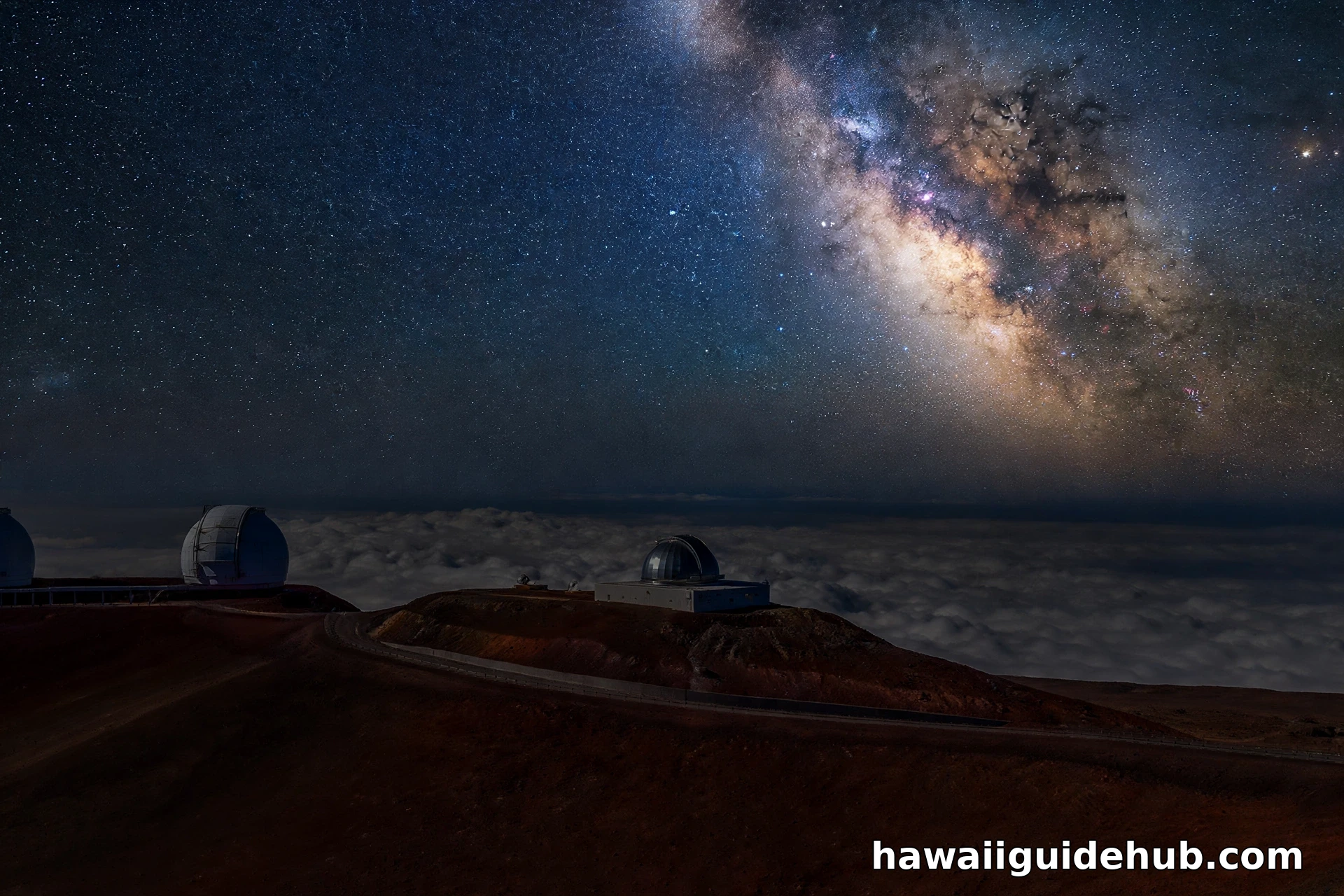
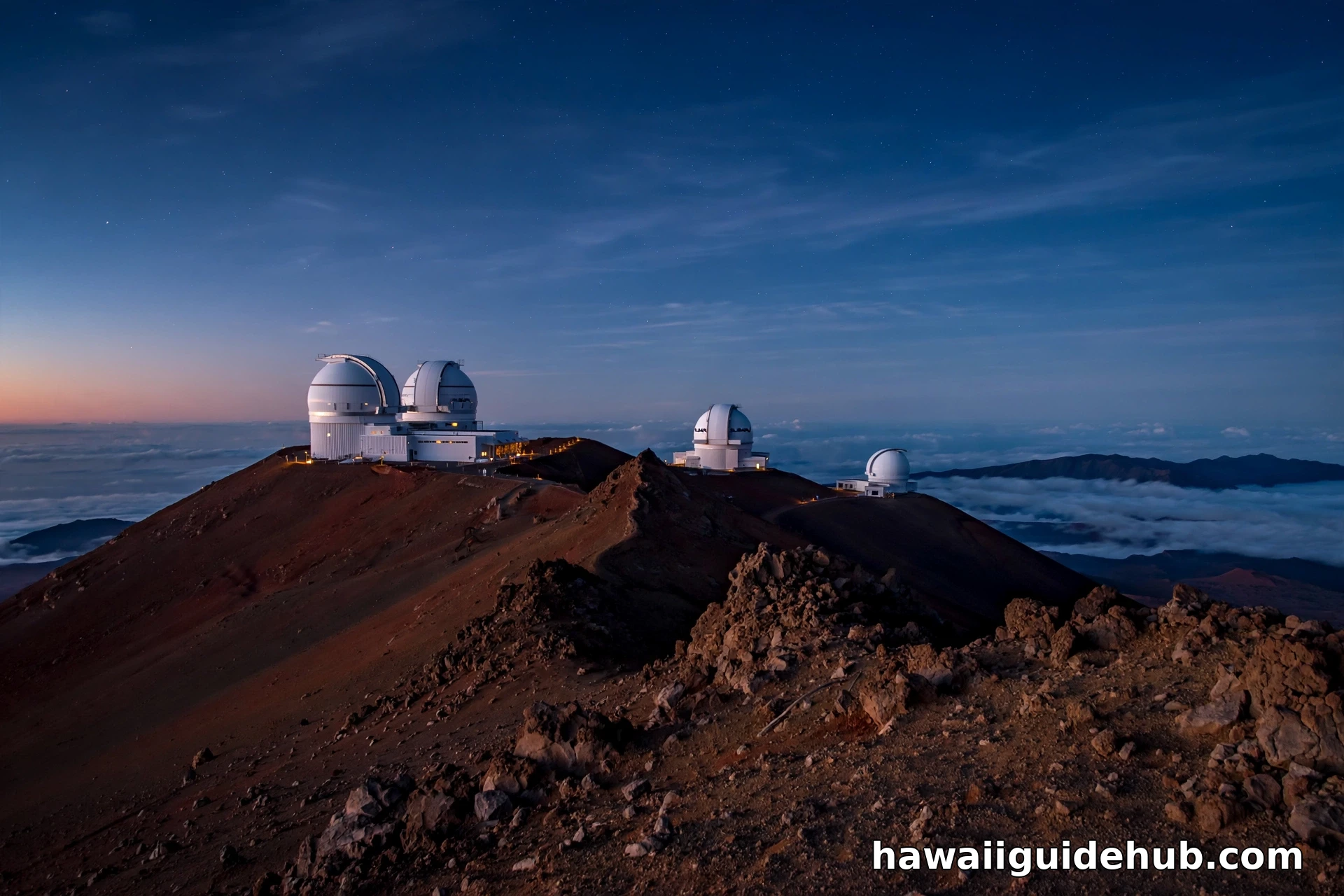
Above the clouds, beneath the galaxy: Mauna Kea’s observatories silhouetted against the Milky Way, the summit floating over a sea of cloud. This is the world’s premier astronomical site, and the image captures why: the telescopes, the altitude, the darkness, the universe in impossible detail. The stargazer’s pilgrimage ends here, at the top of the Pacific, under the best sky on earth.
Why Hawaii’s Skies Are Special
The science of the darkness. The islands sit 2,500 miles from the nearest continent, so there is almost no light pollution from distant cities. The trade winds keep the air clean and stable. The high volcanoes rise above the inversion layer, into dry thin air where the stars do not twinkle but burn steady. And the latitude, 20 degrees north, reveals both northern and southern skies: the Big Dipper and the Southern Cross in the same night. No other inhabited place on earth combines all of these advantages.
The Hawaiian Star Compass
The cultural sky. Long before telescopes, Hawaiian navigators crossed thousands of miles of open ocean by reading the stars: the star compass divides the horizon into 32 houses, each marked by a star that rises or sets there. Hōkūleʻa, Arcturus, the zenith star of Hawaiʻi, guided the voyaging canoes home. When you stargaze in Hawaii, you are looking at a map that once guided a civilization. Learn a few Hawaiian star names; the sky becomes a story.
Moon Phase Planning
The moon is the stargazer’s frenemy: beautiful in its own right, ruinous for deep-sky viewing. Plan around the new moon for the darkest skies and the Milky Way’s full glory. The week around the full moon is for lunar photography and bright-planet viewing instead. Check the moonrise times; even a crescent moon sets early and leaves the rest of the night dark. The serious stargazer plans the trip around the moon, not despite it.
Stargazing Beyond Mauna Kea
The other dark skies. Haleakalā’s summit on Maui offers altitude and darkness with easier access. The Big Island’s South Point has ocean-horizon stargazing with the Milky Way reflecting in the water. Kauaʻi’s Kalalau lookout pairs the cliffs with the galaxy. Oʻahu’s Kaʻena Point, at the island’s dark western tip, is the best the city island offers. Mauna Kea is the headline, but the supporting acts are excellent.
What to Bring for a Night Under the Stars
The night kit: layers, far more than seems reasonable; the temperature drops 30 degrees from the beach to the summit. A red flashlight or headlamp; white light is the enemy. A blanket or reclining chair; necks get tired. Binoculars; the best beginner astronomy tool ever made. Hot drinks in a thermos. And patience: the eyes need 20 minutes to fully adapt to the dark, and the reward grows every minute after.
Stargazing With Kids
Kids are natural astronomers: the questions come fast and the wonder is instant. Start with the bright and obvious: the moon’s craters through binoculars, the planets, the constellations with stories. The visitor station’s programs are family-friendly and free. Keep it short; tired kids and cold nights do not mix. And the kid who sees Saturn’s rings for the first time on Mauna Kea remembers it forever, and tells the story for the rest of their life.
Twilight on the summit: the observatory domes glowing against the deepening blue, the first stars appearing, the clouds far below. This is the blue hour at 13,803 feet: the moment between sunset and the full dark, when the telescopes prepare and the stargazers arrive. The mountain at dusk is a preview of the night’s wonders.
The Stargazing Site Scorecard
The expert’s scorecard: every major site rated on darkness, altitude, access, and best use. Pick your night.
| Site | Darkness | Altitude | Access | Best for |
| Mauna Kea summit (Big Island) | World-class | 13,803 ft | 4WD tours only | The ultimate night |
| Mauna Kea visitor station | Excellent | 9,200 ft | Easy drive | DIY stargazing |
| Haleakalā summit (Maui) | Excellent | 10,023 ft | Easy drive | Sunset + stars combo |
| South Point (Big Island) | Very good | Sea level | Easy drive | Ocean + stars |
| Nā Pali lookouts (Kauaʻi) | Very good | 3,000 ft | Easy drive | Cliffs + Milky Way |
| Dillingham Airfield (Oʻahu) | Good | Sea level | Easy drive | Oʻahu’s darkest easy spot |
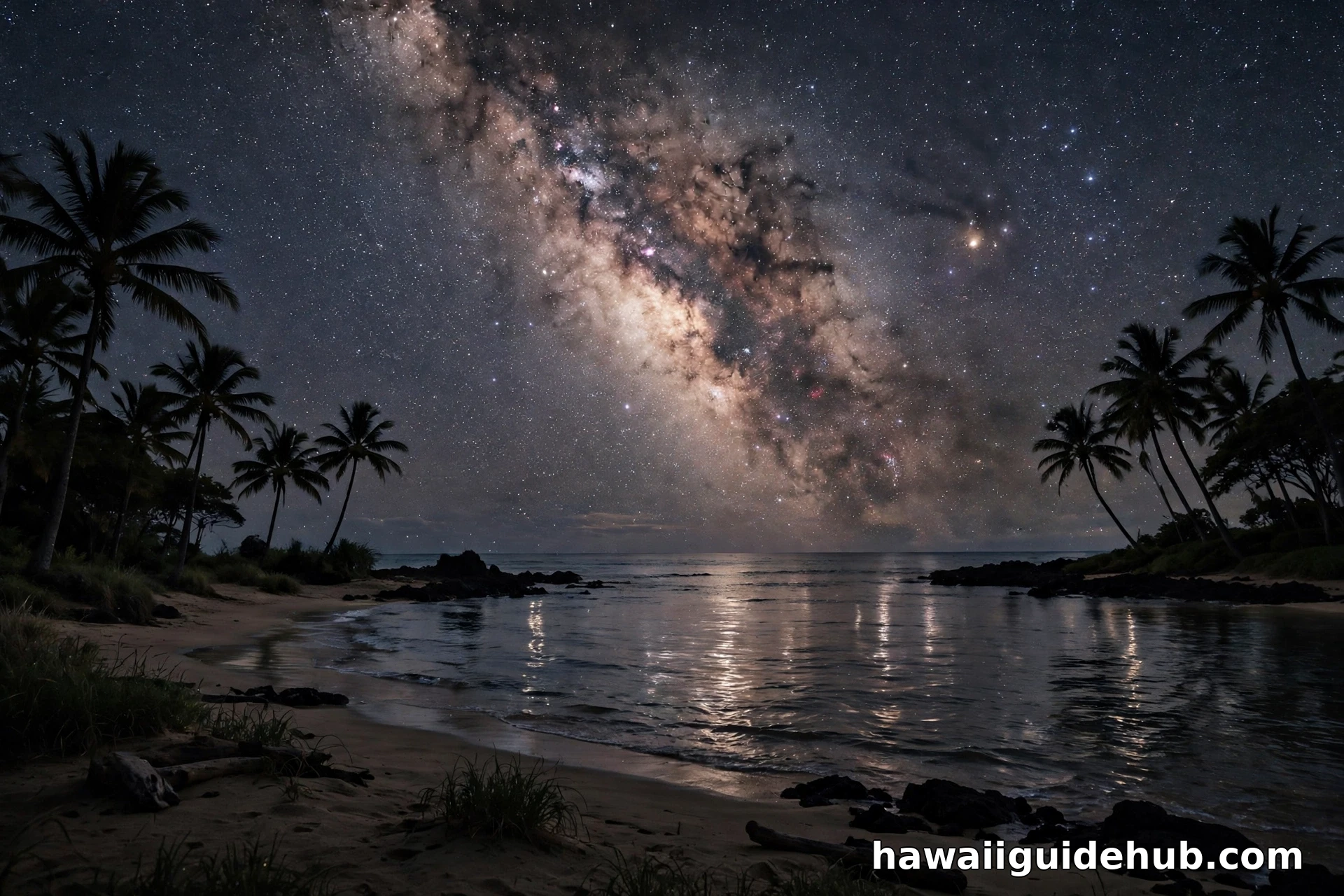
The galaxy over the shore: the Milky Way blazing above a dark Hawaii beach, palms silhouetted, starlight on the water. This is stargazing without the mountain: the beach at midnight on a new moon, the universe overhead, the Pacific whispering below. The dark-sky beaches prove that you do not need altitude to find wonder; you just need darkness and the willingness to stay up late.
Mauna Kea: The World’s Best Seat
The case for Mauna Kea: above 40 percent of the atmosphere, with dry stable air and minimal light pollution, the summit hosts the world’s largest collection of research telescopes. The visitor station at 9,200 feet offers free stargazing programs; the summit at 13,803 feet is accessible by guided tour. The altitude is serious: acclimate at the visitor station, dress for freezing temperatures, and respect the mountain’s cultural significance. This is the best stargazing on earth, full stop.
What You Will See in the Hawaiian Sky
The southern sky rewards: the Southern Cross, invisible from the mainland, hangs low over the Pacific. The Milky Way’s core blazes in summer. The planets march along the ecliptic, bright and steady in the clean air. Satellites drift overhead; meteors streak on the dark nights. And the cultural layer: Hawaiian navigators crossed the Pacific by these stars, reading the sky like a map. The constellations have Hawaiian names and stories; the sky is a library.
Tours vs. Going Solo
The decision matrix. Guided tour: transportation to altitude, telescopes provided, expert narration, hot drinks, no driving the mountain road at night; the cost is real but the experience is seamless. Solo: free, flexible, and the visitor station’s programs are excellent; but you drive the mountain yourself, bring your own gear, and manage the altitude alone. For the summit, the tour is the wise choice; for the visitor station, solo is perfect.
Night-Sky Photography Basics
The starter recipe: tripod, wide-angle lens, manual focus on the stars, and the 500 rule for exposure (500 divided by focal length gives the maximum seconds before star trails). Shoot RAW, embrace the high ISO, and let the foreground be a silhouette or light-paint it gently. The Milky Way core is the prize; the new moon is the time. Hawaii’s dark skies forgive beginner mistakes; the results will stun you anyway.
Stargazing Etiquette and Safety
The night rules: red flashlights only (white light ruins everyone’s night vision), quiet voices, no headlights pointed at the telescopes. Dress far warmer than the daytime suggests; the summit is below freezing at night. Bring water and snacks; the altitude dehydrates. And respect the cultural protocols: Mauna Kea is sacred to Native Hawaiians; visit with reverence, stay on the paths, and listen to the guides. The stars belong to everyone; the mountain deserves respect.
For more trip planning, the guide to Hawaiian cultural traditions adds the cultural layer, while responsible travel practices and the guide to Hawaii’s natural environments help you travel well.
Watch: Mauna Kea Summit and Stars
Frequently Asked Questions
Where is the best stargazing in Hawaii?
Mauna Kea’s summit: the world’s premier astronomical site. The visitor station at 9,200 feet is the accessible alternative.
Can you drive to the Mauna Kea summit yourself?
Most rental cars are prohibited; the road requires 4WD. Guided tours are the recommended way up.
What is the best time for stargazing in Hawaii?
New moon, clear skies, summer for the Milky Way core. Winter offers crisp air and different constellations.
Is it cold on Mauna Kea at night?
Yes, below freezing at the summit. Dress in full winter layers: parka, hat, gloves.
Can you see the Southern Cross from Hawaii?
Yes. Hawaii’s latitude reveals southern constellations invisible from the US mainland.
Stargazing and Hawaiian Culture
The deepest way to experience Hawaii’s night sky is through its culture. The stars were the original GPS of the Pacific: navigators memorized the rising and setting points of hundreds of stars, the star compass guided canoes across thousands of miles of open ocean, and the calendar of the heavens governed planting, fishing, and ceremony. Hōkūleʻa, the star Arcturus, sits at the zenith over Hawaiʻi and guided the voyaging canoes home. Modern programs at the visitor stations and cultural centers share this knowledge; the planetarium shows connect the constellations to the chants. When you learn the Hawaiian names of the stars, the sky stops being a backdrop and becomes a text. Read it with respect: Mauna Kea is sacred, the knowledge is precious, and the visitor’s role is to listen, learn, and look up with gratitude.
Planning the Perfect Stargazing Night
The perfect stargazing night is planned, not stumbled into. Start with the moon calendar: pick dates within a few days of the new moon. Check the weather and the cloud-cover forecasts for your chosen site; the summits have their own microclimates, and the visitor station posts conditions. Arrive before sunset to acclimate, watch the sunset, and let your eyes begin adapting as the twilight fades. Bring the night kit: layers, red light, blanket, binoculars, hot drinks, snacks. Give the sky the full evening, not a quick peek; the best viewing is in the hours after midnight when the atmosphere settles. And build in a backup night, because even Mauna Kea gets clouds. Two planned nights virtually guarantee one spectacular one, which is the kind of odds every traveler should take.
The Stargazer’s Year: Seasonal Highlights
The Hawaiian sky changes through the year, and each season brings its own show. Summer, from May through September, is Milky Way season: the galactic core rises high and bright, the centerpiece of every astro photograph. Winter brings crisp, dry air and the great northern constellations at their best: Orion dominates, the Pleiades glitter, and the long nights give maximum viewing time. Spring and fall are the transition seasons, with fewer crowds at the visitor station and comfortable temperatures at the mid-altitude sites. Meteor showers punctuate the calendar: the Perseids in August and the Geminids in December are the reliable headliners, and Hawaii’s dark skies make even minor showers worth watching. Plan the trip around the celestial calendar, not just the beach weather, and the night sky becomes a second vacation, and often the more memorable half of the trip.
The Hawaiian night sky rewards everyone who looks up, from the summit astronomer to the beach-blanket dreamer. Mauna Kea offers the finest stargazing on earth, the visitor station makes it accessible, and the dark-sky beaches prove you do not need altitude to find wonder. Plan around the new moon, dress warm, bring red light and patience, and give your eyes twenty minutes to adapt. The navigators who found these islands read these same stars as a map; when you stand beneath them, you share their ancient and beautiful sky. Look up tonight. The universe is waiting, and in Hawaii, it puts on its very best show imaginable ever.