Axis Deer in Hawaii: How They Got Here, Why They’re a Problem & Where to See Them

Yes, there are deer in Hawaii, and they are among the most controversial animals in the islands. The axis deer, a spotted deer native to India, was introduced as a royal gift in the 1860s and has since become one of Hawaii’s most destructive invasive species, with tens of thousands roaming Maui alone. This is the complete guide to axis deer in Hawaii: how they arrived, why they exploded in numbers, the damage they cause, the hunting programs that try to control them, and what visitors should know.
What Is an Axis Deer?
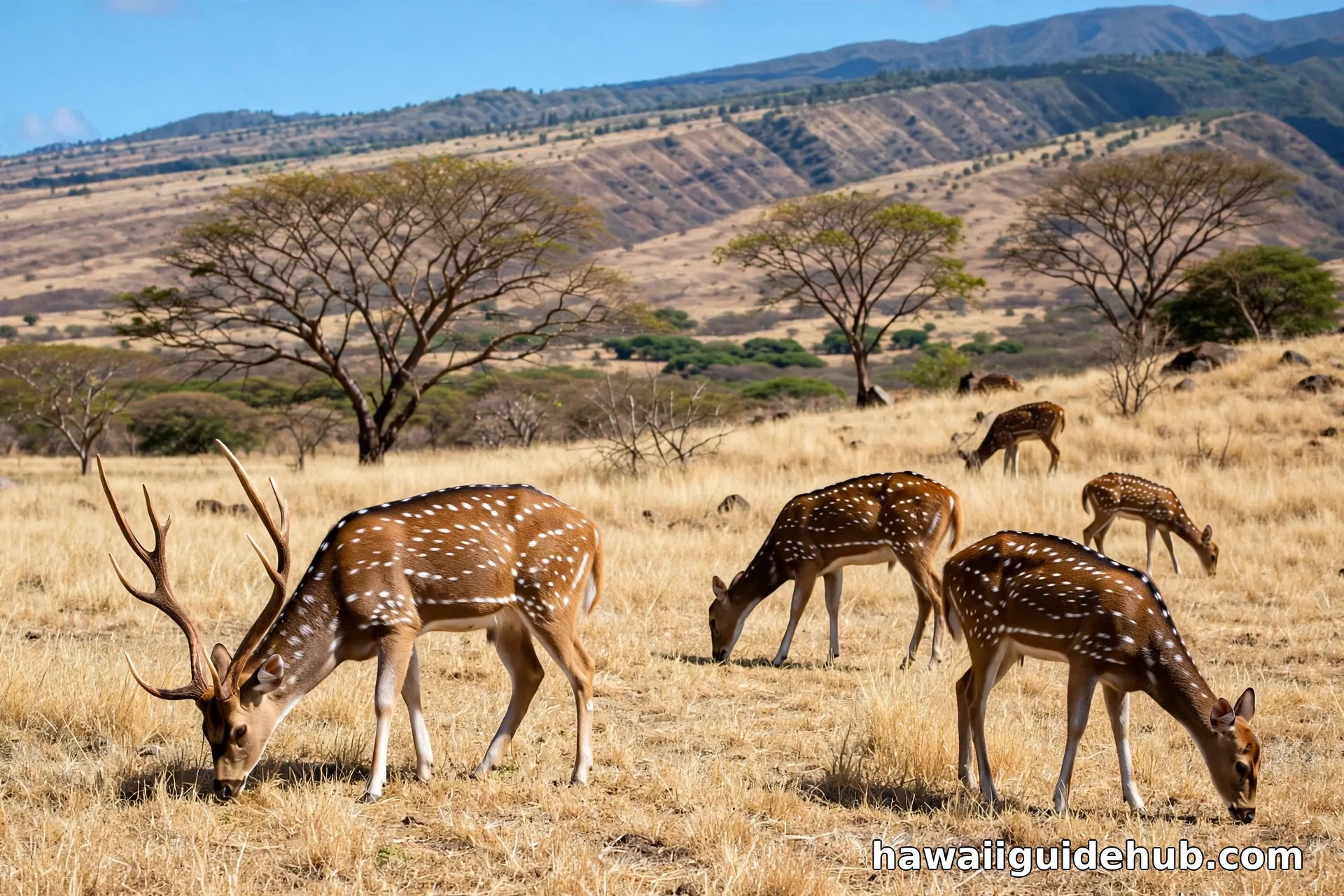
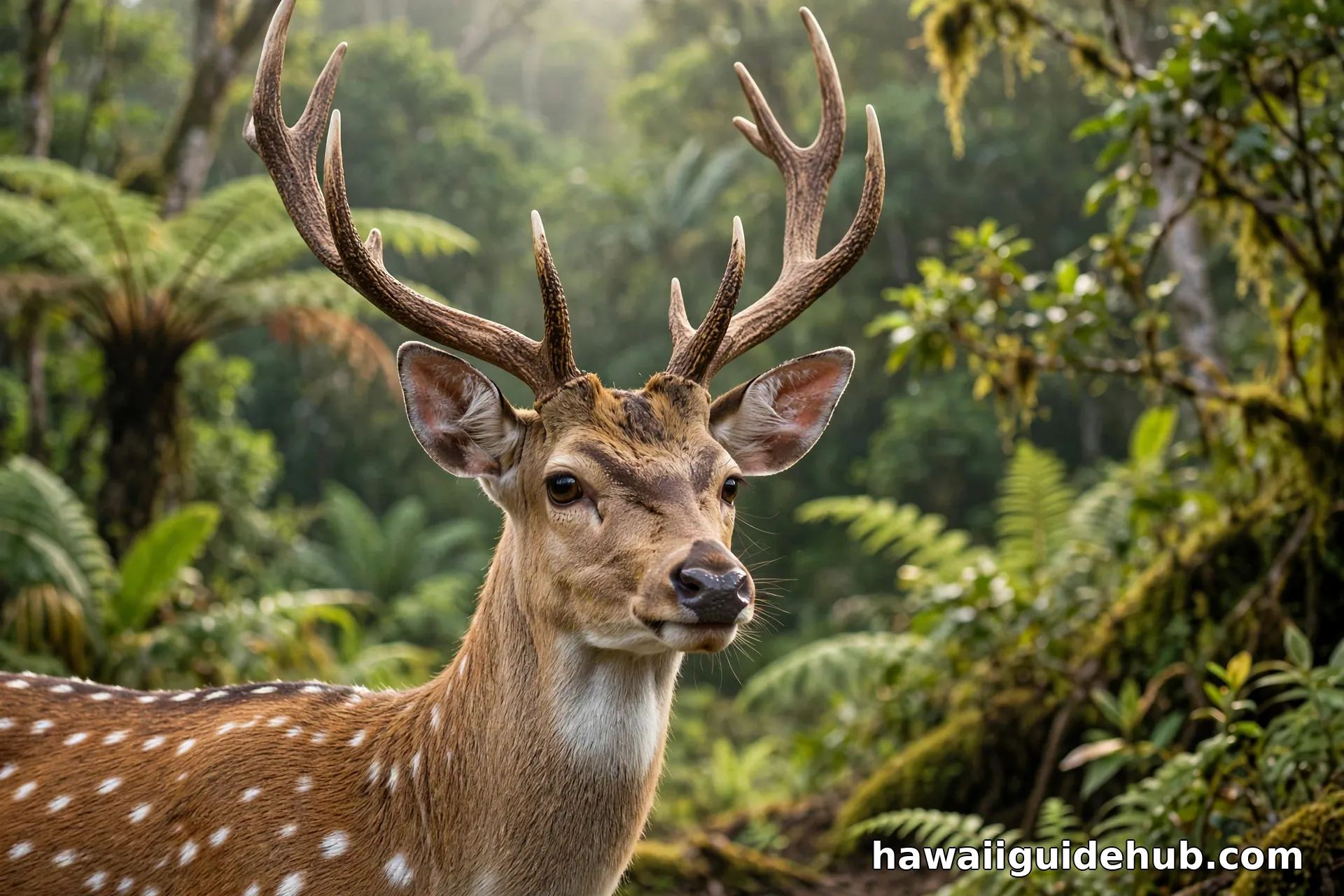
The axis deer (Axis axis), also called the chital, is a medium-sized deer native to the Indian subcontinent. It is easy to recognize: a rich chestnut coat covered in white spots year-round, white throat patch, and elegant antlers on males that can reach nearly three feet. Unlike most deer, axis deer do not follow a strict seasonal breeding cycle in tropical climates, which is one reason their populations grow so fast in Hawaii. They are beautiful animals and, in their native range, a natural part of the ecosystem. In Hawaii, they are an ecological disaster.
Are Deer Native to Hawaii?
No. No deer species, or any land mammal larger than a bat, is native to Hawaii. Every deer in the islands was introduced by humans. The axis deer arrived first: a small group was brought from India in late 1867 as a gift to King Kamehameha V and released on Molokaʻi in 1868, according to the U.S. Geological Survey. From there, animals were moved to Oʻahu before 1898 and to Lānaʻi in 1920. The Oʻahu herd eventually died out, but the Molokaʻi and Lānaʻi populations persisted for over a century.
The Maui introduction was a deliberate wildlife management decision that became a cautionary tale. In 1959 and 1960, the state released a tiny founding group on Maui to create new hunting opportunities: sources report five to ten animals depending on the account, with the Honolulu Advertiser specifying five in 1959 and four the next year, and DLNR-linked reporting describing ten released in 1959. Whatever the exact number, the result was the same: with no predators, no harsh winters, and no population-culling diseases, the herd exploded.
Axis Deer Island by Island: Status and History
Each island’s deer story is different:
| Island | Introduced | Current status |
| Molokaʻi | 1868, gift to Kamehameha V (per USGS) | Long-established population; managed through hunting |
| Lānaʻi | 1920 (per USGS) | Established for over a century; popular hunting destination |
| Maui | 1959–60, released by the state (per Advertiser; DLNR) | Over 26,000 and growing; doubling roughly every 4 years (per DLNR; UC Davis research) |
| Oʻahu | Before 1898 (per USGS) | Died out; only a remnant herd survived into the 1960s |
| Hawaiʻi Island | Never officially introduced | Newly confirmed sightings; officials suspect illicit releases (per BIISC via Maui Now) |
| Kauaʻi | 1961, but a different species | Columbian black-tailed deer, 700+ near Waimea Canyon (per USGS); not axis deer |
A note on the Maui numbers, since sources differ: DLNR-linked reporting puts the population above 26,000, while older accounts cite 10,000 to 12,000. The population has been growing so fast, doubling about every four years per a UC Davis wildlife biologist’s research, that any figure dates quickly. Treat every number as a snapshot, not a census.
Why Axis Deer Are a Problem
The damage falls into four categories. Agricultural: deer cause over $1 million in crop damage annually on Maui, per DLNR-linked reporting, stripping orchards, vineyards, and vegetable farms, sometimes grazing in herds of hundreds. Ecological: they browse native plants, strip bark, and trample watersheds, including encroachment into Haleakalā National Park. Safety: deer-vehicle collisions are a growing hazard on Maui’s roads. Health: as the USGS notes, they may carry diseases transmissible to humans and livestock. Erosion from overgrazed slopes damages reefs downstream when soil washes to sea.

What Is Being Done: Hunting and the Bounty Program
Because there are no natural predators, humans are the only population control. Hawaii allows axis deer hunting under DLNR regulations, with seasons and bag limits set to maximize harvest. In 2024, DLNR launched a Landowner Incentive Program, essentially a bounty, paying landowners up to $50 per deer tail submitted, to accelerate removal on Maui. Private landowners also hire sharpshooters, and a commercial venison operation turns harvested Maui deer into meat, making the invasive animal into a local food source.
The tension is real: hunters value axis deer as a prized game animal, arguably the best-tasting wild venison in America, while farmers, ranchers, and conservationists see an ecological emergency. Both views are honest. The state’s position is unambiguous: the deer are invasive, and the goal is dramatic reduction, not sustainable sport hunting.
The Venison Solution: Eating the Problem
One of the more creative responses to the crisis is commercial harvest. A Maui company built a USDA-inspected operation that turns culled axis deer into venison for restaurants and consumers, converting an ecological liability into local food. Axis venison is widely considered superb: lean, mild, and free of the gamey flavor some associate with mainland deer, because the animals eat year-round on grasses and crops rather than surviving lean winters. If you see axis venison on a Maui menu, ordering it is arguably the most delicious form of conservation available.
The model has limits. Commercial harvest alone cannot outpace a population that doubles every four years, which is why the state pairs it with the bounty program, liberal hunting seasons, and professional sharpshooters. But it changes the politics: when the deer have economic value as meat, landowners cooperate with removal instead of tolerating the herds.
The Oʻahu Mystery: The Herd That Vanished
One of the strangest footnotes in the axis deer story belongs to Oʻahu. Deer were moved there before 1898, yet the population never took hold the way it did on the other islands. By 1962, only a remnant herd survived in Moanalua Valley, and eventually it died out entirely. Wildlife biologists attribute the failure to a combination of hunting pressure, limited suitable habitat, and possibly disease, the same factors that never constrained the Maui herd. Oʻahu is now the only major island with no wild deer, a natural experiment in what happens when an introduction fails.
Axis Deer vs Hawaii’s Other Invasive Mammals
Deer are far from Hawaii’s only introduced mammal problem. Feral pigs root up native forests statewide and are arguably more destructive overall. Feral goats strip vegetation on cliffs and dry slopes. Feral cats devastate native bird populations. What makes axis deer distinctive is speed: no other large mammal went from a handful of founders to tens of thousands so fast, and none causes such concentrated agricultural damage. They are also the most visible: pigs hide in forests, but deer graze openly in fields at dawn, which is why visitors notice them and why farmers despair of them.
Can Tourists See Axis Deer?
Yes, and you do not need to try hard on Maui. Drive the island’s rural roads at dawn or dusk, especially around Kula, Makawao, and the slopes of Haleakalā, and you will likely spot herds grazing in open fields. They are shy but visible, and dawn is the best viewing time. Do not approach or feed them: they are wild animals, feeding wildlife is illegal in many contexts, and habituated deer cause more conflicts. If you are driving in deer country after dark, slow down; collisions are a genuine risk.
For Maui trip planning beyond the deer, see 10 reasons to visit Maui, the best places to visit on Maui, and Haleakalā sunset, on whose slopes the deer now graze. For outdoor adventures statewide, see outdoor adventures in Hawaii.
Driving in Deer Country: A Safety Briefing
Deer-vehicle collisions are one of the fastest-growing costs of the Maui herd, and visitors driving unfamiliar roads at dawn and dusk are at particular risk. The rules are simple: slow down on rural Maui roads, especially around Kula, Makawao, and the upcountry highway; use high beams when no oncoming traffic is present; and remember that where you see one deer, more are usually following. If a collision is unavoidable, brake firmly but do not swerve into oncoming traffic or off the road. Report the incident to police and your rental company. Deer are most active in the hour after sunrise and the hour before sunset, which is exactly when the light is prettiest for driving. Enjoy the view, but keep your eyes on the verges.
The Big Island Scare: Keeping Deer Off Hawaiʻi Island
The newest chapter in the story is the one officials most want to stop. Axis deer were never officially introduced to the island of Hawaiʻi, yet DLNR crews and the Big Island Invasive Species Committee have confirmed sightings in Kohala, Kaʻu, Kona, and on Mauna Kea. Resource managers suspect illicit releases, possibly by people wanting local hunting. The alarm is justified: Hawaiʻi Island’s massive ranchlands and native forests would offer the deer even more room than Maui did, and once established, eradication becomes nearly impossible. The state treats every Big Island sighting as an emergency, and the public is asked to report deer immediately. It is a race between detection and establishment, and the stakes are the island’s entire agricultural and ecological character.
Video: Axis Deer on Lānaʻi
YETI’s Hungry Life films an axis deer hunt on Lānaʻi, showing the island’s deer country.
Frequently Asked Questions About Axis Deer in Hawaii
Are there deer in Hawaii?
Yes. Axis deer live on Maui, Molokaʻi, and Lānaʻi, with new sightings on Hawaiʻi Island. Kauaʻi has a different species, the Columbian black-tailed deer. None are native.
Are deer native to Hawaii?
No. Axis deer were introduced from India starting in 1868. Hawaii had no native land mammals larger than a bat before human arrival.
How did axis deer get to Maui?
The state deliberately released a small group, five to ten animals depending on the source, in 1959–1960 to create hunting opportunities. With no predators, the herd exploded into the tens of thousands.
How many axis deer are on Maui?
Over 26,000 per DLNR-linked reporting, and growing fast: research suggests the population doubles roughly every four years. Figures vary by source and date.
Why are axis deer bad for Hawaii?
They cause over $1 million in annual crop damage on Maui, destroy native vegetation and watersheds, cause vehicle collisions, and may spread disease. They are classified as invasive.
Can you hunt axis deer in Hawaii?
Yes, under DLNR hunting regulations with set seasons and bag limits. DLNR also runs a Landowner Incentive Program paying up to $50 per deer tail to accelerate removal on Maui.
Where can I see axis deer in Hawaii?
Maui’s upcountry roads at dawn or dusk, especially around Kula and Makawao. Observe from a distance and never feed them.
Are axis deer dangerous to humans?
Not directly; they are shy and avoid people. The real dangers are vehicle collisions and the diseases they may carry, which is why you should never approach, feed, or handle them.
What should I do if I see a deer on the Big Island?
Report it to the Big Island Invasive Species Committee or DLNR immediately with the location, date, and photos if possible. Early detection is the only chance to prevent establishment.
The axis deer is Hawaii’s invasive species story in miniature: a royal gift becomes a game animal, a game animal becomes an ecological crisis, and the state now pays bounties to undo what it started. If you spot a herd grazing gold in the Maui dawn, take the photo, appreciate the strange beauty of it, and remember that every one of those spotted coats traces back to a handful of deer released on purpose in 1959, back when Hawaii still believed it could manage nature on its own terms. The deer story is still being written: every management plan on Maui and Lanaʻi is a live experiment in undoing a 150-year-old introduction.