Hawaii in WW2: Pearl Harbor, Martial Law & the Sites to Visit

Hawaii and World War II are inseparable. The war began for America here, on a quiet Sunday morning at Pearl Harbor, and it ended with a surrender signed on a battleship that now rests in the same harbor. Between those two bookends, Hawaii lived under martial law for three years, its Japanese American residents served in the most decorated unit in U.S. Army history, and Oʻahu became one of the most heavily fortified places on earth. This is the complete guide to Hawaii in World War II: what happened, why it mattered, and how to visit the sites today.
December 7, 1941: The Attack on Pearl Harbor
Just before 8 a.m. on Sunday, December 7, 1941, 353 Japanese aircraft launched from six carriers struck the U.S. Pacific Fleet at Pearl Harbor in two waves. The attack lasted under two hours. When it ended, 2,403 service members and civilians were dead and 1,178 were wounded, according to the National Park Service. Twenty-one vessels were sunk or damaged, including eight battleships, and 188 aircraft were destroyed. Nearly half the dead, 1,177 sailors and Marines, were aboard the USS Arizona, which exploded when a bomb detonated its forward magazine.
The human cost breaks down starkly: 2,008 Navy personnel, 109 Marines, 218 Army service members, and 68 civilians, per the Pearl Harbor Visitors Bureau. Japanese losses were light by comparison: 29 aircraft, five midget submarines, and 65 servicemen. The next day, President Franklin D. Roosevelt asked Congress for war, calling December 7 “a date which will live in infamy.” The United States was in World War II.
The Morning of the Attack: A Timeline
The tragedy of Pearl Harbor is sharpened by how close the warnings came. At 6:45 a.m., the destroyer USS Ward fired on and sank a Japanese midget submarine outside the harbor entrance, the first American shots of the Pacific War, but the report moved slowly up the chain of command. At 7:02, Army radar operators at Opana Point detected the incoming first wave, the largest echo they had ever seen, and were told not to worry about it; a flight of B-17s was expected from the mainland. At 7:48, the first bombs fell on Ford Island. By 7:55 the second wave’s targets were burning, and by 10 a.m. it was over: the Arizona’s magazine had exploded at 8:10, the Oklahoma had capsized, and the harbor was a sheet of burning oil.
What the attackers did not know was how much luck favored them beyond surprise. The Pacific Fleet’s three aircraft carriers were all at sea, delivering aircraft to Wake and Midway islands. Had they been in port, the Pacific War might have opened very differently. Instead, the carriers survived to win at Midway, Coral Sea, and beyond, and the battleship era ended in the smoke over Pearl Harbor.
Why Japan Attacked: The Real Reason
Japan did not attack out of nowhere. By 1941, Japan was bogged down in a full-scale war with China and desperate for oil and raw materials to sustain its empire. When Japan occupied French Indochina, the United States froze Japanese assets and cut off oil exports, removing the source of the vast majority of Japan’s oil. Unwilling to abandon its conquests, Japan decided to seize the oil-rich Dutch East Indies by force, and to cripple the U.S. Pacific Fleet first so America could not interfere. Pearl Harbor was a gamble that a devastating blow would make the United States negotiate rather than fight. The gamble failed completely.
What Japan Destroyed vs What It Missed
The attack was a tactical triumph and a strategic failure. An expert accounting:
| Target | What happened | Why it mattered |
| Battleships | All 8 damaged; Arizona and Utah permanently lost (per NPS) | Spectacular, but battleships were already obsolete as the decisive weapon |
| Aircraft | 188 destroyed on the ground (per NPS) | Hurt, but replaceable within months by U.S. industry |
| Aircraft carriers | None in port; all at sea | The fatal miss: carriers became the war-winning weapon at Midway six months later |
| Fuel depots | Untouched; millions of gallons survived | Destroying them would have forced the fleet back to California |
| Shipyards and repair shops | Untouched | Let the U.S. raise and repair most damaged ships in place |
| Submarine base | Untouched | U.S. submarines went on to strangle Japan’s supply lines |
The pattern is the whole story of the Pacific War in miniature: Japan won the morning and lost the war. Six months later, at Midway, the surviving American carriers destroyed four Japanese carriers and turned the tide permanently.
Martial Law: Three Years Under Military Rule
Hours after the attack, Hawaii was placed under martial law, and it stayed there until October 1944, nearly three years. The military governed civilians directly: curfews, blackouts, censored press, and English-only rules for long-distance calls. Japanese language schools were forced to close, and speaking Japanese in public became dangerous. As historian DeSoto Brown has noted, everyone was treated equally unfairly under martial law because the military could not single out the Japanese, who were too essential to the economy.
That economic reality shaped Hawaii’s most distinctive wartime story. About 150,000 of Hawaii’s 400,000 residents were of Japanese ancestry, and mass internment, as imposed on the West Coast, would have collapsed the islands’ economy. So while more than 110,000 Japanese Americans were interned on the mainland under Executive Order 9066, Hawaii’s Japanese community largely stayed, under surveillance and suspicion but not behind barbed wire. It remains one of the great what-ifs of the war: proof that the mainland internment was a choice, not a necessity.
The 442nd: The Most Decorated Unit in U.S. History
From that suspected community came extraordinary service. After being discharged from the Hawaii Territorial Guard, Japanese American ROTC students formed the Varsity Victory Volunteers, doing military construction labor to prove their loyalty. In 1943, the Army formed the 442nd Regimental Combat Team of Japanese American volunteers, joined by the 100th Infantry Battalion of Hawaiʻi National Guardsmen. They fought in Italy and France and became the most decorated infantry regiment in U.S. Army history for its size and length of service, earning thousands of individual decorations. Their motto was “Go for Broke.” Many fought while their own relatives sat in mainland internment camps.

Visiting Pearl Harbor Today
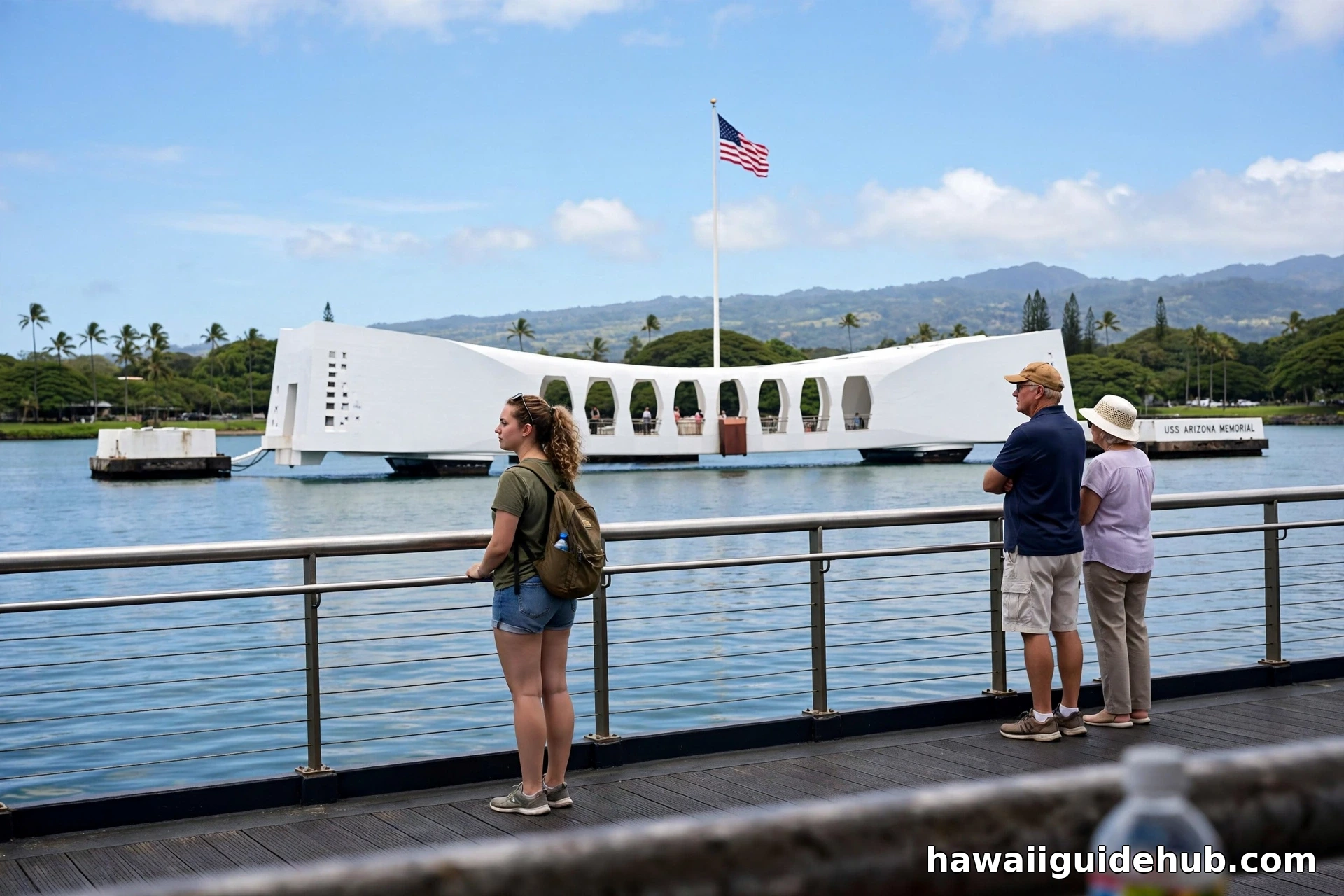
Pearl Harbor National Memorial, run by the National Park Service, is the essential stop. The USS Arizona Memorial, dedicated in 1962, spans the sunken battleship without touching it; oil still seeps from the wreck, known as the “tears of the Arizona.” The memorial program includes a film and a Navy boat ride to the memorial, and tickets are free but timed, reserve ahead on the official NPS site because they sell out. Also at the memorial: exhibits on the attack, and the nearby USS Utah and USS Oklahoma memorials on Ford Island.
Across the harbor at Ford Island, the Battleship Missouri Memorial marks where the war ended: Japan signed the surrender aboard the Missouri in Tokyo Bay on September 2, 1945. The Missouri is deliberately berthed facing the Arizona, so the ship where the war began faces the ship where it ended. The USS Bowfin submarine museum and the Pacific Fleet Submarine Museum complete the harbor’s wartime story. Plan a full day; the sites are spread out and each deserves unhurried time. For the broader Oʻahu military picture, see Oʻahu’s military bases.

Hawaii’s Other Wartime Sites
The war touched the whole island. Hickam, Wheeler, and Bellows airfields were bombed alongside the harbor; Hickam’s scarred buildings still show bullet marks. Schofield Barracks in central Oʻahu became a major Army hub. On the North Shore, pillboxes and gun emplacements still dot the coastline, built against an invasion that never came. Even Waikīkī was transformed: the Royal Hawaiian Hotel became a rest center for submariners. For the island’s deeper past, see Hawaii’s history before statehood, and for planning your Oʻahu days, what not to miss on Oʻahu and the North Shore guide.
How the War Changed Hawaii Forever
World War II remade the islands. The massive military buildup poured federal money into Hawaii and broke the plantation oligarchy’s grip on politics: returning Nisei veterans of the 442nd and 100th used the GI Bill to enter universities and then politics, and within two decades Japanese Americans held the governorship and congressional seats. The war also accelerated statehood: Hawaii’s wartime loyalty and strategic importance made the territory’s second-class status indefensible, and statehood followed in 1959. Tourism, the industry that defines modern Hawaii, grew directly from wartime infrastructure: the airports, roads, and hotels built for the military became the skeleton of the visitor industry.
The deeper legacy is demographic and cultural. The war mixed Hawaii’s peoples as nothing before had: mainland servicemen married local women, plantation workers moved into defense jobs, and the islands’ multiethnic identity hardened into the local culture visitors meet today. When you eat a plate lunch, hear pidgin, or see the easy mix of faces on a Honolulu street, you are seeing the home front’s long echo.
December 7 is observed every year as National Pearl Harbor Remembrance Day, with the flag flown at half-staff and ceremonies at the memorial. If your trip falls on the anniversary, expect crowds and book memorial tickets well ahead. Even on an ordinary day, arrive early: the first boat departures are the quietest, and the morning light on the harbor is worth the alarm.
Video: Why Japan Attacked Pearl Harbor
The Imperial War Museums explain the oil embargo and strategic gamble behind the attack.
Frequently Asked Questions About Hawaii in WW2
What happened at Pearl Harbor?
On December 7, 1941, Japanese carrier aircraft surprised the U.S. Pacific Fleet at Pearl Harbor, killing 2,403 Americans, sinking or damaging 21 ships, and destroying 188 aircraft. The U.S. declared war the next day.
Why did Japan attack Pearl Harbor?
The U.S. oil embargo had cut off most of Japan’s oil supply. Japan decided to seize Southeast Asian oil fields by force and attacked Pearl Harbor first to cripple the U.S. fleet, gambling America would negotiate rather than fight.
Was Hawaii under martial law in WW2?
Yes. Hawaii was placed under martial law hours after the attack and remained under military rule until October 1944, with curfews, blackouts, press censorship, and restrictions on the Japanese language.
Were Japanese Americans in Hawaii interned?
Unlike the West Coast, where over 110,000 were interned, Hawaii did not carry out mass internment because its 150,000 residents of Japanese ancestry were essential to the economy. A smaller number of community leaders were detained.
What is the 442nd Regimental Combat Team?
A segregated Japanese American Army unit formed in 1943, including many Hawaiʻi volunteers. It became the most decorated infantry regiment in U.S. history for its size and length of service, fighting in Italy and France.
Can you visit Pearl Harbor?
Yes. Pearl Harbor National Memorial is free and open to the public; reserve timed USS Arizona Memorial tickets ahead on the NPS site. The Battleship Missouri and USS Bowfin are ticketed separately. Plan a full day.
Where did WW2 end?
Japan formally surrendered aboard the USS Missouri in Tokyo Bay on September 2, 1945. The Missouri is now berthed at Pearl Harbor’s Ford Island, facing the USS Arizona Memorial.
Hawaii’s World War II story runs from the first bombs to the final signature, and it is written across the islands in memorials, scarred buildings, and the living memory of the 442nd. Visit Pearl Harbor with the time it deserves: watch the film, ride the boat, stand on the Arizona Memorial in silence, then walk the deck of the Missouri. Few places on earth hold a war’s beginning and end in a single view, and none hold it with Hawaii’s particular weight: the war came here first, stayed longest in daily life, and left the islands utterly transformed forever.