The Red Flower of Hawaii: ʻŌhiʻa Lehua and the Islands’ Other Scarlet Blooms

The red flower of Hawaii is the lehua blossom: a pom-pom of scarlet stamens bursting from the ʻōhiʻa tree, the most iconic native flower in the islands. It grows on fresh lava, feeds endangered birds, carries a love story about the volcano goddess Pele, and is fighting a fungal disease that threatens its forests. This guide identifies the lehua, tells its legend, shows you where to see it, and introduces the other red flowers you will notice across Hawaii.
This page covers identification of the ʻōhiʻa lehua, its native and endemic status, habitat and range, the Pele and Lehua legend, Rapid ʻŌhiʻa Death, where to see the blossoms, Hawaii’s other red flowers, and FAQs. Everything about Hawaii’s red flower is on this one page.
The Science of the Pom-Pom
The lehua’s shape is engineering, not decoration. Those hundreds of stamens are the flower’s male parts extended outward to dust visiting birds with pollen: the blossom is built for birds, not bees. The red color is the signal: birds see red brilliantly, while most insects do not, so the flower advertises to its pollinators and ignores the rest. The nectar is copious and sweet, the reward that keeps honeycreepers returning. When you see a red ʻapapane bird buried face-deep in a lehua tuft, you are watching a pollination partnership millions of years in the making.
ʻŌhiʻa in Hawaiian Culture
Before it was a flower to admire, ʻōhiʻa was a tree to use. Its dense, hard wood became kapa beaters, weapons, and the frames of temples; it was sacred to Pele, so cutting it required protocol and prayer. The lehua blossoms were strung into lei for hula dancers honoring Laka, goddess of hula. Medicinally, lehua buds and bark treated ailments in traditional practice. The tree appears in chants and place names across the islands. To Hawaiians, ʻōhiʻa is not scenery: it is kin, ancestor, and deity wrapped in bark.
The Honeycreepers: Birds of the Lehua
Hawaii’s honeycreepers are among the world’s great examples of adaptive radiation: one finch ancestor diversifying into dozens of species with beaks shaped for each flower. Several, like the ʻapapane and the ʻiʻiwi with its scarlet plumage and curved salmon-pink bill, feed primarily on lehua nectar. The ʻiʻiwi’s bill matches the lehua’s curve exactly: flower and bird sculpted each other. Many honeycreepers are endangered or extinct, hit by avian malaria spread by introduced mosquitoes. Protecting ʻōhiʻa forests is protecting the birds: the two are one conservation story.
Growing ʻŌhiʻa at Home
You can grow ʻōhiʻa, with patience. Per UH CTAHR, plant in full sun or partial shade in rich, well-drained soil with regular water. Seeds germinate readily but will not grow true to the parent’s flower color; for a guaranteed red, propagate from cuttings or air layers of a known tree. Young growth is susceptible to Chinese rose beetles. The tree is slow growing but extraordinarily tough once established: wind tolerant, volcanic-fume tolerant, and content in poor soils. A potted ʻōhiʻa on a lanai is a very Hawaii flex.
Lehua in Lei Making
Lehua lei are among Hawaii’s most striking: dense, fuzzy, intensely red. They are traditionally made by stringing the blossoms or weaving them with leaves, and they feature in hula performances honoring Pele and Laka. Because of Rapid ʻŌhiʻa Death, gather responsibly: never pick from wild forest trees in affected areas, buy from reputable lei makers who source cultivated blossoms, and never transport lehua between islands casually. A lehua lei bought from a proper maker supports both culture and conservation.
When Lehua Blooms
Per UH CTAHR, ʻōhiʻa blooms mostly in spring but can flower sporadically through the year, with up to three blooming periods annually in some areas. Elevation shifts the timing: lowland trees may bloom earlier than high forest trees. After wet winters, blooms are heavier. There is no single “lehua season” to plan around; instead, every hike in native forest is a lottery ticket. The author’s advice: go in April or May for the peak show, but go whenever you can.
The Short Answer
Hawaii’s most famous red flower is the lehua blossom of the ʻōhiʻa lehua tree (Metrosideros polymorpha), endemic to the six largest Hawaiian islands and the official state tree. The blossom is a tuft of red stamens with no showy petals, blooming heaviest in spring but possible year round. Other red flowers in Hawaii include red hibiscus, torch ginger, royal poinciana, and anthurium, all introduced ornamentals.
Identifying the ʻŌhiʻa Lehua
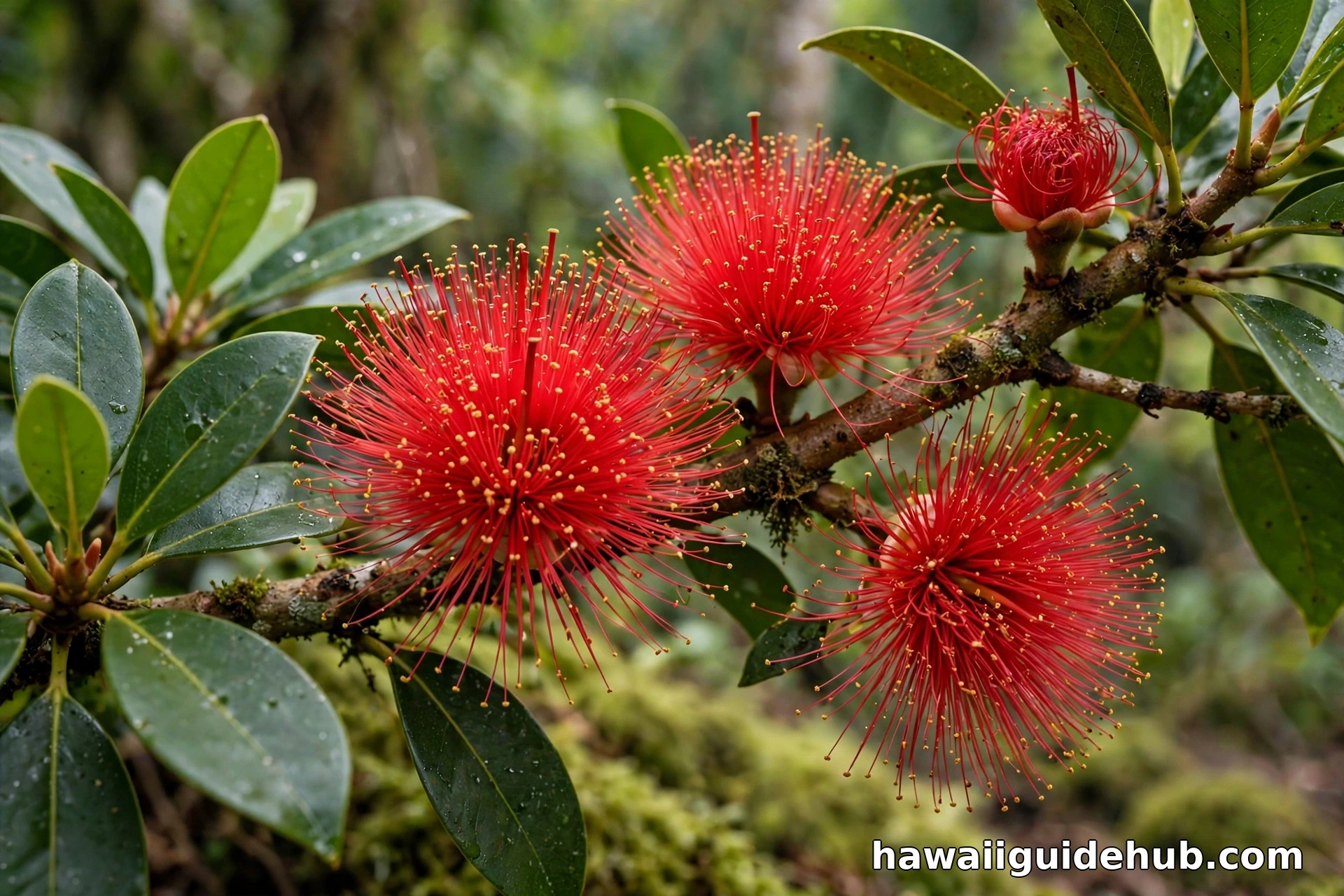
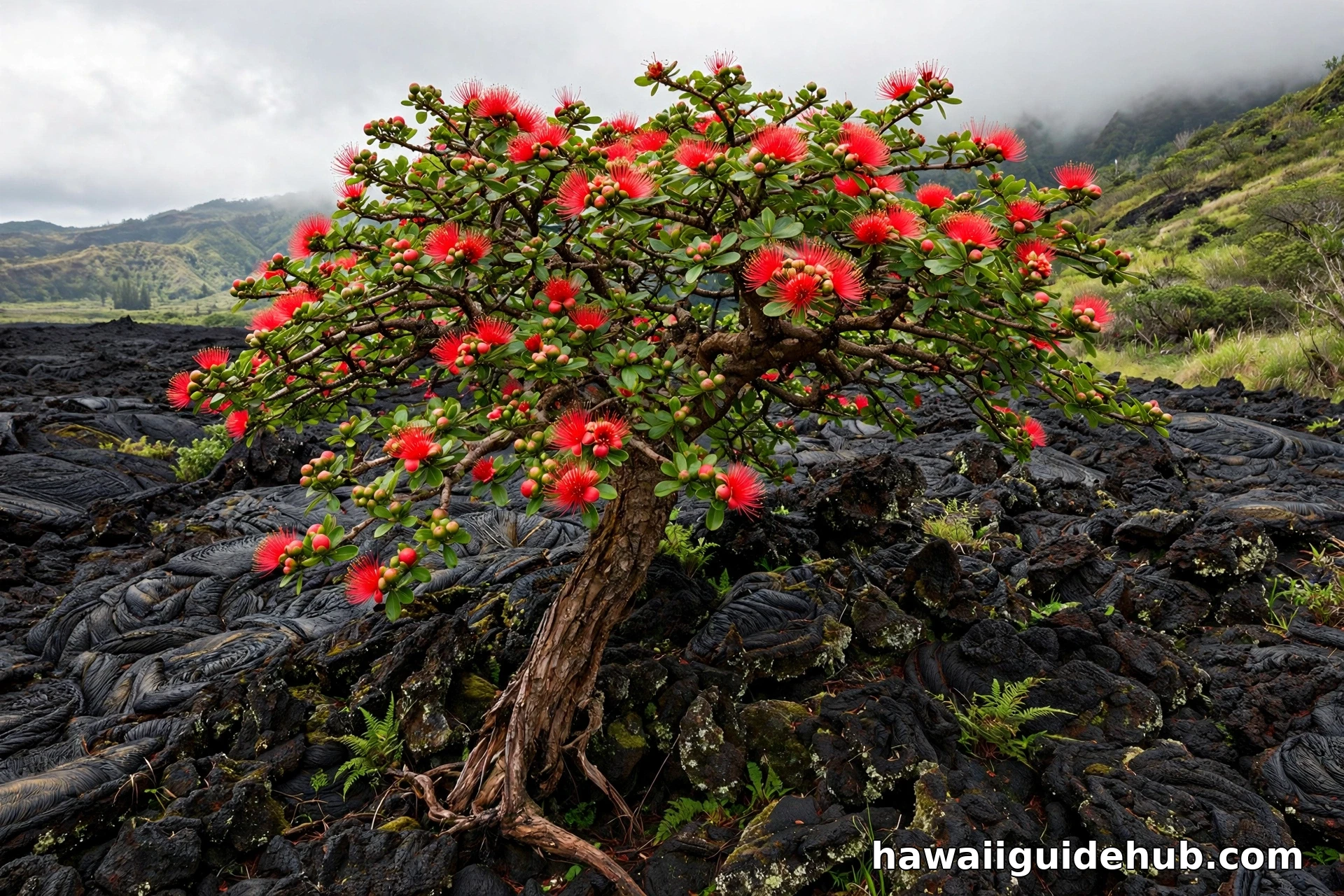
The lehua is unmistakable once you know it. The blossom is a powder puff of fine stamens, usually fiery red, about an inch or two across, with no broad petals at all. The tree is ʻōhiʻa: evergreen, with leathery oval leaves and bark that turns silvery gray and shreddy with age. It is wildly variable, a 100-foot tree in rich forest or a knee-high shrub on raw lava, but the flower is always the same pom-pom. Red is the classic color, but per the University of Hawaii’s CTAHR, yellow, orange, salmon, pink, and white forms exist. If the red pom-pom is on a tree growing straight out of black lava, it is ʻōhiʻa beyond doubt.
Native, Endemic, and Everywhere That Matters
The ʻōhiʻa lehua is endemic: it grows naturally nowhere else on earth, only in Hawaii, on all the main islands except Niʻihau and Kahoʻolawe, per UH CTAHR. It is the most common native tree in the islands, ranging from near sea level to about 8,200 feet, and the first tree to colonize new lava flows: its seeds lodge in cracks and its roots find water where nothing else can. In July 2022 it was designated Hawaii’s state endemic tree. The lehua blossom is also the official flower of the island of Hawaii (the Big Island). Its nectar feeds Hawaii’s endangered honeycreepers, the native birds whose curved beaks evolved for these very flowers.
The Legend of ʻŌhiʻa and Lehua
Hawaiian moʻolelo tells that ʻŌhiʻa was a handsome young man and Lehua a beautiful young woman, devoted to each other. Pele, the volcano goddess, desired ʻŌhiʻa; when he refused her, she turned him into a twisted tree in her fury. Heartbroken, Lehua begged the gods for help, and they turned her into the blossom on his branches so the lovers would never part again. That is why Hawaiians say: pick a lehua blossom and it will rain, the tears of the separated lovers. The tree is sacred to Pele and to Laka, goddess of hula, and the flower is woven into lei with deep respect.
Rapid ʻŌhiʻa Death: The Threat
The ʻōhiʻa faces a real crisis: Rapid ʻŌhiʻa Death, a fungal disease that kills trees quickly and has spread through Hawaii’s native forests. You can help without doing much: do not move ʻōhiʻa wood between islands or areas, clean boots and gear after hiking in native forest, and never wound a tree. The disease spreads through spores entering wounds, so even a weed whacker nick matters. Hawaii’s forests depend on ʻōhiʻa the way a reef depends on coral: lose it and the whole system unravels.
Where to See Lehua Blossoms
The great lehua forests are on the Big Island: Hawaii Volcanoes National Park, where red blossoms dot the Kilauea Iki crater and the Devastation Trail, is the single best viewing. On Maui, the slopes of Haleakalā and the West Maui Mountains hold ʻōhiʻa forest. On Oahu, the Waiʻanae and Koʻolau ranges have native stands. On Kauai, Kokeʻe State Park is prime. Bloom peaks in spring but flowers appear year round, so any month can deliver. Go early morning when the light hits the red against the green.
See the five best things to do in Hawaii Volcanoes National Park for the full crater experience.
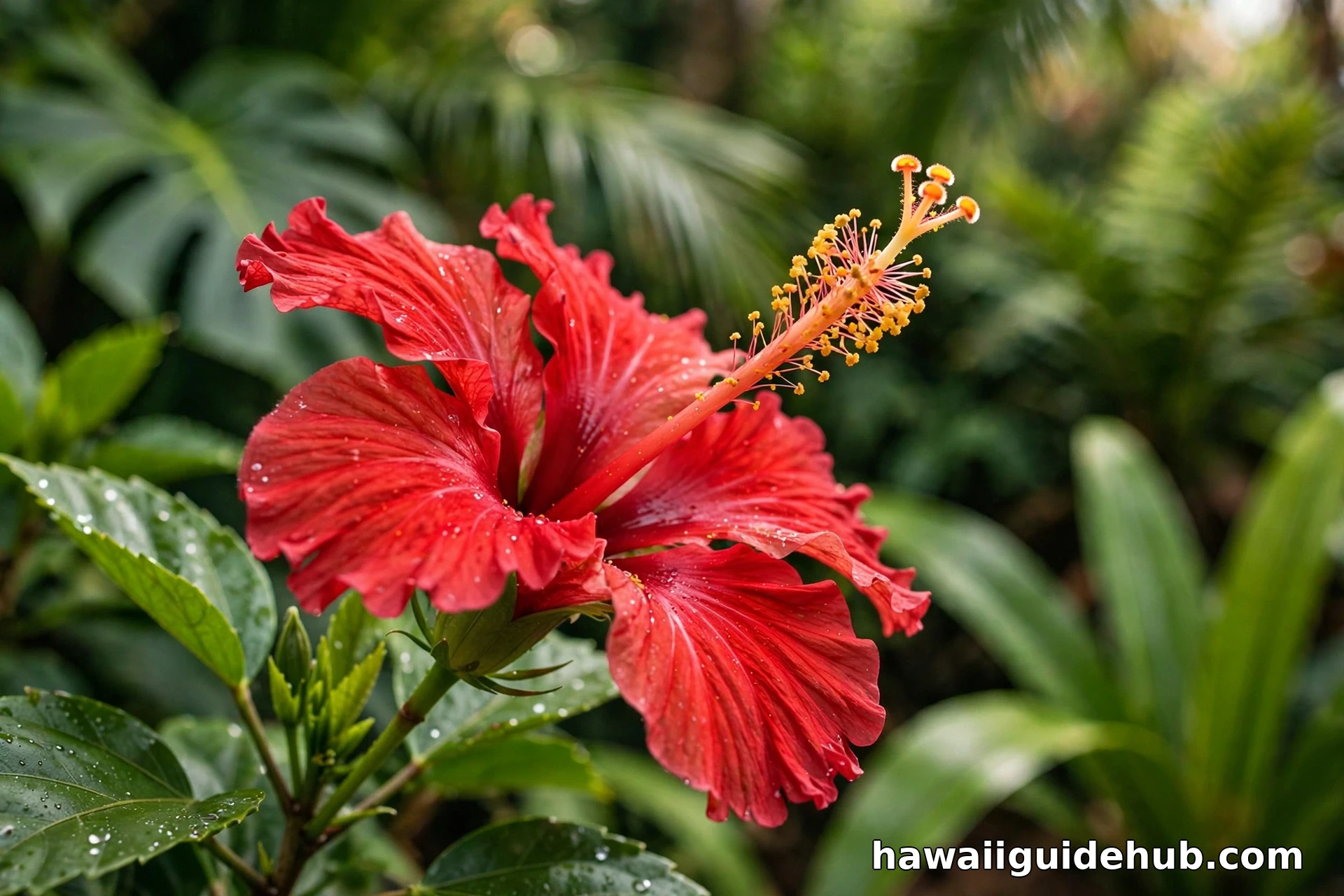
Hawaii’s Other Red Flowers
| Flower | Status | Where you’ll see it | How to tell it apart |
| ʻŌhiʻa lehua | Endemic native | Forests and lava fields, all main islands | Pom-pom of stamens, no petals; on a tree |
| Red hibiscus | Introduced cultivars | Gardens, hedges, resorts everywhere | Big five-petal trumpet with a long stamen column |
| Torch ginger | Introduced ornamental | Gardens, lei shops, florists | Waxy torch-shaped bloom on a tall stalk |
| Royal poinciana | Introduced tree | Streets and parks, summer | Flat-topped tree, fern-like leaves, orchid-like red flowers |
| Anthurium | Introduced | Nurseries, hotel lobbies, florists | Heart-shaped waxy red spathe with a central spike |
A note on the hibiscus: Hawaii’s state flower is the yellow hibiscus (maʻo hau hele), a native species. The red hibiscus blanketing gardens are introduced hybrids. Both are beautiful; only one is Hawaiian.
For more island flora, see Hawaii’s flowers and your full Hawaii bucket list.
The Name Game: ʻŌhiʻa vs Lehua
A widespread misconception holds that ʻōhiʻa is the tree and lehua is only the flower. The Hawaiian Dictionary defines lehua as both the flower and the tree itself, and ʻōhiʻa correctly names the tree too; all three, lehua tree, ʻōhiʻa lehua, ʻōhiʻa, are correct. The confusion is understandable but worth correcting: the language treats tree and blossom as one being, which is rather the point of the legend. Say it with the ʻokina: ʻōhiʻa lehua, “oh-hee-ah leh-hoo-ah.”
Photographing Lehua
Lehua is a demanding photo subject: the red saturates easily and the fine stamens blur in wind. Shoot on overcast days or in open shade to keep the red from clipping; use a fast shutter for the stamens; and get close, the pom-pom structure is the shot. The classic composition is red blossom against black lava or silver bark. Never break branches for a better angle, and stay on trails in native forest: the mosses and seedlings underfoot are the forest’s future.
Lehua Honey
The blossom gives one more gift: lehua honey, made by bees working the ʻōhiʻa forests. It is a prized white honey, delicate and floral, and a jar from a Big Island beekeeper is one of the islands’ best edible souvenirs. Buy it at farmers markets and specialty shops; the flavor carries the forest with it. Like the flower, it is a small, sweet argument for protecting the trees.
Video: The Tale of Ohia and Lehua
The legend of ʻŌhiʻa and Lehua: why picking the blossom is said to bring rain.
Frequently Asked Questions
What is the red flower in Hawaii called?
The lehua blossom, the flower of the ʻōhiʻa lehua tree (Metrosideros polymorpha).
Is the ohia lehua native to Hawaii?
Yes, it is endemic: found naturally only in Hawaii. It is the state tree.
Why does picking a lehua bring rain?
Hawaiian legend says picking the blossom separates the lovers ʻŌhiʻa and Lehua, and the sky weeps. It is folklore, not meteorology, but the respect behind it is real.
What colors do lehua blossoms come in?
Mostly red, but yellow, orange, salmon, pink, and white forms exist, per UH CTAHR.
Where is the best place to see ohia lehua?
Hawaii Volcanoes National Park on the Big Island, especially around Kilauea Iki and the Devastation Trail.
What is Rapid Ohia Death?
A fungal disease killing ʻōhiʻa trees across Hawaii. Help by not moving ʻōhiʻa wood and cleaning gear after forest hikes.
Can I grow ohia lehua at home?
Yes, from seed or cuttings, in sun with well-drained soil. It is slow growing but very tough once established.
Is the red hibiscus native to Hawaii?
The red garden hibiscus are introduced hybrids. Hawaii’s state flower is the native yellow hibiscus, maʻo hau hele.
And if a light rain starts while you are admiring the blossoms, smile: the old ones would say the lovers are weeping, and you are witnessing the legend in real time.
The lehua is Hawaii in miniature: born of volcanoes, shaped by isolation, sacred to gods, feeding birds found nowhere else, and now fighting for its forests. When you see that flash of red on black lava, you are looking at the islands’ whole story in a single blossom. Look, photograph, admire, and leave it on the tree, where it belongs.