How Black Sand Beaches Form in Hawaii (And Where to See Them)

Black sand beaches look like a special effect, but they are pure geology: lava meeting ocean, exploding into fragments, and being ground by waves into sand. Hawaii builds these beaches the way other places build dunes, through eruptions, and some of them formed nearly overnight. This guide explains the process, compares Hawaii’s colored sands, lists where to see black sand, and covers the rules and safety that come with it.
This is the single complete guide to how black sand beaches form in Hawaii. It covers the formation process step by step, why the sand is black, green sand and white sand for comparison, the best black sand beaches, wildlife etiquette, safety, the law on taking sand, and FAQs. Everything about black sand formation lives on this one page.
How Lava Becomes a Beach
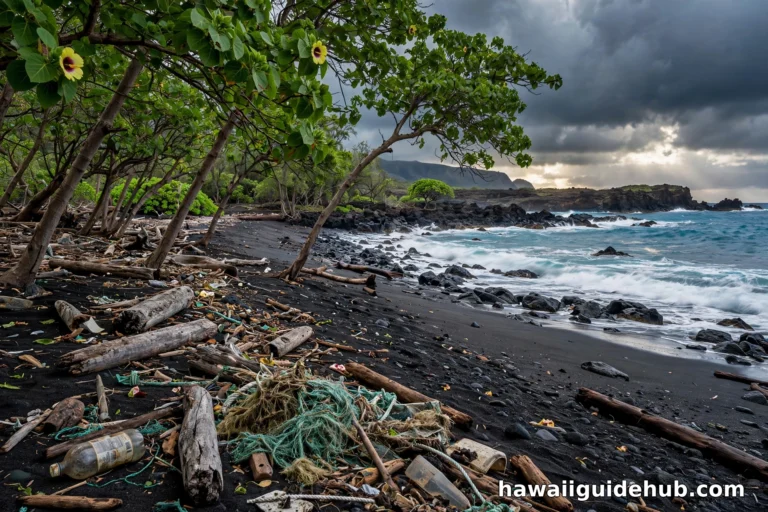
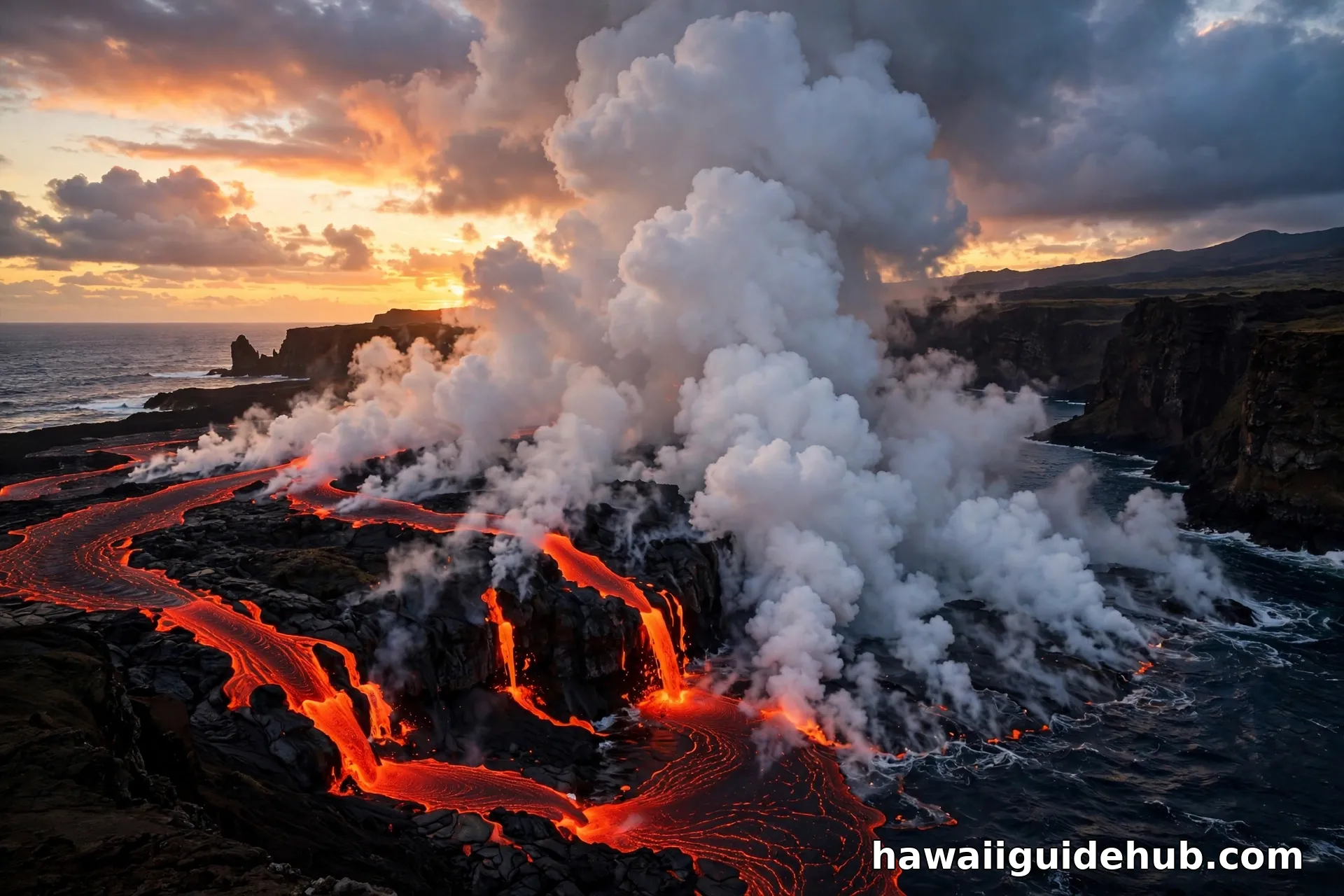
The recipe has four steps. First, basaltic lava from volcanoes like Kilauea flows downhill to the coast; this lava is iron-rich and dark, unlike the pale granites of continents. Second, the 2,100°F lava meets cold seawater, and the thermal shock triggers littoral explosions: steam blasts the molten rock apart into glassy fragments ranging from boulders to grit. Third, waves take over, tumbling the fragments against each other and the reef, grinding them finer with every storm. Fourth, longshore currents pile the finished sand into a beach. Given a big enough lava flow, a beach can appear almost overnight: at Kalapana in the late 1980s and 1990s, Kilauea’s flows buried the old Kaimu black sand beach and built roughly 300 meters of new coastline.
Black sand is young sand. Continental quartz sand survives for millions of years; basalt sand is fragile and weathers fast. That is why black sand beaches cluster near recent eruptions and fade over decades: the beach is a temporary truce between the volcano and the ocean. See the volcano behind it all in our Hawaii Volcanoes National Park guide.
Hawaii’s Sands Compared: Black, White, Green, Red
Hawaii has no continental quartz, so every grain of sand here tells a local story. The comparison:
| Sand | Made of | Where to see it | Know before you go |
| Black | Shattered basalt lava | Punalu’u (Big Island), Wai’anapanapa (Maui) | Burns bare feet at midday; carry sandals |
| White | Ground coral, shells, and marine skeletons | Hapuna (Big Island), Maui’s south shores | Softest underfoot; the classic postcard beach |
| Green | Olivine crystals from Puu Mahana cinder cone | Papakolea (Big Island, hike-in only) | One of four green-sand beaches on Earth |
| Red | Oxidized iron-rich cinder | Kaihalulu (Maui, near Hana) | Remote; the cinder stains everything |
Green sand deserves a note: at Papakolea, ocean erosion washes away the lighter basalt and leaves the denser green olivine crystals behind, concentrating them into a beach. Our site’s green sand coverage lives with the dedicated beach posts; the formation story is the same lava-meets-ocean process with a mineral twist.
Where to See Black Sand
Punalu’u, Big Island
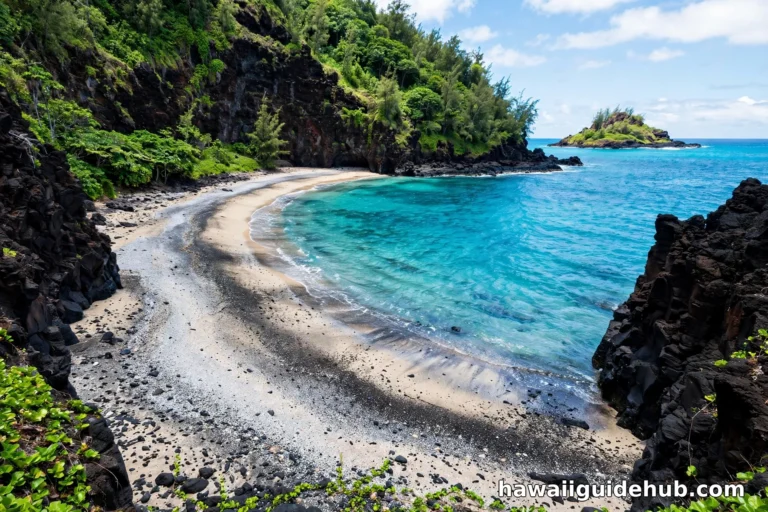
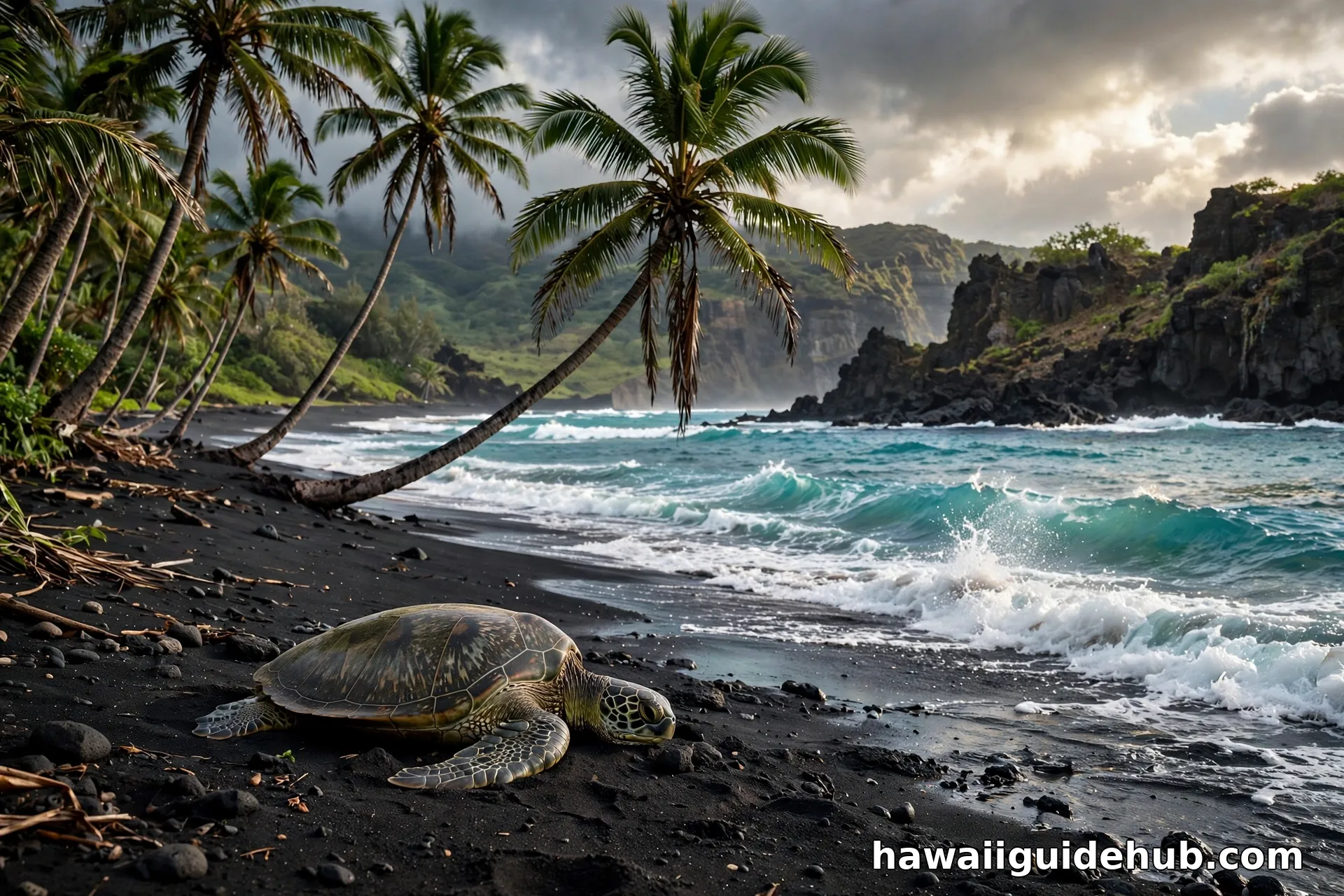
The most famous black sand beach in Hawaii, on the Ka’u coast between Pahala and Naalehu. Jet-black sand, swaying palms, freshwater springs bubbling into the bay, and Hawaiian green sea turtles (honu) basking on the sand. Swimming is often rough here due to strong currents; come for the spectacle. Stay at least 10 feet from basking turtles, per federal wildlife guidance, and never touch them. Turtle etiquette is covered in our honu conservation guide.
Wai’anapanapa State Park, Maui
Maui’s signature black sand beach, framed by lava cliffs, sea caves, and a freshwater cave pool. Out-of-state visitors need advance reservations through Hawaii State Parks, and the park fills up: book before you fly. The scenery is dramatic, the surf is powerful, and swimming is for strong swimmers only on calm days.
Kehena, Big Island
A wilder, clothing-optional-leaning black sand beach on the Puna coast, reached by a steep trail. Beautiful and raw, with strong shore break: a look-don’t-swim spot for most visitors.
Watching It Happen: Lava Meets the Ocean
When Kilauea is erupting into the sea, you can watch beach formation in real time: white steam plumes, littoral explosions throwing incandescent fragments, and new black sand accumulating between flows. These ocean entries are spectacular and genuinely dangerous, with toxic laze (lava haze), unstable new land that can collapse, and scalding water. View them from designated overlooks only, never from the new land itself. Eruption status changes constantly; check Hawaii Volcanoes National Park’s official alerts before planning around an ocean entry.
Safety on Black Sand Beaches
Black sand beaches demand more caution than white sand ones. The sand absorbs heat and can burn bare feet by midday; wear sandals until you reach the waterline. Many black sand beaches face open ocean with powerful shore break and strong currents; Punalu’u and Wai’anapanapa both have drowning histories. Swim only where lifeguards are present and conditions are calm, and never turn your back on the surf. For general swim picks, see our Kauai swimming beach guide for the calmer end of the spectrum.
Can You Take Black Sand Home?
No. Removing sand, rocks, or coral from Hawaii’s beaches is illegal under state law, and taking lava rock carries the cultural weight of Pele’s curse in Hawaiian tradition: the legend says she curses those who remove her rock with bad luck until it is returned. Every year, packages of returned rocks arrive at Hawaii Volcanoes National Park from remorseful visitors. Buy a souvenir made from lava by local artisans instead; the beach keeps its sand, your conscience stays clear, and your luggage keeps its luck for the flight home.
The Chemistry: Why Basalt Is Black
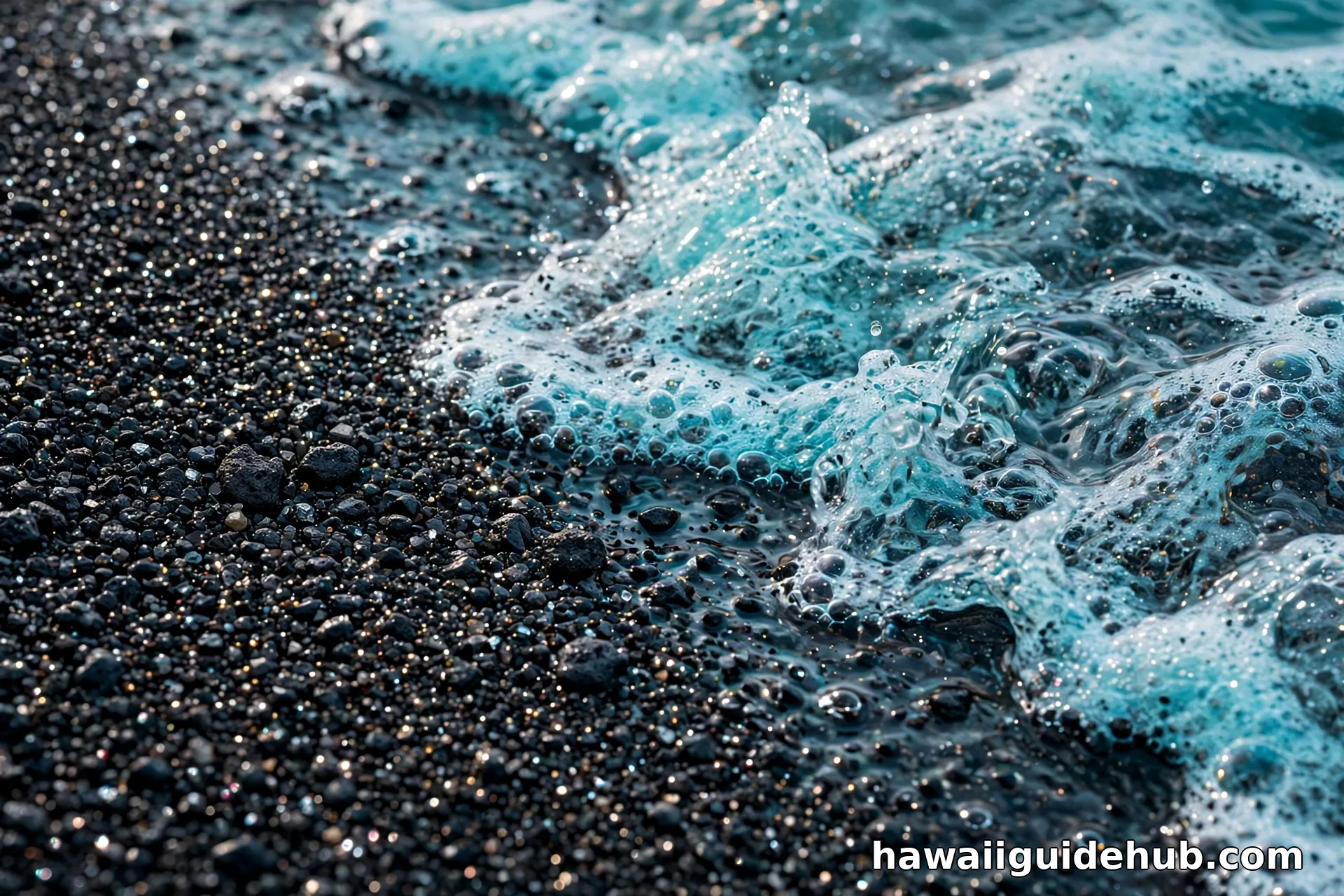
The blackness is chemistry. Basalt is rich in iron and magnesium minerals: pyroxene, olivine, and magnetite, an iron oxide with a dark metallic luster. These minerals absorb light across the visible spectrum, so the sand looks black. Magnetite also makes some black sand faintly magnetic: run a strong magnet through dry black sand and grains will cling to it, a party trick that works on Punalu’u’s shore. Contrast this with Hawaii’s white sand, which is calcium carbonate from coral and shells, and you can read a beach’s origin story in its color.
Grain shape tells a second story. Fresh black sand is angular and glassy, the product of violent shattering, and it can feel sharp underfoot. Older black sand, tumbled by waves for decades, rounds into smoother grains. Geologists read this like tree rings: angular grains mean a young beach near a recent flow; rounded grains mean an old beach far from its source, living on borrowed time.
New Beaches, Lost Beaches: The Kalapana Story
Nowhere illustrates the impermanence better than Kalapana on the Big Island’s Puna coast. In 1990, Kilauea’s lava flows buried the town of Kalapana and its famous Kaimu black sand beach under dozens of feet of lava. Visitors mourned a lost landmark. But the same eruption that destroyed the beach built a new coastline: as lava poured into the ocean through the 1990s, it shattered into fragments that waves piled into brand-new black sand beaches along the fresh shore, extending the land roughly 300 meters seaward.
Today the new Kaimu area has black sand beaches again, different from the old ones, fringed by coconut palms growing on the new land. It is the full life cycle in one place: destruction, creation, and the slow polishing of a new beach. When Kilauea’s 2018 lower East Rift Zone eruption buried more coastline and created yet more new land, the cycle started again. Hawaii’s black sand beaches are not permanent features; they are moments in an ongoing argument between volcano and ocean.
Black Sand Around the World: Why Hawaii’s Is Special
Black sand beaches exist wherever volcanoes meet the sea: Iceland’s Reynisfjara, the Canary Islands, the Aleutians, Tahiti. But Hawaii’s are special for two reasons. First, the setting: tropical palms, turquoise water, and basking sea turtles against jet-black sand is a contrast no subarctic beach can match. Second, the accessibility: Punalu’u is a roadside stop, not an expedition. You can stand on sand that was molten rock in your grandparents’ lifetime, then swim (carefully) in the ocean that made it.
Photographing Black Sand Beaches
Black sand is a photographer’s paradox: it meters dark, so cameras underexpose the scene. Shoot in the golden hours, morning or late afternoon, when the low sun makes the sand shimmer and the turtles haul out. Expose for the highlights and let the sand go rich and dark rather than gray. A polarizing filter cuts the glare off wet sand and deepens the turquoise water. And keep gear away from the surf line: black sand is mildly abrasive and gets into everything, and the shore break at these beaches is stronger than it looks.
Visiting With Kids: What Families Should Know
Black sand beaches thrill kids, but they need a different plan than a white sand day. The heat is the first issue: black sand can burn small feet fast, so water shoes are better than flip-flops, which fall off in the surf. The surf is the second: skip swimming at Punalu’u or Wai’anapanapa with young children and treat the visit as a sightseeing stop, 45 minutes of turtles, photos, and wading at the water’s edge. Bring twice the water you think you need; there is little shade on black sand and it radiates heat. And turn the geology into the entertainment: let kids hunt for green olivine flecks in the sand and explain that every grain was once lava. They will remember it longer than any resort pool.
Watch: How Black Sand Beaches Form
Black Sand FAQs
Why is the sand black in Hawaii?
It is pulverized basalt lava. When molten lava meets the ocean, thermal shock shatters it into fragments, and waves grind the fragments into sand. The iron-rich basalt gives the sand its black color and a slight magnetic quality.
How long does it take a black sand beach to form?
Anywhere from overnight to centuries. A large lava flow entering the ocean can deposit enough fragments to build a beach almost immediately, as happened at Kalapana. Smaller flows build beaches grain by grain over decades.
Do black sand beaches disappear?
Yes. Basalt sand weathers and erodes faster than quartz sand, and without fresh lava to replenish it, black sand beaches shrink over decades. Some beaches formed by eruptions just decades ago are already fading, which makes visiting them now especially worthwhile.
Is black sand hot?
Very. Black sand absorbs far more solar heat than white sand and can burn bare feet by midday. Wear sandals, bring a towel or mat to sit on, and plan beach time for morning or late afternoon.
Which Hawaiian island has the best black sand beaches?
The Big Island, for quantity and drama: Punalu’u, Kehena, and the new beaches of the Puna coast. Maui’s Wai’anapanapa is the most scenic single black sand beach in the state. Both islands still have active or recent volcanic landscapes feeding the process.
What is green sand made of?
Olivine crystals, a green semi-precious mineral from deep in the Earth. At Papakolea on the Big Island, waves wash away lighter basalt and leave dense olivine behind. It is one of only four green sand beaches in the world.
Walk on a Volcano’s Footprint
A black sand beach is a volcano’s footprint, still warm from the making. Every grain was molten rock within recent geological memory, shattered by the ocean and polished by the surf into something you can stand on. Visit Punalu’u at golden hour when the turtles haul out, book Wai’anapanapa before you fly, wear the sandals, respect the turtles, and leave every grain where the volcano put it. The beach is temporary; the memory of standing on it is not. Go see one while the volcano is still restocking the supply. Few beaches on Earth come with a creation story you can watch happening with your very own eyes.