Feral Pigs in Hawaii: The Reef-Killing Paradox of the Puaʻa

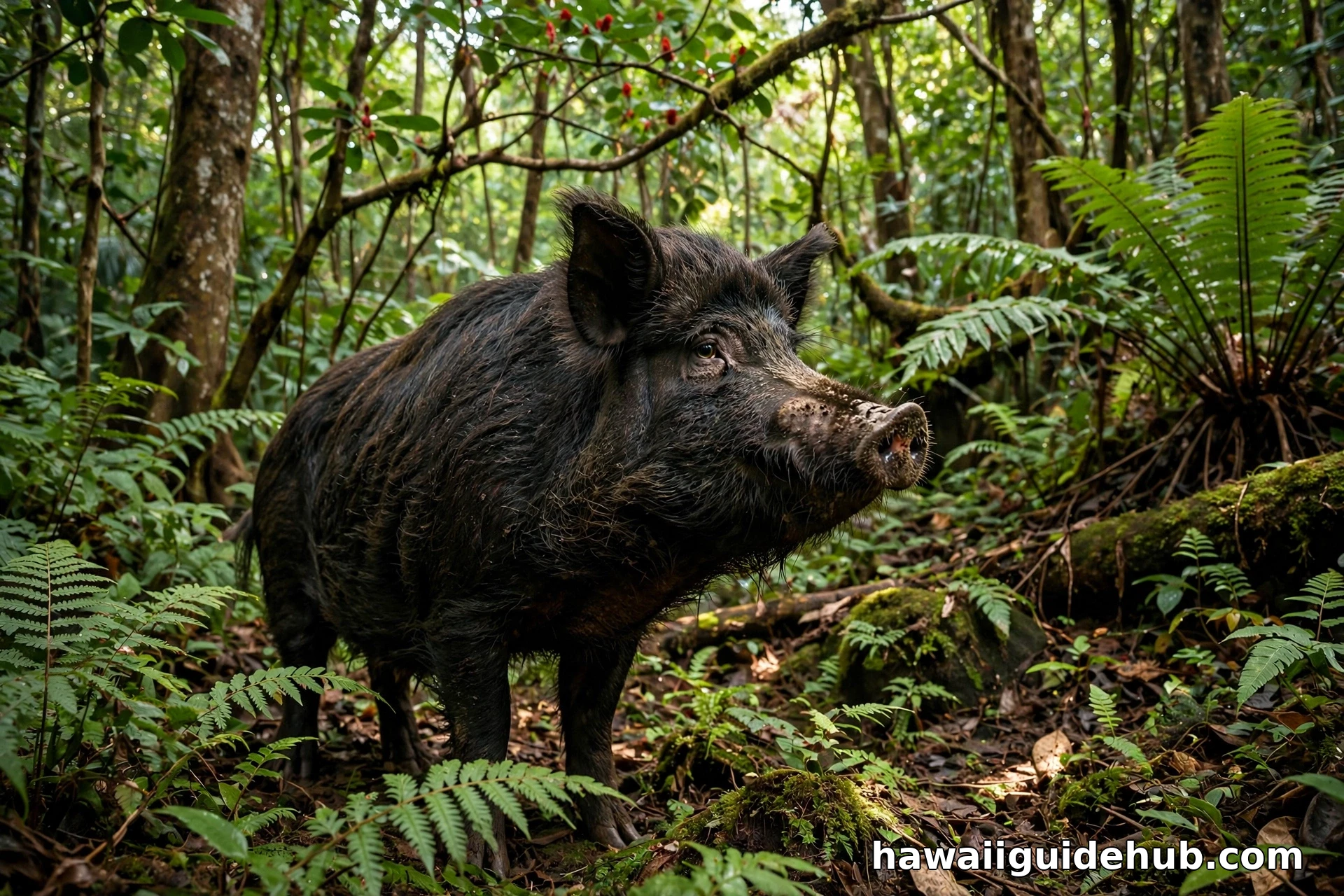
The pig arrived in Hawaii by canoe, sacred and useful, and became the islands’ worst ecological disaster. Feral pigs, puaʻa, now rototill native forests, breed the mosquitoes that kill forest birds, wound the ʻōhiʻa trees that hold the watershed together, and send sediment down streams to smother coral reefs. Yet the pig remains central to Hawaiian culture, hunted, eaten, and honored, which makes managing it one of the most emotionally complex conservation challenges in the Pacific.
This is the single complete guide to feral pigs in Hawaii. It covers how the pig arrived and went wild, the full catalog of damage organized by ecosystem, the surprising chain from forest rooting to dying coral, the disease connections, the cultural side of the puaʻa, how management actually works, and what visitors should know. If you have been searching for anything about feral pigs in Hawaii, the answers are all here on this one page.
From Canoe to Catastrophe
Pigs came to Hawaii with the Polynesians, small, domesticated, and culturally precious. Over centuries, escapees went feral, and modern populations have extensively crossbred with domestic escapees, producing larger, tougher, more prolific animals than the original canoe pigs. With no natural predators in Hawaii and an omnivorous appetite, feral pigs expanded into every wet forest on every island, and their numbers rebounded relentlessly: managers note that populations can recover even after reductions of 40 to 70 percent, and that roughly 70 percent of a population must be removed annually just to hold it steady.
The Rap Sheet: Damage by Ecosystem
Pig damage is not one problem but a chain of them. The table below follows the destruction from the forest floor to the reef.
| Where | What pigs do | Downstream victim |
| Native forest | Root, trample, and eat understory; strip bark; undermine roots (per NPS/HAVO studies) | Native plants; forest birds losing habitat |
| ʻŌhiʻa trees | Rub trunks with tusks, wounding bark; spread fungal spores on hooves | Rapid ʻŌhiʻa Death enters wounds; keystone species dies (per Puna landowner accounts) |
| Wallows | Dig hollows that collect standing water | Mosquitoes breed; avian malaria spreads to native birds |
| Streams | Loosened soil washes downhill in rains | Sediment smothers coral reefs; “can’t get sunlight, oxygen, nutrients” (per TNC’s Chad Wiggins) |
| Farms & yards | Tear up crops and lawns; a sounder can destroy half a 40-acre corn crop in a weekend (per Hawaii pest reports) | Farmers; homeowners; native plantings |
How Pigs Kill Reefs
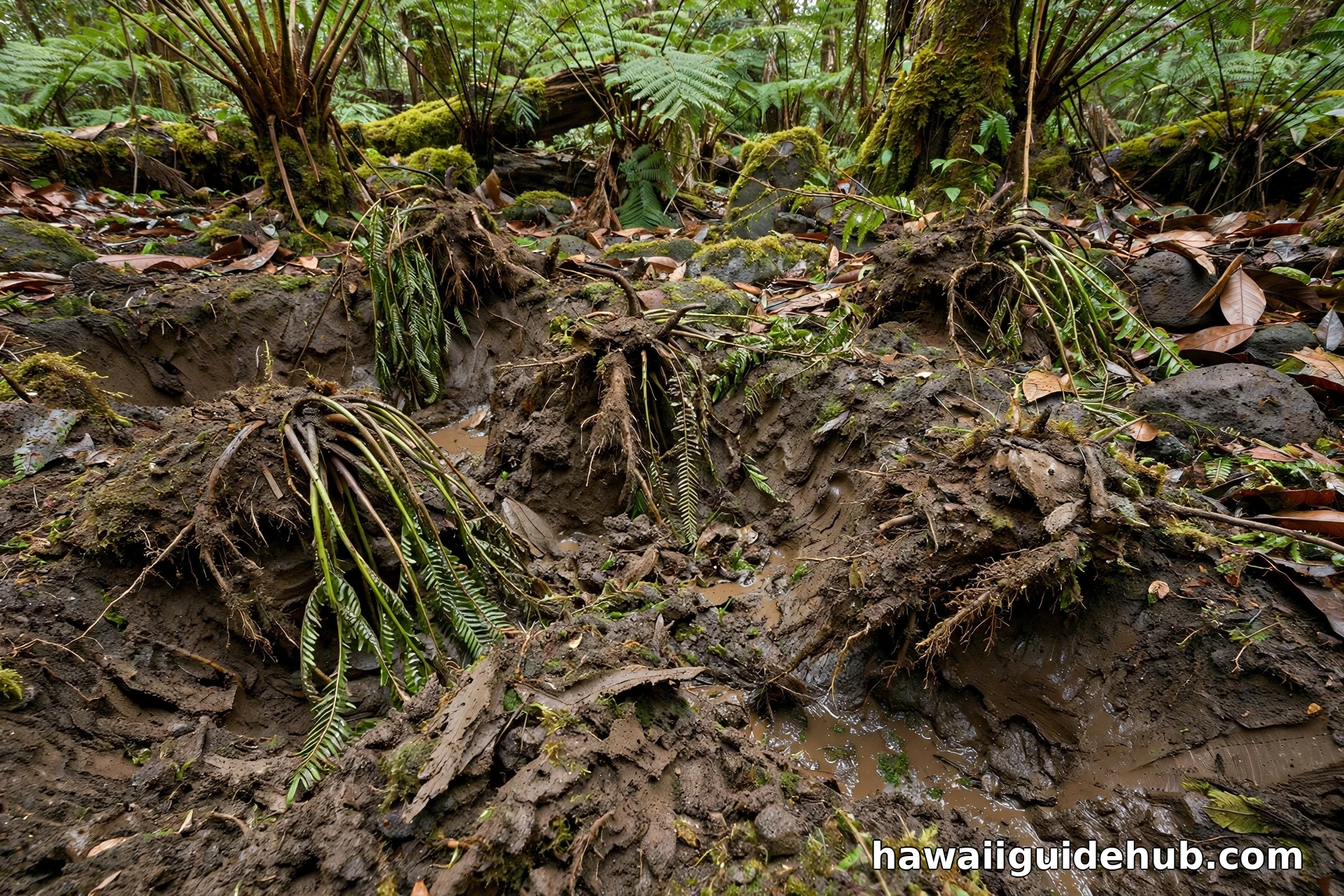
The strangest link in the chain is also the most consequential. Pigs dig in the forest for worms and grubs, loosening vast quantities of soil. When rains come, streams carry the sediment downhill and dump it onto reefs. As The Nature Conservancy’s marine program director Chad Wiggins explains, smothered coral cannot get sunlight, oxygen, or nutrients, and dies; even surviving coral suffers as waves resuspend the sediment, sometimes for decades. NOAA oceanographer Dr. Jamie Gove notes that reefs already stressed by bleaching reach a tipping point faster when land-based sediment piles on. In Hawaii, saving coral means controlling pigs, an argument that has made pig hunters unlikely allies of reef conservation.
Mosquitoes, Fungus, and Feathers
The wallow-to-malaria connection is Hawaii’s cruelest ecological irony. Native Hawaiian forest birds evolved without mosquitoes and have no resistance to avian malaria; a single bite can kill. Pig wallows create the standing-water nurseries mosquitoes need at elevations where birds once found refuge, and the disease has driven honeycreepers to the brink. Meanwhile, the wounds pigs rub into ʻōhiʻa trunks give the Rapid ʻŌhiʻa Death fungus its entry point, and pigs’ roaming spreads the spores. One animal, three extinction drivers: habitat destruction, disease vectoring, and pathogen transport.
Recovery, when it comes, is slow but visible. Studies of pig removal in Hawaiian rainforest found that sites cleared two and four years earlier already differed measurably from infested sites, with native understory returning where the rooting stopped. The forest remembers what it was, and given a fence and a few undisturbed years, it starts becoming it again. That resilience is the quiet argument for every mile of fence wire: the damage is reversible, but only if the pigs are kept out long enough for the seedlings to get above snout height.
The Other Side: Puaʻa as Culture
None of this erases what the pig means to Hawaiians. The puaʻa is a traditional food, the centerpiece of the imu-roasted kalua pig, and pig hunting with dogs is a living cultural practice passed through generations. Hunters know the forests intimately and harvest sustainably. As environmentalist Kyle Thiermann’s reporting found, the goal among thoughtful managers is control, not eradication: managing the population down while continuing to honor the pig’s cultural role. The pig is both destroyer and ancestor, and Hawaii’s management reflects that duality.
What Management Actually Looks Like
The proven formula is fence, then remove. Statewide, roughly 270,000 acres are now fenced against hooved animals, and watershed partnerships keep extending the lines. Inside fences, managers use corral traps that capture entire sounders, box traps for individuals, ground shooting, and, in inaccessible areas, helicopter shooting. The state issues Wildlife Control Permits for public hunters in forest reserves. It is expensive, endless work: pigs are intelligent, learn to avoid traps after a single bad experience, and breed fast enough to replace most of what is removed. But fenced forests recover visibly, understory returning within years, which is why the fence lines keep growing.
A Pig’s Day: How the Damage Happens
To understand the destruction, follow a sounder through 24 hours. At dawn the pigs root through the understory for earthworms, their primary protein, plowing the forest floor with their snouts. One observer watched pigs tear up a 20-by-20-foot area in a single hour. Midday they wallow, coating themselves in mud against insects and heat, excavating hollows that later hold mosquito-breeding water. They eat everything: roots, tubers, fruits, seeds, frogs, eggs, chicks of ground-nesting birds, even young goats. Their simple stomachs demand near-constant foraging, so the destruction never pauses.
At night they rub against ʻōhiʻa trunks, tusks scoring bark, opening the wounds through which the Rapid ʻŌhiʻa Death fungus enters. They travel miles, carrying fungal spores on hooves and snouts to healthy stands. By morning the sounder has moved on, leaving behind a plowed, pocked, wounded forest that will take years to recover, if it gets the chance.
The Hunters’ Knowledge
Hawaii’s pig hunters are among the islands’ most skilled woodsmen, and their knowledge is a cultural treasure in its own right. Hunting with dogs, often a fast “find” dog and a heavier “catch” dog, hunters read sign the way scholars read texts: the freshness of rooting, the direction of trails, the mud on rub trees. Many hunters come from families that have hunted the same valleys for generations, and their harvest feeds extended ʻohana.
This is why management agencies work with hunters rather than against them. Programs like the Mālama O Puna feral pig control project develop hunters’ lists, codes of conduct, and best practices, recognizing that skilled local hunters are the most effective and culturally appropriate control force. The relationship is not always smooth, access, methods, and goals all generate friction, but the shared aim, fewer pigs in the forest, more pigs in the freezer, holds the partnership together.
Leptospirosis and Other Human Risks
Pigs carry risks for people too. Feral pigs can shed leptospirosis bacteria in their urine, contaminating streams and muddy areas, which is one reason hikers are advised to avoid drinking untreated stream water and to cover open wounds. Pig encounters on trails are usually brief, the animals flee, but a cornered boar or a sow with piglets is genuinely dangerous: strong, fast, and armed with tusks. Dogs off leash may chase pigs and get hurt, or drive pigs toward other hikers.
The practical rules are simple. Do not approach or feed pigs. Keep dogs leashed in pig country. Treat stream water. And if you hear crashing in the undergrowth ahead, stop, make noise, and give the animals room to leave. They want the encounter even less than you do.
The Fence Lines
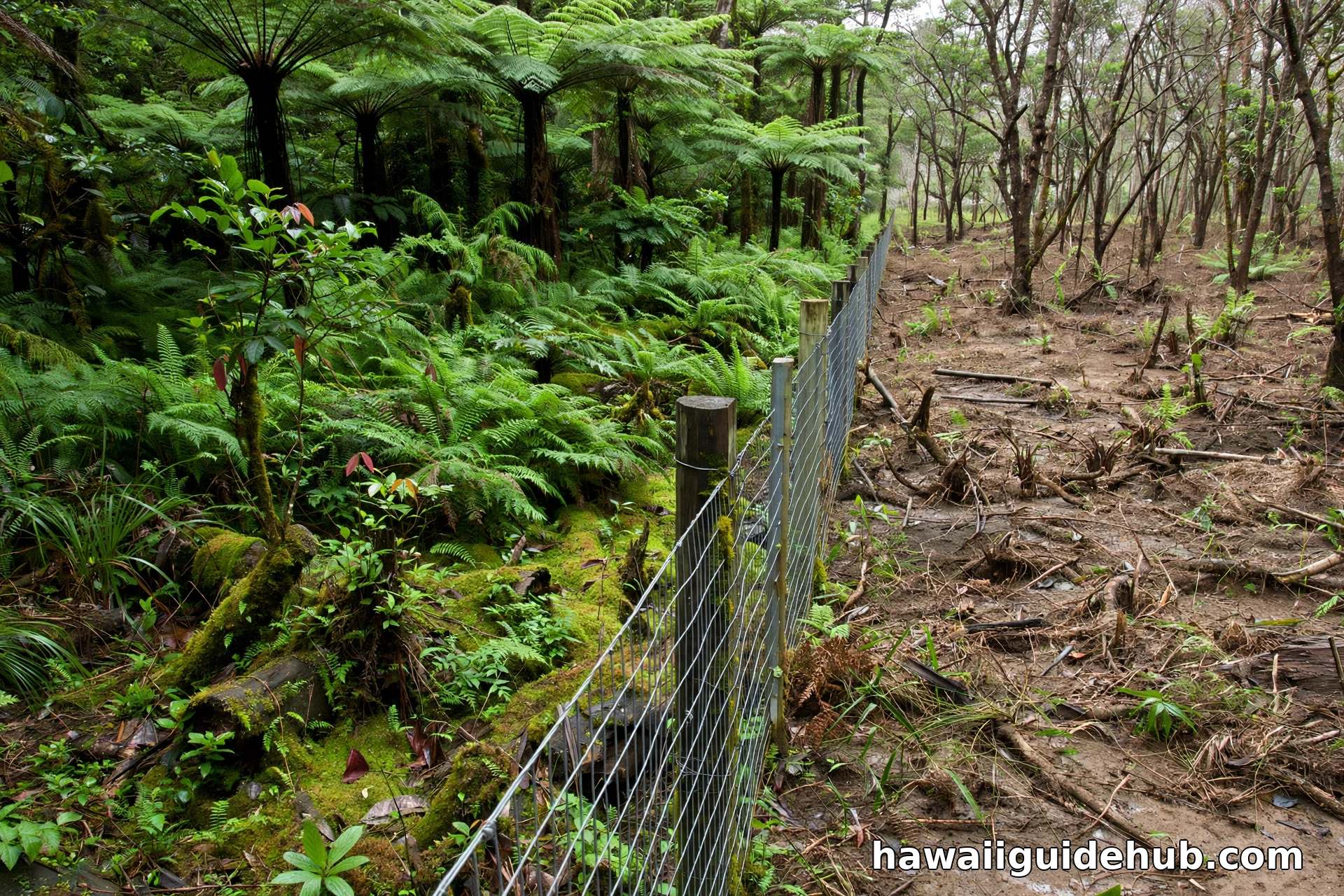
Drive the back roads of the Big Island or Maui and you will cross the fence lines: tall, heavy-gauge barriers marching across ridges and valleys, the front lines of the pig war. Building them is an engineering feat, helicoptering materials into roadless country, and maintaining them is endless, as falling trees and rust work against the wire. But the payoff is visible from the road: inside the fences, the understory returns, ferns unfurling where mud was, seedlings rising where pigs rooted.
The watershed partnerships that build these fences, coalitions of state agencies, private landowners, and conservation groups, represent a distinctive Hawaiian approach to conservation: landscape-scale, cooperative, and patient. Their goal is not to win the war in a year but to hold the lines for decades, expanding the protected acreage fence by fence, valley by valley. It is slow, expensive, unglamorous work, and it is the reason Hawaii still has native forests to argue about.
The fence-line photograph tells the whole story in a single frame: on one side, ferns chest-high and moss on every surface; on the other, bare mud and stumps. Hikers on trails that cross these boundaries walk through the before-and-after of Hawaiian conservation, and the contrast converts more skeptics than any report ever written. When you see the line, stop and look both ways. You are looking at the pig war’s front line, and at proof that the war can be won, one fenced valley at a time.
What Visitors Should Know
You may hear pigs before you see them, rustling in the undergrowth along valley trails. Give them space: sows with piglets are defensive, and boars are strong and fast. Never feed feral pigs; it habituates them to people and concentrates damage. Stay on marked trails in native forest, both for your safety and to avoid spreading Rapid ʻŌhiʻa Death spores on your boots: brush soil off footwear between trails. And if you eat kalua pig at a lūʻau, know that the animal on your plate connects to one of Hawaii’s oldest food traditions, now tangled in its hardest conservation fight.
For more on Hawaii’s conservation challenges, the guide to Hawaiian cultural traditions adds the human dimension, while responsible travel practices and the guide to Hawaii’s natural environments cover visiting fragile places with care.
Watch: How Feral Pigs Damage Hawaii’s Reefs
Frequently Asked Questions
Are there wild pigs in Hawaii?
Yes. Feral pigs inhabit wet forests on every island, descended from Polynesian canoe pigs crossbred with domestic escapees.
Why are feral pigs bad for Hawaii?
They destroy native forest understory, spread Rapid ʻŌhiʻa Death, create mosquito-breeding wallows that spread avian malaria, and send sediment onto coral reefs.
How do pigs damage coral reefs?
Rooting loosens soil that washes down streams onto reefs, smothering coral and blocking the sunlight, oxygen, and nutrients it needs.
Can you hunt feral pigs in Hawaii?
Yes. Pig hunting is a regulated cultural practice; the state also issues Wildlife Control Permits for management hunts in forest reserves.
What is the Hawaiian word for pig?
Puaʻa. The word covers both the domestic pig of Hawaiian culture and the feral pigs of the forests.
Do feral pigs spread disease in Hawaii?
They can spread leptospirosis to people through contaminated water and mud, and they spread the Rapid ʻŌhiʻa Death fungus between trees. Their wallows breed the mosquitoes that carry avian malaria to native birds.
Are feral pigs dangerous to hikers?
They can be. Give pigs space, especially sows with piglets, never feed them, and stay on marked trails.
The feral pig is Hawaii’s hardest paradox: a sacred canoe animal turned ecological wrecking ball, a reef-killer that is also dinner. The islands will be managing this contradiction for as long as there are forests to protect and hunters to hunt, which is to say, for a very long time. The next time you taste kalua pig, remember the whole story: the canoe, the forest, the fence line, and the hunter’s dogs. In Hawaii, even dinner has deep roots.