Ti Plant (Kī) in Hawaii: Guardian, Garment, and Gift

Walk past any Hawaiian home with kī planted at its four corners and you are seeing a security system older than locks. The ti plant, kī in Hawaiian, is the islands’ great multitasker: spiritual guardian, hula skirt, rain cape, food wrapper, medicine cabinet, sled, and, when fermented, liquor. Brought by Polynesian voyagers as a canoe plant, it now grows wild and cultivated across every island, its broad green, red, and purple leaves among the most recognizable in Hawaii.
This is the single complete guide to the ti plant (kī) in Hawaii. It covers the plant’s spiritual power and protective plantings, its role in hula and clothing, every major use organized by human need, the journey from sweet root to ʻōkolehao liquor, its medicinal uses, how to grow it, and where to see it. If you have been searching for anything about the ti plant or kī in Hawaii, the answers are all here on this one page.
The Plant at the Corners of the House
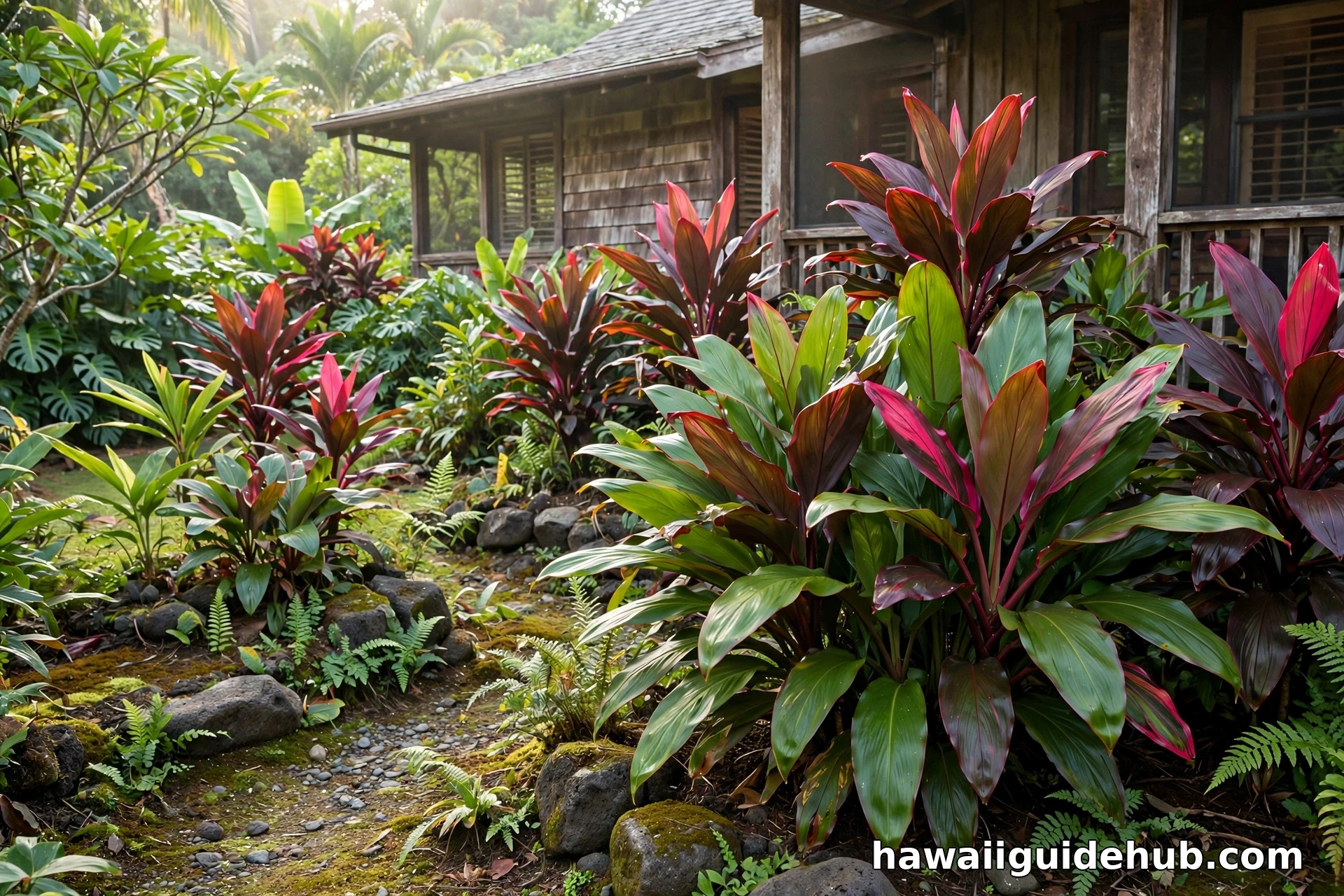
In ancient Hawaii, kī was thought to hold great spiritual power. Only kahuna, priests, and aliʻi, chiefs, could wear its leaves around their necks during certain rituals. The plant was sacred to Lono, god of fertility and agriculture, and to Laka, goddess of the forest and hula. Green kī was planted at the four corners of homes and heiau, along property borders, and around loʻi, not for decoration but for defense: the leaves were believed to ward off evil spirits, ghosts, and bad luck. Travelers carried leaves as charms, and the plant was thought capable of hosting ancestral spirits.
The belief endures. To this day, Hawaiians plant kī near houses for good luck and protection, and kahuna still bless new buildings, ventures, and equipment holding ti leaves. The National Park Service’s lei lāʻī program notes that the ti-leaf lei worn in hula represents not just adornment but the deities Laka and Lono and the kūpuna, the ancestors, braided into wearable form. When you see kī at a doorway, you are seeing a living prayer.
The Hula Skirt and the Rain Cape
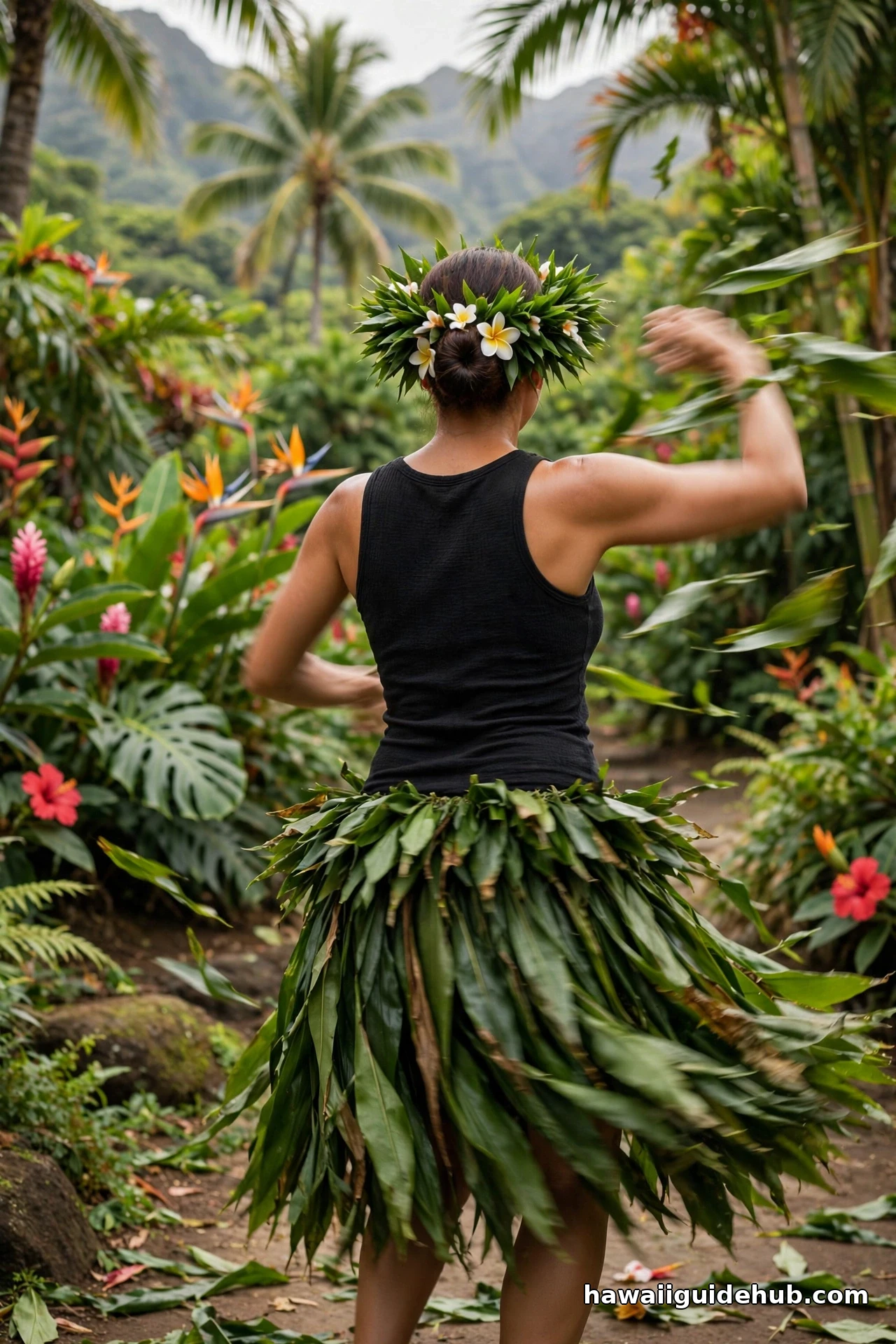
Kī’s most famous garment is the hula skirt: a dense, opaque skirt of at least fifty green leaves, the bottoms shaved flat, rustling with every hip movement. But the wardrobe was wider. Fresh ti leaves, which naturally shed water, were fashioned into rain capes for working in the rain, and into sandals. The leaves thatched roofs, covered lūʻau tables, lined serving platters, and were braided into lei. Rope came from the leaf fibers. It was the original performance fabric: beautiful, waterproof, biodegradable, and free.
Kī’s Jobs: One Plant, Five Toolkits
Rather than list uses at random, it helps to see kī the way Hawaiians did: as five toolkits in one plant, each serving a different human need.
| Human need | What kī provides | Example |
| Protection | Spiritual defense and blessing | Planted at four house corners against evil spirits; kahuna blessings (per NPS and ethnobotanical sources) |
| Clothing | Waterproof, flexible garments | Hula skirt of 50+ leaves; rain capes; sandals; lei |
| Kitchen | Food wrapping and cooking | Laulau wrappers; imu linings; plates and table coverings |
| Medicine | Laʻau lapaʻau remedies | Damp leaf on forehead for headache/fever; boiled-leaf water for nerves; young-leaf eye drops (per UH Hilo sources) |
| Play & craft | Sport and material | Leaves lashed for lava sledding (heʻe hōlua); children’s whistles; surfboard gloss in early 1900s |
From Sweet Root to ʻŌkolehao
Below ground, kī hides its sweetest secret. The starchy rhizomes grow larger and sweeter as the plant matures, and baked, they were eaten as food across Polynesia. Fermented and distilled, they became ʻōkolehao, the Hawaiian liquor whose name translates, with characteristic humor, to “bottom up.” In the early 1900s, ti root extract even served as a glossy coating for surfboards. The plant that guards the house also stocks the bar.
There is a practical reason the hula skirt endures beyond beauty: ti leaves are loud. Fifty leaves rustling in unison become a percussion instrument, accentuating every hip movement and footfall, so the dancer’s body plays its own accompaniment alongside the pahu drum and chant. Watch a hula kahiko performance and listen for the swish beneath the rhythm; that sound is kī doing what it has always done, turning the human body into an instrument of the story.
Medicine and Blessing
In laʻau lapaʻau, Hawaiian herbal medicine, kī is first aid. A damp ti leaf wrapped around the forehead relieves headache and fever. Water from boiled green leaves is drunk for nerve and muscle relaxation. Young leaves yield drops for the eyes, and boiled shoots serve as a decongestant. Early sources also credit the plant with antiseptic and diuretic properties. Around the UH Hilo campus, kī is counted among the seven key plants of the traditional first-aid kit, alongside awapuhi, ʻōlena, noni, niu, hau, and maiʻa.
The medicinal and the spiritual blur, as they often do in Hawaiian practice. The same leaf that cools a fever also carries a blessing, and the kahuna who wraps the one may speak the other. Kī’s power was never just chemical; it was relational, a plant that mediated between people, gods, and ancestors.
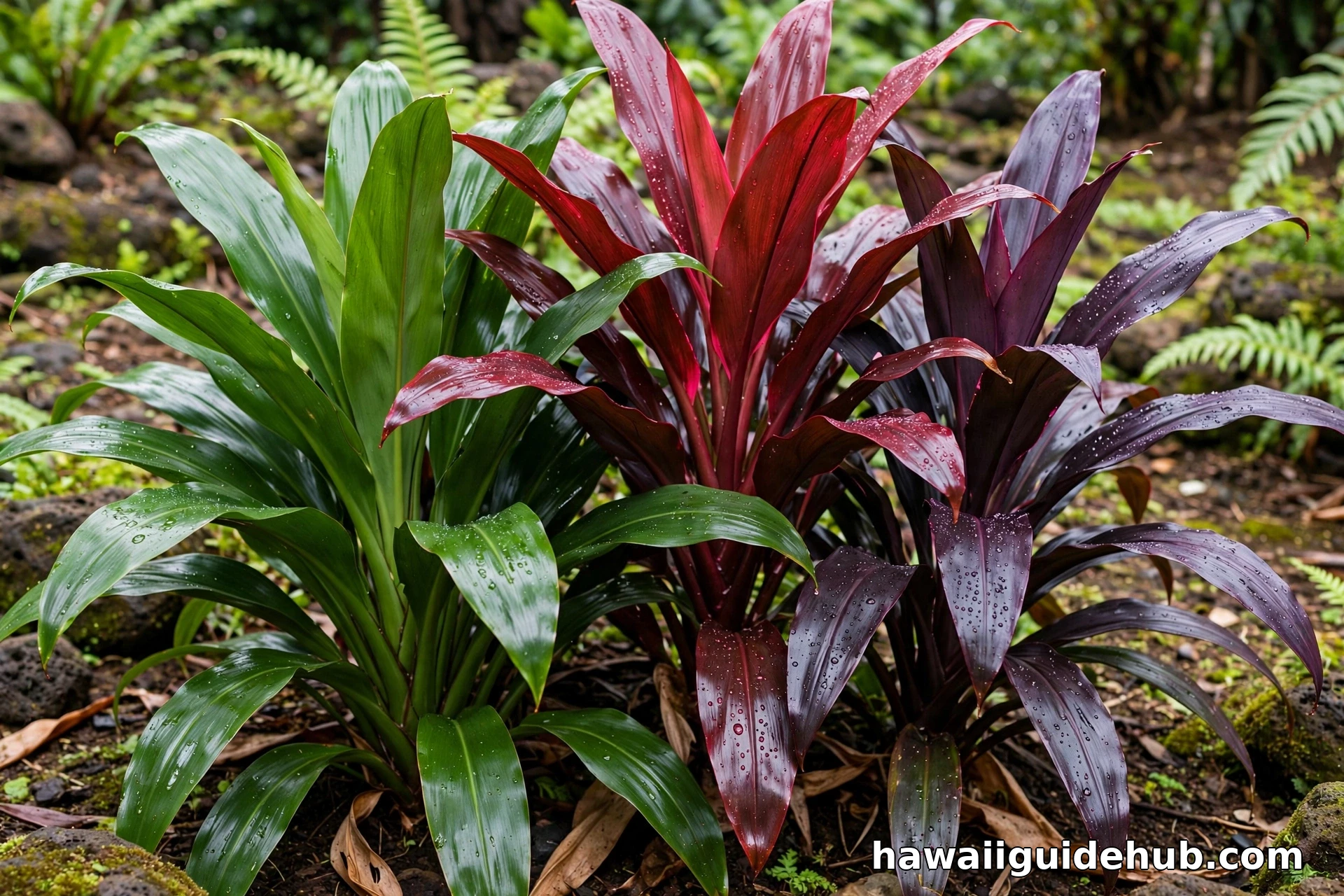
Color carries meaning too. Green is the traditional, sacred form, the one for lei, hula, and blessings. Red kī is often planted for its bold beauty and is sometimes associated with the warrior akua Kū, though green remains the ceremonial standard. Variegated and purple cultivars are modern landscaping selections. When in doubt at a ceremony, reach for green.
Growing Kī
Kī is famously easy to grow in Hawaii, thriving with just a little sun and propagating almost casually. Cut a stalk into six-to-ten-inch pieces and plant them, or root the top in a vase of clean water until roots form. About twenty varieties grow across the islands, from deep green to crimson to variegated purple, and landscapers use them as freely as paint. Plant green kī at your corners if you want the traditional protection; plant red for drama. Either way, ask permission before taking cuttings from anyone’s plant: kī is personal.
Lāʻī: The Leaf in Ceremony
The ti-leaf lei, lei lāʻī, deserves its own chapter. Woven from green leaves into a flat, glossy braid, it is the lei of hula dancers, graduates, and blessing ceremonies, and unlike flower lei, it lasts for weeks. The National Park Service, which teaches lei lāʻī making at Hawaii’s national parks, explains the deeper grammar: the leaves represent Laka and Lono, and the kūpuna whose knowledge the lei carries. To receive a lei lāʻī is to be wrapped, literally, in protection and lineage.
Ceremonial use extends beyond the lei. Kī leaves outline sacred spaces, mark the boundaries of heiau, and serve as the kahuna’s instrument of blessing, sprinkling holy water or simply held aloft while prayers are spoken. New businesses, buildings, fishing boats, and even heavy equipment receive kī blessings, a tradition as alive in Honolulu’s construction sites as in remote valleys. The plant’s spiritual résumé, protection, purification, ancestral connection, made it the obvious choice for every rite of beginning.
Kī Across the Pacific
Hawaii’s kī is one chapter of a Pacific-wide story. In Polynesia, green ti was cultivated for food and religion, planted around homes, marae, and gravesites, and carried as a travel charm. In Pohnpei, Micronesia, ti leaves are buried under new houses to ward off malign sorcery, and shamans commune with the dead through the plant, naming causes of death until the leaves tremble. The Māori of New Zealand ranked the sweetness of ti rhizomes above their native Cordyline species. In Tonga, dancers wear the sisi, an apron of about twenty ti leaves over a tupenu, decorated with yellow or red leaves.
The pattern is consistent across thousands of miles: wherever ti grows, it guards, feeds, clothes, and connects the living with the sacred. Few plants have earned such uniform reverence from so many cultures, which says something about the plant itself. Kī does not merely symbolize protection; in the experience of a dozen Pacific peoples, it provides it.
The Kitchen Wrapper
In the kitchen, kī is the original food-safe wrap. Laulau, pork or fish and taro leaves bundled in ti leaves and steamed, is the signature dish, and the ti wrapper does real work: it holds the bundle together, keeps the steam in, and perfumes the food with a faint green sweetness. Imu cooking uses ti leaves as linings and covers. Before paper plates, there were ti-leaf plates; before tablecloths, ti-leaf table coverings at lūʻau. Modern Hawaiian restaurants still serve on ti leaves for the look and the lineage, and the leaves are compostable in a way no packaging will ever be.
The wrapper tradition teaches a design lesson: the best packaging is grown, not manufactured. A ti leaf is waterproof when fresh, flexible, heat-tolerant, and free for the picking. It kept food clean on voyages, in earth ovens, and at feasts for a thousand years before anyone thought to improve on it.
Kī vs. Its Look-Alikes
Visitors sometimes confuse kī with its ornamental cousins. True kī, Cordyline fruticosa, has broad, flexible leaves on a woody stalk, growing 6 to 10 feet tall in clumps. The narrow-leaved dracaenas of hotel lobbies are relatives, not kī, and lack the cultural résumé. Within true kī, the twenty-odd Hawaiian varieties range from deep green (the sacred, traditional form) through red, pink, and variegated cultivars bred for landscaping. For cultural uses, lei, hula, blessing, green is traditional; for the garden, choose whatever moves you. Just remember which one the kahuna reaches for.
Where to See Kī in Hawaii
Everywhere. Kī grows wild along trails, in valleys, and around homes on every island except Kahoʻolawe. Botanical gardens display the full range of cultivars. Hula performances, from backyard pāʻina to the Merrie Monarch Festival, show the leaves in motion. And the next time you pass a house with ti at its corners, you will know what you are looking at: not landscaping, but guardianship. For more on Hawaii’s living plant traditions, see the guide to Hawaiian cultural traditions, and for respectful visits to the landscapes kī grows in, responsible travel practices and the guide to Hawaii’s natural environments.
Watch: Lei Lāʻī, the Ti Leaf Lei
Frequently Asked Questions
What is the ti plant called in Hawaiian?
Kī. Its scientific name is Cordyline fruticosa, and it was brought to Hawaii by Polynesian voyagers as a canoe plant.
Why do Hawaiians plant ti at the corners of houses?
For spiritual protection. Kī is believed to ward off evil spirits and bring good luck, a tradition that continues today.
What are hula skirts made of?
Traditional hula skirts are made from ti leaves: a dense skirt of at least fifty green leaves with the bottoms shaved flat.
Can you eat ti plant?
The starchy rhizomes can be baked and eaten, and were fermented into ʻōkolehao liquor. The leaves are used to wrap food, not eaten themselves.
What is ʻōkolehao?
ʻŌkolehao is a Hawaiian liquor distilled from fermented ti plant rhizomes. The name humorously translates to “bottom up.”
What is lei lāʻī?
Lei lāʻī is a lei woven from ti leaves into a flat, glossy braid. Worn in hula and ceremonies, it represents the deities Laka and Lono and the kūpuna, and it lasts for weeks unlike flower lei.
How many varieties of ti plant are there in Hawaii?
Around 20 varieties grow across the islands (except Kahoʻolawe), ranging from deep green through red, pink, and variegated purple cultivars.
How do you grow ti plants?
Easily. Root stalk cuttings in water or plant six-to-ten-inch stalk sections directly. Kī thrives in Hawaii with minimal care.
Kī is the plant that does everything: guards the house, dresses the dancer, wraps the laulau, cools the fever, sweetens the root, and blesses the new beginning. Learn to recognize its broad leaves, and you will start seeing Hawaii’s invisible architecture, the spiritual framework, everywhere you look. And the next time you pass a house with green ti at its four corners, give a small nod. The guardians are on duty.