Breadfruit (ʻUlu) in Hawaii: The Mutiny Fruit That Fed the Pacific

Few fruits have caused a mutiny. In 1787, Captain William Bligh sailed the HMS Bounty to Tahiti to collect over 1,000 breadfruit plants for the West Indies, and his crew, dying of thirst while the plants got their water rations, set him adrift. Breadfruit, ʻulu in Hawaiian, was that valuable: a tree that feeds a village for generations. It arrived in Hawaii by canoe around 300 AD, became the islands’ third great starch, grew in legendary groves, and gave its name to the breadfruit belt, the kaluʻulu.
This is the single complete guide to breadfruit (ʻulu) in Hawaii. It covers the Bounty story and the legend of Kū’s sacrifice, ʻulu’s place among Hawaii’s staple crops, a nutrition comparison with the other island starches, the tree’s remarkable non-food uses, how to cook ʻulu, and where to find it. If you have been searching for anything about breadfruit or ʻulu in Hawaii, the answers are all here on this one page.
The Canoe Plant That Caused a Mutiny
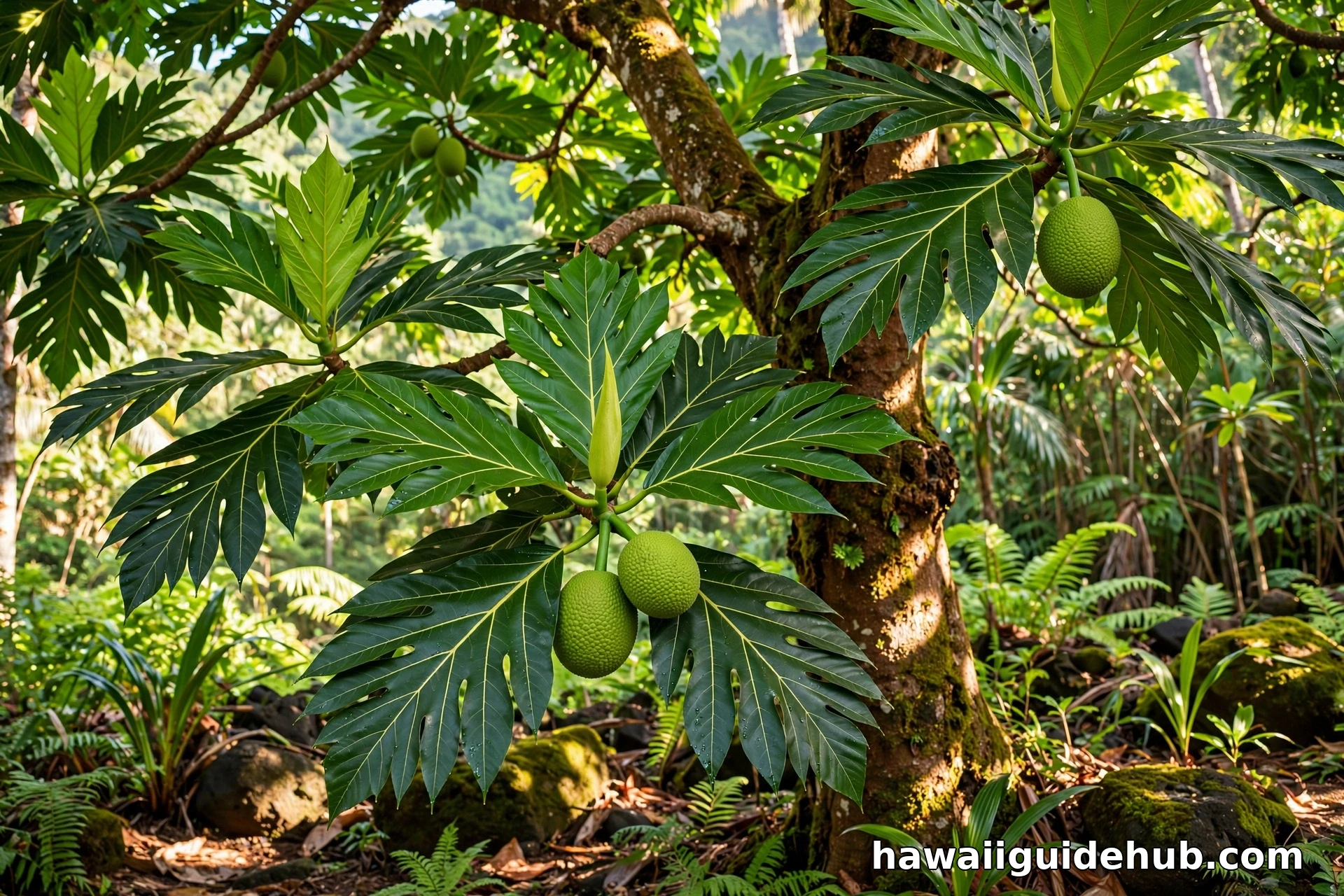
Breadfruit (Artocarpus altilis), a member of the fig family, originated in New Guinea and Southeast Asia and traveled with voyagers across the Pacific, reaching Hawaii around 300 AD as one of the canoe plants. In 1769, Captain James Cook saw it in Tahiti and proposed to King George III that it be transplanted to the Caribbean as cheap, nutritious food for enslaved laborers. William Bligh’s 1787 Bounty expedition was the result: more than 1,000 starter plants loaded at Tahiti, water prioritized for the plants over the crew, and a mutiny a month into the voyage, the plants thrown overboard with the captain.
Bligh survived his famous 3,600-mile open-boat voyage to Timor, returned to Britain, and five years later succeeded on a second expedition aboard HMS Providence. Breadfruit reached the West Indies, where some of the original Jamaican trees, planted over 200 years ago, still bear fruit. The mutiny’s most famous cause was not cruelty or gold but a tree, and the tree was ʻulu.
Kū’s Sacrifice: The Legend of the First ʻUlu
Hawaiian tradition gives ʻulu its own origin story. In a time of famine, the god Kū, living as a man with his family, made the ultimate sacrifice: he gave his own body so his family and community might eat. From his devotion grew the first ʻulu tree, a symbol of life, abundance, and selflessness that continues to nourish Hawaii. The legend is still told today, and it frames the tree not as a resource but as a gift born of love, which is how many Hawaiians still regard it.
Third Among Staples
In Hawaii, ʻulu never became the staple it was in Samoa or Tahiti; that role belonged to kalo. But researchers rank breadfruit third among Hawaii’s complex-carbohydrate crops, after kalo, ʻuala (sweet potato), uhi, and maiʻa, and an essential reserve in times of disturbance. The great groves grew in the kaluʻulu, the breadfruit belt, rain-fed upland forests of productive trees that represented prosperity and long-term planning: planting a breadfruit tree was investing in future generations, since a tree takes about six years to fruit and then produces for more than 50.
The seasonal surplus of ʻulu may even have powered the Makahiki, the extended harvest season when work and warfare paused for recreation and tribute. During Makahiki, breadfruit served ritual purposes, and its abundance underwrote the festivities. A grove of ʻulu, small or large, still marks the site of an ancient settlement, the trees outliving the houses by centuries.
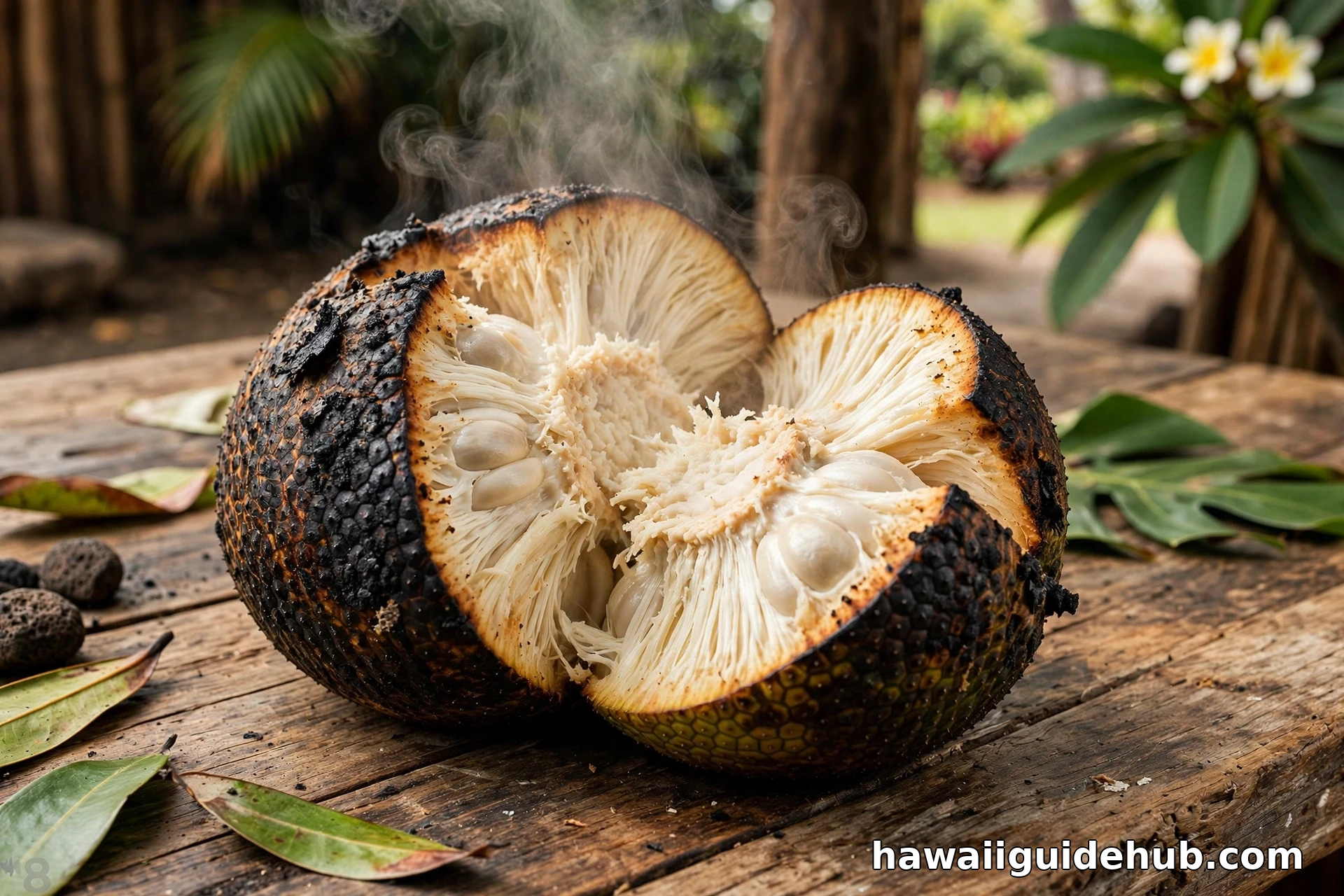
One more detail worth knowing: the name “breadfruit” comes from the cooked flesh’s resemblance to fresh-baked bread in both texture and aroma. Break open a hot roasted ʻulu and the steam carries a faintly bready sweetness that the first European tasters found uncanny, a loaf growing on a tree.
ʻUlu vs. the Other Island Starches
How does ʻulu stack up against Hawaii’s other traditional starches? The comparison below draws on published nutrition reporting and agricultural research.
| Starch | Cultural rank | Nutrition highlights | Best uses |
| ʻUlu (breadfruit) | Third staple; famine reserve | Calcium and carbs comparable to taro; more potassium than bananas; ¼ small fruit meets daily vitamin C (per Honolulu Advertiser) | Roasted, baked, chips, flour; the versatile all-rounder |
| Kalo (taro) | First staple; sacred ancestor | Comparable carbs and calcium to ʻulu (per Advertiser); poi ferments, keeps for weeks | Poi, kūlolo, lūʻau; the ceremonial staple |
| ʻUala (sweet potato) | Major dryland staple | Lower calcium and carbs than ʻulu (per Advertiser comparison) | Baked, steamed; the drought-country staple |
| Maiʻa (banana/plantain) | Everyday fruit-starch | Less potassium than ʻulu (per Advertiser) | Eaten fresh or cooked; the daily fruit |
The Whole-Tree Workshop
The fruit is only the beginning. ʻUlu wood is light, strong, and termite-resistant: Hawaiians shaped it into canoes, house timbers, drums, surfboards, and the papa kuʻi ʻai, the boards on which poi is pounded. The rough skin of the fruit, the malulu, served as sandpaper for polishing bowls, utensils, and kukui nuts for lei. The inner bark of young branches yielded a coarse kapa cloth. The sticky latex caulked canoes and, smeared on branches, snared birds for their feathers, which were then cleaned with kukui oil and the birds released. Virtually every part had medicinal uses too: leaves, bark, fruit, flowers, and latex treated skin conditions, high blood pressure, and cardiovascular complaints, and the flowers repelled mosquitoes.
Cooking ʻUlu: From Imu to Chips
ʻUlu must be cooked, and the traditional method is the most dramatic: whole fruit roasted in the imu, the underground oven, or directly in an open fire until the skin blackens and the flesh turns creamy. Boiled ʻulu, cut in chunks and simmered 20 to 25 minutes with Hawaiian salt, eats like a potato, firm, starchy, satisfying. Modern kitchens have expanded the repertoire enormously: ʻulu chips, hummus, flour, baby food, chocolate mousse, and baked goods now appear at farmers markets, and wholesale processors sell it par-steamed and frozen.
The science supports the revival. The Breadfruit Institute at the National Tropical Botanical Garden on Kauai, directed by Diane Ragone, maintains the world’s largest breadfruit collection, some 300 accessions of 150 varieties, and runs a Global Hunger Initiative promoting ʻulu for food security, agroforestry, and reforestation across the tropics. What Bligh wanted for the Caribbean, the Institute now pursues worldwide: a tree that feeds people with minimal inputs for half a century.
The Kaluʻulu: Walking the Breadfruit Belt
The old Hawaiians planted ʻulu in a distinct ecological zone, the kaluʻulu, the breadfruit belt of the lower uplands, where rain-fed groves of massive trees created a managed forest. These were not orchards in the modern sense but agroforests: ʻulu canopy overhead, understory crops beneath, the whole system producing food, timber, fiber, and medicine from the same acres. Archaeologists read the kaluʻulu as a signature of prosperity, a landscape that only a well-organized society could establish and maintain, since the payoff begins six years after planting and continues for generations.
Fragments of the kaluʻulu survive. On the Big Island’s Kona slopes and in valleys on several islands, ancient ʻulu trees still stand where groves once stretched, their trunks too big to hug, their canopies shading the same ground their planters walked. Horticulturists at the Breadfruit Institute have mapped traditional agroforestry systems as models for modern food forests, and community projects like the 80-acre Koholālele restoration in Hāmākua are rebuilding the kaluʻulu itself, transforming former plantation land into Hawaii’s largest regenerative ʻulu agroforestry system.
ʻUlu in the Modern Food Movement
Breadfruit is having a renaissance, and Hawaii is its laboratory. Chefs across the islands put ʻulu on menus as chips, gnocchi, hummus, and desserts. Food hubs aggregate it from small farms. The Kōkua Hawaii Foundation teaches schoolchildren that ʻulu can substitute for potatoes, pasta, or rice in any meal. Processors turn the seasonal glut into flour, frozen chunks, and value-added products that smooth out the November-to-March and July-to-August harvest peaks.
The argument for ʻulu is food security. Hawaii imports the vast majority of its food, and a tree that produces hundreds of pounds of nutritious starch per year, for 50 years, with minimal inputs, is a strategic asset. The Breadfruit Institute’s Global Hunger Initiative has distributed trees across the tropics on exactly this logic. What the Polynesians knew by instinct, that a canoe plant could anchor a food system, the modern data confirms: ʻulu is one of the highest-yielding staple crops on Earth per unit of labor.
Growing Your Own ʻUlu
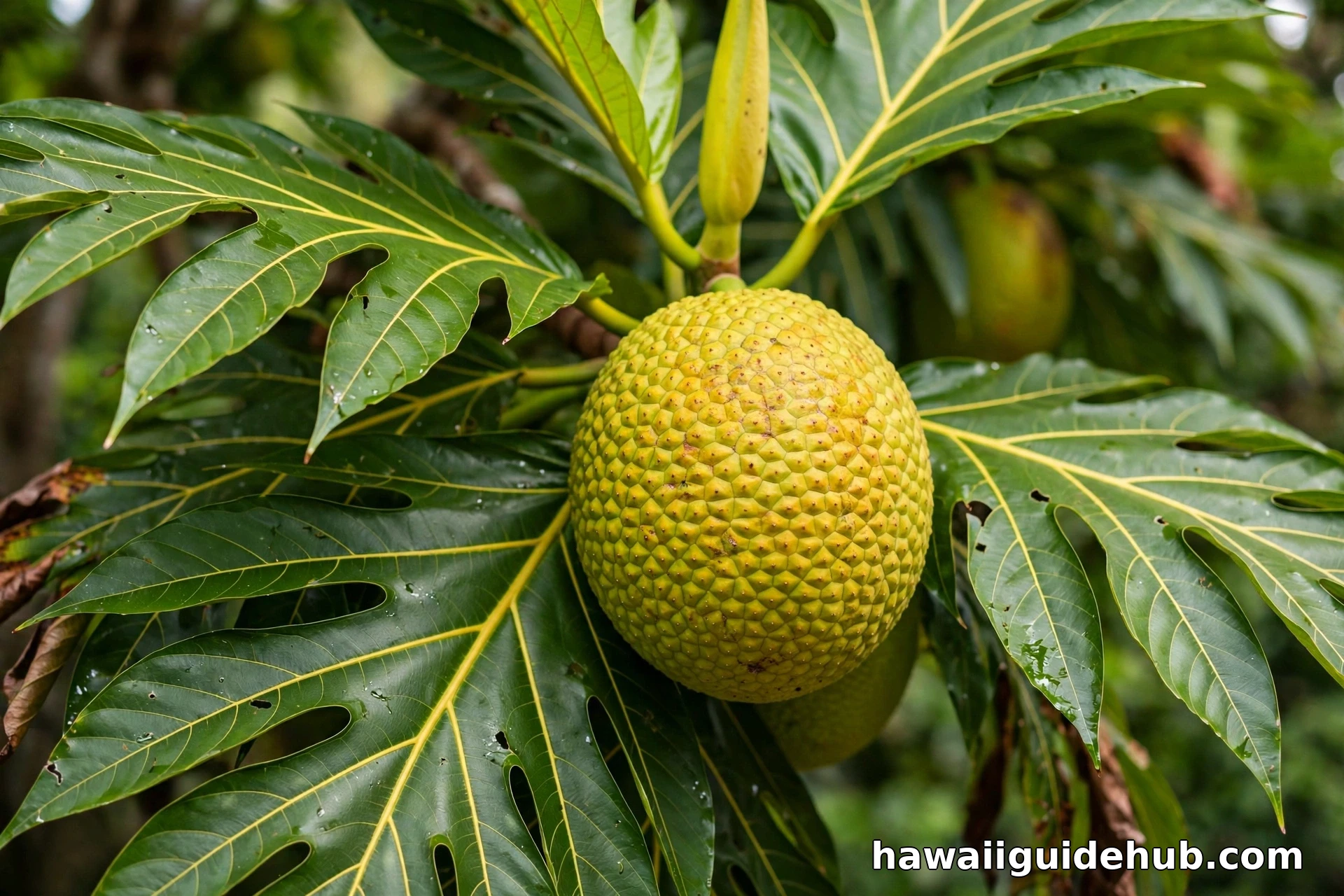
ʻUlu wants what Hawaii gives freely: sun, warmth, rain, and room. Trees reach 40 to 80 feet with a broad canopy, so plant with the mature size in mind, well away from structures and power lines. Propagation is by root shoots or grafted plants rather than seed, since most Pacific varieties are seedless, and grafted trees fruit sooner. Expect the first harvest around year six, then abundance: a mature tree can produce 200 or more fruits a year, each weighing several pounds.
Harvest timing matters. For savory cooking, pick fruit mature but firm, when the skin’s segments begin to smooth and a little latex beads at the stem. For desserts, let it ripen until soft and fragrant. Wear gloves or oil your hands: the latex is sticky and stubborn. And plant for the long term, because an ʻulu tree is a gift to your grandchildren, which is exactly how the old Hawaiians thought of it.
Where to Find ʻUlu in Hawaii
Fresh ʻulu appears in season at farmers markets and some grocery stores, typically during the November-to-March and July-to-August harvests. The National Tropical Botanical Garden’s Allerton and McBryde Gardens on Kauai showcase the great collection. The La ʻUlu Breadfruit Day festival on Maui celebrates the crop each year. And keep an eye on hiking trails: feral ʻulu trees still fruit in valleys like Makiki, where hungry hikers have long helped themselves. For more on Hawaii’s food heritage, see the guide to Hawaiian cultural traditions, and for the landscapes these canoe plants grow in, responsible travel practices and the guide to Hawaii’s natural environments.
Watch: What Is ʻUlu (Breadfruit)?
Frequently Asked Questions
What is ʻulu?
ʻUlu is the Hawaiian name for breadfruit (Artocarpus altilis), a starchy tree fruit brought to Hawaii by Polynesian voyagers around 300 AD as a canoe plant.
Did breadfruit really cause the Mutiny on the Bounty?
In large part, yes. Bligh prioritized water for 1,000+ breadfruit plants over his crew’s rations, and the resentment helped trigger the 1789 mutiny. He succeeded on a second voyage in 1792.
How do you cook breadfruit?
Roast whole in an imu or open fire, boil chunks 20 to 25 minutes, bake, or fry as chips. The cooked flesh eats like a potato.
Is breadfruit nutritious?
Very. It matches taro for calcium and carbohydrates, beats bananas for potassium, and a quarter of a small fruit supplies a day’s vitamin C, with almost no fat.
What is the legend of the breadfruit tree in Hawaii?
In Hawaiian tradition, the god Kū sacrificed his own body during a famine to feed his family, and from his devotion grew the first ʻulu tree, a lasting symbol of abundance and selflessness.
Can you eat breadfruit raw?
ʻUlu is traditionally always cooked: roasted in an imu, boiled, baked, or fried. Cooking transforms the firm, starchy flesh into something creamy and potato-like.
How long does a breadfruit tree live and produce?
A tree takes about six years to bear its first fruit, then produces for more than 50 years, yielding 200 or more fruits annually at maturity.
Where can I see breadfruit trees in Hawaii?
NTBG gardens on Kauai (the world’s largest collection), the La ʻUlu festival on Maui, farmers markets in season, and feral trees on valley hiking trails.
ʻUlu is the tree that crossed an ocean by canoe, caused a mutiny, grew from a god’s sacrifice, and still feeds villages from a single planting. Taste it roasted from an imu, and you will understand why Bligh’s men, for all their thirst, were guarding something worth the trouble.