Pig Island Hawaii: The Truth About Swimming Pigs and Hawaii’s Real Pigs

Here is the honest answer first: there is no Pig Island in Hawaii. The famous swimming pigs that fill social media feeds live on Big Major Cay, nicknamed Pig Island, in the Exuma chain of the Bahamas, thousands of miles from Hawaii. If you came here hoping to swim with pigs in Hawaii, this page will save you a wasted trip, and then tell you the far more interesting story of Hawaii’s real pigs: the puaʻa, the feral pigs that shaped Hawaiian culture and still roam the islands’ forests today.
This page covers where the swimming pigs actually live, why Hawaii does not have them, the history of pigs in Hawaii from Polynesian canoes to today, the feral pig problem and hunting rules, pigs in Hawaiian culture and food, and FAQs. Everything about pigs and Hawaii is here on this one page.
The Bahamas Pigs: How Pig Island Happened
Since you came looking for Pig Island, here is the real story of the one that exists. Big Major Cay’s pigs are domestic animals, not wildlife, and nobody agrees on how they got there: theories range from sailors leaving them as future food, to a shipwreck, to a deliberate tourism plant. What is certain is that they learned to swim out to approaching boats expecting food, tourists started arriving with carrots, and a global phenomenon was born. Today the Exuma pigs are a managed attraction with feeding guidelines, and multiple tour operators run day trips from Nassau and Staniel Cay. If swimming with pigs is the dream, the Bahamas is the destination, and it is a wonderful one.
Hawaii’s Offshore Islets: What People Might Be Thinking Of
Hawaii does have offshore islets with animal nicknames, which may feed the confusion. Off Oahu’s windward coast sit Mokuʻauia, nicknamed Goat Island, a seabird sanctuary you can wade to at low tide, and Mānana, nicknamed Rabbit Island, a protected seabird sanctuary closed to landing. Off Maui, Molokini is the famous crescent crater for snorkeling. None has pigs. If someone told you about an animal island in Hawaii, it was almost certainly Goat Island or Rabbit Island, and the animals are birds, not pigs.
Hunting Pigs in Hawaii: What Visitors Should Know
Pig hunting in Hawaii is a serious local tradition with real rules. Under Hawaii DLNR’s Division of Forestry and Wildlife, feral pig hunting requires a hunting license, and each island’s public hunting areas set their own seasons, bag limits, and weapon restrictions. Some areas require check-in at hunter stations. Private land hunting needs the landowner’s permission. Visitors can hunt, but they need the same licenses as residents and should go with an experienced local guide: the terrain is rough, the pigs are smart, and the regulations are detailed. Guided pig hunts are offered on the Big Island and Kauai for those who want the experience legally and safely.
Kamapuaʻa: The Pig God
No telling of Hawaii’s pigs is complete without Kamapuaʻa, the pig god, one of the most vivid figures in Hawaiian mythology. Half man and half pig, Kamapuaʻa was a trickster and lover associated with rain, fertility, and the lush windward valleys. His great rivalry with Pele, the volcano goddess, is one of the epic cycles of Hawaiian legend: fire against water, barren lava against green growth. Place names across the islands still carry his story. When Hawaiians speak of pigs, this is the cultural depth behind the word puaʻa: not livestock, but a god who walked the valleys.
Where Are the Swimming Pigs? Not Hawaii
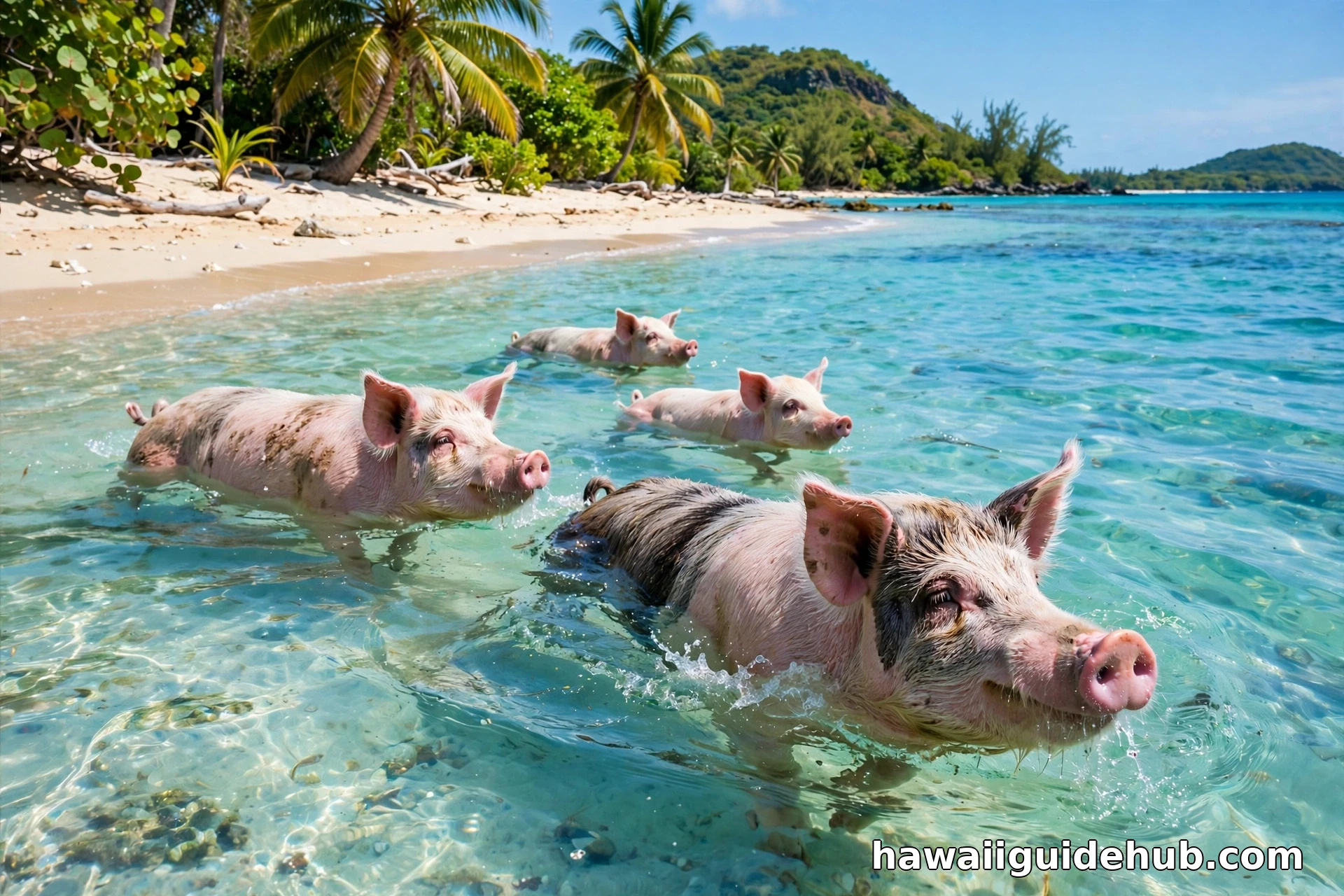
The swimming pigs are one of travel’s great viral phenomena: a colony of friendly pigs that paddle out to meet tour boats in impossibly turquoise water. They live on Big Major Cay, an uninhabited island in the Exuma Cays of the Bahamas, which is why the island is nicknamed Pig Island. Visitors arrive by boat, wade in with the pigs, and feed them carrots while cameras roll. It is a Bahamas experience, full stop.
How did the confusion start? The Bahamas pigs look like they could be anywhere tropical, travel roundups sometimes lump “island pigs” together loosely, and Hawaii travelers see the photos and assume their islands have an equivalent. They do not. No Hawaiian island, islet, or beach has a swimming pig colony, and no tour operator in Hawaii offers pig swims. Anyone selling you one is selling fiction.
The World’s Famous Pigs, Compared
| Pigs | Where they live | Origin | Can you swim with them |
| Bahamas swimming pigs | Big Major Cay, Exuma, Bahamas | Domestic pigs placed on the island; origin stories vary | Yes, on boat tours from Nassau and Staniel Cay |
| Hawaii’s feral puaʻa | Forests and valleys on all main islands | Brought by Polynesian voyagers; later European breeds mixed in | No, and do not try: wild, potentially dangerous |
| Hawaii’s farm pigs | Ranches and farms, especially Big Island | Domestic breeds raised for food | No, but some farms welcome visitors |
Hawaii’s Real Pigs: The Puaʻa
Hawaii’s pig story is older and deeper than the Bahamas’. Pigs, puaʻa in Hawaiian, arrived with the first Polynesian voyagers around a thousand years ago as one of the canoe plants and animals, alongside taro, dogs, and chickens. They were sacred and practical at once: offerings to the gods, food for feasts, and a measure of wealth. The pig god Kamapuaʻa, half man and half pig, is one of the great figures of Hawaiian mythology, a trickster associated with rain, fertility, and the island’s wet windward sides.
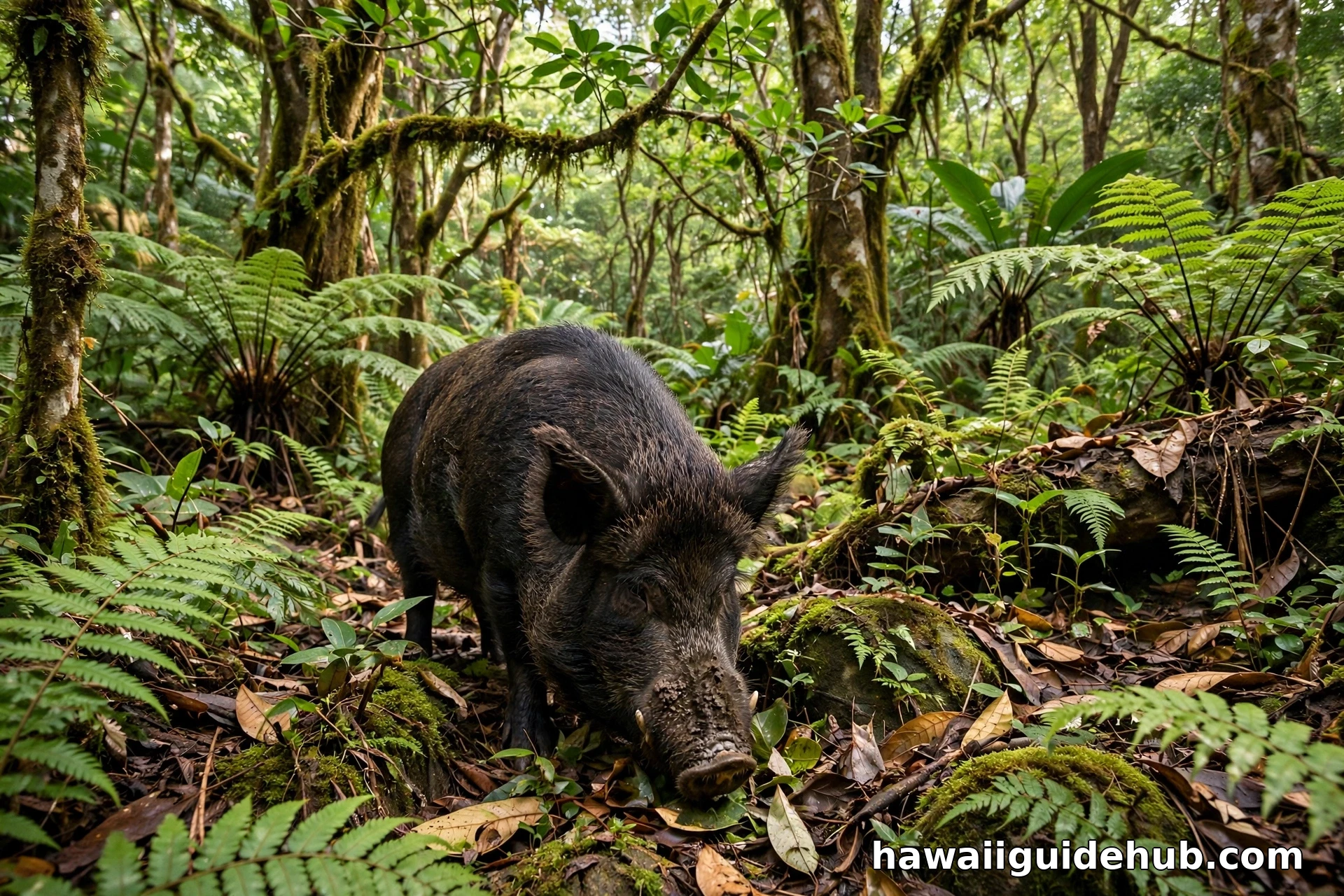
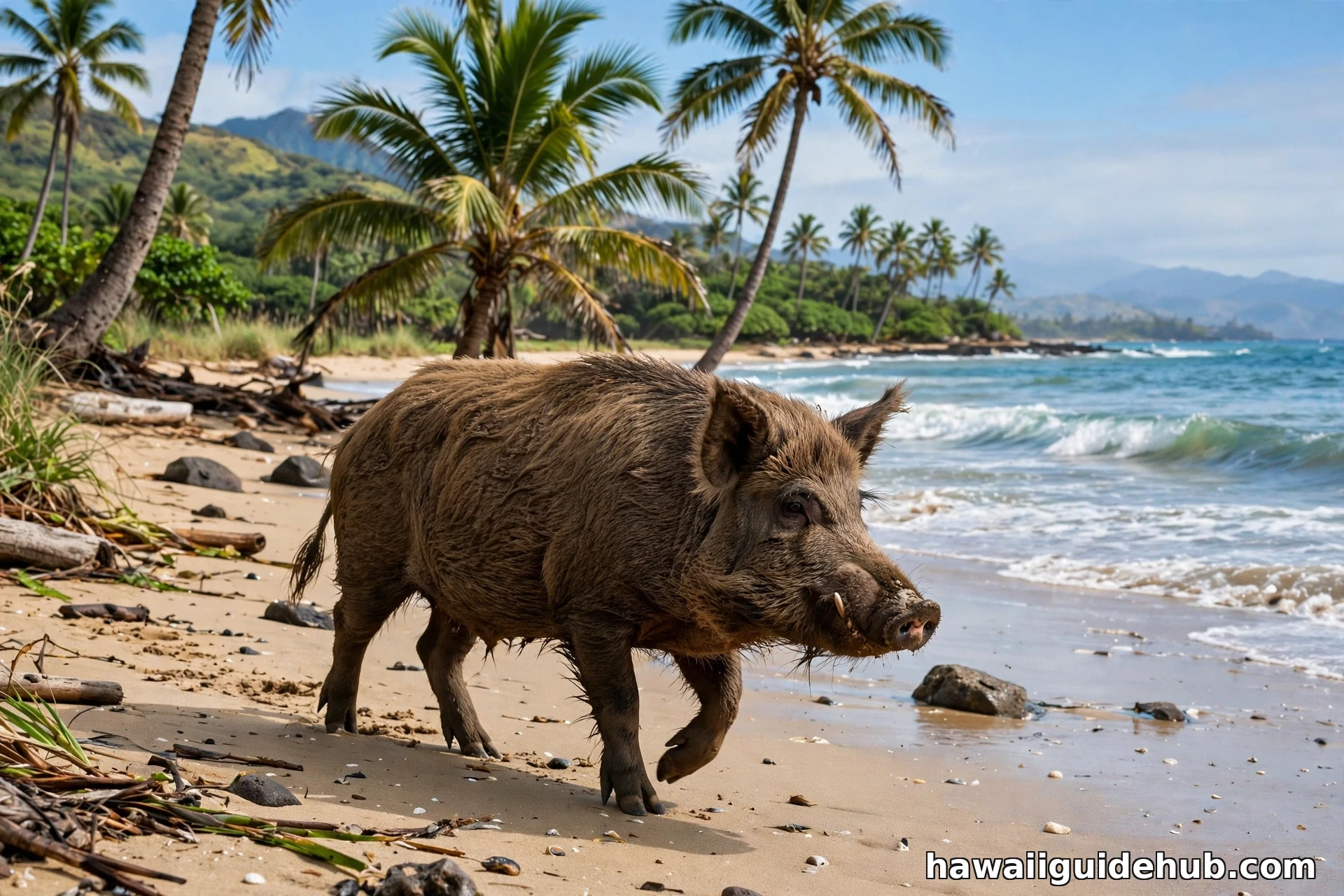
Later, Europeans brought their own larger breeds, which escaped, interbred with the Polynesian pigs, and went feral. Today’s Hawaiian feral pig is a tough, intelligent, dark bristled animal that thrives from sea level to the high forests. They are everywhere on the Big Island, Kauai, Maui, Molokai, and Oahu’s wilder valleys, though you will rarely see one: they are nocturnal, secretive, and gone before you hear them.
Feral Pigs and Hawaii’s Birds: The Conservation Battle
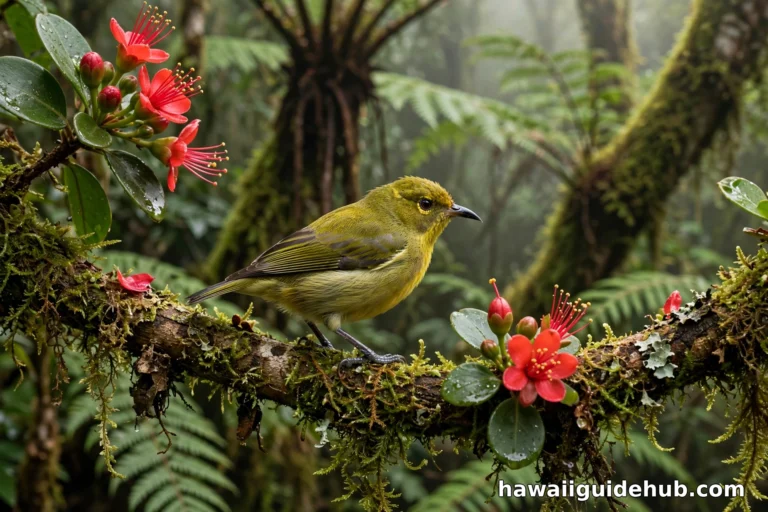
The damage pigs do goes beyond torn up soil. By rooting through the forest floor, pigs create the muddy wallows where mosquitoes breed, and mosquitoes carry avian malaria, the disease that has driven Hawaii’s native honeycreepers to the edge of extinction. Pigs also eat the eggs and chicks of ground nesting seabirds and spread the seeds of invasive plants like strawberry guava. This is why conservationists treat pig removal as emergency medicine: every fenced exclosure on Kauai, Maui, and the Big Island is a hospital ward for the forest. When you see a pig fence on a Hawaiian trail, you are looking at one of the front lines of conservation in America.
Pig Safety on the Trail
Encounters are rare but worth preparing for. Hike with noise: talking alerts pigs long before you arrive. If you see piglets, leave immediately and do not go between them and their mother. Never feed a pig, not even a cute one near a farm: fed pigs lose fear and become aggressive. If a pig charges, sidestep behind the nearest tree and stay there; pigs charge straight and do not maneuver well around obstacles. Report aggressive animals to Hawaii DLNR. These are simple rules, and they work.
The Feral Pig Problem
Feral pigs are one of Hawaii’s most destructive invasive species. They root up native forest floor, spread invasive weeds, damage crops, and threaten endangered birds by disturbing habitat and spreading disease. Conservation groups like The Nature Conservancy spend enormous effort fencing pigs out of native forest: helicopter missions on Kauai airlift dogs and crews into remote exclosures to remove them. A single pig can tear up an acre of fragile forest in a night.
Hunting is legal and encouraged. Feral pig hunting is permitted with a hunting license on Oahu, Kauai, Molokai, Maui, and Hawaii Island, under Hawaii DLNR rules that set seasons, bag limits, and permitted areas. Many local families hunt pigs for food, continuing a tradition that turns a conservation problem into sustenance. If you hike in Hawaii, know the safety basics: never approach a pig, give sows with piglets wide space, and if a pig charges, get behind a tree. They are fast and their tusks are real.
Pigs in Hawaiian Food Culture
No food says Hawaii like kalua pig: whole pig slow roasted in an imu, an underground oven lined with hot rocks and banana leaves, until the meat falls apart smoky and tender. It is the centerpiece of every luau and the soul of plate lunch culture. The tradition descends directly from the Polynesian earth oven, and the best kalua pig you will ever eat is still cooked the old way for family gatherings, not restaurants.
Modern Hawaii also raises pigs on small humane farms. The Korean Natural Farming movement has a foothold on the Big Island, where pigs are raised on deep mulch bedding instead of concrete, eliminating the smell and waste problems of conventional piggeries. Some farms welcome visitors and sell pork directly: it is the closest thing Hawaii has to a pig encounter, and it comes with lunch.
At a luau, watch for the imu unveiling if the venue offers it: the moment the banana leaves are pulled back and the steam rises off the pig is the most theatrical minute of the evening, and it connects your dinner to a thousand years of Polynesian cooking. Ask your server where the pig was raised; island raised pork is a point of pride, and the answer is usually a good story.
Can You See Pigs in Hawaii?
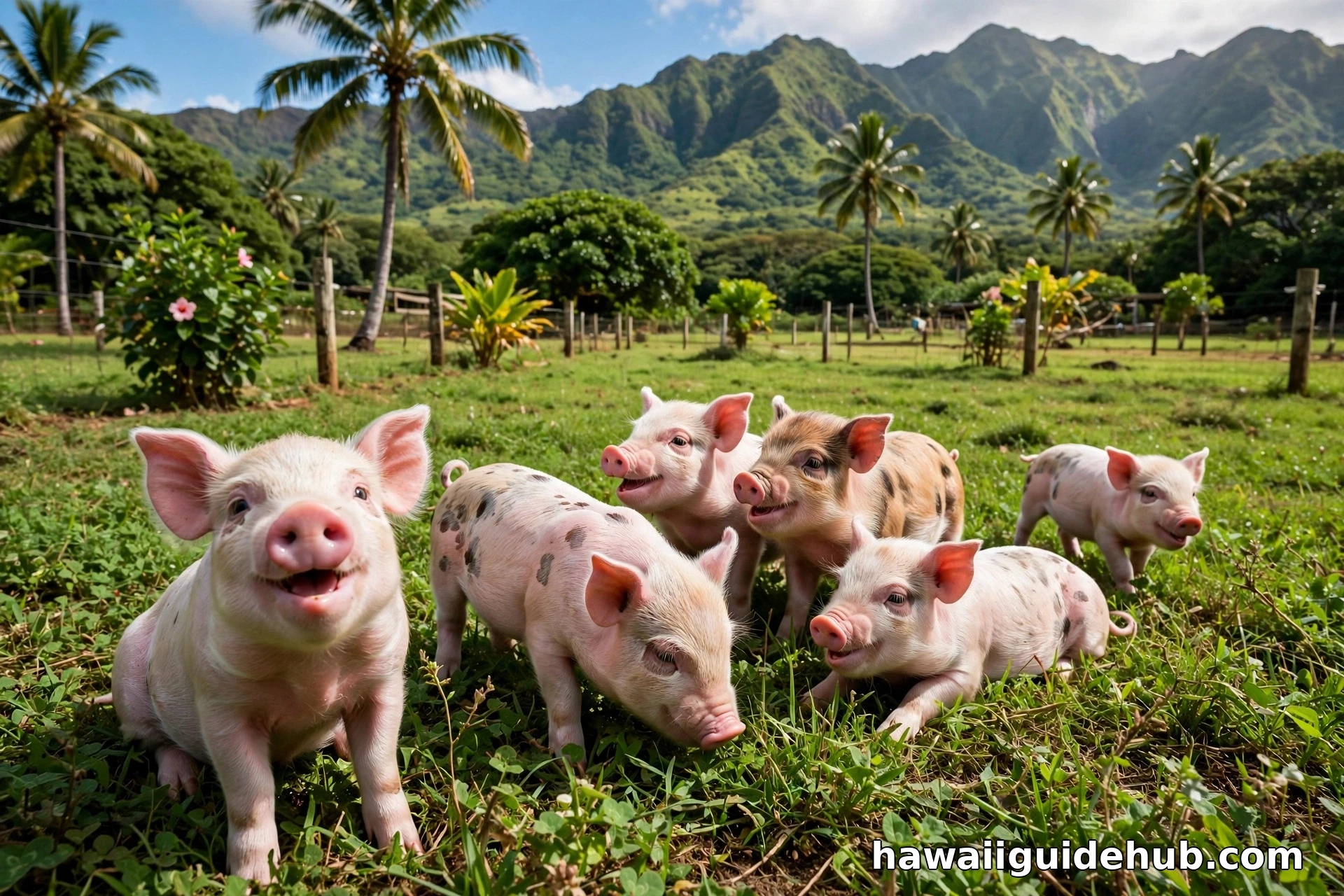
You can see pigs in Hawaii, just not swimming ones. Hikers in the Big Island’s forests and Kauai’s interior sometimes spot feral pigs at dawn or dusk, or at least their handiwork: rooted up trailside soil. Farm tours on the Big Island and Oahu let you meet domestic pigs up close. And at any luau, the kalua pig is the guest of honor. What you cannot do is book a pig swim, because Hawaii’s pigs are either wild forest animals or farm animals, and neither belongs in the ocean with tourists.
For more Big Island wildlife and landscapes, see the best things to do on the Big Island of Hawaii, the best five things to do in Hawaii Volcanoes National Park, and the best things to do in Kona.
Video: Humane Pig Farming in Hawaii
A tour of a humane pig farm on Hawaii Island: how Korean Natural Farming raises pigs without smell or waste.
Frequently Asked Questions
Is there a Pig Island in Hawaii?
No. The famous Pig Island is Big Major Cay in the Bahamas’ Exuma chain. Hawaii has no island, islet, or beach with swimming pigs.
Can you swim with pigs in Hawaii?
No. There are no swimming pig experiences in Hawaii. The swimming pigs live in the Bahamas.
Are there wild pigs in Hawaii?
Yes. Feral pigs (puaʻa) live on all the main islands. They are an invasive species, secretive and nocturnal, and hunting them is legal with a license.
What is puaʻa?
The Hawaiian word for pig. Pigs arrived with Polynesian voyagers and were sacred animals, offerings, and feast food.
What is kalua pig?
Whole pig slow roasted in an imu (underground oven) with hot rocks and banana leaves: the centerpiece of the Hawaiian luau.
Are feral pigs dangerous?
They can be. Sows with piglets and cornered boars may charge. Give them space, never feed them, and get behind a tree if one charges.
Where can I actually swim with pigs?
In the Bahamas: boat tours to Big Major Cay run from Nassau and Staniel Cay in the Exuma chain. That is the real Pig Island.
So no, Hawaii has no Pig Island, and that is fine. The Bahamas can keep its swimming pigs. Hawaii’s pig story, a thousand years of voyagers, gods, earth ovens, and forest conservation battles, is richer than any photo opportunity. Look for the rooted soil on your next forest hike: the puaʻa were there before you, and they will be there long after.