Hawaii Native Forest Ecosystems

Walk a single mountainside in Hawaiʻi and you can pass through four different worlds of forest in a few miles: sun-baked dry woodland, stately koa forest, dripping ʻōhiʻa rainforest, and windswept subalpine scrub. About 90 percent of Hawaiʻi’s native plant species grow nowhere else on Earth, and most of them live in these forests. Together they shelter the honeycreepers, the tree snails, and the Hawaiian hoary bat, and they capture the rain that fills the islands’ streams and aquifers.
This is the complete guide to Hawaiʻi’s native forest ecosystems. It explains the four main forest types, where each grows and why, the wildlife that depends on them, the threats they face, and where visitors can experience them responsibly. Every forest question is answered on this one page.
Hawaiʻi’s Native Forests at a Glance
| Forest type | The short ecology |
|---|---|
| Dry forest | Leeward lowlands, about 20 inches of rain a year; less than 10 percent remains |
| Mesic forest | 3,280 to 6,560 feet elevation, 50 to 75 inches of rain; koa and ʻōhiʻa dominant |
| Wet forest | Windward slopes, over 75 inches of rain a year, no real dry season; ʻōhiʻa dominant |
| Subalpine forest and scrub | Above about 6,500 feet; māmane and pūkiawe, cold nights |
| Found only in Hawaiʻi | About 90 percent of native plant species |
The Four Native Forest Types
Dry forest
On the leeward sides of the islands, where volcanic peaks block the trade winds, dry forests survive on roughly 20 inches of rain a year. These are among the most endangered forests on Earth: the U.S. Geological Survey reports that less than 10 percent of Hawaiʻi’s original dry forest habitat remains. What survives is precious and strange, with trees like wiliwili, which drops its leaves in drought and photosynthesizes through its green bark, lama with its ebony-like wood, and ʻiliahi, the Hawaiian sandalwood that was nearly logged to extinction in the 1800s.
Dry forests were the first to fall to people, cleared for agriculture and then overrun by grazing animals and fire-adapted African grasses. Native Hawaiian plants never evolved with frequent fire or hoofed mammals, so a single wildfire can permanently convert dry forest to grassland. Restoration sites at Kaʻūpūlehu and Auwahi prove these forests can come back with fencing, weed control, and outplanting, but the work is slow and expensive. The palila, a honeycreeper found only in māmane-naio dry woodland on Mauna Kea, depends on what remains.
Mesic forest
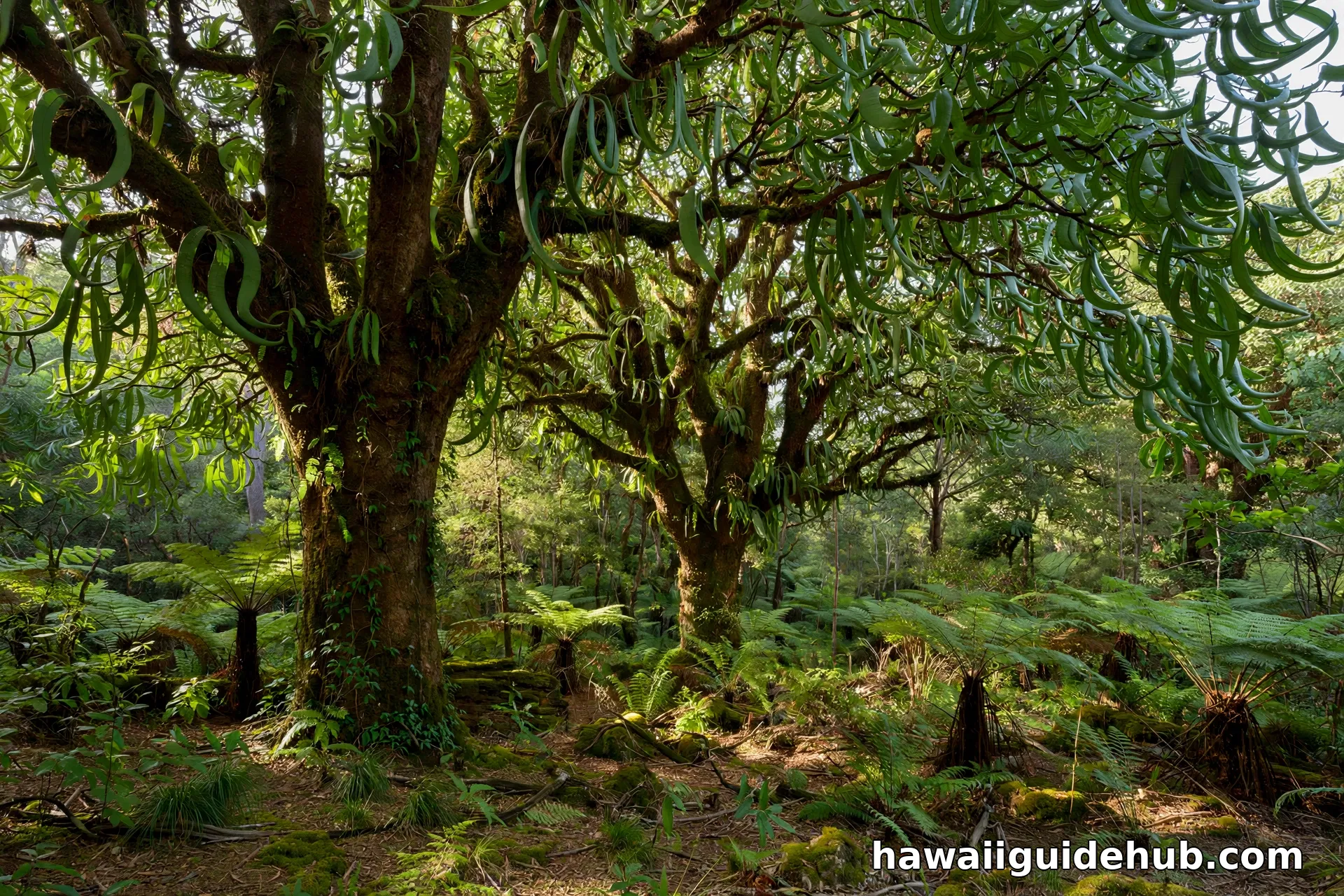
Mesic means middle, and mesic forests are the middle ground between dry and wet. They grow at mid-elevations, roughly 3,280 to 6,560 feet, on both windward and leeward slopes, receiving 50 to 75 inches of rain a year with a seasonal dry spell from about May to October. These forests hold some of the greatest tree diversity in the islands: koa, the great native hardwood once reserved for chiefly canoes, ʻōhiʻa lehua, and lama form the canopy, with an understory of native shrubs, ferns, and sedges.
Mesic forests were historically the most diverse and among the most extensive, and they have suffered some of the steepest losses. On Kauaʻi, where mesic forest once covered nearly half the island, only fragments remain, and the Department of Land and Natural Resources reports that over 78 percent of Kauaʻi’s native forest overall has been lost. Feral pigs and goats devour the understory, and invasive weeds like strawberry guava smother regeneration. The fragments that survive, often on steep ridges and in fenced reserves, hold endangered tree snails, forest birds, and the ʻōpeʻapeʻa, the Hawaiian hoary bat.
Wet forest
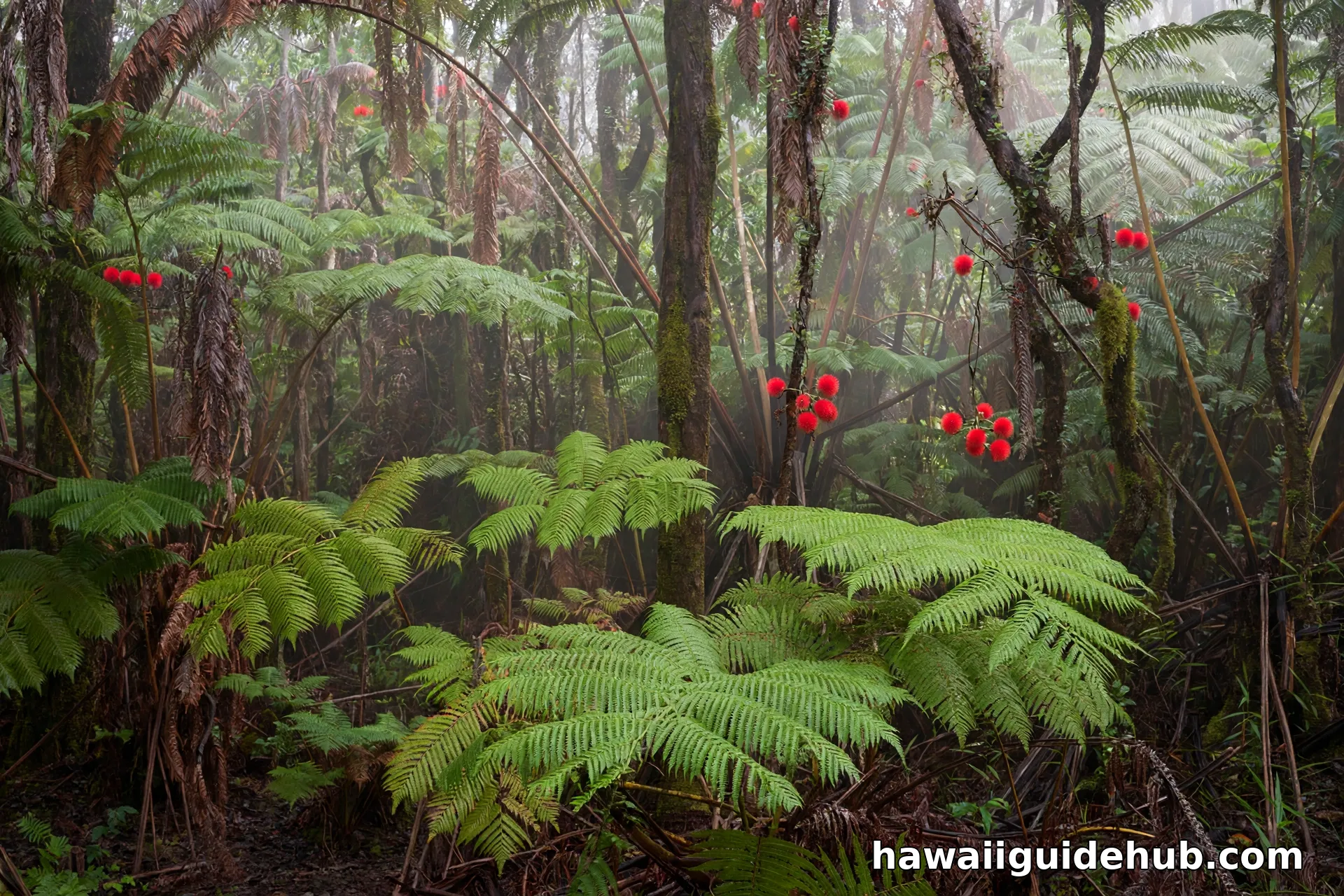
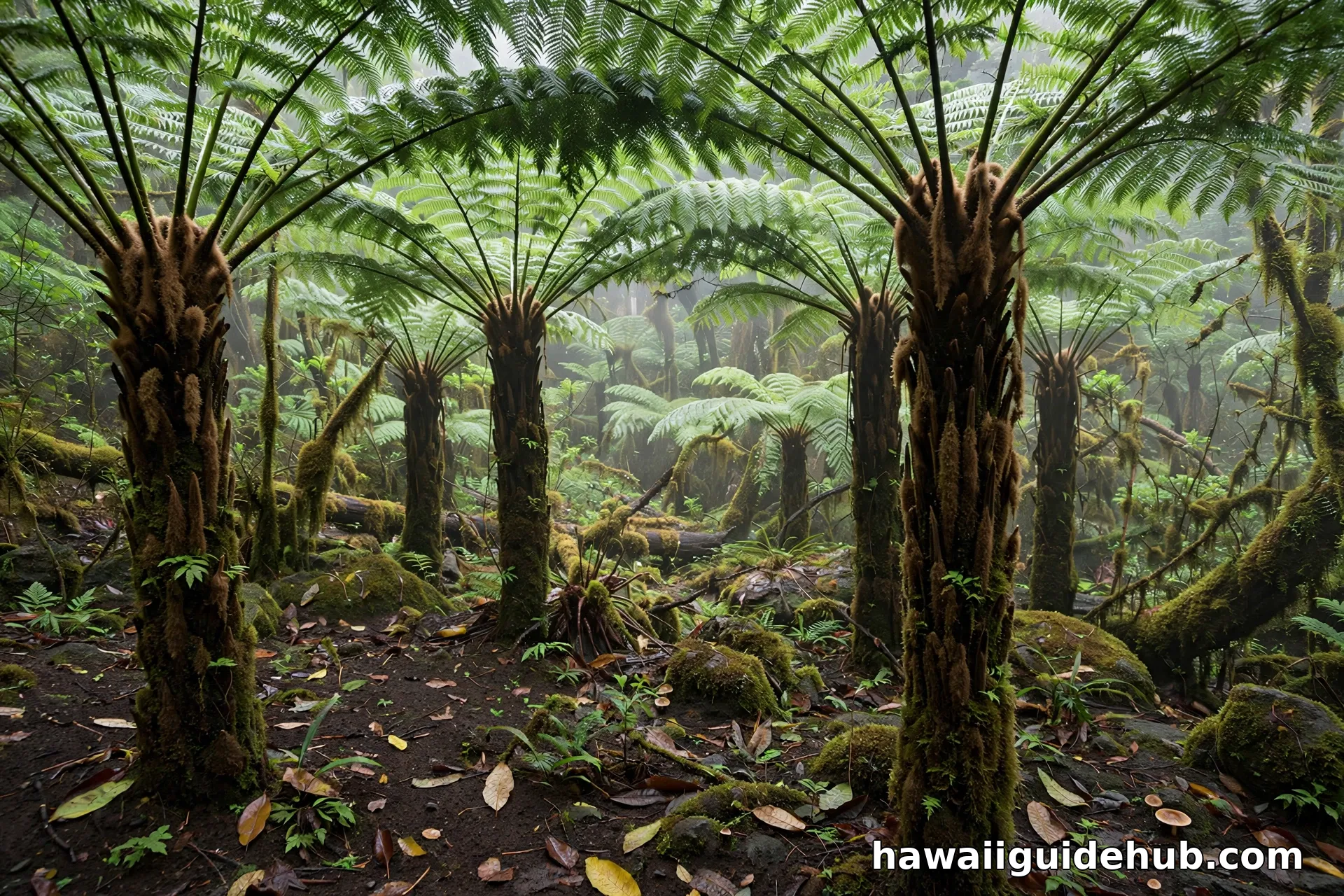
Where the trade winds pile clouds against the mountains, wet forests receive more than 75 inches of rain a year with no significant dry season. Lowland wet forest climbs to about 2,500 feet, and montane wet forest continues to 6,000 feet, dominated almost everywhere by ʻōhiʻa. Beneath the canopy, giant hapuʻu tree ferns spread their fronds, mosses drape every branch, and bogs open on the high plateaus. This is the realm of the honeycreepers: the ʻiʻiwi, ʻapapane, and ʻamakihi still flash through these canopies at dawn.
Wet forests are the best preserved of Hawaiʻi’s forest types, largely because their steep, muddy slopes resisted clearing. But they are not safe. Feral pigs churn the understory and spread weed seeds. Invasive kahili ginger and Australian tree fern crowd out natives. And Rapid ʻŌhiʻa Death, a fungal disease with no cure, has killed more than a million ʻōhiʻa trees, striking at the very foundation of the wet forest. Protecting these forests means keeping pigs out with fences and keeping the fungus out with clean boots and tools.
Subalpine forest and scrub
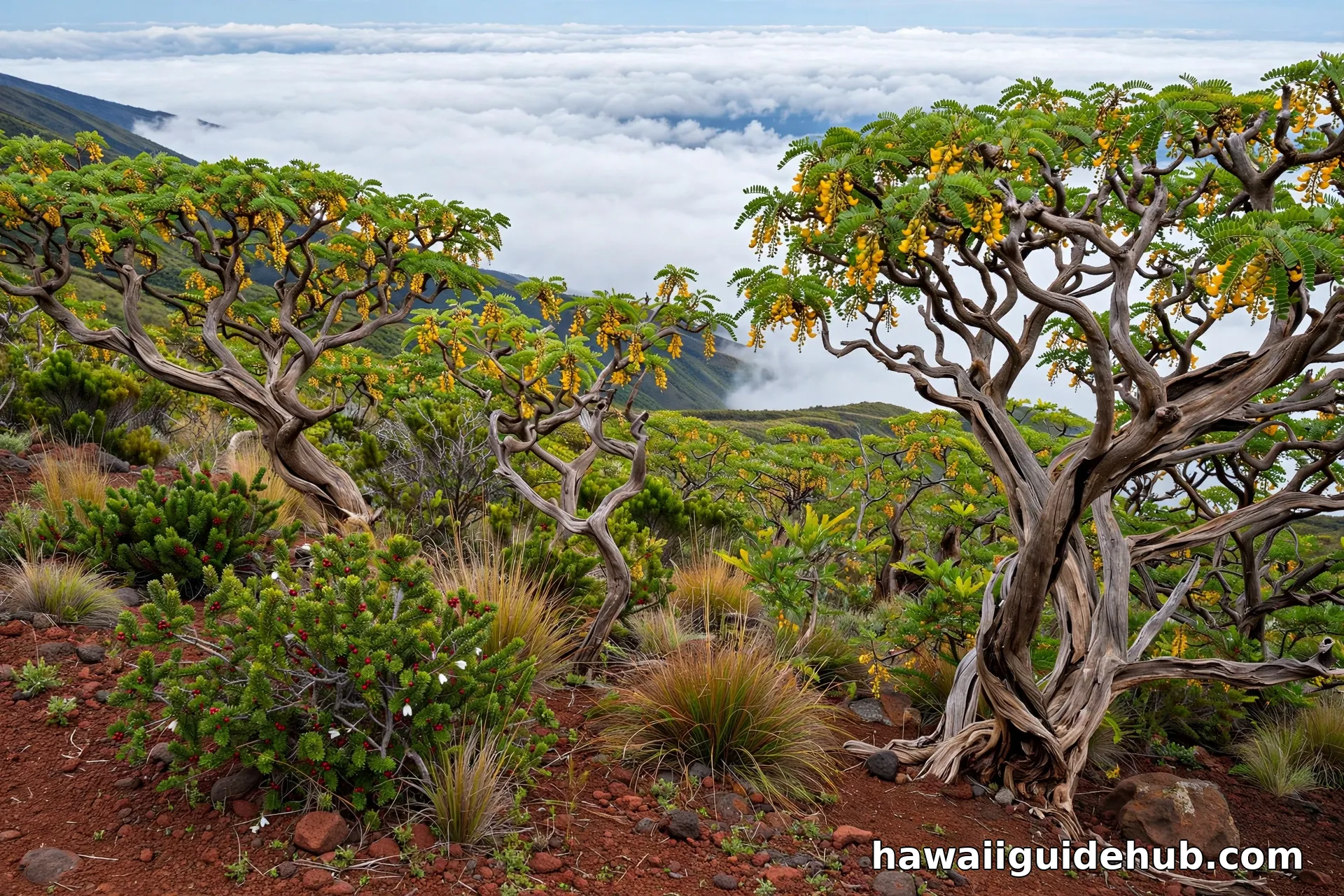
Above about 6,500 feet, past the trade-wind inversion that caps the clouds, the forest thins into subalpine woodland and scrub. Here grow māmane, with its golden flowers that feed the palila, and pūkiawe, ʻōhelo, and native grasses. Nights are cold, sometimes near freezing in winter, and the trees are stunted and widely spaced. On the highest volcanoes, the subalpine gives way to true alpine desert near the summits of Mauna Kea and Mauna Loa.
The subalpine zone is small and fragile. Introduced sheep, goats, and mouflon strip bark and seedlings, and a single population of grazers can denude a mountainside in years. Fenced restoration areas on Mauna Kea show that māmane forest can recover once the animals are removed, and the palila’s fate is tied directly to that recovery. Visitors reach this zone on the slopes of Haleakalā and the Mauna Kea access road, where the silverswords bloom among the cinders.
What Makes These Forests Unique
Two trees define Hawaiʻi’s forests more than any others. ʻŌhiʻa lehua, with its brilliant red pom-pom blossoms, is the most common native tree in the islands, a pioneer that roots directly into fresh lava and anchors forests from the coast to the subalpine. Koa is the great hardwood, growing into massive canopy trees in mesic forest, its sickle-shaped leaves feeding caterpillars that in turn feed native birds. Both are found across many ecosystems, and both are found nowhere else in exactly these forms.
For Native Hawaiians, these forests are family, not scenery. Koa was reserved for the great voyaging canoes and chiefly houses. ʻŌhiʻa wood and lehua blossoms adorn hula altars and lei, and the forests themselves are wao akua, the upland realm of the gods, entered with protocol and respect. Maile vines, palapalai ferns, and ʻōlapa leaves gathered in mesic and wet forest still connect Hawaiian cultural traditions to living places. Protecting the forest protects that relationship, which is why conservation here is cultural work as much as science.
The understory is just as distinctive. The U.S. Forest Service notes that about 90 percent of native plant taxa are endemic, and the forests hold hundreds of species with tiny ranges: a lobeliad found on one ridge, a mint known from a single valley. This hyper-local diversity is why forest protection is measured in acres and ridgelines rather than islands. Lose one valley’s forest, and you can lose species the world will never see again.
The Wildlife of the Native Forest
The forests are famous for their birds. The Hawaiian honeycreepers, some 57 species evolved from a single finch ancestor, radiated through every forest type, and the survivors still depend on ʻōhiʻa blossoms and native insects. The ʻelepaio, a flycatcher-like monarch, follows hikers through mesic and wet forest, snatching insects from the air. Seabirds like the ʻuaʻu (Hawaiian petrel) and ʻaʻo (Newell’s shearwater) nest in burrows on forested mountain slopes, flying in from the ocean after dark.
Look closer and the forest reveals its smaller endemics. Hawaiian tree snails, jewel-like and slow, graze fungus on leaves in mesic and wet forest; hundreds of species evolved here, and many are now endangered. The ʻōpeʻapeʻa, Hawaiʻi’s only native land mammal, roosts alone in forest trees and hunts insects at night. Damselflies found nowhere else patrol the forest streams. Every layer of the forest, from canopy to leaf litter, holds species that exist only in Hawaiʻi.
Threats to the Native Forest
The threats are the same across all four forest types, differing only in degree. Feral ungulates, pigs, goats, sheep, deer, and cattle, eat seedlings, strip bark, and churn soil, opening the forest floor to weeds. Invasive plants, from strawberry guava to kahili ginger to fire-prone grasses, outcompete natives that evolved without such aggressive competitors. Wildfire, once rare, now sweeps dry and mesic forests regularly. And Rapid ʻŌhiʻa Death attacks the dominant tree of the wet forest itself.
Climate change tightens every screw. Warming temperatures let mosquitoes and avian malaria climb higher into the mountains, shrinking the disease-free refuges where honeycreepers survive. Shifting rainfall patterns stress forests already fragmented by weeds and fire, and stronger storms can topple the old koa and ʻōhiʻa that took centuries to grow. Conservationists respond with fences, weed control, outplanting, and captive breeding, but the work must outpace the losses. What remains of Hawaiʻi’s native forest is largely what people have chosen to defend, and every fenced acre is a promise kept to the next century.
Where to See Native Forest
You do not need a research permit to stand in native forest. On the Island of Hawaiʻi, Hakalau Forest National Wildlife Refuge offers guided walks through restored koa-ʻōhiʻa forest loud with honeycreepers, and Hawaiʻi Volcanoes National Park protects vast ʻōhiʻa forests from lowland to subalpine. On Maui, Hosmer Grove in Haleakalā National Park is an easy walk through high-elevation forest, and the Haleakalā summit area shows subalpine scrub and silverswords. On Kauaʻi, Kōkeʻe State Park and the Alakaʻi Wilderness hold some of the wettest, most pristine forest left anywhere.
A few habits keep these places intact. Go at dawn for the birds, and keep voices low. Stay on marked trails: a single shortcut can crush seedlings and spread weed seeds. Clean boots and gear before and after every hike, and never move plants or soil between islands. Do not pick ʻōhiʻa blossoms or cut branches, since wounds invite the fungus that causes Rapid ʻŌhiʻa Death. On hikes across the islands, the boot brush at the trailhead is part of the experience, not an inconvenience.
Guided walks are the easiest way in: refuge and park programs pair you with people who can name every bird by ear and every tree by bark. Book ahead, since group sizes stay small to protect the forest.
In this short film, forest managers, biologists, hunters, and Hawaiian cultural practitioners share their perspectives on protecting Hawaiʻi’s irreplaceable native forests from Rapid ʻŌhiʻa Death and other threats.
Frequently Asked Questions
What are the four types of native forest in Hawaiʻi?
Dry, mesic, wet, and subalpine. Dry forests grow in leeward lowlands on about 20 inches of rain a year. Mesic forests occupy mid-elevations with 50 to 75 inches of rain. Wet forests on windward slopes receive over 75 inches with no real dry season. Subalpine forest and scrub grow above about 6,500 feet.
What is the most common native tree in Hawaiʻi?
ʻŌhiʻa lehua is the most widespread native tree, growing from fresh lava flows to mountain cloud forest, followed by koa in mesic forests. Both are found across many ecosystems and are central to native forest ecology and Hawaiian culture.
How much of Hawaiʻi’s native forest is left?
It varies by type and island. Less than 10 percent of original dry forest remains. On Kauaʻi, over 78 percent of native forest has been lost. Wet forests are the best preserved but face pigs, weeds, and Rapid ʻŌhiʻa Death.
Can visitors help protect native forests?
Yes. Stay on trails, clean boots and gear between hikes and islands, never move plants or soil, do not wound ʻōhiʻa trees, and support conservation by visiting protected areas and joining volunteer restoration days.
Hawaiʻi’s native forests are the living infrastructure of the islands: they make the rain, hold the soil, shelter the wildlife, and carry the culture. Four forest types, each shaped by rain and elevation, hold more unique species per acre than almost anywhere on Earth. They survived millions of years of isolation, and the fragments that remain still hum with birdsong at dawn. Whether they survive the next century depends on fences, science, and the care of everyone who walks through them.