The Hawaiian Flag: History of Ka Hae Hawaiʻi

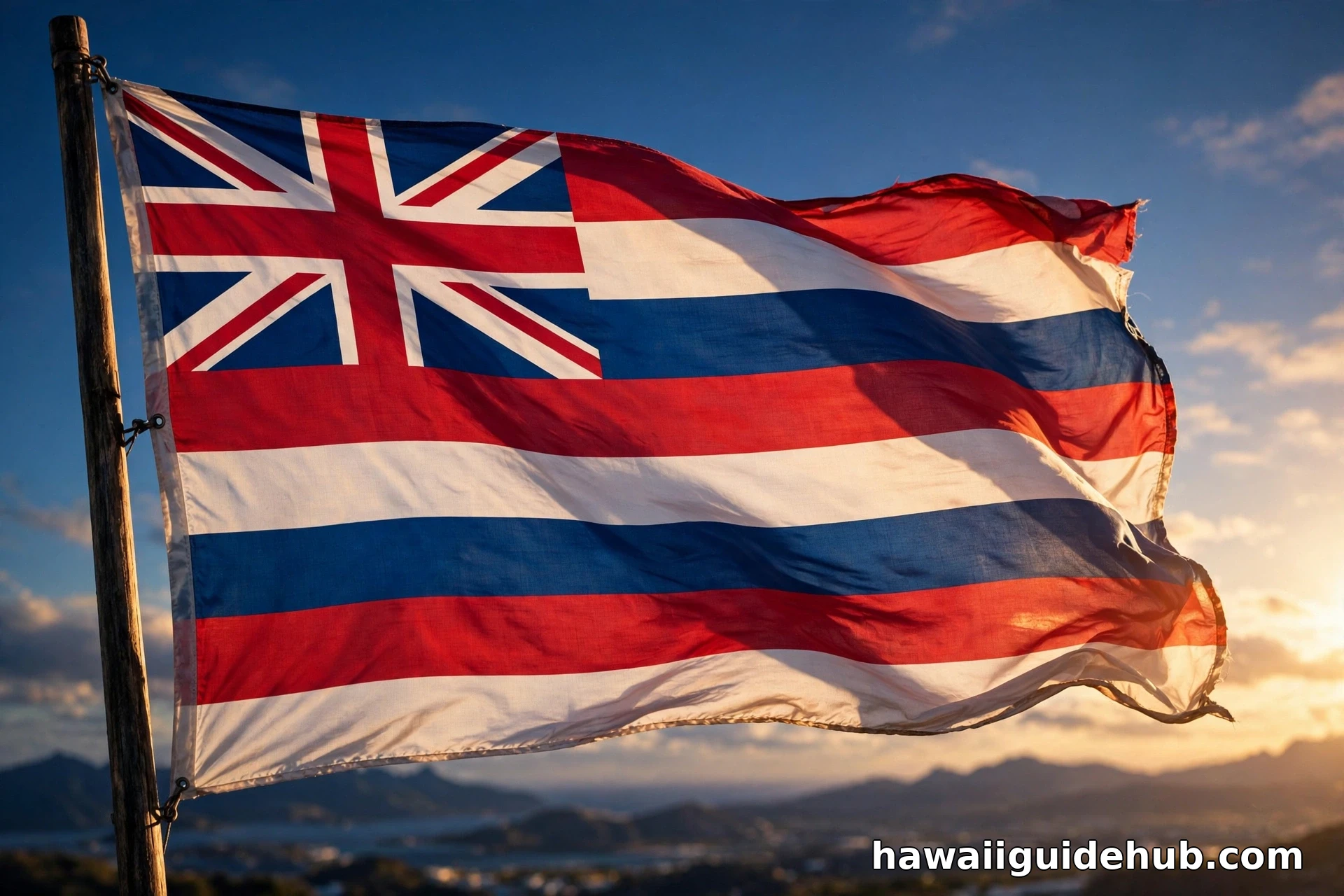
Hawaiʻi’s flag is the most unusual state flag in America. It is the only U.S. state flag that contains another nation’s flag, the Union Jack of the United Kingdom, flying in its canton above eight horizontal stripes of white, red, and blue. It was designed for an independent kingdom, survived an overthrow, a republic, and six decades as a territorial banner, and became the state flag in 1959 without changing a single thread of its 1845 design.
This is the single complete guide to Hawaiian flag history. It covers what the flag looks like and what every element means, why the Union Jack is there, the full story from Captain Vancouver’s 1793 gift to the standardized design of 1845, how the flag endured through every era of Hawaiian history, and how visitors should treat this deeply meaningful symbol with respect.
The Hawaiian Flag at a Glance
| The timeline | |
| 1816 | First version, under Kamehameha the Great |
| 1845 | Standardized under Kamehameha III; unfurled May 25, 1845 |
| 1990 | Lā Hae Hawaiʻi (Flag Day), July 31, proclaimed |
| The symbolism | |
| The eight stripes | White, red, blue, white, red, blue, white, red: the eight main Hawaiian Islands under one sovereign |
| The Union Jack | Friendship between Hawaiʻi and Britain; never British rule |
| The distinction | The only U.S. state flag bearing another nation’s flag |
What the Hawaiian Flag Looks Like
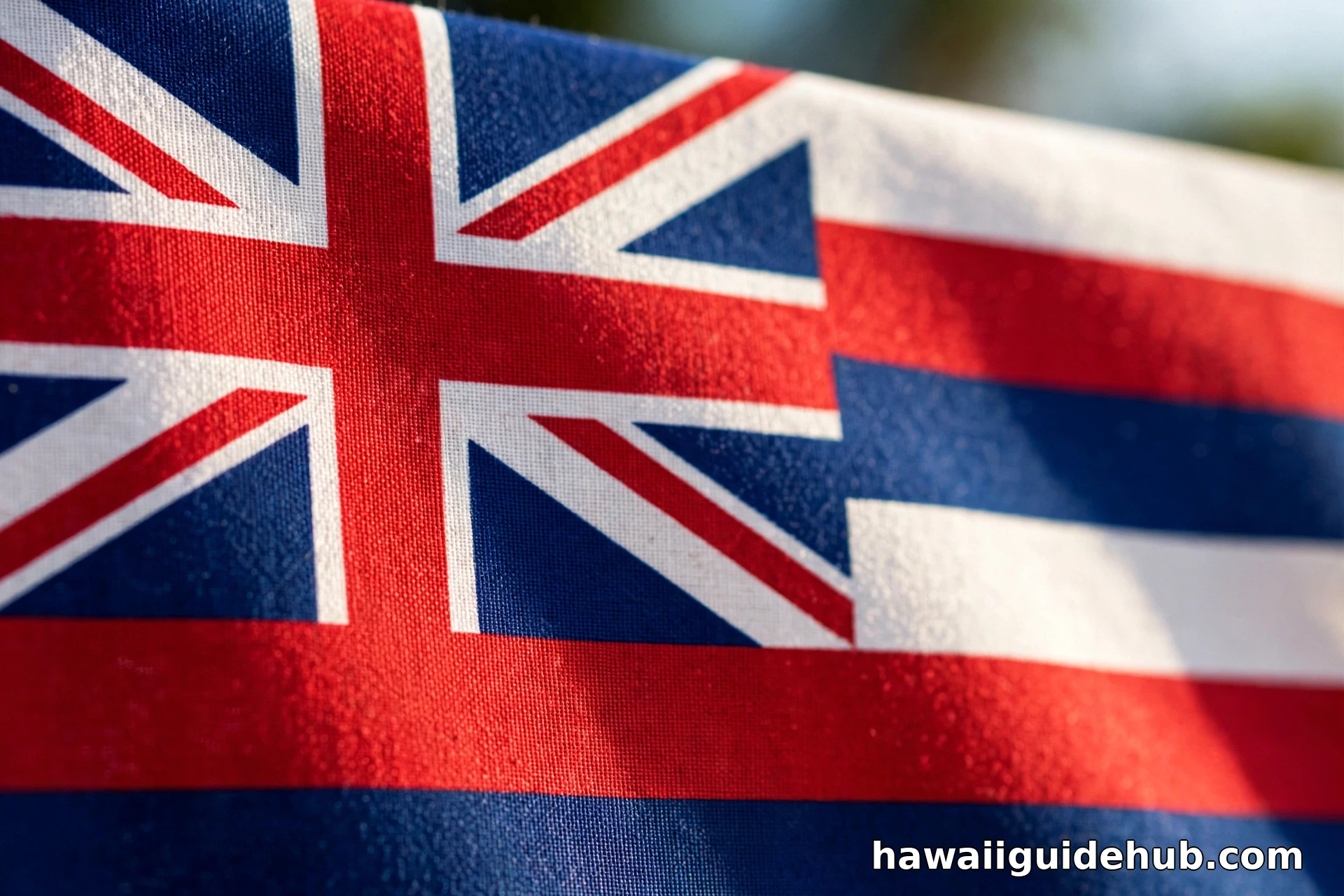
The flag’s field is eight horizontal stripes, running white, red, blue, white, red, blue, white, red from top to bottom. In the upper corner nearest the flagpole sits the Union Jack, the national flag of the United Kingdom, occupying the canton. The proportion is one to two, twice as long as it is tall. The colors were fixed in 1843 and the eight-stripe design in 1845, and the flag you see flying over Honolulu today is the same banner, thread for thread, that flew over the Kingdom of Hawaiʻi.
The numbers tell the design’s story at a glance, three white stripes, three red stripes, two blue stripes, one Union Jack canton, eight stripes for eight islands.
What the Symbols Mean
The eight stripes represent the eight main Hawaiian Islands, Hawaiʻi, Maui, Oʻahu, Kauaʻi, Molokaʻi, Lānaʻi, Niʻihau, and Kahoʻolawe, united under one sovereign. The Union Jack honors the friendship between the Hawaiian Kingdom and Great Britain in the early nineteenth century. It does not mean Hawaiʻi was ever a British colony or possession. It never was. The kingdom was an independent nation, and the British emblem on its flag was a diplomatic courtesy, a signal to the world’s navies that this small Pacific kingdom had powerful friends.
There is also a practical theory behind the design. In the early 1800s, both British and American ships called at Hawaiian ports, and the kingdom needed a flag that would offend neither side while commanding respect from both. Combining elements of the British Union Jack with the red, white, and blue of the young American republic was a deliberate balancing act by a king who understood that his kingdom’s survival depended on playing great powers against each other.
The colors themselves carry no officially recorded symbolism from the kingdom era, unlike the stripes and canton whose meanings are well documented. Over time, though, Hawaiʻi’s people have given them meaning: the red for the lifeblood and sacrifice of the Hawaiian people, the white for truth and peace, the blue for the Pacific that surrounds and connects the islands. These are living interpretations rather than royal decrees, and they show how a flag keeps gathering meaning long after its designer is gone.
1793: Captain Vancouver’s Gift
The story begins in 1793, when the British explorer Captain George Vancouver presented Kamehameha the Great with a British Red Ensign as a gesture of goodwill. Kamehameha flew it as a token of friendship with King George III. But the gift created a problem: American traders visiting the islands objected to the British colors, while the British navy expected them. Kamehameha needed a flag of his own.
Tradition credits the design to Captain George Beckley, a British naval officer advising Kamehameha, though the exact origins are debated and his logbook has been lost. What is documented is that by 1816 the kingdom had a distinct national flag combining the Union Jack with red, white, and blue stripes. In March 1817, the brig Kaʻahumanu, commanded by Scottish Captain Alexander Adams, became the first Hawaiian vessel to sail to a foreign port, Canton, China, under that flag. The Russian navigator Vasily Golovnin, visiting Oʻahu in 1818, described a national flag of seven stripes with the English Union Jack in the corner.
The Paulet Affair and the Flag of 1845
For nearly thirty years, visitors reported different versions of the flag with varying numbers of stripes and colors. The design was finally fixed in the aftermath of a crisis. In February 1843, the British naval officer Lord George Paulet seized Honolulu, raised the Union Jack, and proclaimed Hawaiʻi annexed to the British Crown. The occupation lasted five months until Admiral Richard Thomas arrived, repudiated Paulet’s actions, and restored the kingdom on July 31, 1843, a date still celebrated as Lā Hoʻihoʻi Ea, Sovereignty Restoration Day.
In the wake of that humiliation, the kingdom standardized its symbols. The flag was specified with eight stripes, a white stripe on top followed by red, blue, white, red, blue, white, red, and the new national banner was officially unfurled on May 25, 1845, at the opening of the kingdom’s legislative council. The design was formally adopted later that year, on December 29, 1845, during the reign of Kamehameha III. The eight stripes, one for each main island, were a statement: the kingdom was whole, sovereign, and united.
A Flag That Outlived the Kingdom
Few national flags have survived as many regimes as Ka Hae Hawaiʻi. It flew over the independent kingdom until the overthrow of 1893. The Republic of Hawaiʻi kept it. The Territory of Hawaii kept it. When statehood came on August 21, 1959, Hawaiʻi kept it again, making it one of the only state flags in America with a direct lineage to a royal monarchy. The timeline below traces the flag from Vancouver’s gift to the present day.
Lā Hae Hawaiʻi: Hawaiian Flag Day
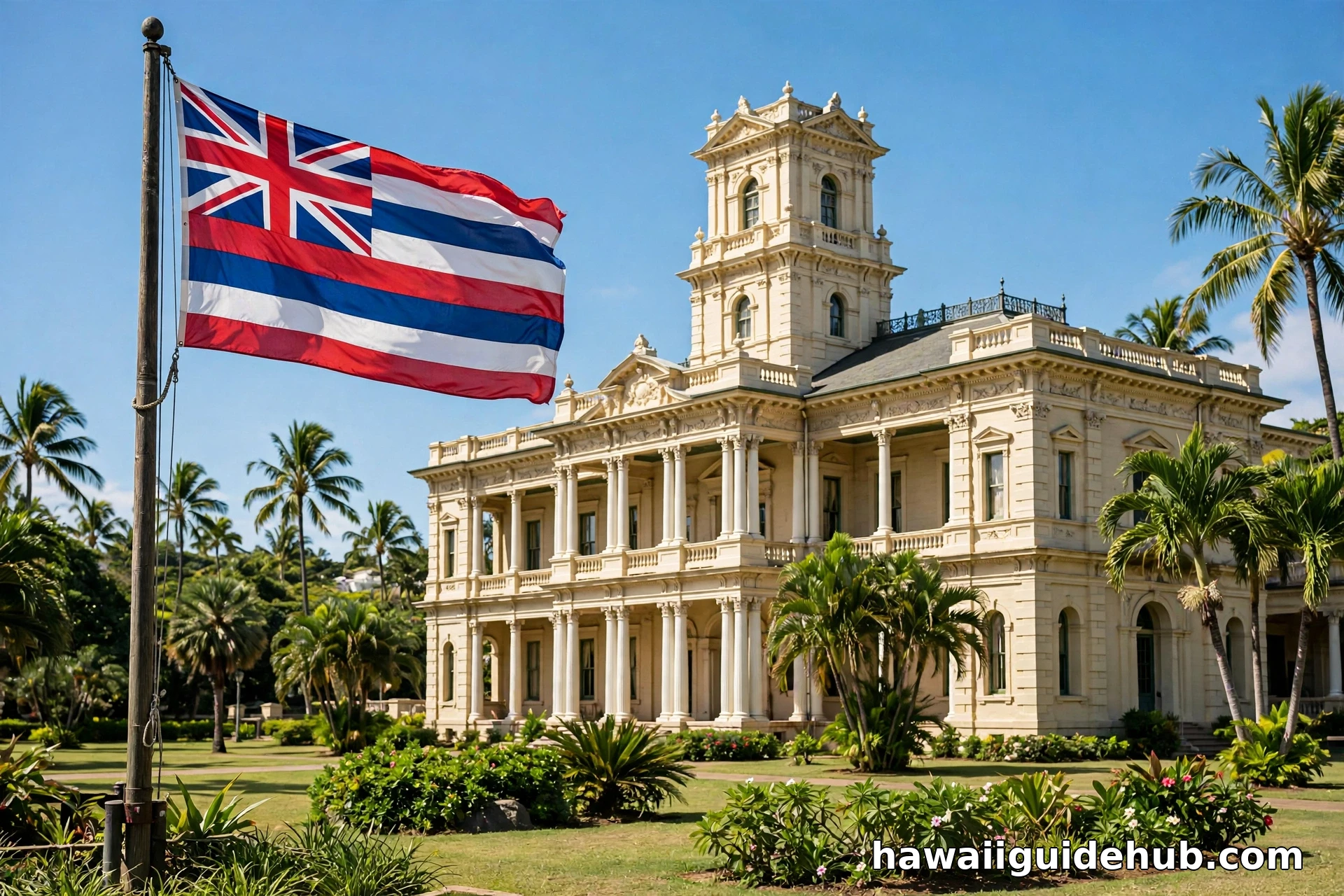
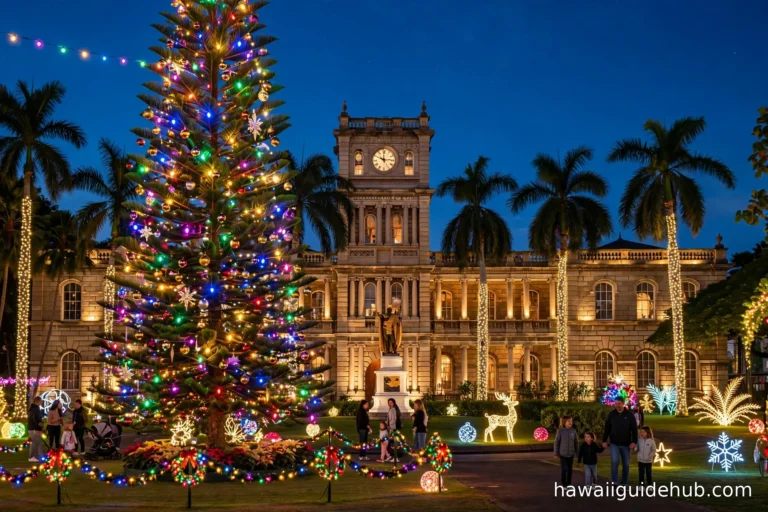
In 1990, Governor John Waiheʻe proclaimed July 31 as Lā Hae Hawaiʻi, Hawaiian Flag Day, to be celebrated each year. The date is no coincidence: July 31 is also Lā Hoʻihoʻi Ea, the anniversary of the restoration of the kingdom’s sovereignty in 1843. The pairing links the flag to the deepest themes of Hawaiian history, independence, survival, and pride. Celebrations include ceremonies at ʻIolani Palace and Thomas Square in Honolulu, the park named for Admiral Thomas, where the 1843 restoration took place.
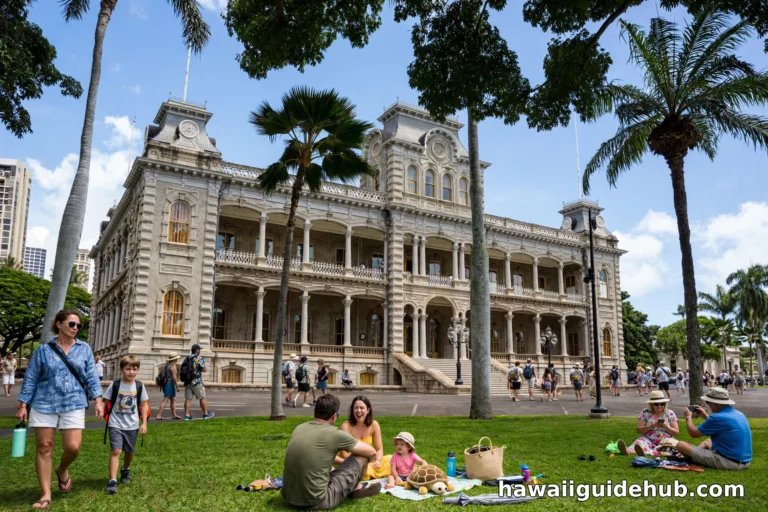
At ʻIolani Palace, visitors will notice something deliberate: the Hawaiian flag flies below the American flag. This is the palace’s statement about its own history, a reminder that the building was a royal residence before it was a capitol, and that the kingdom’s flag still has a place of honor. During the annexation ceremony of 1898, royalists in the streets wore the Hawaiian flag emblazoned with the motto “Kuu Hae Aloha,” my beloved flag, and that affection has never faded.
The Kanaka Maoli Flag
Visitors sometimes see a different Hawaiian flag: nine horizontal stripes of red, green, and yellow with a green shield bearing a kahili (feather standard) and two crossed paddles. This is the Kanaka Maoli flag, claimed by some to be the original flag of the Hawaiian Kingdom before 1816. Its authenticity is disputed by historians, and it was never the kingdom’s official banner, but it has been adopted by parts of the sovereignty movement as a symbol of Native Hawaiian identity. When you see it at rallies or cultural events, you are looking at a living political symbol, not a historical artifact.
Flag Etiquette for Visitors
The Hawaiian flag deserves the same respect as any national or state flag, and a little extra awareness. Do not use it as a beach towel, clothing print, or disposable decoration; many Native Hawaiians consider casual or commercial misuse disrespectful. At ceremonies and memorials, treat it as you would the American flag. If you buy a flag as a souvenir, buy a well-made one and fly it properly at home. And when you see the flag paired with the phrase “Kuu Hae Aloha,” understand you are looking at a love letter to a kingdom, not just a pretty design.
Where to See the Flag at Its Most Meaningful
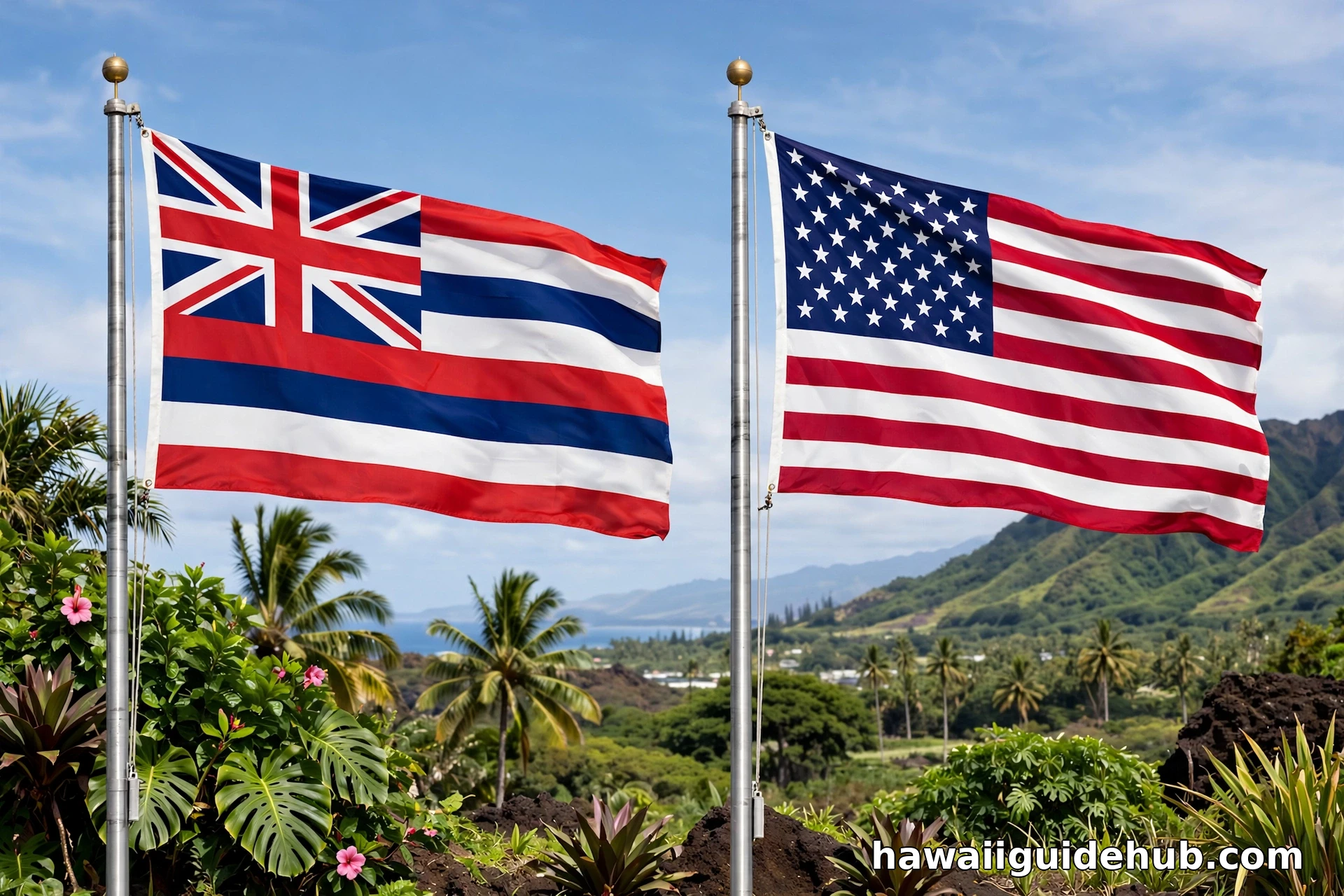
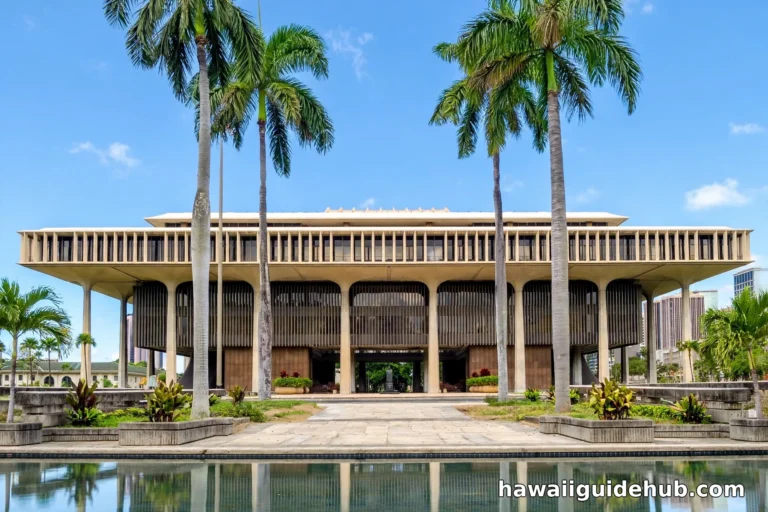
A few places in the islands give the flag a weight you will not feel anywhere else. At ʻIolani Palace in Honolulu, it flies below the Stars and Stripes in a deliberate statement about the building’s royal past; take the guided tour to hear the full story. At Thomas Square, the park named for Admiral Thomas, annual Lā Hoʻihoʻi Ea ceremonies mark the 1843 restoration of sovereignty with the flag at center stage. At the Hawaiʻi State Capitol, a giant replica of the state seal and the flag mark the seat of the government the kingdom became. And at Pearl Harbor, the flag flies alongside the American flag over waters that changed the islands’ destiny. Seeing it in these places, with the history fresh in your mind, is one of the most quietly moving experiences Hawaiʻi offers.
Common Misconceptions
The biggest myth is that Hawaiʻi was once a British colony. It was not; the Union Jack honors friendship, not rule. The second is that the stripes are vertical. They are horizontal, eight of them, and the order of colors is fixed. The third is that the flag changed at statehood. It did not; the 1845 design became the state flag unchanged. The fourth is that the Kanaka Maoli flag was the kingdom’s original flag. Historians dispute that claim, and the kingdom’s documented flag from 1816 onward is the one with the Union Jack.
Watch: Why Hawaii’s Flag Has a Union Jack
Frequently Asked Questions
Why does Hawaii’s flag have a British Union Jack?
The Union Jack honors the early friendship between the Hawaiian Kingdom and Great Britain, beginning with Captain Vancouver’s 1793 visit to Kamehameha the Great. It was a diplomatic gesture, not a sign of British rule; Hawaiʻi was never a British colony.
What do the eight stripes on the Hawaiian flag mean?
They represent the eight main Hawaiian Islands, Hawaiʻi, Maui, Oʻahu, Kauaʻi, Molokaʻi, Lānaʻi, Niʻihau, and Kahoʻolawe, united under one sovereign. The eight-stripe design was standardized in 1845.
When was the Hawaiian flag adopted?
The first version dates to 1816 under Kamehameha the Great. The current eight-stripe design was unfurled on May 25, 1845, and formally adopted on December 29, 1845, under Kamehameha III.
What is Ka Hae Hawaiʻi?
“Ka Hae Hawaiʻi” is Hawaiian for “the Hawaiian flag.” “Hae” means flag or banner, and you will see the phrase used in ceremonies, on Flag Day (Lā Hae Hawaiʻi, July 31), and in the royalist motto “Kuu Hae Aloha,” my beloved flag.
Did the Hawaiian flag change when Hawaii became a state?
No. The 1845 design was retained unchanged through the kingdom, the republic, the territory, and statehood in 1959. It is the only U.S. state flag that features another nation’s flag.
What is the Kanaka Maoli flag?
A red, green, and yellow striped flag with a kahili and crossed paddles, claimed by some to predate the current flag. Historians dispute its authenticity, but it is used today as a symbol of Native Hawaiian identity and the sovereignty movement.
Ka Hae Hawaiʻi is more than a state symbol. It is a survivor: designed by a king balancing empires, standardized after a brush with annexation, carried through overthrow and territoryhood, and still flying over the islands today. When you see the Union Jack in its canton and count the eight stripes, you are reading two centuries of Hawaiian history in a single glance, and standing in the presence of a flag its people have never stopped loving.