Hawaiian Featherwork: The Sacred Art of Nā Hulu Aliʻi

In old Hawaii, nothing said power like feathers. A chief stepping into battle or ceremony wore a cloak and helmet made from hundreds of thousands of tiny red and yellow feathers, each one tied by hand onto a net of plant fiber. The garments shimmered like living flame, and everyone who saw them understood exactly what they meant: here stands an ali’i, a chief, wrapped in the mana of his ancestors and the protection of the gods.
This is the single complete guide to Hawaiian featherwork. It covers what featherwork is, the forest birds whose feathers clothed the chiefs, how the cloaks and helmets were made, the meaning of the colors, the famous cloaks of Kamehameha and Captain Cook, the feather standards called kahili, the kingdom era, and where you can see these treasures today. If you have been searching for anything about hawaiian featherwork, the answers are all here on this one page.
Hawaiian Featherwork at a Glance
| The detail | The fact | The scale of it |
|---|---|---|
| The name | Nā hulu ali’i: the feathers of the chiefs | Featherwork was the regalia of rank |
| The garments | ‘Ahu ‘ula (feather cloak), mahiole (feather helmet) | Cloak and helmet: the full chiefly uniform |
| Other forms | Kāhili (feather standards), lei hulu (feather lei), akua hulu (feathered gods) | From battle standards to sacred images |
| The birds | ‘I’iwi (red), mamo (yellow), ‘ō‘ō (yellow), ‘apapane (red) | Red and yellow: the colors of chiefs |
| The technique | Feather bundles tied onto olonā fiber netting | Thousands of tiny bundles, each hand-tied |
| The masterpiece | Kamehameha’s cloak: 450,000 feathers from 80,000 birds | Generations of work in a single garment |
| Who wore it | Ali’i (chiefs) under the kapu system | Wearing feathers was wearing authority |
| Where to see it | Bishop Museum, ‘Iolani Palace, British Museum | Honolulu holds the finest collections |
What Is Hawaiian Featherwork?
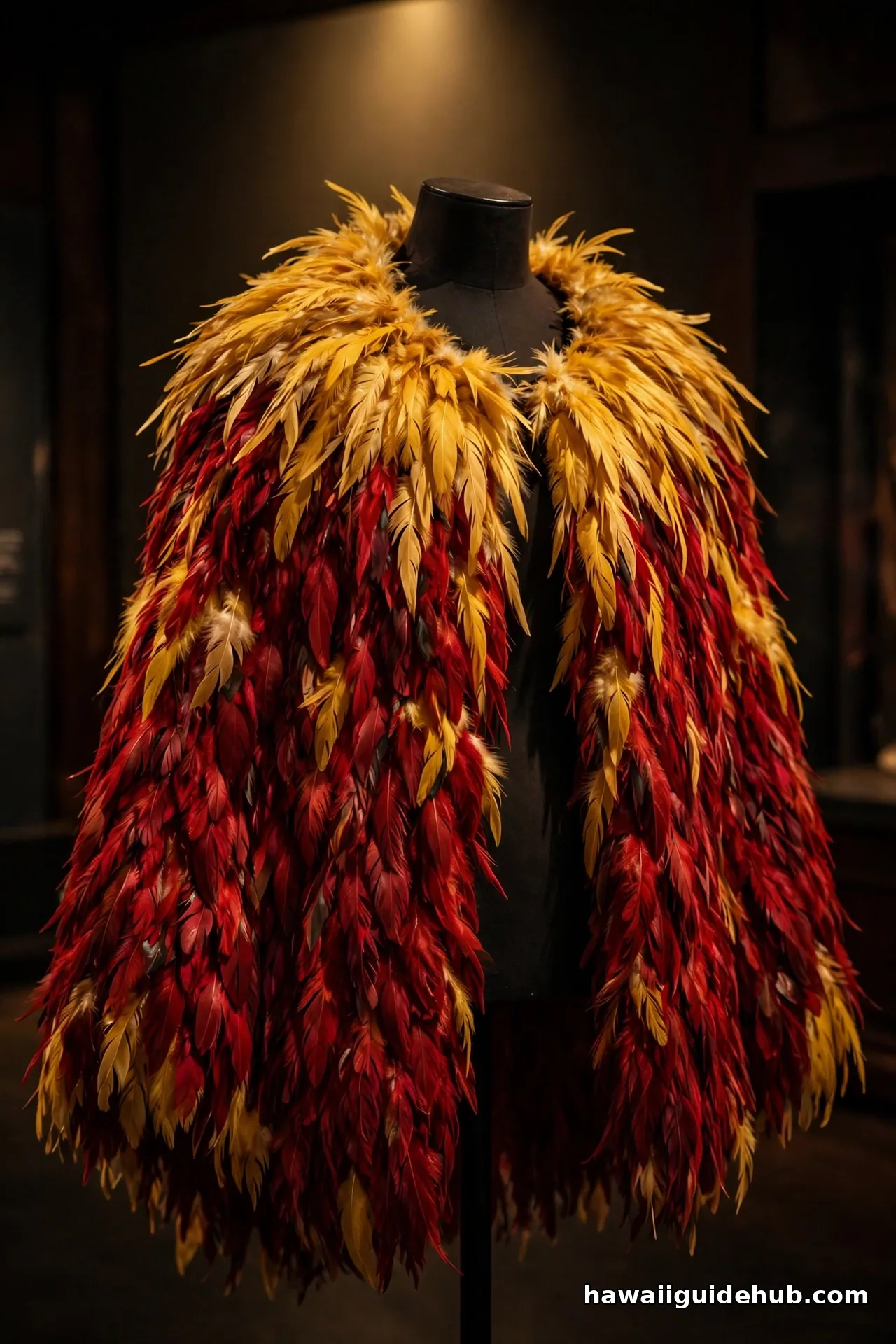
Hawaiian featherwork is the art of making garments and objects from the feathers of native forest birds. Hawaiians call it na hulu ali’i, the feathers of the chiefs, because under the old kapu system the finest featherwork belonged exclusively to the ali’i. The most important pieces were the ‘ahu ‘ula, the great feather cloak, and the mahiole, the feather helmet, worn together as a chief’s full regalia. But featherwork also included kahili, the tall feather standards carried at court; lei hulu, feather lei; and akua hulu manu, sacred god images wrapped in feathers.
These were not decorations in the modern sense. A feather cloak was spiritual armor. It proclaimed the wearer’s rank, carried the mana of the chiefs who had worn it before, and offered protection in battle. The abstract patterns of crescents, triangles, circles, and lines worked into the cloaks look strikingly modern, but they are ancient, and every arrangement of color and form carried meaning that other chiefs could read at a glance.
The Birds Behind the Feathers
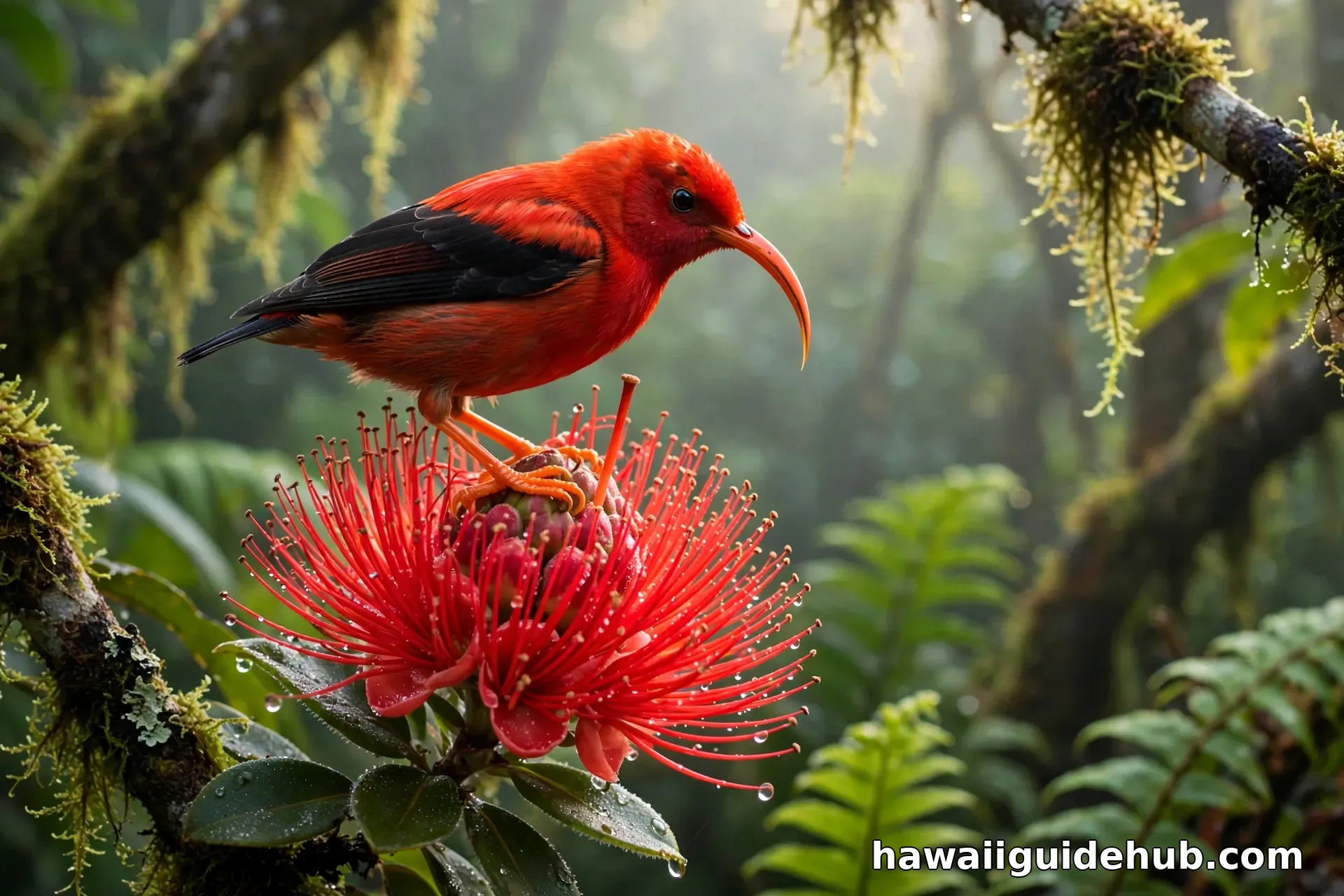
The feathers came from Hawaii’s honeycreepers, small forest birds found nowhere else on earth. The ‘i’iwi gave the brilliant scarlet red feathers, with its long curved bill for sipping nectar from ‘ohi’a lehua blossoms. The mamo, a mostly black bird with golden yellow tufts at its neck and tail, gave the precious yellow feathers. The ‘o’o gave yellow plumes too. The ‘apapane, red and black, contributed red feathers and is still common in high forests today.
Yellow was the scarcest and most prestigious color. A mamo yielded only a few yellow feathers, so a cloak of solid gold, like Kamehameha’s, represented an almost unimaginable gathering of birds. Both the mamo and the ‘o’o are extinct today, victims of habitat loss and disease rather than feather harvesting, since bird catchers traditionally released the birds after plucking a few feathers. The ‘i’iwi survives but is endangered, retreating to the highest, coolest forests.
How Featherwork Was Made
Making featherwork began in the forest with the kia manu, the bird catchers. They coated branches with sticky gum from breadfruit sap, snared the honeycreepers, plucked a few choice feathers, and released the birds. It was skilled, patient work, and gathering enough feathers for a single cloak could take years.
The construction was just as demanding. Workers twisted olona, a native plant fiber, into cord and netted it into a base shaped like the finished garment. Then they tied tiny bundles of feathers, usually about ten to a bunch, in overlapping rows onto the netting, starting at the bottom so each new row covered the quills of the one below. The feathers were sorted by color as they went, building the geometric patterns row by row. A great cloak held hundreds of thousands of feathers, and its making was a communal effort organized by the chief’s household.
The ‘Ahu ‘Ula: Cloaks of the Chiefs
The ‘ahu ‘ula is the supreme achievement of Hawaiian featherwork. Full length cloaks were worn only by the highest chiefs, and their size and density announced rank: the greater the chief, the grander the cloak. Earlier cloaks were trapezoidal, while later ones took the familiar semicircular shape that drapes from the shoulders like a cape of fire.
The most famous ‘ahu ‘ula belonged to Kamehameha I, the chief who united the islands. Held by the Bishop Museum, it is made almost entirely of golden yellow mamo feathers, about 450,000 of them, taken from some 80,000 birds. A smattering of red ‘i’iwi feathers was added to the trimming later, when Kamehameha IV wore it ceremonially. No other cloak with so many mamo feathers is known to exist, and the museum calls it an eternal treasure of the Hawaiian people.
The Mahiole: Feather Helmets
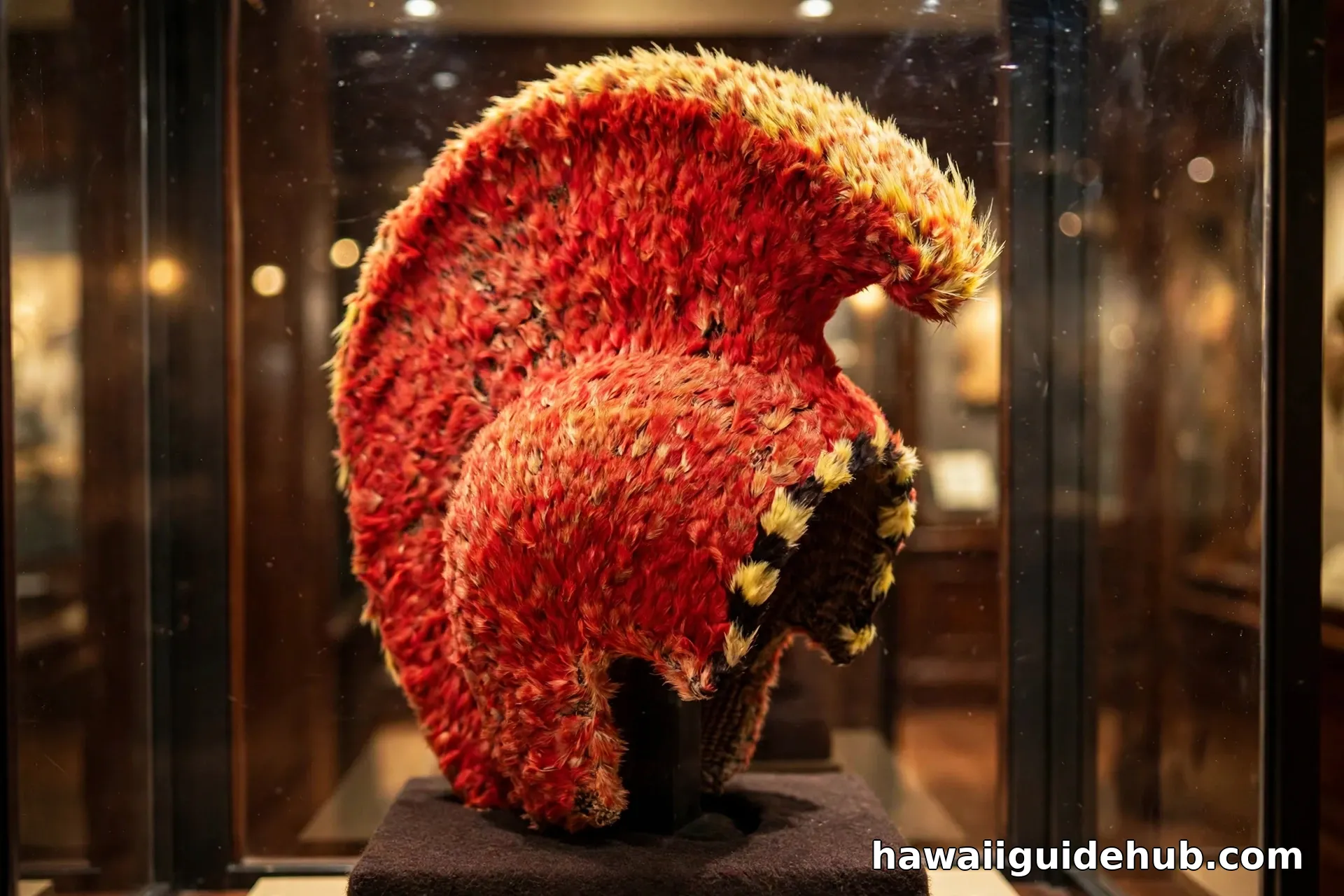
The mahiole, the feather helmet, completed the chief’s regalia. Worn with the ‘ahu ‘ula, it framed the chief’s face in a crest of red and yellow feathers, often rising into a high comb at the back. Like the cloak, it was tied onto a shaped foundation, and its colors matched or complemented the chief’s cloak.
Helmets and cloaks traveled together through history. When high chief Kalani’opu’u met Captain James Cook at Kealakekua Bay in January 1779, he gave the captain both an ‘ahu ‘ula and a mahiole, garments he had worn himself. Those two pieces journeyed to England, spent two centuries in British collections, and were returned to Hawaii in 2016 in a historic act of Pacific generosity, now on long term loan to the Bishop Museum. Their homecoming drew attention around the world.
Kahili: The Feather Standards
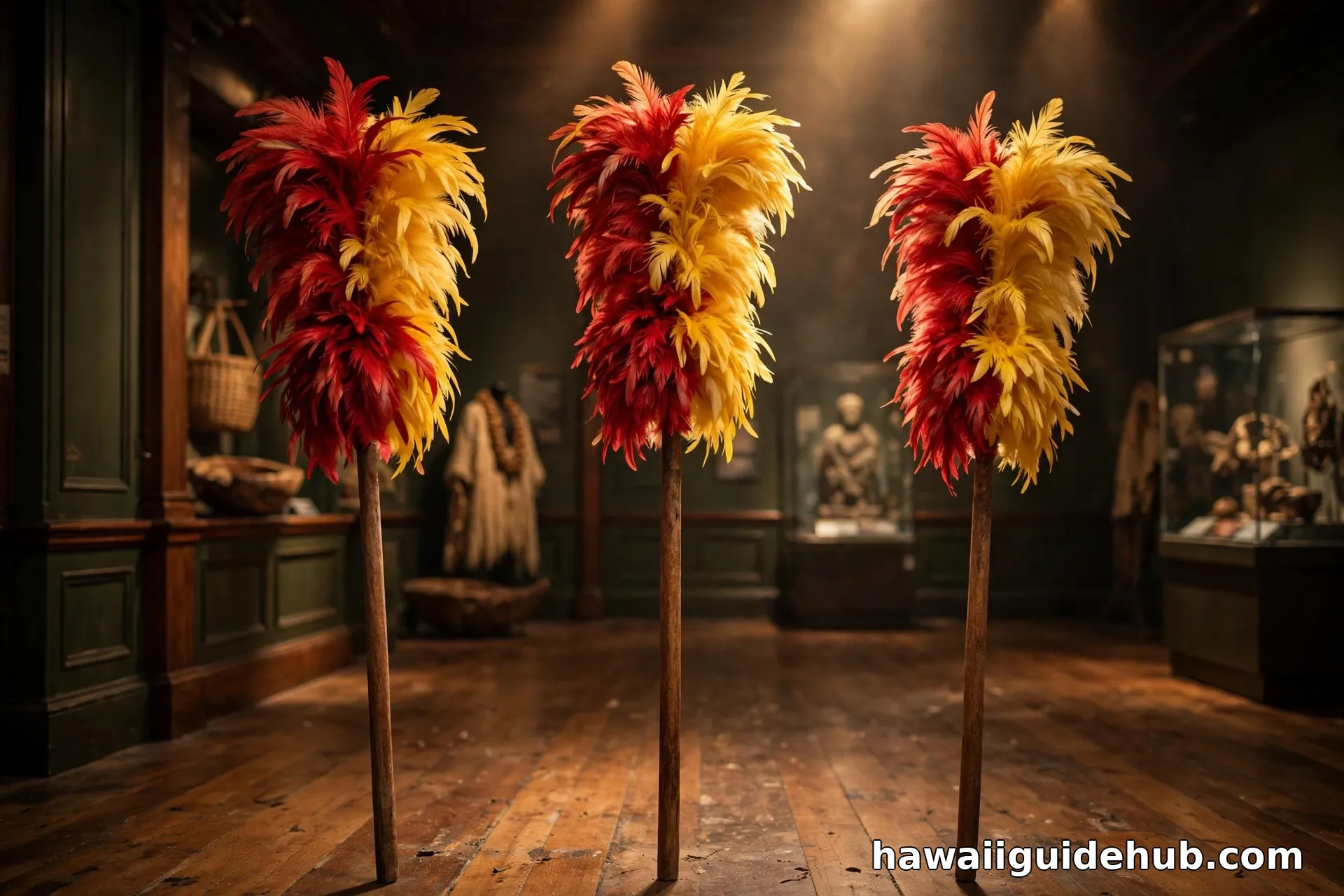
The kahili are tall staffs crowned with cylinders or plumes of feathers, and they were the visible symbols of royalty at court. Attendants carried them beside chiefs at ceremonies, and they stood at the thrones of kings and queens. Some were small enough to hold in the hand; others were so large they needed stands.
Kahili marked the great moments of a chief’s life. They were brought out for coronations and carried at funerals, where they announced the rank of the dead. The feathers were red and yellow like the cloaks, though later kahili sometimes mixed in dyed feathers, ribbons, and even whale ivory. To this day, kahili stand beside the thrones in ‘Iolani Palace, keeping their silent watch over the kingdom’s memory. Our guide to visiting ‘Iolani Palace covers what to look for when you see them in person.
The Meaning of the Colors
Color was language in Hawaiian featherwork. Red was the royal color across Polynesia, the color of chiefs and of the god Ku. Yellow, because it was so rare, was doubly prestigious: a yellow feather said that the chief who wore it commanded the labor of countless bird catchers and the tribute of whole districts. Black, used sparingly, was the rarest of all in cloak designs, and cloaks with bold black patterning are exceedingly rare museum pieces.
The geometric patterns worked in these colors, crescents, triangles, lozenges, lines, identified the wearer’s lineage and rank. Two cloaks might both be red and yellow, but their patterns told different stories. This is why featherworkers sorted feathers so carefully as they tied: a misplaced color could change the meaning of the whole garment.
Captain Cook and the Cloaks That Left Hawaii
Featherwork entered the written record of the West almost the moment Europeans arrived. When Captain Cook’s ships anchored at Kealakekua Bay in 1779, Hawaiian chiefs gave feather cloaks as diplomatic gifts, beginning a long dispersal of featherwork into Western collections. The cloak given to Cook by Kalani’opu’u, made from the yellow and red feathers of an estimated 20,000 mamo, ‘o’o, and ‘i’iwi birds, eventually reached the Museum of New Zealand Te Papa Tongarewa.
For two centuries, Hawaii’s greatest feather treasures lived abroad: in London, in Scotland, in New Zealand, in American museums. The 2015 exhibition “Royal Hawaiian Featherwork: Na Hulu Ali’i,” developed with the Bishop Museum and shown in San Francisco as the first exhibition of Hawaiian featherwork on the U.S. mainland, brought about 75 of the finest capes, cloaks, kahili, helmets, and feathered god images together for the first time. It was a homecoming in spirit, even for pieces that could not stay.
Featherwork in the Kingdom Era
Featherwork reached extraordinary heights during the Kingdom of Hawaii. Princess Nahi’ena’ena, daughter of Kamehameha I, owned a feather pa’u, a skirt, of staggering richness: about one million feathers, mostly the golden yellow of the extinct ‘o’o and mamo, gathered from some 200,000 birds. It took the people of Lahaina what may have been only a year to tie it together, an astonishing communal feat. The pa’u, now 10 feet by 5 feet after being cut and resewn, rests in the Bishop Museum.
The kingdom’s end changed everything. After the overthrow of the monarchy in 1893, the royal featherwork was removed from ‘Iolani Palace and transferred to the Bishop Museum, where much of it remains. The cloaks that had proclaimed living chiefs became museum pieces, which is why seeing them today carries such weight: you are looking at the actual garments of Hawaiian royalty, preserved through the kingdom’s fall. Our account of Hawaii’s history before statehood gives the fuller story of those years.
Where to See Hawaiian Featherwork Today
The Bishop Museum in Honolulu holds the world’s great collection of Hawaiian featherwork, including Kamehameha’s golden cloak, Nahi’ena’ena’s pa’u, and the returned cloak and helmet of Kalani’opu’u. ‘Iolani Palace displays royal featherwork in its throne room and state rooms, where kahili still stand beside the thrones. Beyond Hawaii, the British Museum in London holds feathered god images and cloaks from the Cook voyages, and its 2026 exhibition on the Hawaiian kingdom brought several back into public view.
These visits fit naturally into a deeper exploration of Hawaiian culture. Our guide to cultural experiences and heritage in Hawaii and our deep dive into Hawaiian traditions from hula to storytelling both pair well with a museum day in Honolulu.
Respectful Visitor Etiquette
Hawaiian featherwork is sacred, and the birds behind it are protected. Never buy items made from the feathers of native Hawaiian birds: the ‘i’iwi is endangered, and the mamo and ‘o’o are extinct, so any genuine old featherwork belongs in a museum, not a souvenir shop. Modern Hawaiian feather artists work with legal feathers from game birds and poultry, and buying from them supports a living tradition.
In museums, treat featherwork as you would any sacred object. The cloaks and helmets carry the mana of the chiefs who wore them, and many Native Hawaiians regard them as ancestors rather than artifacts. Follow photography rules, keep your voice low, and take time with each piece. A cloak of 450,000 feathers deserves more than a glance.
Video: Plume of Time, a Story of Featherwork
The Bishop Museum tells the story of Hawaiian featherwork, from the forest birds to the cloaks of the chiefs.
Frequently Asked Questions
What is Hawaiian featherwork called?
Hawaiian featherwork is called na hulu ali’i, meaning the feathers of the chiefs. The great feather cloak is the ‘ahu ‘ula, the feather helmet is the mahiole, and the tall feather standards are the kahili.
What birds were used for Hawaiian featherwork?
The feathers came from Hawaii’s honeycreepers: the ‘i’iwi for scarlet red, the mamo and ‘o’o for golden yellow, and the ‘apapane for red. The mamo and ‘o’o are extinct; the ‘i’iwi is endangered.
How many feathers are in a Hawaiian feather cloak?
Kamehameha’s famous golden cloak holds about 450,000 mamo feathers from some 80,000 birds. Princess Nahi’ena’ena’s feather skirt held about one million feathers from some 200,000 birds. Even a modest cloak required tens of thousands of feathers.
What do the colors of Hawaiian featherwork mean?
Red was the royal color of chiefs. Yellow was the rarest and most prestigious because so few feathers came from each mamo bird. Black was used sparingly and is very rare in surviving cloaks. The geometric patterns in these colors marked the wearer’s lineage and rank.
Where can I see Hawaiian feather cloaks?
The best collection is at the Bishop Museum in Honolulu, including Kamehameha’s cloak. ‘Iolani Palace displays royal featherwork in its state rooms, and the British Museum in London holds important pieces from the Cook voyages.
Every feather in a Hawaiian cloak was placed by a human hand, tied onto fiber twisted from a native plant, plucked from a bird caught in a mountain forest and released. Multiply that single act by 450,000 and you begin to understand what an ‘ahu ‘ula really is: not a garment but a gathering, the labor of whole communities bent toward clothing one chief in light. The birds are mostly gone, the chiefs are gone, but the cloaks remain, still bright, still speaking. That is the power of Hawaiian featherwork, and why it still stops visitors in their tracks.