Cash or Card in Hawaii: What to Carry and Where

Should you bring cash to Hawaii, or will your cards cover everything? The honest answer is both. Credit and debit cards work at nearly every hotel, restaurant, shop, and gas station across the islands, but cash still rules at farmers markets, food trucks, swap meets, and anywhere tips change hands. Add in Hawaii’s unusual tax system, which hides in plain sight on your receipts, and money deserves a little planning. This guide covers exactly when to use each, how much cash to carry, where to get it, and the tax line you will see on every bill.
This is the single complete guide to cash and cards in Hawaii. It covers where cards work, where cash wins, Hawaii’s general excise tax, ATMs, advice for international visitors, how much cash to carry, and obsolete payment methods. If you have been searching for anything about paying for things in Hawaii, the answers are all here on this one page.
The Short Answer: Bring Both
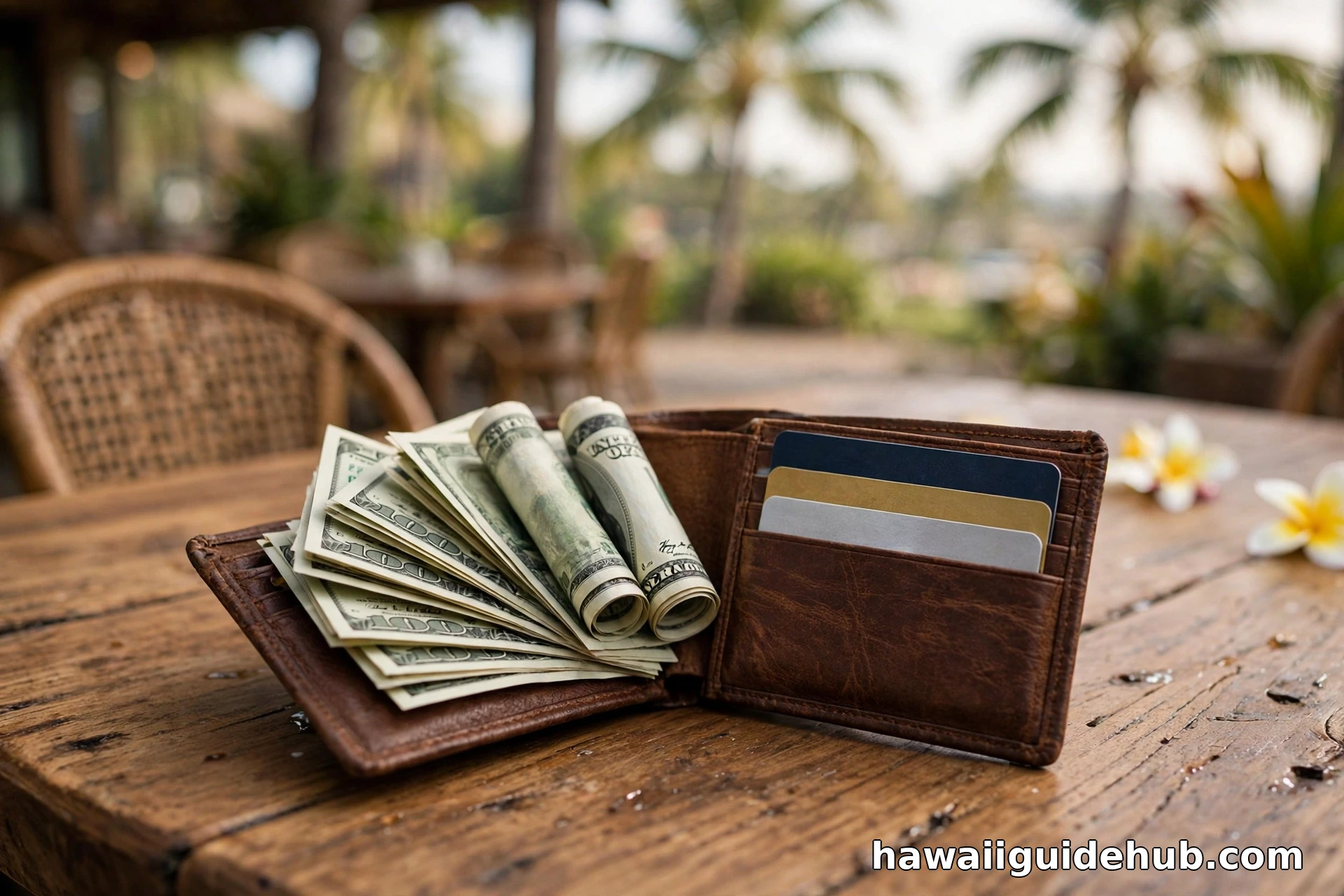
Plan on using cards for 80 to 90 percent of your spending and cash for the rest. Major credit cards, Visa, Mastercard, American Express, and Discover, are accepted essentially everywhere tourists go, and contactless payment with phones and watches works at most registers. But the most memorable Hawaii experiences, the Saturday farmers market, the shrimp truck on the North Shore, the lei stand, the tip for the valet, run on cash. Travelers who bring no cash end up missing out or scrambling for an ATM; travelers who bring only cash miss out on card rewards and spend too much time finding ATMs. Both is the answer.
Where Cards Work
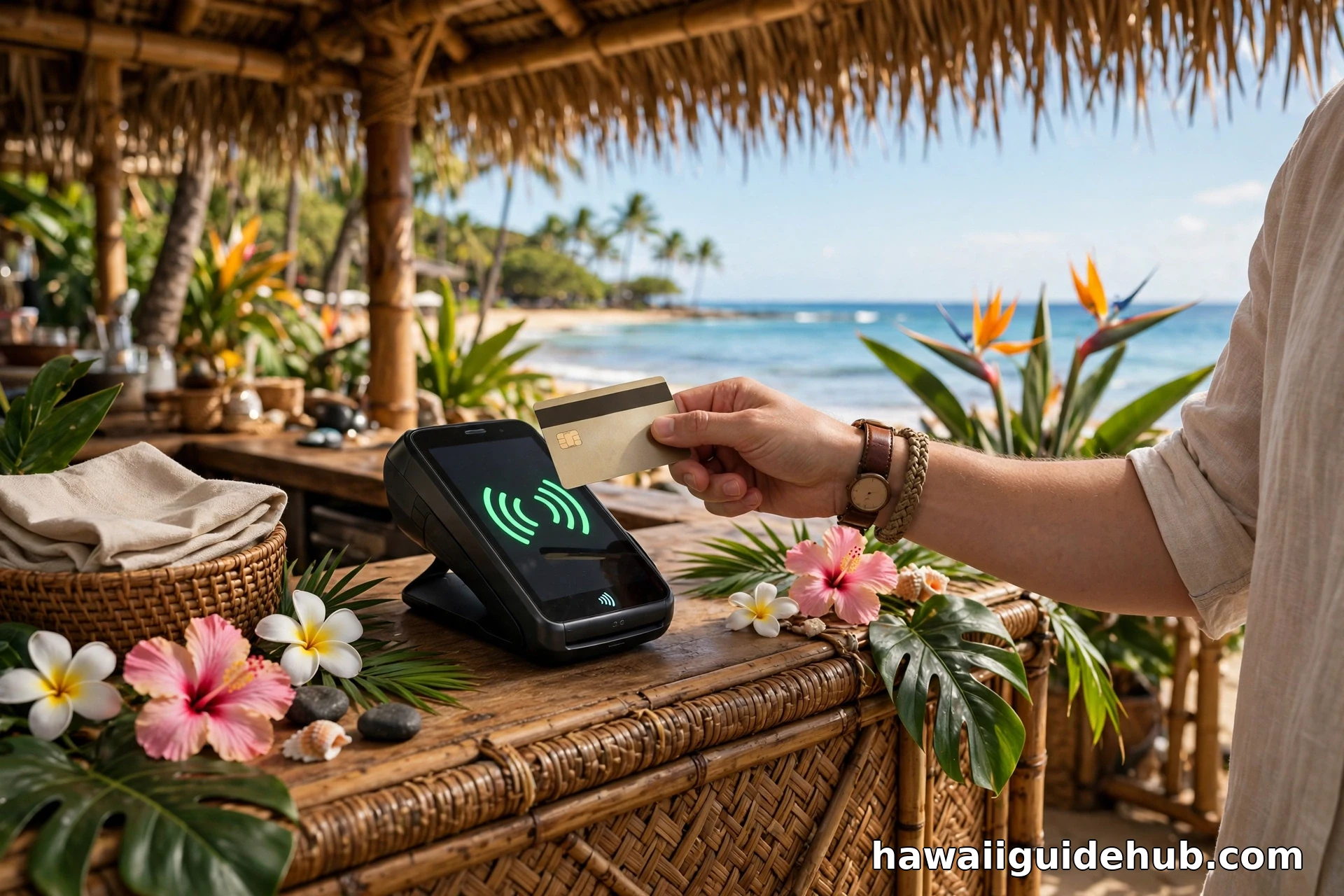
Cards work everywhere you would expect: hotels, resorts, sit-down restaurants, bars, grocery stores, big-box retailers, gas stations, car rental agencies, tour operators, and luaus. Hawaii is thoroughly modern in its payment infrastructure; tap-to-pay terminals are standard, and Apple Pay and Google Pay are widely accepted. Even many food trucks now take cards through phone-based readers. If a place has a printed menu and a roof, your card will almost certainly work. International visitors should prefer a card with no foreign transaction fee, which saves around 3 percent on every purchase compared to a standard card.
Where Cash Wins
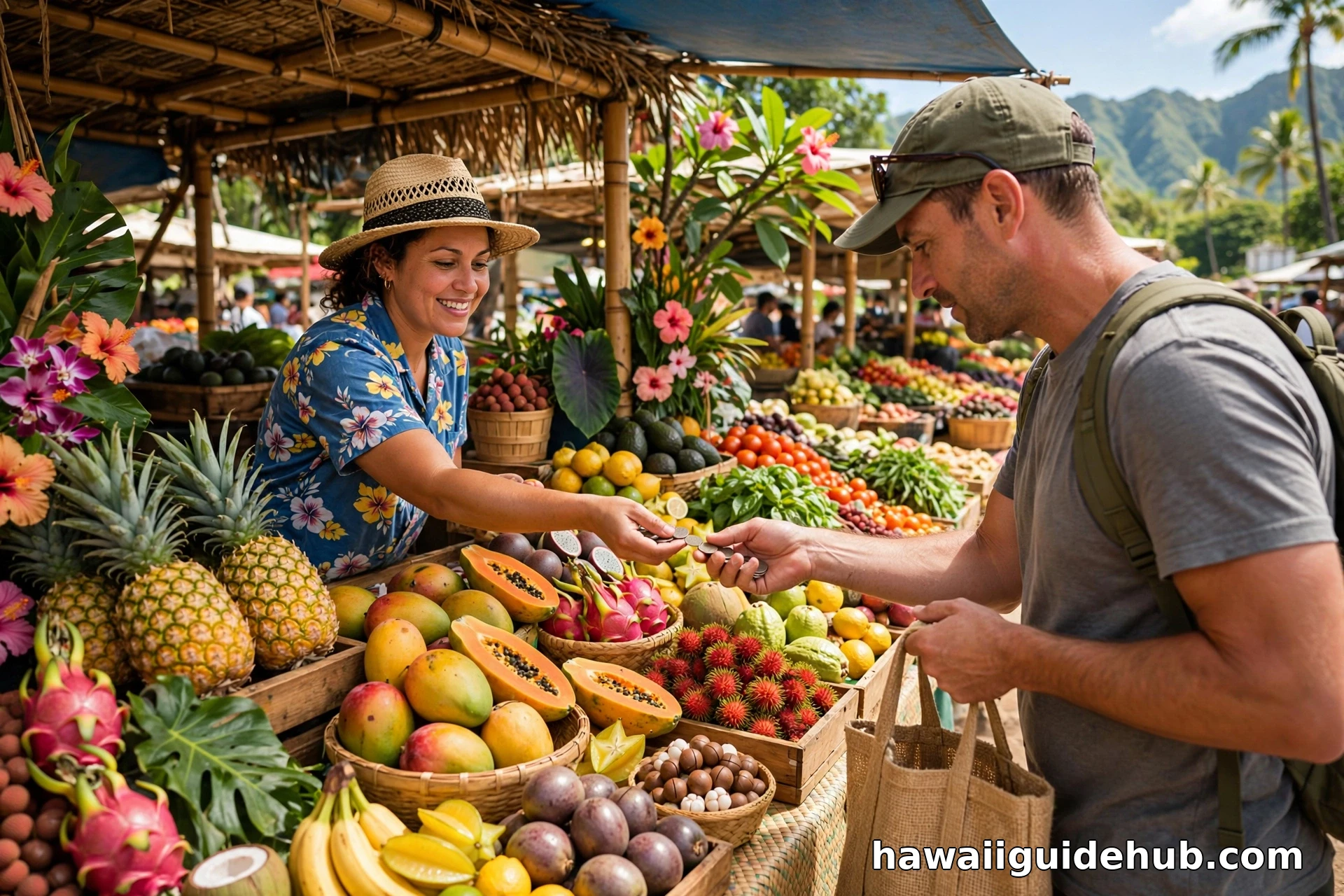
Cash territory starts where the pavement ends. Farmers markets are the classic example: many vendors are small growers who take cash only, and even those with card readers prefer cash to avoid fees. Food trucks are increasingly card-friendly, but cash is faster and some trucks still do not take cards. Swap meets, craft fairs, roadside fruit stands, and lei vendors are usually cash only. Then there are tips: housekeeping, bellhops, valets, shuttle drivers, and tour crews all need bills. And the small daily purchases, shave ice, malasadas, parking meters, beachside snacks, are simply easier in cash.
Hawaii’s GET: The Tax Hidden in Prices
Hawaii has no sales tax. It has something sneakier: the General Excise Tax, or GET, a 4 percent state tax on businesses’ gross income plus a 0.5 percent county surcharge in all four counties, for a combined 4.5 percent. Businesses pass it to you, so it looks and feels like a sales tax, but it is technically a business tax, which is why menu and shelf prices almost never include it. Your $20 plate lunch rings up at $20.90 or so.
Here is the quirk worth knowing: on Oahu receipts you will often see 4.712 percent instead of 4.5 percent. That is not an error. Because the GET applies to a business’s gross receipts including the tax it passes on, the state allows businesses to pass on up to 4.712 percent to fully cover their 4.5 percent liability. It is the mathematically correct pass-through rate, and it confuses every first-time visitor. Now you know. Budget an extra 5 percent over every listed price and you will never be surprised at the register.
ATMs in Hawaii: Getting Cash Smart
You will not struggle to find an ATM in Hawaii; banks, grocery stores, and shopping centers all have them. The smart move is using your own bank’s ATMs to avoid fees, since out-of-network withdrawals can cost $3 to $5 plus your bank’s own fee. Airport ATMs work in a pinch but carry the highest fees, so get cash before you fly or at a bank branch after landing. Withdraw larger amounts less often rather than small amounts daily. And notify your bank of your travel dates before the trip; a sudden burst of Hawaii transactions can trigger a fraud hold that freezes your card at the worst moment.
For International Visitors
Hawaii uses the US dollar exclusively; foreign currency is not accepted anywhere, not even Canadian dollars at the big resorts. Exchange currency before you fly or at your home bank for the best rates; airport exchange counters give the worst. A credit card with no foreign transaction fee is the single best money tool for international visitors, beating cash exchange on rate for nearly every purchase. Notify your bank of US travel so your card is not frozen. And note that some foreign debit cards, notably Canada’s Interac-only cards, do not work at US point-of-sale terminals, though they usually work at ATMs; a credit card avoids the issue entirely.
How Much Cash to Carry
For two travelers, $50 to $100 in cash per day covers tips, markets, food trucks, and small purchases comfortably. Break it into small bills: ones and fives for tips, tens and twenties for markets. Do not carry your whole trip’s cash at once; use the hotel safe and restock every few days. Keep the day’s cash separate from your cards, so losing one does not mean losing both. And keep a $20 bill tucked somewhere unexpected in your luggage as an emergency reserve. It is old travel wisdom, and it has saved many trips.
What About Traveler’s Checks and Foreign Currency?
Traveler’s checks are effectively dead; almost no Hawaii business accepts them anymore, and banks that still cash them do so grudgingly. Leave them at home. Foreign currency, as noted, is not accepted anywhere, so convert before you travel or rely on cards and ATMs. Personal checks from mainland banks are also rarely accepted by retailers. The modern Hawaii wallet is simple: two cards, one with no foreign transaction fee, plus a sensible amount of US cash in small bills.
Paying at Hotels: Holds and Incidentals
Hotels put a hold on your card at check-in, typically $50 to $100 per night on top of the room rate, to cover incidentals. This is normal, but it matters which card you use. On a credit card, a hold just reduces your available credit temporarily. On a debit card, a hold freezes actual money in your checking account, sometimes for days after checkout. For that reason, always give the hotel a credit card, even if you plan to settle the final bill differently. The hold releases automatically, usually within a few business days, but during a two-week stay the frozen amount can be significant. If you only have a debit card, ask the front desk about the hold amount so there are no surprises.
Gas Stations: Pay at the Pump or Inside
Hawaii’s gas is among the most expensive in the nation, so fill-ups are real money. Paying at the pump with a card is fastest, but be aware that pumps often place a pre-authorization hold, sometimes $75 to $150, which falls off in a day or two. Paying inside with cash avoids the hold entirely and is common at rural stations. One caution that applies everywhere but is worth repeating: check card readers for skimmers by giving the reader a firm tug before inserting your card, and prefer pumps in well-lit, busy stations. When in doubt, pay inside.
Budgeting Your Trip: The Real Daily Cost
Money planning starts before the payment method. A mid-range Hawaii day for two runs roughly $300 to $500, which surprises no one who knows how expensive Hawaii is: $200 to $350 for the hotel, $80 to $150 for food, $20 to $40 for activities and parking, plus tips. Budget travelers who cook some meals and stick to free beaches can do $150 to $250 a day; luxury travelers easily pass $800. The GET adds about 5 percent to nearly everything, and resort fees plus parking can add $50 to $80 a night at Waikiki hotels. Knowing your daily number tells you how much cash to carry and how closely to watch the card. Most visitors find that a card handles the hotel, rental car, and dinners, while $50 to $100 in daily cash covers everything else.
Tipping Runs on Cash
It is worth saying plainly: Hawaii’s tipping culture is a cash culture. Housekeeping, bellhops, valets, shuttle drivers, boat crews, and tour guides all prefer bills, and many cannot easily accept card tips. A traveler with no cash ends up either skipping tips they meant to give or awkwardly asking whether Venmo works. It usually does not. Build cash tips into your daily carry: a few ones and fives each morning for housekeeping and the day’s small kindnesses. The standard rates are 18 to 20 percent at restaurants, $3 to $5 a day for housekeeping, $1 to $2 per bag for bellhops, and 15 to 20 percent for taxis and guides.
Video: How Much Spending Money for Hawaii?
A Hawaii travel channel answers viewer questions on spending money, daily budgets, and cash versus card.
Frequently Asked Questions
Do I need cash in Hawaii?
Yes, some. Cards cover most spending, but you will want cash for farmers markets, food trucks, tips, valet, and small vendors. About $50 to $100 per day for two travelers is plenty.
Do food trucks in Hawaii take credit cards?
Many do now, through phone-based readers, but not all. Cash is faster and universally accepted at trucks, so bring bills for lunch stops.
Can I use Apple Pay in Hawaii?
Yes, widely. Most registers at hotels, restaurants, shops, and grocery stores accept contactless payment including Apple Pay and Google Pay.
Is there a sales tax in Hawaii?
Not technically. Hawaii has a General Excise Tax of 4 percent plus a 0.5 percent county surcharge, totaling 4.5 percent, which businesses pass on to you. Prices usually exclude it, so expect the total to be higher than the tag.
Why does my Oahu receipt say 4.712%?
That is the lawful maximum pass-through rate. Because the GET taxes gross receipts including the passed-on tax itself, 4.712 percent is what a business charges to exactly cover its 4.5 percent liability. It is correct, not a mistake.
Should I get cash before I fly or in Hawaii?
Before is better. Your home bank gives you cash with no fee, while Hawaii ATMs charge out-of-network fees and airport ATMs charge the most. Land with $100 to $200 in small bills and restock at bank ATMs as needed.
Do grocery stores in Hawaii take cards?
Yes, all of them, including Costco, Safeway, Foodland, and Walmart. Stocking up the condo kitchen on a card is standard practice.
Are there places in Hawaii that do not take cards at all?
A few. Some remote food stands, beach vendors, and farmers market stalls are cash only, and some rural gas stations close their card readers at night. When heading somewhere remote, assume cash only and you will never be stuck.
Can I use foreign currency in Hawaii?
No. Only US dollars are accepted. Exchange currency before traveling or use a no-foreign-fee credit card and local ATMs.
Money in Hawaii rewards the prepared: cards for the big spending, cash for the good stuff, small bills for the people who earn them, and a mental 5 percent added to every price tag for the GET. Break large bills early, keep the day’s cash separate from your cards, and restock at bank ATMs rather than airport ones. Set that up before you fly, and you will spend your trip thinking about beaches, not bills.