
Lānaʻi Transportation
On This Page
Getting Around Lānaʻi: The Overview
Transportation on Lānaʻi is defined by a single split: a small network of easy paved roads, and a much larger network of rough dirt roads that require a four-wheel drive vehicle. Lānaʻi is the smallest publicly accessible inhabited Hawaiian island, roughly 141 square miles with about 3,000 residents, and nearly all daily life happens in or around Lānaʻi City, the island’s only town, perched on the central plateau. The paved roads connect Lānaʻi City to the airport, to Mānele Harbor and Hulopoʻe Beach on the south coast, and to a few nearby points. Everything else, from the Garden of the Gods to Shipwreck Beach to the Munro Trail ridge, sits at the end of a dirt road that a rental sedan cannot and should not attempt.
This two-tier road system is the key to planning your transportation. If your trip centers on Lānaʻi City, Hulopoʻe Beach, Sweetheart Rock, and the central sights, a standard rental car is all you need, and driving will be easy. If you want to reach the island’s wild north and west sides, you need a four-wheel drive, and you need to reserve it far in advance, because Lānaʻi’s 4WD rental fleet is tiny and sells out routinely. Deciding which kind of trip you are taking is therefore the first transportation decision, and it should happen before you book anything else.
Beyond cars, the options thin out fast. There is no public bus system for visitors. There is no rideshare coverage you can rely on. Taxis are scarce. What does exist, and works well for the right traveler, is the ferry-plus-shuttle combination: walk-on passengers can ride the passenger ferry from Maui to Mānele Harbor and use hotel or private shuttles to reach Lānaʻi City and Hulopoʻe Beach. Day-trippers use this system successfully every day. But anyone staying multiple nights who wants to explore independently will want their own vehicle.
The distances are short by any standard. Lānaʻi City to Hulopoʻe Beach is about 8 miles, roughly 20 minutes down the hill. Lānaʻi City to the airport is about 3 miles. Lānaʻi City to Shipwreck Beach is about 9 miles on dirt. The whole island is only about 18 miles long. You will not spend your trip in transit. What you will spend, if you are not careful, is money and stress on a last-minute vehicle problem that early planning would have prevented. Book your flights, then book your car or arrange your transfers, in that order.
Rental Cars and Four-Wheel Drives
A rental vehicle is the transportation backbone of any independent Lānaʻi trip, and the island’s fleet is the smallest you will find in Hawaiʻi. This is not the kind of place where you can arrive and sort out a car at the counter. Rental inventory is limited, prices run high compared to Oʻahu or Maui, and during busy periods every vehicle can be reserved. Travelers who assumed a car would be available have found themselves with confirmed lodging and no way to move around the island. Reserve your vehicle when you book your flights, and reconfirm a few days before you travel.
Sedan or Four-Wheel Drive
The choice depends entirely on your itinerary. A standard sedan or economy car handles every paved road on Lānaʻi comfortably, and that covers the core visitor experience: Lānaʻi City and Dole Park, the drive down Mānele Road to Hulopoʻe Beach and Mānele Harbor, the airport run, and the town’s shops and restaurants. If those are your destinations, save your money and take the sedan.
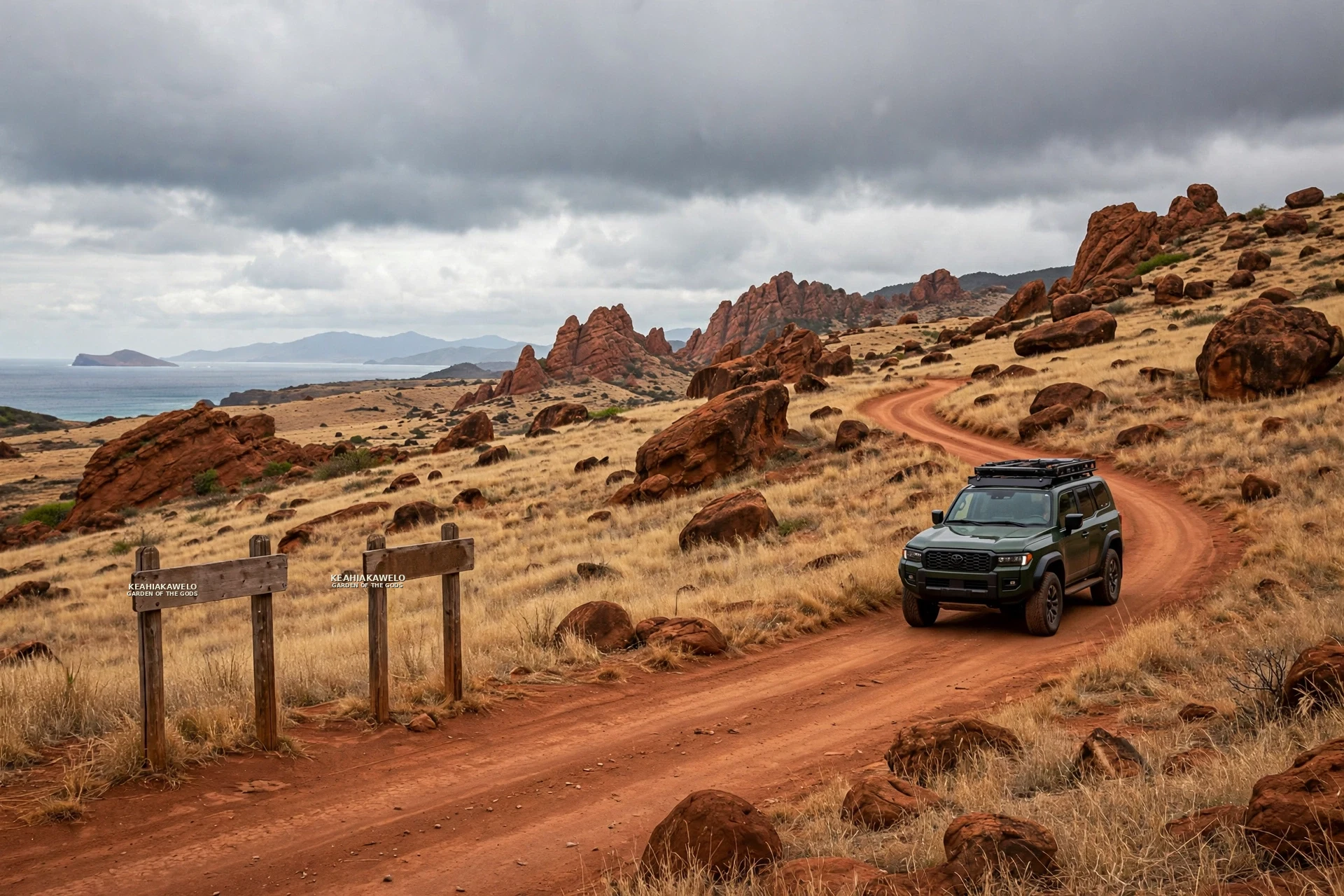
A four-wheel drive becomes necessary the moment your plans include the dirt road network: the Keahiakawelo Access Road to the Garden of the Gods, the Polihua Road to Shipwreck Beach, the Munro Trail access, and the rough tracks to Kaunolū and other remote points. These are unpaved, rutted, and in places rocky roads where a sedan will bottom out, lose traction, or sustain damage. Do not attempt them in a standard rental car. The drive to the Garden of the Gods alone takes about 45 minutes each way from Lānaʻi City on dirt, and it is firmly 4WD territory after rain.
Read your rental contract carefully before leaving the lot. Many rental agreements on Lānaʻi restrict or exclude off-pavement driving, and damage sustained on dirt roads may not be covered by the standard collision waiver. If you rent a 4WD specifically to reach the back roads, confirm in writing what the contract allows. Some travelers arrange their 4WD through specialty local operators rather than the national companies for exactly this reason. Whatever you choose, the rule is simple: know what you rented, know what it covers, and drive accordingly.
Fuel Planning
Lānaʻi has a single gas station, in Lānaʻi City. That is the entire fuel infrastructure of the island. Before any trip out of town, and especially before any dirt road excursion, fill the tank. The distances are short enough that a full tank covers any single day’s driving with wide margin, but leaving town on half a tank for a back road adventure is poor planning. Refuel in Lānaʻi City whenever you pass through, the way residents do, and you will never think about fuel again.
Rental Practicalities
Rental offices on Lānaʻi keep limited hours, and after-hours pickup or return needs to be arranged in advance. Confirm the office hours against your flight or ferry times when you book. Inspect the vehicle before driving off and note any existing damage on the rental agreement. Parking is free and easy everywhere on the island, including Lānaʻi City, the beaches, and the trailheads. Lock the car and keep valuables out of sight at remote trailheads and beach parking areas, the same common-sense practice that applies across Hawaiʻi.
Getting to Lānaʻi
Lānaʻi is reached by air or by ferry from Maui. There is no service from Oʻahu by boat, and no interisland ferry connecting Lānaʻi to Molokaʻi or the Big Island. Both routes are short and straightforward, and most visitors use one for arrival and sometimes the other for departure, depending on where the rest of their trip takes them.
Lānaʻi Airport (LNY)
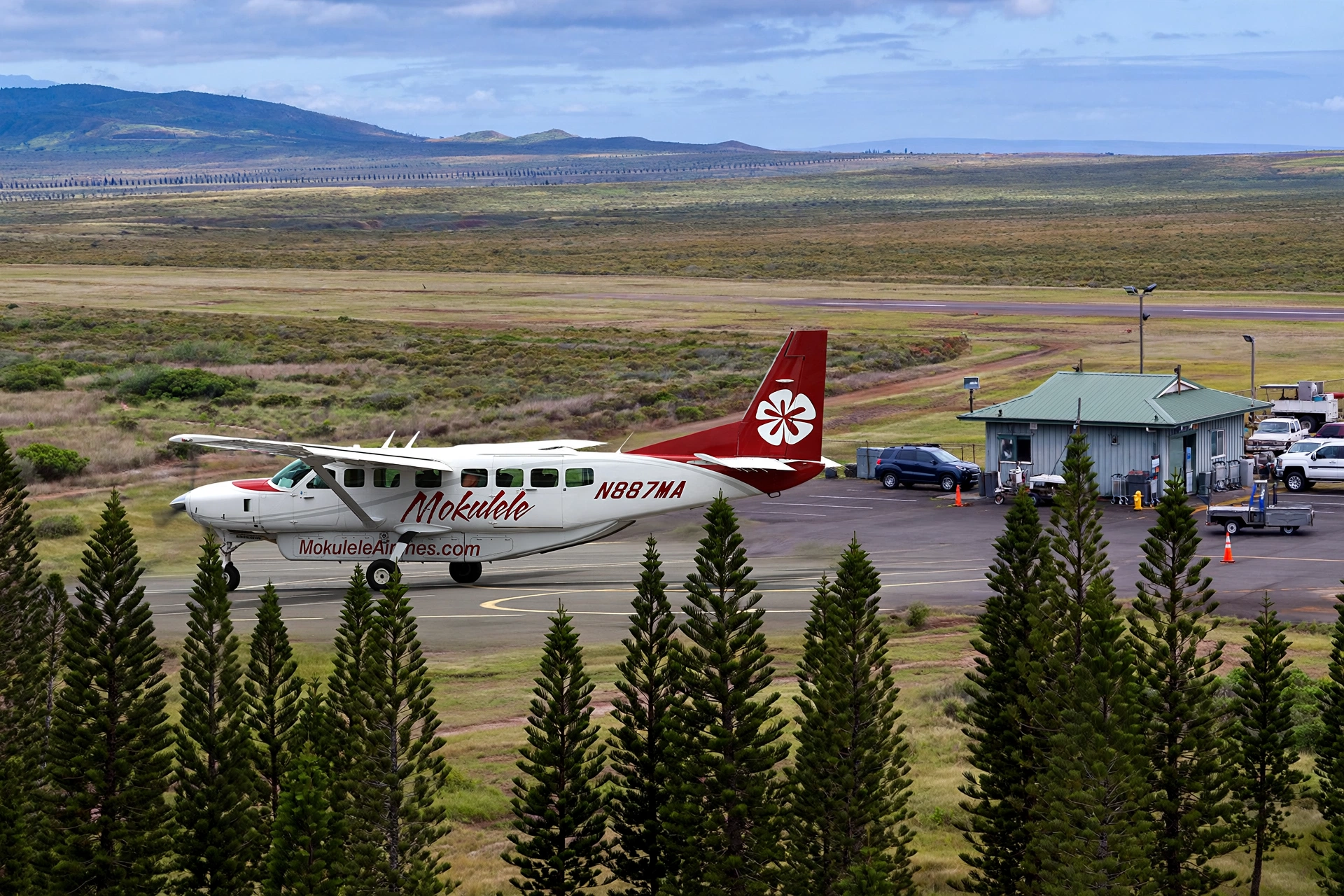
Lānaʻi Airport, with the airport code LNY, sits about 3 miles southwest of Lānaʻi City. It is served by commuter airlines operating small propeller aircraft on the roughly 25 to 30 minute flight from Honolulu International Airport (HNL) and the even shorter hop from Kahului Airport (OGG) on Maui. The flight from Honolulu is one of the great short hops in Hawaiʻi, crossing the channel with views of Molokaʻi, Maui, and on clear days the Big Island. Check-in is quick, the terminal is tiny, and you will be in your rental car within minutes of landing.
Flight schedules are thinner than interisland service between the big islands, with a handful of departures daily from each gateway. The last flight of the day can be quite early, so plan Honolulu or Maui connections with care. If you are arriving on a mainland or international flight into Honolulu, leave generous connection time, because a missed commuter flight can mean an overnight in Honolulu. Baggage allowances on small commuter aircraft can be tighter than on large jets, so check your airline’s limits if you are traveling with oversized gear.
The Ferry from Maui
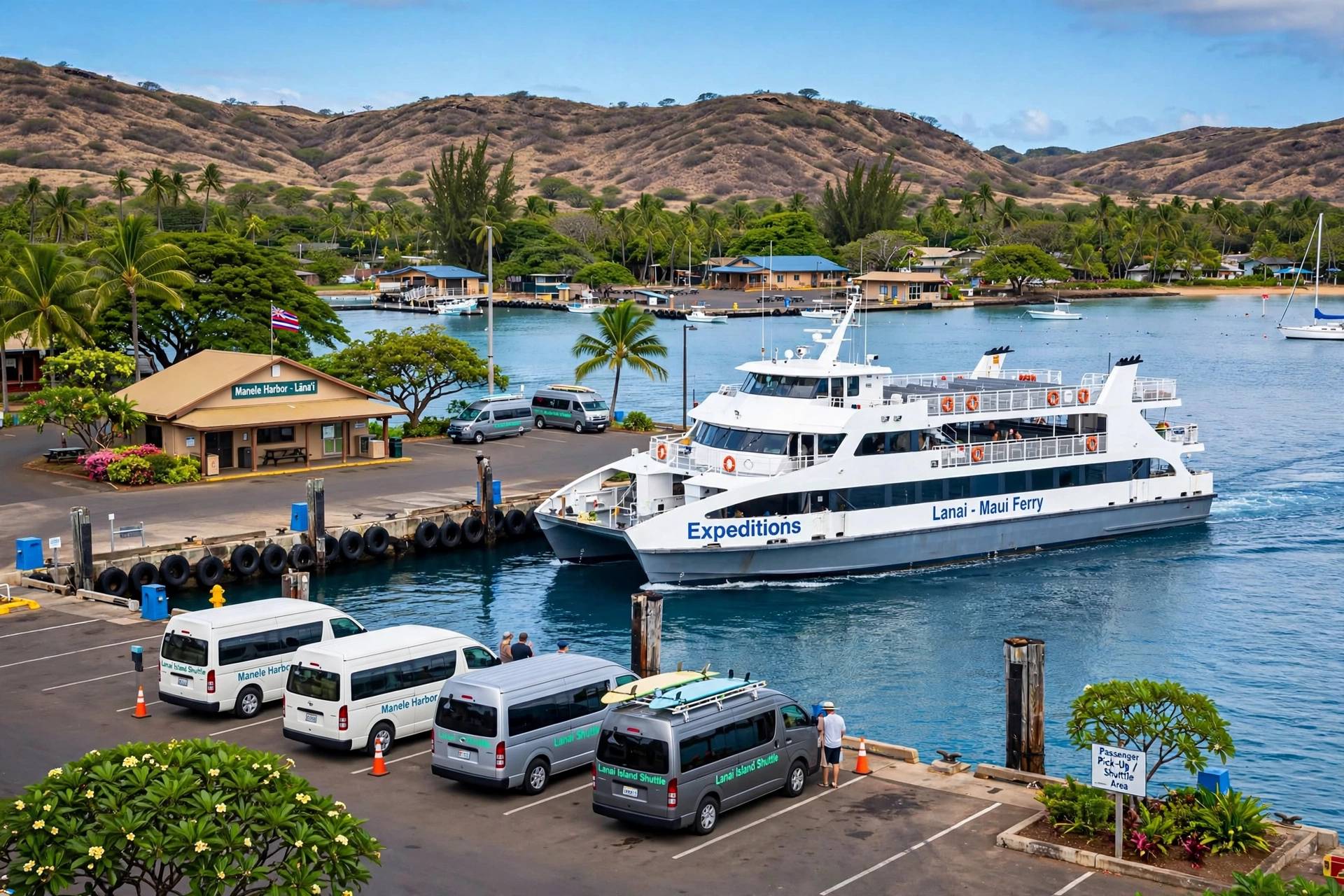
The passenger ferry between Maui and Lānaʻi is one of the most pleasant interisland crossings in Hawaiʻi. The Expeditions ferry runs multiple round trips daily between Māʻalaea Harbor on Maui’s south shore and Mānele Harbor on Lānaʻi, with a crossing time of about 1 hour 15 minutes. The ride crosses the ʻAuʻau Channel, and in winter months passengers regularly spot humpback whales from the deck. Advance booking is strongly recommended, especially for the popular morning departures to Lānaʻi and afternoon returns to Maui, and walk-on space can sell out on weekends and holidays.
The ferry carries passengers only, not rental cars. If you are bringing a car to Lānaʻi, it must come by barge or you must rent on the island. Most ferry passengers are day-trippers or overnight visitors who use shuttles on the Lānaʻi side, which is the subject of the next section. The Māʻalaea departure point has paid parking, and travelers staying on Maui’s west or south shores should allow extra drive time to reach the harbor, particularly for early morning sailings.
Hotel and Shuttle Transfers
For travelers without a rental car, shuttles are the practical way to move between Mānele Harbor, Hulopoʻe Beach, and Lānaʻi City. The large resort at Mānele operates guest shuttles between the harbor, the beach, and its properties, and these run on regular schedules for guests. If you are staying at the resort, your transfers are essentially handled, and many guests never need a car at all.
Independent travelers can use private shuttle services that meet the ferry at Mānele Harbor and run to Lānaʻi City, Hulopoʻe Beach, and other points. These are small operations with limited capacity, so advance reservations are essential, particularly if your ferry arrives outside the main midday window. Your accommodation in Lānaʻi City can usually advise on the current shuttle operators and help you arrange pickups. Confirm the return trip to the harbor at the same time you book the arrival transfer, because missing the last ferry of the day strands you overnight.
Day-trippers from Maui make this system work well. A typical car-free day trip looks like this: morning ferry from Māʻalaea, shuttle to Hulopoʻe Beach for swimming and snorkeling, the coastal walk to Sweetheart Rock, lunch, a shuttle up to Lānaʻi City for Dole Park and the shops, and the afternoon ferry back. It is a full and satisfying day that requires no car at all. What the shuttle system cannot do is reach the dirt road destinations, so Garden of the Gods, Shipwreck Beach, and the Munro Trail remain out of reach without a 4WD or a guided tour that includes transportation.
Public Transit and Rideshares
There is no public bus system on Lānaʻi for visitors, and no rideshare coverage you can plan around. This is worth stating plainly, because travelers accustomed to Oʻahu’s TheBus or Maui’s shuttle network sometimes assume a small island will have something equivalent. It does not. The island’s transportation for residents runs on private cars, and visitors should plan the same way.
Taxi service exists but is extremely limited. A small number of operators serve the island, mainly for airport and harbor transfers, and advance booking is essential. There is no taxi stand culture and no guarantee of availability on short notice. Rideshare apps show effectively no reliable driver presence on Lānaʻi. Do not build any part of your itinerary around the assumption that you can summon a ride. If you need a taxi for a specific transfer, such as an early airport departure, arrange it well in advance through your accommodation.
Walking and Biking
Lānaʻi City is genuinely walkable. The town is compact and flat, Dole Park sits at its center, and the shops, restaurants, grocery store, and the Culture and Heritage Center are all within easy strolling distance. Many visitors park their car at their lodging and explore town on foot, which suits both the scale of the place and its unhurried pace. Sidewalks exist in the town core, traffic is negligible, and there are no traffic lights anywhere on the island.
At the coast, the Hulopoʻe Beach area is walkable in the resort sense: the beach, the tide pools, the coastal trail to Sweetheart Rock, and the Mānele Harbor area connect on foot. Beyond these pockets, walking becomes recreation rather than transportation. The 8-mile road between Lānaʻi City and Mānele has no sidewalks and steady vehicle traffic, and the dirt roads to remote sights are not walking routes.
Cycling is a niche option for experienced riders. The paved roads around Lānaʻi City and the descent to Mānele are rideable, and early mornings bring calm conditions before the trade winds build. However, there are no bike lanes, shoulders are inconsistent, and bike rental availability on the island is limited, so most cyclists bring their own bikes or arrange them well in advance. The dirt roads demand mountain bikes and self-sufficiency. If you ride, use lights, ride defensively, and avoid the highways after dark.
Driving Tips for Lānaʻi
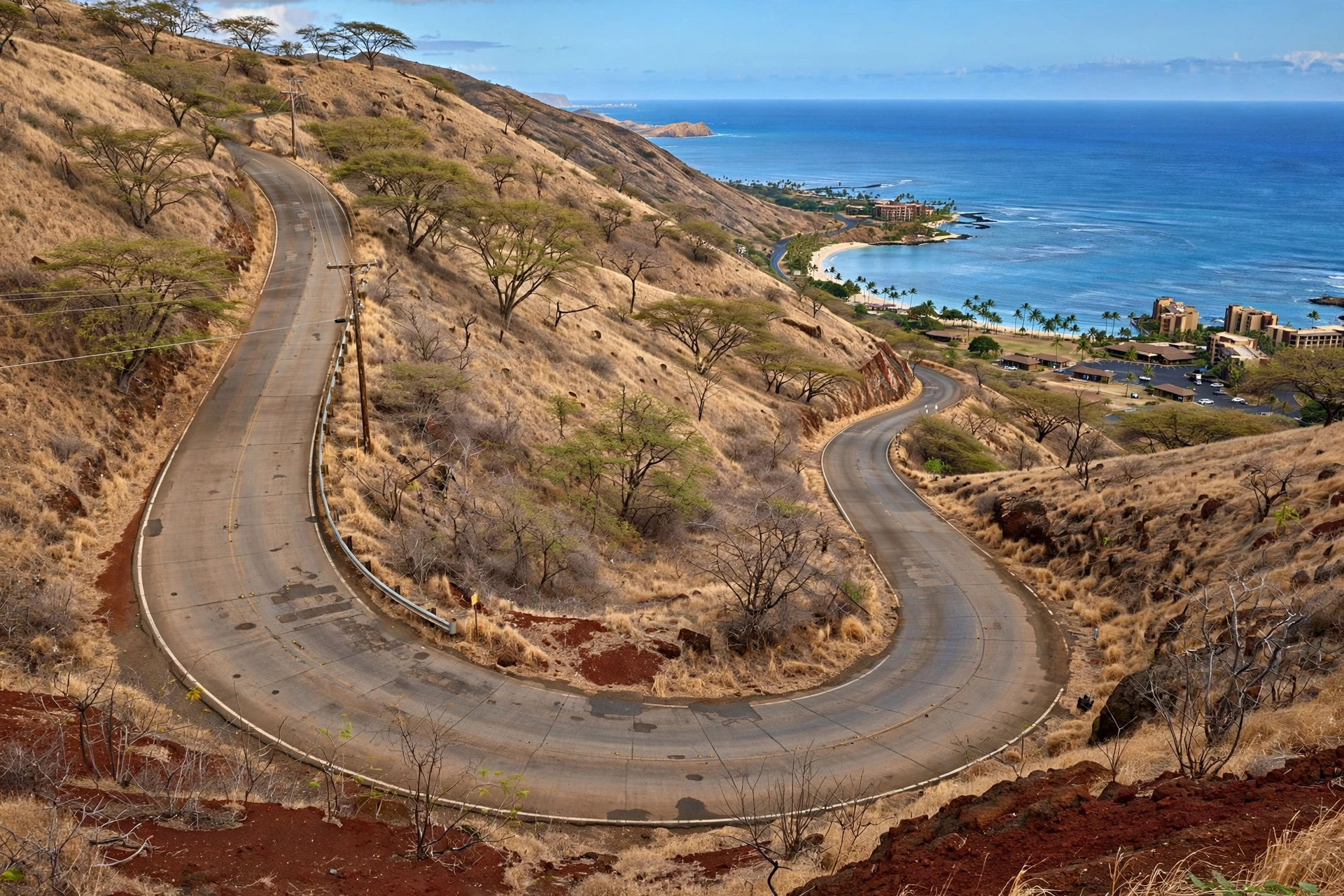
Driving the paved roads of Lānaʻi is easy. The two roads that matter are the Kaumālapaʻu Highway (Route 440), which runs from the airport area to Lānaʻi City, and Mānele Road (Route 460), which descends from Lānaʻi City to Mānele Harbor and Hulopoʻe Beach. Both are well maintained two-lane roads. Speed limits are low, typically 35 miles per hour or less, and they are enforced. Drive the posted speed: the limits reflect narrow shoulders and pedestrian areas in town rather than traffic volume, and the island’s police have little else to do.
The dirt roads are a different undertaking and deserve respect. The Keahiakawelo Access Road, the Polihua Road to Shipwreck Beach, and the Munro Trail road are unpaved, rough, and in wet conditions can become slick or deeply rutted. Reduce speed, keep both hands on the wheel, and never drive these roads at night. Lānaʻi’s famous red dirt stains everything it touches, including shoes, clothing, and car interiors, so dress accordingly and protect the rental’s upholstery if the contract holds you responsible for excessive cleaning.
Cell coverage disappears on the back roads and in the island’s remote corners. Download offline maps before leaving Lānaʻi City, tell someone your route and expected return time before a dirt road excursion, and carry more water than you think you need. There are no services, no fuel, and no help beyond the paved network, and a flat tire or a stuck vehicle on a remote road becomes a real problem without preparation. A portable tire inflator and the knowledge of where your spare is are cheap insurance.
A few final courtesies of the road. Pull over to let faster local traffic pass on the narrow highways. Yield to the island’s axis deer, which cross roads most actively at dawn and dusk. During hunting seasons, parts of the backcountry see increased truck traffic, so stay alert on shared dirt roads. And when you return a 4WD after a dusty day, a quick rinse at a car wash in town, where available, is both polite and sometimes contractually expected.
Accessibility
Travelers with mobility needs should plan Lānaʻi carefully and honestly. The island’s small scale helps: Lānaʻi City’s flat town core, Dole Park, and the shops are navigable, and Hulopoʻe Beach has accessible parking and restroom facilities with a relatively gentle beach approach. The paved viewpoints and the Culture and Heritage Center are workable for most visitors.
The limits are real. Small commuter aircraft have tight boarding and baggage constraints, so travelers who use wheelchairs or need assistance should coordinate with the airline well in advance. Adapted rental vehicles are effectively unavailable on the island. The dirt road destinations, the Munro Trail, and the coastal walk to Sweetheart Rock involve uneven terrain that is not wheelchair accessible. If independent mobility is essential to your trip, the paved corridor of Lānaʻi City, Mānele Road, and Hulopoʻe Beach is the practical scope, and it still makes for a good visit.
Frequently Asked Questions
Do I need a rental car on Lānaʻi?
If you are staying overnight and want to explore independently, yes. A rental car is the only practical way to move between Lānaʻi City, the airport, and Hulopoʻe Beach on your own schedule. Day-trippers arriving by ferry can manage without one by using shuttles between Mānele Harbor, the beach, and town. There is no public transit or rideshare to fall back on, so decide based on your itinerary, not on the assumption that alternatives will appear.
Do I need a four-wheel drive on Lānaʻi?
Only if your plans include the dirt road destinations: the Garden of the Gods, Shipwreck Beach, Polihua Beach, the Munro Trail access, or Kaunolū. Everything on pavement, including Lānaʻi City, the airport, Mānele Harbor, and Hulopoʻe Beach, is easily handled by a standard sedan. If you are unsure, book the 4WD, because upgrading after arrival is often impossible when the small fleet is sold out.
How do I get to Lānaʻi?
Two ways: commuter flights into Lānaʻi Airport (LNY) from Honolulu or Kahului on Maui, taking about 25 to 30 minutes, or the passenger ferry from Māʻalaea Harbor on Maui to Mānele Harbor on Lānaʻi, taking about 45 minutes with multiple daily round trips. There is no ferry from Oʻahu and no service to or from Molokaʻi.
Is the ferry to Lānaʻi reliable?
Yes, it runs daily in normal conditions, but it is weather dependent, and rough channel conditions can cause delays or cancellations, particularly in winter. Book in advance, arrive early, and do not schedule a tight connection to a flight on Maui the same afternoon. Build buffer time into ferry days.
Is there public transportation or Uber on Lānaʻi?
No to both, for practical purposes. There is no visitor bus system and no reliable rideshare coverage. A few taxi operators handle airport and harbor transfers with advance booking. Plan on a rental car, hotel shuttles, or pre-arranged private shuttles.
Can I visit Lānaʻi as a day trip without a car?
Yes, and many people do. Take the morning ferry from Māʻalaea as a walk-on passenger, use shuttles between Mānele Harbor, Hulopoʻe Beach, and Lānaʻi City, and return on the afternoon ferry. You can swim, snorkel, walk to Sweetheart Rock, explore Dole Park, and have lunch, all without a car. Book the ferry and shuttles in advance.
Where do I get gas on Lānaʻi?
There is one gas station, in Lānaʻi City. Fill up before leaving town for any excursion, especially dirt road trips where there are no services at all. A full tank covers any single day of driving on the island with wide margin.
Is driving on Lānaʻi difficult?
The paved roads are among the easiest driving in Hawaiʻi: short, well kept, and nearly empty. The dirt roads are the challenge, requiring a 4WD, daylight, offline maps, and self-sufficiency. If you stay on pavement, anyone comfortable on rural two-lane roads will be completely at ease.
Related Guides
- Lānaʻi Travel Guide: the complete island overview, where to stay, and top things to do.
- Lānaʻi Map: regions, roads, towns, and drive times across the island.
- Lānaʻi Beaches: Hulopoʻe, Shipwreck Beach, and honest ocean safety.
- Lānaʻi Hikes: the Munro Trail, Koloiki Ridge, and coastal walks.
- Lānaʻi Snorkeling: Hulopoʻe Bay and reef etiquette.
- Hawaiʻi Map: the full island chain and interisland distances.
A Final Note
Lānaʻi rewards the traveler who plans transportation early and then stops thinking about it. Reserve the right vehicle or arrange your transfers well before you travel, fill the tank in Lānaʻi City, download your maps, and the island’s short distances take care of the rest. The road to the Garden of the Gods is red, the road to Hulopoʻe is smooth, and both are empty in a way that the bigger islands can no longer offer. On Lānaʻi, the drive is part of the quiet, and a little preparation is all it takes to keep it that way.