Mauna Kea Snow: Hawaii’s Snowcapped Summit, When to Go and How to Get There

There is a photograph every Big Island visitor seems to take at some point: the beach in the foreground, warm and blue, and on the horizon a mountain wearing a cap of white. It looks like a trick of the light, or a bad edit. It is neither. That white cap is snow, sitting on the summit of Mauna Kea, the tallest volcano in Hawaiʻi, and one of the strangest and most beautiful sights in the entire state.
Mauna Kea rises 13,803 feet above sea level, which makes it the highest point in Hawaiʻi and the highest island mountain in the world. Drive from the Kona coast to the summit in a single morning and you pass through more climate zones than some cross-country road trips: beach, dry forest, ranch land, subalpine scrub, and finally a cold alpine desert where the air is thin, the wind bites, and in winter the ground turns white. Few places on Earth let you go from swimming to snow in a few hours.
Before you go up, one thing every visitor should understand: Mauna Kea is sacred to Native Hawaiians, and the mountain deserves respect.
Why Snow Falls on a Hawaiian Volcano
The explanation is simple physics. For every thousand feet you climb, the temperature drops roughly 3 to 5 degrees Fahrenheit. Sea level on the Big Island might be a pleasant 80 degrees; by the time you reach the summit, more than 13,000 feet higher, the air can be 40 to 60 degrees colder. In summer that still leaves the summit chilly but above freezing most days. In winter, cold fronts sweeping down from the north bring the summit temperature below freezing, and when those fronts carry enough moisture, that moisture falls as snow instead of rain.
The summit also sits above the tropical inversion layer, a band of the atmosphere that traps clouds and moisture below. That is why Mauna Kea is such a prized site for observatories: the air above the inversion is dry, thin, and remarkably clear. It is also cold. Average summit temperatures hover around freezing, and overnight lows drop well below it for much of the year. All it takes is one good winter storm to turn the cinder cones white.
When Does It Snow on Mauna Kea?
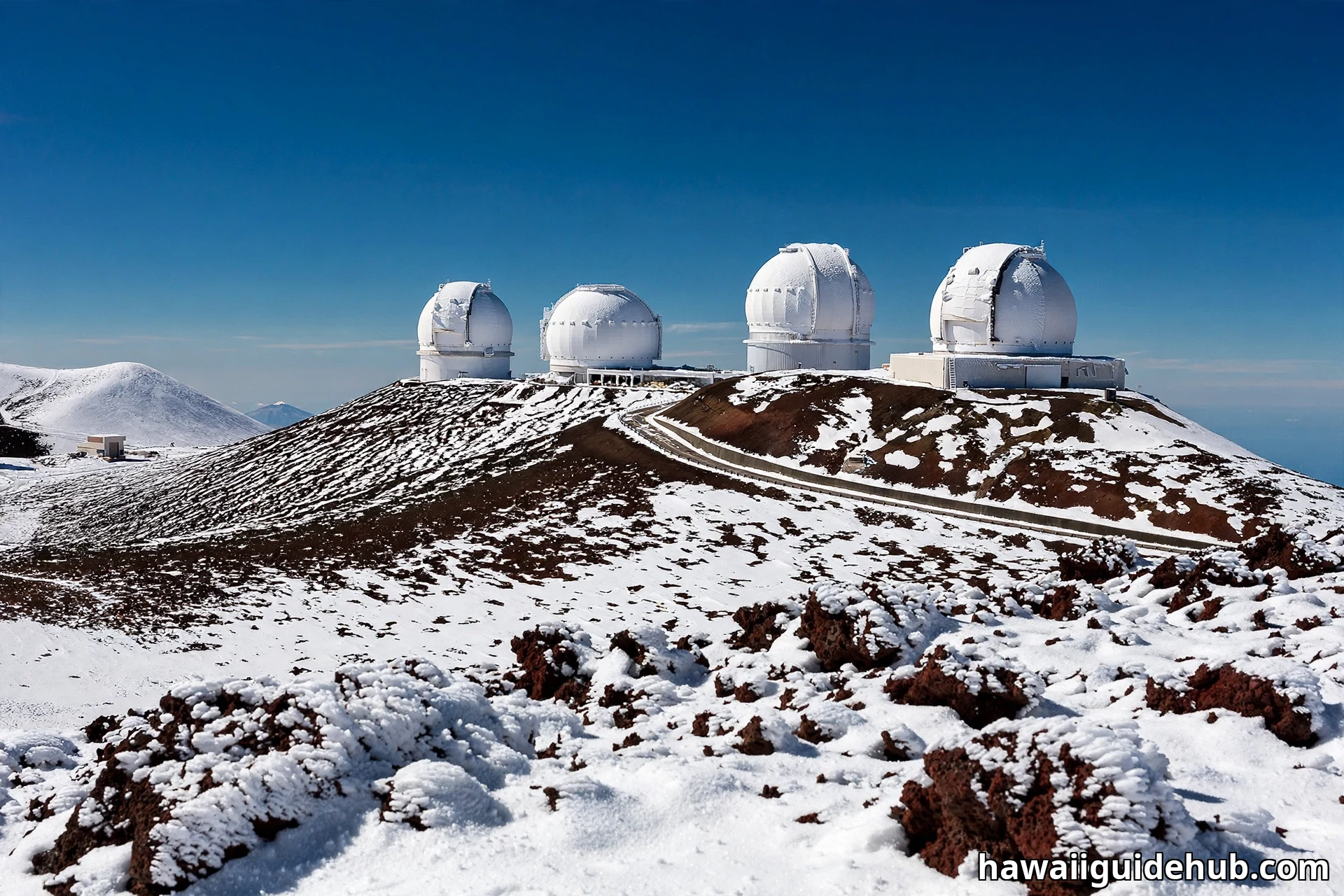
Snow can fall on the summit in any month, and the Mauna Kea Weather Center notes that summer snowstorms have happened. But the real snow season runs from October through April, with December through February offering the highest probability. A single winter storm can drop several feet of snow on the summit; a week of strong tropical sun can melt most of it away. That is the defining feature of Mauna Kea snow: it is fleeting, unpredictable, and completely dependent on the weather.
If your heart is set on seeing snow, plan a winter trip and build flexibility into your schedule. Watch the forecast at the Mauna Kea Weather Center in the days before your visit, and be ready to go up on short notice. The most reliable months are December, January, and February. November and April can deliver, but they are less consistent. In summer, seeing snow is a matter of rare luck, not planning.
One important note: heavy snow almost always means the summit road is closed. The Mauna Kea Rangers close the Summit Access Road whenever there is ice or snow on the road, when sustained winds top 55 miles per hour, or when visibility drops below 50 feet. So the best strategy for most visitors is to go in the days after a storm, when the road has reopened and the summit is still white.
Seeing the Snow From Below
You do not have to drive to the summit to see Mauna Kea snow. On clear winter mornings the white peak is visible from miles away: from the Kohala coast, from Waimea, from Hilo, even from parts of Maui across the channel. It is one of the great visual paradoxes of Hawaiʻi, a snowcapped mountain rising out of the tropics, and for many visitors this distant view is enough.
But standing in the snow yourself, at nearly 14,000 feet, with the observatories gleaming and the Pacific stretching to every horizon, is a different experience entirely. It ranks among the most memorable outdoor adventures in Hawaii. Here is how to do it safely.
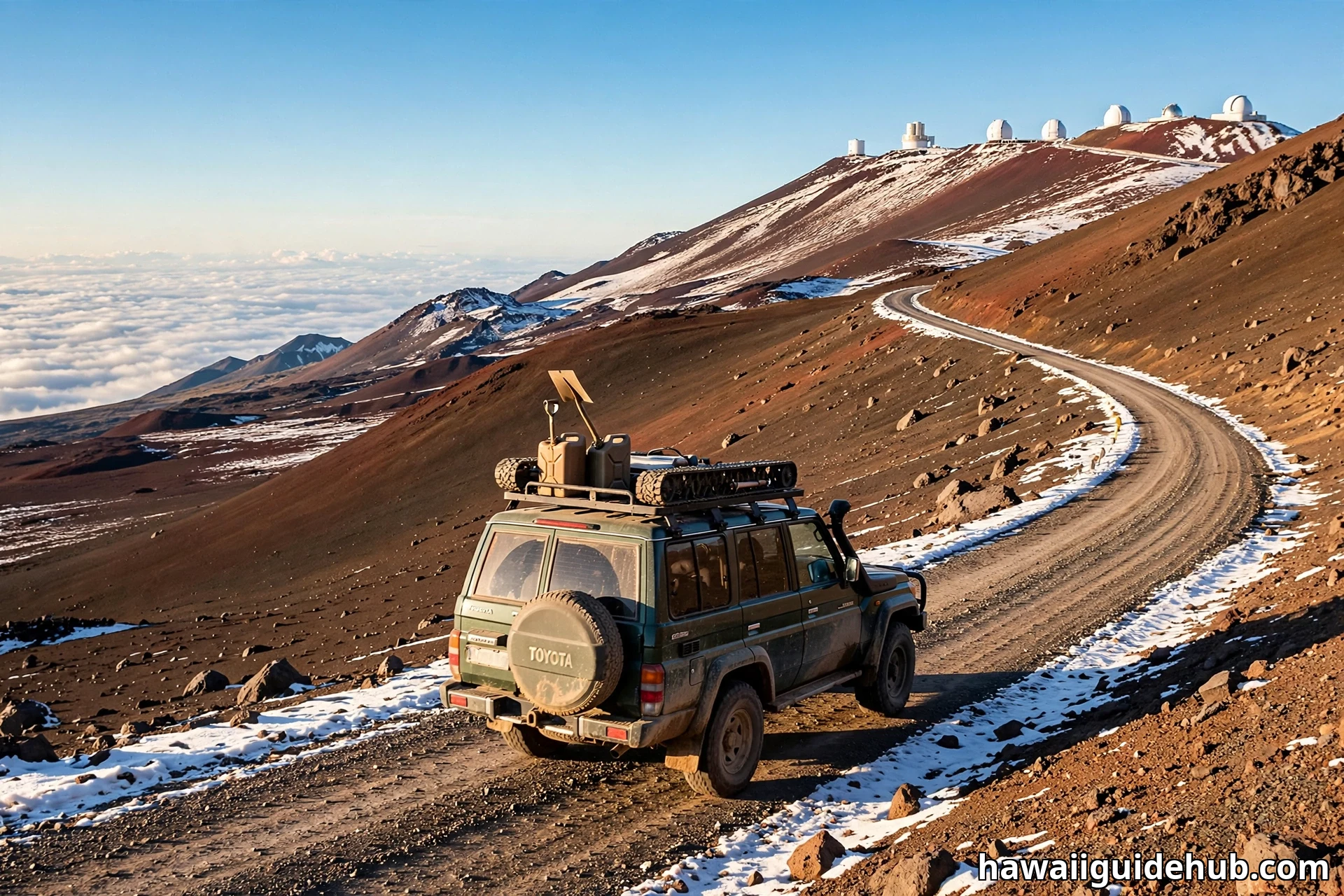
Driving to the Summit: The Road and the Rules
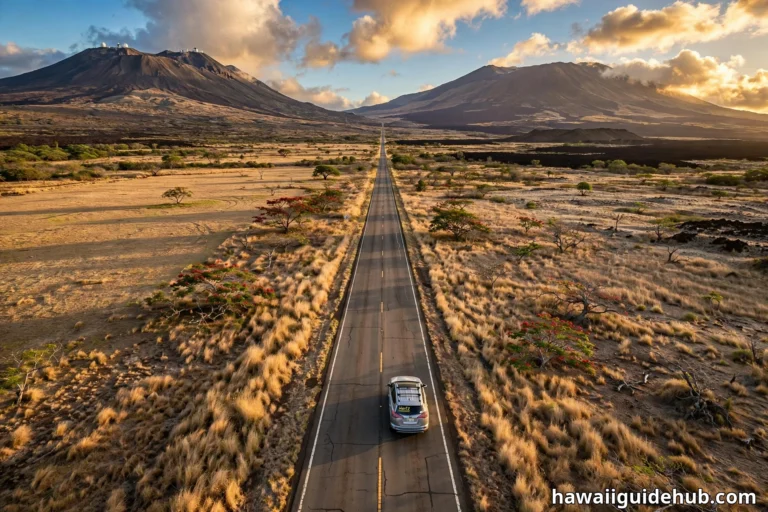
The drive begins on the Daniel K. Inouye Highway, also known as Saddle Road (Highway 200), which runs between Hilo and Kona. The Maunakea Access Road turnoff is at mile marker 28. From Hilo the drive to the turnoff takes about 45 minutes; from the Kona-side resorts, plan on 90 minutes to 2 hours.
The first stop is the Visitor Information Station, or VIS, at 9,200 feet. The road to the VIS is paved and well maintained, and any standard car can make it. The VIS is also where you acclimatize: the rangers recommend stopping here for at least 30 minutes before driving higher, because the jump from sea level to 13,803 feet is extreme and altitude sickness is a real risk.
Beyond the VIS, everything changes. The eight-mile summit road climbs nearly 5,000 feet, and several miles are unpaved, steep, and only wide enough for single-lane traffic in places. Grades exceed 15 percent. The official rule from the University of Hawaiʻi at Hilo, which manages the mountain: dependable, fully operable 4WD or AWD vehicles are required for summit travel. Two-wheel-drive vehicles are not permitted above the VIS, full stop. Rangers screen vehicles at the station and turn back anything without 4WD, anything caked in mud that could spread invasive species, and anything with less than half a tank of fuel.
A warning about rentals: most rental car companies explicitly prohibit driving to the Mauna Kea summit, even in their 4WD vehicles, and will void your coverage if you damage the car on the summit road. Read your rental agreement carefully. If you do not have access to a personal 4WD vehicle you are allowed to take up the mountain, a guided tour is the cleaner and safer choice.
The summit itself is closed to visitors from 30 minutes after sunset to 30 minutes before sunrise, to avoid interfering with observatory operations. Plan to be heading down well before dark.
Check Conditions Before You Go
Mauna Kea weather can turn from calm to dangerous fast. Hurricane-force winds above 120 miles per hour have been recorded at the summit, and a calm sunny morning can become a blizzard by afternoon. Never drive up on a hotel-room forecast alone.
Before you go, check two sources: the Mauna Kea Weather Center website for the summit forecast and road status, and the recorded road-conditions line at (808) 935-6268. If the road is closed for snow, ice, or wind, do not try to talk your way up or find another route. There is no other route, and the closures exist because people have been hurt.
What to Wear and Bring
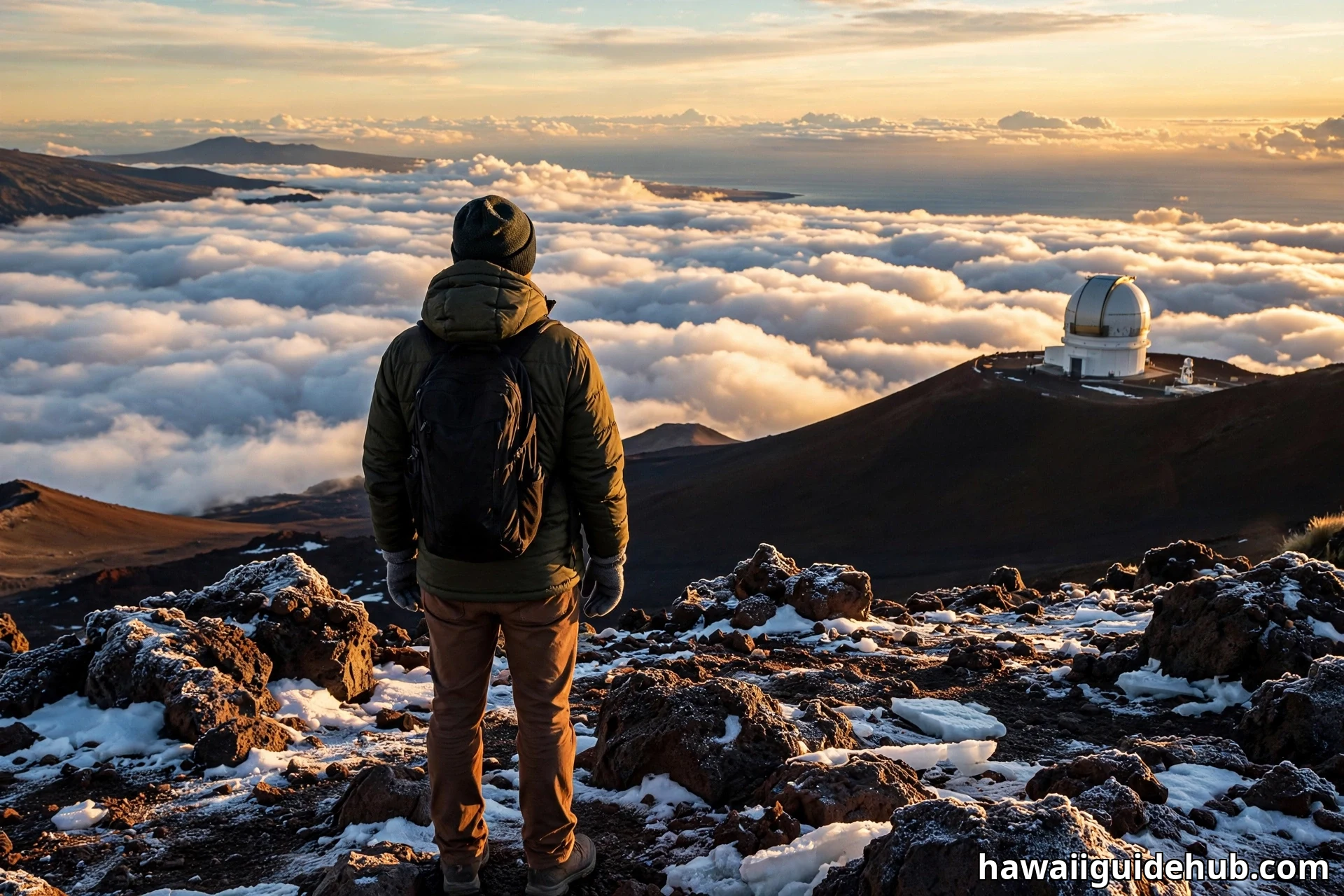
This is where most first-timers go wrong. People drive up in shorts, slippers, and a t-shirt because it was 82 degrees at their hotel. At the summit in winter, temperatures can sit in the 20s with wind chill pushing them far lower. Hypothermia at the top of a Hawaiian volcano is a real and documented emergency scenario.
Dress for a mountain in winter, not a beach in Hawaiʻi. That means a warm base layer, an insulating mid-layer, and a windproof outer shell. Long pants, not shorts. Closed-toe shoes or boots with grip, not slippers. A warm hat, gloves, and sunglasses or goggles for the intense high-altitude sun and snow glare. Sunscreen is essential too: at 13,800 feet the ultraviolet exposure is brutal, and snow reflects it back at you.
Bring more water than you think you need. The thin dry air dehydrates you fast, and there are no services, no water, and no food at the summit. The VIS has limited food and restrooms, but above that you are on your own. A full tank of gas before you leave town is mandatory, and the rangers want to see at least half a tank at the checkpoint.
Altitude: Take It Seriously
At 13,803 feet, the summit of Mauna Kea has roughly 40 percent less oxygen than sea level. Headache, nausea, dizziness, and shortness of breath are common, and they can hit fast. The 30-minute acclimatization stop at the VIS is not a suggestion to skip; it is the minimum. Drink water, move slowly, and do not push yourself.
The official guidance is clear about who should not go above the VIS: children under 13, anyone who is pregnant, anyone with heart or respiratory conditions, and anyone who has been scuba diving in the last 24 hours. If you feel genuinely ill at the summit, the treatment is simple: descend. Do not tough it out at 13,800 feet.
The Summit Experience in Winter
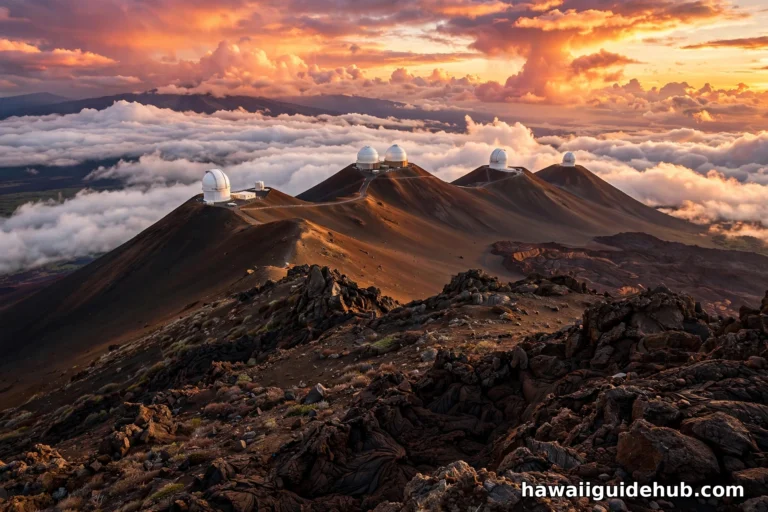
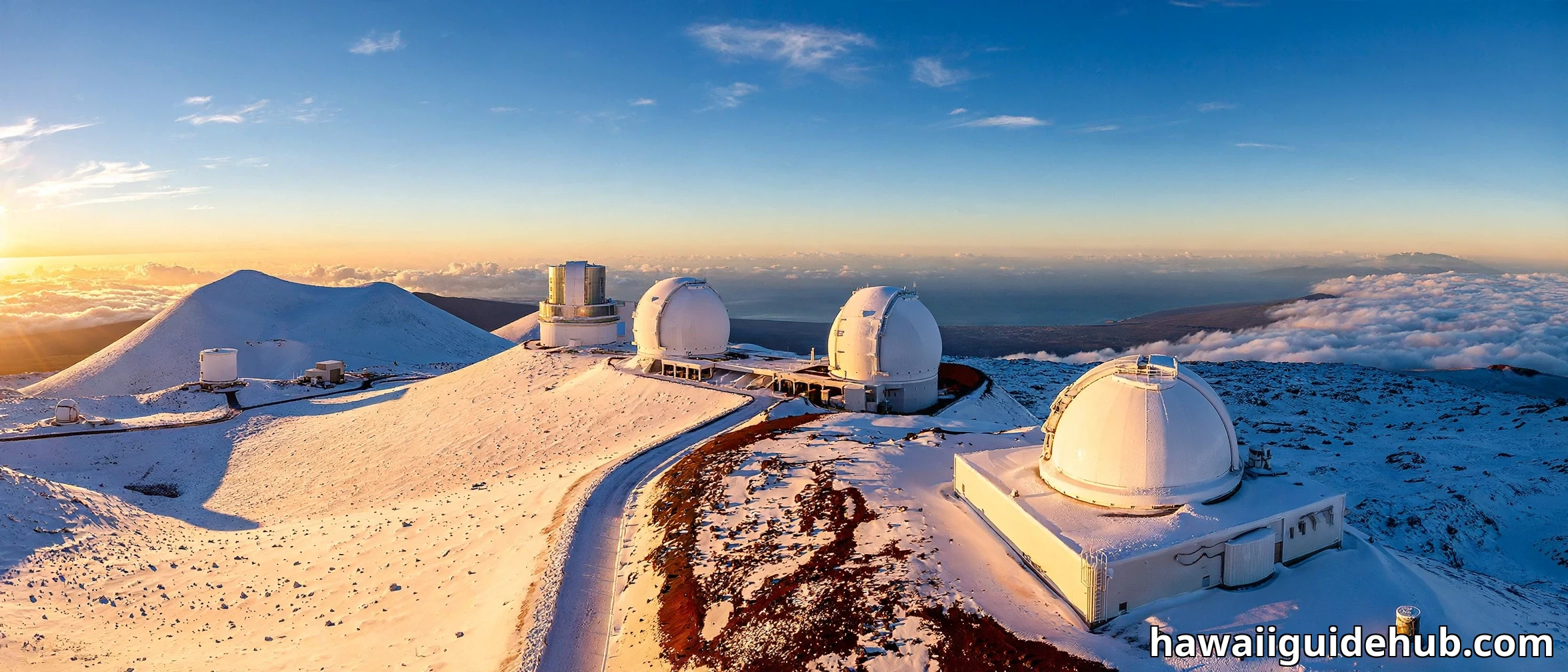
On a clear winter day after a storm, the summit is unforgettable. The red-brown cinder cones wear white. The observatories, a cluster of domes and dishes from institutions around the world, stand out against the snow. Below you, a sea of clouds; above, a sky of impossible blue. On the clearest days you can see the summit of Haleakalā on Maui across the channel. Mauna Kea pairs naturally with a visit to Hawaiʻi Volcanoes National Park for the full Big Island volcano experience.
Walk around the summit area, take your photographs, and keep your visit efficient. The cold and the altitude wear on you faster than you expect. Most visitors spend 30 to 60 minutes at the top before the combination of thin air and cold sends them happily back downhill.
One thing you will not be doing: skiing. People do ski Mauna Kea after big storms, and it is a storied local tradition, but it is entirely unofficial. There are no lifts, no patrol, no rentals anywhere on the Big Island, and no groomed runs. What exists is a steep cinder cone, variable snow, and a long walk back up. Treat any talk of Mauna Kea skiing as expert-only backcountry adventure, not a resort day.
Sunset and Stargazing
Many visitors time their summit trip for late afternoon, catching sunset from above the clouds before descending. The light on the snow and the observatories at golden hour is spectacular. Just remember the rule: you must leave the summit 30 minutes after sunset.
For stargazing, the VIS area hosts evening programs, and the night sky from 9,200 feet is among the best on Earth. Dress even warmer than you think necessary. Nighttime temperatures at the VIS drop into the 30s and 40s even in summer, and in winter they go lower.
Respecting the Mountain
Mauna Kea is not just a mountain. To Native Hawaiians it is a sacred place, the piko, or umbilical cord, connecting Hawaiʻi to the heavens, and the burial place of ancestors. The summit region holds shrines, burials, and cultural sites. This is not background color; it is the central fact of the mountain, and it is why access and development here have been the subject of intense and ongoing debate.
As a visitor, respect is simple: stay on marked roads and in designated areas. Do not hike to or around the true summit peak, do not disturb rock piles or leave offerings or items anywhere on the mountain, and do not take rocks. Follow ranger instructions. The mountain welcomes visitors who come with humility.
Planning Your Trip
For the best chance at snow, visit between December and February and keep your summit day flexible. Stay somewhere that lets you pivot: Waimea and Hilo are both reasonable bases, and the drive from either is manageable. Check the Mauna Kea Weather Center forecast the night before and the morning of. If the road is open and the summit is white, go. If the road is closed, enjoy the view from below and try again tomorrow.
After the cold, you will want warmth. The drive back down passes through Waimea, a paniolo ranching town with some of the must-try local dishes in Hawaii, and the contrast of snow in the morning and a hot meal at sea level in the evening is one of the great Big Island days. For ideas on where to eat and what else to do on the island, see our guide to the best things to do on the Big Island.
See the Summit on Video
Frequently Asked Questions
Does it snow in Hawaii?
Yes. Snow falls regularly on the summits of Mauna Kea and Mauna Loa on the Big Island, and occasionally on Haleakalā on Maui. Mauna Kea is the most reliable, with a snow season running roughly October through April.
When is the best time to see snow on Mauna Kea?
December through February offers the highest probability. Snow is entirely weather-dependent, so watch the Mauna Kea Weather Center forecast and be ready to go on short notice after a storm.
Can I drive to the summit in a regular car?
You can drive a regular car to the Visitor Information Station at 9,200 feet. Beyond the VIS, only dependable 4WD or AWD vehicles are permitted, and rangers turn back 2WD vehicles. Most rental agreements prohibit the summit road entirely.
Is it free to visit Mauna Kea?
Yes. There is no entry fee for the VIS or the summit. Guided tours, which typically include transport, warm gear, and dinner, generally cost between $179 and $250 per person.
How cold does it get at the summit?
Average summit temperatures hover around freezing, 32 degrees Fahrenheit. In winter, daytime highs can sit in the 20s or 30s with wind chill far lower, and overnight lows drop well below freezing.
Is it safe for kids to visit the summit?
Children under 13 are advised not to go above the VIS because of the high risk of altitude sickness at 13,803 feet. The VIS itself, at 9,200 feet, is a great family stop with sunset views and stargazing programs.
Mauna Kea in winter is Hawaiʻi at its most surprising: a snowcapped summit rising out of the Pacific, reachable by road, wrapped in deep cultural meaning. Go prepared, go respectfully, and check the weather. The mountain decides when it wears white, and catching it on a white day is something you will talk about for years.