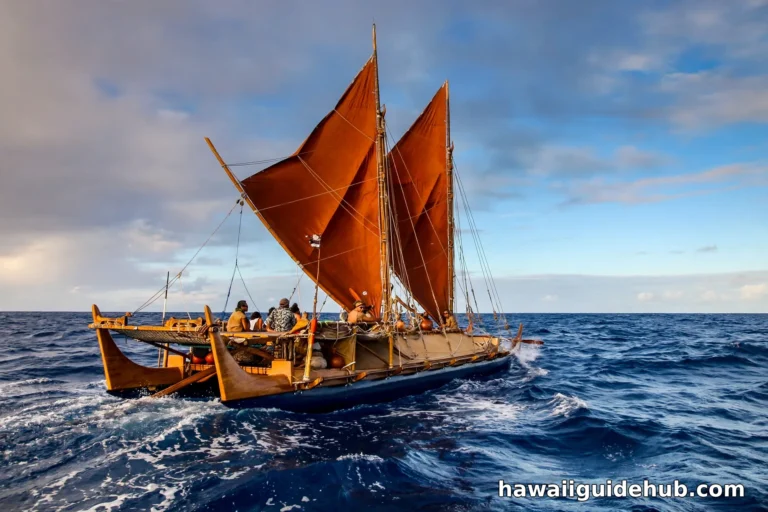
Hawaii’s Plantation Era: Sugar, Struggle, and Modern Hawaii

For over 150 years, sugar ruled Hawaii: its plantations shaped the islands’ economy, demography, politics, and culture. The plantation era brought hundreds of thousands of immigrants, built towns and railroads, enriched the Big Five, and forged modern Hawaii’s multicultural identity in the canefields. This guide tells the full story: the rise, the workers, the strikes, and the end of sugar.
This is the single complete guide to Hawaii’s plantation era. It covers the first plantations, the sugar boom, the Big Five, the immigrant labor waves, plantation life, the strikes, the 1946 turning point, the end of sugar, and the legacy. Everything about the plantation era lives on this one page.
The First Sweet Harvests
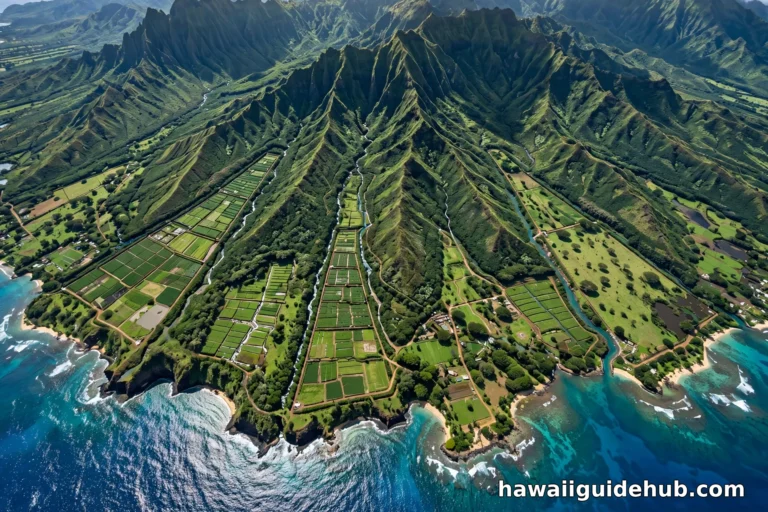
Commercial sugar began in 1835 at Koloa, Kauai: the first plantation, grinding cane with primitive mills. The industry grew slowly until the 1876 Reciprocity Treaty gave Hawaiian sugar duty-free access to the American market: then it exploded. Plantations spread across the islands, irrigation ditches carried water for miles, railroads hauled cane to the mills, and company towns rose around the smokestacks. By the early 1900s, sugar was Hawaii’s economic king, and the plantation owners, the Big Five companies, were its uncrowned rulers.
The Big Five
Five companies came to dominate the industry: Castle and Cooke, Alexander and Baldwin, C. Brewer, American Factors, and Theo H. Davies. Through interlocking ownership, they controlled the plantations, the shipping, the banks, and much of the islands’ land. Their power extended into politics: the Big Five’s influence helped drive the overthrow of the Hawaiian monarchy in 1893 and annexation in 1898, securing the tariff advantages sugar depended on. The plantation era was an economic system and a political order: the companies’ interests were Hawaii’s policy.
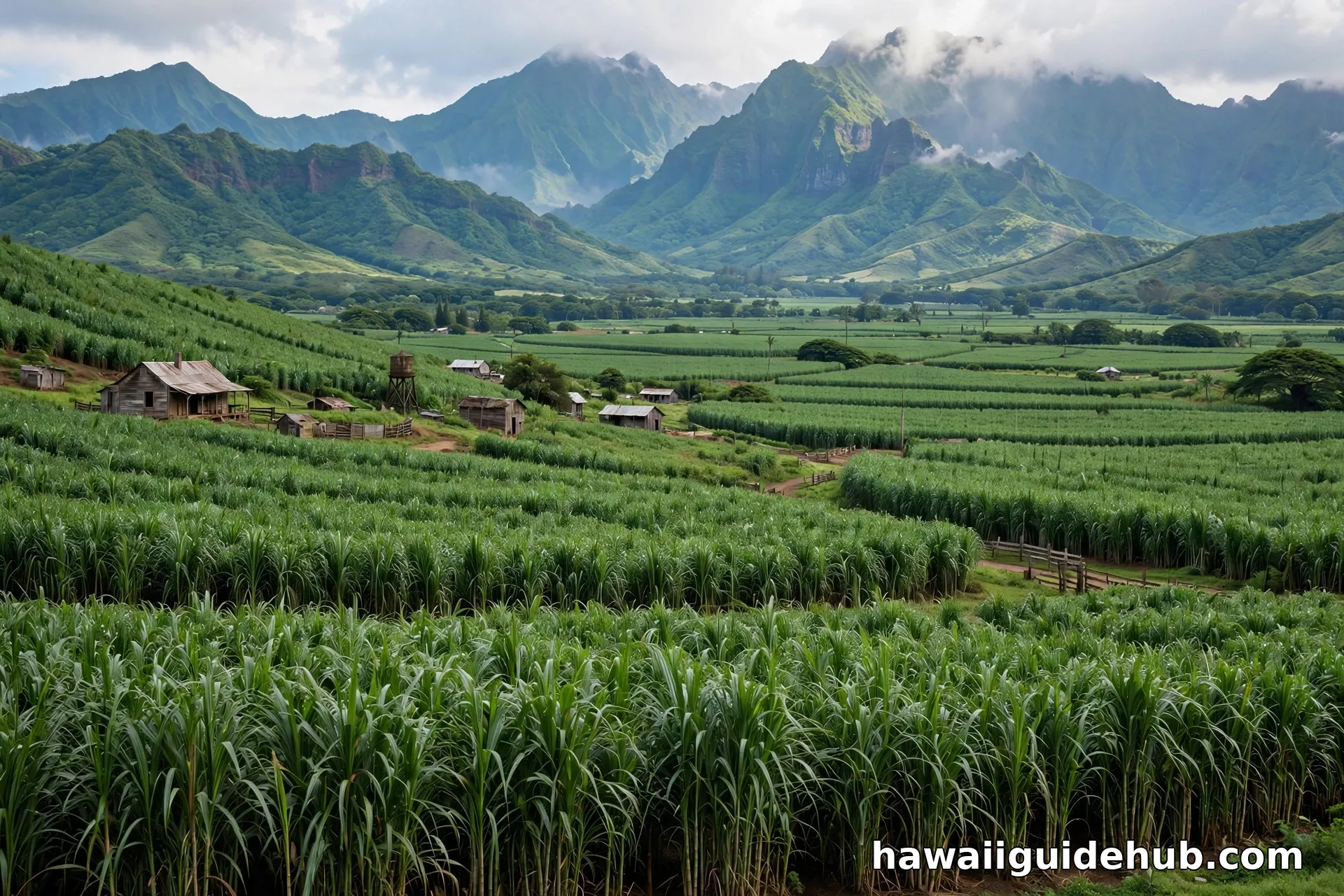
The Labor Waves: Who Came to the Canefields
| Group | First arrivals | Notes | Legacy |
| Chinese | 1852 | First large contract labor wave | Merchants, restaurants, festivals |
| Japanese | 1868, 1885 (City of Tokio) | Largest group; picture brides | Schools, temples, politics, food |
| Portuguese | 1878 | Madeira and Azores; ~16,000 by 1911 | Malasadas, ukulele, ranching |
| Korean | 1903 | Smaller wave, largely Christian | Churches, independence movement |
| Filipino | 1906 (sakadas) | Over 100,000 recruited | Labor movement, communities statewide |
Plantation Life
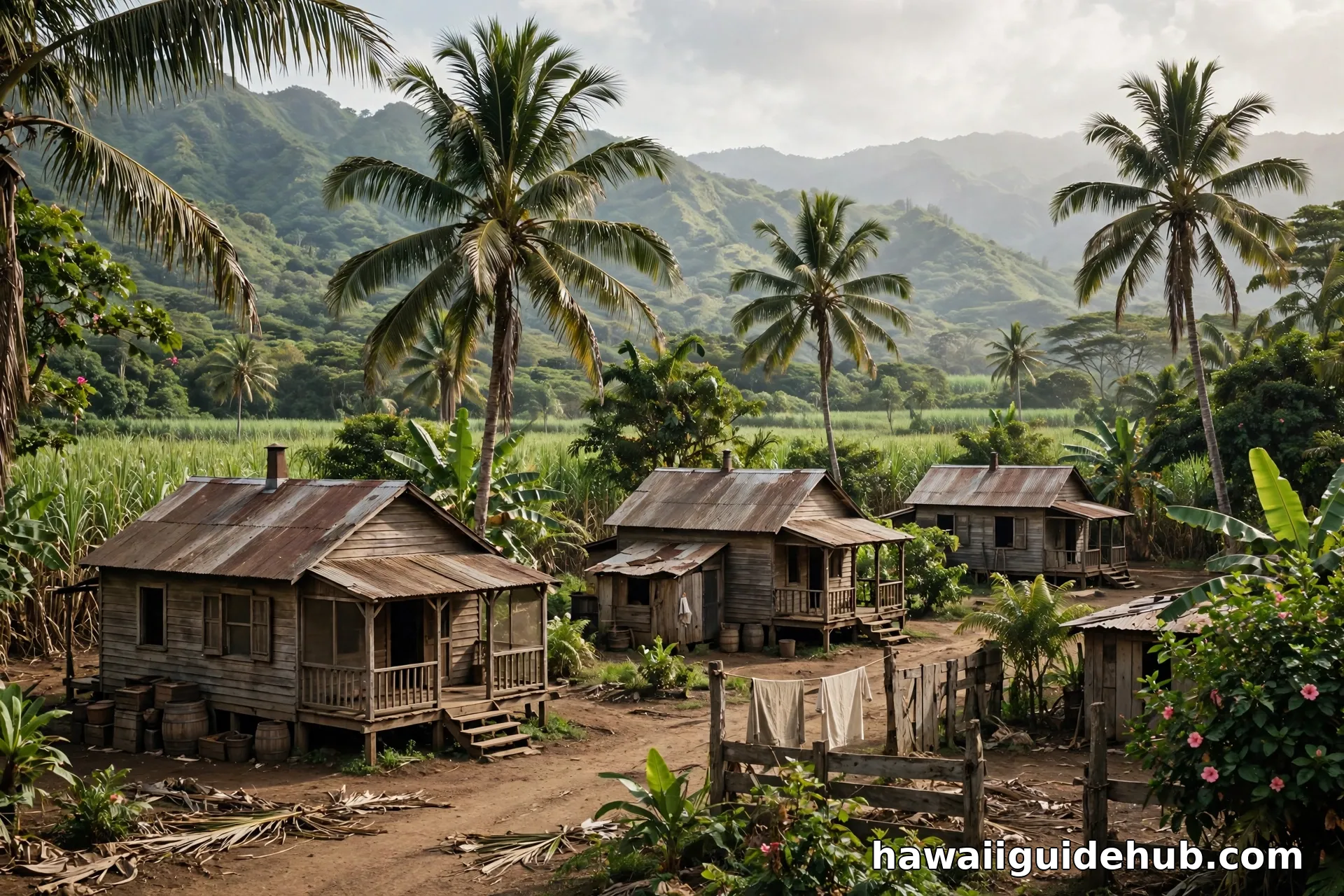
Life in the camps was hard and structured. Workers lived in company housing, shopped at the company store, and labored ten-hour days cutting cane under the tropical sun, supervised by luna overseers. Pay was low, conditions harsh, and the workforce was deliberately divided by ethnicity: different camps, different pay scales, a system designed to prevent unity. Yet the camps also became communities: temples and churches, language schools, stores, and gardens. The workers built lives in the cracks of the system, and their children would transform the islands.
The Strikes: 1920, 1924, 1946
The workers fought back. The 1920 strike united Japanese and Filipino workers across ethnic lines, a breakthrough the companies had worked to prevent. In 1924, the Hanapepe strike turned deadly: striking Filipino workers clashed with police, and sixteen workers and four policemen died. The turning point came in 1946: the Great Sugar Strike, organized by the ILWU across ethnic lines, shut the industry down for 79 days and won unprecedented gains. The strike broke the Big Five’s political power and remade Hawaii’s politics: the workers’ children would elect the Democratic revolution of 1954 and, eventually, a president’s birthplace.
The End of Sugar
Sugar’s decline was slow, then sudden. Competition, costs, and land values eroded the industry through the late 20th century; plantations closed one by one. The last, Hawaiian Commercial and Sugar on Maui, shut down in 2016, ending 181 years of commercial sugar in Hawaii. The mills fell silent, the canefields went fallow or turned to diversified agriculture. The end was an economic trauma for plantation towns, but also a release: the land, long locked in monoculture, could become something new.
The Legacy: Modern Hawaii
The plantation era’s legacy is everywhere: the ethnic mix of the islands, the pidgin language born in the camps, the food (plate lunch is plantation food), the labor movement, the Democratic politics, the multicultural ease that defines Hawaii. The immigrants who came as contract laborers built the schools, temples, businesses, and communities that became modern Hawaii. The era was exploitative and transformative at once: the canefields were a crucible, and what emerged was something new in the world.
The Irrigation Empires: Water for Sugar
Sugar was thirsty, and the plantations replumbed the islands to feed it. Ditch systems carried water for miles across watersheds: the Hamakua ditches, the Kohala ditches, the great Maui systems, engineering works that rivaled anything in the American West. The diversions dried leeward streams, transforming ecosystems and sparking water conflicts that continue today. The plantation era’s water grabs are the root of modern Hawaii’s water wars: the ditches built for cane now serve diversified agriculture and municipal supply, and the legal battles over stream restoration trace directly to the plantation diversions.
Pineapple: Sugar’s Sister
Pineapple was sugar’s junior partner: Dole and Del Monte built vast plantations, most famously on Lanai, the “Pineapple Isle,” where Dole’s plantation once covered nearly the entire island. The pineapple industry shared sugar’s labor system, camps, and strikes, and its own decline paralleled sugar’s. The last Hawaiian pineapple cannery closed decades ago; fresh pineapple still grows on Oahu and Maui, but the era of the great plantations is over. Lanai’s transformation from pineapple fields to resort island is the plantation story in miniature.
The Luna System: Power in the Fields
The luna was the plantation’s frontline authority: the overseer who assigned the work, set the pace, and enforced discipline. Often Portuguese or Hawaiian, the luna stood between the management and the field gangs, and the position carried real power over workers’ daily lives. The luna system was the human machinery of the plantation: impersonal, hierarchical, and effective. Workers’ songs and stories remember the lunas vividly: some fair, some feared, all central to the memory of the era. The system’s end, with unionization, was as significant as any strike.
Picture Brides: Families from the Sea
The plantations were built by single men, but Hawaii was built by families. The picture bride system brought thousands of women from Japan, Korea, and elsewhere: marriages arranged by exchanged photographs, brides crossing the Pacific to husbands they had never met. The brides turned labor camps into communities: they bore the children who would become Hawaii’s doctors, teachers, politicians, and business owners. Their story is one of extraordinary courage: stepping off a ship into an unknown life, and building a future from it. The brides’ descendants are Hawaii’s establishment.
The Democratic Revolution of 1954
The plantation workers’ children changed Hawaii’s politics. In 1954, the Democratic Party, powered by Japanese-American veterans of the 442nd Regimental Combat Team and unionized plantation workers, swept the territorial elections: the “Democratic Revolution” that ended the Republican Big Five’s political dominance. The revolution’s leaders were the sons of the canefields: men who had cut cane, served in the war, and came home to claim power. Hawaii’s modern political landscape, Democratic dominance, labor strength, multicultural leadership, was forged in the plantation era’s aftermath.
What the Plantations Left Behind
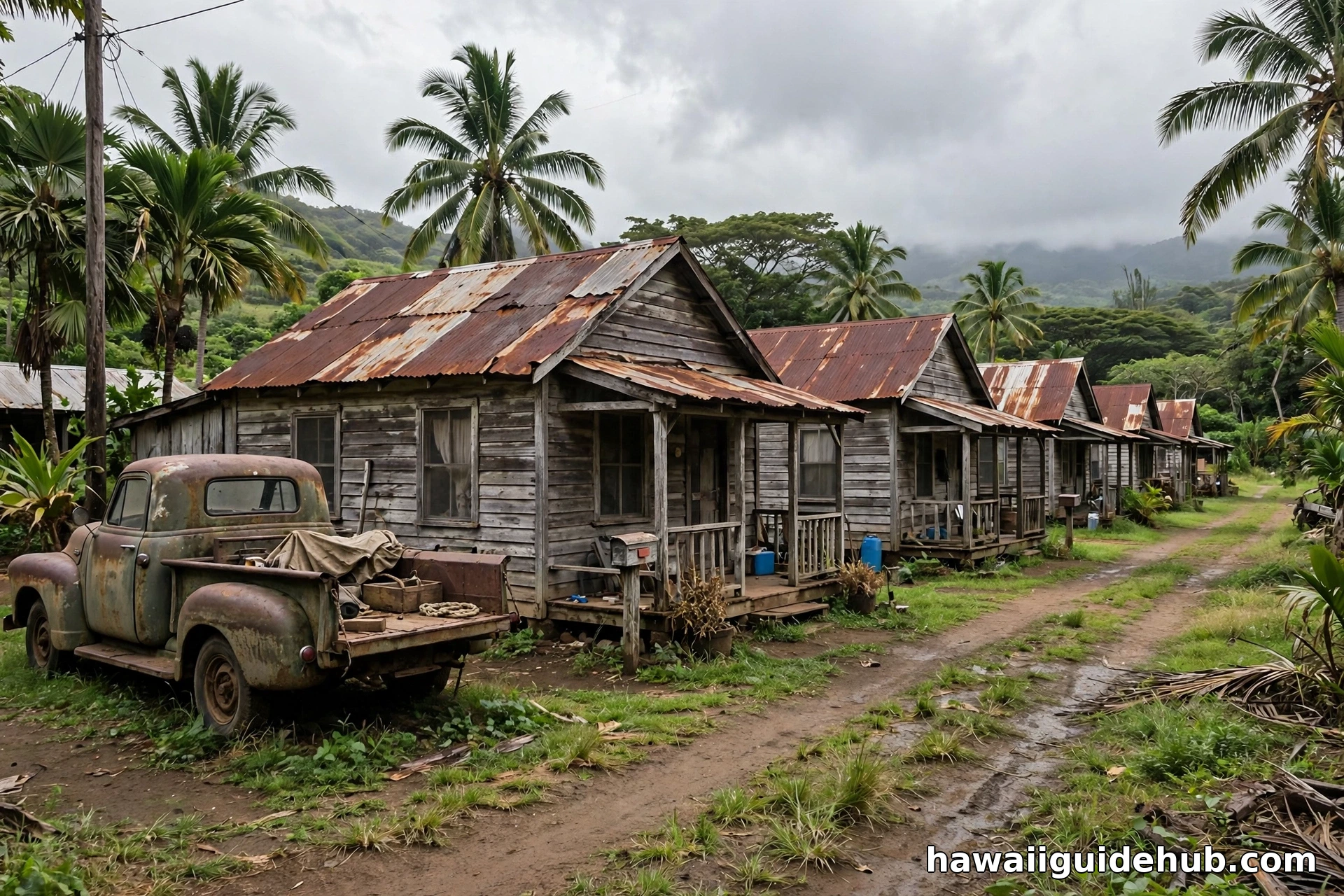
The physical remains are everywhere: mill smokestacks on every island, plantation towns with their camp houses, the ditch trails now hiked for recreation, the railroads turned to bike paths. The cultural remains are deeper: pidgin, plate lunch, the festivals, the family names, the work ethic. The plantation era’s greatest product was not sugar but people: the multicultural society that is modern Hawaii. The canefields are gone; their children run the islands. Drive the old plantation roads and read the landscape: the camp towns with their mixed architecture, the churches and temples side by side, the family names on the mailboxes telling the immigration story in miniature. Every island has its plantation geography, and learning to read it is learning to read Hawaii itself. The smokestacks are monuments now, but the real monument is the society: the most successfully multicultural place in America, built by people who arrived with nothing and made everything: the cane cutters’ children, the picture brides’ grandchildren, the strikers’ heirs, still harvesting what their ancestors planted, in fields their ancestors could not have imagined, and honoring them all the same.
Holehole Bushi: Songs of the Canefields
The workers sang: holehole bushi, the work songs of Japanese canefield laborers, sung to the rhythm of stripping cane leaves. The songs carried news, complaints, humor, and longing: an oral history of the plantation era set to melody. UH West Oahu’s Canefield Songs Project has preserved the songs and the singers’ stories, recording the last generation who knew them. The bushi are the plantation era’s literature: composed in the fields, sung in the fields, remembering what the company records never wrote down.
The 442nd: From Camps to Heroes
The plantation workers’ sons became America’s most decorated soldiers. The 442nd Regimental Combat Team, composed largely of Japanese Americans from Hawaii, fought in Europe with extraordinary valor: the most decorated unit of its size in U.S. military history. Many had grown up in the camps; their parents were the picture brides and cane cutters. The 442nd’s record, “Go for Broke,” became the moral foundation of the Democratic Revolution: men who had bled for America came home demanding its promises. The canefields’ children had earned Hawaii’s future.
Plantation Food: The Plate Lunch
The plate lunch is plantation food: two scoops of rice, macaroni salad, and a protein, served in the compartmented plates of the camp lunchrooms. The workers’ diverse food traditions merged in the fields; our deep dive into Hawaiian traditions covers how hula, chant, and storytelling carried the culture forward: Japanese bento, Filipino adobo, Portuguese sausage, Hawaiian poi, all cross-pollinating into the local cuisine. Spam musubi, saimin, manapua: the foods Hawaii is known for are plantation foods, invented by immigrants making do. The islands’ celebrated food culture is the plantation era’s most delicious legacy.
Watch: The Workers Who Built Modern Hawaii
Plantation Era FAQs
When did Hawaii’s plantation era begin and end?
Commercial sugar began in 1835 at Koloa, Kauai; the last plantation, HC&S on Maui, closed in 2016. The era’s peak ran from the 1876 Reciprocity Treaty through the mid-20th century.
Who were the Big Five?
The five companies that dominated sugar: Castle and Cooke, Alexander and Baldwin, C. Brewer, American Factors, and Theo H. Davies. They controlled plantations, shipping, and banking, and wielded enormous political power.
Where did plantation workers come from?
Successive waves: Chinese (1852), Japanese (1868/1885), Portuguese (1878), Korean (1903), and Filipino (1906). Each group left lasting cultural legacies.
What was the 1946 sugar strike?
The Great Sugar Strike: a 79-day ILWU strike that united workers across ethnic lines, won major gains, and broke the Big Five’s political dominance, reshaping Hawaii’s politics permanently.
Can I visit plantation-era sites?
Yes: the Hawaii Plantation Village in Waipahu (Oahu), the Sugar Museum on Maui (when open), Koloa’s historic sites on Kauai, and plantation towns statewide. Many mill smokestacks still stand as landmarks.
The Crucible
The plantation era was Hawaii’s great transformation: 150 years that turned an island kingdom into a multicultural American state, built by immigrants who came to cut cane and stayed to build a society. The canefields are gone, but their harvest is everywhere: in the faces, the food, the language, and the politics of modern Hawaii. To understand the islands, understand the plantations: the sweetness and the struggle, the exploitation and the endurance. The era ended in 2016; its children are still running Hawaii. Visit the Hawaii Plantation Village in Waipahu and walk through the camp houses: Chinese, Japanese, Portuguese, Korean, Filipino, each one a chapter. Stand where the mill whistle used to order the day and listen for the holehole bushi on the wind. The sugar is gone, but the sweetness remains: in the plate lunch, in the pidgin, in the faces of the islands. The plantation era was Hawaii’s hardest century and its most creative, the crucible that made the modern islands. For more island history, see our volcanoes guide and Kauai guide.