Hawaii Capitol Building: History, Architecture & Visiting Guide

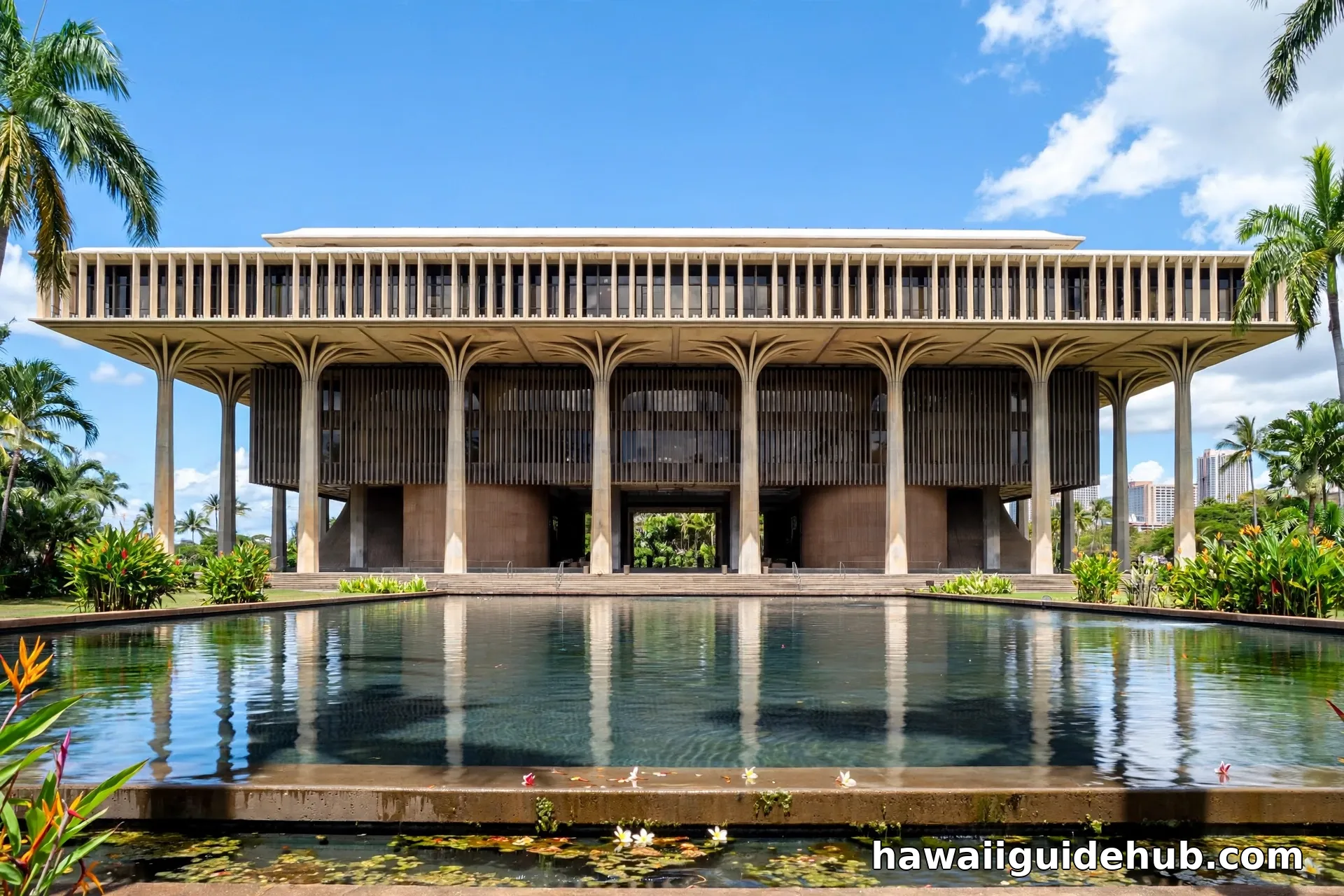
Most state capitols wear a dome. Hawaii’s wears the sky. The Hawaii State Capitol in downtown Honolulu is an open-air modernist landmark where rain falls into the central courtyard, the reflecting pool stands in for the Pacific Ocean, and the columns bloom like palm trees. Dedicated in 1969, ten years after statehood, it is both a working seat of government and one of America’s most unusual public buildings. This guide covers its history, its symbolism, how to visit, and what to see around it.
Where Is the Hawaii Capitol Building?
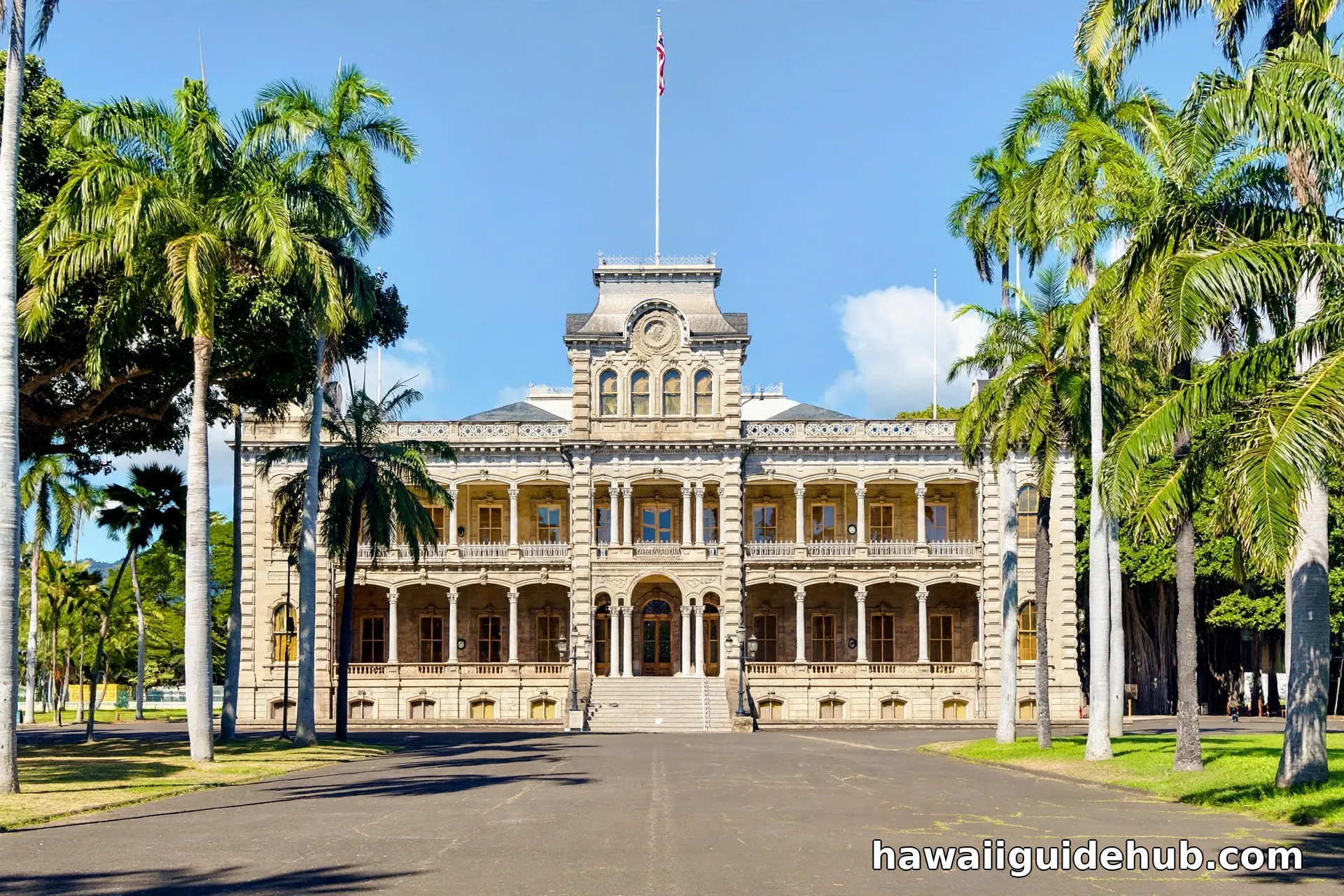
The Hawaii State Capitol stands at 415 South Beretania Street in downtown Honolulu, on Oʻahu, in the heart of the Capitol District. It sits directly across from ʻIolani Palace, Hawaii’s former royal residence and capitol, so the old and new seats of Hawaiian government face each other across the street: a pairing found nowhere else in America. The building houses the Hawaii State Legislature, the offices of the Governor and Lieutenant Governor, and the state’s legislative agencies.
History: From Palace to Capitol
When Hawaii became the 50th state in 1959, its government still operated out of ʻIolani Palace, the former royal residence that had served as the capitol under the Provisional Government, Republic, and Territory. A modern state needed a modern capitol, and Governor John A. Burns commissioned a new building that would express Hawaii’s identity rather than copy a mainland template. Construction ran through the 1960s, and the Capitol was dedicated in 1969. The architects called the style Hawaiian International: an American adaptation of Bauhaus modernism, rethought for a tropical place.
Decoding the Symbolism
Nearly every element of the building is a deliberate symbol of Hawaii. Here is the decoder:
| Feature | What it symbolizes | What to look for |
| Reflecting pool | The Pacific Ocean surrounding the islands | The broad water encircling the building |
| Two cone-shaped chambers | The volcanoes that formed Hawaii | The Senate and House chambers’ conical roofs |
| Palm-like columns | Hawaii’s coconut palms | Columns flaring outward at the top |
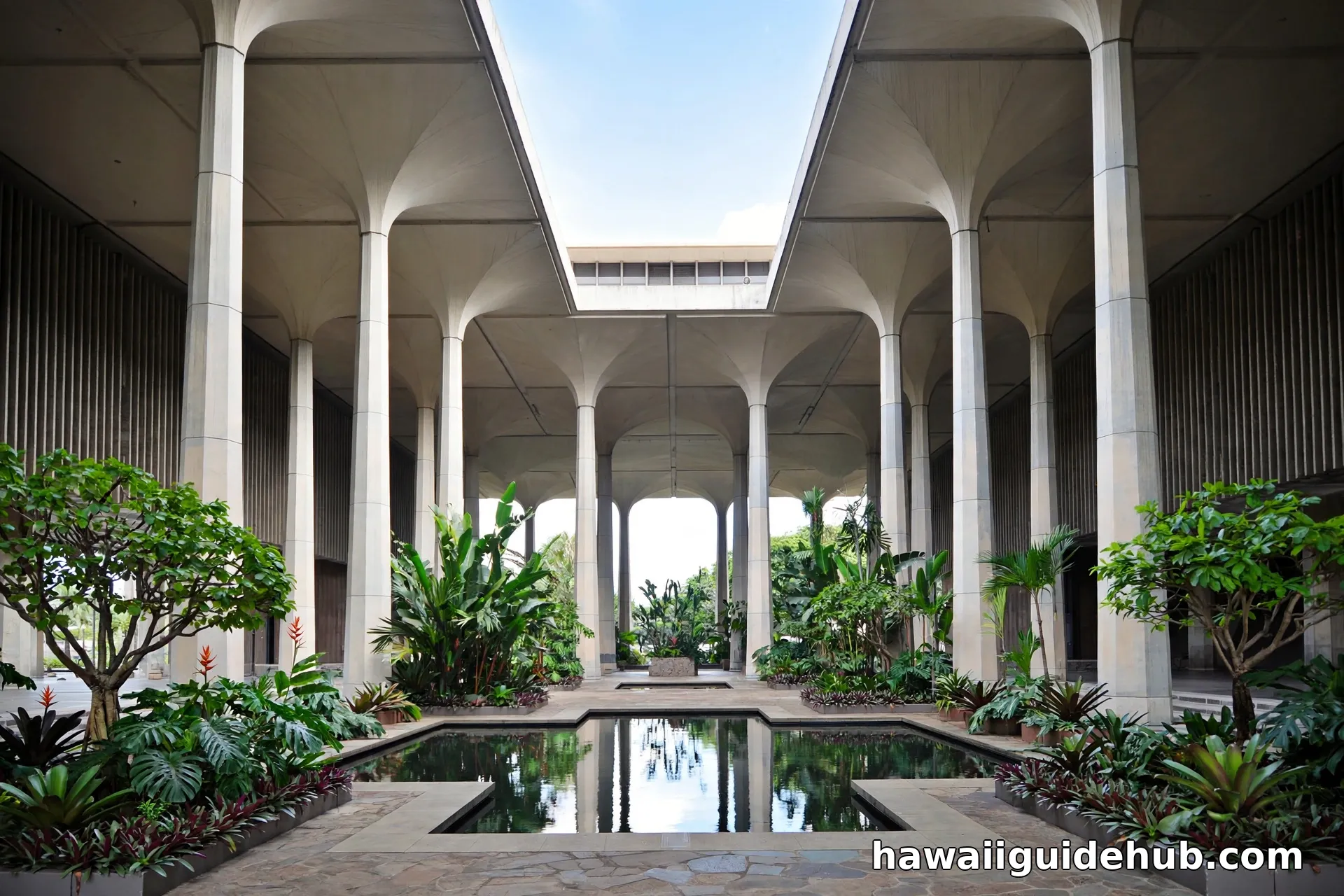
| Open-air courtyard | Hawaii’s indoor-outdoor way of life | The central court open to rain and sun |
| No dome | A break from mainland tradition | The flat, sky-open roofline |
The open-air design is the boldest choice: the central courtyard has no roof, so sun, wind, and rain enter freely. It is government architecture that refuses to pretend it is anywhere but Hawaii.
Visiting the Hawaii State Capitol
The Capitol is open to the public Monday through Friday, 7:00 AM to 5:00 PM, closed weekends and state holidays. Admission is free. Bring a valid photo ID: security screening applies, as it is a working government building. Self-guided tours run weekdays with a brochure available on site (pick one up in Room 415 on the fourth floor). Guided group tours are typically offered on select days when the legislature is in session (January through May) and on a reduced schedule the rest of the year: groups should book at least two weeks ahead through the Public Information Office. Public access can tighten during sessions, security events, or demonstrations: check ahead on session days.
What to See Inside and Around
Inside: the two volcano-cone legislative chambers, the open courtyard, and the building’s art collection. Outside: the statue of Father Damien (Saint Damien of Molokaʻi) in front, and the statue of Queen Liliʻuokalani at the rear near ʻIolani Palace. Across the street, ʻIolani Palace itself is the essential companion visit: the only royal palace on U.S. soil, restored and open as a museum since 1978. Nearby: Washington Place (the governor’s residence), Capitol Modern (the Hawaii State Art Museum), the King Kamehameha statue, the Hawaii State Library, and Kawaiahaʻo Church. Together they form the densest historic district in the Pacific.
Seeing Government in Action
The Hawaii State Legislature convenes from January through May, and session days are the liveliest time to visit: committee hearings are generally open to the public, floor sessions can be observed from the galleries, and the building hums with the business of the 50th state. Testimony at hearings is a genuine local tradition: residents show up in person to speak on bills, and visitors are welcome to watch. Outside session, the building is quieter but the architecture is easier to appreciate without the crowds. Either way, remember it is a workplace: keep voices down in office corridors and follow staff directions.
How Hawaii’s Government Works (The 60-Second Version)
The building houses a bicameral legislature: a 25-member Senate and a 51-member House of Representatives, meeting in the two volcano-cone chambers. Sessions run January through May; the rest of the year is interim, when legislators work in-district. The Governor’s office sits in the same building, making the Capitol the full seat of state power. For the deeper story of the kingdom that preceded the state, read Hawaii’s history before the 50th star: it explains why the palace across the street matters so much.
The Capitol vs. Other State Capitols
Stack it against its peers and Hawaii’s Capitol is the outlier in every category: the only one with no dome, the only open-air design, the only one built around a reflecting pool as a central feature, and among the youngest (dedicated 1969). Most state capitols quote Jefferson or the Romans; Hawaii’s quotes the islands themselves. Whether you find it beautiful or brutalist, you will not confuse it with any other: which was precisely the point Governor Burns commissioned it to make.
The Capitol District Walking Tour
The Capitol anchors a walkable historic core you can cover in half a day. Start at the Capitol itself (allow an hour), then cross to ʻIolani Palace for the guided tour (book ahead: it sells out, and what to know before visiting ʻIolani Palace will prepare you). Continue to the King Kamehameha statue for the obligatory photo, then Washington Place and the Governor’s mansion grounds. Finish at Capitol Modern, the state art museum with free admission, or the Hawaii State Library’s historic reading rooms. For the rest of the island, the Oʻahu guide covers what not to miss. Downtown Honolulu parking is metered and tight: TheBus serves the district well, and the whole loop is flat and walkable.
Art, Statues, and Memorials
The grounds carry Hawaii’s memory in bronze and stone. The Father Damien statue honors the Belgian priest who served the Kalaupapa leprosy settlement on Molokaʻi; a duplicate stands in the U.S. Capitol’s Statuary Hall, one of two statues representing Hawaii there. The Queen Liliʻuokalani statue at the rear faces the palace she was forced from: placed deliberately, it is a site of quiet remembrance. Inside, the Capitol’s art collection includes works by Hawaii artists commissioned for the building. Each piece was chosen to reflect the islands: look for the integration of native materials and motifs.
Photography Tips
The money shot is the reflecting pool at golden hour, with the palm-columns mirrored in the water: arrive late afternoon for the best light. The open courtyard photographs best midday when sun shafts through the open roof. Personal photography is allowed in public areas; tripods and selfie sticks need permission, and flash is restricted in some galleries. The ʻIolani Palace across the street is even more photogenic at dusk when it is lit. Combine both in one evening for the definitive Capitol District photo set.
Video: Welcome to the Capitol
What to expect when entering the Hawaii State Capitol.
Frequently Asked Questions About the Hawaii Capitol Building
Where is the Hawaii State Capitol?
415 South Beretania Street, downtown Honolulu, Oʻahu, across from ʻIolani Palace.
When was the Hawaii State Capitol built?
Constructed through the 1960s and dedicated in 1969, ten years after Hawaii became the 50th state in 1959.
Why doesn’t the Hawaii Capitol have a dome?
Deliberate design choice: the architects rejected the mainland dome tradition in favor of Hawaii-specific symbolism: ocean, volcanoes, and palms, under an open sky.
Can you tour the Hawaii State Capitol?
Yes. Free self-guided tours on weekdays 7 AM to 5 PM with a brochure from Room 415; guided group tours on select days with advance booking. Closed weekends and holidays.
What was Hawaii’s capitol before 1969?
ʻIolani Palace, which served as the seat of government under the monarchy’s overthrow, the Provisional Government, the Republic, the Territory, and the early state. It is now a museum across the street.
Is the Hawaii State Capitol free to visit?
Yes: no admission fee. Bring valid photo ID for security screening.
The Reflecting Pool: Beauty and Controversy
The pool is the building’s signature, and its most debated feature. At its best, it is a perfect mirror doubling the palm-columns against the sky. At its worst, algae blooms cloud the water: some wry observers note the algae has come to symbolize pollution in the Pacific the pool represents. Maintenance of the vast water feature has been a recurring budget line and a recurring headline. Whatever its condition on your visit, the pool’s symbolism survives the algae: it remains the most photographed water in downtown Honolulu that is not the harbor.
Events at the Capitol
The Capitol grounds are Hawaii’s civic stage. Rallies, marches, and demonstrations gather here as a matter of tradition: it is where the islands come to be heard. Ceremonial events include the Governor’s State of the State address each session, Lei Day celebrations, and the King Kamehameha Day floral parade, which processes through the district. The annual Children and Youth Day fills the grounds with families. If your visit coincides with an event, expect road closures and a livelier, louder Capitol than the weekday norm: check the state’s event calendars.
What the Critics Said
The Capitol divided opinion from the start, as bold modernism always does. Admirers call it a masterpiece of regional modernism: a government building that could exist nowhere else, honest about its climate and culture. Detractors found the concrete brutalist-adjacent and missed the palace’s grandeur. Time has been kind: as mid-century modernism earned heritage status worldwide, the Capitol’s reputation grew, and architecture tours now treat it as a destination rather than a curiosity. It remains the only state capitol designed around being rained on.
How long does a Capitol visit take?
Plan one hour for the Capitol itself, plus another 60-90 minutes for the ʻIolani Palace tour across the street. The full Capitol District walking loop is a half day.
Is there parking at the Hawaii State Capitol?
Limited metered street parking downtown; public lots nearby. TheBus serves the Capitol District well, and the area is flat and walkable from downtown hotels.
What is the Hawaii State Capitol’s architectural style called?
Hawaiian International: an American adaptation of Bauhaus modernism redesigned for the tropics, with open-air spaces, water features, and symbolic references to the islands’ nature.
Who built the Hawaii State Capitol?
It was commissioned by Governor John A. Burns, Hawaii’s second governor, and constructed through the 1960s, with dedication in 1969.
Why the Capitol Matters to Visitors
It is easy to skip: a government building on a beach vacation. That would be a mistake. The Capitol is the single best one-hour crash course in what makes Hawaii different: the symbolism teaches the islands’ nature (ocean, volcano, palm), the palace across the street teaches the history (kingdom, overthrow, statehood), and the open-air design teaches the culture (life lived outside, formality optional). No other Honolulu attraction compresses that much meaning into a free hour. Go in the morning when the light fills the open courtyard, cross to the palace right after, and you will understand Hawaii better by lunch than most visitors do in an entire week of beach days.
The Hawaii State Capitol is proof that government buildings can belong to their place: no borrowed dome, no imported marble fantasy, just ocean, volcano, palm, and sky rendered in concrete. Pair it with ʻIolani Palace across the street, and you will have seen Hawaii’s entire political story in a single block.