
Big Island Golf Courses Map
The Big Island of Hawaiʻi holds some of the most dramatic golf real estate in the world. Championship layouts drape over black lava fields on the Kohala Coast, roll through green ranch country near Waimea, wind between towering trees near Volcano, and cling to the sunny slopes above Kailua-Kona. This Big Island golf courses map is your complete reference: where every course sits on the island, which regions fit your game and your travel plans, and what to know before you tee off in Hawaiʻi.
On This Page
Big Island Golf at a Glance

Golf on the Big Island is defined by contrast. On the island’s dry west side, the Kohala Coast packs a remarkable density of championship golf into a short stretch of shoreline. Here, fairways of green grass cut through fields of black pāhoehoe lava, with the deep blue Pacific as a near constant backdrop. Many of these courses were built on lava flows from Hualālai and Mauna Kea that are thousands of years old, and the black rock is not just scenery. It frames fairways, punishes wayward shots, and gives Kohala Coast golf its unmistakable look.
Inland, the character changes completely. Near Waimea, courses sit at around 2,700 feet of elevation in green ranch country where morning fog burns off into cool, clear afternoons. The grass grows thick, the air feels crisp, and the ocean is a distant blue band on the horizon. On the east side of the island, near Volcano Village, golfers play through a landscape of native ʻōhiʻa forest at about 4,000 feet, where mist, birdsong, and towering trees replace ocean views entirely.
The Big Island’s golf season runs year-round, but conditions vary by region and time of day. The Kohala Coast averages well under 10 inches of rain per year, making it one of the most reliable golf climates in the state. Morning tee times are prized everywhere on the island: trade winds typically build through the afternoon, and on the Kona side the famous afternoon cloud buildup over Hualālai can bring brief showers to higher elevations while the coast stays dry.
Elevation is another defining feature. Sea-level courses on the Kohala Coast play at full air density, so the ball flies its normal distance. At Waimea’s elevation, shots carry noticeably farther, and at Volcano the thin, cool air combined with altitude can add real distance. Golfers visiting from sea-level home courses often find themselves a club or two long on their approach shots during their first round at elevation.
The island’s course roster spans public resort courses, daily-fee layouts, semi-private clubs, and a small number of private clubs. Most visitors will play the well-known resort courses on the Kohala Coast and around Kona, which welcome outside play and are set up for travelers with rental clubs, resort shuttles, and practice facilities. A few of the island’s most famous layouts are private, so it is worth knowing which courses you can actually book before you build your itinerary around them.
Map: Where the Courses Are
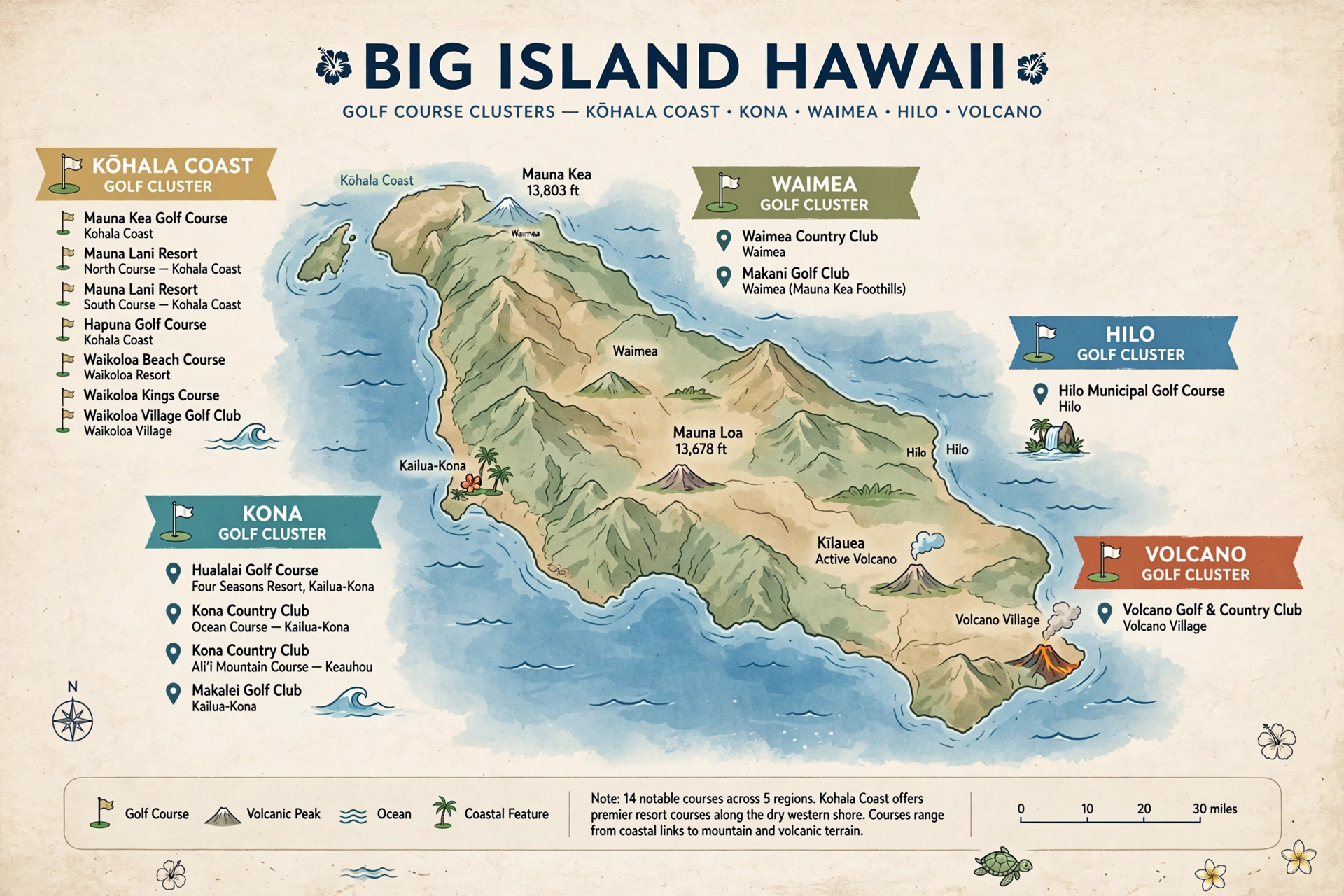
Big Island golf clusters in five areas, and understanding this geography saves real driving time because the island is large. Distances that look short on a map can take an hour or more on winding two-lane roads.
Kohala Coast (the main cluster)
The densest concentration of golf on the island runs along Queen Kaʻahumanu Highway (Highway 19) between the Kona International Airport area and the northern Kohala resorts. Within roughly 30 miles of coastline you will find Mauna Kea Golf Course, Hāpuna Golf Course, the two Waikōloa courses, the two Mauna Lani courses, and the private Hualālai courses. This is the heart of Big Island golf, and most golf-focused visitors base themselves here. Courses are typically 10 to 30 minutes apart by car, making two rounds a day or easy course-hopping realistic.
Kailua-Kona and South Kona
South of the airport, the Kona side hosts Kona Country Club with its Ocean and Mountain courses, plus a few smaller layouts. These courses sit closer to Kailua-Kona town, which makes them convenient for visitors staying in town rather than at the Kohala resorts. The terrain here is hillier than the Kohala Coast, and several holes climb the lower slopes of Hualālai with views down over Kailua Bay.
Waimea (Kamuela)
Inland at the junction of the island’s major highways, Waimea offers a completely different golf setting: rolling green ranch land at elevation. The courses here play cooler and greener than the coastal layouts, and the town itself, with its paniolo (Hawaiian cowboy) heritage, restaurants, and Saturday farmers market, makes a pleasant base for golfers who want variety. From Waimea, both the Kohala Coast courses and the Hāmākua side of the island are within reasonable reach.
Hilo and East Hawaiʻi
The windward side has fewer courses, but what it offers is distinctive. Golf near Hilo plays through lush, rainy landscapes with tree-lined fairways and a completely different feel from the lava-field golf of the west side. Rain is far more likely here, so east-side golf rewards flexible scheduling and a morning tee time when showers are least likely.
Volcano
At around 4,000 feet near Hawaiʻi Volcanoes National Park, Volcano Golf Course is one of the most unusual rounds in the state: a course routed through native forest where nēnē (Hawaiian geese) wander the fairways and the air smells of eucalyptus and rain. It is a long drive from the Kohala Coast resorts, usually 90 minutes to two hours each way, so it works best as part of a Volcano area day rather than a quick add-on round.
Top Courses by Region
Mauna Kea Golf Course (Kohala Coast)
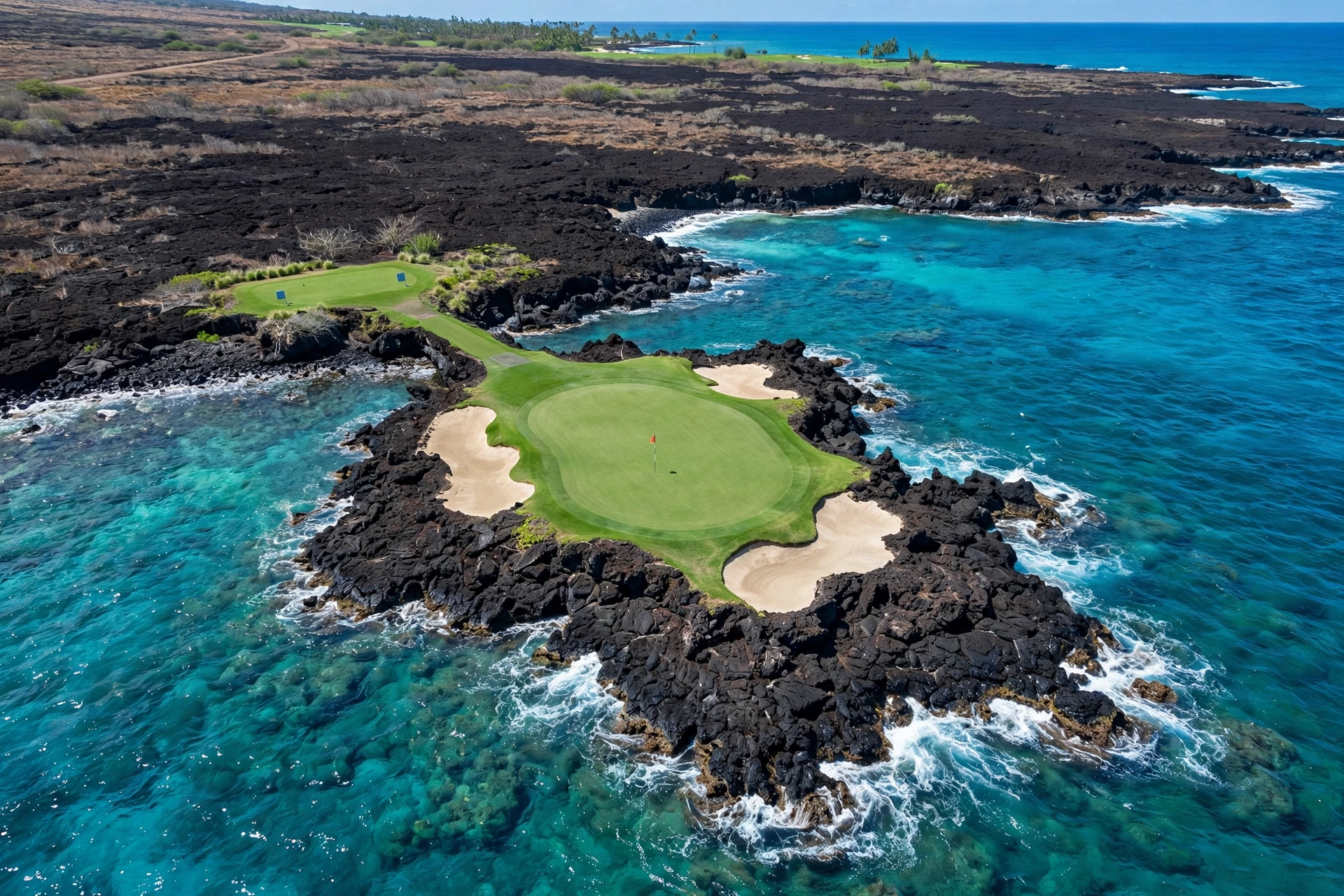
Designed by Robert Trent Jones Sr. and opened in 1964, Mauna Kea is the course that put Big Island golf on the map. Its signature third hole, a par 3 played across an ocean cove to a green perched above the surf, remains one of the most photographed holes in Hawaiʻi. The layout climbs from the shoreline into rolling terrain with views of the Kohala mountains, and the course has hosted decades of professional and top amateur events. It is a resort course open to outside play, and it consistently ranks among the top courses in the state. Book well ahead, especially in winter.
Hāpuna Golf Course (Kohala Coast)
Just south of Mauna Kea, Arnold Palmer’s Hāpuna layout plays higher on the mountain slopes, with elevation changes and panoramic ocean views from nearly every hole. The course moves through kiawe forest and open grassland, and its higher elevation means slightly cooler temperatures and a bit more wind than the shoreline courses. Hāpuna pairs naturally with Mauna Kea for a two-course stay, and many golfers consider the one-two combination the best 36 holes on the island.
Waikōloa Beach and Kings’ Courses (Kohala Coast)
Waikōloa offers two distinct 18-hole experiences side by side. The Beach Course, also a Robert Trent Jones Jr. design, weaves through a resort landscape with lakes, palms, and ocean views, and is generally considered the more forgiving of the two. The Kings’ Course, designed by Tom Weiskopf and Jay Morrish, plays through stark black lava fields in a more rugged, links-like style that demands accuracy. Playing both gives you the two faces of Kohala Coast golf in a single day.
Mauna Lani North and South Courses (Kohala Coast)
Mauna Lani’s two courses are built on the lava fields of the Puakō area. The South Course is famous for its 15th hole, a par 3 played over the ocean to a green surrounded by black lava, with turquoise water crashing below. The North Course, designed later, winds through kiawe forest with a quieter, more inland character. Both courses are known for excellent conditioning and for the way they integrate native archaeological features, including ancient fishponds and petroglyph fields, into the routing.
Hualālai Golf Club (Kohala Coast, private)
The two Jack Nicklaus-designed courses at Hualālai are private and reserved for members, guests, and those staying at the resort’s accommodations. They are included here because travelers sometimes encounter the name when researching the island’s top courses. If you are not staying at the property, plan your golf around the many excellent public and resort alternatives nearby.
Kona Country Club: Ocean and Mountain Courses (Kailua-Kona)
South of the airport, Kona Country Club offers 36 holes with a local, longtime-Hawaiʻi feel that contrasts with the big-resort polish of the Kohala Coast. The Ocean Course plays closer to the shoreline with classic parkland character, while the Mountain Course climbs into the hillside with elevation changes and views over Kailua Bay. Both are more affordable than the Kohala resort courses, making them popular with repeat visitors and kamaʻāina (Hawaiʻi residents).
Volcano Golf Course (Volcano)
At about 4,000 feet elevation near the national park, this is Hawaiʻi’s most unusual golf setting. Fairways wind through native ʻōhiʻa and koa forest, mist drifts through the trees, and nēnē geese are regular hazards of the feathery kind. The course is shorter and less manicured than the resort layouts, but the experience is singular. Bring a jacket, expect cool damp air, and treat it as a sightseeing round as much as a golf round.
Choosing the Right Course

Start with your base location. If you are staying at a Kohala Coast resort, the courses along Queen Kaʻahumanu Highway are minutes away, and you can easily play a different course each day without long drives. If you are based in Kailua-Kona town, Kona Country Club and the south Kohala courses are the convenient choices. Golfers staying in Hilo or Volcano should plan around the east-side courses and accept that the Kohala resort courses are a full-day commitment.
Match the course to your game. Higher-handicap golfers and casual players tend to enjoy the Waikōloa Beach Course, the Mauna Lani courses, and Kona Country Club’s Ocean Course, where there is room off the tee and the emphasis is on scenery and fun. Lower-handicap players seeking a test gravitate to Mauna Kea, the Waikōloa Kings’ Course, and Hāpuna, where forced carries over lava, elevated greens, and ocean winds demand precision.
Consider scenery as a separate criterion. If the setting matters as much as the scorecard, the ocean holes at Mauna Kea, Mauna Lani South, and Hāpuna are the island’s showpieces. For something completely different, the forest golf at Volcano and the ranch-country golf near Waimea offer settings you will not find on any other Hawaiian island.
On price, expect broad ranges. Kohala Coast resort courses typically charge premium visitor rates, often in the low to mid hundreds of dollars per round in USD, with lower twilight and shoulder-season rates. Kona Country Club and the municipal and daily-fee courses elsewhere on the island are generally much more affordable. Hawaiʻi resident (kamaʻāina) rates are substantially lower at many courses, but they require a Hawaiʻi ID. Rental clubs, usually from major manufacturers and in good condition, add a separate fee at most resort courses.
Book ahead in winter. December through March is peak season, when snowbirds and holiday travelers fill tee sheets, and the top Kohala courses can sell out days in advance. Summer and the shoulder months of April, May, September, and October generally offer easier booking and lower rates, with excellent playing conditions.
Golf Practicalities in Hawaiʻi

Trade winds are the defining on-course weather factor. Mornings are typically calm, and the wind builds through late morning into the afternoon, especially on exposed coastal holes. An early tee time is the single best strategy for scoring conditions and comfort. Afternoon rounds can still be enjoyable, but expect a two-club wind on the most exposed holes and plan your ball flight accordingly.
Sun protection is non-negotiable. The equatorial sun is intense even on overcast days, and a four-to-five-hour round delivers serious UV exposure. Wear a hat or visor, reapply reef-safe sunscreen, and carry more water than you think you need. Most resort courses provide water stations, but a personal bottle or two is wise, especially on the lava-field courses where there is no shade.
Dress codes at Big Island resort courses follow standard resort-golf norms: collared shirts, golf shorts or slacks, and golf shoes or athletic shoes. Denim, swimwear, and metal spikes are generally not permitted. The dress code is enforced more strictly at the high-end Kohala resorts than at the casual daily-fee courses, so pack at least one proper golf outfit if you plan to play the big-name layouts.
Rental clubs are widely available and generally high quality at the resort courses, with current or recent models from major brands, offered in men’s and women’s sets in regular and stiff flexes. If you have unusual specs, very tall or short stature, or a strong preference for your own equipment, traveling with your clubs is worth the airline fee. Left-handed rental sets exist but in smaller numbers, so lefties should reserve ahead.
Pace of play on the resort courses is typically managed by marshals, with rounds running about four to four and a half hours. Carts are standard and almost always included; walking is permitted at some courses but is a serious undertaking in the heat on the lava-field layouts. Caddies are rare outside the most exclusive properties.
One local rule worth knowing: lava is out of bounds for your ball and your feet. Climbing on sharp ʻaʻā lava to retrieve a ball is a reliable way to ruin both the ball and your shoes, and possibly your skin. Take the penalty and move on.
For Non-Golfer Companions
Golf trips to the Big Island work well for mixed groups because the resort areas are built for it. While golfers play, non-golfers at the Kohala resorts have beaches, pools, spas, snorkeling, and cultural programs within the property. The beachwalk paths at the major resorts make for easy morning walks, and the resort towns have shops, galleries, and restaurants.
Several courses welcome non-playing riders for a cart fee, which can be a pleasant way to share the scenery, though riding along for a full round is a long sit. A better shared plan is often a morning round for the golfers while companions visit a nearby beach or town, meeting up for lunch. The Kohala Coast’s compact geography makes this easy: few courses are more than 20 minutes from a swimmable beach.
Golf Events and Tournament Heritage

The Big Island’s championship courses have hosted professional and elite amateur golf for decades, and that tournament heritage is part of what draws visiting golfers. The PGA Tour’s season-opening events were long associated with the Kohala Coast, bringing the world’s best players to courses like Hualālai and the Mauna Kea resort area each January. Watching tour professionals navigate the same lava-framed holes you will play a week later is a distinctive thrill, and January tournament weeks are a popular time for golf travelers to visit even if they only watch.
Beyond the professional game, the island hosts a full calendar of amateur events, charity tournaments, and club championships that welcome visitor entries. The Hawaiʻi State Amateur, junior championships, and various resort member-guest events rotate through the top courses. If your trip coincides with one of these, spectating is usually free and offers a relaxed way to scout a course before you play it.
For golfers who want the tournament experience firsthand, several resort courses host pro-am events and stay-and-play tournament packages during the winter season. These fill quickly and carry premium pricing, but they combine competitive golf with the resort experience in a way that is hard to replicate elsewhere.
Frequently Asked Questions
Where are most Big Island golf courses located?
The majority cluster on the Kohala Coast along Queen Kaʻahumanu Highway between the Kona airport area and the northern resorts. Additional courses are found around Kailua-Kona, in Waimea, near Hilo, and at Volcano.
What is the best Big Island golf course for beginners?
The Waikōloa Beach Course and Kona Country Club’s Ocean Course are among the most forgiving options, with generous fairways and less forced carry over lava than the tougher Kohala layouts.
Can visitors play Mauna Kea Golf Course?
Yes. Mauna Kea is a resort course open to outside play. Advance reservations are strongly recommended, especially in the winter peak season from December through March.
How much does golf cost on the Big Island?
Visitor rates at Kohala Coast resort courses are typically in the low to mid hundreds of dollars per round in USD, with lower twilight and shoulder-season pricing. Daily-fee and municipal courses elsewhere on the island are considerably less expensive.
Do Big Island courses rent clubs?
Yes. Resort courses offer quality rental sets from major manufacturers in men’s and women’s configurations. Reserve ahead if you are left-handed or need uncommon specifications.
When is the best time of day to play?
Early morning. Trade winds are calmest before late morning, temperatures are cooler, and you finish before the peak afternoon heat on the lava-field courses.
Is there good golf near Volcano and Hilo?
Volcano Golf Course offers a unique forest setting near the national park, and the Hilo area has tree-lined courses in a lush windward landscape. Expect more rain on the east side and plan morning tee times.
Are there private courses visitors cannot play?
Yes. The Hualālai courses are private, reserved for members, guests, and those staying at the property. The island’s many resort and daily-fee courses provide excellent public alternatives.
Related Guides
- Big Island Map: Complete Reference Map & Area Guide: regions, towns, and driving routes
- Kona Hawaii Map: Complete Reference Map & Area Guide: the Kona side in detail
- Hawaii Map: Complete Reference Map & Area Guide: the statewide picture
- Maui Map: Complete Reference Map & Area Guide: for multi-island golf trips
- Hawaii Beaches: beaches near the golf resorts
- Hawaii Hikes: non-golf outdoor activities
Reading the Island Through Its Courses
The remarkable thing about Big Island golf is how directly the courses express the island itself. The lava-field layouts of the Kohala Coast could exist nowhere else: they are golf routed through geology that is still young by planetary standards, with the ocean always in view and the great volcanoes looming behind. The ranch-country courses near Waimea speak to the island’s paniolo heritage, and the misty forest round at Volcano belongs to the rain-soaked windward world that most visitors never see. Played together, they add up to something no single course can deliver: a round-by-round tour of the most geographically diverse island in Hawaiʻi, one fairway at a time.