Hawaii Weapons: The Traditional Arsenal of the Koa Warriors

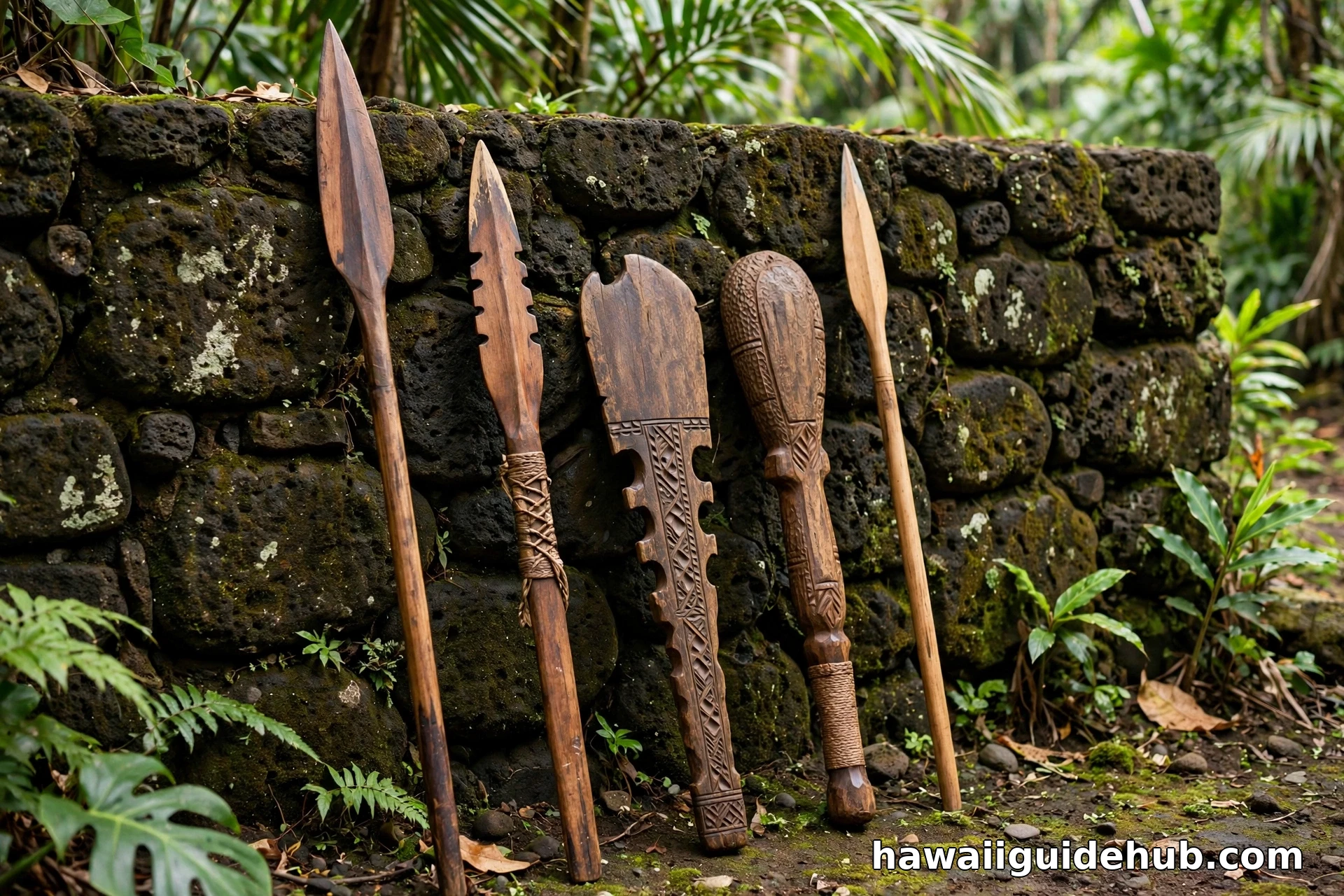
Hawaiian warriors, the koa, fought with one of the most distinctive arsenals in Polynesia: clubs edged with tiger shark teeth, barbed spears, long pikes, slings, and daggers, all carved from native koa wood and wielded with the martial art of lua. With no metal in the islands, Hawaiians turned wood, bone, shell, and shark teeth into weapons of terrifying efficiency. This is the complete guide to Hawaii’s traditional weapons: what they were, how they were used, and where you can see them today.
This page covers the famous leiomano, the spears and pikes, the sling and dagger, the martial art of lua, the warrior’s life, where to see real weapons, and FAQs. Everything about Hawaii weapons is on this one page.
The Short Answer
Traditional Hawaiian weapons were made from koa wood, shark teeth, bone, and stone: no metal existed in pre-contact Hawaii. The most famous is the leiomano, a paddle-shaped club edged with tiger shark teeth. Others include the ihe (barbed short spear), the pōlolu (long pike), the maʻa (sling), the pāhoa (dagger), and the kaʻane (strangling cord). Warriors trained in lua, the Hawaiian martial art, and fought in the great unification wars of Kamehameha the Great.
The Hawaiian Arsenal, Weapon by Weapon
| Weapon | What it is | Battlefield role |
| Leiomano | Paddle club edged with tiger shark teeth | Close-combat slashing; the signature weapon |
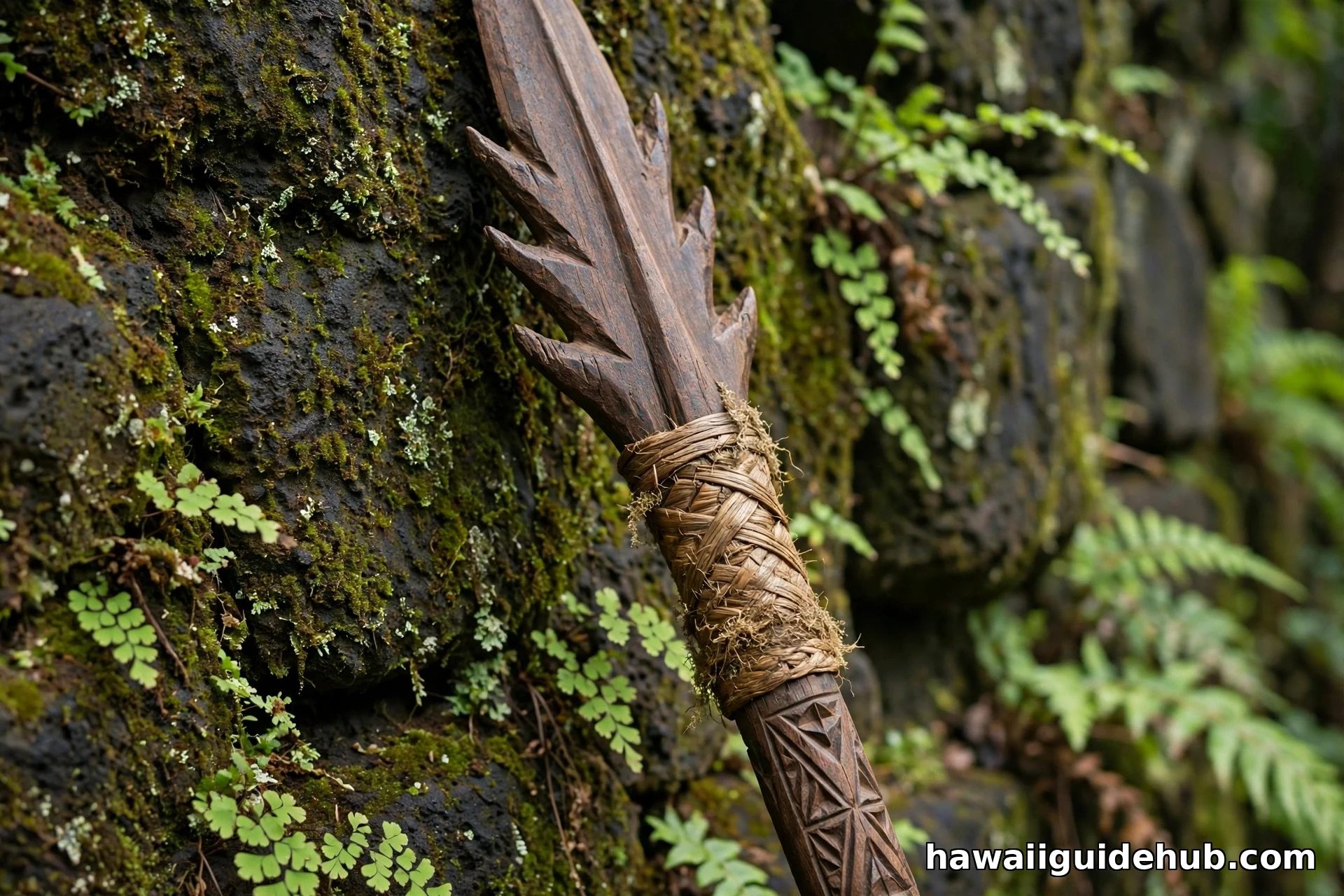
| Ihe | Short spear, 3 to 9 ft, often barbed | Throwing and thrusting at mid-range |
| Pōlolu | Long pike, 12 to 15 ft | Formation fighting; the front rank’s reach |
| Maʻa | Sling of braided fiber | Opening volleys of sling stones |
| Pāhoa | Dagger of wood, bone, or stone | Close quarters; Hawaiians alone in Polynesia had daggers |
| Kaʻane | Strangling cord | Silent killing; the lua specialist’s tool |
The Leiomano: Shark’s Lei
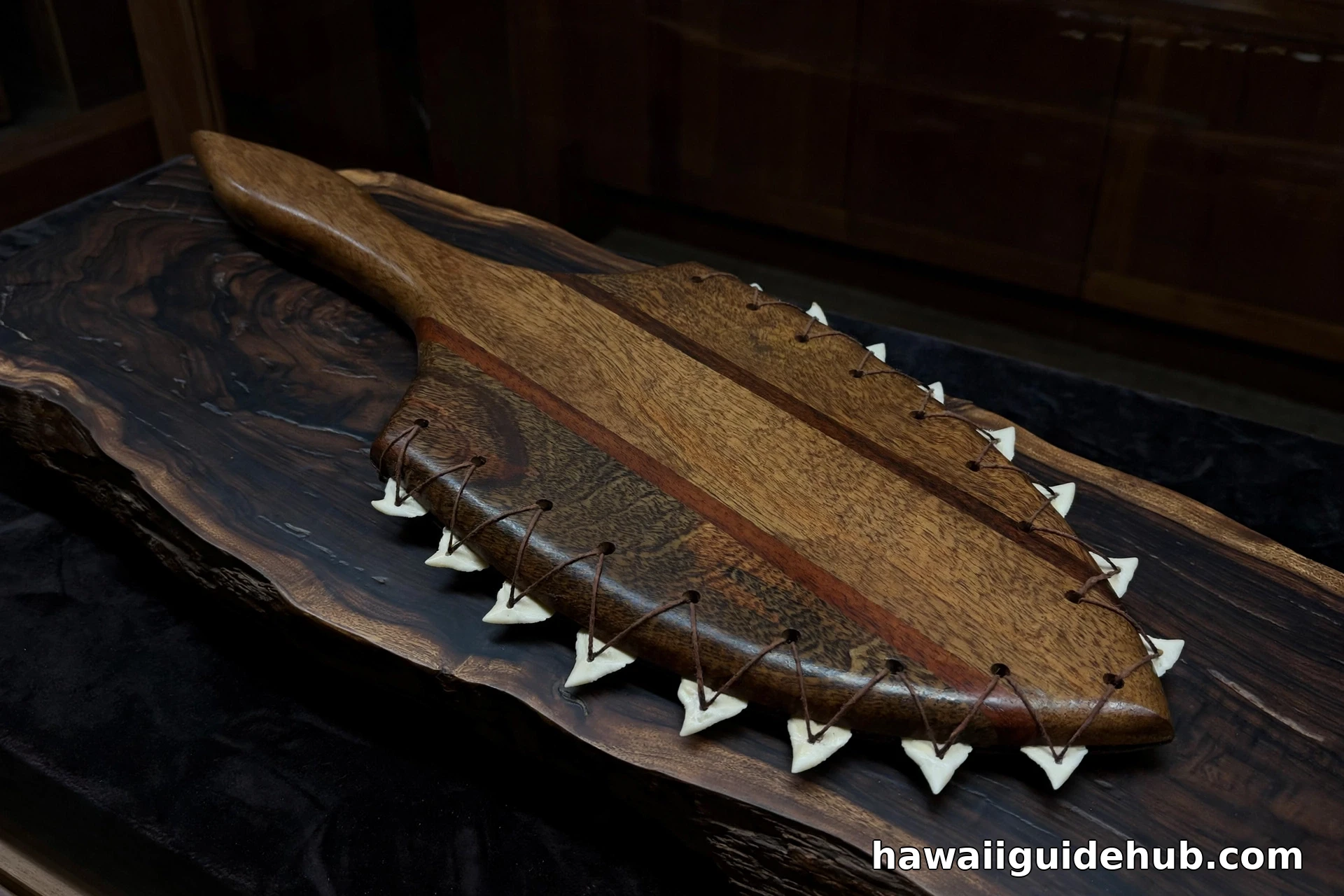
The leiomano may derive from “lei o manō,” the shark’s lei: a paddle of dense koa wood with tiger shark teeth sewn into grooves along its edges with coconut fiber cordage. Swung like a club, it did not just bruise: the serrated teeth slashed flesh and could tear through light armor. Some versions carried dozens of teeth; others had a marlin bill set in the handle as a dagger. The shark was an ʻaumakua, a family guardian, for many Hawaiians: wearing its teeth into battle carried the shark’s mana, its spiritual power, into the fight.
Lua: The Martial Art
Hawaiian weapons were wielded through lua, a complete martial art of striking, grappling, joint locks, and weapons work. Lua was kapu, restricted: taught within families and to warriors, with spiritual training alongside the physical. Practitioners learned each weapon’s targets and techniques: which club struck which part of the body, how the spear was thrown, how the cord was used. Lua nearly died out after contact but has been revived by modern practitioners. It is not a sport; it was a battlefield art, and its teachers treat it with the gravity of its history.
How Battles Were Fought
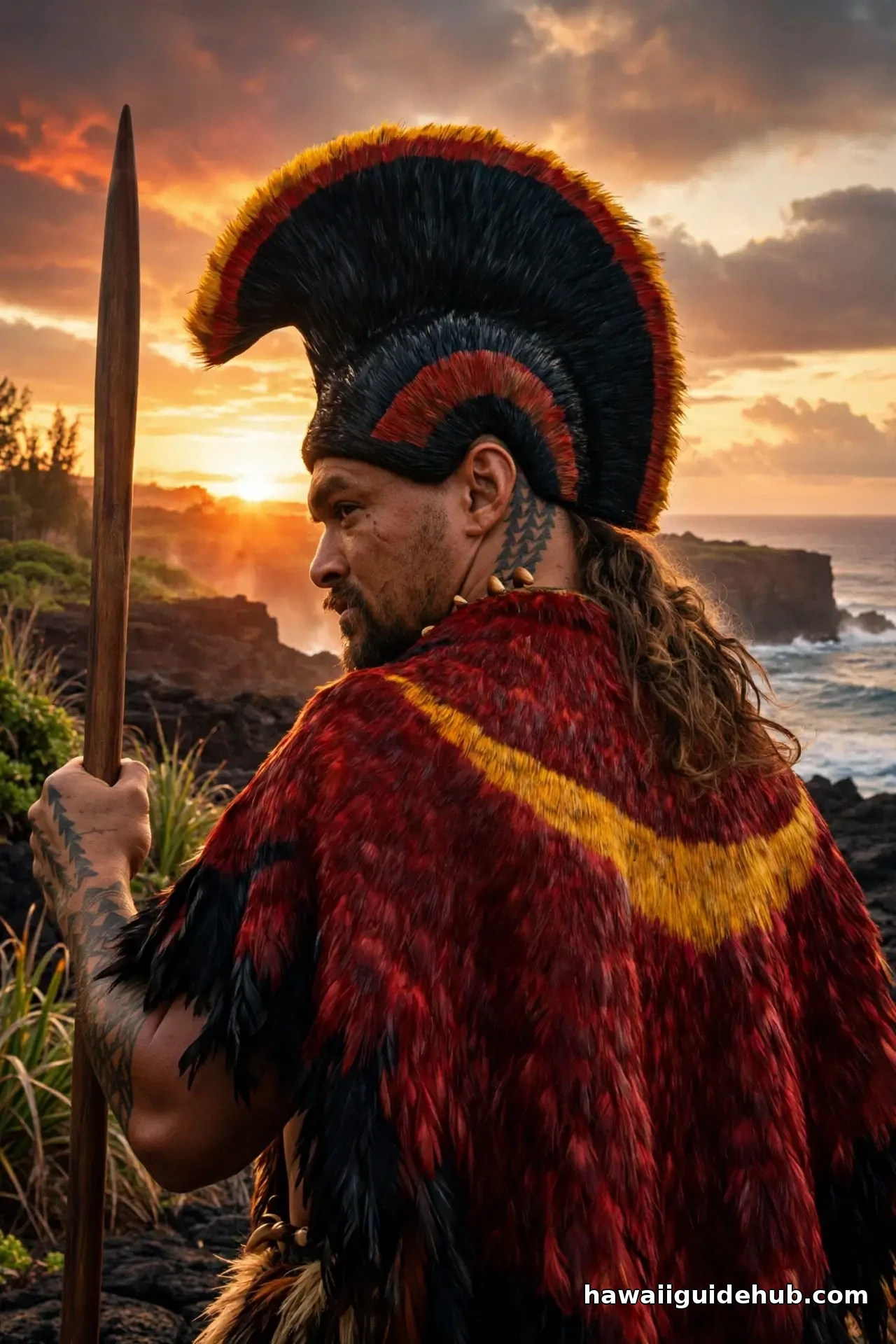
Hawaiian battles opened at range: volleys of sling stones (the maʻa could be devastatingly accurate) and thrown spears rained down like artillery. Then the pike formations closed, 12 to 15-foot pōlolu leveled in ranks. Then the melee: clubs, daggers, and bare hands, with lua techniques deciding it. Warriors fought nearly naked, wearing only the malo loincloth, bodies oiled so enemies could not grip them; chiefs wore feather cloaks and helmets that were both armor and rank insignia. It was disciplined, brutal, and ritualized: war was sacred to Kū, the god of war.
Kamehameha’s Wars
The weapons reached their peak in the unification wars of Kamehameha the Great (1795-1810). At the Battle of Nuʻuanu in 1795, Kamehameha’s forces drove Oahu’s army up the valley and over the pali cliffs: the decisive victory that unified the islands. By then, Western muskets and cannon were entering the arsenal too: Kamehameha’s genius was combining traditional Hawaiian warfare with European firepower. The old weapons did not vanish overnight, but the age of the shark-tooth club was ending. The kingdom’s wars would be fought with guns.
Where to See Real Weapons
The Bishop Museum in Honolulu holds the great collection: leiomano, spears, daggers, and feather cloaks, displayed with the context they deserve. The British Museum in London holds significant Hawaiian weapons, including pieces linked to Cook’s voyages. ʻIolani Palace displays royal arms. When you see them, look at the craftsmanship: the lashing, the tooth-setting, the polish of the koa. These were not crude clubs; they were precision instruments made by master artisans. The beauty of the weapons is part of their story.
For Hawaiian history, see Hawaii’s history before the 50th star, the significance of ohana, and Hawaiian traditions: hula, chanting, and storytelling.
The Koa Tree: The Arsenal’s Source
Nearly every Hawaiian weapon began as a koa tree. Koa (Acacia koa) is Hawaii’s great hardwood: dense, strong, beautifully grained, growing in the upland forests. Warriors were called koa too: the brave ones, named for the tree that armed them. Felling a koa for weapons was ceremonial work, with prayers and protocols. The same wood built canoes, houses, and ukuleles: the tree that armed the warriors also carried the voyagers and now makes the music. There is no more Hawaiian material.
Feather Cloaks: Armor of Rank
The great chiefs went to war in ʻahu ʻula, feather cloaks, and mahiole, feather helmets: tens of thousands of red and yellow feathers from the ʻiʻiwi and ʻōʻō birds, each cloak the work of generations. They were armor of a kind: thick enough to turn a glancing blow, but their real function was rank. On the battlefield, the cloaks marked the aliʻi, the chiefs, and their capture was a war aim in itself. The most famous cloaks, like Kamehameha’s, are treasures beyond price. War, in old Hawaii, was fought in finery.
The Sling: Hawaii’s Artillery
Before the spears flew, the slings spoke. The maʻa, a sling of braided olonā fiber, hurled smooth water-worn stones with lethal accuracy: Hawaiian historians describe specialist slingers who could hit targets at remarkable range. Battles opened with stone volleys that broke formations and killed at distance. It was the closest thing to artillery in the Hawaiian arsenal, and in skilled hands it was devastating. The humble sling, a cord and a stone, was a weapon of war.
Daggers: Hawaii’s Unique Weapon
Hawaiians were the only Polynesians to develop the dagger: the pāhoa, a stabbing weapon of wood, bone, or stone, sometimes with shark teeth set along its edges. Others include the makapāhoa (double-edged eye dagger) and the small hand daggers worn concealed. Why daggers only in Hawaii is a mystery of Polynesian arms: perhaps the intensity of Hawaiian warfare demanded them. In the crush of the melee, when spears were useless and clubs too long, the dagger decided.
The Night Fighters
Not all Hawaiian warfare was battlefield honor. The kaʻane, the strangling cord, and the pikoʻi, the tripping cord, belonged to a darker art: silent killing, assassination, the lua of the night. Specialists trained in these weapons served chiefs as enforcers and executioners. Hawaiian tradition does not romanticize this: it records it. War had its codes and its shadows, and the cords were the shadows. The full arsenal included both the glorious and the grim.
Women Warriors
Hawaiian warfare was not men-only. Women of rank trained in lua and fought: Kekūhaupiʻo, Kamehameha’s own teacher, was part of a tradition that included formidable women warriors. Chiefesses led troops; women used the sling and other weapons. The Hawaiian martial tradition recognized that courage had no gender. Modern lua schools continue this: women train alongside men, as they did centuries ago. The koa spirit was never exclusive.
After Contact: The Gun Era
Western contact changed everything. Muskets, cannon, and gunpowder entered Hawaiian warfare within decades: Kamehameha’s victory at Nuʻuanu owed much to his artillery. The old weapons became ceremonial, then museum pieces, then symbols. But they never fully died: lua practitioners kept the knowledge, carvers kept the craft, and the weapons survived as cultural treasures. Today they are made for ceremony and collection, not battle: the arsenal became the heritage.
Making a Leiomano: The Craft
Making a leiomano was dangerous before it was ever used: someone had to catch the sharks. Tiger sharks were hunted for their teeth, each tooth extracted, cleaned, and sorted. Grooves were carved along the koa paddle’s edges, the teeth set in and lashed with coconut sennit in patterns that were both functional and beautiful. Teeth broke in combat and had to be replaced: the weapon was high-maintenance. A finished leiomano was a collaboration between the shark hunter, the wood carver, and the cord maker: three crafts in one weapon.
The Weapons in Modern Culture
The old weapons live on in new forms. The Apple TV series “Chief of War” put authentic Hawaiian arms, the kuʻe kuʻe shark-tooth knuckle duster among them, before a global audience. Lua schools teach the weapons as living arts. Carvers sell leiomano reproductions to collectors. Museum exhibitions tour the pieces worldwide. The weapons that once decided battles now decide arguments about cultural authenticity: they have become symbols of Hawaiian identity itself, carried in parades instead of war parties.
Buying and Collecting
Reproduction Hawaiian weapons are widely sold: leiomano clubs, spears, and daggers carved by Hawaiian artisans make powerful display pieces. Buy from Hawaiian carvers, not mass importers, and understand what you are buying: a cultural object, not a toy. Real antique weapons belong in museums; the market in genuine 19th-century pieces is fraught with fakes and looted artifacts. A well-made modern leiomano by a known carver is the honorable choice: it supports the living tradition instead of plundering the past.
The Oiled Warrior: Battle Preparation
Hawaiian warriors prepared for battle as a ritual. They shaved their heads, leaving distinctive patterns, and oiled their entire bodies with kukui nut oil: partly so enemies could not get a grip, partly as spiritual protection. Prayers to Kū preceded the fighting; the night before battle was kapu, sacred. War was not just violence; it was ceremony with casualties. The preparation mattered as much as the weapons: a warrior entered battle consecrated, and the oil on his skin was the least of his armor.
The Arsenal’s Legacy
The weapons are gone from the battlefield but present everywhere else: in the museums, in the lua schools, in the carvers’ workshops, in the imagery of Hawaiian pride. They represent a paradox worth sitting with: objects of terrible purpose, made with extraordinary beauty. The Hawaiians who made them were artists as much as warriors, and the weapons they left behind are among the finest arms ever made from wood and teeth. That is the final lesson of the arsenal: even war, in old Hawaii, was an art.
Video: Traditional Hawaiian Weapons
A detailed review of traditional Hawaiian weaponry, with examples.
Frequently Asked Questions
What is the most famous Hawaiian weapon?
The leiomano, the shark-tooth club: a koa wood paddle edged with tiger shark teeth.
Did Hawaiians have metal weapons?
No. Pre-contact Hawaii had no metal; weapons were wood, bone, stone, shell, and shark teeth.
What is lua?
The traditional Hawaiian martial art: striking, grappling, and weapons, once restricted and now revived.
What wood were weapons made from?
Primarily koa, the dense native hardwood; the warriors (koa) took their name from the tree.
Where can I see real Hawaiian weapons?
The Bishop Museum in Honolulu has the great collection; the British Museum holds significant pieces too.
Are Hawaiian weapons still made?
Yes. Cultural practitioners and artisans still carve traditional weapons for ceremony, teaching, and collection.
Hawaii’s weapons tell the story of a warrior culture that turned the materials of an island, wood, shark teeth, stone, into instruments of war refined over centuries. The leiomano is beautiful and terrifying in equal measure, which is exactly what it was meant to be. See them in the museum, learn the names, and remember: these were carried by real men, in real battles, for a kingdom that changed the Pacific.