The Egret in Hawaii: Meet the Cattle Egret, the Islands’ Imported Hunter

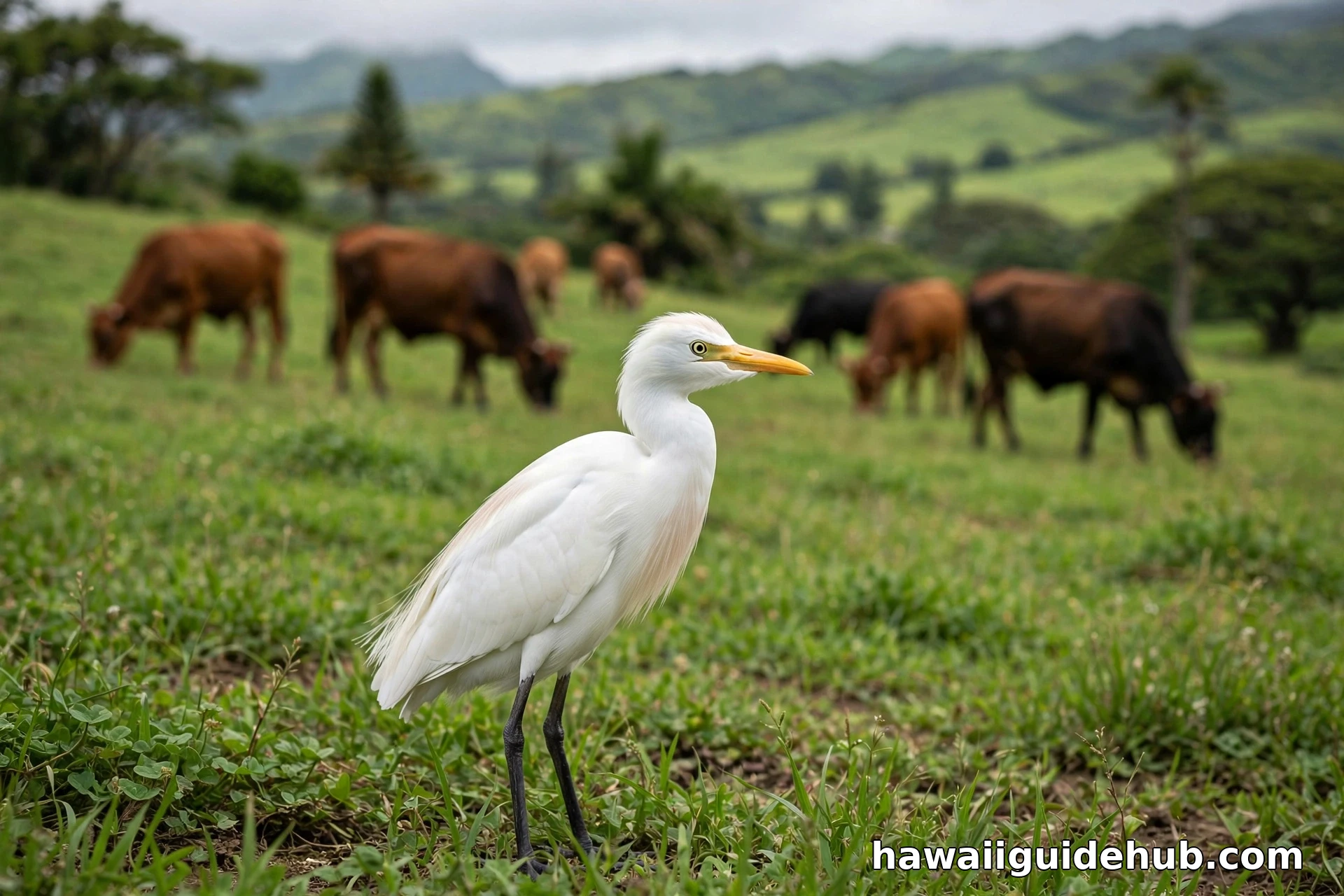
The white bird stalking Hawaii’s pastures is the cattle egret: a 20-inch hunter introduced from Florida in 1959 to eat the flies plaguing cattle herds. It worked, too well. From 105 released birds the population exploded to tens of thousands, and the egret is now one of Hawaii’s most visible birds, and one of its most controversial, accused of hunting the chicks of endangered native waterbirds. This is the complete story of the egret in Hawaii: identification, history, behavior, impact, and where to see it.
This page covers what egret lives in Hawaii, identification, native versus introduced status, the 1959 introduction story, habitat and range, behavior and diet, the threat to native birds, where to see egrets, and FAQs. Everything about Hawaii’s egret is on this one page.
The Short Answer
Hawaii’s egret is the cattle egret (Bubulcus ibis), introduced, not native. It is a stocky white bird about 20 inches long with a yellow bill and dark legs, turning buff-orange on the head and chest in breeding plumage. It was brought from Florida in 1959 by the Board of Agriculture and Forestry to control cattle flies; 105 birds were released and the population reached roughly 30,000 by the early 1980s. It is now widespread on all the main islands.
Identifying the Cattle Egret
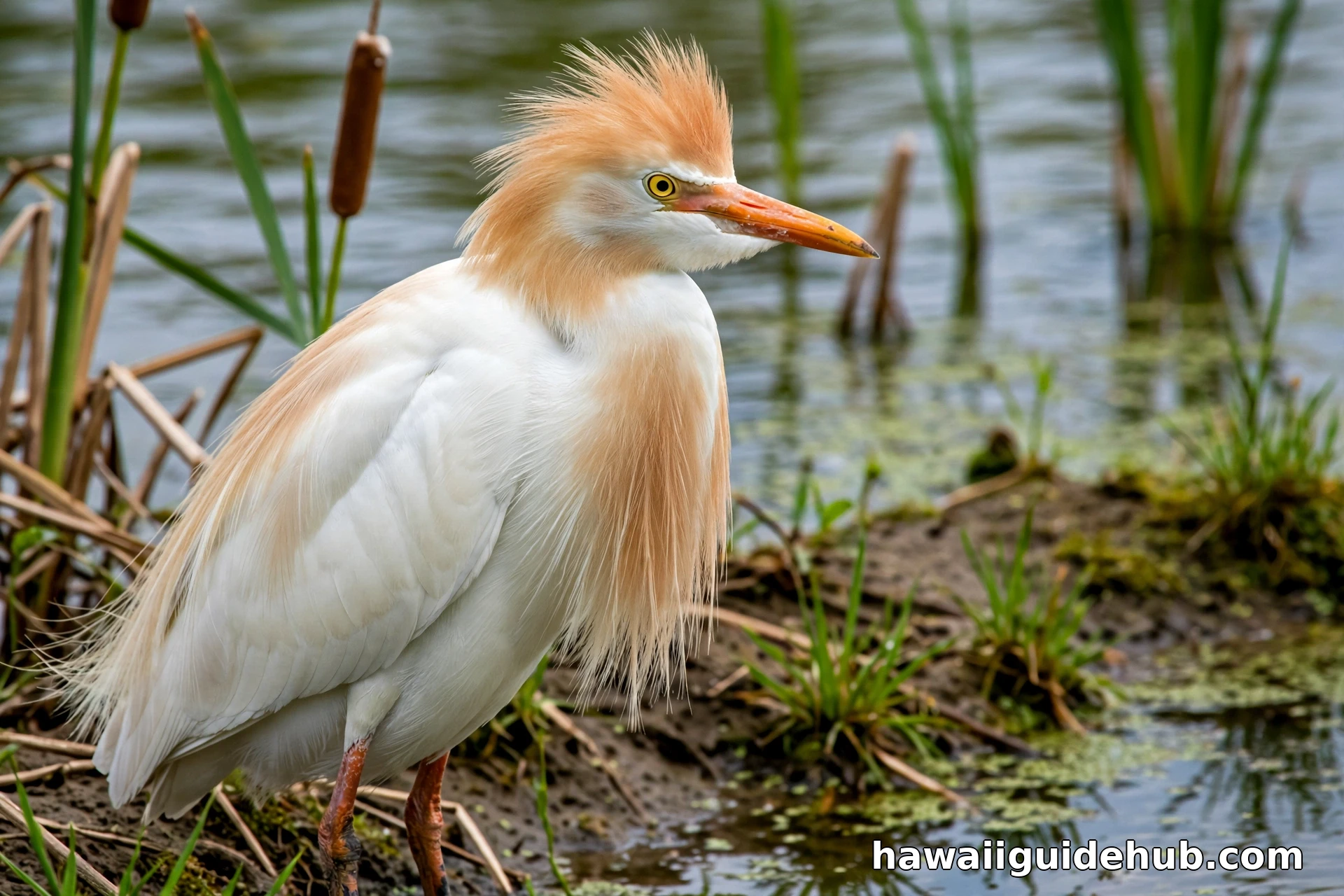
Look for a compact white heron, noticeably stockier and shorter-necked than the elegant egrets of mainland postcards. The bill is yellow and dagger-straight, the legs dark gray, the eyes yellow. In breeding season, adults grow beautiful buff-orange plumes on the crown, chest, and back: a bird you might not recognize as the same species. In flight, egrets fold their necks into an S, unlike cranes and herons’ cousins the ibises, which fly neck-out. Flocks often travel in the crisp V formation the state’s birding trails note as a field mark.
Which White Bird Is It? Hawaii’s Look-Alikes
| Bird | Status in Hawaii | Key ID marks | Behavior |
| Cattle egret | Introduced 1959 | Yellow bill, dark legs, stocky, 20 in | Follows cattle, hunts insects in fields |
| Hawaiian stilt (aeʻo) | Endemic, endangered | Black back, white face, extremely long pink legs | Wades in shallow wetlands, high-stepping |
| Black-crowned night heron (ʻaukuʻu) | Indigenous resident | Stocky, gray wings, black crown, red eyes | Nocturnal; hunches at pond edges by day |
| Great egret | Rare visitor | Very large, yellow bill, black legs, S-curved neck | Stalks fish in deep water |
The 1959 Introduction: A Pest Control Experiment
The cattle egret did not arrive by accident. Hawaii’s cattle ranchers were losing money to biting flies that stressed herds, slowed weight gain, and damaged hides. The Board of Agriculture and Forestry, working with ranchers, imported cattle egrets from Florida and released 105 birds across the islands in 1959. The logic was sound: in Africa and the Americas, the birds famously follow large grazers eating the insects they stir up. The birds thrived beyond all expectation: by the early 1980s, the population had exploded to an estimated 30,000. It is one of history’s most successful, and most debated, biological control introductions.

Behavior: The Opportunist
Cattle egrets are generalists, which is why they conquered the islands. They follow cattle, horses, and even lawn mowers, snatching the insects, lizards, and frogs flushed by the disturbance. They hunt in pastures, golf courses, parks, and wetlands, and they have learned to work airport runways for the insect clouds kicked up by landing planes. They nest colonially in treetop rookeries near water, sometimes hundreds of nests together, laying three to seven pale blue eggs with both parents sharing duties. They are aggressive and adaptable: exactly the traits that made them useful, and exactly the traits now worrying conservationists.
The Dark Side: Threat to Native Birds
Here is the controversy the state does not soft-pedal. Per the Hawaiʻi Birding Trails program, cattle egrets pose a threat to native waterbirds as aggressive chick hunters: they raid the nests of endangered species like the Hawaiian stilt (aeʻo), Hawaiian coot (ʻalae keʻokeʻo), and Hawaiian duck (koloa). They compete for nesting sites and food in the same wetlands the natives depend on. Hawaii’s native waterbirds were already endangered from habitat loss and introduced predators; the egret added a new one. Wildlife managers now monitor egret colonies near sensitive wetlands, and the bird’s story is taught as a cautionary tale about biological control: solving one problem created another.
Where to See Egrets in Hawaii
You barely have to look. Cattle egrets are common in pastures and agricultural land on every main island: the Parker Ranch country of the Big Island, Kauai’s north shore fields, Oahu’s central plain. Wetlands like Kawainui Marsh on Oahu and Hanalei National Wildlife Refuge on Kauai host feeding flocks. At dusk, watch for the V formations streaming to treetop roosts. Waikiki’s parks have resident birds famously tame around people. For the full birding experience, the state’s Hawaiʻi Birding Trails site maps hotspots island by island.
For more island wildlife, see your full Hawaii bucket list and exploring Hawaii’s hidden gems.
The Egret’s Global Conquest
The cattle egret is one of the great range expanders of the bird world. Native to Africa and southern Europe, it crossed the Atlantic on its own in the late 1800s, reached South America, then spread through North America in the 1940s and 50s. Hawaii’s 1959 introduction was part of that same mid-century wave. Today it breeds on every continent except Antarctica. Few birds have ridden human-altered landscapes so successfully: wherever there are grazers, mowers, or tractors stirring up insects, the cattle egret follows. It is the sparrow of the heron world.
Nesting Colonies: Cities in the Trees
Egret rookeries are spectacular and cacophonous. Colonies of hundreds of pairs pack into treetops near water, building stick nests shoulder to shoulder, often mixed with night herons. Both parents incubate the pale blue eggs and feed the chicks. The colonies are noisy, smelly, and constantly active: a wildlife spectacle hiding in plain sight in suburban parks and wetland edges. Do not approach nesting colonies closely: disturbance causes nest abandonment, and the birds’ droppings are no joke.
Egrets and Airports
One of the stranger chapters: cattle egrets learned that airport runways are buffets. Landing planes kick up clouds of insects, and the birds feast in the infield grass. This puts them in the path of aircraft, making them a bird-strike concern that airport wildlife managers actively manage. It is a neat summary of the species: endlessly opportunistic, thriving in the most human of landscapes, and creating management headaches wherever it succeeds.
What Hawaii Is Doing About It
Hawaii cannot unintroduce the egret, so it manages the damage. Wildlife agencies monitor egret colonies near critical native waterbird wetlands, and targeted control happens where egrets threaten endangered species recovery. The broader lesson reshaped policy: Hawaii now screens biological control introductions far more rigorously than in 1959. Visitors can help by keeping to trails in wetland refuges, never feeding egrets (they are carnivores; your sandwich teaches them to mob people), and reporting banded or unusual birds to the state’s birding programs.
The Native Waterbirds Worth Knowing
Learn the birds the egret threatens and your wetland visits gain meaning. The Hawaiian stilt (aeʻo) is unmistakable: black and white with absurdly long pink legs, high-stepping through shallow water. The Hawaiian coot (ʻalae keʻokeʻo) is a dark, duck-like bird with a white bill. The Hawaiian duck (koloa) looks like a mottled brown mallard. All are endangered, all are found in the same wetlands the egrets hunt. Seeing them is a privilege: they survived the mongoose, the rats, and the egret, and they are still here. Combine birding with hiking: see the ultimate guide to hiking in Waimea Canyon and exploring Hawaii’s hidden gems.
Photographing Egrets
Egrets are generous photo subjects: large, white, and tolerant of people in parks. The challenge is exposure: white feathers blow out in Hawaii’s hard light, so shoot in morning or late afternoon and underexpose slightly. The breeding plumage season is the prize: buff-orange on white is gorgeous. Capture the hunting behavior, the neck coiled, the strike, rather than just portraits. And the dusk V formations against a colored sky need no technique at all: just be there.
Egret vs Heron: What’s the Difference
There is no scientific difference: “egret” is just the name for the white, showy-plumed members of the heron family. The cattle egret is a true heron (family Ardeidae), closer to the great blue heron than to anything called an ibis, despite its species name. The egret name comes from the French aigrette, the ornamental plumes that nearly drove the world’s white herons extinct in the plume trade of the 1800s. The cattle egret escaped that slaughter mostly by being small and drab in non-breeding plumage: fashion saved it by ignoring it.
The Cattle Partnership Up Close
The egret-cattle relationship is a textbook commensalism with benefits both ways. The bird gets a beater: every step the cow takes flushes grasshoppers, crickets, and flies into the open. The cow gets pest control: the egret plucks ticks and biting flies directly off the animal’s back and legs, and will even ride the cow between feeding spots. Ranchers who once despaired of flies now watch white birds riding their herds like tiny cowboys. It is one of nature’s most visible partnerships, playing out daily in Hawaii’s pastures.
Seasonal Rhythms
Cattle egrets are year-round residents in Hawaii: no migration, no winter absence. Breeding peaks in the warmer months, when the buff-orange plumage appears and colonies grow loud. Flock sizes swell and shrink with the seasons: big post-breeding aggregations in late summer, tighter groups in winter. The dusk flights to roosts happen every evening of the year, and they are the most reliable wildlife show in the islands: pick a wetland edge at sunset and wait.
Egrets for Young Birders
The cattle egret is the perfect first bird for kids in Hawaii: big, white, everywhere, and doing something interesting. Challenge young birders to spot the yellow bill, count a V formation, or find a bird riding a cow. The breeding plumage color change is a great lesson in how animals transform. And the conservation story, a bird brought to help that ended up hurting, is an honest introduction to how complicated nature can be. Binoculars optional; curiosity required.
The Egret’s Hawaiian Name
Unlike native birds with ancient Hawaiian names, the cattle egret arrived too recently for a traditional name: it is generally just called the cattle egret, or sometimes the cow bird. That namelessness is telling. The ʻaukuʻu, the aeʻo, the ʻalae: the native waterbirds carry names from centuries of observation. The egret carries a job description. In a culture where naming is knowing, the bird without a Hawaiian name is still, sixty years on, a stranger.
Video: Cattle Egret in Waikiki
A cattle egret foraging in Waikiki: the islands’ most adaptable bird up close.
Frequently Asked Questions
Are egrets native to Hawaii?
No. The cattle egret was introduced from Florida in 1959. Hawaii has no native egret species.
Why were egrets brought to Hawaii?
To control biting flies plaguing cattle herds. The Board of Agriculture and Forestry released 105 birds.
Are cattle egrets a problem in Hawaii?
They are controversial: useful for fly control but documented predators of endangered native waterbird chicks.
What do cattle egrets eat?
Insects, lizards, frogs, small fish, and the chicks of other birds. They are carnivores, not vegetarians.
Where can I see egrets in Hawaii?
Pastures, wetlands, golf courses, and parks on all main islands; dusk V-formation flights to roosts are the classic sight.
How big is a cattle egret?
About 20 inches long with a 35-inch wingspan: compact for a heron.
The cattle egret is Hawaii’s most instructive bird: beautiful, useful, destructive, and entirely human-made. It reminds us that in island ecosystems, every introduction is a gamble, and the house sometimes collects in ways nobody predicted. Watch the white hunter working the pasture, admire its success, and remember the stilt chicks it threatens. Both stories are true, and knowing both is what makes you more than a tourist.