Silversword in Hawaii: The Plant That Waits 90 Years to Bloom Once

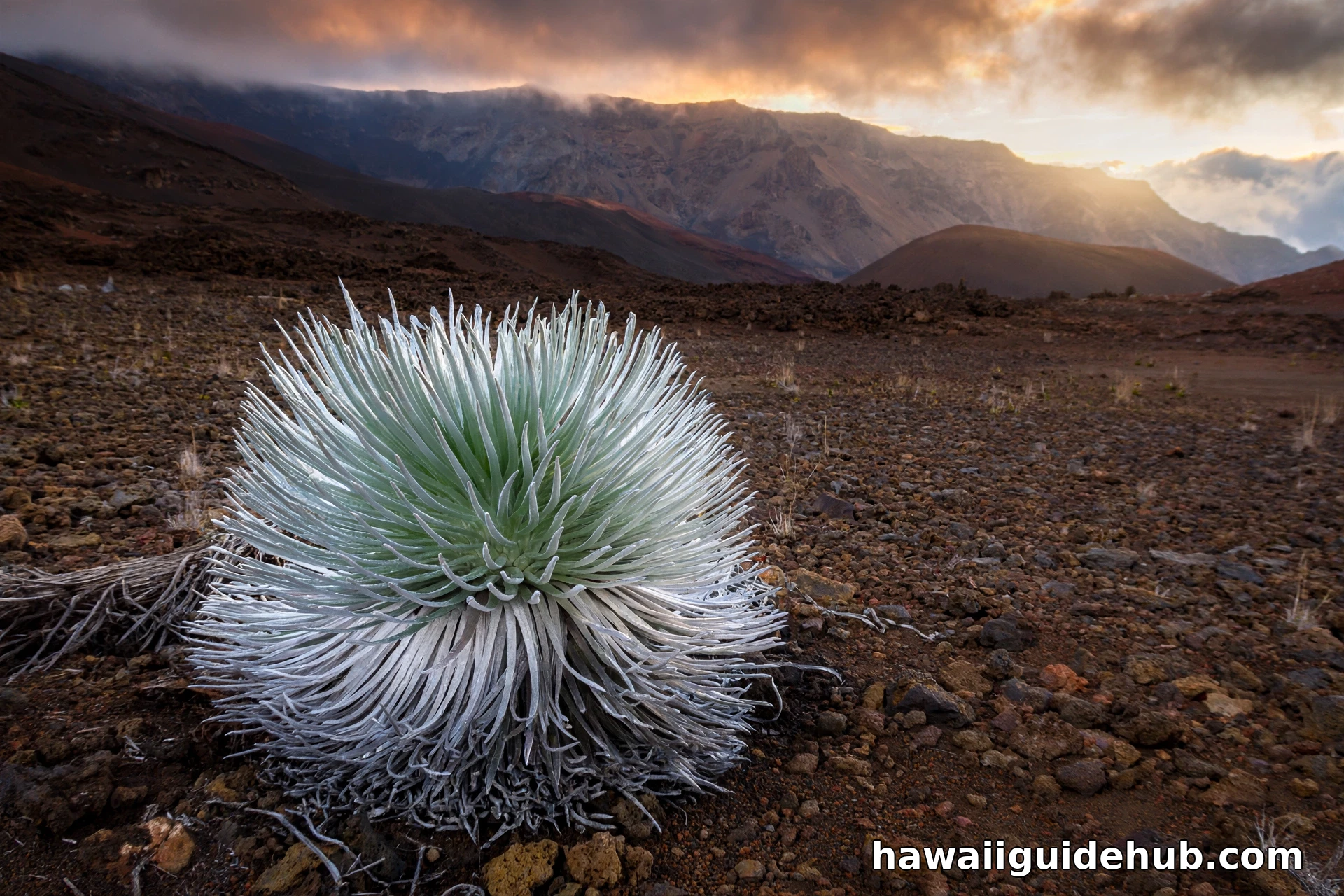
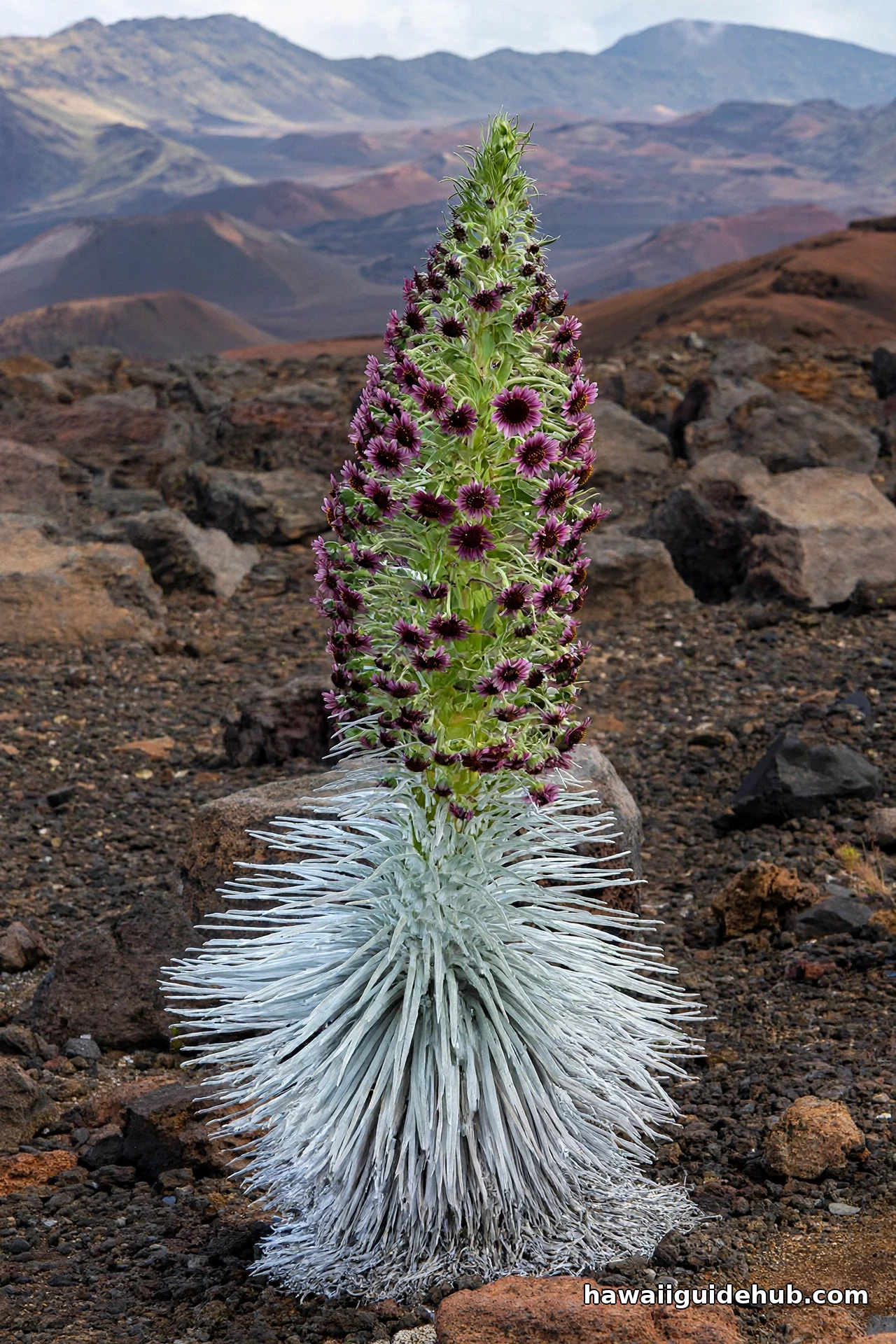
It waits up to 90 years to flower once, then dies. The Haleakalā silversword, ʻāhinahina in Hawaiian, is a ball of silver daggers growing in the cinder desert of a dormant volcano, a plant so strange it looks designed for another planet. When its moment finally comes, usually in June or July, it sends up a six-foot stalk crowded with hundreds of maroon blooms, sets seed with the help of native bees, and is gone within weeks. Nowhere else on Earth does anything quite like it happen.
This is the single complete guide to the silversword in Hawaii. It covers the plant’s one-bloom life cycle, its extreme adaptations, a timeline of a silversword’s life, its evolution from a California weed, the near-extinction and recovery story, its critically endangered Mauna Kea cousin, and how to see silverswords responsibly. If you have been searching for anything about the silversword in Hawaii, the answers are all here on this one page.
The Flower of Patience
The Haleakalā silversword (Argyroxiphium sandwicense subsp. macrocephalum) is monocarpic: it flowers once and dies. For 20 to 90 years it sits as a low silver rosette, a dome of narrow, dagger-like leaves, slowly gathering resources in one of the harshest plant habitats in Hawaii. Then, in a single summer, the rosette’s heart elongates into a towering stalk up to six feet tall, bearing as many as 600 maroon, sunflower-like flower heads. Pollinators come, seeds set, the wind scatters them, and the plant that waited a human lifetime is gone.
The name ʻāhinahina means “very gray,” for the silvery sheen. Native Hawaiians knew the plant and used its tough leaf fibers for rope. Early Western visitors were less respectful: in the 1920s, tourists gathered the striking blooms as souvenirs, unwittingly preventing seed set, while goats and cattle browsed the rosettes. By the 1930s, when Haleakalā became a national park, as few as 4,000 plants remained.
Built for Mars
The silversword’s home is the alpine cinder desert above 6,900 feet: intense UV radiation, freezing nights, desiccating wind, and nutrient-poor volcanic cinder. Its survival kit is a masterclass in adaptation. Tiny silver hairs coat the leaves, reflecting UV and reducing heat load, which gives the plant its metallic glow. Thick, fleshy leaves store water for droughts. The dome shape hugs the ground, dodging the worst of the wind, and the skin resists both freezing and dehydration. It is, researchers say, a textbook example of biological adaptation, a daisy that learned to live on Mars.
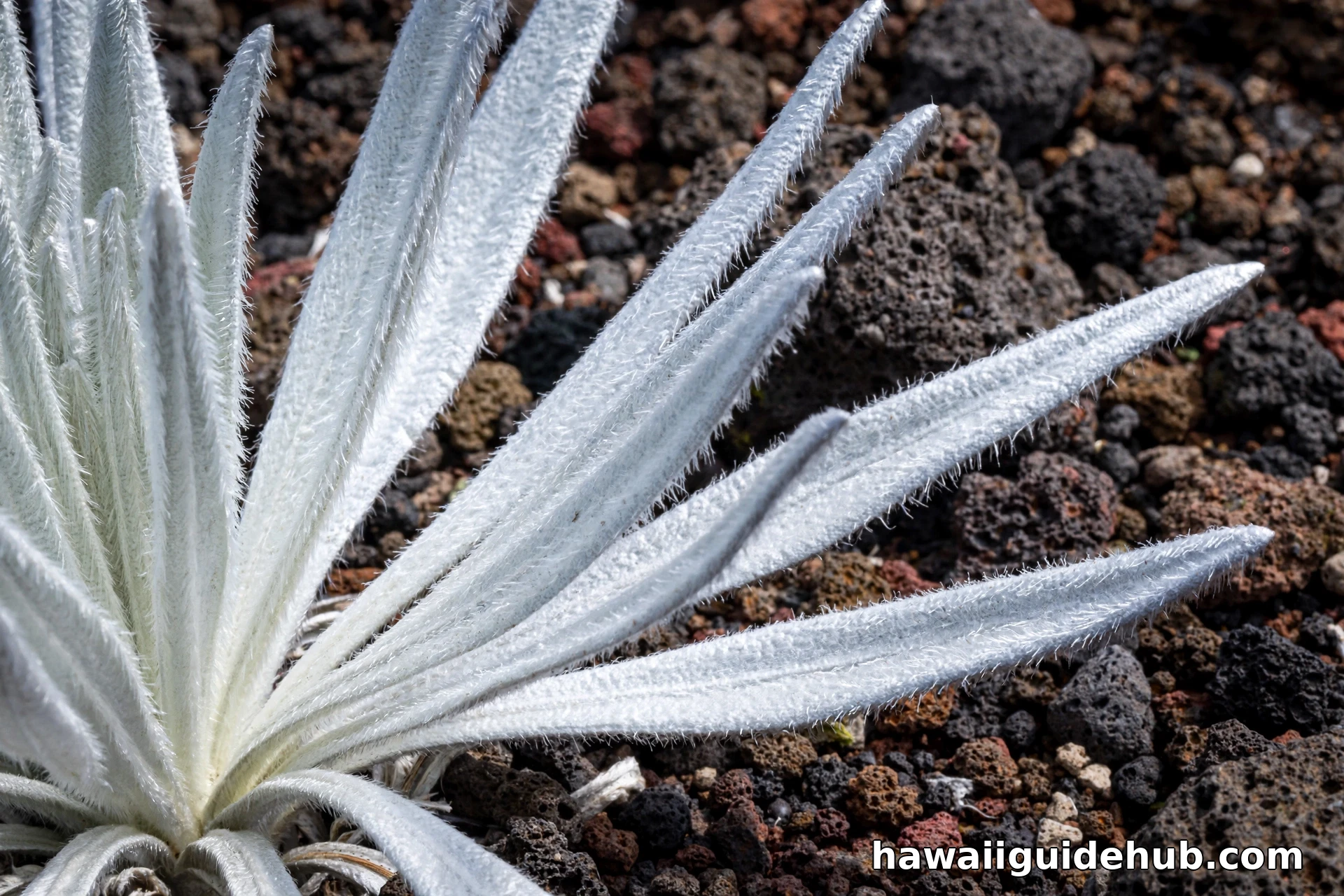
Run a finger, hypothetically, along a silversword leaf and you would feel velvet over steel. The hairs are dense enough to trap a boundary layer of still air against the leaf surface, cutting water loss in the desiccating wind, while their reflectivity bounces back the UV that would shred unprotected tissue at 10,000 feet. It is the same principle as a space blanket, evolved 5 million years before NASA. Engineers studying thermal protection have examined the structure with professional envy.
One Life, One Bloom: A Silversword’s Timeline
A silversword’s life is a slow fuse. The table below follows one plant from seed to seed.
| Stage | Age | What happens |
| Seed | Year 0 | Wind-scattered; fewer than 10% germinate even in trials (per USFWS) |
| Rosette | Years 1 to 20+ | Silver dome grows slowly on cinder; stores water, endures frost |
| Waiting | Years 20 to 90 | Continues growing; flowering triggered by size and conditions, timing still poorly understood |
| The bloom | One summer | Stalk to 6 ft with up to 600 flower heads; needs cross-pollination by insects (per SummitPost/USFWS) |
| Death & dispersal | Weeks later | Plant dies; seeds scatter on the wind; the cycle restarts |
From California Tarweed to Martian Rosette
The silversword’s strangest fact is its ancestry. It belongs to the silversword alliance, some 30 Hawaiian species that all evolved from a small, daisy-like tarweed that arrived from California about 5 million years ago. From that weedy ancestor came not just the silversword but green-leafed shrubs, trees, and vines across the islands, one of the great adaptive radiations in botany. The silversword is the most extreme form, but it can grow beside its shrubby cousins and even hybridize with them, the weed and the wonder side by side.
Near Extinction and Return
The silversword is considered a conservation success story with an asterisk. Fenced protection, goat removal, and the end of bloom-gathering brought the population from 4,000 in the 1930s to about 65,000 by 1991, and the subspecies was listed as threatened in 1992. But the recovery has reversed: by 2010 the count had fallen to about 28,500. Research published in Global Change Biology blames a warming, drying climate, fewer moisture-bearing trade wind days, and fewer breaks in the inversion layer that waters the summit. Argentine ants disrupt the native pollinators. Unlike most extinctions, scientists warn, the silversword might disappear while a million visitors a year watch.
The Pollination Problem
The silversword’s one shot at reproduction is precarious by design. The plant is mostly self-incompatible, meaning its flowers cannot fertilize themselves; it needs insects to carry pollen between simultaneously blooming individuals. In a good year, dozens of stalks flower together on the slopes, and native yellow-faced bees work the maroon heads. In a bad year, a lone bloomer may set almost no seed, its 90-year wait wasted.
This is why population size matters so existentially. A scattered handful of plants cannot reliably pollinate each other, and the Argentine ant invasion has disrupted the native pollinator networks the silversword depends on. Conservation is not just about counting rosettes; it is about keeping enough of them blooming together, in the same summers, for the bees to do their work. The silversword’s love life is a group project.
For the botanically curious, the flower heads themselves reward a close look with binoculars: each maroon “flower” is a composite of many tiny florets, the daisy family’s signature, a miniature sunflower repeated 600 times up the stalk. The tarweed ancestor would recognize the architecture, even if it would not recognize the silver armor or the 90-year wait.
A Family of Wonders
The silversword is the celebrity of a remarkable family. The silversword alliance, all descended from that Californian tarweed, includes the greenswords, less silvery cousins of the high bogs; Dubautia, shrubs and trees of the forests; and Wilkesia, the iliau of Kauai’s Waimea Canyon, a woody relative with its own dramatic flowering. Together they are botany’s favorite example of adaptive radiation on islands, a single weedy ancestor diversifying into trees, shrubs, vines, and the silver marvel of Haleakalā.
Standing on the summit, you can sometimes see the family resemblance across species: the daisy-like flower heads betray the shared ancestry, tiny suns echoing the tarweed of California. Five million years of evolution, written in maroon and silver.
The Vandalism Era
Before goats and climate change, the silversword’s enemy was admiration. In the early 1900s, as Haleakalā became a visitor destination, tourists pulled up rosettes and gathered the spectacular blooms as souvenirs, each stolen flower a plant’s entire reproductive future destroyed. Writers of the era described the slopes littered with uprooted plants. The vandalism, combined with browsing by introduced goats, sheep, and cattle, drove the species to the brink: by the 1920s it was near extinction.
Protection worked, for a while. The national park’s establishment in the 1930s brought fences, ungulate removal, and enforcement, and the population’s rebound to 65,000 by 1991 remains one of Hawaii’s great conservation victories. But the victory assumed a stable climate, and the climate did not cooperate. The lesson of the vandalism era, that human behavior can be changed in time, is now being tested against a threat no fence can stop.
Climate Change on the Summit
The current decline is a climate story told in rainfall. Haleakalā’s summit depends on trade-wind moisture and periodic breaks in the inversion layer that caps the mountain; both have diminished. Researchers tracking the population found growth rates tracking annual rainfall more than any other variable, and rainfall has been dropping. Warmer temperatures compound the stress on a plant already living at its physiological limits.
What makes the silversword’s plight haunting is its visibility. Most endangered species vanish unnoticed; this one is watched by over a million visitors a year, photographed, marveled at, and still declining. Scientists call it extinction in plain sight. Whether the fences, the seed banks, and the outplanting programs can outrun the drying sky is the open question of Hawaiian conservation.
The Mauna Kea Cousin
Haleakalā’s silversword has a sister on the Big Island, and her situation is dire. The Mauna Kea silversword (A. sandwicense subsp. sandwicense), federally listed as endangered, survives as perhaps 40 individuals above 8,500 feet. Where the Maui subspecies numbers in the tens of thousands, the Mauna Kea one could vanish in a single bad decade. It is a reminder that the silversword story is not one story but two, and only one of them currently has a hopeful chapter.
Timing a visit to a bloom is part luck, part strategy. The park does not predict which plants will flower, but rangers at the visitor centers track the summer’s stalks, and the Sliding Sands trail in June and July offers the best odds. A blooming silversword is visible from a long way off, a maroon exclamation mark on the cinder, drawing hikers the way a lighthouse draws ships. If you find one, savor it: that plant waited longer than you have been alive, and it will not bloom again.
Seeing Silverswords Responsibly
Haleakalā National Park is the place, and the rules are simple: stay on designated trails, never touch or pick the plants, and keep to the cinder paths. The rosettes are fragile, the soils are fragile, and a single footstep off-trail can damage decades of growth. Blooming season, typically June and July, is the pilgrimage: the Sliding Sands (Keoneheʻeheʻe) trail passes blooming stalks in good years. Go for sunrise, stay for the silverswords, and remember that the plant you photograph may have been waiting since before you were born.
For more on Hawaii’s extraordinary native life, the guide to Hawaiian cultural traditions adds the human context, while responsible travel practices and the guide to Hawaii’s natural environments cover visiting fragile habitats with care.
Watch: Haleakalā Silversword Blooming
Frequently Asked Questions
What is the silversword in Hawaii?
The Haleakalā silversword (ʻāhinahina) is a rare plant found only on the volcanic slopes of Haleakalā, Maui. It grows as a silver rosette for decades, flowers once, and dies.
How long does a silversword live before blooming?
Between 20 and 90 years. It then sends up a stalk with up to 600 flower heads, sets seed, and dies within weeks.
Is the silversword endangered?
The Haleakalā subspecies is federally listed as threatened (since 1992); the Mauna Kea subspecies is endangered, with as few as 40 plants left.
When do silverswords bloom?
Usually June or July. Blooming stalks are visible along summit trails in Haleakalā National Park in good years.
Why is it called a silversword?
For its narrow, silver, dagger-like leaves, coated in reflective hairs. The Hawaiian name ʻāhinahina means “very gray.”
How many silverswords are left?
The Haleakalā subspecies numbered about 28,500 in 2010, down from 65,000 in 1991. The Mauna Kea subspecies has as few as 40 plants.
Where does the silversword grow?
Only on the volcanic slopes of Haleakalā, Maui, above 6,900 feet, inside Haleakalā National Park. Its sister subspecies grows on Mauna Kea, Big Island.
Can you touch a silversword?
No. Stay on designated trails and never touch or pick the plants; they and their soils are extremely fragile.
The silversword is patience made visible: ninety years of silver silence for one summer of maroon glory. Stand beside a blooming stalk at 10,000 feet, and you are witnessing the most patient performance in the plant kingdom, one that may not survive the century. Go gently, go soon, and when you tell the story later, tell it with the urgency it deserves. Some wonders do not wait for us to be ready, and this is emphatically one of them.