Taro (Kalo) in Hawaii: The Ancestor Crop That Fed a Civilization

In Hawaii, taro is not a crop. It is an ancestor. Kalo, as Hawaiians call it, grows from the body of Hāloa, the stillborn first son of the sky father and earth mother, and every Hawaiian alive is his younger sibling. From that sacred root grew the staple food of an island civilization: hundreds of cultivated varieties, terraced valleys of flooded loʻi that fed hundreds of thousands, and poi, the fermented paste that Hawaiians alone among Pacific Islanders learned to make.
This is the single complete guide to taro (kalo) in Hawaii. It covers the Hāloa creation story and what it means, the loʻi and ʻauwai engineering that sustained ancient Hawaii, the hundreds of varieties, every major kalo dish from corm to table, how poi is traditionally made, and where visitors can respectfully experience kalo culture. If you have been searching for anything about taro or kalo in Hawaii, the answers are all here on this one page.
Hāloa: The Ancestor in the Field
The Kumulipo, the Hawaiian creation chant, tells that Wākea, the sky father, and Papa, the earth mother, had a daughter, Hoʻohōkūkalani. From Wākea’s union with her came a firstborn son who was stillborn. They buried him, and from his grave grew the first kalo plant, named Hāloanakalaukapalili for the long stem, the unfolding leaf, the quivering blade. Their second son, healthy and living, was named Hāloa after his elder brother, and from him came the Hawaiian people.
This is why kalo is not merely food but family. The Hawaii State Legislature, in findings for taro-protection legislation, records kalo as “the older brother of mankind” to the kanaka maoli, providing the life-giving sustenance, poi. The language carries the relationship: ʻohana, the word for family, derives from ʻohā, the small corms that sprout from the parent plant to feed the family, with “ana” connoting regeneration. The huli, the cut stalk planted for the next generation, means “to turn,” as in turnover, renewal. To farm kalo is to tend one’s genealogy.
Loʻi: Engineering a Civilization
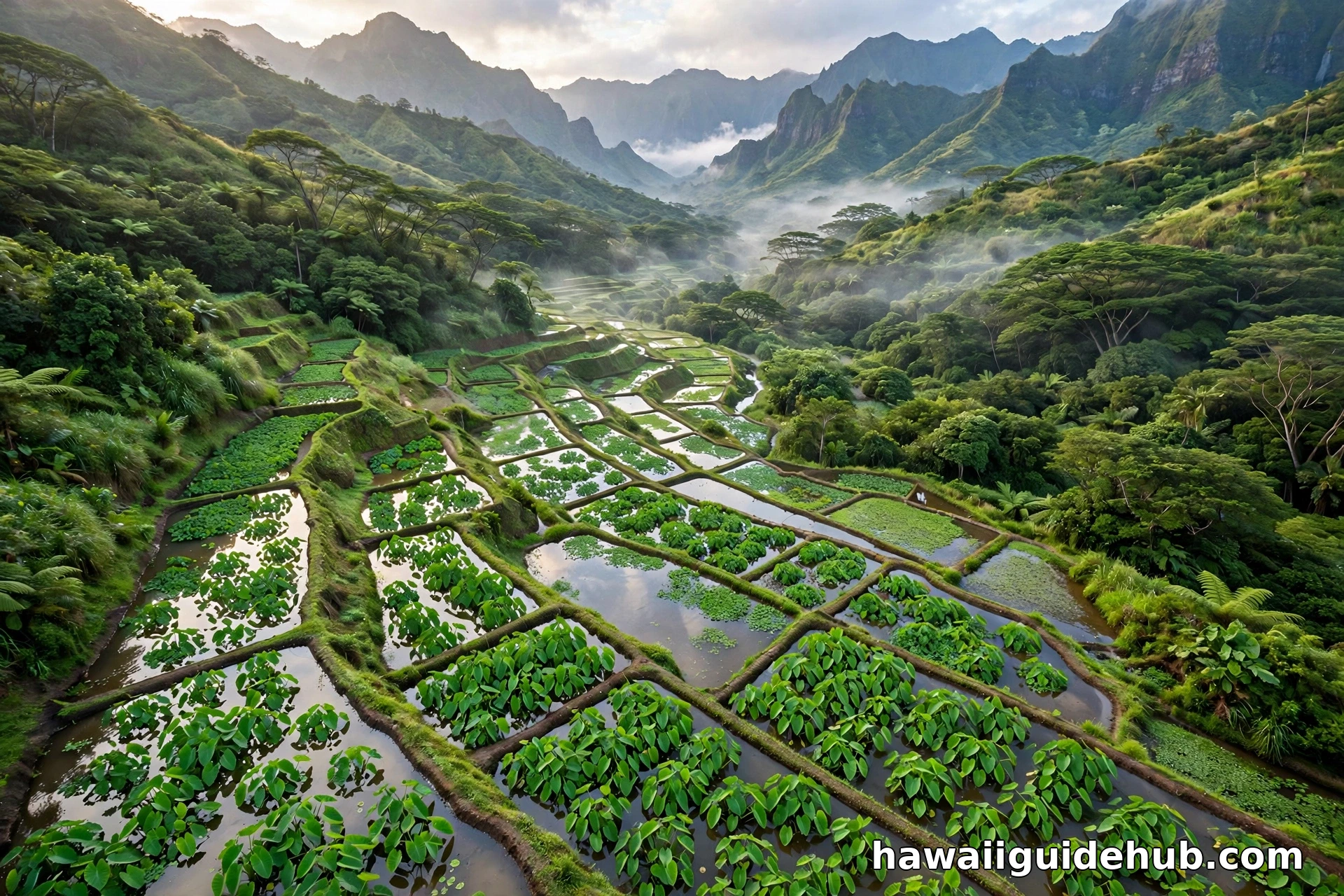
Kalo grows in loʻi, shallow terraced ponds fed by diverted mountain streams. Water flows from an ʻauwai, an irrigation channel, into the top terrace, cascades down through each level, and returns to the stream at the valley floor, often cleaner than when it entered, since the loʻi filter it. Some working ʻauwai on Kauai and Oahu still follow channels dug centuries ago. University of Hawaii researchers describe ancient Hawaii as the zenith of pre-industrial taro cultivation technology, and the numbers support it: around 1650, a population over 400,000 was sustained by this engineered abundance.
The system was also social technology. Loʻi demanded coordinated water management across whole valleys, which demanded governance, which the ahupuaʻa land system provided, each wedge of land from mountain to sea managing its own water, food, and people. Taro was the crop that made the civilization possible, and the civilization was organized around growing it. When you stand at the edge of a loʻi in Waipiʻo or Hanalei, you are looking at infrastructure as sophisticated, in its way, as anything Rome built.
Three Hundred Varieties, One Family
At the time of European contact, Hawaiians cultivated over 300 named kalo varieties, a diversity unmatched anywhere in the Pacific and a testament to centuries of deliberate breeding. The legislature’s findings note that of the roughly 70 varieties surviving today, the majority are unique to Hawaii, products of native Hawaiian horticultural skill. Varieties differed in corm color, leaf shape, taste, and purpose, and the differences were socially coded: royal taros producing pinkish and purplish poi were reserved for high chiefs and royalty, while gray and white poi went to commoners.
Preservation continues. On Molokai, growers like the late Martha and Cowboy Otsuka spent decades seeking out and preserving rare varieties, and the Polynesian Cultural Center’s Hawaiian Village maintains over 30 varieties in working loʻi. Each variety is a living archive of selection decisions made by farmers whose names are lost but whose taste survives in the corm.
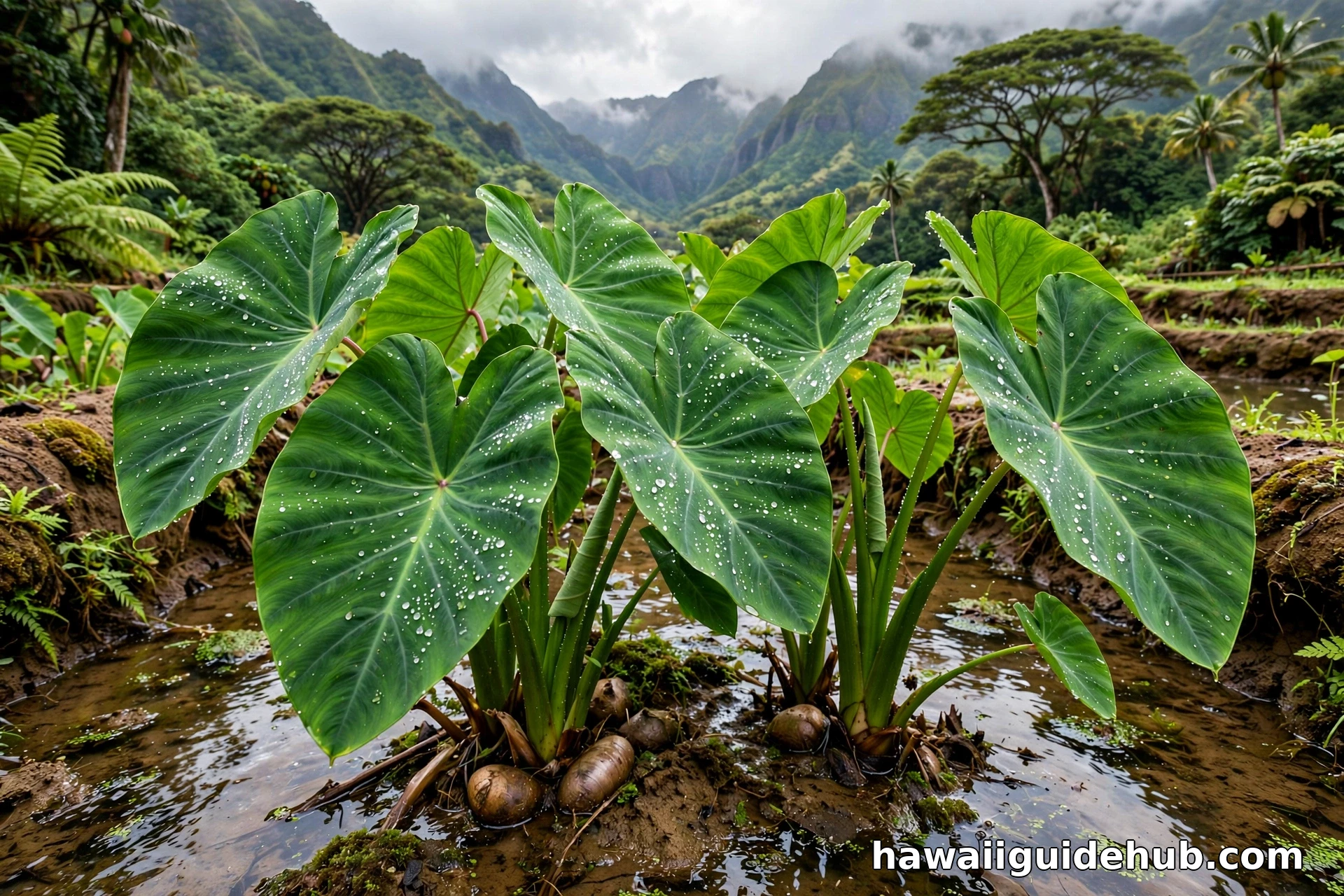
Look closely at a kalo plant and you can read its whole story in its parts. The hā, the long leaf stalk, rises from the corm like a breath made visible. The lau, the heart-shaped blade, unfolds and quivers in the wind, the kapalili of the old name. Below the waterline, the corm swells with starch while the ʻohā cluster at its sides, the next generation already forming. Every part named, every name meaningful: this is a plant its people truly knew.
From Corm to Table: The Kalo Dishes
All parts of the kalo plant are eaten, but the corm is the star. The table below maps the essential dishes, because “taro” on a menu can mean very different things.
| Dish | What it is | Kalo part |
| Poi | Steamed corm pounded to a paste, thinned with water; eaten fresh (sweet) or fermented (sour) | Corm; pounded on papa kuʻi ʻai with pōhaku kuʻi ʻai (per UH Hilo) |
| Paʻi ʻai | Hand-pounded, undiluted poi; dense, moldable, the traditional voyager’s ration | Corm; keeps for weeks, ferments rather than spoiling |
| Kūlolo | Baked pudding of grated taro and coconut milk | Corm, grated; a beloved dessert |
| Lūʻau | Cooked taro leaves, often with coconut milk; also the name for the feast | Leaves; always cooked (raw kalo irritates the mouth) |
| Kalo chips | Thin-sliced, fried corm | Corm; the modern snack-aisle form |
How Poi Is Made
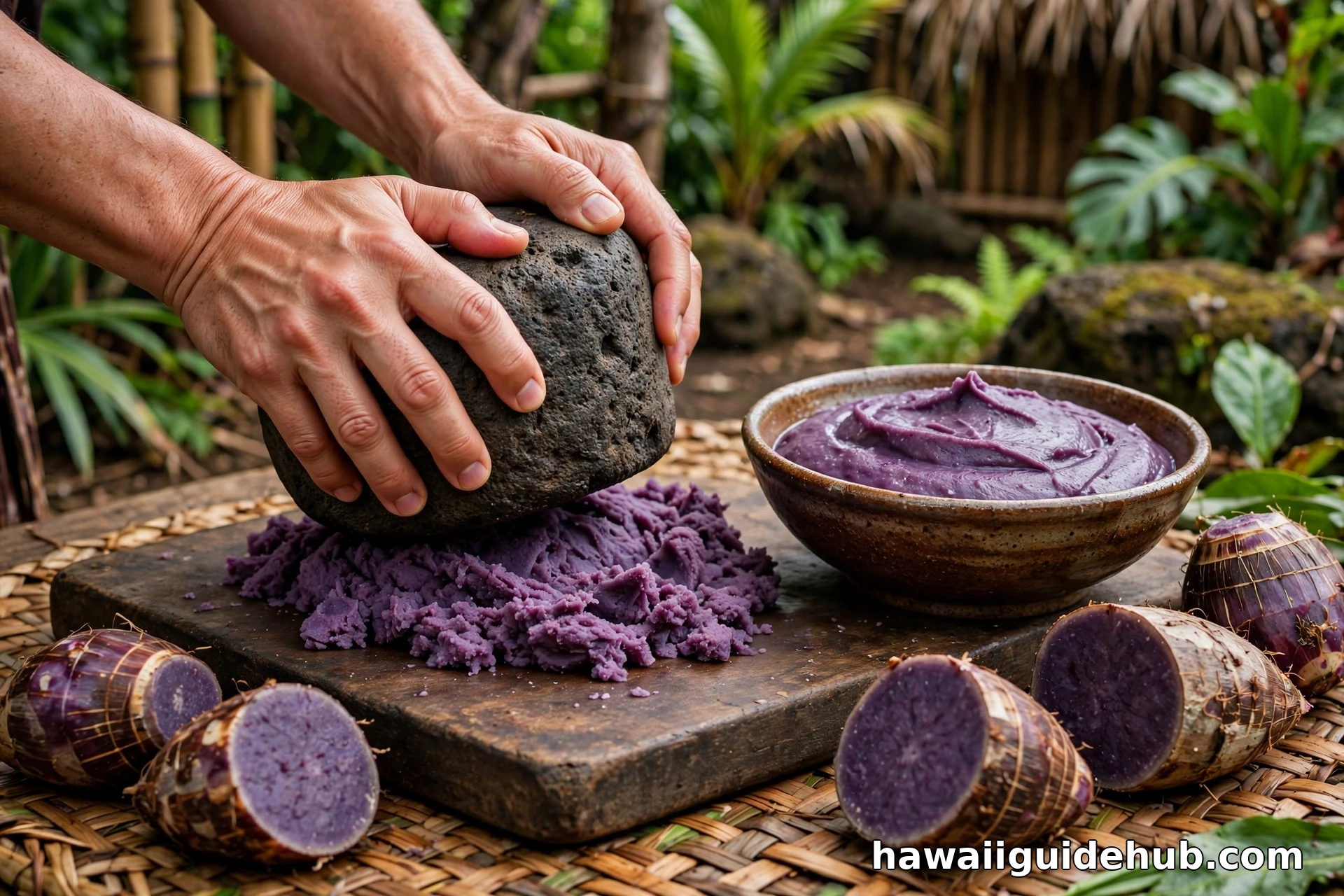
Traditional poi-making is a ritual of patience. The corm is steamed, traditionally in an imu, an underground oven, then peeled and pounded between the papa kuʻi ʻai, a wooden board, and the pōhaku kuʻi ʻai, a stone pounder, with small additions of water, until it becomes a thick, smooth paste. The pounding drives air from the starch, which is why poi ferments instead of spoiling: travelers once stashed it along trails for days. Fresh poi is subtly sweet; after a day it sours to a tangy flavor that devotees prize. It is eaten with two fingers, scooped from the center of the bowl with a twist, straight to the mouth.
One safety note that matters: raw kalo contains calcium oxalate crystals that irritate the mouth and throat, so corms and leaves are always cooked before eating. This is not a taste-raw situation. The cooking transforms an inedible irritant into one of the world’s great staple foods, which is part of the ancient genius of the crop.
Wetland vs. Dryland Kalo
Not all kalo grows in water. Hawaiians recognized two broad groups: wetland kalo, cultivated in flooded loʻi along riverbanks and streams, and dryland (upland) kalo, grown in rain-fed fields at higher elevations, maturing over roughly 12 months on rainfall alone. Wetland varieties produce the corms prized for poi; dryland varieties, of which Big Island farmers still cultivate over 60, tend toward different textures and flavors suited to baking and steaming whole.
The distinction shaped the landscape. Wetland cultivation required the ʻauwai engineering of the valleys; dryland cultivation required reading rainfall and soil across the uplands. Both required the same deep knowledge of varieties, planting calendars, and fallow cycles. Traditionally, Hawaiians alternated loʻi plantings with fallow periods to let the land rest, a practice modern regenerative farmers are rediscovering as the science catches up with the kupuna.
The Modern Kalo Renaissance
Kalo nearly vanished from Hawaii’s commercial landscape in the 20th century, as plantation agriculture diverted water from the valleys and imported starches displaced the corm. The revival began with farmers and cultural practitioners who refused to let the ancestor go. On Oahu, growers like Daniel Anthony built a movement around kalo as food sovereignty, co-founding poi companies, teaching poi pounding, and spearheading the successful statewide campaign to legalize the public sale of hand-pounded poi made in the traditional manner with wooden board and stone.
That legislation mattered beyond commerce: it recognized the traditional method as legitimate food production, not a health-code violation. Today, kalo is back in classrooms, farmers markets, and restaurants, and young Hawaiians are learning loʻi farming as cultural practice, not just agriculture. The renaissance is still fragile, water rights battles continue in the old taro valleys, but the direction is unmistakable. The elder brother is being fed again.
Kalo Beyond Poi: The Whole-Plant Kitchen
Poi gets the glory, but the kalo kitchen is wider. The leaves, cooked long with coconut milk, become lūʻau, rich and silky. The corm steams, bakes, and fries beautifully; taro chips and taro fries are the gateway for skeptics. Kūlolo, the baked taro-and-coconut pudding, converts even poi doubters. And the huli, the planting stalk, goes back in the ground, because in the kalo kitchen nothing is wasted and everything regenerates. Ask at Hawaiian plate lunch spots and bakeries for the kalo specials; the purple-stained fingers of the poi pounders are a badge of honor, not a mess.
Where to Experience Kalo in Hawaii
The great kalo landscapes are Waipiʻo Valley on the Big Island and Hanalei Valley on Kauai, where loʻi still checker the valley floors much as they have for centuries. Several working farms and cultural centers welcome visitors for loʻi experiences: expect to get muddy, to hear the Hāloa story from your hosts, and to begin with an acknowledgment of the ancestor in the field. Listen through it; that framing is the point. The Polynesian Cultural Center’s Hawaiian Village grows 30-plus varieties in working loʻi alongside a stream, and Kualoa Ranch on Oahu runs taro farm experiences.
Eat the food where it is made. Fresh poi from a farmers market, kūlolo from a bakery, lūʻau at a proper Hawaiian plate lunch spot: these taste nothing like the shelf-stable versions. And when you buy, you support the growers keeping the 70 surviving varieties alive. For more on Hawaii’s food traditions, the guide to Hawaiian cultural traditions adds depth, while responsible travel practices and the guide to Hawaii’s natural environments cover visiting working landscapes with respect.
Watch: Taro (Kalo) 101
Frequently Asked Questions
What is kalo?
Kalo is the Hawaiian word for taro (Colocasia esculenta), the staple crop of ancient Hawaii and, in Hawaiian belief, the elder brother of the Hawaiian people.
What is poi made from?
Poi is made from steamed taro corms, pounded with a stone pounder on a wooden board and thinned with water. Hawaiians were the only Pacific Islanders to make poi.
Who is Hāloa?
In the Kumulipo creation chant, Hāloa is the stillborn first son of Wākea and Hoʻohōkūkalani, from whose grave the first kalo grew. His younger brother, also named Hāloa, is the ancestor of Hawaiians.
Can you eat raw taro?
No. Raw kalo contains calcium oxalate crystals that irritate the mouth and throat. Corms and leaves must always be cooked.
What is the difference between poi and paʻi ʻai?
Poi is pounded taro thinned with water to a paste; paʻi ʻai is the dense, undiluted hand-pounded form. Paʻi ʻai keeps for weeks and was the traditional voyager’s ration, since it ferments rather than spoiling.
How many taro varieties did Hawaiians grow?
Over 300 named varieties at European contact, per the Hawaii State Legislature’s findings. About 70 survive today, most of them unique to Hawaii.
What is lūʻau?
Cooked taro leaves, often prepared with coconut milk. The word also names the Hawaiian feast, where the dish is a staple.
Where can I see taro growing in Hawaii?
Waipiʻo Valley (Big Island), Hanalei Valley (Kauai), the Polynesian Cultural Center’s Hawaiian Village (Oahu), and working farm tours island-wide.
Kalo is the rare food that is also a relative. It fed a civilization of hundreds of thousands, carried its genealogy in its language, organized its valleys and its water law, and still grows in terraces its first farmers would recognize. Taste fresh poi, walk a loʻi wall, learn the name Hāloa, and you will understand Hawaii a little the way Hawaiians do. The elder brother has been waiting a very long time for you to come and visit at last.