Hawaiian Adobo: The Filipino Dish Hawaiʻi Made Its Own

Ask a Hawaiʻi local what they ate growing up, and adobo will come up fast. This tangy, garlicky, soy-and-vinegar braise is one of the islands’ great comfort foods, as at home on a paper plate at a beach potluck as it is in a Filipino grandmother’s kitchen. But adobo did not start in Hawaiʻi. It crossed the Pacific with Filipino plantation workers in the early 1900s, carrying centuries of history in a single pot: pre-colonial vinegar preservation, a Spanish name, and Chinese soy sauce, all simmered into something entirely its own.
This is the single complete guide to Hawaiian adobo. It covers what adobo is, its Filipino origins and journey to Hawaiʻi, how it is made, the chicken versus pork debate, regional variations, where to find the best adobo in Hawaiʻi, how to make it at home, and answers to the questions visitors ask most. Everything about Hawaiian adobo is right here on this one page.
Hawaiian Adobo at a Glance
| Element | Detail | Taste it in |
|---|---|---|
| What it is | Meat braised in vinegar, soy sauce, garlic, bay leaves, and peppercorns | Tangy, savory, garlicky, with a glossy reduced sauce |
| Origin | The Philippines; brought to Hawaiʻi by plantation workers in the early 1900s | A plantation-era story in every pot |
| Name | From Spanish “adobar” (to marinate), given by Spanish colonizers | A name with colonial roots |
| Most common | Chicken adobo and pork adobo | Start with chicken; graduate to pork |
| Served with | Steamed white rice, always | The sauce demands rice |
| Where to find it | Filipino restaurants, plate lunch spots, potlucks, home kitchens | Potluck adobo is the benchmark |
| Hawaiʻi twist | Local versions with pineapple, extra garlic, or spicy chili pepper | Pineapple adobo is the island signature |
What Adobo Is
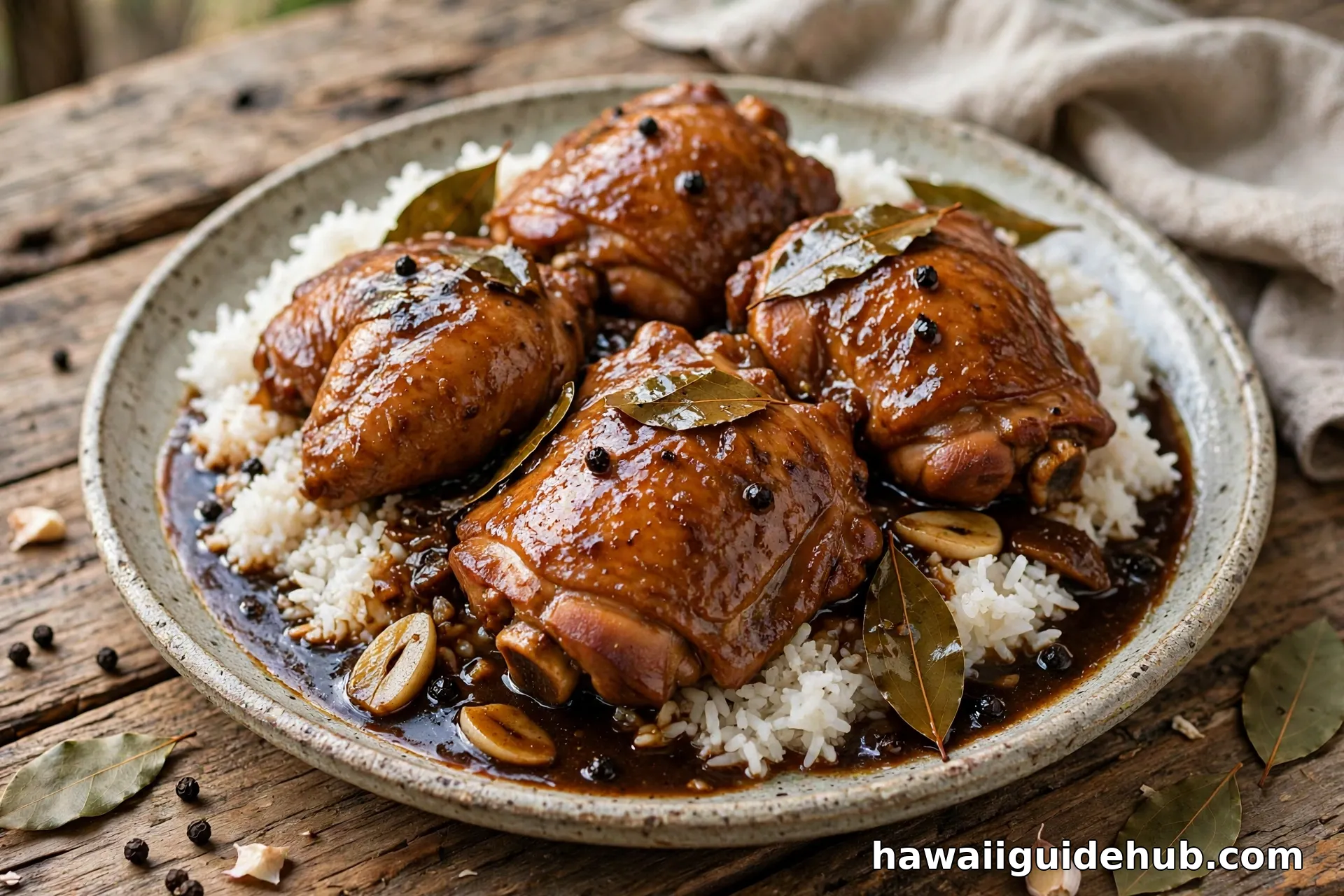
At its core, adobo is a method more than a recipe: protein marinated and then braised in a mixture of vinegar and soy sauce with crushed garlic, bay leaves, and black peppercorns, simmered until tender and finished by reducing the braising liquid into a glossy, intensely flavored sauce. The vinegar tenderizes and preserves, the soy sauce brings salt and depth, the garlic brings punch. Served over steamed white rice with some of the sauce spooned over, it is the definition of comfort food: sour, salty, rich, and deeply satisfying.
From the Philippines to Hawaiʻi: The History
Adobo’s story starts before the Philippines had the name. Long before Spanish colonization, native Filipinos preserved meat in vinegar and salt, a practical technique in a tropical climate without refrigeration. When the Spanish arrived in the 1500s, they recognized the method as similar to their own adobar, marinating, and gave the dish the name it carries today. Later, Chinese traders introduced soy sauce to the islands, and it became the second pillar of the braise. Three cultures, one pot.
The dish reached Hawaiʻi with the sakadas, the Filipino laborers recruited to work the sugar plantations starting in 1906. They brought their recipes, their ingredients, and their cooking methods, and adobo took root in plantation camps alongside the foods of Japanese, Chinese, Portuguese, and Korean workers. Over generations it became part of Hawaiʻi’s shared local food culture, served at potlucks, fundraisers, and family gatherings across ethnic lines. Today, adobo is as much a Hawaiʻi dish as it is a Filipino one.
Three Cultures in One Pot
Adobo is a history you can taste. The vinegar braise itself is pre-colonial: native Filipinos cooked meat in vinegar and salt centuries before Europeans arrived, because acid preserves meat in tropical heat. The name is Spanish: colonizers in the 1500s saw the method, thought of their own adobar, and the label stuck so firmly that most people today assume the dish is Spanish. The soy sauce is Chinese: traders brought it to the archipelago, and it replaced salt as the braise’s savory backbone. Garlic, bay leaves, and peppercorns rounded out the formula. When Filipino sakadas carried the recipe to Hawaiʻi’s plantations in the early 1900s, they carried all three layers with it.
Adobo Across the Philippines
There is no single adobo, even in the Philippines. Tagalog adobo is the famous one: dark with soy sauce, tangy, garlicky. Adobong puti, or white adobo, skips the soy sauce entirely and leans on vinegar, garlic, and peppercorns for a paler, sharper result. Adobong dilaw adds turmeric for a golden color. In the Visayas, some versions add coconut milk or sugar; in Bicol, chilies bring serious heat. Every province, and honestly every family, has a ratio it will defend. The Hawaiian versions descend mostly from the Ilocano cooking of the sakadas, who came largely from the northern Philippines.
Chicken Adobo vs. Pork Adobo
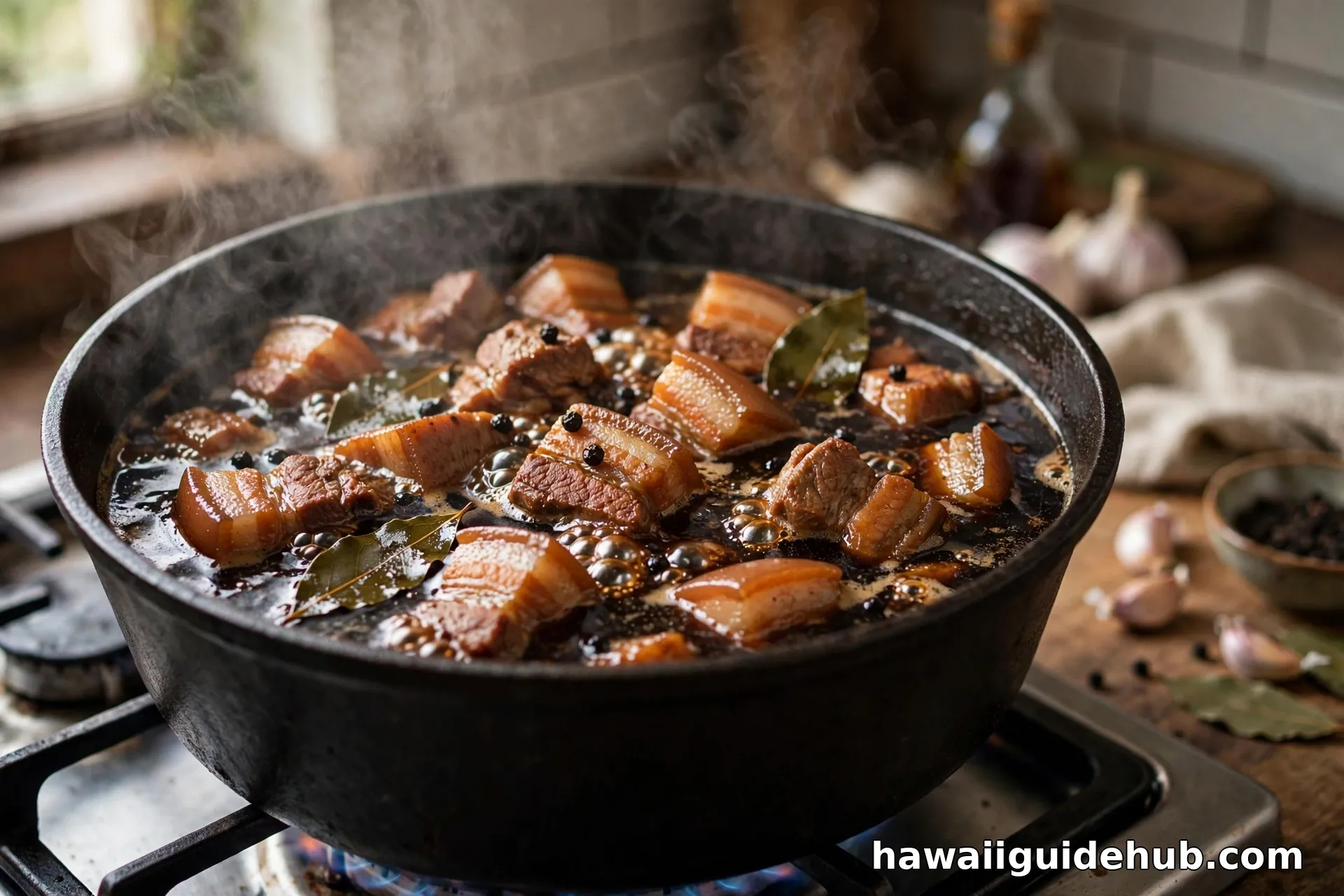
The friendly debate never ends, and every family has a position. Chicken adobo is the everyday version: leaner, quicker, the one most home cooks make on weeknights. Bone-in chicken thighs are the classic cut, staying juicy through the braise. Pork adobo is the celebration version: richer, more indulgent, traditionally made with pork belly or shoulder until the fat renders into the sauce. Both are correct. Order both if you can.
How Adobo Is Made
Every family guards its own ratios, but the method is universal. The meat marinates in vinegar, soy sauce, and crushed garlic, then gets seared for color before the marinade, bay leaves, and peppercorns go back in. It simmers low and slow until tender, and the sauce reduces to a glaze. The most argued-over question: when does the vinegar go in, and do you stir it? Traditionalists add the vinegar and leave the pot undisturbed until it boils, believing that stirring raw vinegar makes the dish harsh. Science is quiet on this point; grandmothers are not.
Variations Worth Knowing
Adobo is a formula, and the Philippines has dozens of regional expressions: adobong pusit (squid, with its ink), adobong kangkong (water spinach), adobong sitaw (long beans). In Hawaiʻi, local twists appear: pineapple chunks for sweetness, extra garlic by the head rather than the clove, Hawaiian chili pepper for heat. Some cooks add coconut milk, edging toward ginataan. The through-line is always the vinegar-soy braise; everything else is personal. That flexibility is the dish’s genius: adobo is less a recipe than a method, and the method welcomes whatever the cook has on hand.
Hawaiʻi’s Own Adobo Twists
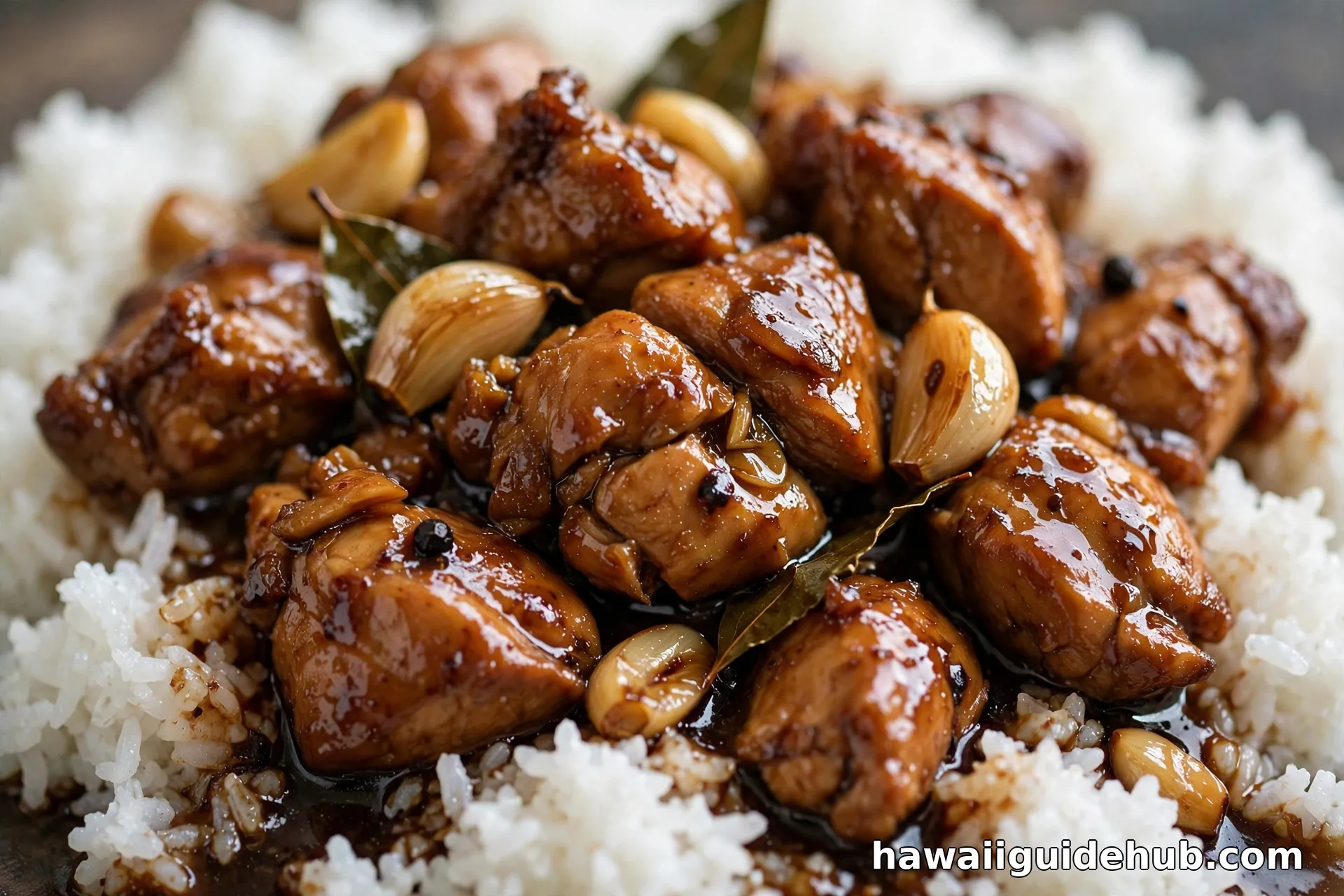
In Hawaiʻi, adobo kept evolving. Local cooks add pineapple chunks, a nod to the islands’ plantation fruit, for a sweet-sour balance. Some use Hawaiian chili pepper or a splash of chili pepper water for heat. Garlic quantities that would alarm a mainlander are normal here; a whole head per pot is standard, and some cooks go further. A few add a spoonful of sugar to round the vinegar’s edge. None of this breaks the dish. Adobo has always been a formula that absorbs its surroundings, and Hawaiʻi’s surroundings include pineapple, chili peppers, and very strong opinions about garlic.
Adobo at the Potluck
To understand adobo’s place in Hawaiʻi, picture the potluck table: foil pans lined up at a beach park or a school fundraiser, each one a family’s signature. The adobo pan is always one of the first to empty. It travels well, feeds a crowd cheaply, and tastes even better the next day as the vinegar mellows into the meat. For many Hawaiʻi families, adobo is the dish someone’s grandmother is famous for, the recipe that gets requested by name. Visitors who get invited to a potluck should treat it as the honor it is, and go back for seconds.
Where to Find Adobo in Hawaiʻi
The best adobo in Hawaiʻi is usually not in a restaurant at all; it is at a potluck, a fundraiser plate sale, or a coworker’s birthday party. But visitors have excellent options. Filipino restaurants across the islands serve it as a centerpiece: look for them in Kalihi and Waipahu on Oʻahu, in Kahului on Maui, and in Hilo on the Big Island. Plate lunch spots often carry chicken adobo alongside the standard mix plates. And if a local invites you to a potluck, say yes; the adobo will find you.
Making Adobo at Home
Adobo is one of the most forgiving dishes to learn. The ingredient list is short, the technique is simple, and the result tastes like it took far more effort. Use a 1:1 ratio of soy sauce to vinegar as your starting point, a whole head of crushed garlic, a few bay leaves, and a teaspoon of peppercorns for two pounds of chicken thighs or pork shoulder. Marinate at least 30 minutes, sear, simmer 30 to 40 minutes until tender, then reduce the sauce until it coats a spoon. Serve over rice. Adjust the vinegar up or down to your taste; that calibration is what makes it yours.
Video: How to Make Authentic Chicken Adobo
This step-by-step video walks through an authentic Filipino chicken adobo recipe, from marinating to the final glossy sauce.
What to Eat With Adobo
Rice is non-negotiable, but the supporting cast matters. A simple tomato and onion salad, dressed with a little vinegar, cuts the richness. Pickled vegetables, atchara in Filipino homes, add crunch and acid. At a Hawaiian potluck, adobo shares the table with mac salad, lomi salmon, and poi, and it holds its own against all of them. To drink, water or iced tea; the dish is bold enough without competition. The only real rule: make more rice than you think you need, because the sauce will not last.
Adobo and the Plate Lunch
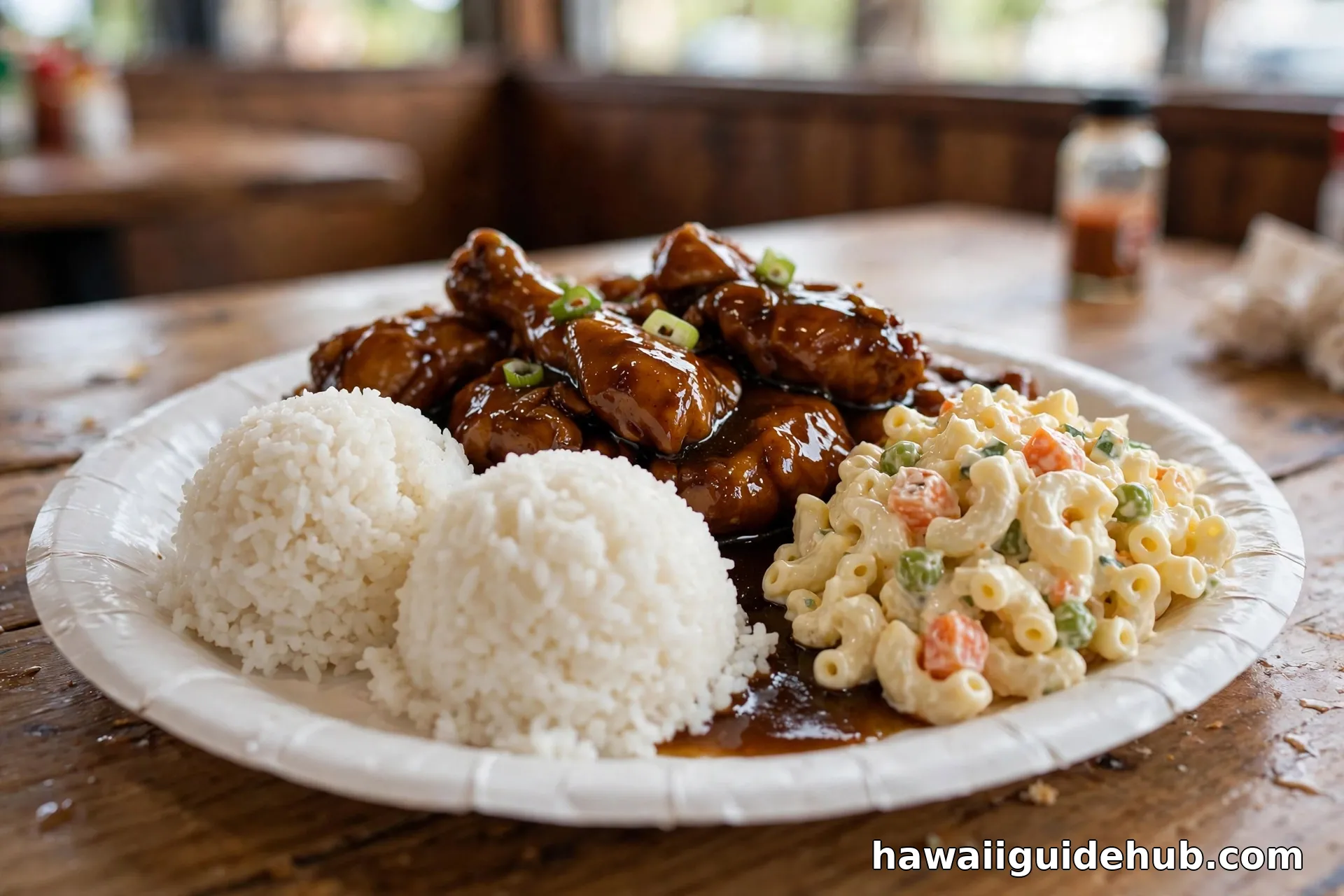
Adobo earned its place in Hawaiʻi’s other great culinary institution: the plate lunch. The plantation-era meal of two scoops of rice, mac salad, and a protein absorbed the islands’ immigrant foods, and chicken adobo slid naturally into the rotation. Order a mini plate with adobo and you are tasting a century of Hawaiʻi history: Filipino technique, served in the format that plantation workers invented, eaten by everyone.
Frequently Asked Questions
Is adobo Filipino or Hawaiian?
Adobo is Filipino in origin, brought to Hawaiʻi by plantation workers in the early 1900s. Over generations it became part of Hawaiʻi’s shared local food culture.
What does adobo taste like?
Tangy, savory, and garlicky, with a rich reduced sauce. The vinegar provides brightness, the soy sauce provides depth, and the long simmer makes the meat tender.
What is the difference between chicken and pork adobo?
Chicken adobo is leaner and quicker, the everyday version. Pork adobo, often made with belly or shoulder, is richer and more indulgent.
Why is it called adobo?
Spanish colonizers in the Philippines named the native vinegar-braised dish “adobo” after the Spanish word adobar, meaning to marinate.
Is adobo spicy?
Traditionally no; the heat comes from black peppercorns, not chilies. Hawaiian versions sometimes add chili pepper for spice.
What do you serve with adobo?
Steamed white rice, always. The rice soaks up the sauce, which is half the point of the dish.
Storing and Reheating
Adobo is one of the rare dishes that improves overnight. The vinegar continues to tenderize and the flavors marry, so day-two adobo is a legitimate upgrade. Refrigerate it in the braising liquid for up to four days, and reheat gently on the stove with a splash of water if the sauce has thickened. It also freezes well for up to three months. The sauce, thinned slightly, makes an excellent base for fried rice the next morning.
Can I make adobo with other meats?
Yes. Beef, goat, and even tofu all work with the same vinegar-soy method, though cooking times change. Seafood adobo, like squid, cooks in minutes rather than an hour.
What vinegar should I use?
Cane vinegar or white vinegar are traditional. Apple cider vinegar works in a pinch. Avoid balsamic; its sweetness and color throw off the balance.
Why Adobo Endures
Adobo endures because it is honest food: cheap cuts made magnificent, a method that preserves and transforms, a flavor that tastes like home to people from two island chains. In Hawaiʻi, it carries the story of the sakadas who crossed an ocean for plantation work and fed their families with vinegar, soy sauce, and garlic. Every plate is a small history lesson. Eat it over rice, with people you like, and you will understand why nobody in Hawaiʻi ever gets tired of it. Some dishes feed you for an evening; adobo, done right, feeds a memory that lasts for years.