Whales Use Bubble-Net Feeding to Dance in the Ocean

There are so many amazing things in the ocean, from tiny plankton to huge blue whales. One of the most impressive things about it is a hunting method that is so smart and well-planned that it looks like a carefully choreographed show. Humpback whales use a very interesting way to hunt their prey called bubble-net feeding. It’s a beautiful sight that shows how smart and social these big sea creatures are.
If you’re interested in the ocean’s secrets, learning how bubble-net feeding works will help you understand the complicated lives of humpback whales even more. This guide will look at the complicated mechanics of this feeding method, the science that makes it work, and why it is so important to the marine ecosystem. We’ll talk about how whale pods work together, what the bubbles are for, and what threats these amazing animals face. By the end, you’ll have a clear idea of one of the most amazing ways that animals work together in nature.
What is feeding in a bubble net?
Bubble-net feeding is one of several feeding techniques used by humpback whales. It can involve one whale or a coordinated group. Bubbles help concentrate prey before a feeding lunge. Depending on the setting, prey can include schooling fish or krill; krill are crustaceans, not fish.
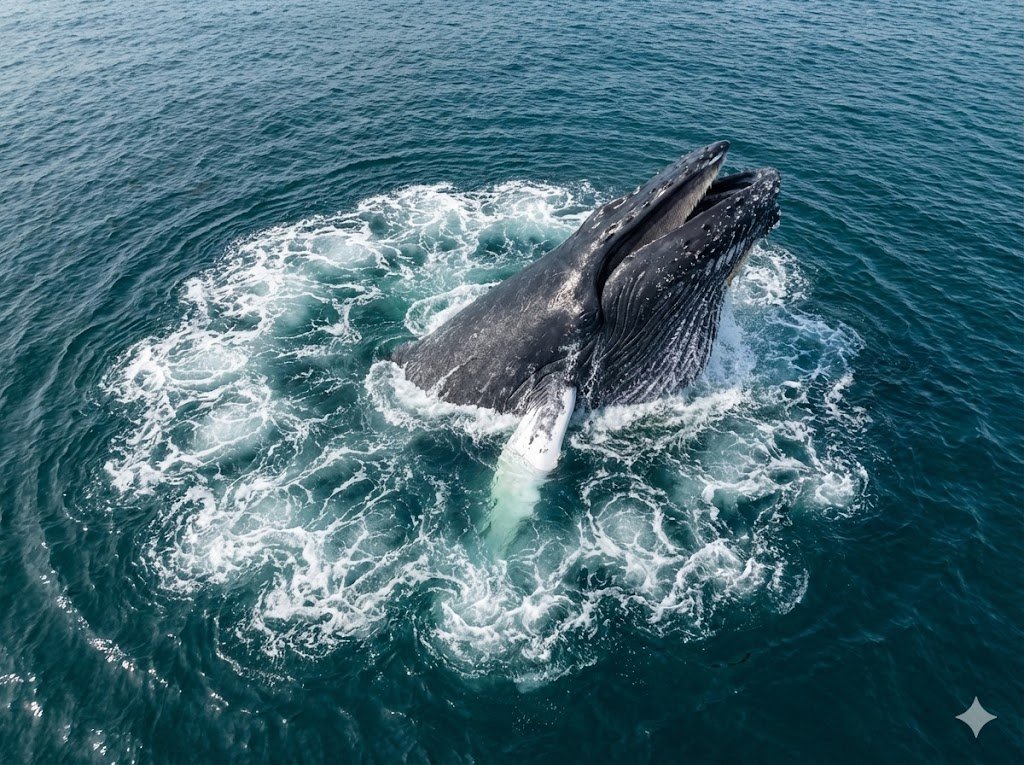
A whale releases bubbles while moving around or beneath prey, forming a temporary structure in the water. The net’s shape and the whale’s path vary. The animal then lunges through concentrated prey with its mouth open, taking in water and food before filtering the water through baleen.
How uncommon is bubble-net feeding?
Bubble-net feeding is well documented in feeding areas such as Southeast Alaska. It is not a routine expectation for visitors in Hawaii’s winter breeding waters. Humpbacks use different feeding strategies in different places, so a video of one group should not be treated as a universal sequence.
Researchers study how these techniques develop and differ among whales. Avoid assuming every event involves a mother teaching a calf, a fixed team of specialists or the same prey. The observed behavior and the evidence for how it was learned are separate questions.
The mechanics of bubble-net feeding
Both solitary and group bubble-net feeding have been documented. Coordinated group feeding is visually striking, but cooperation is not required for every bubble net. This distinction matters when interpreting photographs or descriptions.
Roles and Coordination in the Pod
In group events, observers may see bubble production, coordinated movements and feeding calls. The exact combination varies; it should not be described as a fixed division of jobs in every pod.
- Bubble production: One or more animals may release bubbles that help concentrate prey.
- Sound: Feeding calls occur in some group events, but do not assume that a call paralyzes fish or has an identical function in every setting.
- Movement: Whales’ positions and swimming paths can influence how prey are concentrated. These patterns need observation rather than a fixed job label.
Repeated observations and underwater recordings are needed to understand what individuals are doing. A surface photograph cannot establish who made the net or whether each whale occupied a distinct role.
What Science Says About the Bubbles
Bubbles can concentrate prey within a smaller area before a lunge. Their function depends on their arrangement and on the behavior of the prey. They are a temporary structure, not a solid physical net.
A 2024 study of solitary humpbacks feeding on krill in Southeast Alaska examined how whales varied bubble-net structure. The researchers used tags and aerial observations, showing that net construction can be more controlled than simply releasing a ring of air. Their estimates of feeding benefits depended on model assumptions; they should not be read as a guaranteed number of prey captured in every event.
The Climb and the Capture
A feeding whale lunges into concentrated prey with its mouth open. In some group events, several whales surface close together, but timing and geometry vary. The visible splash is only part of a sequence that began underwater.
Baleen plates hang from the upper jaw and help separate prey from seawater. After engulfing a mouthful, a whale expels the water while retaining food. Feeding builds reserves that support migration and reproduction; it does not require the whale to breathe while its mouth is open.
Importance for the environment and conservation
Bubble-net feeding is not just a fascinating behavior; it plays an important role in the marine ecosystem and is affected by the health of our oceans.
What it does in the marine ecosystem
Humpbacks consume fish and krill and contribute to marine food webs. The effect of their feeding depends on the population, prey and ecosystem; a single feeding event does not demonstrate a simple “balance” maintained by whales.
It’s interesting that whale poop is also very important for the health of the ocean. After eating a lot, their nutrient-rich poop feeds phytoplankton, which are tiny organisms that make up the base of the marine food web and make a lot of the oxygen on Earth.
Impact of Environmental Changes
The delicate balance of the marine environment is under threat from climate change, overfishing, and pollution. These changes have a direct effect on humpback whales and how they eat.
- Ocean Warming: As the sea gets warmer, the distribution and abundance of krill and small fish can change, making whales have to travel farther to find food.
- Ocean Acidification: Increased carbon dioxide in the atmosphere is making the oceans more acidic, which can harm the shells of krill and other small crustaceans that whales depend on.
- Overfishing: Commercial fisheries can deplete fish stocks like herring and sand lance, which can make it harder for whales to find the big, dense schools of prey they need for effective bubble-net feeding.
Threats and efforts to protect them
People used to hunt humpback whales to the point where they were almost extinct. While commercial whaling is now largely banned, they still face numerous threats:
- Vessel Strikes: Collisions with ships are one of the main reasons whales get hurt or die, especially in busy shipping lanes.
- Gear Entanglement: Whales can get stuck in fishing gear and trash in the ocean, which can hurt them, drown them, or starve them.
- Noise Pollution: The ocean is getting louder and louder because of shipping, sonar, and industrial activity. This noise can make it hard for whales to talk to each other, find their way, and find food.
Fortunately, conservation efforts around the world have helped many populations of humpback whales bounce back. Organizations and governments are trying to set up marine protected areas, control shipping traffic, and make it less likely that fishing gear will get stuck. Responsible whale watching tourism also helps by making people more aware and giving them reasons to protect whales.
Frequently Asked Questions About Bubble-Net Feeding
How many whales know how to bubble feed?
There is no reliable worldwide count of individual humpbacks that use this technique. Researchers document it in particular feeding populations and study both solitary and group events. The number observed in one study should not be presented as the global total.
Should I expect bubble-net feeding in Hawaii?
Bubble-net feeding belongs mainly in discussions of feeding grounds, not the usual Hawaii visitor itinerary. Humpbacks come to Hawaii primarily for breeding and calving. Research has documented occasional feeding in Hawaiian waters, so “they never feed here” is too absolute, but those observations do not make bubble-net feeding a predictable local sight.
Is bubble-net feeding a game for whales?
The observed purpose is feeding: concentrating and capturing prey. Calling it a game or claiming a whale is practicing playfully assigns a motive that a brief observation cannot establish.
Connect Feeding Behavior With Hawaii’s Whales
Bubble-net feeding is a strong reminder of how smart and socially complex humpback whales are. It shows how closely species and their environments are linked, and how important it is to protect our oceans. The carefully made bubble net and the synchronized lunge are striking examples of humpback whale intelligence shaped by evolution.
In Hawaii, visitors are more likely to interpret surface activities such as breaches and tail slaps than to witness bubble-net feeding. Use our guide to humpback behavior in Hawaii to understand those observations.
For the connection between feeding and breeding areas, read our humpback migration guide. For a coastal visit, use the separate Hawaii whale season and viewing locations guide.