Humpback Whale Migration to Hawaii: Routes, Breeding and Research

Every winter, humpback whales arrive in the warm waters around the Hawaiian Islands after a journey of roughly 3,000 miles from Alaska. It is among the longest migrations documented for any mammal. The journey links northern feeding grounds with Hawaiian breeding habitat, and decades of research on it have advanced understanding of migration behavior, energy use and population change.
The migration connects two different parts of the humpback life cycle: feeding in productive northern waters and breeding, calving and nursing in Hawaii. These are connected habitats, not independent destinations. Conditions in the feeding grounds can affect the animals later seen around the islands.
This guide explains the journey, energy demands, breeding habitat and evidence used to study migration. For visitor timing and places to watch from land, use our Hawaii whale season and shore-viewing guide.
Learning about the migration of humpback whales
Why do humpback whales go to Hawaii?
Hawaii is an important North Pacific breeding and calving area. Its warm waters support this phase of the annual cycle, while northern feeding grounds provide dense seasonal prey. Scientists continue to investigate the factors behind long-distance migration; it should not be reduced to a claim that Hawaii is perfectly calm or free of predators.
Humpbacks in Hawaiian waters can travel, rest, interact, sing and nurse calves. Male song is associated with reproductive behavior, but its exact function remains debated. See the humpback behavior guide for how researchers distinguish visible activity from its interpretation.
The Epic Journey: Alaska to Hawaii
The Alaska-to-Hawaii journey is often described as roughly 3,000 miles, although routes differ. NOAA reports that some humpbacks can complete it in as few as 28 days. That is not a fixed schedule for every animal, and a single typical swimming speed cannot predict an individual’s arrival.
Humpbacks rely heavily on energy stored during the feeding season to support migration and breeding. Mothers also face the demands of nursing calves. Avoid assigning every whale the same percentage of weight loss: body condition and energy expenditure vary with reproductive status and individual circumstances.
Biological Changes That Help Animals Move
A streamlined body, powerful tail flukes and stored fat support long-distance movement. Blubber serves both insulation and energy-storage functions. The journey still has substantial costs, particularly for a female that must support a calf as well as herself.
The precise navigation mechanisms remain incompletely understood. Researchers consider environmental cues and learned routes, but a claim that humpbacks navigate by stars as an established fact goes beyond the evidence presented here. Tracking a route shows where an animal traveled; it does not by itself reveal which cues guided it.
Hawaiian Breeding Habitat
How Whales Use Different Areas
Humpbacks occur around the main Hawaiian Islands, with important concentrations in Maui Nui waters. The ecological question is how whales use breeding habitat, rather than which island offers the closest visitor encounter.
The channels around Maui, Lanai and Molokai include relatively shallow habitat used by whales during the breeding season. Shallow habitat is not necessarily calm, and it is not a barrier that excludes predators or human disturbance.
Different activities create different habitat needs:
A whale traveling between areas may use habitat differently from a mother resting with a calf. A temporary concentration at one location does not mean every whale follows the same route through the islands.
- Resting and nursing: Mothers and calves need room to continue these activities without being crowded.
- Social activity: Group formation and separation can change where whales are observed during a day.
- Travel: Whales move between areas; a local sighting is only one point in a wider pattern.
What Makes Hawaiian Waters Great for Breeding
The sanctuary describes important humpback habitat in waters shallower than about 600 feet, while whales can also occur in deeper water. This describes preferred habitat, not the depth of all Hawaiian waters. It does not imply constant temperature, no current or protection from every hazard.
Hawaii is a breeding destination for many migrating humpbacks, not merely a convenient stop on one universal route. Vessel traffic, fishing gear and other human activity still pose risks around the islands. Isolation in the Pacific does not remove those pressures.
The National Marine Sanctuary for Hawaiian Humpback Whales
Congress designated the Hawaiian Islands Humpback Whale National Marine Sanctuary in 1992. It is managed through a federal-state partnership to protect humpbacks and their habitat. Its boundaries cover specific marine areas; they do not include every part of the surrounding ocean.
Humpback approach protections also apply outside sanctuary boundaries in Hawaiian waters. Our responsible viewing guide explains the 100-yard approach restriction and links to the official regulations.
The Annual Cycle and Its Variation
Seasonal Presence in Hawaii
Humpbacks generally occur in Hawaii from November through May, with abundance usually greatest from January through March. Individual whales arrive and depart at different times. Those broad patterns should not be turned into exact dates for every stage of reproduction.
An early sighting does not mean the full population has arrived, and a late sighting does not establish that most whales remain. Local observation effort and conditions also affect what people report. Long-term surveys are more informative than isolated sightings.
From Feeding Grounds to Breeding Grounds and Back
Feeding phase: In northern waters, humpbacks consume fish or krill and accumulate energy reserves. Food availability can vary substantially between places and years.
Southbound travel: Individuals leave feeding areas at different times and cover different routes. Migration involves a population spread across the ocean rather than a single group moving together.
Breeding habitat: Whales use Hawaiian waters for reproductive and social activity. A calendar month alone cannot tell an observer whether a particular animal is mating, resting or traveling.
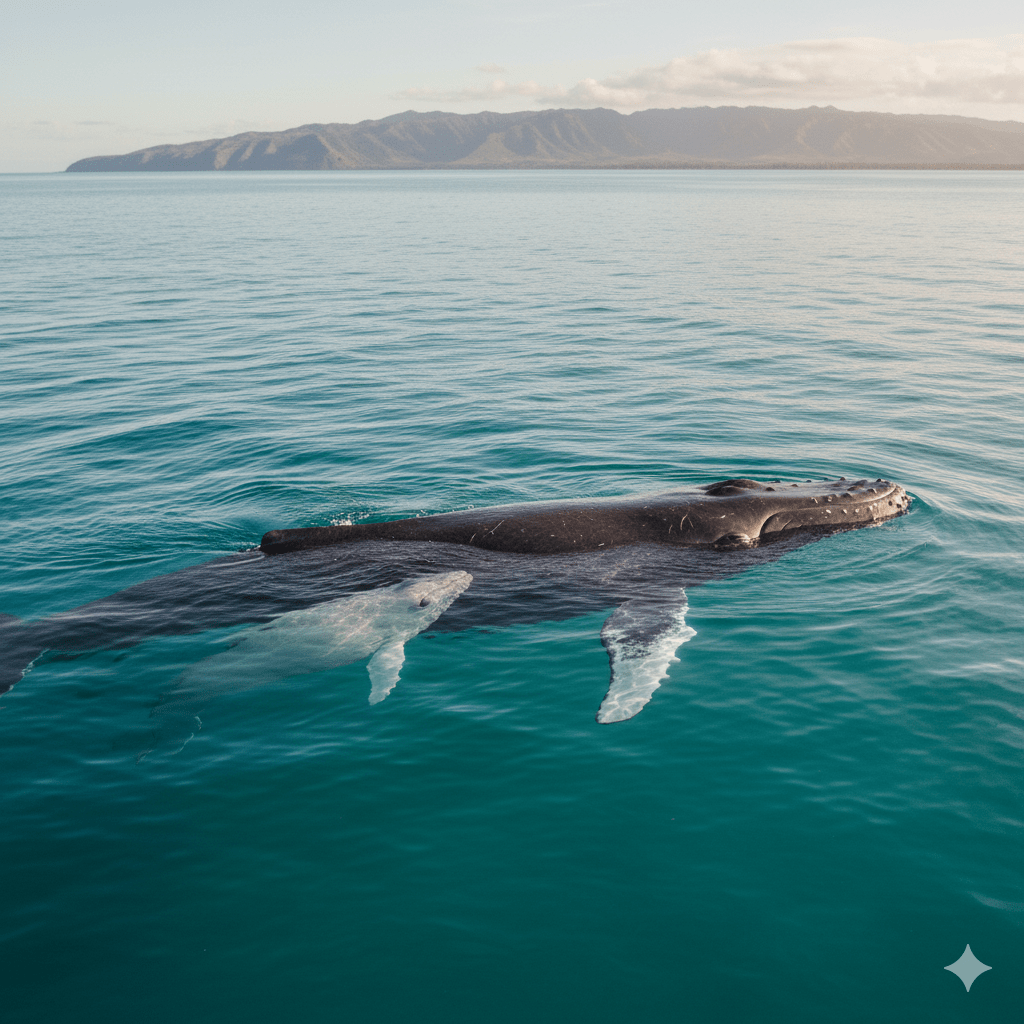
Calves and mothers: Calves nurse and grow while remaining associated with their mothers. Their development continues beyond a short stay in Hawaii.
Northbound return: Whales travel back toward feeding areas, with timing varying among individuals. The next feeding season influences the energy available for future reproduction and migration.
How Scientists Study Migration
Scientists compare sightings, photographs, sound recordings and tag data. Each method reveals something different: a shore count records animals visible from a place, while a tag can reveal movements below the surface or across a route.
Observation conditions matter. Wind, glare, time spent watching and distance from shore affect what is detected. More sightings on one day do not automatically prove that the population has grown or that whales are more active at that hour.
Following Individuals Across the Pacific
Photo-Identification
The pale and dark patterns and trailing edges of a humpback’s flukes can help researchers recognize individuals. Matching photographs across feeding and breeding areas provides evidence of connections between regions without assuming every animal follows the same itinerary.
Photo-identification requires usable images, careful matching and an understanding of observation effort. One photograph does not measure a population. Researchers combine many observations over time and account for animals that were present but not detected.
Combining Research Methods
Different research methods answer different questions:
- Shore surveys: Repeated observations from defined locations help track seasonal presence.
- Photo-identification: Fluke matches connect individual sightings across time and regions.
- Acoustic monitoring: Recordings help study sound and seasonal presence, but not every whale is singing.
- Tagging: Permitted studies can record movement, depth and sound to investigate behavior.
Combining methods is valuable because surface visibility, sound production and tag coverage each have limits. A whale that is not seen during a shore survey may still be present offshore or underwater.
Research and Public Observation Have Different Rules
Visitors should observe within public wildlife rules. Scientific permits may authorize specific research methods that ordinary visitors cannot copy. A close research image is not permission to approach, tag or follow a whale.
When contributing observations:
- Never approach whales directly or attempt to touch them
- Avoid making loud noises or sudden movements
- Don’t throw anything into the water
- Follow the project’s observation protocol and public wildlife-viewing rules.
- Do not approach more closely to obtain a photograph or a better data point.
Conservation Efforts and Whale Population Recovery
North Pacific Humpback Whale Recovery Success
Recovery after commercial whaling has not been a simple uninterrupted increase. A 2024 North Pacific population study estimated a decline from about 33,500 whales in 2012 to about 26,700 in 2021, with uncertainty around both estimates. These refer to the broader North Pacific, not a count of whales simultaneously present in Hawaii.
The number using Hawaii changes over time and depends on what is measured. Do not treat an old annual estimate as a current head count. NOAA’s 2026 discussion of population change describes how feeding-ground conditions and marine heatwaves can affect the whales observed on Hawaiian breeding grounds.
Ongoing Threats and Challenges
Despite population recovery, humpback whales still face significant challenges. Ship strikes, entanglement in fishing gear, and ocean noise pollution represent the primary threats to whale populations. Climate change also has long-term effects on food sources in Alaska and could change migration patterns.
In Hawaiian waters, the main concerns include vessel strikes from high-speed boats and disturbance from increased marine tourism. The Hawaiian Humpback Whale National Marine Sanctuary continues monitoring these threats while educating the public about responsible wildlife viewing practices.
How Visitors Can Support Conservation
Visitors can support conservation by maintaining viewing distance, reporting entangled animals and respecting habitat. Taking part in a wildlife activity does not automatically mean you are contributing scientific data or funding research.
Organized community-science projects can provide useful observations when participants follow a consistent protocol. The sanctuary’s Ocean Count program is one example; check its current participation information rather than submitting informal observations to an assumed active app.
Supporting organizations like the Pacific Whale Foundation, Hawaiian Islands Humpback Whale National Marine Sanctuary, and NOAA Fisheries through donations or volunteer work directly contributes to ongoing research and conservation efforts.
Interpreting Sightings in Context
Are the whales migrating in Hawaii right now?
Migration is an ongoing process spread across individuals and seasons. A current local sighting confirms that an animal was observed at a place and time; it does not show the location of every whale or the status of the whole migration.
Using Migration Knowledge for a Visit
Use the season and location guide linked above for visitor planning, and consult official local notices for access. This article’s migration background should not be treated as a live sightings report.
A successful observation may be distant and brief. Document what you see from where you are, and never reduce the distance to an animal for a better view or photograph.
A Connected Ocean Life Cycle
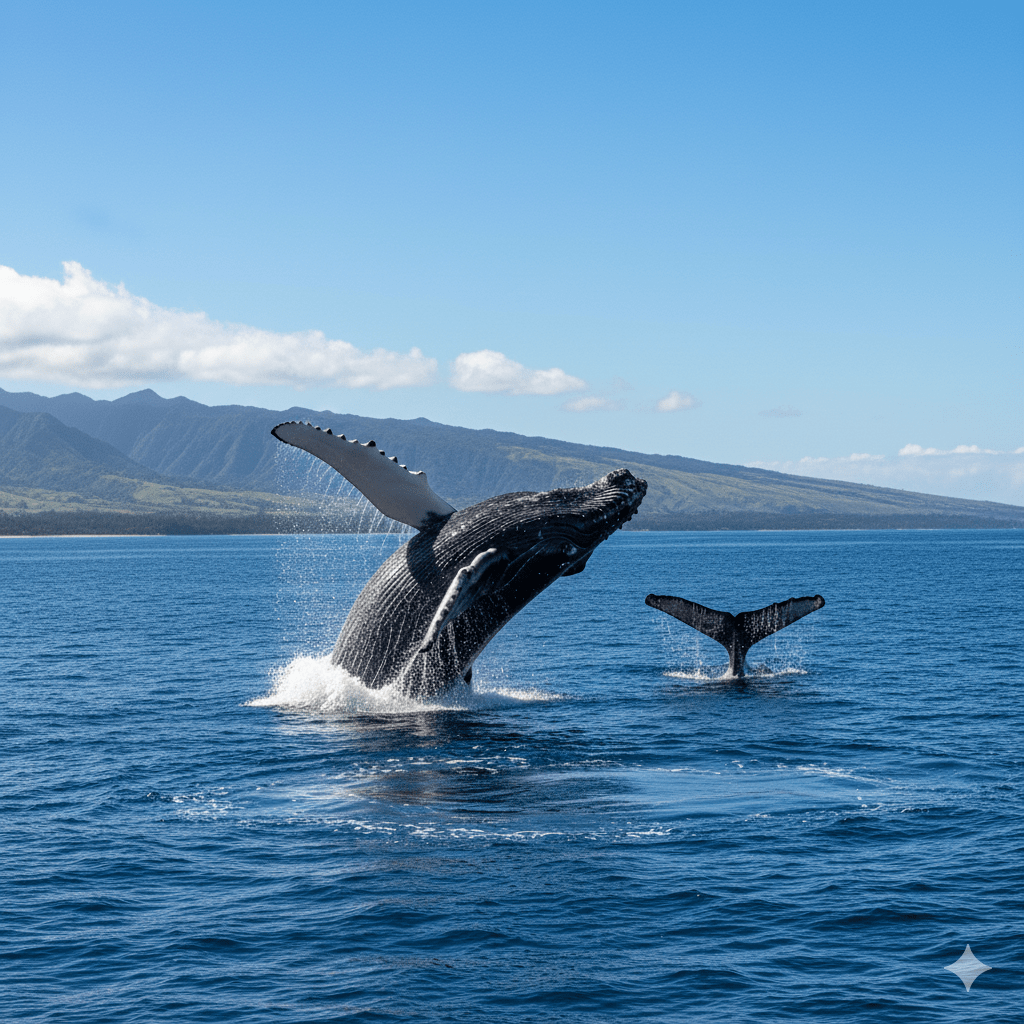
The annual migration of humpback whales to Hawaii is one of the ocean’s great recurring events: a population-wide movement that connects feeding, travel, breeding and nursing across thousands of miles. Research continues to refine how individuals use each habitat, how energy reserves carry them through the journey, and how changing ocean conditions affect the population’s future.
The migration connects habitat, food supply and reproduction across a large ocean. Understanding those connections makes a sighting more meaningful without turning it into a promise of a close encounter.
Protection from whaling helped many populations recover, but recent changes show why continued monitoring matters. Recovery in one period does not mean threats have disappeared or that future numbers will always increase.
In northern feeding grounds, humpbacks use feeding strategies such as bubble-net feeding to build the energy reserves that power the southbound journey. Such coordinated feeding is a feature of the feeding grounds, not a routine sighting in Hawaiian breeding waters.