Hawaii Custard Pie: The Simple Bakery Classic

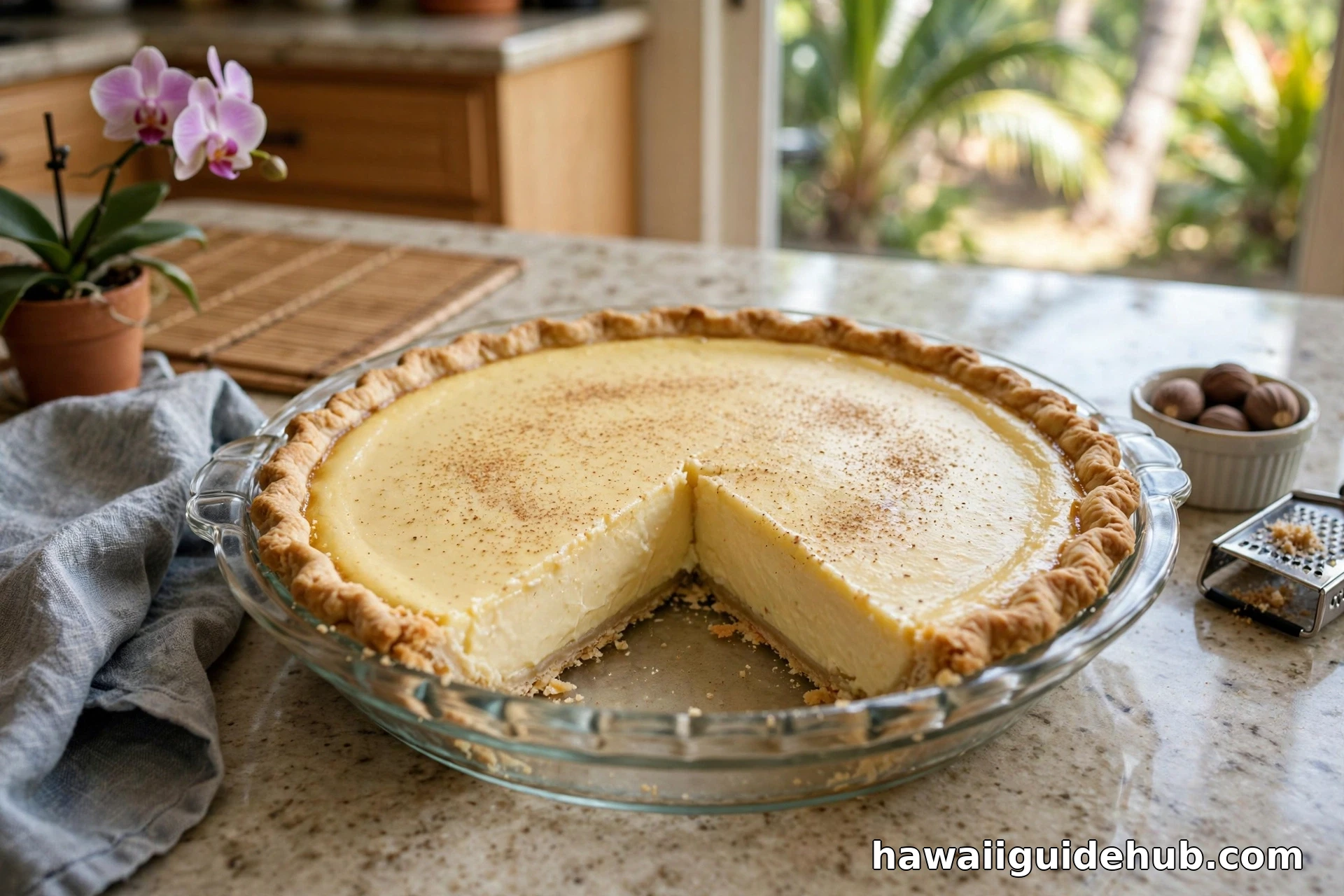
Ask a longtime Hawaiʻi home baker to name the pie that shows up at every family gathering, school fundraiser, and holiday table, and plain custard pie will be near the top of the list. It is not flashy. There is no fruit on top, no chocolate layer, and no whipped cream mountain. It is a smooth, pale gold custard baked in a flaky crust, finished with the lightest dusting of nutmeg, and served cold. That restraint is exactly the point. A good Hawaiʻi custard pie tastes clean and eggy and gently sweet, and it lets a simple handful of pantry ingredients do all the work.
This page is the single complete guide to the custard pie recipe Hawaiʻi style. It gives you the full recipe with exact amounts, the method local bakers actually use, the chilling step that makes or breaks the texture, the mistakes that ruin an otherwise easy pie, and the variations you will meet in island bakeries, from pumpkin custard at Thanksgiving to the famous coconut haupia pies that are close cousins but not the same dessert. If you have searched for a Hawaii custard pie recipe, a custard pie Hawaii bakeries would recognize, or just Hawaii custard pie explained properly, everything is here on this one page.
Custard Pie at a Glance
| Pie size | One 9 inch deep dish pie, about 8 slices |
| Signature ingredient | Evaporated milk, the Hawaiʻi pantry staple |
| Filling | Eggs, sugar, evaporated milk, whole milk, vanilla, salt |
| Finish | Light dusting of nutmeg before baking |
| Oven | 350 degrees Fahrenheit |
| Bake time | About 50 to 60 minutes, until the center jiggles gently |
| Resting rule | Cool fully, then chill at least 4 hours, ideally overnight |
| How it is served | Chilled, in clean wedges, plain or with coffee |
What Makes a Custard Pie a Hawaiʻi Custard Pie
Custard pies exist all over the United States, and the old fashioned mainland version is usually made with fresh milk or cream. The Hawaiʻi version grew up in a different pantry. For generations, evaporated milk was the reliable milk in island kitchens. It shipped well, it kept well in a warm climate, and it was already on the shelf for coffee, cooking, and baking. Bakers built the local custard pie around it, and the result is a filling with a slightly richer, faintly caramelized depth that fresh milk alone does not give.
The second local habit is patience. Hawaiʻi recipes for this pie repeatedly tell you to mix the filling ahead and let it rest in the refrigerator, to strain it before it goes into the shell, and above all to chill the finished pie completely before anyone touches it with a knife. Warm custard pie slumps. Cold custard pie stands up in a perfect wedge with a glossy top and a clean cut edge. The pie you remember from a bakery case in Honolulu or Hilo was almost certainly sliced stone cold, and that is not an accident.
The third habit is restraint with flavoring. Vanilla and a whisper of nutmeg are the classic pairing. Nothing else competes with the egg and milk. When island bakers want a different pie, they make a different pie entirely, such as pumpkin custard in the fall. The plain pie stays plain, and that is why people trust it.
A Short History of Custard Pie in Hawaiʻi
Custard baked in pastry is an old idea that arrived in Hawaiʻi with the many food traditions that met in the islands during the plantation era and the decades that followed. English style custards, Portuguese baking, and American pie making all circulated through home kitchens, church cookbooks, and neighborhood bakeries. Hawaiʻi took the form and adapted it to what island pantries held, which meant evaporated milk, shelf stable and dependable, and to what island weather demanded, which meant a dessert that could be served cold.
Through the twentieth century the pie became a fixture of local bakeries and plate lunch counters, the kind of dessert case staple you could count on next to the butter rolls and the malasadas. It also became a holiday regular. Many Big Island and Oʻahu families serve custard pie at Thanksgiving right alongside pumpkin and apple, a tradition visitors are often surprised by until they taste how well the cool, plain custard works after a heavy meal. Home bakers passed the recipe on cards and in community cookbooks, which is why the same basic formula repeats, with small family variations, all over the state.
It helps to separate this pie from its famous cousin. Haupia is a traditional Hawaiian coconut pudding, set firm and cut into squares, and chocolate haupia pie layers that coconut custard over a chocolate filling in a crust, a combination popularized by Ted’s Bakery on the North Shore of Oʻahu in the late 1980s. Those are coconut pies. The plain custard pie on this page contains no coconut at all. Both belong to Hawaiʻi’s pie case, but they are different desserts with different histories, and a baker who knows one should know the other by its proper name.
Ingredients for Hawaiʻi Style Custard Pie
You need one 9 inch deep dish pie crust, unbaked. A homemade flaky crust is wonderful, and a good store bought crust is completely respectable for this pie. Local bakers care far more about the filling and the chill than about crust heroics. Keep the crust cold in the refrigerator until the moment you fill it, because a cold shell going into the oven with cold filling is one of the quiet secrets of the Hawaiʻi method.
For the filling, gather 3 large eggs, one 12 ounce can of evaporated milk, three quarters of a cup of whole milk, half a cup of granulated sugar, 1 teaspoon of pure vanilla extract, a pinch of salt, and ground nutmeg for dusting. That is the whole list. Some families use 4 or 5 eggs for a firmer set, and some raise the sugar slightly, but the proportions above give you the classic balance: set but silky, sweet but not cloying, with the evaporated milk flavor present in every bite. Use eggs at cool room temperature if you can, since very cold eggs can make the mixing and baking less even.
Why Evaporated Milk Matters
Evaporated milk is milk that has had much of its water gently cooked away, so it pours thicker and tastes a little deeper than fresh milk. In custard it does two jobs. It adds body without the heaviness of cream, and it brings a faint cooked milk sweetness that reads as nostalgia to anyone who grew up with this pie. Substituting all fresh milk makes a paler, softer pie. Substituting all cream makes a rich pie that buries the delicate egg flavor. The Hawaiʻi blend, a full can of evaporated milk plus a smaller amount of whole milk, is the tested middle path, and it is the one to learn first.
The Recipe, Step by Step
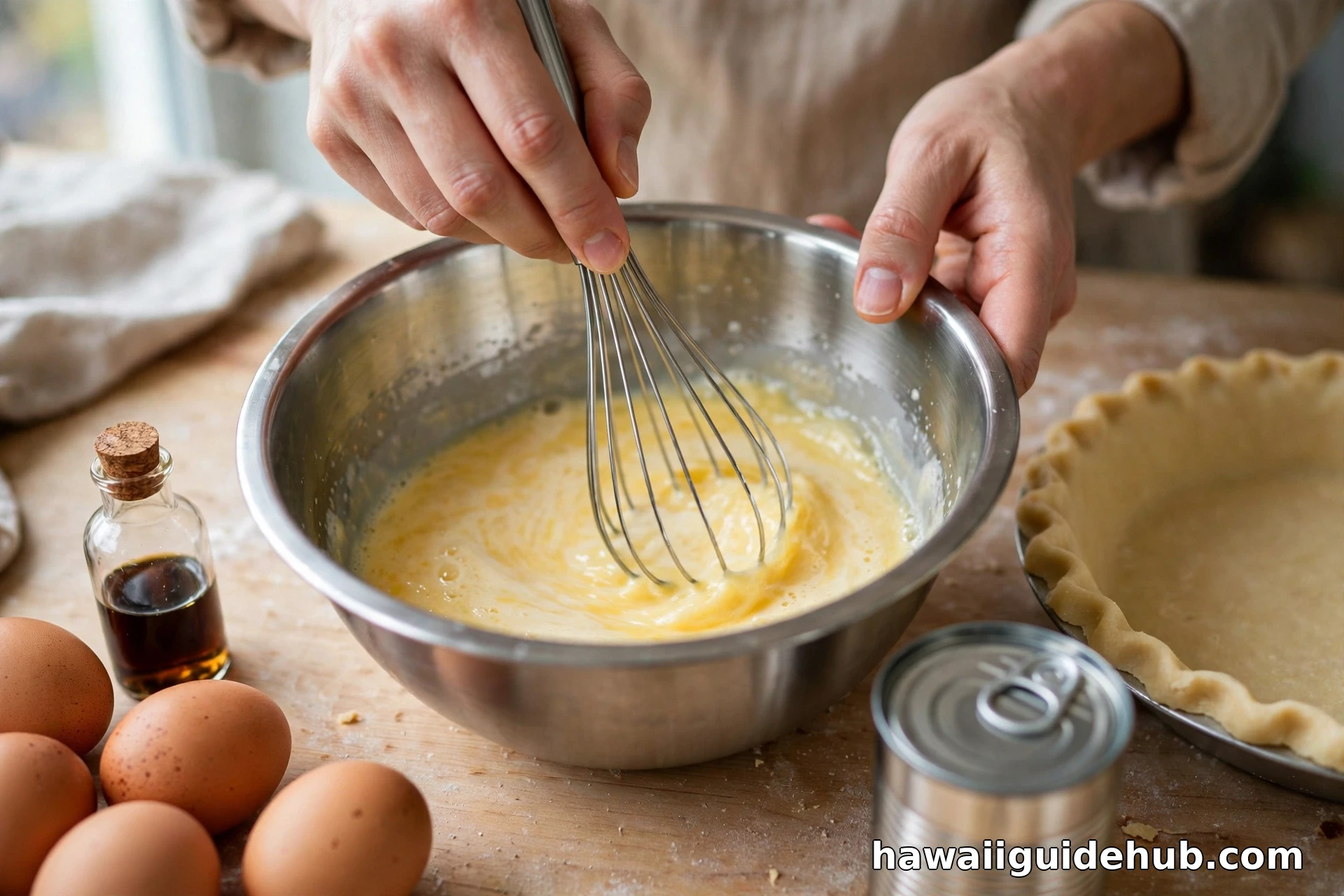
First, make the filling ahead. Whisk the eggs, sugar, and salt together in a large bowl until they are fully combined and slightly frothy. Whisk in the evaporated milk, the whole milk, and the vanilla. Cover the bowl and refrigerate the mixture for several hours or overnight. This rest is a signature Hawaiʻi step. It lets the sugar dissolve completely, lets any foam settle, and gives you a smoother custard with a cleaner top after baking.
Second, when you are ready to bake, heat the oven to 350 degrees Fahrenheit and place a rack in the middle. Take the cold pie crust and the cold filling out of the refrigerator. Strain the filling through a fine mesh strainer directly into the crust. Straining removes chalazae, foam, and any small cooked or unmixed bits, and it is the difference between a good top and a flawless one. Skim off any bubbles sitting on the surface with a spoon, then dust the top lightly and evenly with nutmeg. Go gently. Nutmeg here is a garnish, not a headline.
Third, bake the pie on the middle rack for 50 to 60 minutes. The pie is done when the edges are set and the center still jiggles like set gelatin when you nudge the pan. That jiggle is correct. The center finishes setting as the pie cools, and carryover heat does the last of the work. If you bake until the center is completely firm in the oven, you have overbaked, and the cooled pie will be rubbery and may crack or weep. A knife test can help beginners: a thin knife inserted near the center should come out mostly clean, but trust the gentle jiggle more than any single poke.
Fourth, cool the pie completely on a wire rack at room temperature, then refrigerate it for at least 4 hours and preferably overnight before slicing. This is the rule that separates bakery slices from home disappointments. Cut with a long, thin knife, wiping the blade between slices, and serve the wedges cold, exactly as they come from the refrigerator. The texture you are after is firm enough to hold its shape on the fork and soft enough to melt almost immediately on the tongue.
What It Tastes Like and How It Is Served
A proper slice tastes first of sweet egg and vanilla, then of that distinctive evaporated milk depth, then of warm spice from the nutmeg on top, all carried by a crisp, buttery crust that should still shatter a little at the edge. It is a quiet dessert. It does not compete with coffee or with the rest of a big local meal, which is why it survives at potlucks where richer desserts come home half eaten.
In Hawaiʻi you will meet this pie in bakery cases, in supermarket bakery sections, at family parties in a foil pan from someone’s auntie, and on holiday tables next to pumpkin pie. Visitors usually encounter it first by the slice with coffee. If you are comparing island baking traditions, it sits in the same beloved, everyday category as Hawaiian bread: familiar, repeatable, and tied to memory far more than to novelty. Nobody in Hawaiʻi is trying to reinvent custard pie. They are trying to make it exactly the way it is supposed to taste.

Variations You Will Meet in the Islands
Pumpkin Custard Pie
In the fall, and especially at Thanksgiving, many Hawaiʻi families blend pumpkin puree and warm spices into the same evaporated milk custard base. The method, the chill, and the clean slice are identical. Only the flavor changes. If you master the plain pie, the pumpkin version is a one bowl variation, not a new skill.
Haupia and Chocolate Haupia Pie
These are the celebration cousins. A haupia pie tops or layers the crust with firm coconut pudding, and the chocolate version adds a chocolate layer beneath the haupia, finished with whipped cream. They are richer, colder, and more festive than plain custard pie, and they belong at a different kind of gathering. Enjoy them on their own terms and keep the names straight, because calling a haupia pie a custard pie confuses every baker in the room.
Coconut and Other Gentle Twists
Some home bakers fold a little coconut into the filling or swap part of the milk for coconut milk, and lime and coconut versions have appeared in Hawaiʻi newspaper recipe columns over the years. Make the classic pie first, twice, so your hands know the set and the jiggle, and only then start bending it.
Substitutions and Troubleshooting
If you have no evaporated milk, you can make this pie with whole milk alone, but expect a softer set and a milder flavor, and handle the chilled slices carefully. If you use a frozen store bought crust, let it thaw in the refrigerator, not on the counter, so it stays cold and firm. If your top browns in spots, that is normal and even attractive. If it puffs dramatically, your oven is running hot. An inexpensive oven thermometer settles most custard arguments in a Hawaiʻi kitchen, where ovens work hard in warm, humid air.
The common failures have simple causes. A soggy bottom means a warm shell or a pie left filled and unbaked, so fill at the last moment. A grainy texture means violent whisking or a hot, long bake, so whisk gently and respect the jiggle. A collapsed slice means one thing almost every time: somebody cut it warm. Refrigerate it and slice it tomorrow. For more on how island food traditions fit together, our overview of Hawaii facts is a useful companion read.
Video: Custard Pie Basics
Watch the pour, the set, and the finished texture on video before you bake.
Frequently Asked Questions
Can I make Hawaiʻi custard pie the day before?
Yes, and you should. The overnight rest for the filling and the full chill after baking both improve the pie. A custard pie made a full day ahead, kept refrigerated and sliced cold, is better than one made the same morning. It keeps well for several days in the refrigerator, although the crust slowly softens as it sits.
Why did my custard pie not set?
It was almost certainly underbaked, cut before it chilled, or made with a substitution that added water. Check that your oven truly reaches 350 degrees Fahrenheit, bake until only the center jiggles, and give the pie its full refrigeration time. Custard finishes setting in the cold, not only in the oven.
Is custard pie the same as haupia pie?
No. Plain custard pie is an egg and milk custard with no coconut. Haupia pie is built on Hawaiian coconut pudding, and chocolate haupia pie adds a chocolate layer. They share a crust and a pie case in Hawaiʻi bakeries, but the fillings, flavors, and histories are distinct.
Do I have to use nutmeg?
No, but the light dusting is traditional and it perfumes each slice. Use very little, freshly grated if you have it. If you dislike nutmeg, cinnamon is the common home substitute, used with the same restraint.
Can I freeze custard pie?
Freezing is not recommended. Egg custard tends to weep and turn grainy when thawed, and the crust loses its crispness. This is a make ahead refrigerator pie, not a freezer pie. Bake it two days before you need it and keep it cold instead.
Hawaiʻi custard pie endures because it asks so little and gives so much: a can of evaporated milk, a few eggs, a cold night in the refrigerator, and the discipline to wait for the chill. Learn the jiggle, respect the rest, and slice it cold, and you will have the pie that island families have trusted for generations, ready for your own table.