Things to Do in Kaneohe: Oahu’s Windward Wonder

Kaneohe sits on the windward side of Oahu, tucked between the dramatic Koolau cliffs and one of the prettiest bays in Hawaii. While Waikiki gets the crowds, Kaneohe rewards visitors who drive over the Pali Highway with a calmer, greener Hawaii: a free 400-acre botanical garden, one of the most beautiful temples in the Pacific, and a sheltered bay dotted with coral reefs. This is the side of Oahu where locals spend their weekends, and it makes one of the easiest and most satisfying day trips from Honolulu.
In Hawaiian, Kane’ohe means “bamboo man,” a nod to the area’s lush vegetation. The town itself is a working windward community of neighborhoods, schools and strip malls rather than a polished resort district, but its surroundings hold some of Oahu’s signature sights. Here is everything worth doing in and around Kaneohe, from the garden road everyone photographs to the temple hidden at the base of the mountains.
Ho’omaluhia Botanical Garden
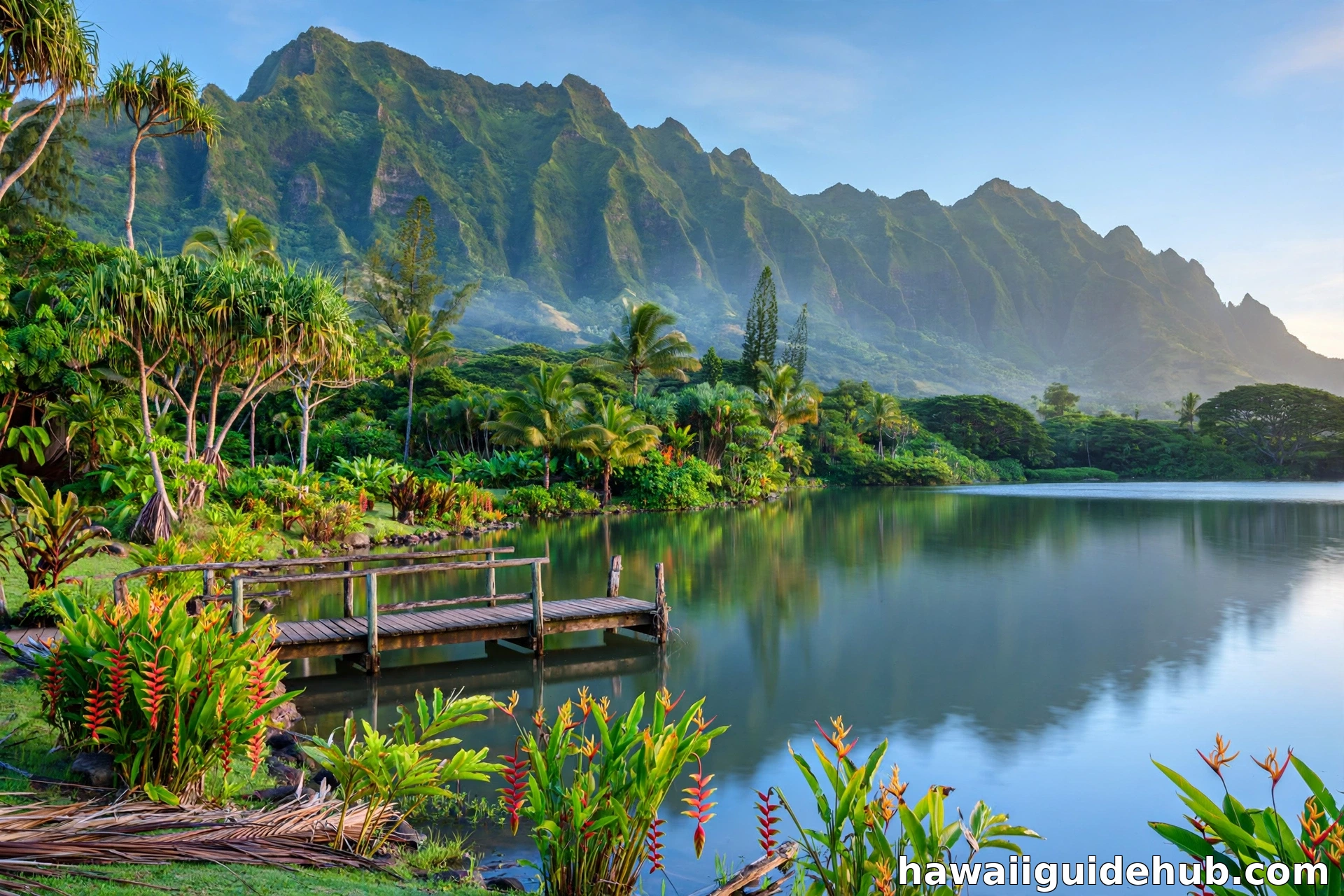
The Ho’omaluhia Botanical Garden is the single best reason to visit Kaneohe, and one of the finest free attractions on Oahu. Ho’omaluhia means “a place of peace and tranquility,” and the name fits: 400 acres of gardens, forest and a 32-acre lake set directly beneath the sheer green face of the Koolau Range.
The garden was designed and built by the US Army Corps of Engineers and opened in 1982, originally as a flood-control project to protect Kaneohe after devastating floods in the 1960s. Heavy rainfall is channeled into the lake, which doubles as the garden’s centerpiece. It is one of five gardens in the Honolulu Botanical Gardens system, and the largest of them.
What to see in the garden
Plantings are grouped by their tropical region of origin: Hawaii, Polynesia, Melanesia, the Philippines, Malaysia, tropical America, India and Sri Lanka, and Africa. There are more than 4,000 plant species, with a special emphasis on conserving native Hawaiian plants plus palms, aroids and heliconias.
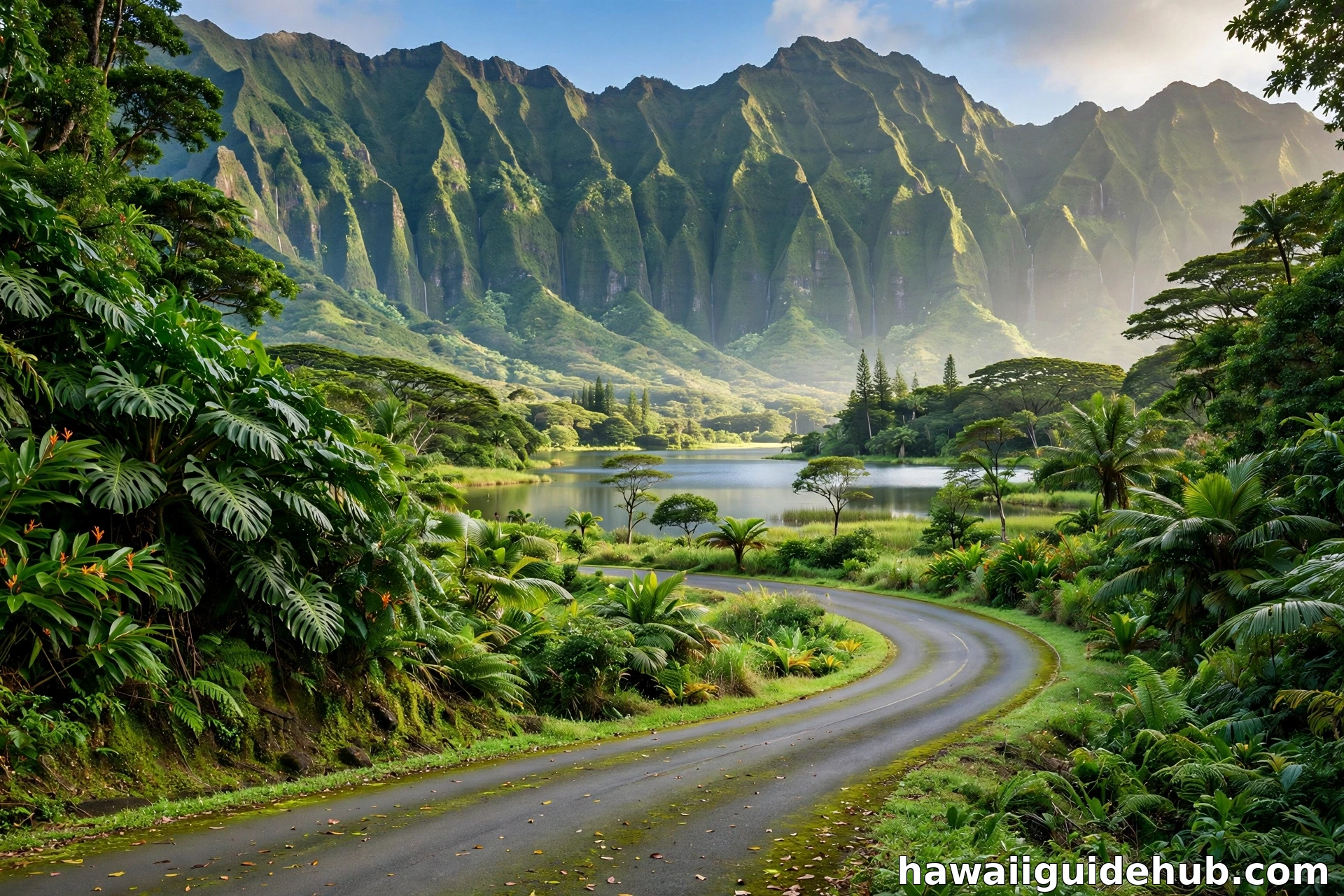
A two-mile scenic drive loops through the garden, and this road has become one of the most photographed spots on Oahu, with the Koolau cliffs framing the pavement. Walk one of the short trails down to the lake for the classic view, visit the visitor center for maps and exhibits, and keep an eye out for native waterbirds like the Hawaiian coot in the wetlands. Camping is available with a permit from Friday morning through Monday afternoon.
Hours, admission and tips
Admission is free. The garden is open daily from 9 AM to 4 PM, closed on Thursdays, Christmas Day and New Year’s Day. The last vehicle entry is at 3:30 PM and all guests must exit by 4 PM. Arrive right at opening for the quietest experience and the softest morning light on the mountains. Bring a light rain jacket: the windward side gets passing showers year round, and they are part of what keeps the garden so green.
Byodo-In Temple
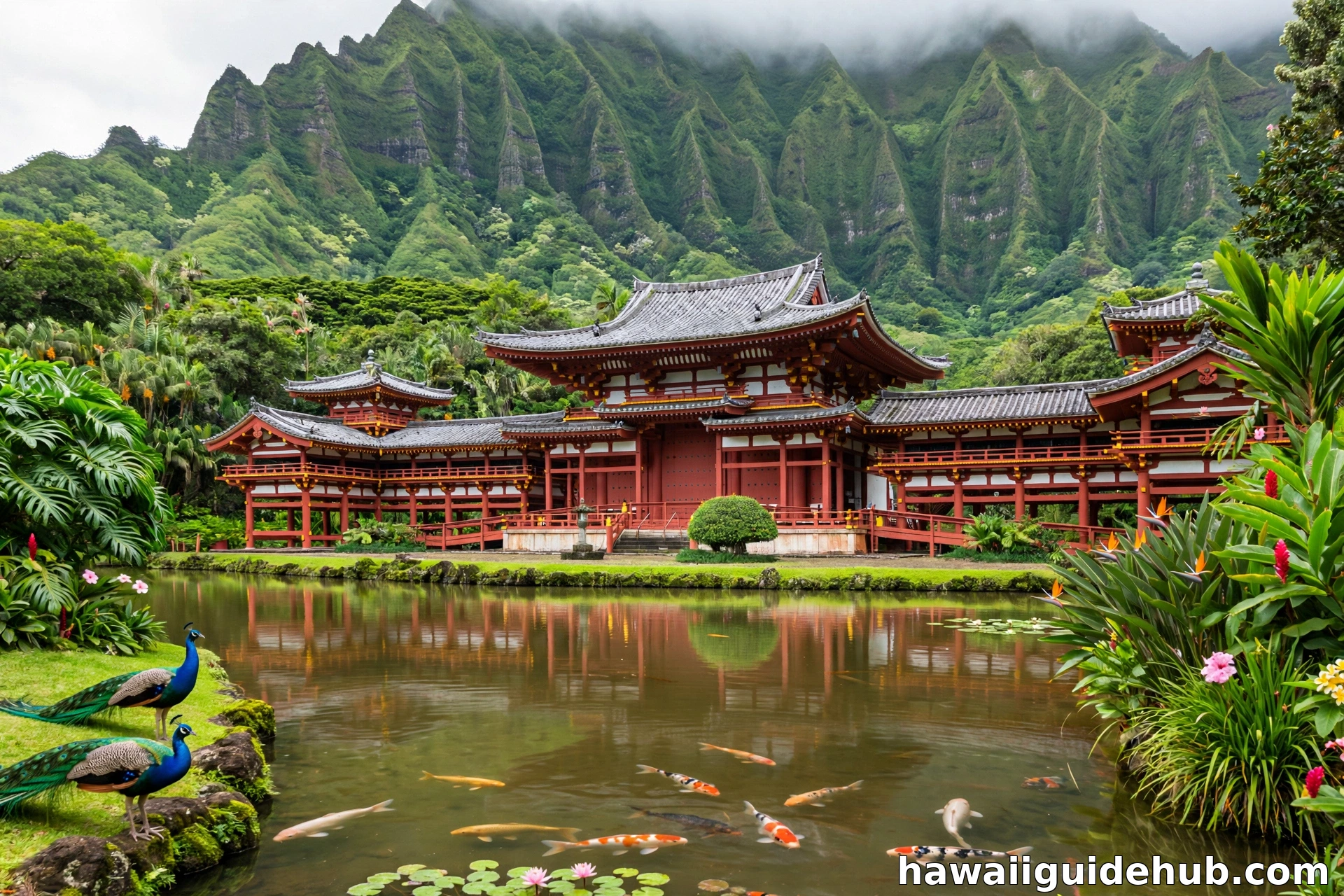
A few minutes from the garden, at the foot of the Koolau Mountains in the Valley of the Temples Memorial Park, sits one of the most photographed buildings in Hawaii. The Byodo-In Temple is a half-scale replica of the nearly thousand-year-old Byodo-in in Uji, Japan, a UNESCO World Heritage Site established in 1052.
The Oahu temple was dedicated in 1968 to commemorate the 100th anniversary of the first Japanese immigrants to Hawaii. It is a non-denominational temple that welcomes people of all faiths to meditate, worship or simply take in the beauty. Inside stands an 18-foot golden statue of the Lotus Buddha, and outside hangs a three-ton brass peace bell.
What to do at the temple
Cross the bridge over the two-acre koi pond and ring the peace bell for good luck before entering. Wander the Japanese gardens, watch the hundreds of koi swirling below, and look for the resident peacocks and black swans. The grounds also hold small waterfalls and meditation pavilions tucked into a ravine of the pali. Photography is welcome, but this is a place of reflection: keep voices low and be respectful, especially since the temple sits within a memorial park.
Hours, admission and tips
The temple grounds are open daily from 8:30 AM to 4:30 PM. There is a modest admission fee, and feeding the koi and birds costs a small extra amount. Pair the temple with Ho’omaluhia in the same morning, since they are minutes apart. Allow about an hour for a relaxed visit.
Kaneohe Bay
Kaneohe Bay is the largest sheltered bay in the main Hawaiian Islands, a broad turquoise lagoon protected by a barrier reef and dotted with coral heads. It is the heart of the windward ocean scene and the gateway to two of Oahu’s most distinctive landmarks.
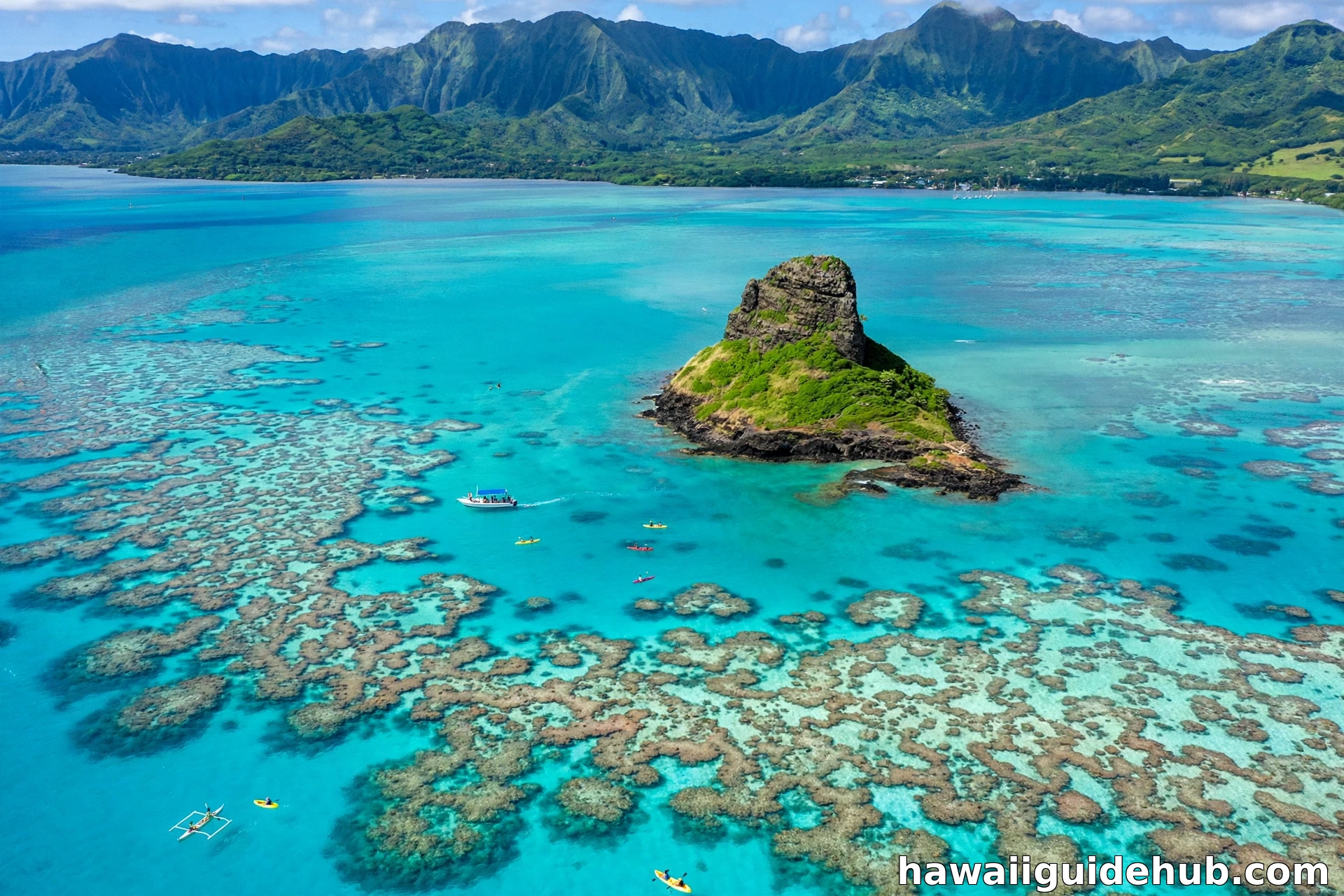
Mokoli’i and the Ahu o Laka sandbar
Rising from the bay is Mokoli’i, better known as Chinaman’s Hat, a small conical island whose shape matches its nickname. On calm mornings, kayakers paddle out from He’eia State Park to land on the island and climb to its small summit for panoramic bay views. Nearby, the Ahu o Laka sandbar emerges at low tide as a stretch of white sand in the middle of the bay, a popular boat-tour destination for wading and snorkeling over the surrounding reef.
Kayaking and boat tours
The bay is best explored on the water. Rent kayaks and launch from He’eia State Park on a calm morning, when conditions are smoothest and the trade winds have not yet picked up. Several local operators run boat tours to the sandbar and snorkeling spots over the reef. Because the bay is a sensitive marine environment, never stand on coral and keep your distance from sea turtles, which are protected by law.
More things to do around Kaneohe
Beyond the big three, the Kaneohe area fills a day nicely. He’eia State Park sits right on the bay with picnic tables, shoreline views and the bay’s calmest kayak launch. History buffs can learn about the windward side’s plantation past and the Marine Corps base that has shaped the town since the 1950s. For a bit of retail, Windward City and the Windward Mall cover the basics, while Kaneohe Bay View and the town’s strip malls hold the local food worth stopping for.
If you are up for a short detour, the Nu’uanu Pali Lookout is about 20 minutes south on the Pali Highway, with sweeping views down the windward coast. Many visitors combine Kaneohe with Kailua for a full windward day: garden and temple in the morning, bay or beach in the afternoon.
Where to eat in Kaneohe
Kaneohe is a local-food town, and eating here is part of the experience. Look for poke by the pound at the town’s fish markets, plate lunches at the longtime local spots, and saimin at the old-school noodle counters. Shave ice on the windward side is a rite of passage after a hot morning in the garden. For a sit-down dinner, the waterfront restaurants near the bay and the town’s Japanese and Korean spots draw steady local crowds. If you want more options, Kailua, ten minutes south, has the windward side’s best-known restaurant row.
For a broader taste of the island’s food scene, our guide to must-try local dishes in Hawaii covers what to order and where to find it.
How to get to Kaneohe
Kaneohe is about 30 minutes from Waikiki by car. The two main routes are the Pali Highway (Highway 61), which winds through the Koolau Range and delivers you to the windward side with a flourish, and the H-3 freeway, which is faster and tunnels straight through the mountains. Renting a car is by far the easiest way to reach the garden, temple and bay, since public transit is slow between them. Parking is free at the garden and the temple.
If this is your first trip to the island, read our complete Oahu island guide and the best island for first-time visitors before you plan your days.
Planning tips for a Kaneohe day
Kaneohe is easy to fold into a windward Oahu itinerary. Start at Ho’omaluhia when it opens at 9 AM, visit the Byodo-In Temple late morning, have lunch in town, then spend the afternoon on Kaneohe Bay or pair the day with Kailua Beach. Mornings are calmer on the windward side, so schedule any kayaking early. Go on a weekday for the quietest garden visit. Pack a rain jacket, reef-safe sunscreen, water and insect repellent, and bring cash for small food stands.
To understand the island’s weather patterns and what “windward” actually means for your plans, see our windward side of Oahu explainer and the guide to outdoor adventures in Hawaii.
See Kaneohe on video
Frequently asked questions
Is Kaneohe worth visiting?
Yes. Kaneohe holds two of Oahu’s standout sights, the Ho’omaluhia Botanical Garden and the Byodo-In Temple, plus the beautiful Kaneohe Bay. It is one of the easiest and most rewarding day trips from Honolulu.
How much time do I need in Kaneohe?
Plan a half day for the garden and temple, or a full day if you add kayaking on Kaneohe Bay or pair the town with Kailua. Two hours at Ho’omaluhia gives a good introduction to the garden.
Is Ho’omaluhia Botanical Garden free?
Yes, admission is free. The garden is open daily from 9 AM to 4 PM, closed on Thursdays, Christmas Day and New Year’s Day.
Can you swim at Kaneohe Bay?
The bay is best enjoyed by kayak or boat tour rather than swimming from shore. The Ahu o Laka sandbar is a popular wading and snorkeling spot reached by boat.
What does Kaneohe mean?
In Hawaiian, Kane’ohe means “bamboo man,” a reference to the area’s lush vegetation.
A calmer side of Oahu
Kaneohe shows visitors a different Oahu from the Waikiki postcard: rainforest valleys, a serene temple, a working bay town and the greenest scenery on the island. It takes almost no planning to enjoy, costs little, and consistently surprises first-time visitors who expected to spend every day on the south shore. Give the windward side a day, and you will understand why locals guard it so fondly.
When to visit Kaneohe
Kaneohe is a year-round destination, but a little timing knowledge goes a long way on the windward side. The Koolau cliffs squeeze moisture out of the trade winds, so Kaneohe runs wetter than Waikiki in every season. Showers usually pass quickly, and mornings are reliably the driest and calmest part of the day. If you want the glassy bay conditions kayakers dream about, be on the water before 10 AM, when the trade winds typically pick up.
Winter, from November through March, brings bigger surf to Oahu’s north and east shores and slightly cooler temperatures, though highs still sit in the upper 70s. Summer is drier and warmer, with highs in the mid 80s. The garden is at its most lush right after the wetter months, while the bay is clearest on calm summer mornings. There is no bad month for the temple, which is beautiful in any weather.
Coconut Island and the bay’s hidden corners
Look across Kaneohe Bay and you will spot a small green island near the middle: Coconut Island, home to the Hawaii Institute of Marine Biology, the University of Hawaii’s marine research station. The island is not open to casual visitors, but its presence is a reminder of how scientifically important the bay is. Kaneohe Bay holds some of the most studied coral reefs in the Pacific, and the barrier reef that shelters it is the only one of its kind in the main Hawaiian Islands.
A few smaller islets dot the bay, and the shoreline around He’eia holds layers of history, from ancient Hawaiian fishponds to the He’eia Fishpond, a massive walled fishpond that is being restored by community groups. If your schedule allows, a walk along the He’eia shoreline at low tide adds a quieter, more local layer to a Kaneohe day.