Hawaiian Kapa Cloth: The Ancient Art of Bark Cloth

Kapa is Hawaii’s ancient cloth: beaten from the bark of the wauke tree, decorated with carved patterns and natural dyes, worn by chiefs and commoners for a thousand years. The art nearly died with the 19th century, then rose again in the Hawaiian Renaissance. This is the complete story of Hawaiian kapa: how it’s made, what it meant, and the women who brought it back.
This is the single complete guide to Hawaiian kapa cloth. It covers wauke and the harvest, the beating process, the tools, natural dyes, patterns and their meanings, kapa’s uses in old Hawaii, the decline, the renaissance revival, modern kapa artists, where to see it, and FAQs. Everything about kapa lives on this one page.
What Kapa Is
Kapa (barkcloth) is cloth made without weaving: the inner bark of the wauke (paper mulberry) tree is stripped, soaked, fermented, and beaten into thin felted sheets. The result is soft, strong, and versatile: clothing, bedding, ceremonial wraps, and more. Hawaiian kapa was among the finest barkcloth in the Pacific: thinner, softer, and more beautifully decorated than most. It was everyday technology and high art at once.
Wauke: The Tree of Cloth
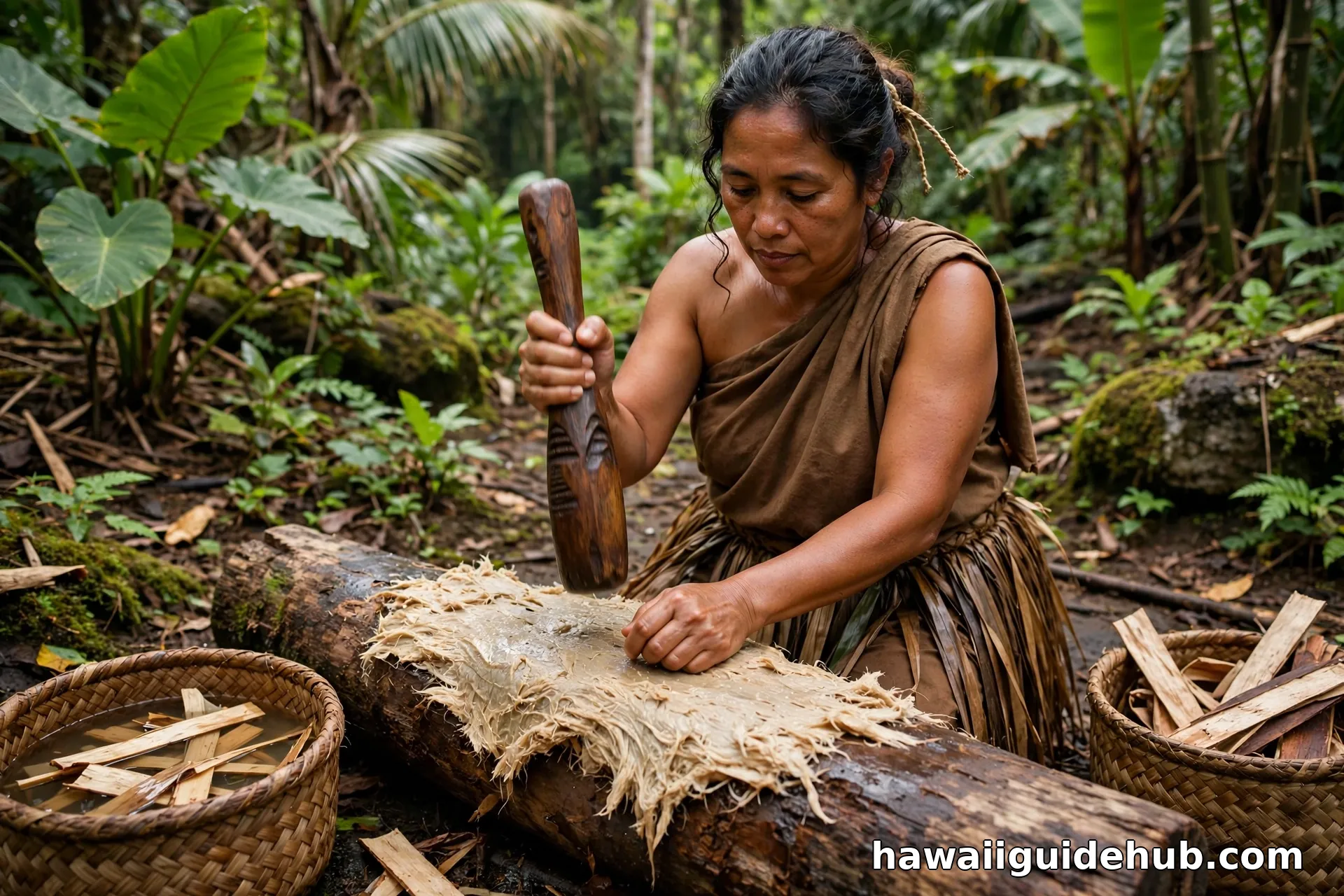
Everything starts with wauke: the paper mulberry, grown in dedicated plantations, harvested at the right age, the bark stripped in long ribbons. The inner bark is separated, cleaned, soaked, and fermented: the Hawaiian fermentation step is what made kapa uniquely soft. Growing wauke was agriculture; preparing it was chemistry. The tree was so central that origin stories say it was created specifically to clothe the people.
The Beating: Days of Rhythm
Beating is the heart of kapa: the prepared bark is laid on a wooden anvil (kua) and beaten with a carved four-sided beater (‘i’e kuku), hour after hour, day after day. The beater’s carved faces do double duty: they felt the fibers and stamp watermark patterns into the cloth, visible when held to light. The rhythm is communal: women beat together, talking story, the sound carrying across the village. Making cloth was making community.
The Maker’s Kit
| Tool | Made from | Use |
| ‘I’e kuku | Carved hardwood | Beats and watermarks the cloth |
| Kua | Hardwood log | Anvil the bark is beaten on |
| Wauke | Paper mulberry bark | The fiber itself |
| ‘Ohe kapala | Carved bamboo | Stamps patterns with dye |
Colors from the Land
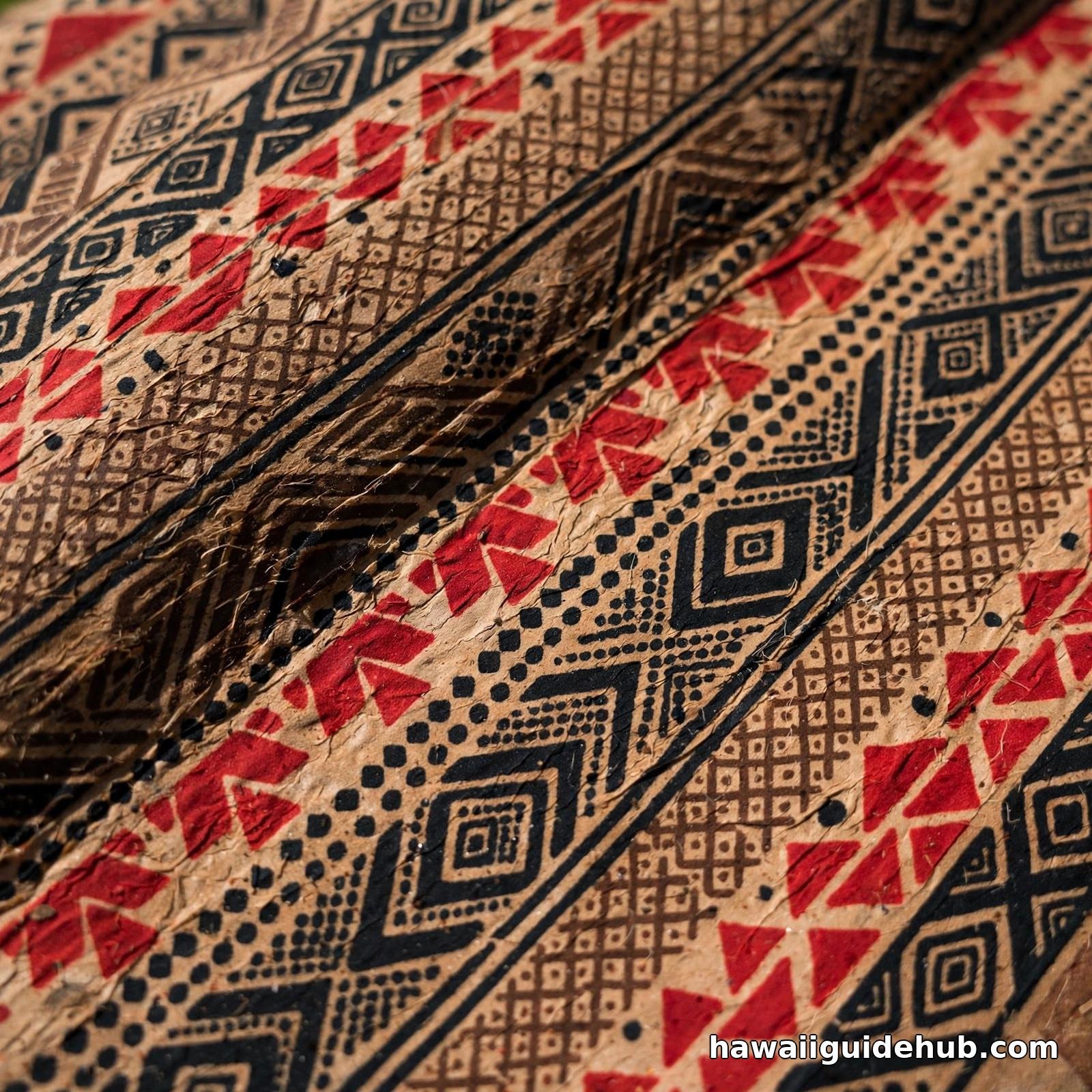
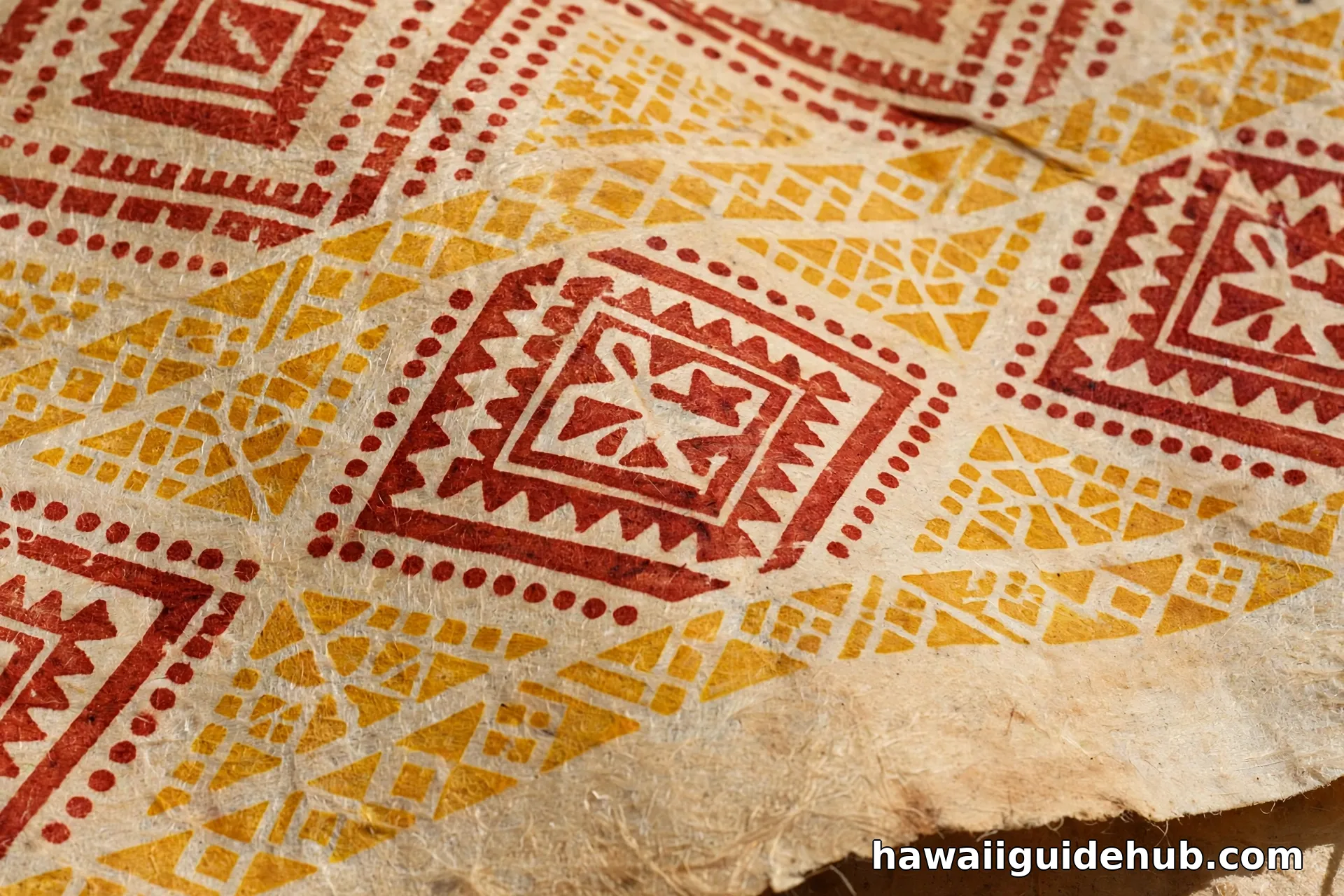
Kapa’s colors come from the landscape: noni root for red, ‘olena (turmeric) for yellow, charcoal and mud for black, kukui nut for brown-black. Dyes are applied with bamboo stamps (‘ohe kapala) carved with geometric designs, or painted freehand. The palette is earthy and rich: the reds deep, the yellows golden, the blacks soft. Modern makers still use the traditional dyes: the land still provides.
Patterns and Their Meanings
Kapa patterns are a visual language: geometric designs, plant forms, and abstract motifs, each carrying meaning. Some patterns marked rank: certain designs were kapu, reserved for chiefs. Others told stories: of places, events, genealogies. The beater’s watermark and the stamp’s dye work together: texture and color, structure and symbol. Reading old kapa is reading history: the cloth remembers what the maker knew.
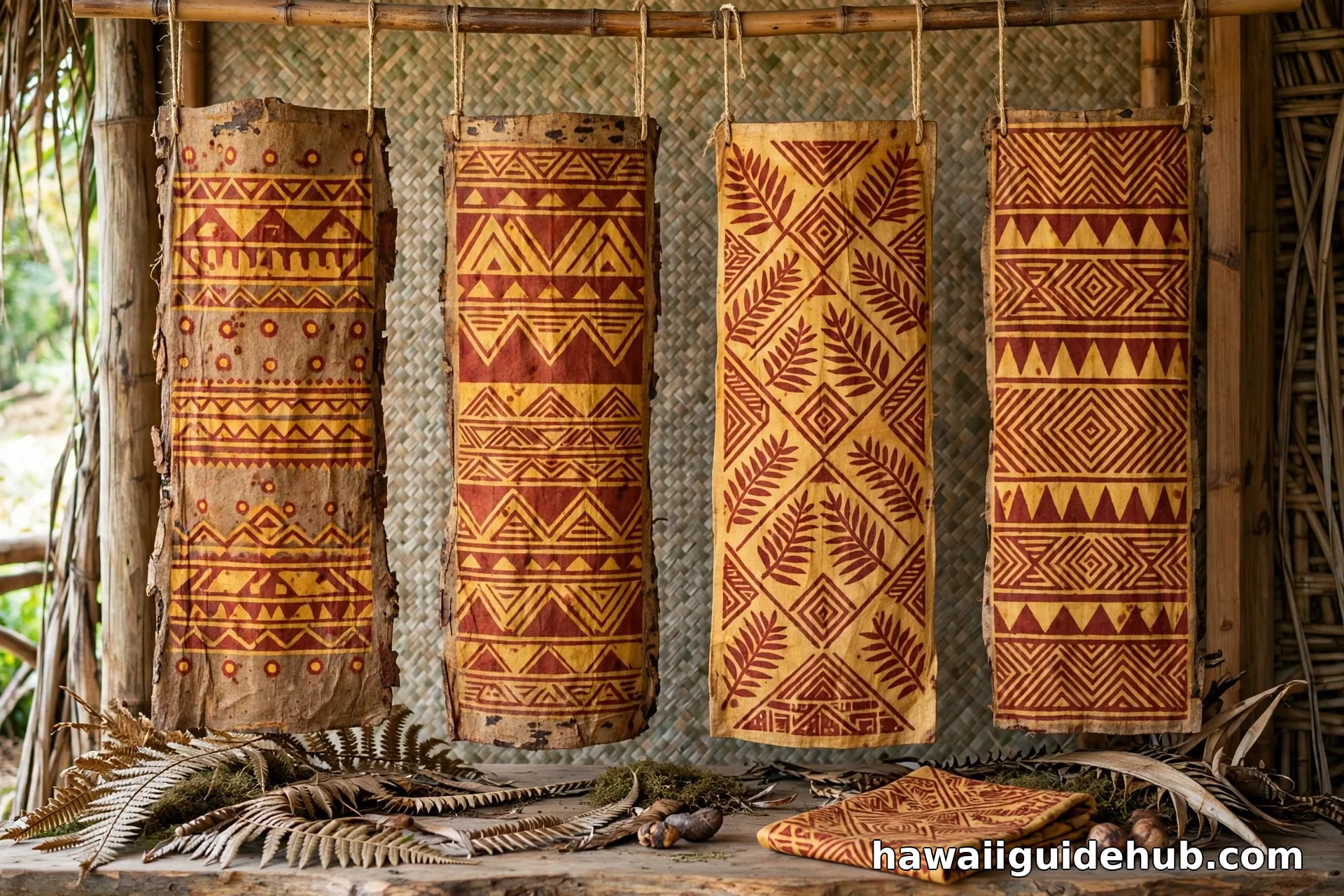
Kapa in Old Hawaii
Kapa clothed the islands: malo (loincloth) and pa’u (skirts), kihei (cloaks), bedding (kapa moe), baby carriers, ceremonial wraps for sacred objects and ancestors’ bones. Quality marked status: the finest, softest, most beautifully decorated kapa belonged to the ali’i. Making kapa was women’s work and women’s power: the expertise passed mother to daughter, and a skilled kapa maker held real standing. The cloth was the economy’s fabric in every sense.
The Decline and the Return
Western cloth arrived and kapa declined: by the late 19th century, the art had nearly died. But the knowledge slept, not died: in the 1960s and 70s, the Hawaiian Renaissance woke it. A small group of women, taught by the few remaining elders and by studying museum pieces, revived the full process: growing wauke, beating, dyeing, stamping. The film “Ka Hana Kapa” tells their story. Today kapa is taught, practiced, and innovated: the art lives.
Kapa Moe: The Bedding Art
Some of the finest kapa ever made was kapa moe: bedding, layered sheets of the softest beaten cloth, sometimes perfumed, used as blankets and mattresses. Chiefs slept under layers of exquisite kapa; the quality of one’s kapa moe marked one’s standing. Making bedding-grade kapa required the most beating, the softest fiber, the finest finishing. The bed was a status symbol and a comfort: the islands’ nights are cool, and good kapa moe was luxury.
Malo and Pa’u: What People Wore
Daily dress was kapa: the malo (loincloth) for men, the pa’u (skirt) for women, the kihei (shoulder cloak) for both. Work kapa was plain and sturdy; ceremonial kapa was fine and decorated. The wardrobe was minimal but meaningful: what you wore said who you were. The missionaries’ arrival changed dress codes, but kapa remained the underlayer of Hawaiian clothing for generations.
The Scented Kapa: Perfumed Cloth
Hawaiian kapa was often scented: rubbed with fragrant oils, flowers, and woods, the cloth carried perfume. Scented kapa moe made sleep fragrant; scented garments announced presence. The practice shows kapa’s luxury dimension: this wasn’t just cloth, it was sensory art. Modern makers sometimes revive the scenting: the old recipes, like the old patterns, are being remembered.
Kapa and Rank: Reading Status
An expert could read a person’s rank from their kapa: the fineness of the beating, the complexity of the pattern, the richness of the dye, the scent. Certain patterns and colors were kapu to commoners. The ali’i’s kapa was made by the most skilled makers from the finest wauke. Cloth was currency, tribute, and diplomacy: fine kapa sealed alliances and honored guests. The textile was the text of power.
Learning Kapa Today
Want to learn? Workshops teach the full process: harvesting wauke, preparing bark, beating, dyeing, stamping. It’s slow work: a single piece takes days. But the learning is the point: every step teaches patience, observation, and respect. Students describe it as transformative: you don’t just learn a craft, you join a lineage. The teachers are generous; the tradition welcomes all who come with respect.
Kapa in Fashion: The Modern Runway
Contemporary Hawaiian designers are bringing kapa to fashion: garments, accessories, and art pieces that honor the tradition while speaking modern. The runway shows are cultural statements: kapa as high fashion, as identity, as resistance. The designers work with traditional makers, ensuring the craft knowledge flows both ways. Kapa’s future includes the catwalk: the ancient cloth, worn proudly into tomorrow.
Caring for Kapa: Preservation
Historic kapa needs care: barkcloth is fragile, sensitive to light, humidity, and handling. Museums like the Bishop Museum preserve the great old pieces in climate control. If you own kapa, keep it from direct sun, handle with clean hands, and store flat and dry. The old pieces are irreplaceable: each one is a maker’s lifetime of knowledge. Preservation is respect: the cloth cared for its people; now we care for the cloth.
The Wauke Groves: Growing the Raw Material
Wauke wasn’t wildcrafted casually: it was cultivated in groves, tended like a crop. Growers managed the shoots, harvesting at the right diameter and age for the finest fiber. Different groves produced different qualities; the best wauke land was valuable. The agricultural knowledge was precise: when to cut, how to strip, how to store. Kapa began in the ground, years before the beating started.
Fermentation: Hawaii’s Secret Step
Hawaii’s kapa had a secret: fermentation. After stripping, the bark was soaked and allowed to ferment, breaking down fibers in a way beating alone couldn’t. This step, unusual in the Pacific, is why Hawaiian kapa could be so thin and soft. The knowledge was empirical: generations of makers learned the timing by feel and smell. It’s biotechnology before the word existed: controlled rot, producing beauty.
Kapa Across the Pacific: How Hawaii’s Compares
Barkcloth spans the Pacific: Tonga’s ngatu, Samoa’s siapo, Fiji’s masi. Each tradition is distinct; Hawaii’s stands out for thinness, softness, and the watermark technique. The fermentation step and the fine beating produced cloth other islands couldn’t match. But the family resemblance is clear: shared ancestry, shared plants, shared genius. Hawaii’s kapa is the Pacific tradition at its most refined.
The Economics of Kapa: Cloth as Currency
Kapa was wealth: fine pieces served as tribute, bride-price, and diplomatic gifts. The ali’i collected the finest; commoners paid taxes in cloth. A great kapa maker was an economic asset: her products moved through the chiefly economy like currency. The cloth economy bound the islands: wauke from one district, dyes from another, finished pieces traveling everywhere. Kapa was the GDP you could wear.
Watch: Ka Hana Kapa | PBS Hawai’i Presents
Kapa Cloth FAQs
What is Hawaiian kapa?
Barkcloth beaten from wauke (paper mulberry) bark: Hawaii’s traditional cloth for clothing, bedding, and ceremony, decorated with natural dyes and carved patterns.
How is kapa made?
Wauke bark is stripped, soaked, fermented, then beaten for days on a wooden anvil with a carved beater. The beater’s faces stamp watermark patterns; bamboo stamps add dyed designs.
What gives kapa its colors?
Natural dyes: noni root for red, ‘olena (turmeric) for yellow, charcoal and mud for black. All from the Hawaiian landscape.
When did kapa making revive?
During the Hawaiian Renaissance of the 1960s-70s: a small group of women relearned the art from elders and museum pieces. It’s now taught and practiced widely.
Where can I see real kapa?
The Bishop Museum in Honolulu holds world-class historic kapa; cultural festivals and demonstrations show the making live. Modern makers sell and exhibit contemporary work.
Cloth of the People
Kapa is Hawaii’s memory made tangible: every sheet holds the wauke grove, the beating rhythm, the dye maker’s knowledge, the pattern’s meaning. The women who revived it gave the islands back a piece of their soul: cloth that remembers. See it, touch it if you’re allowed, and understand: this isn’t craft, it’s continuity. A thousand years of hands, beating bark into beauty. Consider what the revival really means: an art that died, brought back by women who refused to let it go. They studied museum pieces behind glass and figured out how to make them live again. They planted wauke, carved beaters, mixed dyes from memory and experiment. They taught their daughters, and their daughters’ daughters. Today a child in Hawaii can learn kapa from a teacher whose teacher learned it from the revival generation: the chain is unbroken again. That’s not nostalgia; that’s resurrection. The next time you see kapa, whether in a museum case or on a living maker’s table, remember the beating: the rhythm that never quite stopped, the hands that never quite forgot. The cloth remembers. Now, thanks to the women of the renaissance, so do we. So go see it: stand before the old pieces at the Bishop Museum and marvel at the thinness, the softness, the precision of the patterns. Then find the living makers: watch a demonstration, take a workshop, feel the beater in your own hands. The rhythm will teach you what words can’t: patience, attention, and the deep satisfaction of making something real. Kapa is Hawaii’s reminder that the finest technologies are often the oldest, and the most beautiful things are made slowly, by hand, with love. The bark becomes cloth; the cloth becomes culture; the culture endures, beaten into every fiber by hands that knew exactly what they were doing. Mahalo nui for reading this history of Hawaii’s cloth of ages, from the wauke grove to the finished pattern, from the first beating to the last stamped design, every step a prayer and every pattern a story told in bark and dye by masters of the ancient art, past and present and future. E ho’omau: perpetuate, always and forever, world without end, amen and aloha nui loa indeed, forevermore and ever and evermore, truly. For more island culture, see our volcanoes guide and Kauai guide.