
Capturing the Moment: Tips for Photographing Whales in Hawaii

Hawaii’s clear waters are some of the best places in the world to see whales. Every winter, thousands of humpback whales travel to Hawaii to mate, have babies, and take care of their young. For people who love to take pictures, this is an amazing chance to see these beautiful marine mammals in their natural habitat.
You need to be patient, skilled, and use the right method to take pictures of whales. Wildlife photography, especially marine wildlife photography, requires you to be flexible and think on your feet. This is different from studio photography, where you control everything. But the rewards are amazing. One frame can show how graceful a 40-ton humpback whale is when it breaches the surface or how sweet a mother and her calf are together.
This complete guide will give you all the information and skills you need to take great pictures of whales in Hawaiian waters. These tips will help you take great whale photos that tell a story, whether you’re a beginner with a smartphone or an experienced photographer with professional gear.
To take good pictures of whales, you need to know how to use your camera and how to interact with the whales. Whales are unpredictable, and their behavior can change in a matter of seconds. They could be quietly gliding beneath the surface one moment and then launching themselves completely out of the water in a spectacular breach the next.
Understanding Hawaiian Whale Seasons
When to go whale watching in Oahu and all of Hawaii
From November to May is the best time to take pictures of whales in Hawaii. The best time to see them is between January and March. North Pacific humpback whales travel more than 3,000 miles from their feeding grounds in Alaska to Hawaiian waters during these months.
Humpback whales are the most common type of whale you can see in Hawaiian waters, but you might also see pilot whales, sperm whales, and sometimes blue whales. Different species act in different ways, which has a direct effect on how you take pictures.
The best lighting and calmest seas are usually between 6:00 AM and 10:00 AM in the morning. When whales come up, the golden hour light makes the water’s natural blue tones stand out even more. Additionally, whales tend to be more active during cooler parts of the day.
The weather is very important for taking good pictures of whales. Trade winds can make the water choppy, which makes it hard to keep the camera steady. Check the weather forecasts for your area and pick days when the winds are lighter and the waves are smaller for the best shooting conditions.
Essential Equipment for Whale Photography
Camera Bodies and Lenses
For whale photography, you need a camera that can focus quickly. DSLR and mirrorless cameras are the best, but don’t forget about modern smartphones that can take pictures from far away. Having gear that can quickly focus and take pictures of fast-moving things is the most important thing.
A telephoto lens with a focal length of 70 to 200 mm is very flexible when it comes to choosing a lens. If your budget allows, a 100-400mm lens offers even greater reach for distant subjects. Keep in mind that you’ll often be taking pictures from a moving boat, so it’s very important to have image stabilization.
When taking pictures of whales, a fast continuous shooting mode (burst mode) is very useful. These beautiful animals can jump out of the water at any time, so having more than one frame increases your chances of getting the perfect shot. Set your camera to continuous autofocus mode to track moving subjects effectively.
Stabilization and Support
Taking pictures from a boat is hard in its own way. A monopod can help keep things steady while still letting you move and change positions quickly. Don’t use regular tripods on boats because they are heavy and can be dangerous in the water.
You might want to use a camera strap that keeps your gear close to your body. Unfortunately, cameras often fall during whale watching trips, and the ocean is not kind to electronics.
Settings for taking pictures of whales with a camera
What is the best place to take pictures of whales?
For taking pictures of whales, shutter priority mode (S or Tv mode) works really well. You can control motion blur with this setting, and the camera will take care of changing the aperture to get the right exposure.
If you want to take pictures of whales in general, start with a shutter speed of 1/500th of a second or faster. At this speed, most whale movements stop, but the details stay sharp. To get clear pictures of breaching whales, set your shutter speed to 1/1000th of a second or faster. This will make sure that every drop of water is in focus.
What is the best shutter speed for taking pictures of whales?
The best shutter speed for a whale depends on how it acts and what you want to do with the photo. For whales swimming near the surface, 1/500th of a second is usually enough. For moving actions like breaching, tail slapping, or showing off their pectoral fins, though, faster shutter speeds of 1/1000th to 1/2000th of a second give the best results.
Don’t be afraid to try using slower shutter speeds to get creative effects. A shutter speed of 1/125th to 1/250th of a second can create beautiful motion blur in the water while keeping the whale relatively sharp, conveying a sense of movement and grace.
You should keep your ISO settings as low as possible while still getting the shutter speed you want. Modern cameras do a good job with ISO 800–1600, but you should always put proper exposure ahead of low noise levels. A slightly grainy, properly exposed image is superior to a noise-free, underexposed photograph.
When to Take Pictures of Whales
How to Find Whales in Hawaii
If you can read whale behavior, you will be much more likely to get good photos. People who have seen whales before look for “footprints” on the water’s surface. These are smooth, circular areas made by a whale’s tail flukes below the surface.
The most obvious signs that a whale is nearby are spouts or blows. Humpback whales typically surface every 8-15 minutes, though this can vary based on their activity level. After seeing a spout, get ready for the next time it comes to the surface.
Watch how people dive. When a whale shows its tail flukes, which is called “fluking,” it usually means that it is going to dive deeper and longer. Take this time to move around or check your camera settings for when the whale comes back.
Reading Behaviors on the Surface
Different surface behaviors require different photographic approaches. When whales are logging (resting at the surface), it’s a great time to take close-up portraits and detail shots. These moments allow for more careful composition and exposure adjustments.
Breaching is the most impressive thing whales do, but it’s also the hardest to get a picture of. Breaches often occur without warning, emphasizing the importance of being camera-ready at all times. When whales are nearby, keep your camera on and your eye on the viewfinder.

How to Compose Whale Photos
Setting the scene and point of view
The rule of thirds works great for taking pictures of whales. Put the whale’s eye or the action point along the lines where your imaginary grid lines cross. This makes compositions that are more dynamic and interesting to look at than centering your subject.
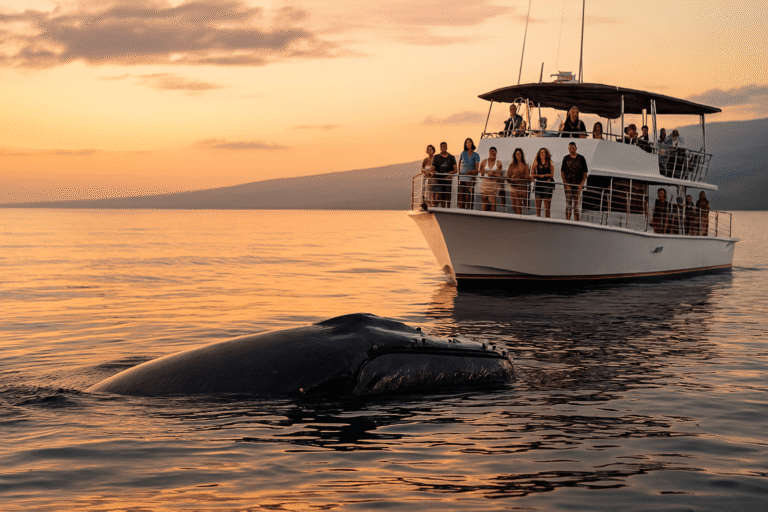
In your shots, show the environment around you. Pictures of whales up close are beautiful, but pictures of whales in their natural Hawaiian habitat tell a fuller story. Add things like other islands in the background, dramatic clouds, or the boat’s shape to show how big it is.
Try out different points of view and angles. Taking pictures of whales from a low angle can make them look bigger and more powerful. Conversely, elevated positions can reveal whale behaviors that aren’t visible from sea level.
Using Natural Light
Hawaiian sunlight can be intense and create harsh shadows. Early morning and late afternoon light provides warmer, more flattering illumination. But don’t completely rule out taking pictures in the middle of the day. The bright light lets you use faster shutter speeds and lower ISO settings.
Backlighting can create dramatic silhouettes, especially during sunrise or sunset whale watching trips. When a whale breaches against the sun, the shadow it casts can be very strong and beautiful.
Cloudy conditions often provide the most even lighting for whale photography. Overcast skies act like a natural softbox, getting rid of harsh shadows and making sure that the light is even across the whole frame.
How to Take Pictures of Humpback Whales in Particular
Learning about how humpbacks act
Humpback whales are great subjects for dynamic photography because they are known for their acrobatic displays. These whales often breach, slap their tails, and do other things on the surface that make for great photo opportunities.
Pairs of mothers and calves need special attention. Maintain respectful distances and avoid using flash photography, which can disturb these sensitive interactions. The bond between mother and calf provides some of the most emotionally powerful whale photographs.
People also know that humpback whales are curious. Whales may sometimes swim close to boats, which is a great chance to take pictures up close. Always follow the rules in your area and keep the right distance, as the law says you should.
Getting pictures of unique humpback features
Humpback whales have distinctive features that make them photographically interesting. Their long pectoral fins, unique head tubercles, and unique tail fluke patterns make them easy to identify and great for art.
The pattern of each humpback whale’s tail fluke is different, like a human fingerprint. Taking clear pictures of a whale’s tail fluke helps scientists and makes unique, identifiable portraits of each whale.
When you can get close enough, the unique bumps (tubercles) on a humpback’s head each have a hair follicle in them, making them great subjects for detail photography..

New and creative ways to do things
Artistic Effects and Motion Blur
While sharp images are typically preferred, creative use of motion blur can convey the power and grace of whale movement. Try using slower shutter speeds while panning with the whale’s movement to make the background blur while keeping the whale in focus.
Taking multiple pictures of whales can help you make art about how they behave. This method is especially good for recording behaviors that happen over and over, like tail slapping or breaches that happen in a row.
Views from underwater and partially underwater
If you have waterproof camera housings, you can take unique pictures of whales from below the water. But this needs special tools and training. Always put safety first and follow the rules in your area when you see whales in the water.
Split-level photography (half underwater, half above water) can create dramatic images showing whales in their complete environment. For best results, this method needs calm conditions and special dome ports.
Post-Processing Tips for Whale Photos
Simple Changes
Whale photography often requires post-processing to bring out the best in your images. Start by making simple changes to the exposure to bring out details in both the whale and the water around it.
Contrast adjustments can help separate the whale from the background, especially in overcast conditions. Be careful not to over-process—maintain the natural look of the marine environment.
There is often a blue tint from the sky and water that needs to be fixed. Set the white balance so that the whale’s skin looks natural while keeping the Hawaiian waters’ beautiful blue color.
Sharpening and Reducing Noise
Using higher ISO settings in difficult lighting situations may cause noise. Modern noise reduction programs can get rid of grain while keeping important details like the whale’s skin texture and the water droplets.
Selective sharpening can make important details stand out, like the whale’s eye or skin texture, without making the whole picture too sharp. Apply sharpening only where necessary by using masking techniques
Things to think about for safety and ethics
Taking care of marine animals
Federal law requires boats to maintain a minimum distance of 100 yards from humpback whales in Hawaiian waters. Responsible whale watching tour operators follow these rules to the letter to protect both the whales and the people who go on the tours.
Don’t ever try to touch or swim with wild whales. These wild animals are strong and can hurt people without meaning to. Also, whales can become stressed and stop doing what they normally do when they come into contact with people.
Don’t use flash photography, as it can bother whales and other marine life. Modern cameras work great in natural light, so you don’t need a flash to take pictures of whales..
Awareness of the environment
While whale watching, think about how your actions affect the environment. Pick tour companies that care about protecting the ocean and using environmentally friendly methods.
Sharing your pictures in a responsible way can help protect whales. Teach other people why it’s important to protect these amazing animals and their Hawaiian home.
Getting ready for your whale photography trip
Picking the Right Tour
Choose whale watching tours that put both seeing wildlife and protecting it first. Experienced captains understand whale behavior and can position boats for optimal photography opportunities while respecting marine life regulations.
Smaller boats often give you a more personal experience and better angles for taking pictures. But bigger boats are more stable when the weather is bad. When you make reservations, think about how comfortable you are and what you want to photograph.
Getting Ready for Your Trip
Charge all of your camera batteries the night before your trip and bring extras. Marine environments can quickly drain battery power, especially when it’s cold in the morning.
Use rain covers or clear plastic bags to keep salt spray off your equipment. Salt water can damage camera gear permanently because it is very corrosive.
If you get sick from moving around, bring seasickness medicine. You can’t capture great whale photographs if you’re feeling unwell. Take medication before boarding the boat for maximum effectiveness.
Making Your Hawaiian Whale Photography Dreams Reality
Taking pictures of whales in Hawaiian waters is one of the most rewarding challenges in wildlife photography. The combination of stunning natural beauty, fascinating animal behavior, and technical photographic skills creates an unforgettable experience that goes far beyond simple tourist snapshots.
Success in whale photography comes from preparation, patience, and respect for these incredible marine mammals. Every trip gives you new chances to learn and improve your skills, as well as a deeper appreciation for Hawaiian marine life.
Keep in mind that the best picture of a whale is often the one you didn’t plan. Stay alert, keep your camera ready, and remain flexible in your approach. The most memorable times you see whales are often when you least expect them.
Ready to embark on your whale photography adventure? Hawaii Guide Hub helps photographers find the best places to see whales all over the Hawaiian Islands. Our carefully chosen tour partners know what serious photographers need and also do their best to protect marine wildlife. Book your unforgettable whale watching photography trip with us and make memories that will last a lifetime.