Hawaiian Petroglyphs: Ancient Rock Art Carved in Lava

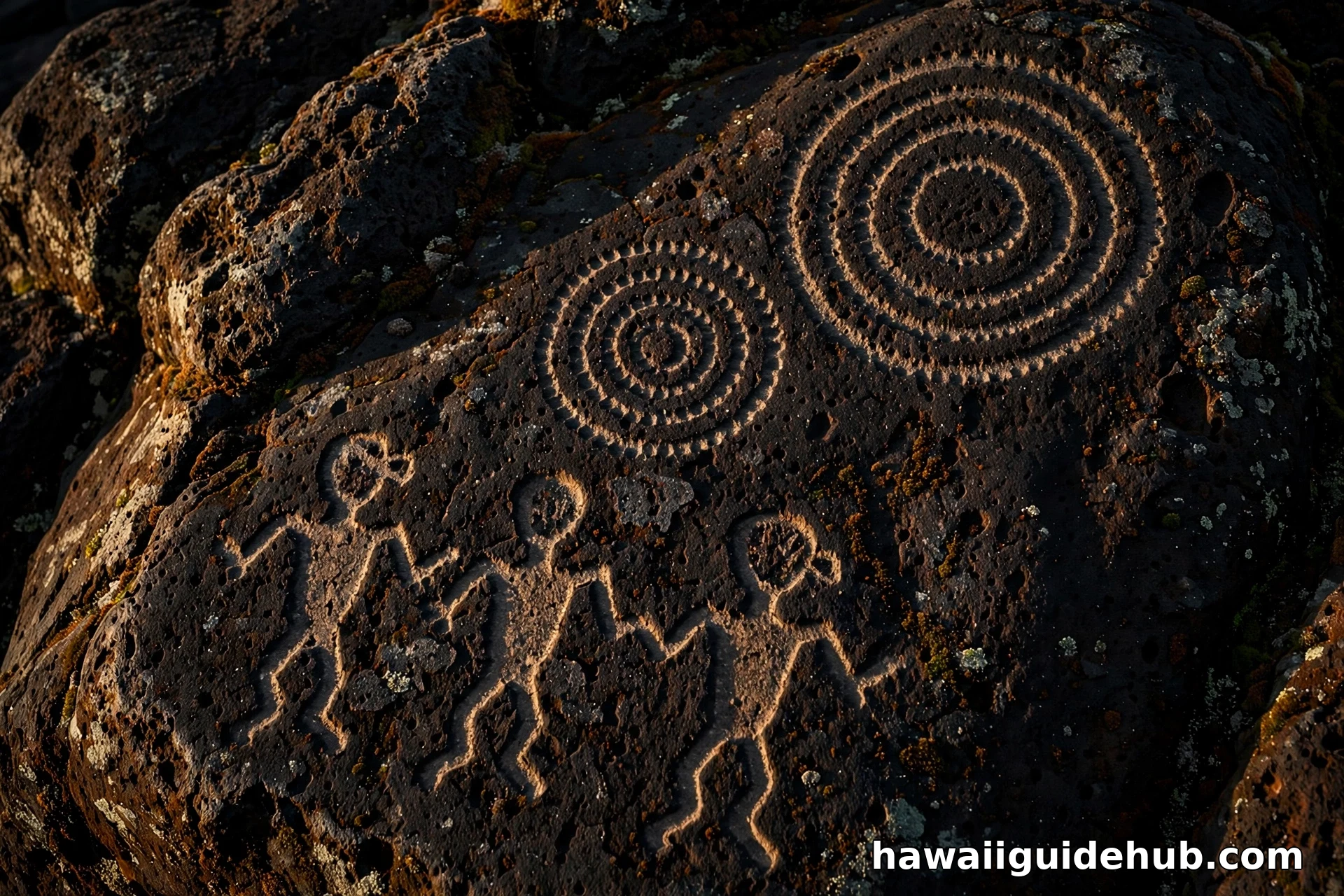
On a smooth lava field in Hawaiʻi Volcanoes National Park, more than 23,000 images are pecked into the stone: human figures, concentric circles, canoe sails, and thousands of small cupped hollows. They were carved by Hawaiian hands centuries ago, and many of them honor the births of children whose descendants still live in the islands. These are Hawaiian petroglyphs, the rock art of old Hawaiʻi.
This is the single complete guide to Hawaiian petroglyphs. It covers what petroglyphs are and how they were made, what the carvings meant, the three great places to see them (Puʻu Loa, Puakō, and Oʻahu’s west shore), how to visit each site, the best light for viewing, and the respectful rules every visitor must follow.
Hawaiian Petroglyphs at a Glance
| Aspect | The story |
|---|---|
| What they are | Kiʻi pōhaku: images pecked or carved into lava rock by ancient Hawaiians |
| How they were made | Pecked with stone tools into the thin hard crust of pāhoehoe lava flows |
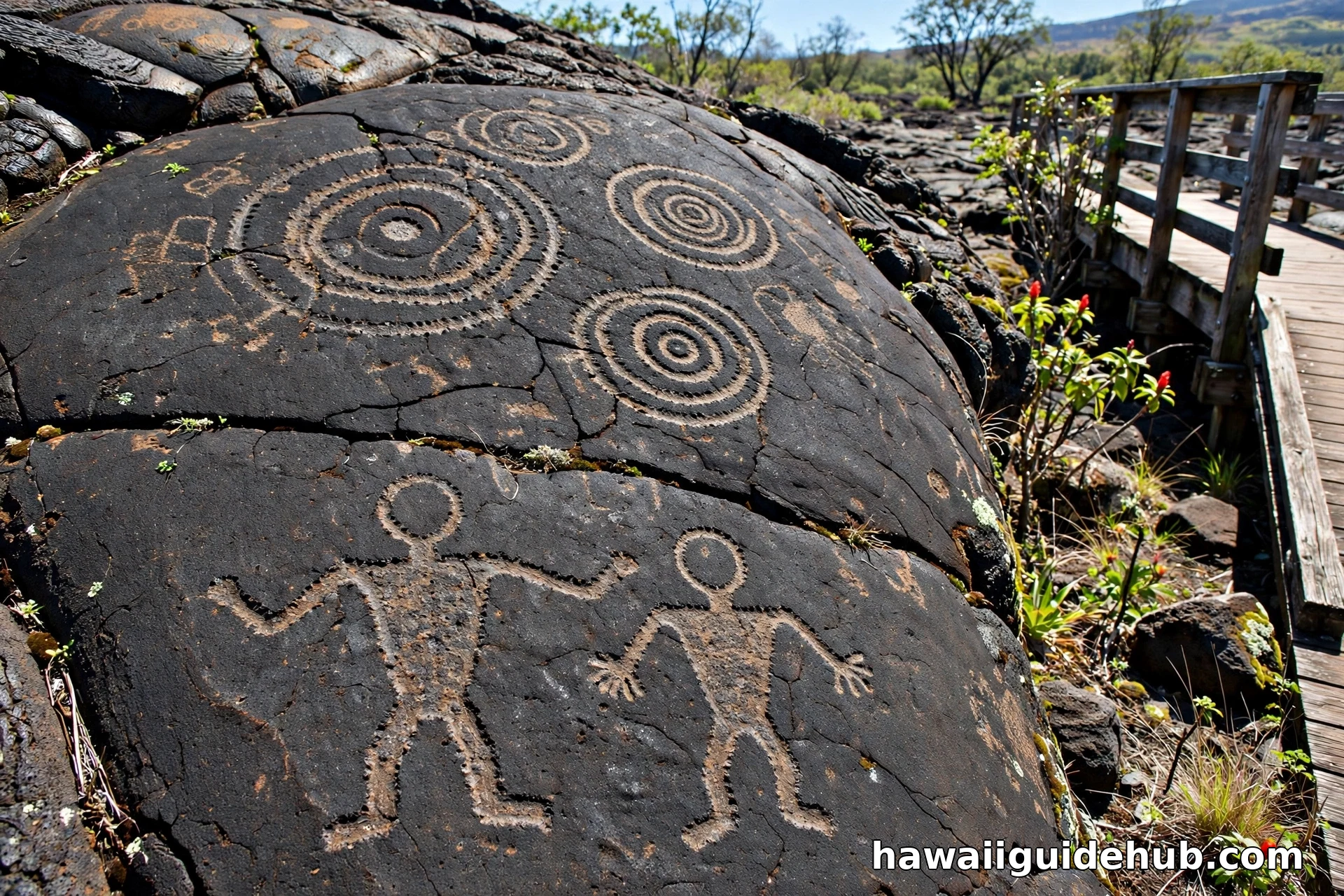
| What they show | Human figures, circles, canoe sails, geometric designs, and cupules (small hollows) |
| What they mean | Birth records, genealogy markers, travel records, spiritual messages |
| How old | Carved into lava dated AD 1200 to 1450; some Oʻahu carvings are 500 to 1,000 years old |
| The biggest site | Puʻu Loa, Hawaiʻi Volcanoes National Park: more than 23,000 carvings |
| Other top sites | Puakō Petroglyph Park (Big Island), Pōkaʻī Bay (Oʻahu) |
| The visitor rule | Stay on paths and boardwalks; never touch, rub, or walk on the carvings |
What Are Hawaiian Petroglyphs?
Hawaiian petroglyphs, called kiʻi pōhaku (images in stone), are designs pecked, carved, or etched into volcanic rock. Using stone adze tools, Hawaiian artists chipped through the dark, thin crust of pahoehoe lava to reveal the lighter rock beneath, leaving images that can survive for centuries. The subjects range from simple circles and lines to detailed human figures, canoe sails, and even feathered capes.
Petroglyphs are found on every major Hawaiian island, but they cluster where smooth lava offered a natural canvas. They are not decoration. To Native Hawaiians, the carvings are spiritual and ancestral messages, records of births, markers of genealogy and family custom, notes of travel, and prayers set in stone. Researchers still debate the meaning of many designs, which is part of their mystery.
Puʻu Loa: The Hill of Long Life
The greatest petroglyph field in Hawaiʻi lies at the end of Chain of Craters Road in Hawaiʻi Volcanoes National Park. Puʻu Loa, which means hill of long life, holds more than 23,000 carvings spread across a smooth pahoehoe flow. The lava here erupted from the Kāne Nui o Hamo shield volcano some 600 years ago and is dated between AD 1200 and 1450, so the carvings document more than five centuries of Hawaiian life.
Puʻu Loa’s fame rests on its most touching tradition. About 16,000 of the 23,000 carvings are cupules, small pecked hollows, many ringed by concentric circles. When a child was born, the family placed the newborn’s umbilical cord in one of these hollows and covered it with a stone, asking the mana of Puʻu Loa to grant the child a long life. The lineage of thousands of Hawaiian families is literally written into this hillside, which is why the place is called the hill of long life.
The remaining carvings include anthropomorphs (human figures), canoe sails, circles, geometric patterns, and cryptic designs. The first outsider to record them was the missionary Reverend William Ellis, who described the site in 1823. Today the National Park Service protects the field with a wooden boardwalk loop, and it is one of the essential stops in our guide to the best things to do in Hawaiʻi Volcanoes National Park.
Visiting Puʻu Loa
The trailhead is a signed pullout between mile markers 16 and 17 on Chain of Craters Road. The hike is an easy 1.4 miles round trip across open lava, taking one to one and a half hours, but there is no shade and no water, so bring both, plus sturdy shoes and a hat. Stay on the boardwalk at the site. The carvings are delicate, and walking on the rock can destroy images you cannot even see.
Time your visit for the light. The carvings are shallow, and the direct overhead sun of midday can wash them out completely. Go in the early morning or late afternoon, or on an overcast day, when low angled light makes every pecked line stand out. Walk the boardwalk loop in both directions; carvings you miss one way often appear on the return.
Puakō Petroglyph Park: The Malama Trail
On the Kohala coast near Waikoloa, the Puakō Petroglyph Archaeological Preserve protects one of the largest concentrations of rock art in the Pacific. The 223-acre preserve holds more than 3,000 etchings, with nearly 1,200 visible from the trail. These carvings were likely made between 1600 and 1800, younger than Puʻu Loa but just as evocative.
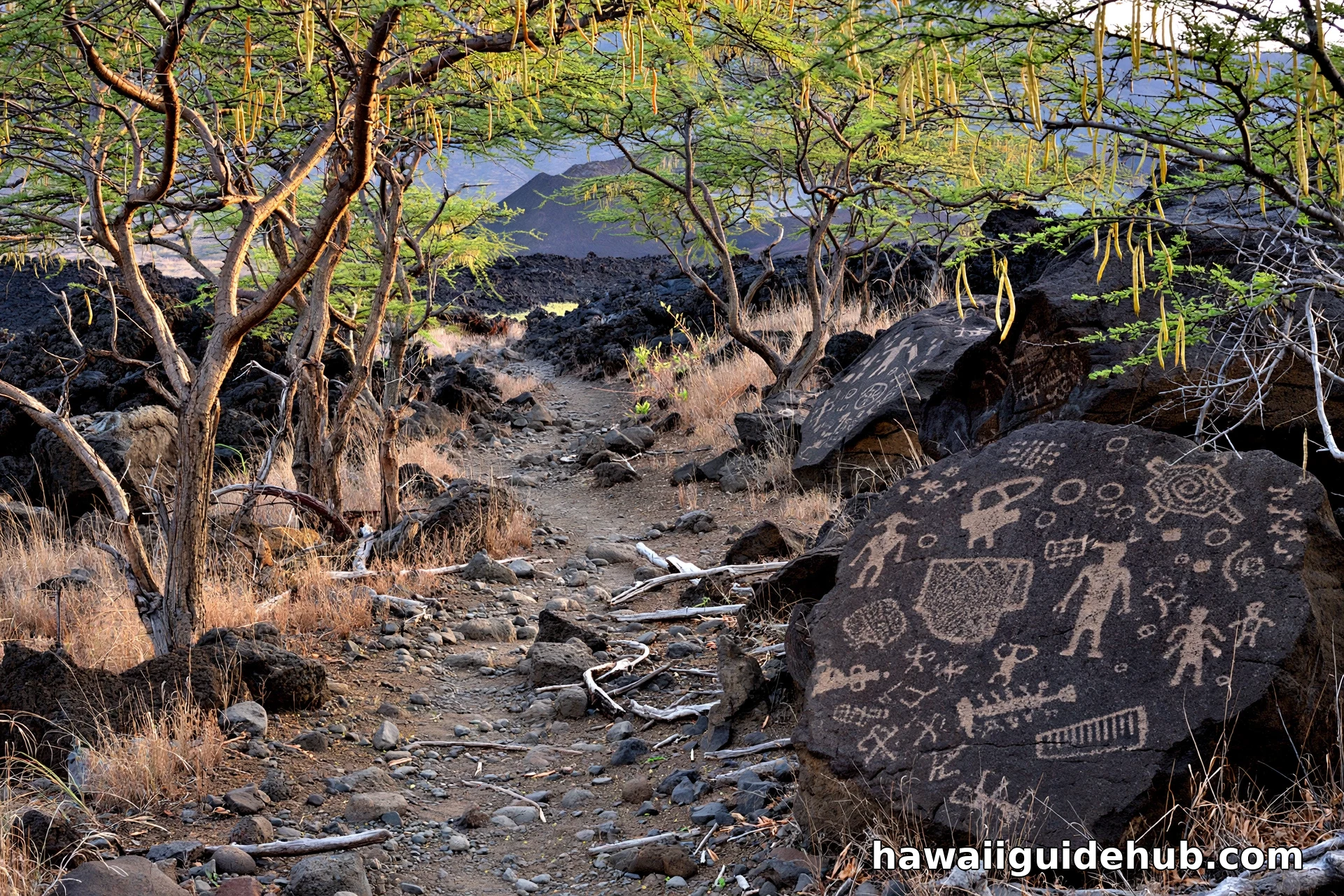
The Malama Trail winds through a rugged kiawe forest to a sacred enclosure, with educational signs explaining what you are seeing. The walk is a few miles over uneven ground, and it gets very hot, so go in the morning or evening, carry water, and wear sturdy shoes. It pairs perfectly with the surrounding area, and our guide to the best things to do in Waikoloa covers what else to see nearby. As everywhere, look with your eyes, not your hands: never touch the carvings, and never make rubbings.
Pōkaʻī Bay, Oʻahu: Petroglyphs Revealed by the Sea
Oʻahu’s most dramatic petroglyphs appear and disappear with the ocean itself. At Pōkaʻī Bay on the island’s west side, ancient carvings etched into a sandstone shoreline platform emerge when seasonal swells peel away the covering sand. The panel stretches about 115 feet along the shore and holds more than two dozen images, mostly human-like stick figures, some remarkably detailed: two of the large figures even have fingers, a rarity in Hawaiian rock art. The tallest figure stands more than eight feet tall.
Experts date these carvings to at least 500 to 600 years old, while Hawaiian oral traditions place Native Hawaiians in the area for more than a thousand years. They are visible at low tide, when gentle waves roll over the algae-covered rock. One figure with raised and lowered arms may represent sunrise and sunset, tying the images to the natural cycles at the heart of traditional Hawaiian belief. Because the site is tidal and unprotected, visit at low tide, step with extreme care, and never pry at the stone.
How Petroglyphs Were Made
The technique was patient and physical. The artist chose a smooth pahoehoe surface, then pecked the design with a stone hammer or adze, chipping away the dark outer crust dot by dot to expose the lighter stone beneath. Adze blanks were quarried from places like Keanakākoʻi in the volcano region, and the work could take hours for a single figure. Some artists returned to the same panels over generations, adding new births and new journeys beside the old ones, so a single boulder can hold centuries of a community’s story. The result was permanent: barring lava flows and human damage, a petroglyph endures for centuries.
This permanence is exactly why the carvings matter. Long after the artists’ names were forgotten, their records of births, journeys, and beliefs remained. The National Park Service describes Puʻu Loa’s carvings as markers of genealogy and family custom, a stone archive of the community that lived around it. When you look at a cupule that once held a newborn’s umbilical cord, you are looking at a family’s hope, set in rock five hundred years ago.
Etiquette: How to Visit Petroglyphs Respectfully
Petroglyphs are sacred cultural sites, and they are fragile. A single footstep on the wrong rock can erase a carving forever. Follow these rules at every site: stay on marked trails and boardwalks, never walk on carved surfaces, never touch or trace the carvings with your fingers, never make rubbings or press paper against the stone, and never move rocks. Oils from your skin and the abrasion of even light contact wear the images away.
Bring water, sun protection, and sturdy shoes, and give the sites the quiet attention they deserve. These courtesies belong to the same living culture described in our guide to Hawaiian cultural traditions, and in our look at Native Hawaiian spirituality today, where ancestral places remain active and revered.
Common Misconceptions About Petroglyphs
One misconception is that petroglyphs are ancient doodles or idle graffiti. They are nothing of the sort. Every carving took real labor with stone tools, and the subjects, births, genealogies, voyages, prayers, were the important records of their communities. Treat them as documents, not decorations.
Another is that all petroglyphs are thousands of years old. Hawaiʻi’s carvings are younger than many expect: Puʻu Loa’s span roughly the last 600 years, and Puakō’s date to the 1600s through 1800s. They are not prehistoric in the distant sense; they were made by the direct ancestors of Hawaiians living today, which is why they remain spiritually alive.
A third is the idea that you can enhance a visit by touching the carvings to feel them. You cannot. Touch is destruction. The shallow pecked lines wear down with contact, and the oils on your hands stain the stone. The carvings survived centuries of rain and sun; do not let a curious fingertip be what finally erases them.
Video: Puʻuloa Petroglyphs
In this National Park Service video, the ancestral connections of Puʻuloa’s petroglyphs are explained, from genealogy markers to family customs.
Frequently Asked Questions
What are Hawaiian petroglyphs?
Hawaiian petroglyphs, or kiʻi pōhaku, are images pecked or carved into volcanic rock by ancient Hawaiians using stone tools. They depict human figures, circles, canoe sails, geometric designs, and small cupped hollows called cupules, and they served as birth records, genealogy markers, travel records, and spiritual messages.
Where is the best place to see petroglyphs in Hawaii?
Puʻu Loa in Hawaiʻi Volcanoes National Park is the premier site, with more than 23,000 carvings on an easy 1.4-mile round-trip trail. Puakō Petroglyph Park near Waikoloa offers over 3,000 etchings on the Malama Trail. On Oʻahu, ancient carvings emerge at Pōkaʻī Bay at low tide when sand washes away.
How old are Hawaiian petroglyphs?
Puʻu Loa’s carvings sit on lava dated AD 1200 to 1450, making them up to 600 or more years old. Puakō’s carvings likely date from 1600 to 1800. The Pōkaʻī Bay carvings on Oʻahu are at least 500 to 600 years old, with oral traditions suggesting Native Hawaiians have been in that area for over a thousand years.
What do the small holes in Hawaiian petroglyphs mean?
The small pecked hollows, called cupules or pukas, were ceremonial vessels. At Puʻu Loa, families placed a newborn’s umbilical cord inside a cupule and covered it with a stone, asking the mana of the hill of long life to bless the child with a long life. About 16,000 of Puʻu Loa’s 23,000 carvings are these cupules.
Can you touch Hawaiian petroglyphs?
No. Never touch, trace, or make rubbings of petroglyphs. The carvings are shallow and fragile; contact wears them away and skin oils stain the stone. Stay on marked trails and boardwalks, and never walk on carved surfaces.
When is the best time to see petroglyphs?
Early morning, late afternoon, or an overcast day. The carvings are shallow, and harsh midday sun washes them out, while low angled light makes every pecked line visible. At Pōkaʻī Bay on Oʻahu, go at low tide, when the carvings emerge from beneath the sand and surf.
Hawaiian petroglyphs are letters from people who wrote in stone because they had no paper, and their messages, of births, of journeys, of hope for long life, are still legible today. Walk the boardwalk at Puʻu Loa in the low light of morning, and you will read them as clearly as the day they were pecked.