
On This Page
Figuring out how to get around Maui shapes the whole trip. The island is larger than it looks on a map, the resort areas sit far from the airport, and the best scenery often waits at the end of a long drive. This guide explains every practical way to move around Maui: rental cars, the Maui Bus, taxis and rideshares, walking and biking, interisland flights and the Lānaʻi ferry, plus the driving tips that keep the trip smooth. It is written as a neutral reference, not a sales pitch. For where the airport sits in relation to the island, see Where Is the Airport on Maui, and for terminal details see Maui Airport Map.
Getting Around Maui: The Big Picture
Maui is the second largest island in Hawaiʻi at about 727 square miles, and it is really two volcanoes joined by a narrow isthmus. Kahului Airport (OGG) sits on that central isthmus, which makes it a reasonably central arrival point. From there, the island spreads out: West Maui (Lahaina, Kāʻanapali, Nāpili, Kapalua) lies to the west across the West Maui Mountains; South Maui (Kīhei, Wailea, Mākena) lies to the south along the base of Haleakalā; Upcountry (Makawao, Kula, Pukalani) sits on Haleakalā’s slopes; East Maui (Pāʻia, Haʻikū, Hāna) stretches along the windward coast.
The distances surprise many first-time visitors. The drive from Kahului Airport to Kāʻanapali takes roughly 45 minutes to an hour in normal traffic. Wailea is about 30 to 40 minutes south. Hāna is a two-and-a-half to three-hour drive each way along the famous winding highway. Haleakalā summit is about an hour and a half uphill from Kahului. Because the island’s attractions spread across every compass point, most visitors find a rental car close to essential. Maui does not have a rail line or a comprehensive public transit network that reaches every beach and trailhead, so planning transport before arrival matters more here than on Oʻahu.
That said, car-free travel on Maui is possible for certain trip styles. Visitors staying in one resort area, such as Kāʻanapali or Wailea, can walk to many restaurants and beaches, use hotel shuttles, and rely on rideshares for occasional longer trips. Budget travelers sometimes combine the Maui Bus with walking to keep costs low. Day-trippers heading to Hāna often join guided driving tours instead of renting a car for the whole trip. The right choice depends on the itinerary: a week split between West and South Maui demands a car, while a long weekend in one resort town may not.
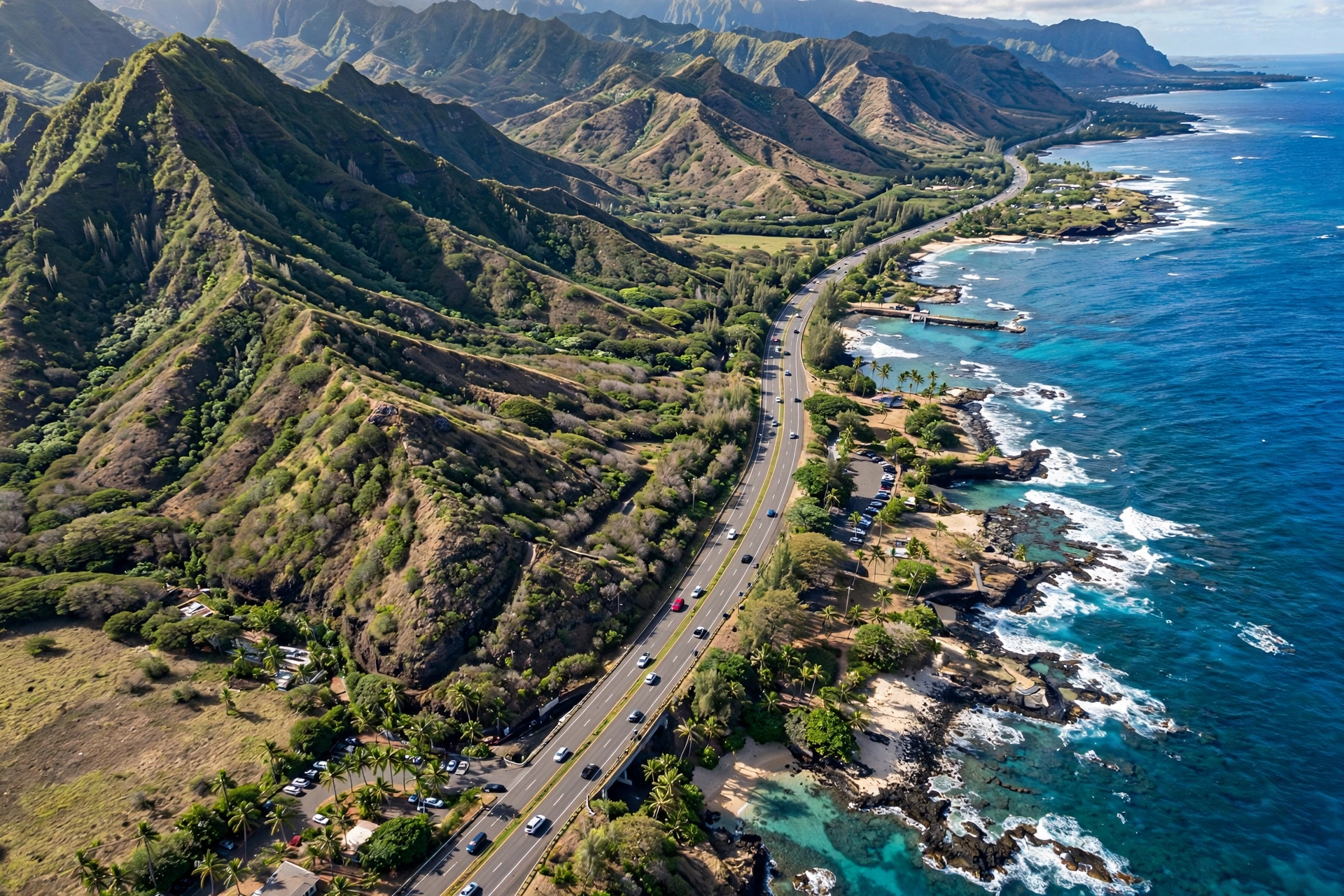
Road conditions are generally good on the main highways. The Honoapiʻilani Highway (Route 30) connects Kahului to West Maui, the Piʻilani Highway (Route 31) runs south through Kīhei and Wailea to Mākena, the Hāna Highway (Routes 36/360) runs east to Hāna, and the Haleakalā Highway (Route 37/377/378) climbs to the summit. Narrow mountain roads, one-lane bridges, and steep grades appear on the Hāna Highway and parts of the West Maui loop, and drivers should be comfortable with those conditions before attempting them.
Rental Cars
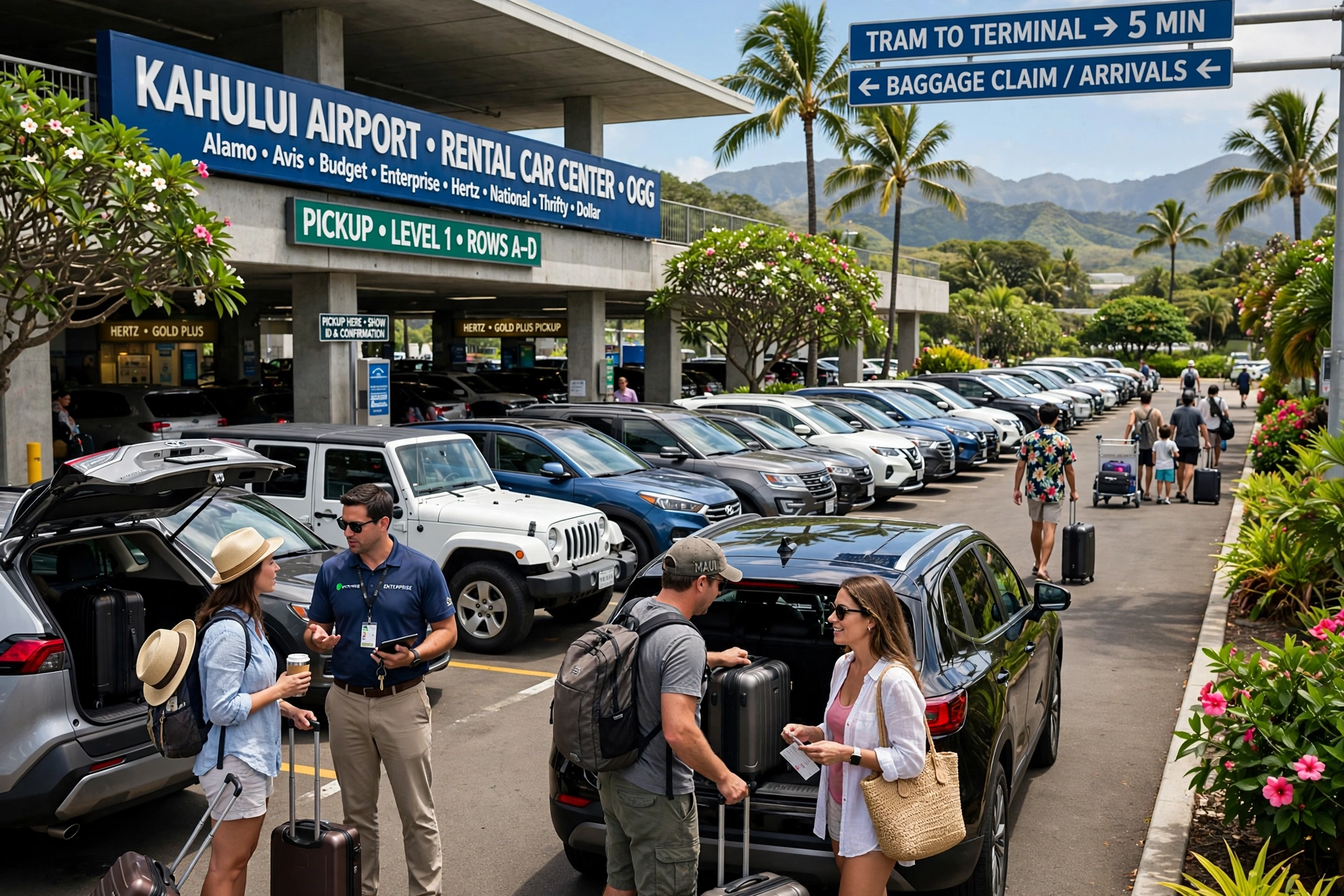
For most visitors, a rental car is the single most practical choice on Maui. It unlocks the Road to Hāna, Haleakalā sunrise and sunset, Upcountry farms and markets, and the flexibility to chase good weather from one side of the island to the other. Book early for busy seasons, because Maui’s rental fleet can sell out around holidays and school breaks, and prices rise steeply when supply tightens.
Rental car agencies operate at Kahului Airport, with counters and vehicles in the consolidated rental car facility near the terminal. Some visitors prefer to pick up a car at the airport on arrival and keep it for the whole trip. Others stay car-free for the first days in a walkable resort area and rent for only the days they plan excursions. Off-airport rental locations exist in some resort areas, though the selection is smaller than at OGG.
Vehicle choice matters more on Maui than on a typical vacation. A standard sedan handles every paved road on the island, including the Hāna Highway and Haleakalā. Jeeps and convertibles are popular, but remember that convertibles offer no secure trunk and Jeeps on Maui are mostly two-wheel drive, not the rock crawlers people imagine. If the plan includes Haleakalā summit in winter, note that temperatures at 10,023 feet can drop near freezing, and the road can close for ice or storms, so check conditions before heading up.
Parking costs deserve a line in the budget. Most Wailea, Kāʻanapali, and Kapalua resorts charge nightly self-parking or valet fees, commonly in the general range of $40 to $60 per night at upscale properties. Many vacation rentals and condos include parking, which is one reason condo stays appeal to car renters. Public beach parks offer free parking, though popular trailheads and beach parks fill early, especially on weekends.
Gas stations cluster in Kahului, Wailuku, Kīhei, Wailea, Lahaina, and along the main highways. Fuel costs more than on the mainland, and stations thin out on the Road to Hāna and in remote West Maui. Fill the tank before leaving Kahului for Hāna, and do not let the gauge drop below half on any long excursion.
One common concern is rental car damage and theft. Break-ins happen at popular trailheads and beaches, most often when valuables are left visible. Park in well-traveled areas, take valuables with you or lock them in the trunk before arriving, and avoid leaving luggage visible. This is standard advice for any island trip, and it applies on Maui.
Maui Bus
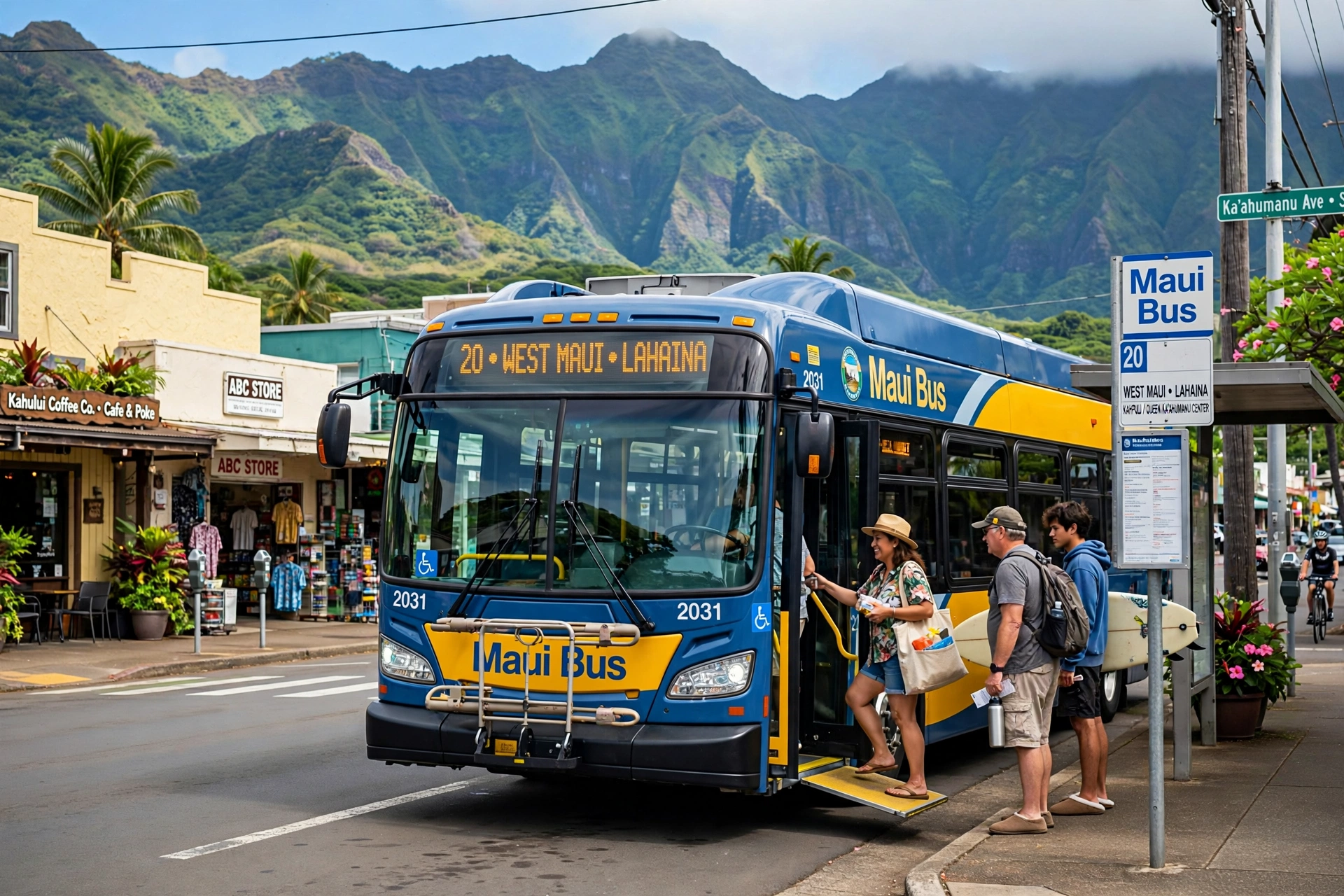
The Maui Bus is the county-run public bus system, operated on routes that connect Kahului, Wailuku, Kīhei, Wailea, Lahaina, Kāʻanapali, Napili, Kapalua, Pāʻia, Haʻikū, Makawao, Kula, and other communities. It is an affordable option, and for travelers on a tight budget or those staying along a bus corridor, it can work for point-to-point trips.
Fares are simple: the general single-ride fare is $2 per boarding on all routes, and a day pass costs $4. Monthly passes run about $45 for general riders, with discounted passes for students (about $30) and seniors 55 and older (about $25). Maui County also runs a fare-free program for qualifying riders, including seniors, students of any age, ADA paratransit cardholders, Medicare cardholders, people with disabilities, and people demonstrating financial need. Visitors who qualify can ride free with the right identification.
The buses are ADA accessible, air-conditioned, and equipped with bike racks, which helps cyclists combine biking with bus trips. Schedules and route maps are posted online by the County of Maui Department of Transportation and are also available on the buses. Service frequencies are lower than a big-city transit system, so planning around the schedule matters. Missing a bus can mean a long wait, particularly on commuter routes and in rural areas.
The main hub is the Queen Kaʻahumanu Center transit center in Kahului, where many routes connect. From Kahului Airport, riders can walk to the bus stop on the median outside the baggage claim area and catch connecting routes. This works for light packers, but travelers with multiple suitcases will find the bus awkward. Luggage is allowed but space is limited, and the bus is designed for commuters, not airport travelers.
The honest limitations: the bus does not reach the Road to Hāna, Haleakalā summit, or many trailheads and remote beaches. Trips that take 30 minutes by car can take two hours or more by bus with transfers. Service runs on a commuter schedule, so late-night service is limited or nonexistent on many routes. For visitors whose plans center on resort areas, the bus is a decent supplement. For visitors chasing waterfalls, sunrises, and far-flung beaches, it cannot replace a car.
Taxis, Rideshares, and Shuttles
Uber and Lyft both operate on Maui, with coverage strongest around Kahului, Wailuku, Kīhei, Wailea, and West Maui. Availability thins out in Hāna, Upcountry, and remote areas, where a ride may take a long time to arrive or never come at all. Airport pickups work well at OGG, and the apps show estimated fares before booking. Surge pricing applies during peak demand, such as late-night arrivals and major events.
Taxis serve the airport and resort areas, with regulated rates posted by the county. Taxis can be hailed at the airport taxi stand and at some hotels, or called by phone. For groups of three or four splitting the cost, a taxi from OGG to Kāʻanapali or Wailea can be reasonable for a one-way trip, though it is far more expensive than the bus and less flexible than a rental car for a full week.
Shared shuttles and private transfer companies run airport transfers to the major resort areas. These work well for travelers who want door-to-door service without driving themselves on arrival day. Prices vary by company and destination, and reservations are recommended, especially for late-night arrivals. Some hotels also operate their own shuttles within resort areas, such as between Kāʻanapali hotels and Whalers Village, or between Wailea properties and the Shops at Wailea.
Resort-area trolleys and shuttles deserve a mention. The Kāʻanapali area has a shuttle loop connecting hotels, the beach, and shopping. Wailea properties run shuttles along the resort. These are typically free or low-cost for guests and make it easy to move within a resort zone without a car. Ask the front desk about routes and schedules on arrival.
Walking and Biking
Walking works well within individual resort areas. Kāʻanapali has a beach walkway connecting the hotels along the sand. Wailea has the Wailea Beach Path, a paved oceanfront walk linking the resorts and beaches. Kīhei’s South Kīhei Road runs for miles with sidewalks, shops, and beach parks along the way. Downtown Lahaina’s Front Street is a classic stroll, though visitors should check current conditions and access guidance given the ongoing recovery from the 2023 fires. Pāʻia’s small main street is walkable, and Makawao’s Baldwin Avenue invites a slow wander past galleries and boutiques.
Walking between towns is a different story. Distances are long, shoulders are narrow on many highways, and the tropical sun is intense. The walk from Kahului to Wailuku is doable, but walking from Kīhei to Wailea or from Lahaina to Kāʻanapali means miles along busy roads. Plan walks within neighborhoods, not between them.
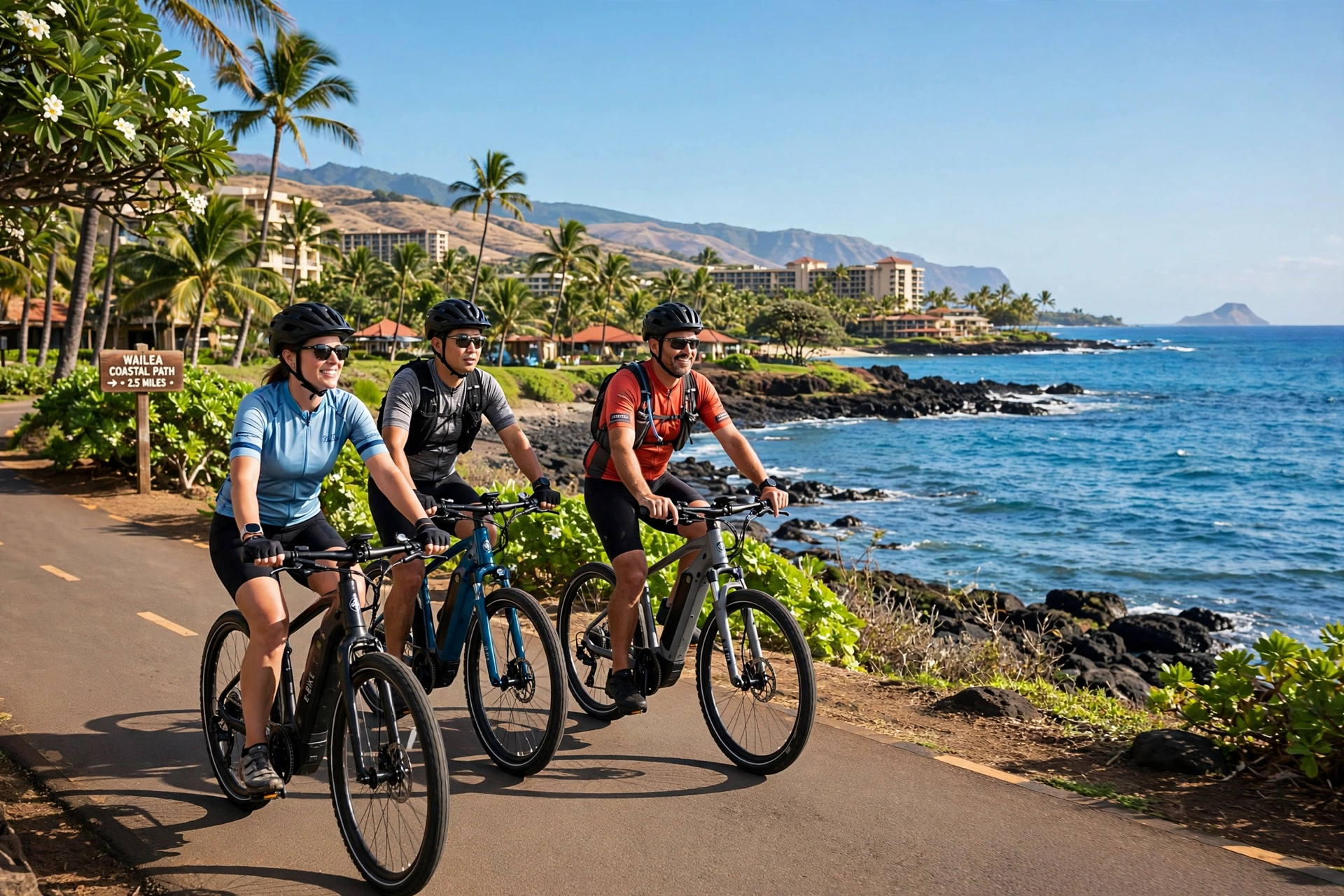
Biking appeals to active travelers, particularly in flat South Maui and around resort areas. Bike rentals, including e-bikes, are available in Kīhei, Wailea, and West Maui, and some hotels lend bikes to guests. The West Maui coastline has a multi-use path in places, and the flat roads around Kīhei suit casual riders. Maui does not have an island-wide public bikeshare system like Oʻahu’s Biki, so rentals come from private shops.
Serious cyclists tackle Haleakalā, a legendary climb of nearly 10,000 feet from sea level to the summit, but this is an expert undertaking on a road shared with cars and tour vehicles. Downhill bike tours from Haleakalā were once a signature Maui activity; check current availability and operator status before planning around them, as the industry has changed in recent years.
Interisland Travel From Maui
Maui connects to the other islands primarily by air. Kahului Airport (OGG) is the island’s main gateway, with frequent interisland flights to Honolulu (HNL), Kona (KOA), Līhuʻe (LIH), and Hilo (ITO). Hawaiian Airlines and Southwest Airlines both operate interisland routes from OGG, with flight times around 30 to 45 minutes to Oʻahu and the Big Island. Booking early often brings the best fares, and morning flights run most reliably before afternoon trade-wind turbulence builds.
Two smaller airports serve Maui. Kapalua Airport (JHM) in West Maui offers short commuter flights, primarily to Honolulu, operated by Mokulele Airlines. Hāna Airport (HNM) on the east end offers limited commuter service to Kahului, also through Mokulele. These small airports save a long drive for travelers based at the far ends of the island, though schedules are limited and aircraft are small.
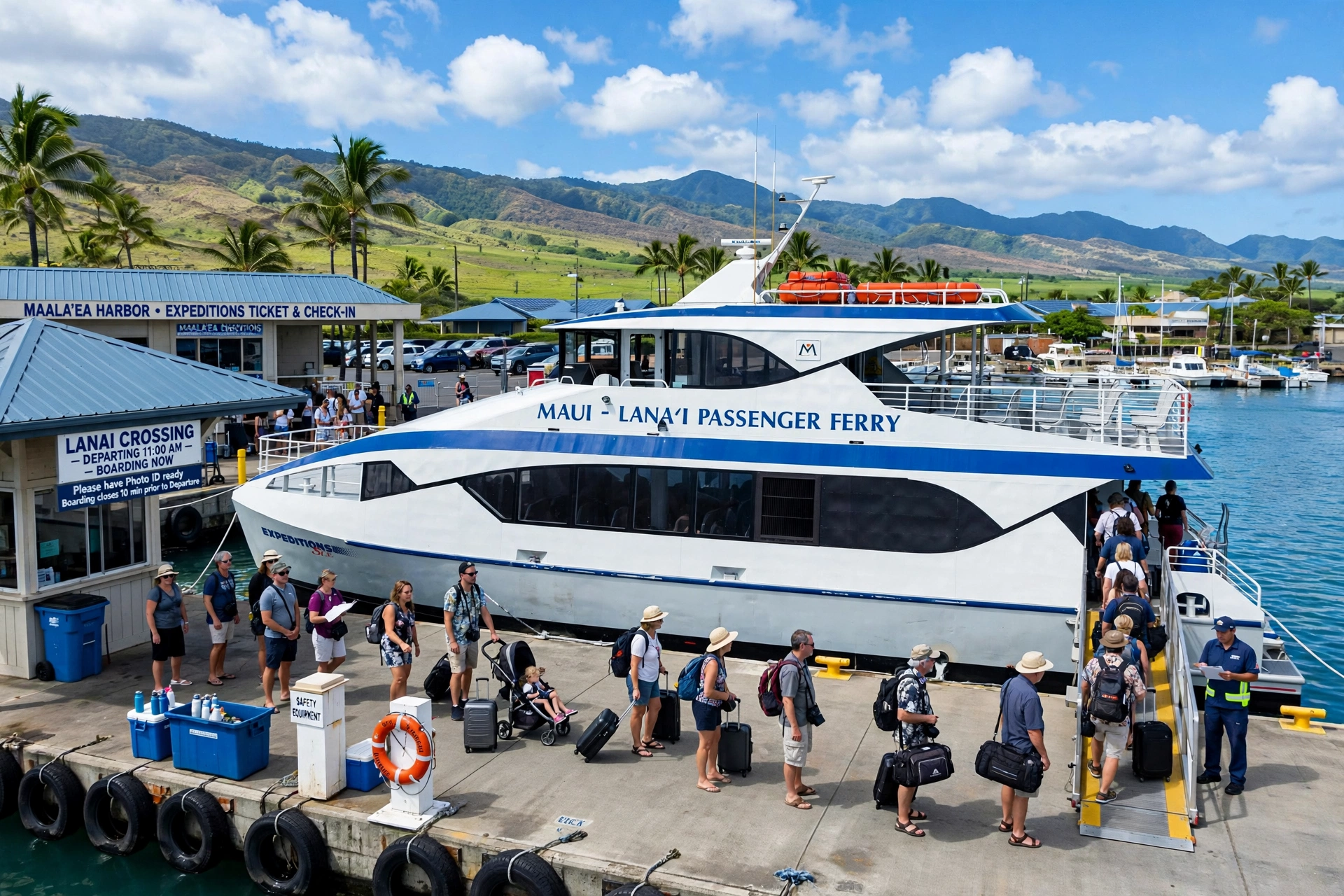
The one regular passenger ferry in Hawaiʻi runs between Maui and Lānaʻi. Operated by Expeditions, the ferry now departs from Māʻalaea Harbor on Maui and arrives at Mānele Harbor on Lānaʻi. It previously ran from Lahaina Harbor, but Lahaina Harbor was damaged in the August 2023 fires and remains closed to the ferry, so the service relocated to Māʻalaea. The crossing takes about an hour to an hour and ten minutes from Māʻalaea. Schedules typically include multiple daily departures in each direction, with morning, midday, and afternoon sailings. Adult fares run about $66 each way and child fares about $34 (kamaʻāina rates about $40 adult; seniors, children, and infants under 2 have separate discounts), with discounts for residents and seniors. Check in at least 30 minutes before departure, and note that Māʻalaea Harbor has pay parking.
There is currently no regular passenger ferry between Maui and Molokaʻi. The Molokaʻi ferry service ended in 2016, and despite periodic proposals and a county feasibility study, no replacement service operates as of this writing. Travelers heading to Molokaʻi fly from Kahului or Honolulu to Hoʻolehua Airport (MKK), with Mokulele Airlines providing the main scheduled service.
For cruise travelers, Kahului Harbor receives visiting cruise ships, and Nāwiliwili on Kauaʻi and Honolulu Harbor are the other main cruise ports in the islands. Interisland cruises typically embark in Honolulu rather than Maui.
Driving Tips for Maui
Maui driving is straightforward on the main highways and adventurous on the famous scenic routes. A few island-specific tips make the difference between a relaxed trip and a stressful one.
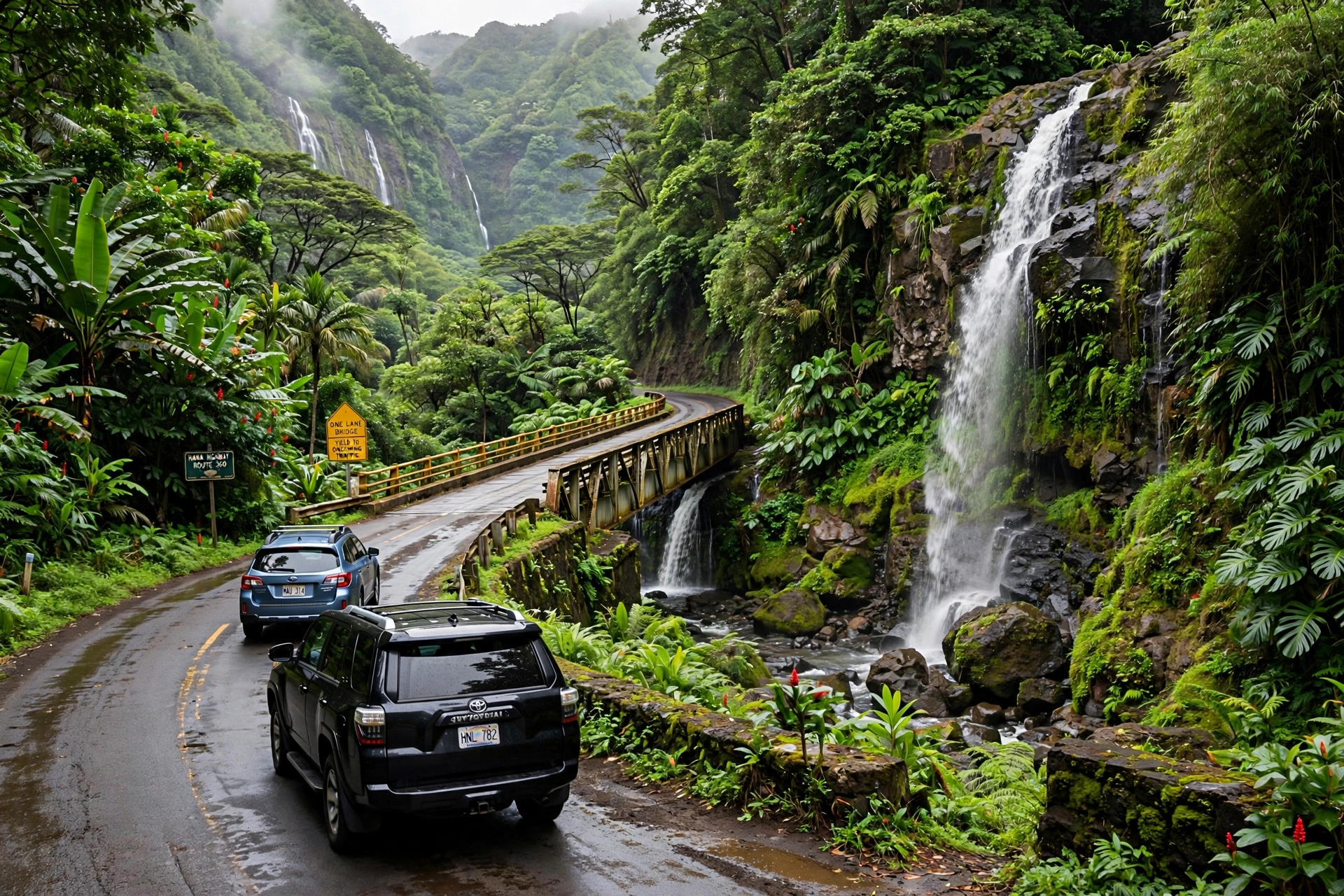
The Road to Hāna. The Hāna Highway is about 64 miles of winding road with more than 600 curves and dozens of bridges, many of them one lane. Allow a full day, start early from Kahului or Paʻia, and plan to turn around at Hāna or Kīpahulu rather than attempting the full loop. The southern route past Kīpahulu toward Kaupō is rough, narrow, and unpaved in stretches; most rental agreements prohibit it, and tow trucks charge heavily for rescues there. Pull over for local traffic, never stop on bridges, and respect private property and no-trespassing signs at waterfalls and pools. For the full route breakdown, see Road to Hāna Map.
Haleakalā. The drive to the summit climbs from sea level to 10,023 feet on a well-paved but winding road with switchbacks. Sunrise visits require a reservation booked in advance through recreation.gov, and the parking lots fill with reservation holders. Bring warm layers: summit temperatures can be 30 to 40 degrees cooler than the beach, and winter mornings can dip near freezing. Drive with headlights on, watch for cyclists, and allow extra time for the descent. Altitude affects some visitors with headaches or shortness of breath, so take it easy at the top. For trail details, see Maui Hikes.
One-lane bridges and narrow roads. The Hāna Highway’s one-lane bridges follow a simple rule: the first vehicle to arrive generally proceeds, and drivers yield with a wave. On narrow stretches, the uphill driver or the driver with the easier pullout often yields. Patience and courtesy keep these roads moving. Honking is rare and considered rude.
Gas stations. Fill up in Kahului, Wailuku, Pāʻia, Kīhei, or Lahaina before long drives. Stations are sparse on the Road to Hāna, in Hāna itself fuel is limited, and remote West Maui has few options. Do not start the Hāna Highway or the Haleakalā climb with less than half a tank.
Parking. Beach parks and trailheads fill early, especially on weekends and holidays. Popular spots like the ʻĪao Valley State Monument require parking reservations booked in advance. Never park illegally on highway shoulders near trailheads; tickets and towing are common at crowded spots. In resort areas, use hotel or public lots rather than residential streets.
Rush hour. Maui has real traffic. The Honoapiʻilani Highway between Māʻalaea and Lahaina congests badly during morning and evening commute hours, and the Piʻilani Highway through Kīhei slows at peak times. Plan West Maui departures outside the 7 to 9 a.m. and 4 to 6 p.m. windows when possible.
Weather and road closures. Heavy rain can close the Hāna Highway with landslides, and high winds can close Haleakalā’s summit road. Flash flood warnings mean staying out of stream valleys and off the Hāna Highway’s low-water crossings. Check the National Weather Service Honolulu forecasts and Hawaiʻi Department of Transportation alerts before scenic drives.

Accessibility
Maui Bus vehicles are ADA accessible, and Maui County operates ADA paratransit door-to-door service for eligible riders who cannot use the fixed-route buses. Paratransit rides require advance reservation, generally at least 24 hours ahead, and serve areas within three-quarters of a mile of existing bus routes. Visitors with disabilities should contact the county transportation office before the trip to confirm eligibility and booking procedures.
Many of Maui’s headline attractions offer accessible options. The ʻĪao Valley State Monument has an accessible paved path. Haleakalā’s summit visitor centers and several overlooks are wheelchair accessible, though some trails are not. Several South and West Maui beaches have beach wheelchairs available through county programs or lifeguard stations; availability varies, so call ahead. Resort properties built or renovated in recent decades generally meet ADA standards for rooms, pools, and common areas.
Travelers who need accessible rental vehicles should reserve well in advance, as the accessible fleet on Maui is small. Confirm the specific vehicle and its features directly with the rental location rather than relying on a general reservation category.
Maui Transportation FAQ
Do I need a rental car on Maui?
For most itineraries, yes. Maui’s attractions spread across the island, public transit does not reach the Road to Hāna, Haleakalā summit, or many beaches and trailheads, and rideshares thin out in rural areas. Travelers staying entirely within one walkable resort area can manage without a car by using shuttles, walking, and occasional rideshares.
How much does the Maui Bus cost?
The general fare is $2 per boarding on all routes, with a $4 day pass and a roughly $45 monthly pass. Discounted passes exist for students and seniors 55 and older, and a county fare-free program covers qualifying riders including seniors, students of any age, and people with disabilities. Bring exact fare; drivers do not make change.
Does the ferry still run from Lahaina to Lānaʻi?
No. The Expeditions ferry moved to Māʻalaea Harbor after the August 2023 fires damaged Lahaina Harbor, and it has not returned. The ferry now runs between Māʻalaea Harbor on Maui and Mānele Harbor on Lānaʻi, with multiple daily departures. The crossing takes about an hour to an hour and ten minutes.
Is there a ferry from Maui to Molokaʻi?
Not currently. The Molokaʻi passenger ferry ended service in 2016, and no replacement operates. Travelers fly from Kahului or Honolulu to Molokaʻi’s Hoʻolehua Airport instead, with Mokulele Airlines providing scheduled service.
Can I take the bus from Kahului Airport?
Yes. The Maui Bus serves OGG, with a stop on the median outside the baggage claim area. It works for light packers heading to Kahului, Wailuku, or along bus corridors, but travelers with heavy luggage or resort destinations far from bus stops will find a rental car, shuttle, or rideshare far more practical.
How long does it take to drive around Maui?
A full perimeter drive is not practical because no road circles the entire island. Key drives: Kahului to Kāʻanapali about 45 to 60 minutes, Kahului to Wailea about 30 to 40 minutes, Kahului to Hāna about two and a half to three hours each way, and Kahului to Haleakalā summit about an hour and a half each way.
Do I need a reservation to drive up Haleakalā for sunrise?
Yes. Haleakalā National Park requires a sunrise reservation booked in advance through recreation.gov, separate from the park entrance fee. Reservations release on a set schedule and sell out, especially in peak season. Sunset and daytime visits do not require the sunrise reservation, though the park entrance fee still applies.
Is Uber available on Maui?
Yes. Uber and Lyft operate on Maui with the best coverage around Kahului, Wailuku, Kīhei, Wailea, and West Maui. Expect longer waits and possible unavailability in Hāna, Upcountry, and remote areas. Airport pickups at OGG work well.
Related Guides
- Maui Map: the island overview with regions and driving routes
- Where Is the Airport on Maui: OGG location and orientation
- Maui Airport Map: terminal and ground transport details
- Maui Towns: where to base yourself by region
- Road to Hāna Map: the full driving route breakdown
- Maui Hikes: trailheads and how to reach them
- Maui Beaches: beach access and parking by coast
- Maui Weather: conditions that affect driving plans
A Final Word
Transportation on Maui rewards the traveler who matches the method to the day. A rental car covers the big driving days, the Hāna Highway, Haleakalā, and Upcountry wandering. The Maui Bus, rideshares, and resort shuttles fill the gaps for beach days and dinners out. The Lānaʻi ferry opens a second island without a flight, and interisland flights from Kahului keep the rest of Hawaiʻi within an hour. Pick the right tool for each day, check conditions before the scenic drives, and the island’s distances stop feeling like obstacles and start feeling like part of the trip.