Hawaiian Agriculture History: Farming the Islands

Before plantations, Hawaii fed up to a million people with stone-walled terraces, irrigation channels, and the ahupua’a system: mountain-to-sea land divisions that made every community self-sufficient. Hawaiian agriculture was engineering, ecology, and spirituality in one. This is the complete guide to Hawaiian agriculture history: the lo’i, the crops, and the ahupua’a.
This is the single complete guide to Hawaiian agriculture history. It covers the lo’i kalo terraces, the ‘auwai irrigation, the ahupua’a system, the staple crops (kalo, ‘uala, ‘ulu), dryland farming, the Māhele’s impact, plantation transformation, and modern restoration. Everything about ancient Hawaiian farming lives on this one page.
Kalo: The Staff of Life
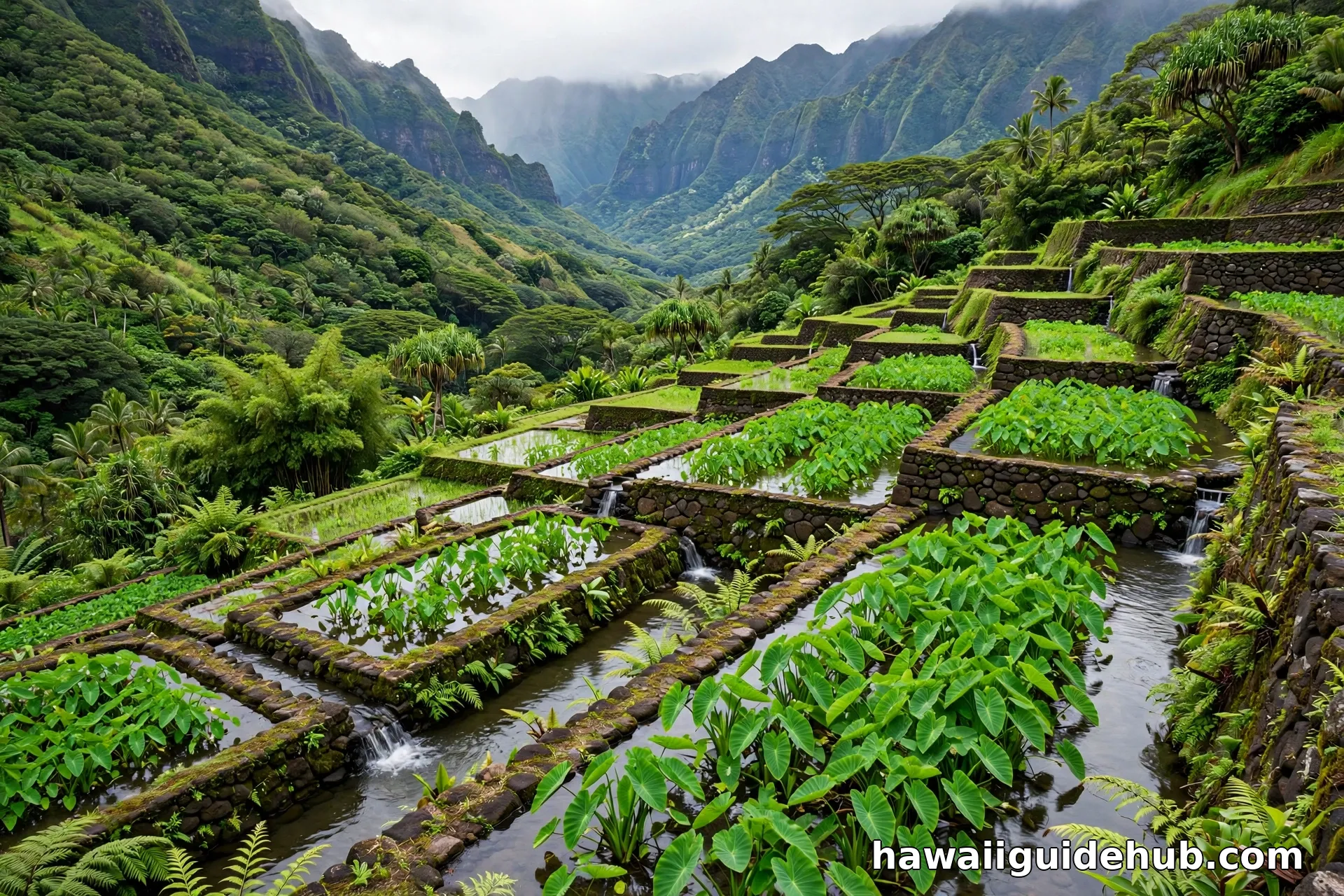
Kalo (taro) was Hawaii’s staple: the starchy corm pounded into poi, the leaves cooked as lu’au. Kalo was also sacred: in Hawaiian genealogy, kalo is the elder sibling of the Hawaiian people, born of the gods. Growing kalo was thus a spiritual duty as much as farming. The wetlands terraces (lo’i) were engineering masterpieces: stone-walled paddies fed by ‘auwai (irrigation channels) diverted from streams, the water flowing terrace to terrace, each farmer’s intake regulated by custom. The system was productive and sustainable: some valleys held thousands of terraces, feeding huge populations.
Kalo Varieties: A Living Library
Hawaiians cultivated over 300 named varieties of kalo: each with distinct colors, flavors, growing needs, and uses. Some were for poi, some for table taro, some reserved for chiefs, some grown for medicine. The varieties were a genetic library, bred and selected over centuries for every microclimate: wet varieties for the lo’i, dryland varieties for the uplands, varieties that matured fast for lean times, varieties that stored well. Farmers traded planting stock between valleys, spreading diversity. This diversity was food security: if disease or drought hit one variety, others survived. The plantation era wiped out most varieties; today, cultural practitioners are hunting down the survivors, preserving them in living collections. Each variety carries a name, a story, and a taste: the library is being rebuilt, one corm at a time.
The Ahupua’a: Mountain to Sea
| Zone | What grew / lived there | Who managed |
| Mountains (wao) | Forest; birds; timber | Kapu; chiefs |
| Uplands | ‘Uala; dryland crops | Commoners |
| Lowlands | Lo’i kalo; villages | Konohiki |
| Shore | Fishponds; salt; canoes | Lawai’a |
| Ocean | Reef and deep-sea fish | Konohiki |
Building the Terraces: Labor and Organization
The terraced valleys of Hawaii represent one of the Pacific’s great construction achievements: thousands of stone walls, built by hand, fitted without mortar, holding back water and earth for centuries. The labor was organized by the ali’i and konohiki: commoners contributed work as part of their obligation, the community building the infrastructure it would farm. Stones were carried from streambeds, passed hand to hand, set by master wall-builders who understood how basalt locks together. The walls had to be level, strong, and watertight enough to hold a flooded paddy: tolerances measured by eye, achieved by experience. The scale staggers: some valleys held 2,000+ terraces, each a small engineering project, together a landscape transformed. And it was maintained forever: walls repaired, channels cleared, silt managed, every generation doing its part. The terraces were a promise to the future, kept in stone.
The ‘Auwai: Water Engineering
Water was life, and the ‘auwai (irrigation channels) were its arteries: stone-lined ditches carrying stream water to the lo’i, sometimes for miles. Building them required surveying by eye, grading by feel, and maintenance by the whole community. Water rights were custom and sacred: each terrace took its share, the rest flowed on. Disputes were settled by the konohiki. The system was so efficient that water leaving the lo’i was often cleaner than when it entered: the terraces filtered it. Modern engineers study the ‘auwai with admiration: gravity-fed, self-cleaning, sustainable.
Water Law: The Old Rules
Water in old Hawaii was governed by custom as precise as any modern water code: the stream belonged to no one and everyone; each user took a fair share; no one could take so much that downstream users suffered. The konohiki allocated water, settled disputes, and enforced the rules. Taking water out of turn was theft, punished seriously. The system worked because it was local, visible, and backed by spiritual sanction: water was a kinolau, a body form of the gods, and wasting it was sacrilege. When plantations diverted entire streams to cane fields, they broke this system: downstream lo’i dried up, communities withered, and the legal battles over water began. Those battles continue today: the fight for stream water is the fight for the lo’i, for the fish, for the old way of sharing. The old rules were simple and just: the water belongs to all, and no one takes more than their share.
Dryland Farming: ‘Uala and ‘Ulu
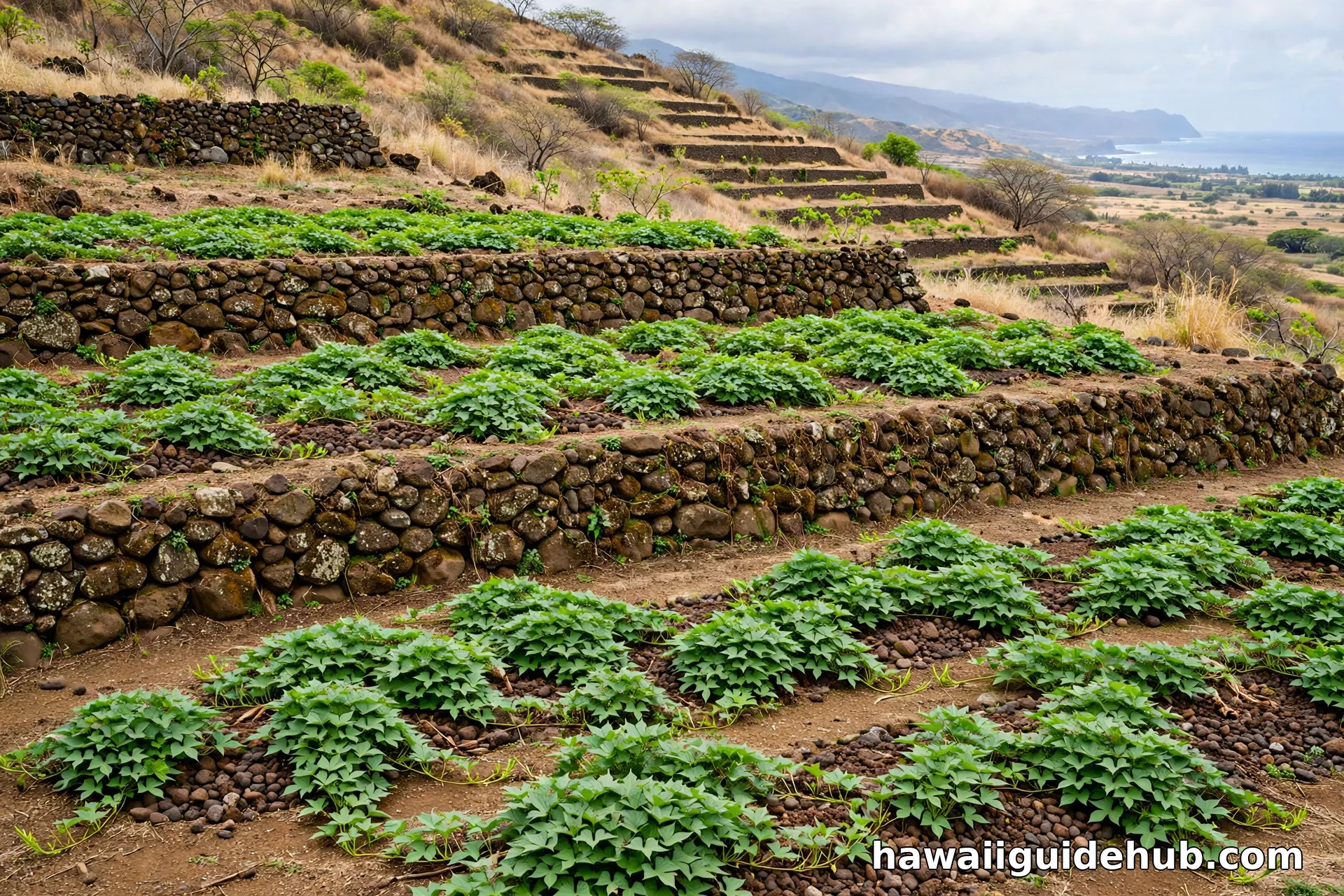
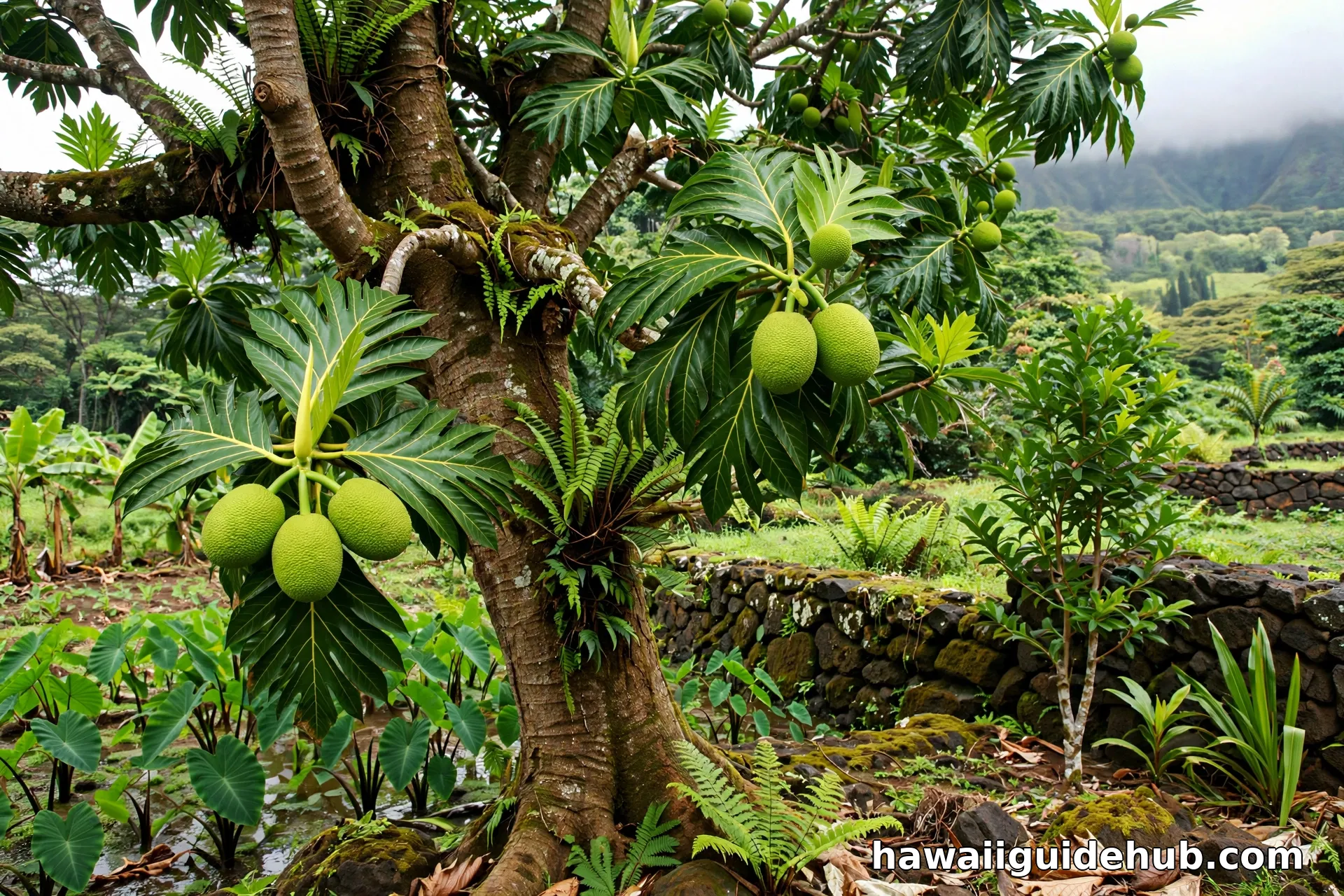
Not all of Hawaii was wet: the dry leeward slopes grew ‘uala (sweet potato) in vast mulched fields, some covering thousands of acres. Farmers built stone walls to trap moisture, mulched with grass, and planted in mounds. The Kona field system was one of the Pacific’s largest dryland agricultural complexes. ‘Ulu (breadfruit) grew in upland groves: a single tree feeding a family, the fruit roasted, pounded, and fermented into a storable paste. Together, kalo, ‘uala, and ‘ulu formed a food system with no weak season: something was always harvestable.
Agroforestry: The Forest Gardens
Beyond the terraces and fields, Hawaiians practiced agroforestry: managed forest gardens where ‘ulu, kukui, mai’a (banana), kō (sugarcane), and other useful plants grew in layered abundance. These weren’t wild forests but designed ecosystems: canopy trees sheltering understory crops, each species chosen for food, medicine, fiber, or wood. The gardens required little labor once established: the forest did the work, the people harvested. This was farming that looked like nature: productive, diverse, resilient. Modern permaculture rediscovers these principles and calls them revolutionary; Hawaiians called them Tuesday. The forest gardens fed families, provided medicine, and preserved biodiversity: agriculture and conservation in one system. Remnants survive in old homesteads and valleys, and restoration projects are replanting them: the future of Hawaiian farming may look a lot like its past.
The Māhele and the Plantations
The Great Māhele of 1848 divided Hawaii’s land into private ownership, ending the communal ahupua’a system. The consequences were profound: commoners, unfamiliar with Western land claims, lost most of the land; water was diverted to sugar plantations; the lo’i were drained and planted in cane. In a generation, a thousand-year food system was dismantled. Hawaii went from self-sufficient to importing nearly all its food: a dependency that persists today. The Māhele’s legacy is still debated: some call it necessary modernization, others the great dispossession.
The Plantation Transformation
The plantation era didn’t just change what Hawaii grew: it changed how Hawaii thought about land. Sugar and pineapple demanded vast monocultures, imported labor, and diverted water: the opposite of the diverse, local, sustainable ahupua’a. The plantations were productive in the narrow sense: they made fortunes. But they depleted soil, drained streams, and concentrated land ownership in few hands. The workers, brought from Japan, China, Portugal, the Philippines, and elsewhere, brought their own food traditions, creating Hawaii’s beloved mixed plate: the plantation’s culinary legacy. When sugar collapsed in the 1990s, the plantations left behind fallow fields, irrigation infrastructure, and a question: what now? The answer, increasingly, is the old answer: diverse local agriculture, the ahupua’a reimagined. The plantation century was an interlude; the thousand-year system is the main story.
The Return: Restoration
The revival is underway: lo’i are being restored in valleys island-wide; young farmers are learning the old methods; the ahupua’a concept informs modern watershed management and food sovereignty movements. Organizations rebuild terraces, clear ‘auwai, and plant kalo: the work is hard, muddy, and joyful. The goal isn’t nostalgia but resilience: Hawaii imports ~90% of its food, and the old system proves the islands can feed themselves. The farmers of the restoration are the new konohiki: stewards of land and water.
Watch: AHUPUA’A: How Hawaii Designed Balance From Mountain to Sea
Hawaiian Agriculture FAQs
What is an ahupua’a?
A traditional land division running from mountain to sea, containing everything a community needed: forest, farmland, water, shoreline, and fishing grounds.
What is lo’i kalo?
Flooded terraces for growing kalo (taro), fed by ‘auwai irrigation channels. Ancient, productive, and sustainable wetland agriculture.
What did ancient Hawaiians eat?
Kalo (poi), ‘uala (sweet potato), ‘ulu (breadfruit), fish, and other seafood, supplemented by bananas, sugarcane, and greens. A complete, healthy diet.
What was the Māhele?
The 1848 land division that converted Hawaii’s communal land system to private ownership, ending the ahupua’a and enabling the plantation era.
Can visitors see working lo’i?
Yes: many restoration sites welcome volunteers and visitors. Working in the mud of a lo’i is the best education in Hawaiian agriculture there is.
The Land Provides
Hawaiian agriculture was a thousand-year proof that people can feed themselves abundantly without destroying the land: the terraces, the channels, the ahupua’a, all of it sustainable, all of it sacred. Consider the numbers: at contact, Hawaii supported hundreds of thousands of people, entirely from island resources, with a system that improved the land rather than depleting it. No synthetic fertilizer, no pesticides, no fossil fuels: just stone, water, sun, and knowledge. The achievement humbles modern agriculture, which feeds more people but at enormous ecological cost. The plantations erased it in a generation; the restoration is bringing it back terrace by terrace. And here’s the deeper truth: the old system wasn’t primitive, it was advanced. The Hawaiians solved problems we still struggle with: water management, soil fertility, biodiversity, food security, all without a single written equation. They did it with observation, patience, and a worldview that treated the land as family rather than commodity. That worldview is the real inheritance: not just the terraces and channels, but the understanding that the land is alive, that water is sacred, that food is a relationship. The restoration isn’t just rebuilding walls; it’s rebuilding that relationship, one farmer, one valley, one meal at a time. When you see a lo’i gleaming green in a valley, you’re seeing the future as well as the past: the islands can feed themselves again. The land remembers how, and the farmers are listening. Visit a restoration site, get muddy, taste fresh poi: the history of Hawaiian agriculture isn’t in a museum. It’s in the ground, growing, and it has been for a thousand years. The terraces will outlast us all if we let them: stone doesn’t forget, water doesn’t lie, and the land keeps its promises to those who keep theirs. Mahalo for reading this history of Hawaiian farming, from the first terraces to the restoration fields of today. May your own garden grow half as well as the old lo’i did, and may you learn, as the old farmers did, that the land gives back exactly what you give it, multiplied a hundredfold, season after season, for as long as the water flows and the sun shines on these islands, which is to say, forever, if we take care of them as the old farmers did, with patience, with respect, and with the long view that built the terraces in the first place, stone by stone, generation by generation, in the faith that the future would need them, and the future does need them, now more than ever, as the islands reach again for the food sovereignty they once had and will have again, if the farmers keep faith and the water keeps flowing and the next generation learns the names of the kalo varieties as their grandparents knew them, every variety a story, every story a seed, every seed a promise kept across a thousand years of Hawaiian farming, and a thousand more to come if we honor it as the old farmers did, with work and with love and with the patience of stone and water and the faith of a thousand harvests past and a thousand future. For more island culture, see our volcanoes guide and Kauai guide.