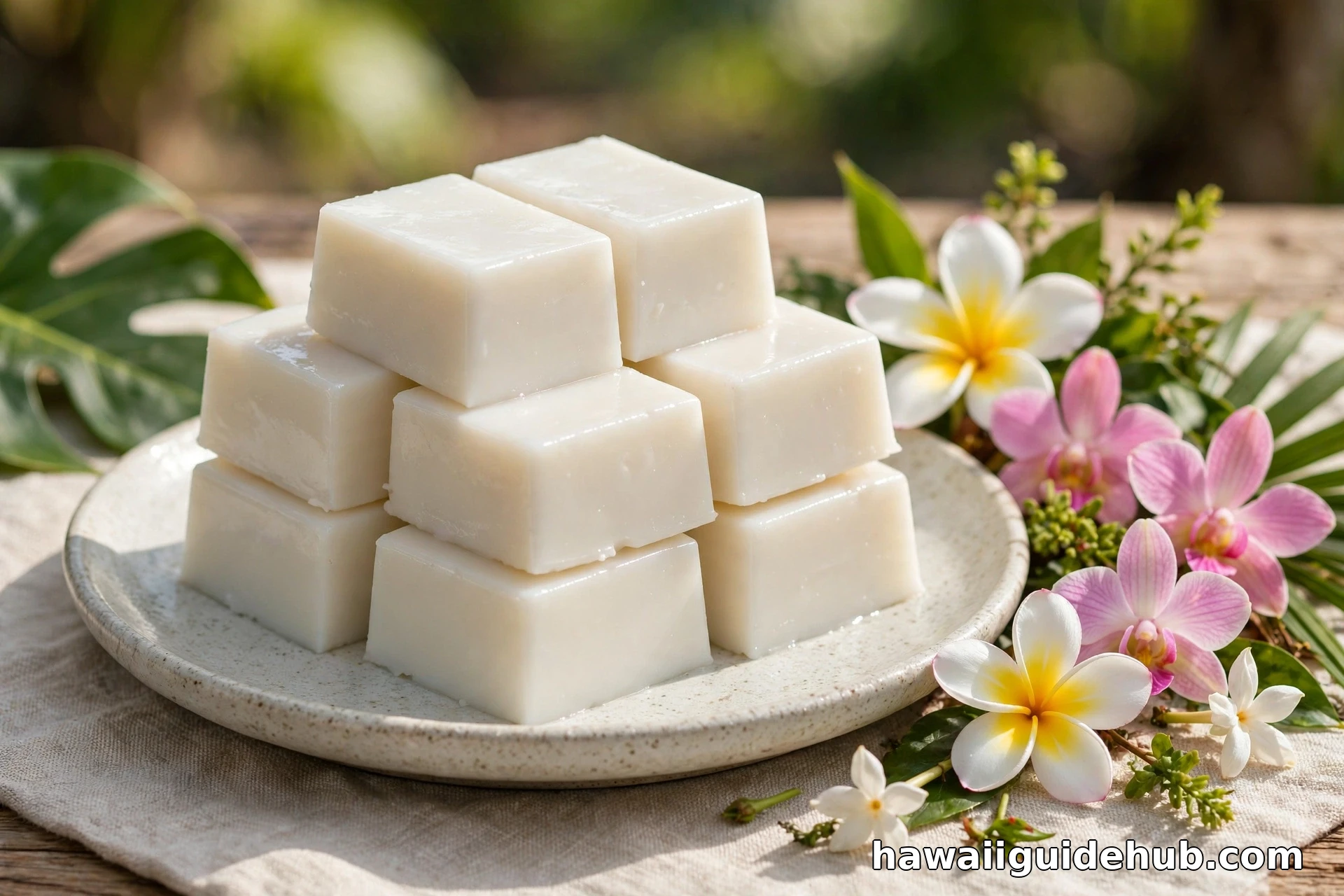
Haupia: Hawaii’s Silky Coconut Pudding

Cool, creamy, and white as fresh snow, haupia is the dessert Hawaii reaches for when the celebration matters. This coconut pudding shows up at luaus, weddings, baby parties, and graduations across the islands, cut into neat squares and eaten by the hundred. Four ingredients are all it takes, yet getting it right is a small art that Hawaiian cooks take seriously.
This is the single complete guide to haupia in Hawaii. It covers what the name means, the dessert’s origins, how the traditional recipe differs from the modern one, what haupia tastes like, the famous chocolate haupia pie, where visitors find it, and how to make it at home. If you have been searching for anything about haupia, the answers are all here on this one page.
Haupia at a Glance
| What it is | A chilled coconut pudding set firm enough to cut into squares |
| Name meaning | Hau (“cool”) + pia (Polynesian arrowroot): essentially “cool arrowroot” |
| Origin | Traditional Hawaiian dessert; the arrowroot version predates Western contact |
| Traditional thickener | Pia, the starch of Polynesian arrowroot (Tacca leontopetaloides) |
| Modern thickener | Cornstarch, now standard in nearly all recipes |
| Core ingredients | Coconut milk, sugar, starch, water, a pinch of salt |
| Texture | Silky and firm, like a delicate gelatin that melts in the mouth |
| Dietary notes | Naturally dairy free, gluten free, and vegan in its basic form |
| Famous variation | Chocolate haupia pie, layered coconut and chocolate in a pie shell |
What Haupia Tastes Like
Imagine the cleanest coconut flavor you have ever tasted, suspended in something between a pudding and a jelly. Haupia is lightly sweet rather than sugary, cool on the tongue, and impossibly smooth. It does not taste like the coconut cream pies or candy-bar coconut of the mainland. There is no chocolate, no toasted coconut, no heavy cream getting in the way. Just coconut milk, gently sweetened and set.
The texture is what surprises first-timers. It looks solid enough to pick up with your fingers, and indeed it is traditionally eaten as finger food, yet it dissolves almost instantly in the mouth. Good haupia has no lumps, no skin on top, no graininess. When it is made well, the square holds its shape on the plate and vanishes on the tongue.
What the Name Means: The Story of Hau and Pia
The name tells the whole recipe. In Hawaiian, hau means cool, and pia is the starch made from Polynesian arrowroot, a plant the first settlers brought with them across the Pacific. Haupia is, quite literally, cool arrowroot: a chilled pudding thickened with pia starch and enriched with coconut cream. The Hawaiian language dictionary describes it as a pudding formerly made from pia and coconut cream, which confirms how old the dish is.
Pia itself is worth a moment. The starch comes from the root of Tacca leontopetaloides, also called Tahiti arrowroot, a plant cultivated across Polynesia long before Europeans arrived in the Pacific. In old Hawaii it grew as a wild and cultivated crop, and its starch was a pantry staple. Coconut palms, also introduced by the voyaging Polynesians, provided the other half of the dessert. Haupia is one of the rare Hawaiian sweets built entirely from pre-contact ingredients.
From Pia to Cornstarch: How the Recipe Changed
Modern haupia is almost always thickened with cornstarch, and the switch happened for practical reasons. Pia became harder to find and more expensive as Hawaii’s agriculture changed, while cornstarch was cheap, reliable, and available in every store. By the mid twentieth century, cornstarch had become the standard, and most people in Hawaii today have never tasted the pia version.
Traditionalists will tell you the difference matters. Pia starch sets with a slightly different sheen and a cleaner melt than cornstarch, and the flavor of fresh coconut cream, squeezed from grated coconut meat, is richer than canned coconut milk. They have a point. But the cornstarch version is what nearly every bakery, luau, and home cook in Hawaii makes, and it is delicious on its own terms. Both versions share the same soul: cold, smooth, coconut.
How Traditional Haupia Is Made
The old method starts with fresh coconut. Mature coconuts are husked, cracked, and grated, and the grated meat is squeezed to produce thick coconut cream. That cream is heated gently with the pia starch, stirred constantly until it thickens to a smooth, glossy pudding. Sugar and a pinch of salt go in to balance the richness.
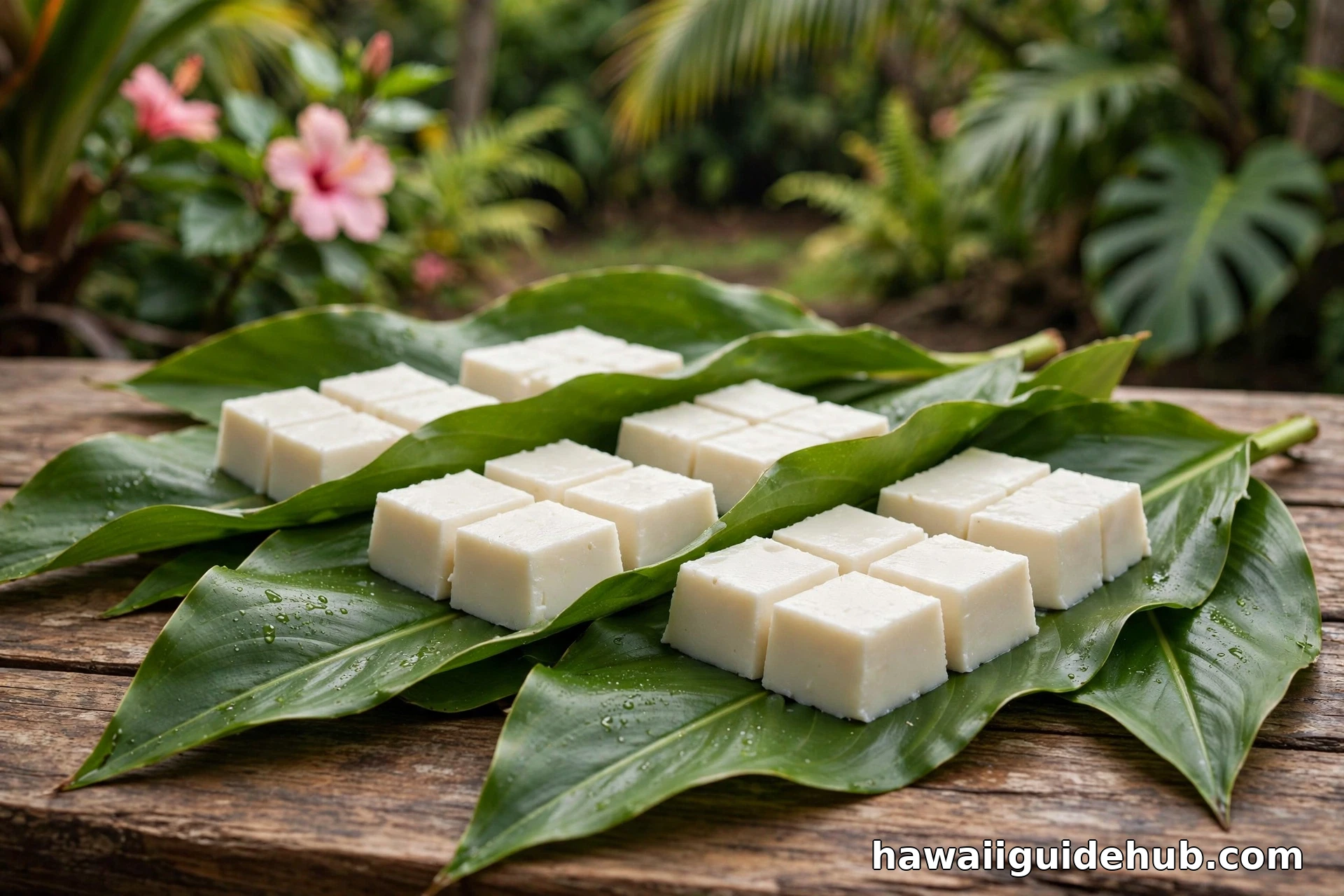
The mixture is poured into a shallow pan or onto ti leaves and left to cool, then chilled until firm enough to slice. The ti leaf is not just decoration. Serving food on ti leaves is an old Hawaiian practice, and the leaves keep the squares from sticking while adding a faint green freshness. Even today, haupia served on ti leaves at a gathering signals that someone made it the proper way.
The Modern Four-Ingredient Version
Today’s standard haupia could hardly be simpler: coconut milk, sugar, cornstarch, and water, with a pinch of salt. The dry ingredients are whisked with water into a smooth slurry, the coconut milk is heated until it just begins to bubble, and the slurry is stirred in. Constant stirring over medium heat for five to ten minutes brings it to a thick, pudding-like consistency. It is poured into an 8×8 pan, cooled, and refrigerated for at least two hours until set.
The pitfalls are all about patience. Undercooking leaves a soft pudding that will not hold a square. Walking away from the stirring invites lumps and scorching on the bottom of the pan. And haupia must be refrigerated promptly, since coconut milk spoils quickly at room temperature. Made carefully, the home version is every bit as good as what you will eat at a gathering in Hawaii.
Haupia vs. the Desserts Visitors Confuse It With
Haupia gets mistaken for several other coconut desserts, and the distinctions are worth knowing before you order. An expert would sort them like this.
| Haupia | Coconut haupia pie filling | Mainland coconut cream pie | Kulolo | |
| Base | Coconut milk set with starch | Haupia layered over chocolate | Custard with eggs and cream | Taro and coconut milk, baked |
| Texture | Firm, sliceable, melts clean | Soft set in a pie shell | Rich and eggy | Dense, fudgy, chewy |
| Sweetness | Light and delicate | Moderate, chocolate adds depth | Quite sweet | Deep caramel-like sweetness |
| Dairy | None | None in the haupia layer | Yes, cream and butter | None |
| Where you meet it | Luaus, parties, bakeries | Bakeries, especially on Oahu | Mainland diners | Luaus and Hawaiian fundraisers |
| Order it when | You want the pure traditional taste | You want haupia plus chocolate | You are not in Hawaii | You want the other great Hawaiian dessert |
Chocolate Haupia Pie and Other Famous Variations
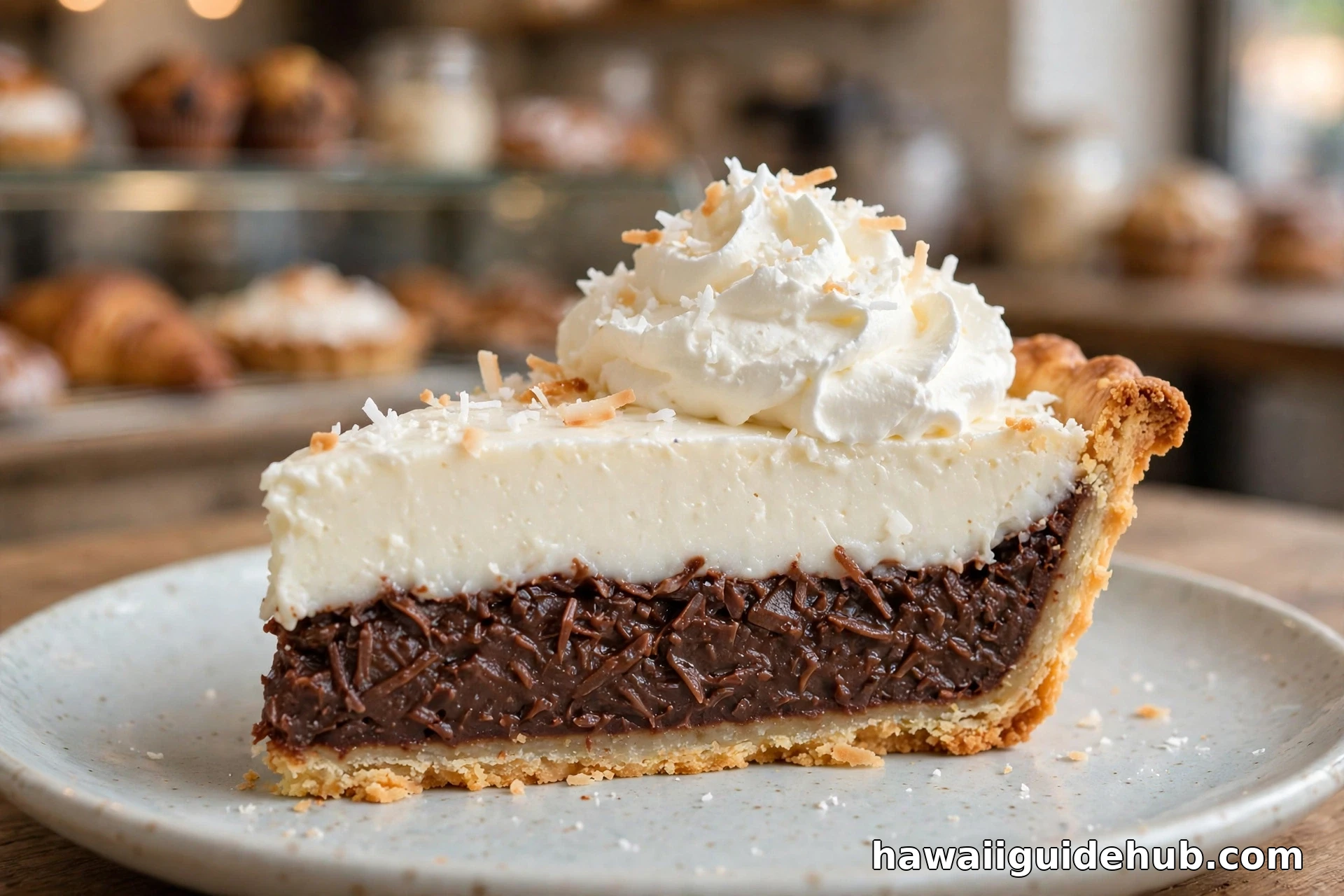
The most famous variation is the chocolate haupia pie: a pie shell layered with chocolate coconut filling, plain haupia, and whipped cream. It has become a signature Hawaiian dessert in its own right, and bakeries across the islands compete on their versions. On Oahu’s North Shore, Ted’s Bakery, operating since 1988, built its reputation on pies including the chocolate haupia pie, and it remains one of the island’s most talked-about desserts.
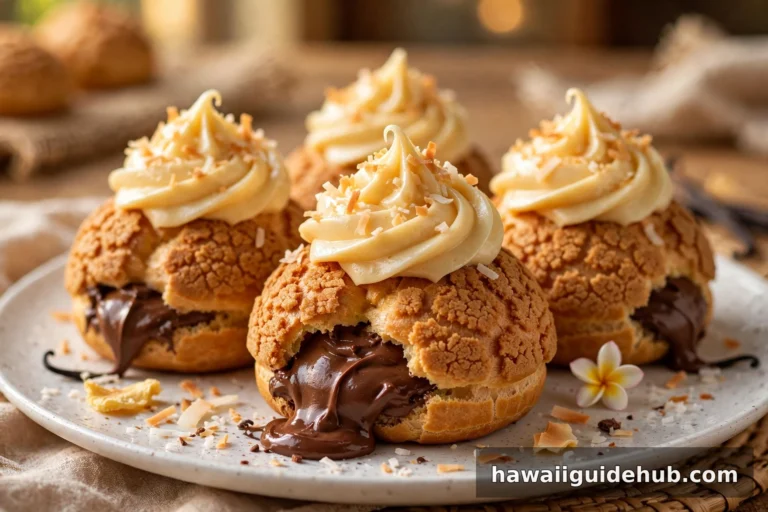
Haupia also appears as a cake topping and filling, a layer it has worn since at least the 1940s, when it became popular as a white topping for wedding cakes. Modern bakeries fold it into haupia cakes, drizzle it over shave ice, blend it into ice cream, and sandwich it into pastries. Each variation starts from the same cool white base. For more island sweets, see our guide to malasadas, Hawaii’s Portuguese-rooted treat.
Where Visitors Find Haupia in Hawaii
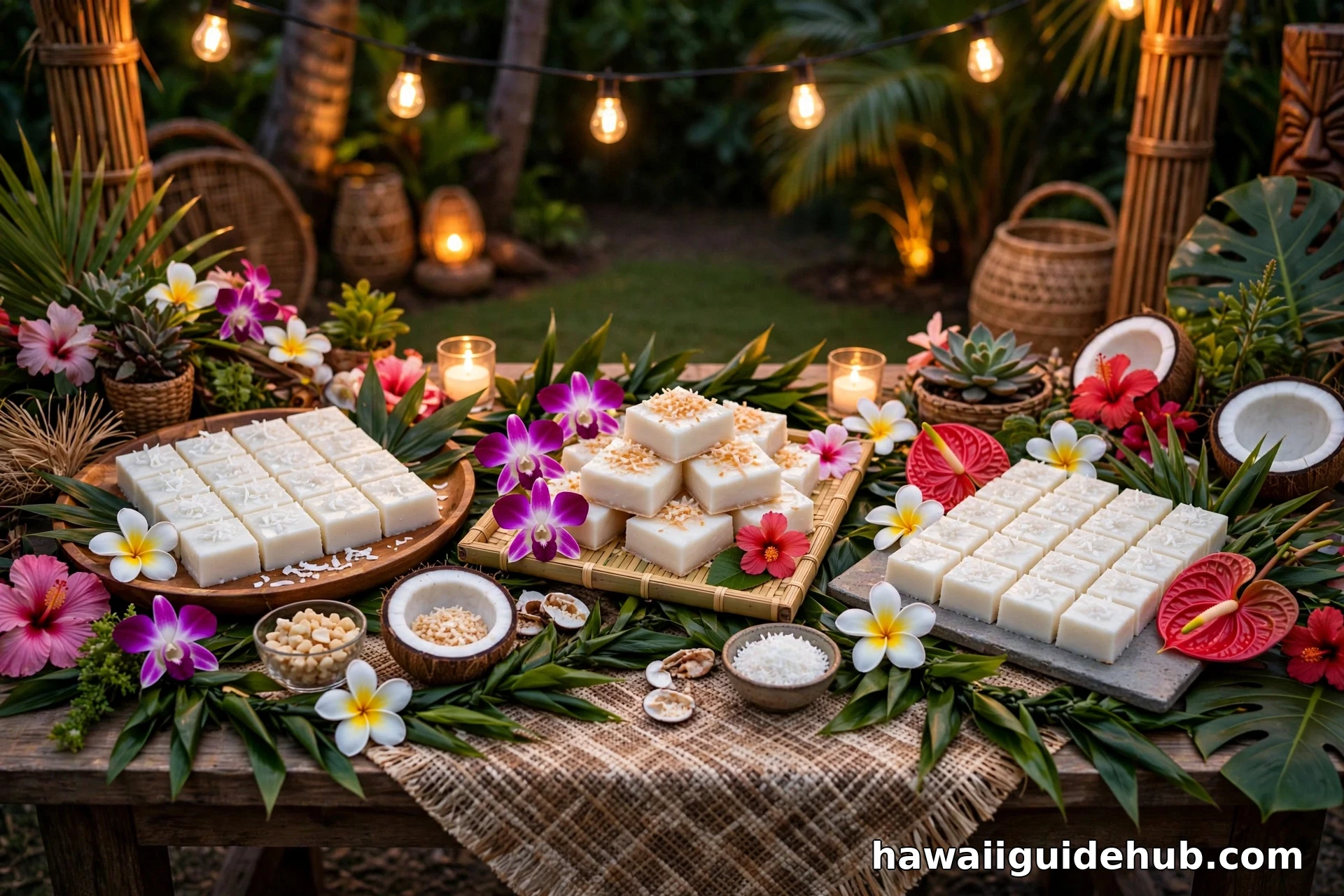
Haupia is celebration food, so the surest place to find it is wherever Hawaiians are celebrating. Luaus serve it as the standard dessert, and family gatherings, from baby luaus to graduations, almost always include a pan of it. Bakeries and grocery stores across the islands sell haupia squares and haupia-topped desserts daily, and many local restaurants list haupia or haupia pie on the dessert menu.
It is worth seeking out at a luau, where it arrives as part of the full spread of traditional foods. Our guide to what to wear to a luau covers the evening’s practical side. And if you are building a tasting tour of the islands’ flavors, our roundup of must-try local dishes in Hawaii puts haupia in context with the savory classics.
Making Haupia at Home: Tips That Matter
Haupia is one of the easiest Hawaiian recipes to make away from the islands, since every ingredient is available in a mainland supermarket. Use full-fat coconut milk, not the light kind, for the richest set. Whisk the cornstarch completely smooth before it meets the heat, and never stop stirring once the mixture warms. Pour it into the pan while it is still pourable, because it firms fast as it cools.
For a version closer to the original, seek out arrowroot starch and use it in place of cornstarch. It will not be pia, but the texture lands nearer to the traditional ideal than cornstarch does. Serve the squares well chilled, on a plate lined with a ti leaf if you can find one, or simply as they are. Coconut is one of the great native Hawaiian foods, and haupia is its sweetest expression.
Haupia and the Hawaiian Celebration Table
There is a reason haupia appears at nearly every Hawaiian gathering. It is inexpensive to make in large pans, it feeds a crowd, it suits almost every diet without modification, and it can be made a day ahead and refrigerated until serving time. For hosts feeding dozens of relatives, those practical virtues matter as much as tradition. A pan of haupia is the rare dessert that asks nothing of the cook on party day.
It also carries symbolic weight. Serving a traditional food at a baby’s first birthday luau, a graduation party, or a wedding connects the celebration to the generations that came before. Elders expect to see it. Children grow up associating its cool sweetness with happy occasions. In that sense haupia functions the way birthday cake does on the mainland, as the edible signal that something worth celebrating is happening.
Video: Making Haupia Step by Step
Watch a four-ingredient haupia come together, from whisking the slurry to cutting the chilled squares.
Frequently Asked Questions
What does haupia mean in Hawaiian?
Haupia combines hau, meaning cool, with pia, the starch of Polynesian arrowroot. The name essentially means “cool arrowroot,” describing a chilled pudding originally thickened with pia starch.
What is haupia made of?
The modern version uses coconut milk, sugar, cornstarch, water, and a pinch of salt. The traditional version used fresh coconut cream and pia (Polynesian arrowroot starch) instead of canned milk and cornstarch.
Is haupia vegan and gluten free?
Yes, in its basic form. Traditional and modern haupia contain no dairy, no eggs, and no wheat, so they are naturally vegan, dairy free, and gluten free. Always check bakery versions, which may share equipment with other products.
Does haupia need to be refrigerated?
Yes. Haupia is served chilled and must be refrigerated, since coconut milk spoils quickly at room temperature. It keeps about two days in the refrigerator. Freezing is not recommended, as the texture changes when thawed.
What is chocolate haupia pie?
A Hawaiian bakery classic: a pie shell layered with chocolate coconut filling and plain haupia, topped with whipped cream. It is one of the most popular desserts on Oahu and a favorite souvenir stop for visitors.
Can you make haupia without cornstarch?
Yes. Arrowroot starch is the closest modern substitute for the original pia and gives a texture nearer to traditional haupia. Use it in the same proportion as cornstarch.
Haupia proves that the simplest recipes are often the hardest to perfect. Coconut, starch, sugar, and chill: four ideas that Polynesian voyagers carried across the ocean centuries ago, still served cold at every celebration in Hawaii. Taste it at a luau, buy a square from a bakery, or whisk up a pan at home, and you will understand why this quiet white dessert has outlasted every food trend the islands have seen.