Hawaii Currency: Dollars, Cash vs Card, Tipping & Money Tips

What currency does Hawaii use? The U.S. dollar, full stop: Hawaii is the 50th state, and money works here exactly as it does on the mainland, with a few island twists. Cards are accepted nearly everywhere, cash still rules at farmers markets and food trucks, and tipping follows standard American norms with a local emphasis on generosity. This guide covers everything about money in Hawaii: currency, cash vs. card, tipping, taxes, ATMs, and what international visitors need to know.
What Currency Is Used in Hawaii?
Hawaii uses the United States dollar (USD, $). There is no separate Hawaiian currency, no island scrip, and no place that prefers foreign currency. U.S. visitors need no exchange at all: your money works the moment you land. International visitors should arrive with U.S. dollars or withdraw them from ATMs on arrival: exchanging at airport kiosks gives the worst rates. Prices are listed in dollars, taxes are added at the register (Hawaii’s general excise tax runs about 4.7% on Oʻahu), and tipping is expected in service settings.
Cash vs. Card in Hawaii: Where Each Wins
| Situation | Cash or card? | Why |
| Hotels, restaurants, tours, car rentals | Card | Universally accepted; builds a paper trail |
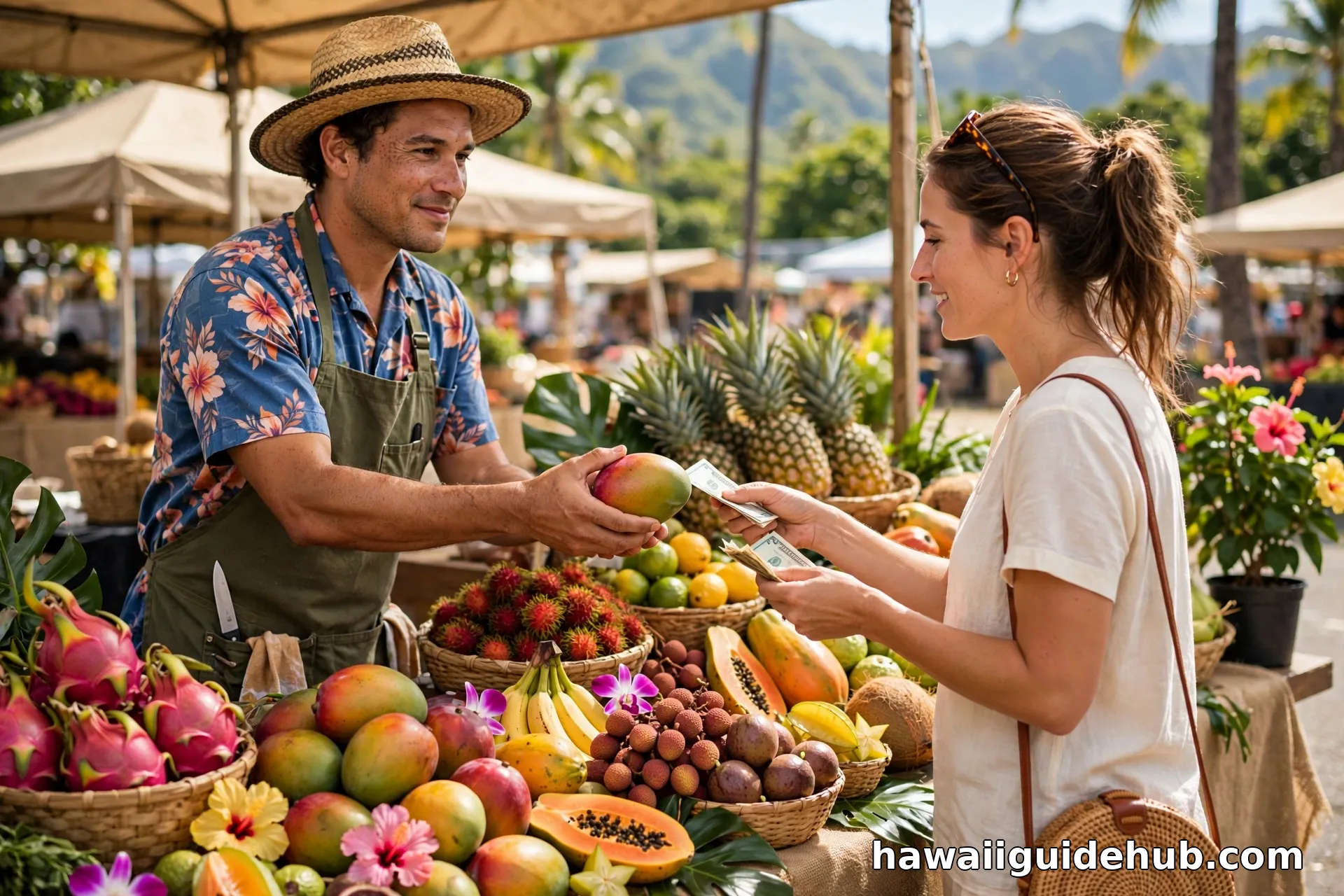
| Farmers markets, flea markets, roadside stands | Cash | Many vendors are cash-only |
| Food trucks | Cash (some take cards) | Signal is spotty; cash is faster |
| Tipping (housekeeping, musicians, valets) | Cash | Small bills are the island standard |
| ABC Stores, groceries, gas | Card | All major cards accepted |
| Parking meters, beach vendors | Cash | Coins and small bills still rule |
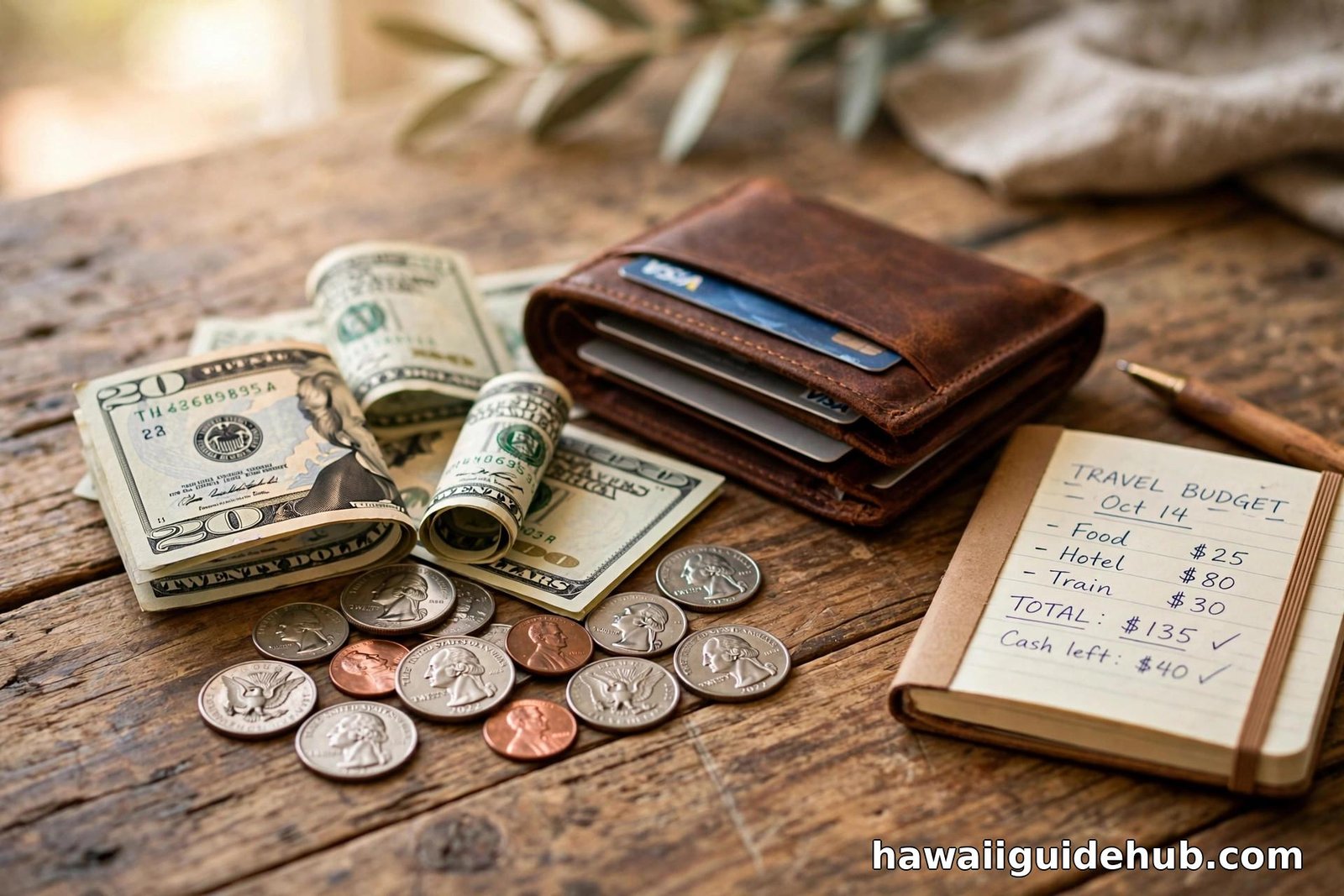
The winning formula: cards for everything big, plus $200-300 in small bills for the week. Break large bills early: small vendors appreciate ones, fives, and tens. Carry about $40-50 in cash per day out and about, and leave the rest in the hotel safe.
Tipping in Hawaii: The Complete Cheat Sheet
Hawaii follows standard U.S. tipping, and it matters more here: the cost of living is crushing and service workers depend on gratuities. Restaurants: 15-20% (20% for great service). Bars: $1-2 per drink. Housekeeping: $5-7 per night, left daily in a marked envelope. Bellhops: $2-3 per bag. Valet: $2-5 on return. Tour guides: $10-20 per person for group tours, 15-20% for private. Luau servers: $5-10 per person. Musicians at restaurants: a few dollars in the tip jar is local custom. Taxis and rideshares: 15-20%. When a restaurant adds a service charge, ask whether it goes to staff: if yes, add 5-10% more for great service; if no, tip the full 15-20% yourself.
ATMs, Banks, and Fees
ATMs are everywhere in tourist areas: banks, ABC Stores, hotels, and shopping centers. Out-of-network ATM fees run about $3.50 per withdrawal, so use your bank’s network when possible (Bank of Hawaii participates in the Allpoint network with tens of thousands of fee-free ATMs). Airport ATMs are convenient but often carry the highest surcharges: withdraw what you need for the first day or two, then use bank ATMs. Grocery stores often offer cash back with debit purchases: a fee-free way to top up. On Lānaʻi and Molokaʻi, ATMs are scarce: bring cash before you go.
For International Visitors
Exchange currency before you leave home or withdraw USD from ATMs on arrival: airport exchange kiosks offer poor rates. Notify your bank of travel to avoid card blocks. Canadian debit cards (Interac) often do not work at U.S. point-of-sale terminals: bring a credit card or use ATMs for cash. Check your card’s foreign transaction fee (often 2.5-3.5%): a no-foreign-fee card saves real money over a week. Tipping is not optional in Hawaii the way it may be at home: budget 15-20% on top of restaurant prices.
A Brief History: Hawaii Once Had Its Own Money
Here is a fun fact for the history buffs: the Kingdom of Hawaiʻi issued its own currency. Hawaiian dollars (dala) circulated in the 19th century, with coins minted bearing the images of Hawaiian monarchs: Kamehameha III through Kalākaua. After annexation, U.S. currency replaced them, and surviving Hawaiian coins are now prized collectibles worth far more than face value. So when someone asks about “Hawaii currency,” the technically complete answer is: U.S. dollars now, Hawaiian dala then. You will not spend dala anywhere today, but you might see them in museums.
Why Hawaii Feels Expensive
Hawaii imports roughly 90% of its food and goods, and everything arrives by ship or plane: that freight cost lands in every price tag. Groceries run noticeably above mainland prices, restaurant meals reflect high rents and wages, and the general excise tax adds its few percent to everything. But the “Hawaii is impossibly expensive” reputation is overstated: budget travelers eat well from food trucks, ABC Stores, and farmers markets; free beaches and hikes anchor every day; and off-season fares can be reasonable. The islands punish the unplanned, not the budget-conscious.
The Daily Budget: Three Traveler Profiles
Budget traveler: $120-200 per day per person. Hostel or budget hotel, food trucks and groceries, TheBus or limited rental car, free beaches and hikes. Mid-range: $350-450 per day per person. Three-star hotel or condo, mix of restaurants and casual meals, rental car, a paid tour or two. Luxury: $800+ per day per person. Beachfront resort (plus the resort fee: always check), fine dining, private tours, spa. These are per-person figures for two traveling together: solo travelers pay more per person, families with a condo kitchen pay less. For trip timing that stretches the budget, see the cheapest time of year to visit Hawaii.
Hidden Costs That Ambush Visitors
Resort fees: $25-50 per night at many hotels, on top of the room rate, often excluding tax. Parking: $30-60 per night at Waikīkī hotels; downtown meters otherwise. Rental car extras: insurance, toll-free but gas is pricey. Activity gratuities: budget 15-20% on top of every tour price. The GET tax: added to nearly everything, so mentally add 5% to every menu price. None of these are scams: they are just rarely in the headline price. Read the fine print before you book, and the total will not surprise you.
Video: Visiting Oahu on a Budget
Real-world proof that Hawaii money goes further with the right strategy.
Frequently Asked Questions About Hawaii Currency
What money is used in Hawaii?
The U.S. dollar. Hawaii is a U.S. state: no separate currency, no exchange needed for American visitors.
Do I need cash in Hawaii?
Some. Cards work almost everywhere, but bring $200-300 in small bills for farmers markets, food trucks, tips, and parking.
Are credit cards widely accepted in Hawaii?
Yes. Visa and Mastercard are universal; American Express is widely accepted too. Only small vendors and markets may be cash-only.
How much should I tip in Hawaii?
15-20% at restaurants, $1-2 per drink at bars, $5-7 per night for housekeeping, $10-20 per person for tour guides.
Is there sales tax in Hawaii?
Hawaii has a general excise tax (GET) rather than a sales tax: about 4.7% on Oʻahu, added at the register. It applies to most goods and services.
Can I use foreign currency in Hawaii?
No. Only U.S. dollars are accepted. Exchange before arrival or withdraw USD from ATMs.
Money-Saving Moves That Actually Work
Stay where there is a kitchen: a condo with a stove turns $60-a-day food spending into $25. Shop at Costco, Safeway, or Foodland instead of resort shops: an ABC Store water bottle costs a third of the hotel’s. Eat your big meal at lunch: many restaurants serve the same food cheaper midday. Book activities directly with operators rather than through hotel concierges when the price differs. Travel in shoulder season (April-May, September-October) for lower fares and rates. And embrace the free stuff: Hawaii’s best assets, beaches, hikes, sunsets, cost nothing. The best island for first-time visitors guide helps you pick the island that fits your budget too.
Paying for Activities: What to Know
Book tours with a credit card: you get fraud protection and a clear record if weather cancels. Most operators charge in full at booking with a 24-48 hour cancellation policy: read it. Luaus, snorkel cruises, and helicopter tours all expect gratuities on top: factor 15-20% into the real cost. State park and attraction fees (Diamond Head reservations, Hanauma Bay) are small and card-friendly. If an operator asks for cash or wire transfer only, walk away: legitimate Hawaii businesses take cards.
Medical Costs and Travel Insurance
U.S. health insurance works in Hawaii as it does in any state: but check your network, since island providers may be out-of-network for mainland plans. International visitors: get travel medical insurance before you fly. A sprained ankle on a hike can mean hundreds or thousands in bills, and medical evacuation between islands is eye-wateringly expensive. Travel insurance that covers trip cancellation is worth it in hurricane season (June-November). This is the least fun money topic and the most important one.
How much money should I bring to Hawaii for a week?
Excluding prepaid flights and hotels, mid-range travelers spend roughly $500-800 per person per week on food, transport, and activities. Carry $200-300 of that in cash; put the rest on cards.
Do ATMs in Hawaii charge fees?
Out-of-network ATMs charge about $3.50 per withdrawal. Use your bank’s network or get cash back at grocery stores to avoid fees.
The ABC Store Economy
No money guide to Hawaii is complete without the ABC Store: the ubiquitous Waikīkī chain that functions as convenience store, souvenir shop, and budget travelers’ lifeline. ABC Stores sell snacks, drinks, sunscreen, and souvenirs at sane prices, and they are everywhere in the tourist zones. The local wisdom: buy your water, breakfast pastries, and beach snacks at ABC, not at the hotel shop where the same items cost double or triple. It is the single highest-ROI money habit in Waikīkī. For the food side of the budget, Hawaii’s best late-night eats proves that great food does not require fine-dining prices.
Souvenir Budgeting: What Things Actually Cost
Set the souvenir budget before the gift shops set it for you. Typical prices: macadamia nuts $8-15 a bag, Kona coffee $20-35 a bag, a decent ukulele $60-150, Hawaiian shirts $30-80, shell leis $10-20 at markets. The airport shops charge the most; flea markets (like the Aloha Stadium Swap Meet on Oʻahu) charge the least for the same categories. Buy consumables (coffee, chocolate, nuts) and wearables you will actually use: skip the shot glasses. A $100 souvenir budget covers generous gifts for a family if you shop the markets, not the hotel lobby.
Gas, Groceries, and Sticker Shock
A few prices to calibrate expectations before you land: gas typically runs $1-1.50 above mainland averages; a gallon of milk can top $6-8 in resort areas; restaurant entrees at mid-range spots run $25-40. None of this should scare you: it is the freight talking, not gouging. The antidote is the same as everywhere: cook some meals, eat where locals eat, hit the farmers markets, and remember that the beach, which is the actual point of the whole trip, is completely free.
Emergencies: Lost Cards and Empty Wallets
If your wallet disappears in Hawaii: first, use your phone’s mobile payment (Apple Pay/Google Pay are widely accepted) to stay functional. Second, call your bank’s collect number to freeze and replace cards: replacements can be expedited to hotels. Third, Western Union and MoneyGram have locations in Honolulu and tourist areas for emergency transfers. Keep a backup card in the hotel safe, separate from your daily wallet: the two-wallet system means one loss never strands you. Photograph both sides of your cards before the trip and store the photos securely: it makes cancellation calls ten times faster.
Money in Hawaii is refreshingly simple: dollars, cards for the big stuff, small bills for the human stuff. Bring the cash, tip generously, keep a backup card in the safe, and spend the rest on shave ice and island sunsets: after all that smart money planning, you have definitely earned both.