Petroglyphs of Hawaiʻi Island: Puʻu Loa, Puakō, and Waikoloa

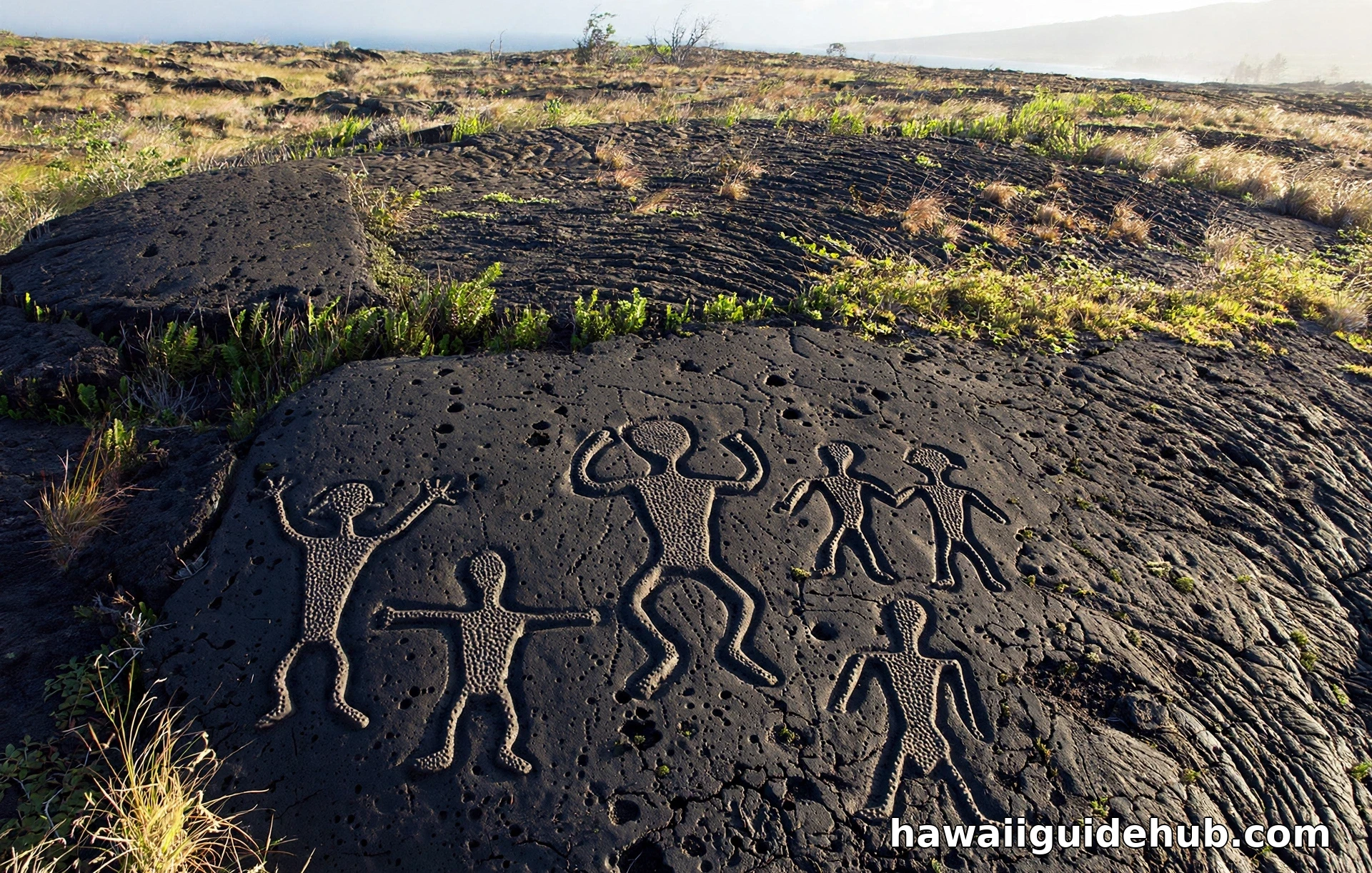
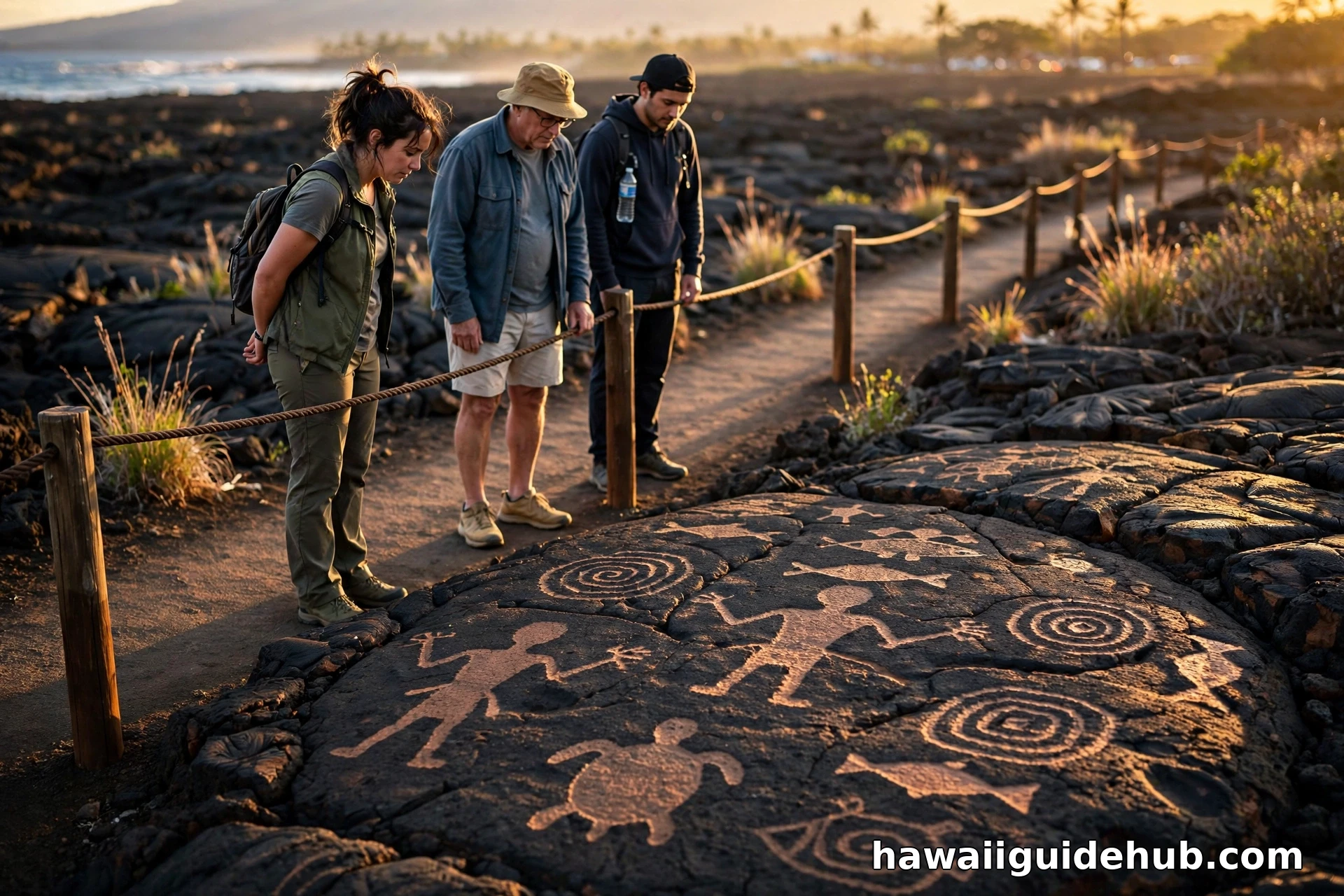
Scratched and pecked into the smooth black skin of young lava flows, the Big Island’s petroglyphs are the closest thing Hawaiʻi has to an ancient library. Hawaiians call them kiʻi pōhaku, images in stone. There was no written Hawaiian language before the 1800s, so generations left their marks the durable way: human figures and family groups, canoes and sails, turtles and dogs, circles, dots, and long lines of small holes whose meanings are still debated. Hawaiʻi Island holds the state’s great concentrations of this rock art, and three fields in particular can be visited easily and respectfully: Puʻu Loa inside Hawaiʻi Volcanoes National Park, the Puakō district on the Kohala Coast, and the Waikoloa preserve a short walk from the resort shops. This guide covers all three, what the carvings are thought to mean, when the light makes them visible, and the etiquette that keeps them intact for the next thousand years.
The Three Great Fields at a Glance
| Puʻu Loa | Hawaiʻi Volcanoes National Park, Chain of Craters Road |
| Puʻu Loa count | More than 23,000 carvings, the largest field in Hawaiʻi |
| Puʻu Loa walk | 1.4 miles round trip, about 1 to 1.5 hours, boardwalk viewing |
| Puakō district | 223 acres on the Kohala Coast, more than 3,000 carvings |
| Puakō access | Mālama Trail from the parking area near Mauna Lani and Holoholo-Kai |
| Waikoloa preserve | Marked trail by the Kings’ Shops at Waikoloa Beach Resort |
| The Hawaiian name | Kiʻi pōhaku, images in stone |
| Best light | Early morning or late afternoon, when shadows fill the carvings |
| The one rule | Look from the path or boardwalk. Never touch, step on, or rub a carving |
Puʻu Loa: The Hill of Long Life
Puʻu Loa, also written Puʻuloa, is the giant. The National Park Service counts approximately 23,000 petroglyphs on this low volcanic dome inside Hawaiʻi Volcanoes National Park, more than at any other single site in Hawaiʻi. The name translates as long hill, with an underlying meaning the Park Service gives as hill of long life, and that second reading explains the place. Most of the carvings here are not figures at all. They are poho, small cup like depressions pecked into the lava, and tradition holds that families brought the piko, the umbilical cord remnant of a newborn, to Puʻu Loa and placed it in a carved cup, covering it in hope of a long and prosperous life for the child. The NPS says the site was used ritually for over 500 years. Around the fields of cups you will also find the picture gallery: geometric designs, human figures, canoe sails, and feathered cape motifs.
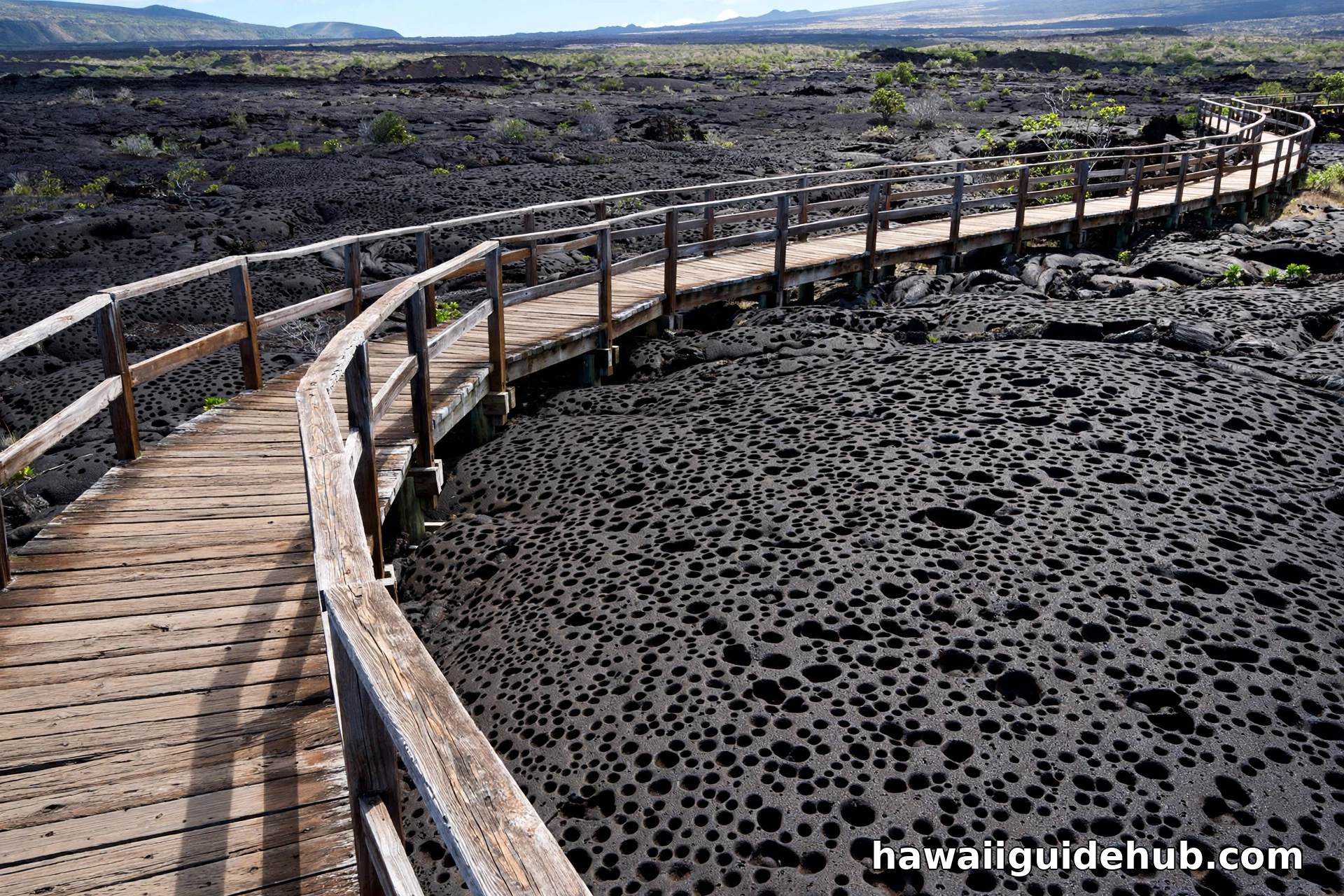
The visit is straightforward and exposed. The trail leaves from a marked parking area on Chain of Craters Road, near mile marker 16.5, and crosses a lava field that the NPS dates to roughly 500 to 550 years old, formed in the eruption of Kāne Nui o Hamo. The walk is 1.4 miles round trip and takes most people one to one and a half hours, ending at the boardwalk that loops over the densest carvings. There is no shade and no water, the lava radiates heat by midday, and the Park Service is blunt about the core rule: the petroglyphs are fragile, you must stay on the boardwalk, and walking on the lava surface fragments and destroys them. Park entrance fees apply to reach the trailhead. Go early or late, both for the cooler air and because raking light makes the carvings stand out, which is the same advice the island’s other fields reward.
Puakō: The Great Kohala Coast Field
On the opposite side of the island, the Puakō Petroglyph Archaeological District spreads across 223 acres of pāhoehoe near the shore of the Kohala Coast, and it is listed on the National Register of Historic Places. Sources describe more than 3,000 carvings here, the largest concentration in the Pacific by some accounts, with the visitor section alone holding around 1,200. The historic marker at the site notes that many were likely made between about AD 1000 and 1800. The imagery leans toward life in motion: family groups and processions of figures, canoe paddlers, sails, dancers, turtles, and dogs, carved along what was once a well traveled coastal corridor. Where Puʻu Loa feels like a ceremonial archive, Puakō feels like a community’s wall of record, centuries of travelers and families leaving a mark where the trail met the sea.
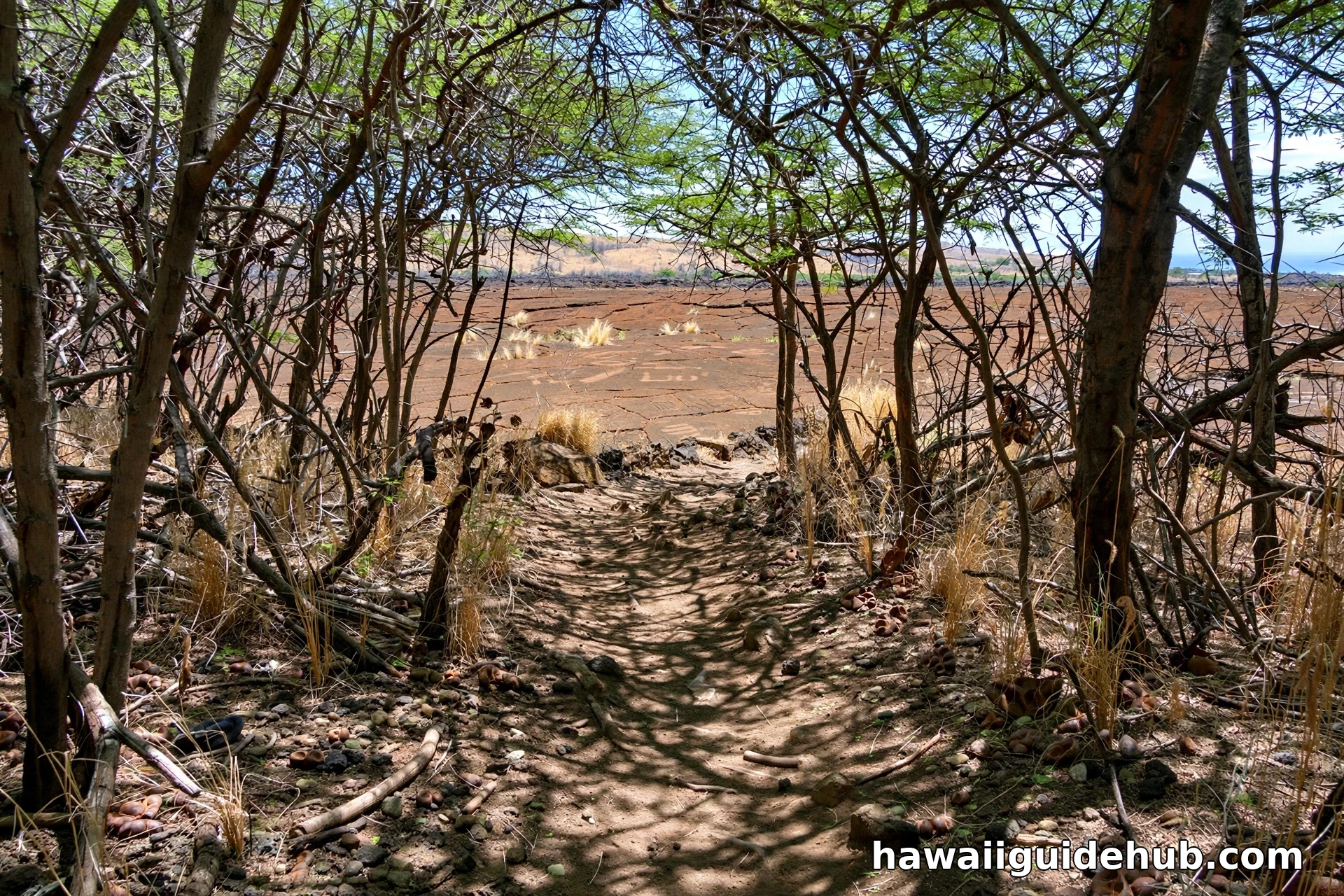
Reach it by driving north from the Mauna Lani resort area on North Kaniku Drive to the parking lot at the end, near Holoholo-Kai Beach Park, and taking the Mālama Trail into the field. The path runs through kiawe forest, and kiawe thorns are genuinely sharp, so closed shoes are not optional equipment here, they are the price of admission. Budget the better part of an hour for the walk in, the viewing area, and the return, more if the light is good. A replica set of carvings near the start of the trail lets families practice spotting shapes before the real field, which rewards slow looking: the carvings are shallow, and in flat midday light many simply vanish until you change your angle.
Waikoloa: The Accessible Preserve
The third field is the easiest of all. The Waikoloa Petroglyph Preserve sits beside the Kings’ Shops at Waikoloa Beach Resort, along the line of an old trail at the boundary country between the Kona and Kohala districts, and a short marked path loops through carvings that accumulated over a long span of time. Human figures, animals, and geometric marks fill the smooth lava, and the field’s later layers tell the contact story directly: among the traditional images you can find a figure on horseback and other marks from after Western contact, including lettering. It is the best first petroglyph stop on the island, flat, quick, and shaded in parts, and it pairs naturally with the rest of a Waikoloa day from our guide to things to do in Waikoloa. Interpretive signs along the path explain the main figure types, and guided walks have traditionally been offered from the shops area, though schedules change, so check locally when you arrive.
How the Carvings Were Made
Making a kiʻi pōhaku was slow, deliberate work. The carver chose a smooth pāhoehoe surface, the ropy, billowy kind of lava that sets with a natural skin, and pecked or incised the design through that skin using a harder stone tool, sometimes working with a second stone as a hammer. Pecking produced the dotted, stippled texture you can still see inside many figures at Puakō and Waikoloa, where the image is built from hundreds of individual strikes. Other carvings were ground or incised in cleaner lines. The contrast that makes a petroglyph visible comes from the broken skin exposing lighter, fresher rock beneath the dark weathered surface, and over centuries the exposed lines slowly darken again, which is one reason the age of neighboring carvings can sometimes be guessed from how dark they have become. Nothing about the process was casual. A family group of figures, each one pecked strike by strike into stone that blunts tools, represents hours of labor, and the piko cups at Puʻu Loa each represent a journey: the field sits far from the coastal villages, across young, sharp lava that punishes sandals and bare feet alike. People did not end up at these places by accident. They came on purpose, for reasons that mattered, and the effort itself is part of the record the fields preserve.
It also explains the geography. The great fields gather where smooth pāhoehoe met human traffic: along the coastal trail corridors of the Kohala and Kona coasts, where the Ala Kahakai, the island’s ancient shoreline trail system, carried travelers between communities, and at Puʻu Loa, where a distinctive dome of smooth lava rose beside the coastal route through what is now the national park. Stone suitable for carving, a path people already walked, and a reason to stop: where those three met, the rock filled with images.
What the Carvings Mean, and What We Honestly Do Not Know
Visitors always ask for translations, and the honest answer has two parts. Some meanings are documented tradition: the piko cups at Puʻu Loa, with their link to long life, are the clearest example, and researchers read many human figures as family records, with rings and groupings possibly marking births, journeys, and genealogy. Other recurring readings are plausible but unproven: petroglyph fields often sit along travel routes, so some carvings likely marked journeys and resting places; animal and canoe images likely recorded the life and status of their makers; and some geometric forms have been interpreted as ceremonial or astronomical. What no responsible guide will do is hand you a certain translation for a specific figure, because the carvers left no key, and early outside observers who dismissed the sites as picture writing experiments missed how much genealogy and custom the NPS now recognizes embedded in them. The mystery is not a failure of the sites. It is their nature, and it is part of why standing quietly in front of a 600 year old family group feels different from reading a plaque.
Etiquette: How These Fields Survive
Every rule at these sites protects a surface thinner than you expect. A petroglyph is a shallow break in the lava’s natural skin; feet, hands, and chalk all wear it away, and paper rubbings, once a popular souvenir technique, pull and abrade the surface and are prohibited in spirit everywhere and by rule in the national park context. So: stay on trails and boardwalks, never step onto a carved panel even for a photograph, never touch a carving, never make a rubbing or pour anything into the grooves, and never stack or move rocks. The Park Service adds a related point about ahu, the stacked rock markers: park staff build some for trail marking, and visitor built stacks are culturally offensive, misleading, and potentially illegal inside the park. Photograph freely from the path. A zoom lens or phone zoom from the boardwalk gives you close views with zero contact, and the low light of early morning or late afternoon will do more for your pictures than any step closer ever could. These are living cultural sites for Native Hawaiians, not ruins of a vanished people, and the descendants of the carvers still visit them. Behave the way you would in a family cemetery that happens to be made of lava, because in the case of the piko fields, that is close to the truth.
Video: Walking the Puʻu Loa Trail
A walk along the Puʻuloa trail in Hawaiʻi Volcanoes National Park, from the Chain of Craters Road pullout to the boardwalk over the carvings.
Frequently Asked Questions
Where are the best petroglyphs on the Big Island?
Puʻu Loa in Hawaiʻi Volcanoes National Park is the largest field, with about 23,000 carvings and boardwalk viewing. Puakō, on the Kohala Coast, holds more than 3,000 carvings in a 223 acre archaeological district. The Waikoloa preserve is the easiest to reach, a short marked trail by the Kings’ Shops.
What does Puʻu Loa mean?
Puʻu Loa means long hill, with an underlying meaning of hill of long life. Families placed a newborn’s piko, or umbilical cord remnant, into its carved cups in hopes of a long life for the child, a practice the National Park Service documents at the site.
Can you touch the petroglyphs?
No. The carvings are shallow and fragile, and touching, stepping on, or rubbing them damages them permanently. View and photograph from the boardwalks and marked paths only, and never make rubbings or stack rocks at these sites.
When is the best time to see petroglyphs?
Early morning and late afternoon, when low sunlight rakes across the lava and shadows make the shallow carvings visible. In flat midday light many carvings nearly disappear, and the exposed fields are also at their hottest then.
How long does the Puʻu Loa hike take?
The National Park Service lists it at 1.4 miles round trip and about one to one and a half hours, rated moderate because of the uneven lava and heat rather than distance. Bring water, a hat, and sunscreen; there is no shade on the trail.
A petroglyph field asks something unusual of a traveler: slow down, look closely, and leave no trace of having been there at all. In return it offers the rarest sight on the island, the handwriting of people who walked these same lava plains centuries before there was an alphabet here to write with. Visit Puʻu Loa for the scale, Puakō for the stories, and Waikoloa for the easy first look, and let the low sun do the reading aloud. For the wider cultural landscape around them, our guide to things to do in Kona is a good companion on the drive between fields.