Hawaiian Voyaging Canoes: The Ships That Settled the Pacific

The ships that settled the Pacific were not ships at all, by European definition: no nails, no screws, no glue, just hulls lashed with miles of cordage, sails woven from pandanus, and a design refined over millennia. The Hawaiian waa kaulua, the double-hulled voyaging canoe, carried families, crops, and animals across thousands of miles of open ocean. This guide explains how the canoes were built, the types, Hokulea’s story, and the modern fleet.
This is the single complete guide to Hawaiian voyaging canoes. It covers what a waa kaulua is, canoe types, traditional construction, the parts of the canoe, Hokulea’s building and voyages, Eddie Aikau, the modern fleet, and FAQs. Everything about Hawaiian voyaging canoes lives on this one page.
What a Waa Kaulua Is
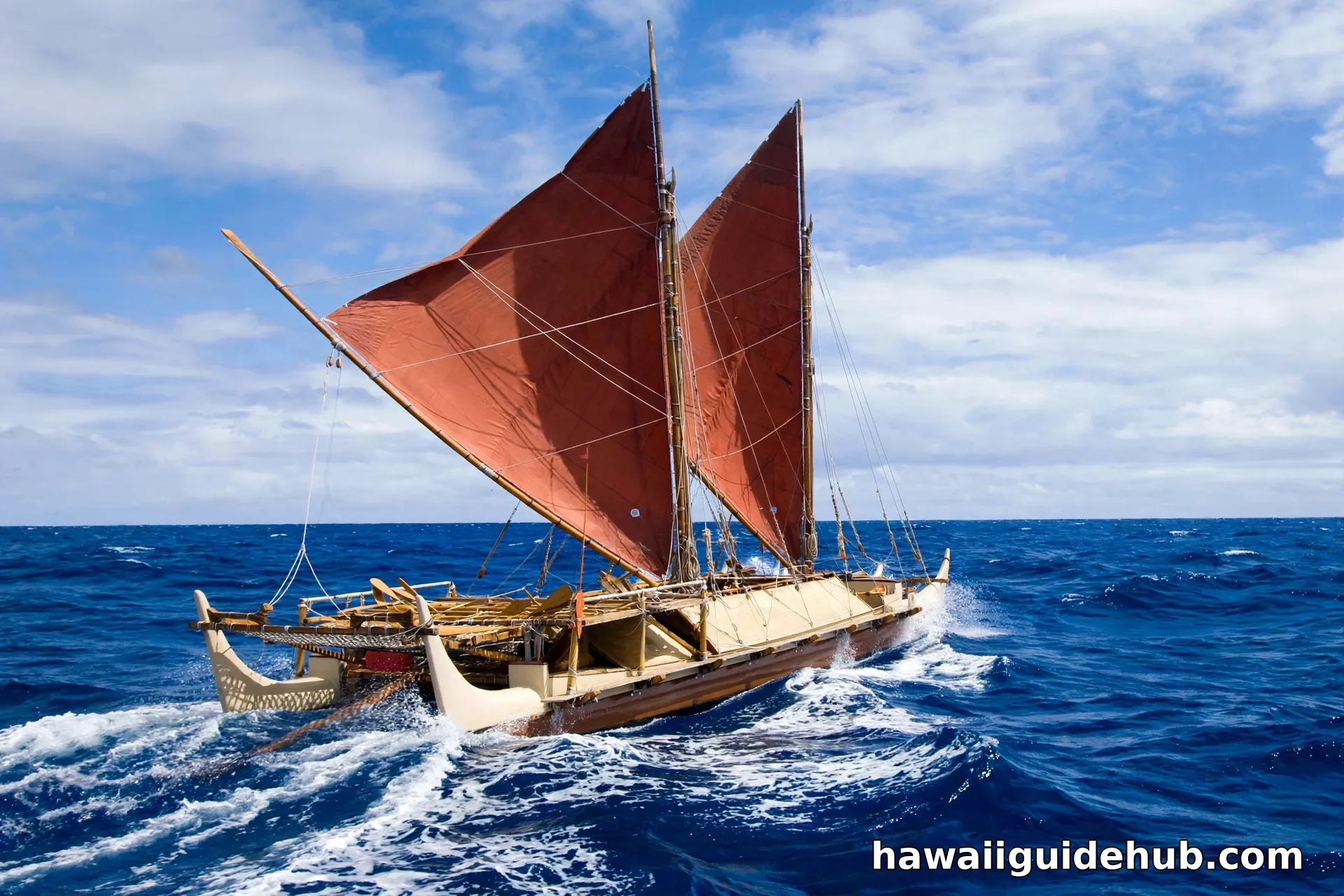
A waa kaulua is a double-hulled voyaging canoe: two long hulls joined by crossbeams (iako), with a platform and shelters between, driven by crab-claw sails. The twin hulls give stability without ballast and a broad deck for cargo: families, water, and the canoe plants and animals of a colonization expedition. Some reached 100 feet in the old accounts. The design is the product of thousands of years of Pacific refinement: fast enough to outrun storms, seaworthy enough to cross oceans, and beachable on islands with no harbors. It was, quite simply, the finest ocean-going vessel of the ancient world.
Canoe Types: From Lagoon to Open Ocean
| Type | Hawaiian name | Hulls | Use |
| Voyaging canoe | Waa kaulua | Double | Open-ocean settlement voyages |
| Sailing canoe | Waa kaukahi | Single + outrigger | Inter-island travel, fishing |
| Fishing canoe | Waa lawaiia | Single + outrigger | Nearshore fishing |
| Surf canoe | Waa nalu | Single, small | Wave riding, racing |
| War canoe | Waa kaua | Double, large | Warfare, chiefly transport |
Building the Traditional Way
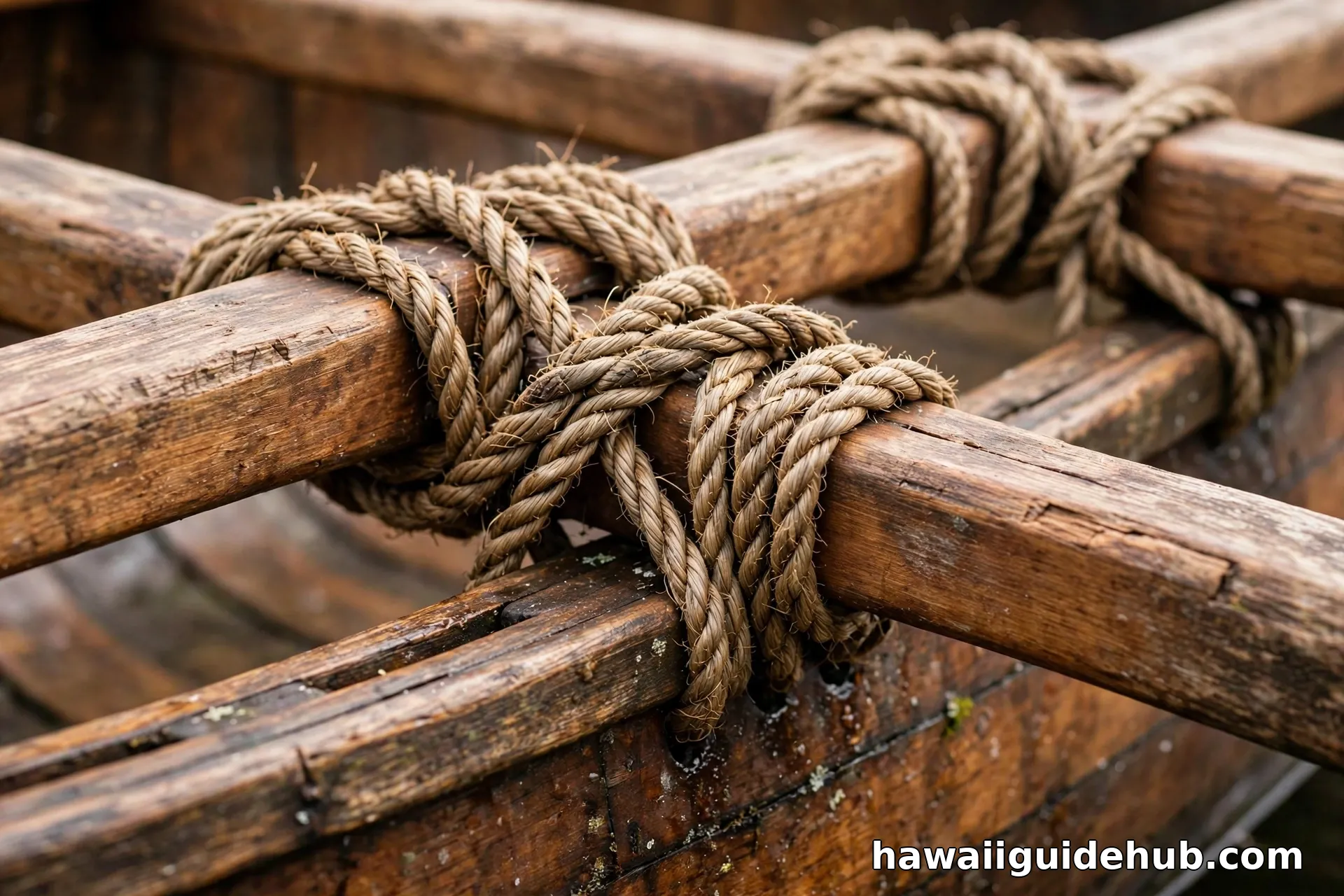
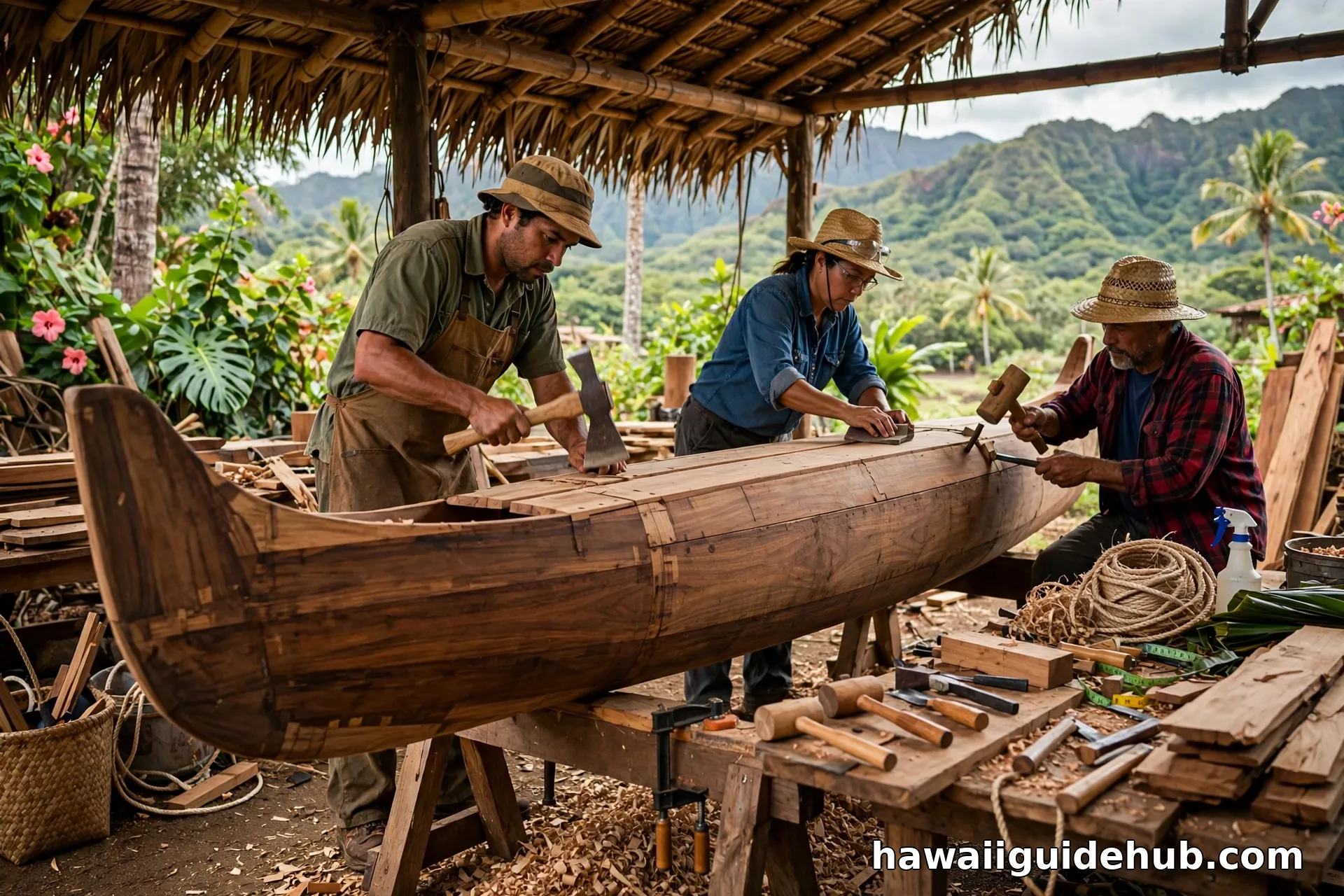
Traditional hulls were hewn from koa logs, the great hardwood of the upland forests: a single log could become a hull, or planks could be sewn edge to edge. Everything was lashed: the iako crossbeams to the hulls, the platform to the beams, the masts stepped in sockets, all with aha, cordage braided from coconut fiber. Miles of it: Hokulea uses about six miles of lashings. The crab-claw sails were woven pandanus. No metal, no nails: the structure flexes with the sea instead of fighting it, and every joint can be inspected, tightened, or replaced. A voyaging canoe was maintainable at sea with the materials aboard: the ultimate repairable machine.
The Parts of the Canoe
Learn the anatomy: the wa’a (hull), doubled in the kaulua; the iako (crossbeams) joining them; the pola (platform) between; the kia (masts) carrying the pe’a (sails); the hoe uli (steering paddle), worked by two or more crew in heavy weather. The manu, the curved end pieces, rise like horns fore and aft. Each part has its protocols: the canoe is launched with ceremony, the parts named and blessed, the vessel treated as a living being. The 1975 launch of Hokulea at Kualoa revived blessings unseen for centuries: the canoe’s rebirth was spiritual as well as technical.
Hokulea: Star of Gladness
Hokulea was born as a challenge. In the 1970s, Hawaiian artist and historian Herb Kawainui Kane set out to disprove the “accidental drift” theory by building a performance-accurate waa kaulua and sailing it to Tahiti traditionally. Designed by Kane and built by the Polynesian Voyaging Society between 1973 and 1975, launched March 8, 1975, at Hakipuu-Kualoa: 62 feet long, 20 feet wide, named for Arcturus, Hawaii’s zenith star. She has since sailed over 140,000 nautical miles, including the 2014-2017 Malama Honua circumnavigation. Modern materials (plywood, fiberglass, synthetic lashings) keep her safe; the design, handling, and navigation are the ancestors’ own.
Eddie Aikau: The Loss
In March 1978, on the second Tahiti voyage attempt, Hokulea capsized off Molokai in heavy seas. Crew member Eddie Aikau, the legendary Waimea Bay lifeguard and big-wave surfer, paddled off on his surfboard to seek help for the crew. The crew was rescued; Aikau was never seen again. His sacrifice is central to the voyaging story: “Eddie would go,” the saying runs, meaning no task is too great, no risk too much for others. Every voyage since has sailed in his honor, and his memory shapes the culture of the canoes: courage in service of the crew.
The Modern Fleet
Hokulea is the flagship, but she is not alone. Hikianalia, her sister canoe, sails as a floating classroom with modern safety systems. Makalii, built on the Big Island, trains new navigators. Alingano Maisu, gifted by the Polynesian Voyaging Society to the Micronesian master Mau Piailug’s people, sails in Satawal. Across the Pacific, the voyaging revival has launched dozens of canoes: Hawaii’s fleet is the best known, but the movement is pan-Pacific. Each canoe is a school: navigation, culture, seamanship, and stewardship taught on the water.
Life Aboard
Voyaging life is spare: crew sleep on six-foot wooden planks in the hulls, sheltered by canvas; meals are cooked on a small camp stove; watches rotate through day and night; the steering paddle takes two or more in a blow. There is no engine: the canoe is towed in and out of harbor. A dozen or so volunteer crew rotate monthly; some 360 sailors joined the worldwide voyage. It is hard, wet, and sublime: navigators describe the moment the stars come out on a clear night, the canoe humming along, as the reason for everything. The canoe is a monastery with sails. Food is simple and shared, water is rationed with care, and every crew member has duties that keep the vessel moving and the people fed. Disagreements are settled quickly: the ocean does not tolerate division. Ask any voyager what they remember most, and it is rarely the landfalls: it is the nights, the stars wheeling overhead, the bioluminescence in the wake, the sense of the canoe as a small warm world in a vast dark sea, carrying everything that matters, and everyone who matters, together.
The Crab-Claw Sail: Aerodynamics of Pandanus
The crab-claw sail looks exotic, but it is aerodynamically superb: a tall, narrow triangle that generates lift efficiently on a reach, the point of sail voyaging canoes use most. Woven from pandanus leaves, the sails were light, repairable, and replaceable: a torn sail could be rewoven from materials aboard. Modern Hokulea uses synthetic sailcloth in the traditional shape, dyed the iconic red-brown. The rig is simple: two masts, two sails, sheets and guys of cordage. Simplicity is the point: every part must be repairable at sea, thousands of miles from land, by a crew with hand tools and spare cordage.
The Canoe as Sacred Space
A voyaging canoe is not just a vessel but a sacred space, governed by protocol. The building, launching, and voyaging are wrapped in ceremony: blessings, chants, offerings, and kapu. Certain behaviors are expected aboard: respect for the vessel, for the crew, for the ocean. The 1975 launch at Kualoa revived rites unseen for centuries, and every major voyage begins with ceremony. This is not decoration: the protocols bind the crew, focus the mind, and acknowledge that the ocean is a power to be respected. A canoe that is sacred is a canoe that is cared for.
Refit and Maintenance: The Canoe Never Rests
A wooden canoe in the tropics is always decaying and always being rebuilt: Hokulea has been taken apart down to the hulls and rebuilt with new lumber, foam cores, and modern materials where safety demands. The lashings are inspected and replaced; the rigging renewed; the hulls refaired. Maintenance is done by crew and volunteers, often in public, as education: the refit is as much a teaching event as the voyage. A voyaging canoe is not a static artifact but a living machine, renewed plank by plank, lashing by lashing, generation by generation.
Voyaging and Cultural Renaissance
Hokulea’s 1975 launch is dated as the spark of the Hawaiian cultural renaissance: along with the voyaging revival came the renewal of language, hula, chant, and traditional arts. The canoe proved that the ancestors’ knowledge was real and sophisticated, and that proof rebuilt cultural confidence. The renaissance was not nostalgia but reclamation: Hawaiians taking back the narrative of who they were, demonstrated on the open ocean where no one could argue. The canoe sailed, and a culture stood taller.
The Pacific Fleet: Beyond Hawaii
Hawaii’s revival inspired a pan-Pacific movement. Aotearoa (New Zealand), Tahiti, the Cook Islands, Samoa, and others have built voyaging canoes and trained navigators; the canoes gather for festivals and joint voyages, a Pacific fleet connected by shared heritage. Knowledge flows both ways: Hawaiian navigators learned from Mau Piailug of Satawal, and now teach across the Pacific. The ocean that colonial maps drew as empty is being reclaimed as a connected world: Moananuiakea, the wide ocean, as the ancestors knew it.
Sailing Performance: How Fast, How Far
The canoes are fast: Hokulea routinely makes 100-plus nautical miles a day on a good reach, and the design’s speed was essential to the settlement voyages, minimizing time at sea and exposure to storms. Range was effectively unlimited: with water, preserved food, and fishing gear, a well-provisioned canoe could sail for weeks. The Hawaii-Tahiti run, 2,400 miles, takes about a month. The worldwide voyage covered 47,000 miles over three years. These are not coastal hoppers but true ocean ships: the Pacific’s settlement required nothing less, and the canoes delivered.
The Next Generation: Youth Voyaging
The revival’s most important cargo is young people. Educational programs bring students aboard for day sails and dockside learning; youth crews train for inter-island voyages; navigator apprenticeships pass the star compass to a new generation. The goal is explicit: the knowledge must live in practitioners, not books. Every young navigator trained is a guarantee that the revival outlives its founders. The canoes were built to carry the future: first crops and families across the Pacific, now students across the threshold of mastery.
Watch: Hokulea, Star of Gladness
Hawaiian Voyaging Canoes FAQs
What is a waa kaulua?
A double-hulled voyaging canoe: two hulls joined by crossbeams, with a platform between and crab-claw sails. The ocean-going vessel that settled the Pacific, built traditionally with no nails, screws, or glue.
How big is Hokulea?
62 feet long, 20 feet wide, weighing nearly 13 tons fully loaded. She has sailed over 140,000 nautical miles since her 1975 launch.
How were the canoes built without nails?
Every joint lashed with aha (coconut-fiber cordage): about six miles of it on Hokulea. The lashed structure flexes with the sea and can be repaired with materials aboard.
Who was Eddie Aikau?
The legendary lifeguard and surfer lost at sea in 1978 after paddling from the capsized Hokulea to seek help. “Eddie would go” is the voyaging community’s motto of selfless courage.
Can I see the voyaging canoes?
Hokulea is based in Honolulu and appears at public events through the Polynesian Voyaging Society. Dockside programs and occasional day sails let visitors experience the canoes firsthand.
Ships of Memory
The waa kaulua is more than a vessel: it is the argument, made in wood and cordage, that the ancestors were deliberate, brilliant navigators. Every mile Hokulea sails is a mile of proof; every student trained is a rebuttal to the drift theorists. The canoes are still being built, still being lashed, still launching with blessings at Kualoa. Go see one. Stand on the dock and look at six miles of lashings holding 62 feet of canoe together, and understand: this is what the settlement of the Pacific looked like. Then watch her sail, if you get the chance: the crab-claw sails drawing, the hulls humming, the crew working the sheets in practiced silence. A voyaging canoe under way is the most beautiful argument ever made, that human ingenuity given wood, fiber, and stars needs nothing else to cross an ocean. For more Hawaiian heritage, see our volcanoes guide and Kauai guide.